
Givan A.L. Flow Cytometry. First Principles
Подождите немного. Документ загружается.

grams (as a rule of thumb, <3% is good; >8% is not good). A wide
CV might result from old and partially degraded material, from
erratic ¯ow due to a partially clogged ¯ow ori®ce, from a ¯uctuating
laser beam, from a sample that has been run too quickly (remember
that widening of the core diameter within the sheath stream may lead
to unequal illumination as particles stray from the center of the laser
beam), from nuclei that have been unequally exposed to stain, or,
®nally, from abnormal cells with a DNA content quite close to that of
the normal material. The sensitivity of the technique for detecting
these near diploid abnormalities and thus for classifying tissue as
euploid or aneuploid therefore depends on the cytometrist's ability to
obtain narrow CVs in the normal controls.
Another problem concerning interpretation arises from the incon-
venient fact that aneuploid tumors often have DNA content that is
very close to double the amount found in normal cells. This amount
is referred to as 4C or tetraploid. If we stop and think, we can im-
mediately see why this might lead to problems in ¯ow analysis (see
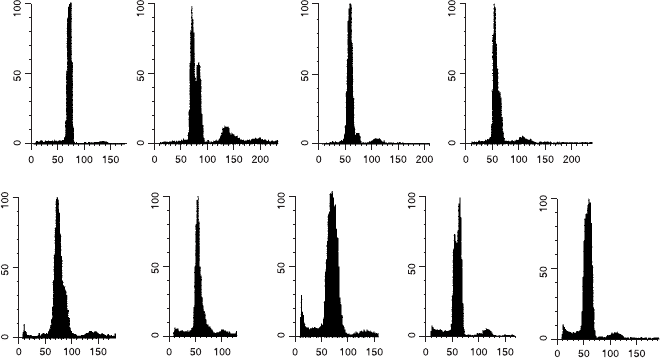
the small 4C peaks in Fig. 8.2). First of all, perfectly normal cells
Fig. 8.2. Compared with the narrow peak in the normal histogram at the upper left,
it can be seen that a single peak with a wide coe½cient of variation (CV) or skewed
pro®le may mask a near-diploid malignant cell line. In addition, an extra small peak
at the 4C position may result from clumping of nuclei, cycling cells, or a true tetra-
ploid abnormality. Data courtesy of Colm Hennessy.
Flow Cytometry130
with the 4C amount of DNA appear at certain phases in the cell cycle
( just before cell division); therefore, if normal dividing cells are pres-
ent, a signi®cant number of particles may have double the 2C amount
of DNA and will therefore appear in a peak at the tetraploid posi-
tion. Second, remember that the ¯ow cytometer is poor in its ability
to distinguish large particles from clumped particles. It is not sur-
prising, then, that the cytometer is, in the same way, inadequate at
distinguishing a nucleus with double the normal amount of DNA
from two normal nuclei clumped together. Scientists and clinicians
usually resort to adopting some threshold value for classi®cation
purposes. For example, a sample with a 4C peak may be considered
aneuploid only if the tetraploid peak contains more than 10% of the
total number of nuclei counted; otherwise it will be considered nor-
mal on the assumption that about 10% of normal cells may appear in
the tetraploid position owing to clumping and/or mitosis.
CELL CYCLE ANALYSIS
As mentioned above, normal cells will have more DNA than the 2C
amount appropriate to their species at times when they are preparing
for cell division. The cell cycle has been divided into phases (Fig. 8.3).
Cells designated as being in the G0 phase are not cycling at all; cells
in G1 are either just recovering from division or preparing for the
initiation of another cycle; cells are said to be in S phase when they
are actually in the process of synthesizing new DNA; cells in the
G2 phase are those that have ®nished DNA synthesis and therefore
possess double the normal amount of DNA; and cells in M phase are
in mitosis, undergoing the chromosome condensation and organiza-
tion that occur immediately before cytokinesis (resulting in the pro-
duction of two daughter cells, each with the 2C amount of DNA). A
DNA ¯ow histogram provides a snapshot of the proportion of dif-
ferent kinds of nuclei present at a particular moment. If we look at
the DNA content of cells that are cycling (not resting), we will ®nd
some nuclei with the 2C amount of DNA (either G0 or G1 cells),
some nuclei with the 4C amount of DNA (G2 or M cells), and some
nuclei with di¨erent amounts of DNA that span the range between
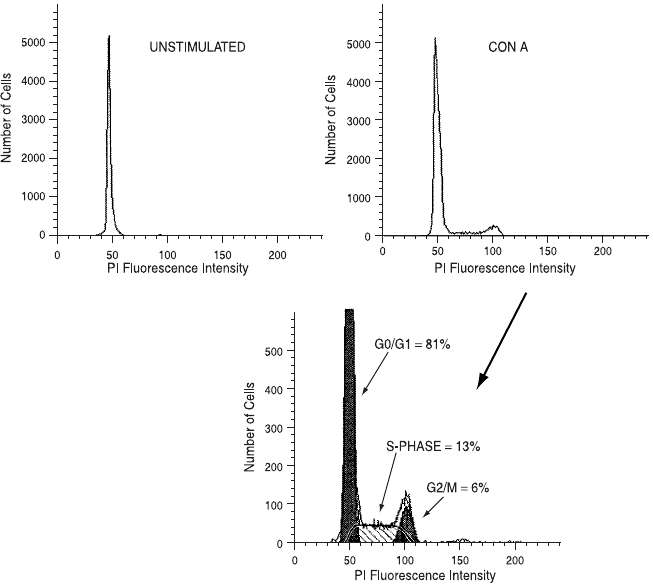
these 2C and 4C populations (Fig. 8.4). A theoretical histogram dis-
tribution would look like Figure 8.5. Figure 8.6 shows an example of
DNA in Life and Death 131
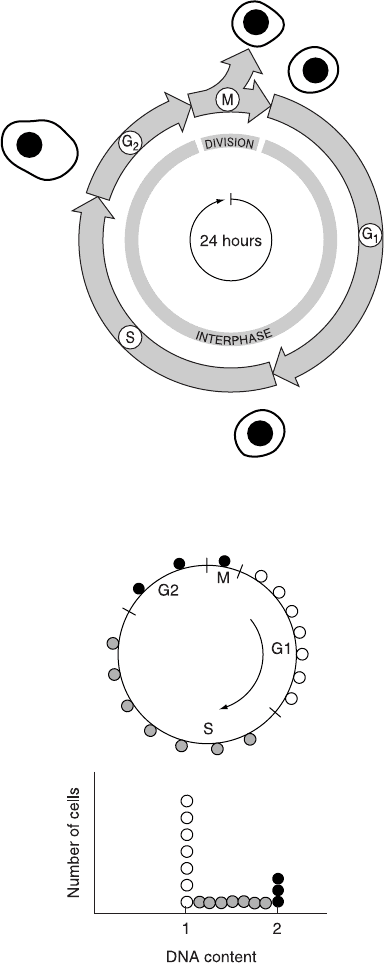
Fig. 8.3. The four successive phases of a typical mammalian cell cycle. From Alberts
et al. (1989).
Fig. 8.4. Schematic illustration of the generation of a DNA distribution from a
cycling population of cells. From Gray et al. (1990).
Flow Cytometry132
DNA ¯ow histograms that result from the propidium iodide staining
of cells taken from a culture before and after they have been stimu-
lated to divide.
The traditional method for analyzing cell division involves mea-
suring the amount of DNA being synthesized in a culture by counting
the radioactivity incorporated into DNA when the dividing cells
are given a 6 h pulse with tritiated thymidine. The DNA histogram
resulting from ¯ow cytometric analysis o¨ers an alternative to this
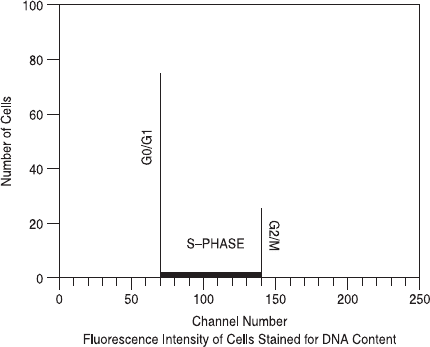
technique. By dividing the histogram up with four markers, we can
delineate nuclei with the 2C amount of DNA, those with the 4C
amount of DNA, and those with amounts of DNA between the two
delineated regions and therefore caught in the process of synthesizing
DNA. The nuclei making DNA and showing up between the two
peak regions should in some way correlate with the values obtained
for DNA synthesis based on the uptake of tritiated thymidine. The
values are not directly convertible one to the other: The radioactive
method re¯ects the total amount of DNA being synthesized and will
give higher values when more cells are present, whereas the ¯ow
method measures the proportion of cells that are in the process of
making DNA and will not be a¨ected by increases in the total
number of cells. In addition, the radioactive method will give higher
values if there is a signi®cant amount of DNA repair going on,
Fig. 8.5. The theoretical histogram generated from the sampling of a population of
cycling cells.
DNA in Life and Death 133
whereas the ¯ow method will give higher values if a proportion of
cells are blocked in S phase. However, with these provisos, ¯ow
cytometry does o¨er a rapid and painless (nonradioactive) method
for looking at cell proliferation.
Having agreed on the general principle that ¯ow cytometry in
conjunction with propidium iodide staining is an appropriate tech-
nology for analyzing cell proliferation, we have now to face the
problem that the actual histogram has a certain width to the G0/G1
and to the G2/M peaks and does not look like our theoretical distri-
bution; we have to decide where to place those four markers men-
tioned above so as to delineate correctly the three regions (2C, 4C,
and S phase). In a scenario that may by now be familiar, what
seemed like a straightforward question turns out to have a less than
Fig. 8.6. DNA histograms from lymphocytes stimulated to divide.
Flow Cytometry134
straightforward answer. Because the 2C and 4C peaks in a ¯ow his-
togram have ®nite widths (remember the discussion about CV in the
section on ploidy), it turns out to be rather di½cult to decide where
the 2C (or G0/G1) peak ends and nuclei in S phase begin. Similarly,
it is di½cult to know exactly where the distribution from nuclei in S
phase ends and the spread from nuclei in G2 or M (4C amount of
DNA) begins. In fact, there is no unambiguously correct point to
place markers separating these three regions: The regions overlap at
their extremes as a result of the inevitable nonuniformity of staining
and illumination. The question therefore becomes not where to place
the markers delineating the three cell cycle regions, but how many of
the nuclei lurking under the normal spread of the 2C and 4C regions
of the histogram are actually in S phase. Enter the mathematicians.
Algorithms based on sets of assumptions about the kinetics of cell
division and the resulting shape of cell cycle histograms can be used
to derive formulae for separating the contribution to the ¯uorescence
distribution from our three separate cell cycle components. The algo-
rithms range from the simple to the complex. They all seem to work
reasonably well (that is, they all give similar and intuitively appro-
priate answers) when cell populations are well behaved. However,
they all re¯ect the intrinsic limitations of using simplistic mathemati-
cal models for complex biological systems when cell populations grow
too rapidly, are blocked in the cycle, or are otherwise perturbed.
Bearing these limitations in mind, we can now look at four of the
models used.
Figure 8.7 shows a DNA histogram derived from the propidium
iodide staining of cells from a dividing culture. The simplest method
for analyzing this histogram is the so-called peak re¯ect method
whereby the shape of the G0/G1 peak is assumed to be symmetrically
distributed around the mode. Given this assumption, the width of the
peak, from the mode to the left (low ¯uorescence) edge is simply
copied to the right (high ¯uorescence) edge; the same thing is done in
reverse with the G2/M peak. Then everything in the middle between
these two delineated regions is considered to be the result of S-phase
cells.
A slightly more complex method for estimating the proportion
of S-phase cells is called the rectangular approximation method. This
method assumes that cells progress regularly through S phase and
therefore that the proportion of cells at any given stage of DNA
DNA in Life and Death 135
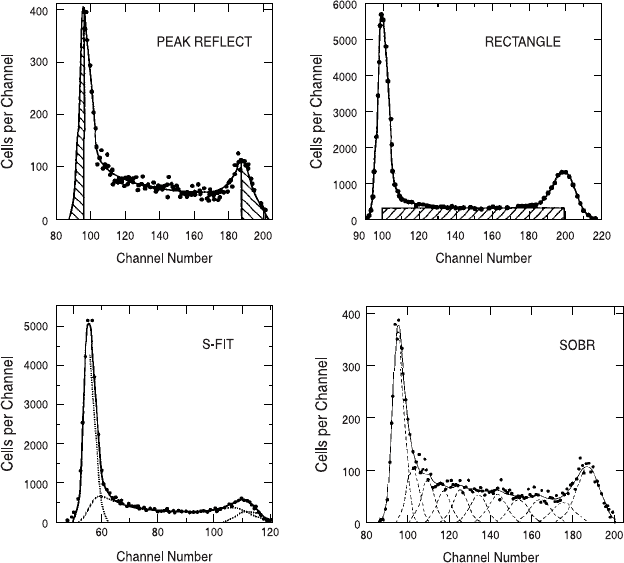
synthesis is constant. When this method is used, the average number
of cells in the middle region of the DNA histogram is evaluated,
and the height of this region is then extrapolated in both directions,
toward the 2C peak and toward the 4C peak. The rectangle derived
from this evaluation is then ascribed to S-phase cells, and all the
other cells are considered either G0/G1 or G2/M depending on
whether they have higher or lower ¯uorescence than the middle point
of the distribution.
The so-called S-FIT method and the sum-of-broadened-rectangles
(SOBR) method both use more sophisticated mathematical assump-
tions to model the shape of the S-phase region of the histogram. A
polynomial equation (S-FIT) or a series of broadened Gaussian dis-
Fig. 8.7. Di¨erent mathematical algorithms for determining the contribution of
S-phase nuclei to a DNA ¯ow histogram. Upper left and lower right from Dean
(1987); upper right and lower left from Dean (1985).
Flow Cytometry136
tributions (SOBR) is derived that best ®ts the S-phase region of the
histogram; then this derived shape is extrapolated toward the 2C and
4C peaks to estimate the contribution of S-phase cells within these
regions.
One of the essential problems in assigning cells in a ¯ow histogram
to certain stages of the cell cycle is that an aggregate or clump of two
G0/G1 cells will have double the normal DNA content (remember
our discussion of the problem in diagnosing tetraploid tumors) and
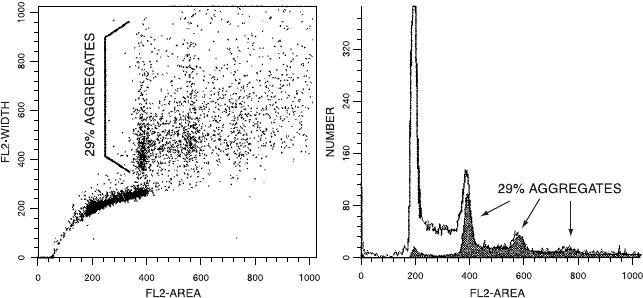
will appear as if they are a single G2/M cell. One way of diagnosing a
clumped sample is by looking for peaks at the 6C position (resulting
from three nuclei together). If there are clumps of three cells, then,
statistically, there will be even more clumps of two cells. DNA anal-
ysis software can estimate the doublet contribution to the tetraploid
peak by using probability algorithms to extrapolate from the triplet
peak at the 6C position. The software (Fig. 8.8, right hand plot) can
then subtract out this doublet contribution and give a measure of the
``true'' number of G2/M cells.
As well as software-based aggregate subtraction, so-called pulse
processing (or, more recently, digital) electronics can give us help in
this task. In general, particles (cells or nuclei) give out signals that
Fig. 8.8. By looking at the peak at the 6C and 8C positions (aggregates of three and
four cells), software algorithms use this information to estimate the contribution of
clumps of two cells to the peak at the G2/M (4C) position. The graph at the right
indicates the software estimation of these aggregated cells. The graph at the left
indicates where these cells fall on a plot of signal area versus signal width.
DNA in Life and Death 137
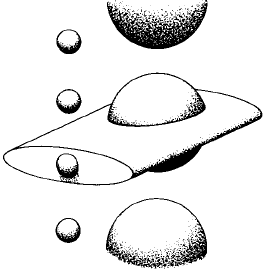
last, in time, just as long as it takes for the entire particle to move
through the laser beam. What this means is that particles with diam-
eters smaller than the laser beam all give out signals that last
approximately the same length of time (dependent primarily on the
laser beam width in the direction of ¯ow and on the stream velocity);
this is a traditional method of ¯ow analysis. However, it is apparent
that larger particles (or small particles in a very narrow laser beam)
will give out signals whose time pro®les are related primarily to their
own diameter (Fig. 8.9). Pulse processing or digital electronics
involves analysis of the full pro®le of the ¯uorescence signal from
a particle. This includes a measure of the signal's width (the time
it takes for the cell to pass through the laser beam), its height
(the maximum ¯uorescence during this passage), and its area (the
total ¯uorescence emitted during this passage) (Fig. 8.10). One large
(G2/M) nucleus will pass through a narrow laser beam more quickly
than will two smaller aggregated nuclei of the same total DNA
content; however, the G2/M nucleus will have greater ¯uorescence
intensity when it is centered in the beam (assuming a narrow laser
beam relative to the diameter of two cells). Therefore, the signal area
is used as the DNA parameter in cell cycle analysis because it is most
closely proportional to total DNA content of a cell, but the width
and height characteristics of the resulting ¯uorescence signal can be
stored as extra parameters and can be used to distinguish clumps
Fig. 8.9. The time that a ¯uorescence signal lasts (the signal width) depends pri-
marily on the size of the laser beam (if the cell is smaller than the beam) or primarily
on the size of the cell (if the cell is larger than the beam). From Peeters et al. (1989).
Flow Cytometry138
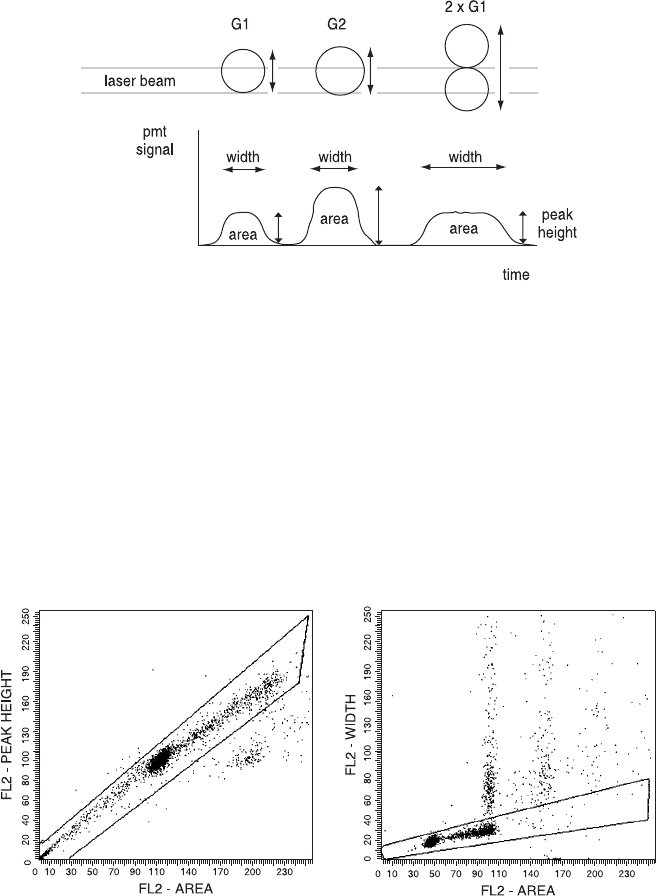
from single G2/M particles. This can help considerably in the inter-
pretation of DNA histograms (Fig. 8.11).
Software algorithms for estimating the proportion of S-phase cells
are approximations. They can be re®ned mathematically in the hope
of better approaching the biological truth. A mathematical model
will always, however, have trouble coping with a biological situation
that is disturbed or contains mixed populations behaving in erratic
Fig. 8.10. Signal width, area, and height characteristics of light pulses as G1, G2,
and two clumped G1 cells move through a narrow laser beam. Modi®ed from
Michael Ormerod.
Fig. 8.11. Single cells (shown in the gates) can be distinguished from aggregates
because single cells have lower signal widths and greater signal heights relative to
their signal areas. The left plot is of data acquired on a Beckman Coulter cytometer;
data in the right plot were acquired on a Becton Dickinson cytometer.
DNA in Life and Death 139