
Givan A.L. Flow Cytometry. First Principles
Подождите немного. Документ загружается.

ways. Flow cytometry does, however, o¨er a more direct way to
measure DNA synthesis. Bromodeoxyuridine (sometimes abbreviated
BrdU or BUdR or BrdUdr) is a thymidine analog. If cells are pulsed
with BrdU, it will be incorporated into the cell's DNA in the place
of thymidine. Fluorescein-conjugated monoclonal antibodies with
speci®city for BrdU are available so that cells that have been pulsed
with BrdU for a short period of time (about 30 min) can then be
treated to partially denature their DNA, exposing the BrdU within
the double helix so that it can be stained with the anti-BrdU anti-
body. Any cells that have incorporated BrdU during the pulse will
then stain ¯uorescein positive.
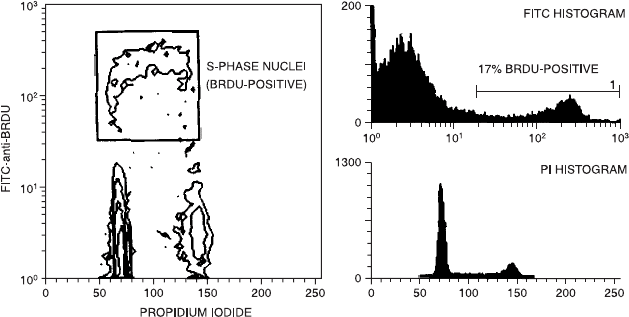
The clever part of this technique is that the denatured DNA can be
stained with propidium iodide at the same time. The resulting two-
color contour plots look like those in Figure 8.12. The red ¯uores-
cence axis shows the propidium iodide distribution (proportional to
DNA content) with which we have grown familiar; the green ¯uo-
rescence axis shows which of these nuclei have actually incorporated
BrdU during the pulse. As might be expected, the cells in the middle
region of the propidium iodide distribution have all incorporated
BrdU; but a proportion of the cells at either end of the propidium
iodide distribution have also done so. This method, while somewhat
Fig. 8.12. Fluorescein (FITC) histogram, propidium iodide (PI) histogram, and
dual-color correlated contour plot of human keratinocytes cultured for 4 days,
pulsed with BrdU, and then stained with FITC±anti-BrdU and PI. Data courtesy of
Malcolm Reed.
Flow Cytometry140
time consuming and a bit tricky technically, does allow a ¯ow cyto-
metrist to quantify the proportion of cells in S phase in a way that
cannot be done accurately with simple propidium iodide staining. The
bromodeoxyuridine method is, in fact, more comparable than simple
propidium iodide staining to the traditional method of measuring cell
division by assaying the incorporation of tritiated thymidine. It also
provides the ability to distinguish cells that may be blocked in S
phase from those that are actually incorporating nucleotides.
BrdU staining has also been used to provide information about the
kinetics of cell cycles. If we consider cells pulsed for a short period of
time with a small amount of BrdU and then killed immediately and
stained with both propidium iodide and with a ¯uorescein±anti-BrdU
monoclonal antibody, the ¯uorescein±antibody should stain equally
all cells in S phase (stretching from the 2C peak to the 4C peak). If,
however, we wait for some time before killing the cells (and if the
BrdU has been used up quickly), then the cells that have incorporated
the BrdU (that is, all the cells that were in S phase at the time of the
pulse) will have synthesized more DNA, and some of those cells will
have progressed into the G2 or M phase of the cell cycle (or indeed
cycled back to G1). In addition, some new cells will have started to
make DNA after the BrdU had been used up, and these cells will
now be in S phase but will have DNA that does not contain BrdU.
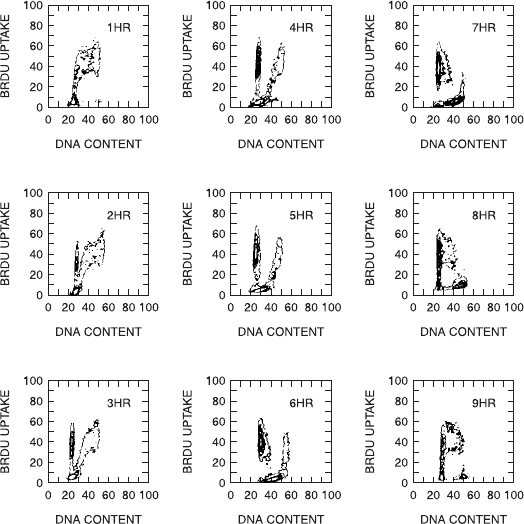
The contour plots for these cases look like those in Figure 8.13. We
can estimate the rate of movement of the BrdU-containing cells
through S phase and into the G2 peak by assuming that they are
evenly distributed throughout S phase at the time of pulsing and then
sampling and staining the cells at one subsequent time. The rate
of increase in propidium iodide intensity of the ¯uorescein-positive
nuclei is equivalent to their rate of DNA synthesis and provides us
with information about the cycle time of the actively dividing cells.
Moreover, the cycle time of the ¯uorescein-positive cells, in conjunc-
tion with the proportion of cells in S phase, can be used to estimate
the doubling time of a population of cells.
Given the possible ambiguities in attempting to correlate clinical
prognosis with aneuploidy and given the knowledge that malignant
cells typically have ``out-of-control'' or unregulated proliferation,
considerable work has been done in an attempt to use ¯ow cytometry
to correlate the percentage of cells in S phase with clinical prognosis
in malignant disease. Although ¯ow cytometrists tend to have reser-
DNA in Life and Death 141
vations about the reproducibility of S-phase determinations from
mathematical modeling of a propidium iodide ¯uorescence histogram
(for the reasons mentioned above), many reports have been published
in the medical literature showing useful correlation of the proportion
of cells in S phase (the ``S-phase fraction'') with poor clinical prog-
nosis (see Chapter 10).
TWO-COLOR ANALYSIS FOR DNA AND
ANOTHER PARAMETER
Having described the analysis of cells for total DNA content (with
propidium iodide) and newly synthesized DNA (with BrdU), we may
now go on to consider some other techniques for exploiting the multi-
Fig. 8.13. Dual-color distribution of BrdU versus DNA content for Chinese hamster
cells pulsed with BrdU and then sampled hourly. From McNally and Wilson (1990).
Flow Cytometry142
parameter potential of the ¯ow cytometer with the dual staining of
cells for both DNA and some other parameter. Zbigniew Darzyn-
kiewicz and coworkers in New York have used acridine orange with
great success to look at the DNA and RNA contents of cycling cells.
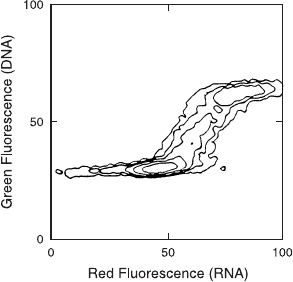
Because acridine orange ¯uoresces red when it binds to RNA and
green when it binds to DNA, cells can be examined simultaneously
for both constituents. Dual analysis of this type has given us increased
information about the progression of cells through the cell cycle.
Speci®cally, it can be seen quite clearly from plots like that in Figure
8.14 that some of the cells with the 2C amount of DNA (G0 or G1)
contain increased levels of RNA. The synthesis of RNA appears to be
an early event in the entrance of a cell into the division cycle. After
this initial increase in RNA content, cells synthesize more RNA as
they begin to synthesize DNA (S phase). At mitosis, they have in-
creased levels of both RNA and DNA compared with resting cells.
Analysis of the acridine orange staining of cycling cells has led, in
particular, to improved ability to analyze early events in the division
cycle.
This acridine orange technique has been taken one step further by
Darzynkiewicz's group. Because acridine orange ¯uoresces red when
bound to single-stranded nucleic acid, but green with double-stranded
nucleic acid, acridine orange can be used under mildly denaturing
Fig. 8.14. DNA (green ¯uorescence) versus RNA (red ¯uorescence) content of
human leukemic cells stained with acridine orange. From Darzynkiewicz and
Traganos (1990).
DNA in Life and Death 143
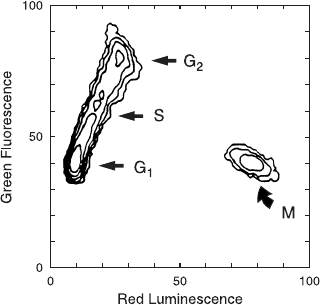
conditions (and in the presence of RNase) to distinguish easily dena-
tured from more resistant forms of DNA. Once RNase has been used
to remove the RNA, mild denaturation can be used to cause un-
winding of the helical forms of DNA that are loosely packed (e.g.,
in cells that are in the process of DNA synthesis); it will not a¨ect
DNA that is tightly condensed (e.g., in resting cells). Figure 8.15 in-
dicates the kind of contour plots that can be obtained from this type
of procedure.
Dual staining of cells can also be used to look at DNA and protein
markers simultaneously. Using methods similar to those described in
the previous chapter for looking at cytoplasmic proteins simultane-
ously with surface membrane proteins, cells can be stained for surface
proteins, then ®xed and permeabilized, and then stained for DNA.
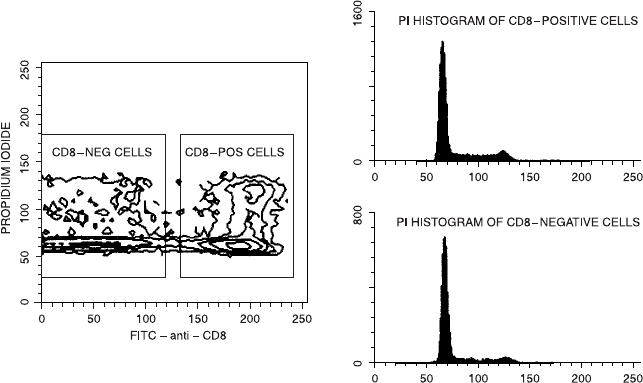
Figure 8.16 shows the way that this type of technique can be used to
permit the cell cycle analysis of subpopulations of cells indepen-
dently. In this particular example, it can be seen that, after treatment
with the mitogen phytohemagglutinin, it is the CD8-positive cells
more than the CD8-negative cells that have been induced to enter S
phase.
Similar techniques can be used to stain cells for both DNA and
internal (cytoplasmic or nuclear) markers. By ®xing the cells, then
Fig. 8.15. L1210 cells treated with RNase and acid and then stained with acridine
orange reveal that DNA in mitotic cells is extensively unwound and exhibits
increased red and decreased green ¯uorescence relative to DNA from cells in other
phases of the cell cycle. From Darzynkiewicz (1990).
Flow Cytometry144
staining for cytoplasmic markers like cytokeratin (as in the example
of staining tumor cells for cytokeratin and estrogen receptors in the
previous chapter, Fig. 7.3), and then staining with propidium iodide,
classes of cells can be selected for ploidy analysis. In this way,
for example, breast tumor cells (which are likely to be of epithelial
origin) can be gated in a mixed population from a tumor. Then the
cells gated for ¯uorescein±anti-cytokeratin positivity can be further
analyzed to see if any of these nuclei are aneuploid. By this technique,
minor populations of tumor cells within a heterogeneous population
may be selected and their ploidy determined with more sensitivity.
The Darzynkiewicz laboratory has continued, more recently, to
use ¯ow cytometry in creative ways to contribute to our knowledge
of the regulation of cell division. By staining for DNA as well as cell
cycle-regulatory proteins (the cyclins), the presence of these proteins
can be associated with certain stages of the cell cycle. Figure 8.17
shows an example of data derived from a protocol staining cells
for DNA content along with antibodies against the nuclear proteins
H3-P (H3 is a histone, which, when phosphorylated, is associated
Fig. 8.16. Cell cycle analysis of CD8-positive and CD8-negative cells. Lymphocytes
were cultured with phytohemagglutinin, stained with FITC±anti-CD8 monoclonal
antibody, treated with saponin to permeabilize the outer membrane, and then stained
with propidium iodide (PI) and RNase. Cells provided by Ian Brotherick.
DNA in Life and Death 145
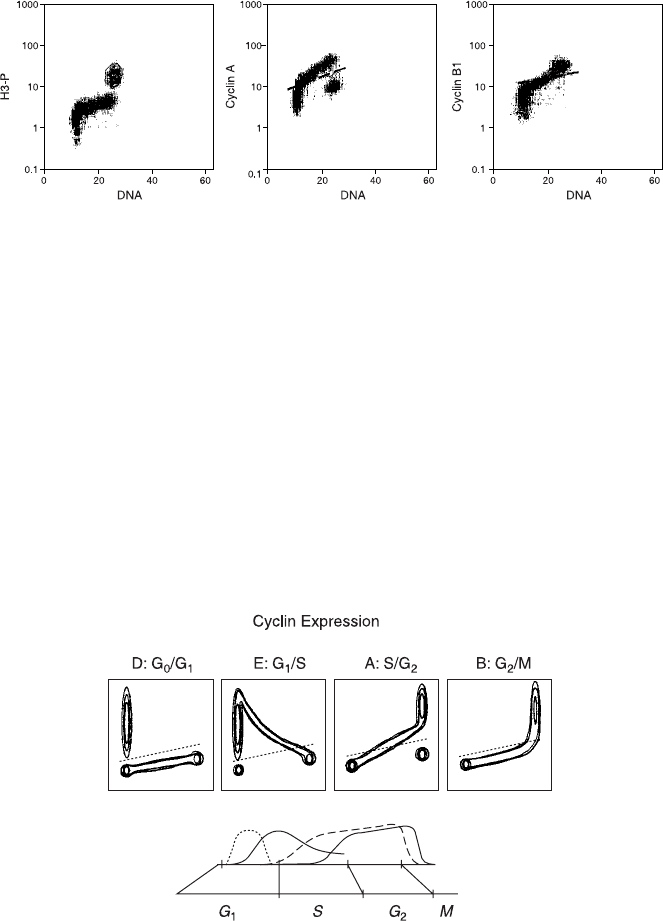
with chromosomal condensation), cyclin A (a cycle-regulatory pro-
tein that begins to accumulate at mid-S phase, reaches maximal con-
centration at the end of G2, and is degraded early in mitosis), and
cyclin B1 (which begins to accumulate at the beginning of G2 and is
maximal at the beginning of mitosis, declining at the cell's entry into
anaphase). H3-P can dichotomize 4C cells into those that are in the
G2 stage of the cycle and those that are actually mitotic. Similarly,
the cyclins can additionally separate cells at di¨erent stages of mito-
sis. Figure 8.18 indicates a summary of the time course for expression
of cyclins D, E, A, and B.
Fig. 8.18. A summary of the time course of expression of cyclins D, E, A, and B
through the cell cycle. DNA is plotted on the x-axis of the coutour plots and cyclin
expression on the y-axis. Courtesy of James Jacobberger.
Fig. 8.17. The use of stains for the intracellular proteins H3-P, cyclin A, and cyclin
B1 in conjunction with propidium iodide to distinguish cells with the same DNA
content but at di¨erent stages of the cell cycle. From Juan et al (1998).
Flow Cytometry146
Some particular issues arise when combining DNA staining with
protein staining; these issues are related to those discussed in the
previous chapter on combining the staining of intracellular with
extracellular proteins. In both cases, the ®xation procedure, while
maintaining the integrity of the cells after permeabilization, can also
a¨ect the stainability of the molecules in question. In the case of
DNA staining, ®xation of cells will cross-link histones on the chro-
mosomes, thus limiting the access of DNA-speci®c ¯uorochromes to
their binding sites. In practice, this means that cells ®xed with form-
aldehyde will maintain their cytoplasmic integrity well but will show
decreased propidium iodide ¯uorescence and wider CVs than will
cells ®xed with, for example, ethanol. The solution is, once again, a
compromise. Short ®xation with low concentrations of formaldehyde
followed by detergent treatment works well to permit maintenance of
cytoplasmic proteins along with fairly good DNA pro®les. Exact
procedures need to be individualized to the proteins and cells in
question.
CHROMOSOMES
Until now, the particles ¯owing through our ¯ow cytometer have
been cells or nuclei. Other types of particles are, of course, possible.
One of the best examples of the successful application of ¯ow cy-
tometry to noncellular systems has been in the analysis of chromo-
somes. In this case, the particles ¯owing through the system are
individual chromosomes that are released from cells that have been
arrested in metaphase (much the same conditions as those that are
used to prepare chromosomes for analysis in metaphase spreads
under the microscope). The released chromosomes are stained with
a DNA stain (like propidium iodide) and then sent through the
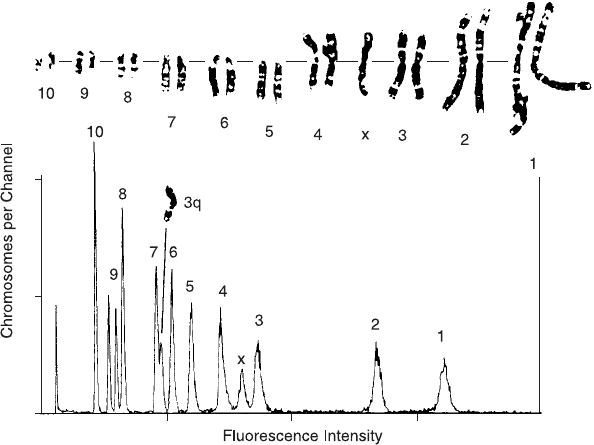
¯ow cytometer. The resulting histograms of ¯uorescence intensity re-
veal peaks whose positions along the x-axis are proportional to the
amount of DNA in the chromosome and whose areas are propor-
tional to the number of chromosomes with that particular DNA con-
tent (Fig. 8.19). Histograms of this type are called ¯ow karyotypes,by
analogy with the microscope karyotypes derived from conventional
genetic analysis.
Figure 8.20 shows examples of ¯ow karyotypes from di¨erent
DNA in Life and Death 147
species. While some species with small numbers of chromosomes
reveal relatively simple histogram patterns, the 23 pairs of chromo-
somes in the human lead to a rather complex pattern. It is apparent
that, although 23 pairs of chromosomes are readily distinguished
under the microscope by a combination of size, centromere position,
and banding patterns, many of these pairs have similar total DNA
content and are not distinguishable in a ¯ow histogram. We can
obtain considerable help by using Hoechst 33258 and chromomycin
A3 in a dual staining system: Hoechst 33258 stains adenine- and
thymine-rich regions of DNA preferentially, and chromomycin A3
is speci®c for regions rich in the guanine and cytosine base pairs.
By using this dual system, we ®nd that some chromosomes with
closely similar total DNA content have di¨ering base pair ratios.
Compare particularly the positions of chromosomes 13±16 in the
one-dimensional histograms (Fig. 8.20A) with these same chromo-
somes (now separable) in the contour plot (Fig. 8.21). Unfortunately,
chromosomes 9±12 are not distinguishable with either system.
Fig. 8.19. A ¯ow karyotype (¯uorescence histogram) of Chinese hamster chromo-
somes stained with propidium iodide (PI). The G-banded chromosomes from this
particular aneuploid cell line are included for comparison with the histogram peaks.
From Cram et al. (1988).
Flow Cytometry148
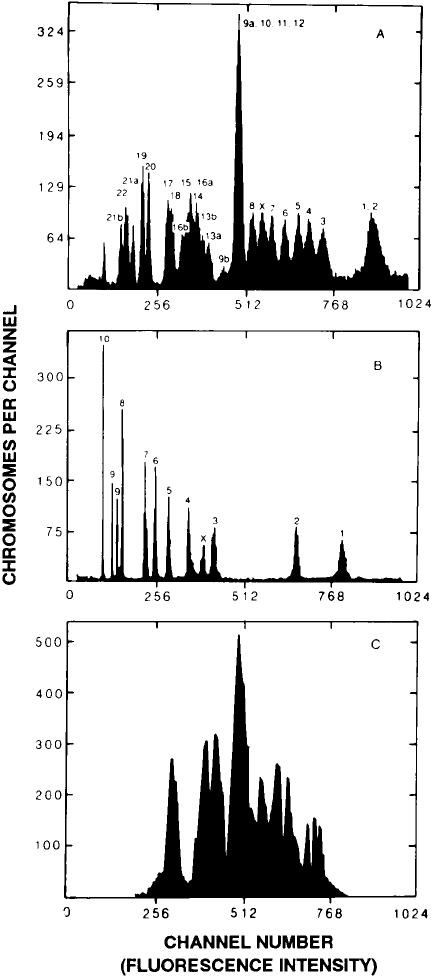
Fig. 8.20. Flow karyotypes from human chromosomes (A), hamster chromosomes
(B), and mouse chromosomes (C ). From Gray and Cram (1990).
DNA in Life and Death 149