
Givan A.L. Flow Cytometry. First Principles
Подождите немного. Документ загружается.

There has been much discussion about the potential utility of ¯ow
cytometry of chromosomes for clinical diagnosis. As regards its sen-
sitivity, this technique appears to stand somewhere between the tech-
nique of ¯ow analysis of whole cells for DNA content and that of
microscope analysis of banded chromosomes. It may be a useful
intellectual exercise for readers to ask themselves which technique or
techniques would be most appropriate for detecting the following
types of chromosome abnormalities: (1) tetraploidy, where the normal
chromosome content of cells is exactly doubled because of failure of
cytokinesis after mitosis; (2) an inversion in an arm of one particular
chromosome; and (3) trisomy (the existence of cells with three instead
of two) of one of the small chromosomes. In addition to these limi-
tations, the use of ¯ow cytometry to look for abnormal chromosomes
has been confounded by the fact that several human chromosomes
are highly polymorphic, and ¯ow karyotypes, therefore, vary consid-
erably among normal individuals.
APOPTOSIS
We can close this chapter with discussion of two ``end of life''
applicationsÐapoptosis and necrosis. Although a naõ
È
ve observer
0
0
255
255
Chromomycin A3
Hoechst 33258
1
2
3
4
5
6
7
8
9-12
13
14
15
16
17
18
19
20
21
Y
22
X
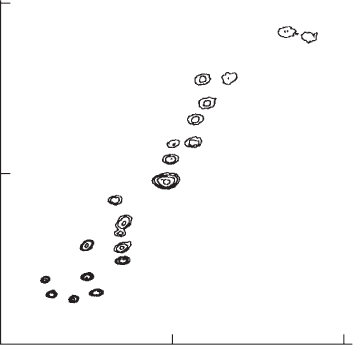
Fig. 8.21. A bivariate ¯ow karyotype for human chromosomes stained with Hoechst
33258 and chromomycin A3. From Gray and Cram (1990).
Flow Cytometry150
might see death as an unfortunate (and scienti®cally boring) end-
point, recent work indicates that cell death is neither boring nor nec-
essarily unfortunate. Cells often die by an active process that is an
important part of the maintenance of organismal homeostasis. This
process is called apoptosis. Apoptosis, or programmed death, can, for
example, prevent the survival of potentially malignant cells with
damaged DNA.
Cells that are undergoing apoptosis progress through a series of
events. Many of the events that we measure in association with
apoptosis, however, may be overlapping in time and therefore may
not be a ``pathway'' so much as symptoms of the underlying process.
Some of the events are not obligatory and may di¨er depending on
the nature of the apoptotic trigger and the cell type. In any case,
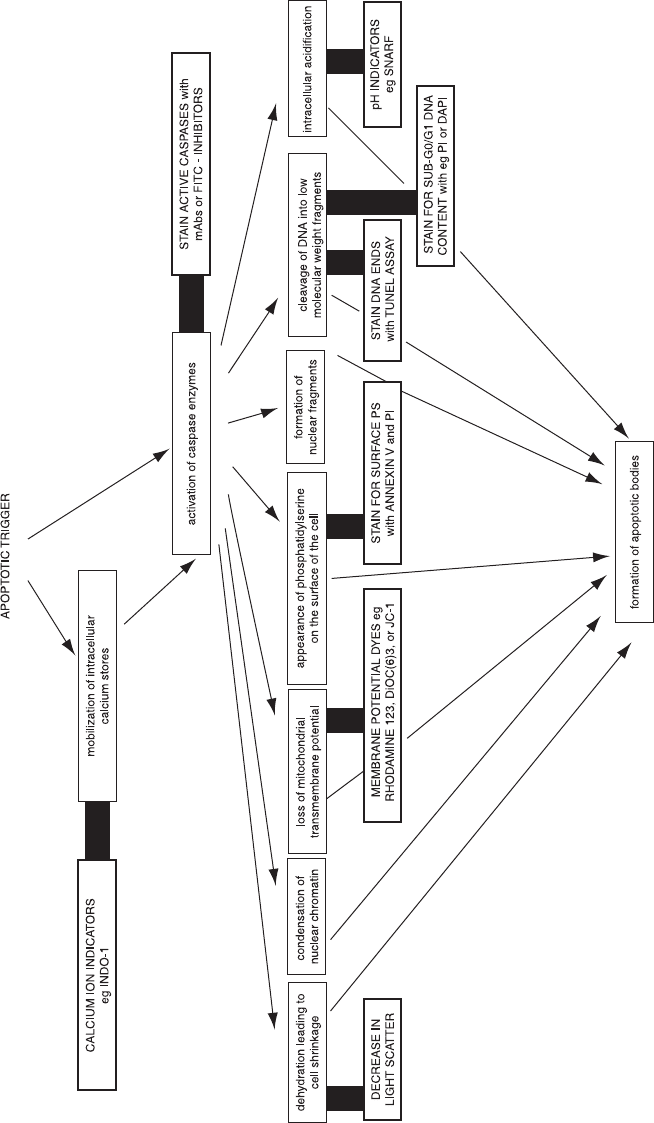
several of these apoptotic-associated events can be analyzed by ¯ow
cytometry (Fig. 8.22). One of the events is the ¯ipping and stabiliza-
tion of phosphatidylserine from the inner surface of the cytoplasmic
membrane to the outer surface. On the outer surface, phosphatidyl-
serine appears to identify cells as targets for phagocytosis. Because
annexin V binds to phosphatidylserine, staining of intact cells with
¯uorochrome-conjugated annexin V will detect cells that are in early
stages of apoptosis.
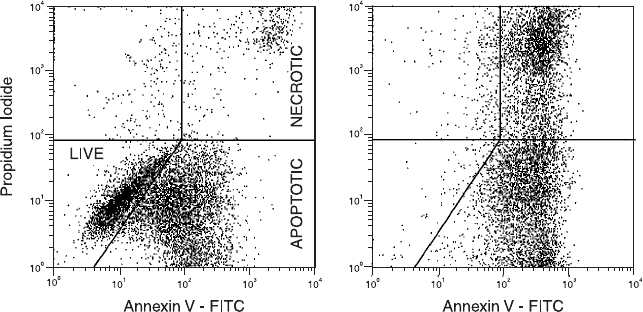
A two-color dot plot (Fig. 8.23) of cells stained with propidium
iodide and annexin V±FITC will indicate cells in three of the four
quadrants. Unstained cells are alive and well and are the double
negatives; they neither express phosphatidylserine on their surface
nor take up propidium iodide through leaky membranes. Cells that
stain just with annexin V are apoptotic; they have begun to express
phosphatidylserine on their surface, but have not yet gone through
the process that leads to permeabilization of their cytoplasmic mem-
brane. Cells that stain both with propidium iodide and annexin V
are necrotic (that is, dead); they take up propidium iodide and also
stain with annexin V. With a permeable cell, the ¯ow cytometer
cannot tell us whether the annexin V is on the outside of the mem-
brane (because the cells have gone through apoptosis before mem-
brane permeabilization) or on the inside of the membrane (because
the cells have died by the necrotic pathway without apoptosis).
Another event associated with apoptosis is the fragmentation of
DNA due to endonuclease activation. This fragmentation results in
the appearance of increased numbers of ``free ends'' on the DNA
molecules in the cell. By incubating ®xed and permeabilized cells with
DNA in Life and Death 151
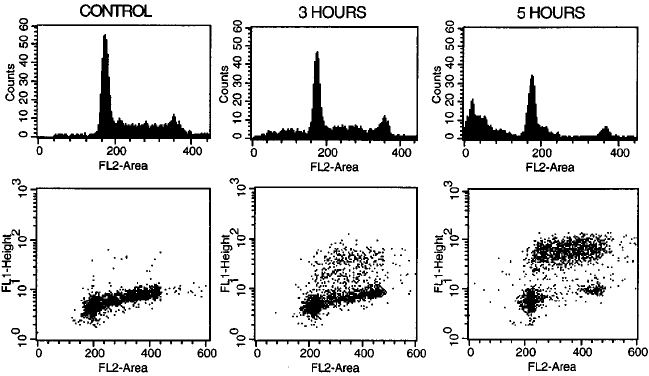
the enzyme terminal deoxynucleotidyl transferase (TdT) and with
¯uorochrome-labeled nucleotides, cells with greater numbers of DNA
fragments incorporate more of the ¯uorescent nucleotides onto their
increased number of termini. The resulting increased cellular ¯uores-
cence is indicative of an apoptotic cell (Fig. 8.24, lower dot plots).
Appearance of positive cells in this TdT ¯ow assay correlates well
with the classic gel electrophoresis assay for apoptosis, where ``lad-
ders'' of small DNA fragments are indicators of endonuclease acti-
vation. In a desperate attempt to ®nd an acronym, this ¯ow assay for
apoptosis has been called the TUNEL assay (for Terminal deoxy-
nucleotidyl transferase±mediated dUTP N ick End-Labeling).
Propidium iodide staining alone can be used to detect later stages
of apoptosis (Fig. 8.24, upper histograms). When the DNA becomes
extensively fragmented, the small fragments begin to be ejected from
Fig. 8.23. Cells stained with propidium iodide for permeable membranes and with
annexin V for phosphatidylserine can distinguish live (double negative), apoptotic
(annexin V-positive, propidium iodide±negative), and necrotic (double positive) cells.
This ®gure (with data from Robert Wagner) shows cultured bovine aortic endothelial
cells; the left plot displays data from adherent cells, and the right plot displays data
from the ``¯oaters.''
g
ÐÐÐÐÐÐÐÐÐÐÐÐÐÐÐÐÐÐÐÐÐÐÐÐÐÐÐÐÐÐÐÐÐÐÐÐÐÐÐÐ
Fig. 8.22. A diagram of some of the events associated with apoptosis, showing
related ¯ow cytometric assays (outlined in bold boxes). Although it is generally
agreed that calcium ¯ux and caspase activation are early events following the trigger
signal, the events following on from there may be essential steps in an ordered
pathway or may be independent and merely symptomatic of apoptosis.
DNA in Life and Death 153
the cells and/or can be washed from the cells during the staining
protocol. In either case, the apoptotic cell at this stage will have sig-
ni®cantly less DNA than a healthy, viable cell. This lowered DNA
content can be detected as a ``sub-G0/G1'' peak in a simple, one-
color DNA histogram. It needs to be mentioned that staining for the
cells with sub-G0/G1 DNA content requires a protocol that encour-
ages apoptotic cells to release their fragmented DNA. In contrast, the
TUNEL assay uses ®xation to ensure that the fragmented DNA is
retained.
NECROSIS
Unlike apoptosis, which involves the scheduled and active coordina-
tion of metabolic processes, necrosis is a passive response to a toxic
or injurious environment. Whereas in apoptosis the cell membrane
remains intact until very late in the game, permeabilization of the cell
membrane is an early event in necrosis. Because propidium iodide
Fig. 8.24. Cells in late apoptosis have fragmented DNA. They can be visualized as
cells with increased incorporation of ¯uorochrome-labeled nucleotides to the ends of
the fragments in the ¯ow cytometric TUNEL assay (lower dot plots, with FL1 as
FITC-dUTP and FL2 as propidium iodide bound to DNA). Alternatively, they can
be visualized as cells with less-than-normal (sub-G0/G1) DNA content (upper his-
tograms of propidium iodide ¯uorescence). Data from etoposide-treated ML-1 cells
courtesy of Mary Kay Brown and Alan Eastman.
Flow Cytometry154
is excluded from entering cells by an intact plasma membrane and
because it only ¯uoresces when intercalated between the bases of
double-stranded nucleic acid, it will not ¯uoresce if it is added to a
suspension of intact cells. The intact plasma membrane forms a
barrier, keeping propidium iodide and nucleic acids apart. It is only
when the outer membrane has been breached that the cells will emit
red ¯uorescence. Propidium iodide (or other membrane-impermeant
DNA ¯uorochromes) is therefore a stain (like trypan blue) that can
be used to mark necrotic cells (on the reasonable but not necessarily
valid assumption that cells with holes in their membranes large
enough to allow the penetration of propidium iodide are actually
dead according to other viability criteria and vice versa). By this
method, cell viability can be monitored in the presence of various
cytotoxic conditions (Fig. 8.25).
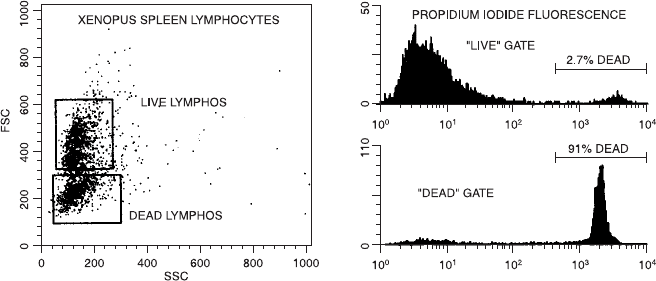
The only di½culty in using ¯ow cytometry to monitor cell death is
that, as mentioned in Chapter 3, dead cells have di¨erent scatter
properties than living cells. In particular, because of their perforated
outer membrane, they have a lower refractive index than living cells
and therefore have forward scatter signals of lower intensity. For this
reason, it is important not to use a gate or forward scatter threshold
when analyzing a population for the proportion of dead and live
cells. Any forward versus side scatter gate drawn around normal
lymphocytes, for example, will always show most if not all of the cells
Fig. 8.25. The use of propidium iodide to monitor cell death. Dead lymphocytes
have a less intense forward scatter signal than do live lymphocytes. Cultured Xen-
opus spleen lymphocytes courtesy of Jocelyn Ho and John Horton.
DNA in Life and Death 155
within that gate to have excluded propidium iodide no matter how
many cells in the preparation are dead; this is simply because the
dead cells drop out of the gate (Fig. 8.25). The lesson here (and one
that needs repeating in reference to most ¯ow analysis) is that gating
is an analytic procedure that needs to be performed carefully and
with explicit purpose. If we do not de®ne our population of interest
(by gating) with care, our results may be accurate answers to inap-
propriate questions (e.g., ``what percentage of living lymphocytes are
alive?'').
The use of membrane-impermeant DNA ¯uorochromes to mark
dead cells has a more routine application in simply allowing the
exclusion of dead cells from ¯ow analysis. This is important because
dead cells have the habit of staining nonspeci®cally when their broken
membranes tend to trap monoclonal antibodies directed against sur-
face antigens. Therefore a cell suspension including many dead cells
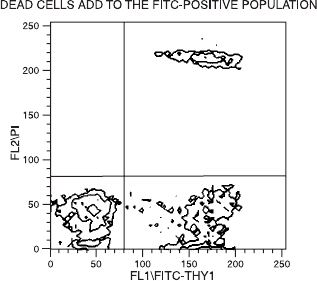
may show high levels of nonspeci®c stain. By adding propidium
iodide to cells just before analysis, the cells ¯uorescing red can be
excluded from further analysis by gating on red negativity and only
the living cells then examined for surface marker staining. Figure 8.26
shows the way that this technique can be used when looking at ¯uo-
rescein staining for surface antigens on cultured mouse thymocytes.
Fig. 8.26. The use of propidium iodide to exclude dead cells from analysis of a
mouse spleen cell population for the expression of the Thy-1 surface antigen. The
cells were stained with ¯uorescein for Thy-1 and then with propidium iodide to mark
the dead cells. It can be seen that the dead cells (upper right quadrant) contribute to
the ¯uorescein-positive population. Stained cells courtesy of Maxwell Holscher.
Flow Cytometry156
The use of propidium iodide or equivalent dyes to exclude dead cells
from analysis is a procedure that is recommended as routine for any
system staining for surface markers. It is particularly important in
analysis of mixed populations where a high percentage of the cells
may be dead.
It should, however, be remembered that ®xed cells cannot be
stained with propidium iodide for live/dead discrimination. Fixed
cells are, in fact, all dead and will therefore all take up propidium
iodide even if some were alive and some dead before ®xation. Ethi-
dium monoazide o¨ers an alternative to propidium iodide if cells
will be ®xed before ¯ow analysis. It is a dye that, like propidium
iodide, only enters dead cells. It has, however, the added advantage
of forming permanent cross-links with DNA when photoactivated.
Therefore, cells can be stained for surface proteins, incubated with
ethidium monoazide under a desk lamp, washed, and then ®xed. At
the time of acquisition of data on the ¯ow cytometer, red ¯uorescence
will mark the cells that were dead before ®xation.
FURTHER READING
Chapters 13±16 and 24 in Melamed et al. and Chapters 11±13 in Watson are
detailed reviews of the applications of ¯ow cytometry to various aspects of
cell cycle research.
Several chapters in Ormerod and several sections in the Purdue Handbook,
in Diamond and DeMaggio, and in Current Protocols in Cytometry give
good practical protocols. Darzynkiewicz (both the 1994 and 2001 editions)
include many chapters with protocols and advice on both the simpler and
the more complex methods in nucleic acid, apoptosis, and cell cycle analysis.
Good discussions of the mathematical algorithms for cell cycle analysis can
be found in Chapter 6 of Van Dilla et al., Chapter 23 of Melamed et al., and
in the multiauthor book Techniques in Cell Cycle Analysis, edited by Gray
JW and Darzynkiewicz Z (1987), Humana Press, Clifton, NJ.
The ``Cytometry of Cyclin Proteins'' is reviewed by Darzynkiewicz Z, et al.
(1996) in Cytometry 25:1±13.
Molecular biology and chromosome analysis are discussed in Chapters 25±
28 of Melamed et al. A special issue (Volume 11, Number 1, 1990) of the
journal Cytometry, although somewhat aged, is devoted to the subject of
DNA in Life and Death 157
analytical cytogenetics; it contains articles about work at the interface be-
tween theory and clinical practice (as well as some beautiful pictures).
A review article by Darzynkiewicz Z, et al. (1997) on ``Cytometry in Cell
Necrobiology: Analysis of Apoptosis and Accidental Cell Death (Necrosis)''
appeared in Cytometry 27:1±20. Boehringer Mannheim produces a free, but
substantial manual (now in its second edition) on methods related to the
study of cell death.
Flow Cytometry158

9
The Sorting of Cells
Although early ¯ow cytometers were developed as instruments that
could separate or sort particles based on analysis of the signals
coming from those particles, it is now true that most ¯ow cytometry
involves analyzing particles but not actually sorting them. This is
just one of many examples of the way in which ¯ow technology
has moved in unpredictable directions. Many cytometers now do not
even possess a sorting capability, and the instruments that can sort
particles may be used only infrequently for that purpose. Neverthe-
less, sorting cells or chromosomes with a ¯ow cytometer is an elegant
technology; it may be the only method available for obtaining pure
preparations of particles with certain kinds of characteristics of in-
terest. On both of those counts it is certainly worth knowing about
sorting even if you are not interested in using the technique at the
moment. Now that you are comfortable with ¯ow cytometry and
its basic applications, this chapter will present a bit more technical
information about the way a sorting ¯ow cytometer (Fig. 9.1) can be
used to sort cells.
SORTING THEORY
If a stream of liquid is vibrated along its axis, the stream will break
up into drops (pick a nice summer day and try it with a garden hose).
The characteristics of this drop formation are governed by an equa-
tion that will be familiar to anyone who has studied light waves:
v fl, where v is the velocity of the stream, f is the frequency of the
vibration applied, and l is the ``wave length'' or distance between the
drops. One other fact that needs to be known before we can under-
159
Flow Cytometry: First Principles, Second Edition. Alice Longobardi Givan
Copyright
2001 by Wiley-Liss, Inc.
ISBNs 0-471-38224-8 (Paper); 0-471-22394-8 (Electronic)