
Hogg S. Essential microbiology
Подождите немного. Документ загружается.

JWBK011-04 JWBK011-Hogg August 12, 2005 15:53 Char Count= 0
78
JWBK011-04 JWBK011-Hogg August 12, 2005 15:53 Char Count= 0
4
Microbial Nutrition
and Cultivation
In Chapter 2 we introduced the major groups of macromolecules found in living cells;
the raw materials from which these are synthesised are ultimately derived from the
organism’s environment in the form of nutrients (Table 4.1). These can be conveniently
divided into those required in large quantities* (macronutrients) and those which are
needed only in trace amounts (micronutrients or trace elements).
You will recall that carbon forms the central component of proteins, carbohydrates,
nucleic acids and lipids; indeed, the living world is based on carbon, so it should come as
no surprise that this is the most abundant element in all living cells, microbial or other-
wise. Of the other macronutrients, nitrogen, oxygen, hydrogen, sulphur and phosphorus
are also constituents of biological macromolecules, while the remainder (magnesium,
potassium, sodium, calcium and iron in their ionised forms) are required in lesser quan-
tities for a range of functions that will be described in due course. Micronutrients are
all metal ions, and frequently serve as cofactors for enzymes.
All microorganisms must have a supply of the nutrients described above, but they
show great versatility in the means they use to satisfy these requirements.
The metabolic processes by which microorganisms assimilate nutrients to make cel-
lular material and derive energy will be reviewed in Chapter 6. In the following sec-
tion we briefly describe the role of each element, and the form in which it may be
acquired.
Carbon is the central component of the biological macromolecules we discussed
in Chapter 2. Carbon incorporated into biosynthetic pathways may be derived from
organic or inorganic sources (see below); some organisms can derive it from CO
2
, while
others require their carbon in ‘ready-made’, organic form.
Hydrogen is also a key component of macromolecules, and participates in energy gen-
eration processes in most microorganisms. In autotrophs (see ‘Nutritional categories’ be-
low), hydrogen is required to reduce carbon dioxide in the synthesis of macromolecules.
Oxygen is of central importance to the respiration of many microorganisms, but in
its molecular form (O
2
), it can be toxic to some forms (see Chapter 5). These obtain the
oxygen they need for the synthesis of macromolecules from water.
* Everything is relative in the microbial world; a typical bacterial cell weighs around three tenmillion
millionths (3 × 10
−13
) of a gram!
79

JWBK011-04 JWBK011-Hogg August 12, 2005 15:53 Char Count= 0
80 MICROBIAL NUTRITION AND CULTIVATION
Table 4.1 Elements found in living organisms
Form in which Occurrence in
Element usually supplied biological systems
Macronutrients
Carbon (C) CO
2
, organic compounds Component of all organic
molecules, CO
2
Hydrogen (H) H
2
O, organic compounds Component of biological
molecules, H
+
released by
acids
Oxygen (O) O
2
,H
2
O, organic compounds Component of biological
molecules; required for
aerobic metabolism
Nitrogen (N) NH
3
,NO
3
−
,N
2
, organic N
compounds
Component of proteins,
nucleic acids
Sulphur (S) H
2
S, SO
4
2−
, organic S
compounds
Component of proteins;
energy source for some
bacteria
Phosphorus (P) PO
4
3−
Found in nucleic acids, ATP,
phospholipids
Potassium (K) In solution as K
+
Important intracellular ion
Sodium (Na) In solution as Na
+
Important extracellular ion
Chlorine (Cl) In solution as Cl
−
Important extracellular ion
Calcium (Ca) In solution as Ca
2+
Regulator of cellular
processes
Magnesium (Mg) In solution as Mg
2+
Coenzyme for many enzymes
Iron (Fe) In solution as Fe
2+
or Fe
3+
or
as FeS, Fe(OH
3
) etc
Carries oxygen; energy source
for some bacteria
Micronutrients Present as contaminants at
very low concentrations
Copper (Cu) In solution as Cu
+
,Cu
2+
Coenzyme; microbial growth
inhibitor
Manganese (Mn) In solution as Mn
2+
Coenzyme
Cobalt (Co) In solution as Co
2+
Vitamin B
12
Zinc (Zn) In solution as Zn
2+
Coenzyme; microbial growth
inhibitor
Molybdenum (Mo) In solution as Mo
2+
Coenzyme
Nickel (Ni) In solution as Ni
2+
Coenzyme
Nitrogen is needed for the synthesis of proteins and nucleic acids, as well as for
important molecules such as ATP (you will learn more about ATP and its role in the
cell’s energy relations in Chapter 6). Microorganisms range in their demands for nitrogen
from those that are able to assimilate (‘fix’) gaseous nitrogen (N
2
) to those that require
all 20 amino acids to be provided preformed. Between these two extremes come species
that are able to assimilate nitrogen from an inorganic source such as nitrate, and those
that utilise ammonium salts or urea as a nitrogen source.

JWBK011-04 JWBK011-Hogg August 12, 2005 15:53 Char Count= 0
NUTRITIONAL CATEGORIES 81
Table 4.2 Selected microbial growth factors
Growth factor Function
Amino acids Components of proteins
p-Aminobenzoic acid Precursor of folic acid, involved in nucleic acid synthesis
Niacin (nicotinic acid) Precursor of NAD
+
and NADP
+
Purines & pyrimidines Components of nucleic acids
Pyridoxine (vitamin B
6
) Amino acid synthesis
Riboflavin (vitamin B
2
) Precursor of FAD
Sulphur is required for the synthesis of proteins and vitamins, and in some types is
involved in cellular respiration and photosynthesis. It may be derived from sulphur-
containing amino acids (methionine, cysteine), sulphates and sulphides.
Phosphorus is taken up as inorganic phosphate, and is incorporated in this form into
nucleic acids and phospholipids, as well as other molecules such as ATP.
A cofactor is a non-
protein component of
an enzyme (often a
metal ion) essential for
its normal functioning.
Metals such as copper, iron and magnesium are re-
quired as cofactors in enzyme reactions.
Many microorganisms are unable to synthesise
certain organic compounds necessary for growth and
must therefore be provided with them in their growth
medium. These are termed growth factors (Table 4.2), of
which three main groups can be identified: amino acids,
purines and pyrimidines (required for nucleic acid synthesis) and vitamins. You will al-
ready have read about the first two of these groups in Chapter 2. Vitamins are complex
organic compounds required in very small amounts for the cell’s normal functioning.
They are often either coenzymes or their precursors (see Chapter 6). Microorganisms
vary greatly in their vitamin requirements. Many bacteria are completely self-sufficient,
while protozoans, for example, generally need to be supplied with a wide range of these
dietary supplements. A vitamin requirement may be absolute or partial; an organism
may be able, for example, to synthesise enough of a vitamin to survive, but grow more
vigorously if an additional supply is made available to it.
Nutritional categories
Microorganisms can be categorised according to how they obtain their carbon and
energy. As we have seen, carbon is the most abundant component of the microbial cell,
and most microorganisms obtain their carbon in the form of organic molecules, derived
directly or indirectly from other organisms. This mode of nutrition is the one that is
familiar to us as humans (and all other animals); all the food we eat is derived as complex
organic molecules from plants and other animals (and even some representatives of the
microbial world such as mushrooms!). Microorganisms which obtain their carbon in

JWBK011-04 JWBK011-Hogg August 12, 2005 15:53 Char Count= 0
82 MICROBIAL NUTRITION AND CULTIVATION
A heterotroph must use
one or more organic
compounds as its source
of carbon.
this way are described as heterotrophs, and include all
the fungi and protozoans as well as most types of bac-
teria. Microorganisms as a group are able to incorpo-
rate the carbon from an incredibly wide range of or-
ganic compounds into cellular material. In fact there
is hardly any such compound occurring in nature that
cannot be metabolised by some microorganism or other,
explaining in part why microbial life is to be found thriving in the most unlikely habitats.
Many synthetic materials can also serve as carbon sources for some microorganisms,
which can have considerable economic significance.
An autotroph can derive
its carbon from carbon
dioxide.
A significant number of bacteria and all of the algae
do not, however, take up their carbon preformed as or-
ganic molecules in this way, but derive it instead from
carbon dioxide. These organisms are called autotrophs,
and again we can draw a parallel with higher organ-
isms, where all members of the plant kingdom obtain
their carbon in a similar fashion.
A chemotroph obtains
its energy from chemi-
cal compounds. A pho-
totroph uses light as its
source of energy.
We can also categorise microorganisms nutritionally
by the way they derive the energy they require to carry
out essential cellular reactions. Autotrophs thus fall into
two categories. Chemoautotrophs obtain their energy
as well as their carbon from inorganic sources; they
do this by the oxidation of inorganic molecules such
as sulphur or nitrite. Photoautotrophs have photosyn-
thetic pigments enabling them to convert light energy
into chemical energy. The mechanisms by which this is achieved will be discussed in
Chapter 6.
The great majority of heterotrophs obtain energy as well as carbon from the
same organic source. Such organisms release energy by the chemical oxidation of or-
ganic nutrient molecules, and are therefore termed chemoheterotrophs. Those few het-
erotrophs which do not follow this mode of nutrition include the green and purple
non-sulphur bacteria. These are able to carry out photosynthesis and are known as
photoheterotrophs.
There is one final subdivision of nutritional categories in microorganisms! Whether
organisms are chemotrophs or phototrophs, they need a molecule to act as a source
A lithotroph is an organ-
ism that uses inorganic
molecules as a source
of electrons. An organ-
otroph uses organic
molecules for the same
purpose.
of electrons (reducing power) to drive their energy-
generating systems (see Chapter 6). Those able to use an
inorganic electron donor such as H
2
O, H
2
S or ammonia
are called lithotrophs, while those requiring an organic
molecule to fulfil the role are organotrophs. Most (but
not all) microorganisms are either photolithotrophic au-
totrophs (algae, blue-greens) or chemo-organotrophic
heterotrophs (most bacteria). For the latter category, a
single organic compound can often act as the provider of
carbon, energy and reducing power. The substance used
by chemotrophs as an energy source may be organic (chemoorganotrophs) or inorganic
(chemolithotrophs).
JWBK011-04 JWBK011-Hogg August 12, 2005 15:53 Char Count= 0
HOW DO NUTRIENTS GET INTO THE MICROBIAL CELL? 83
How do nutrients get into the microbial cell?
Having found a source of a given nutrient, a microorganism must:
r
have some means of taking it up from the environment
r
possess the appropriate enzyme systems to utilise it.
The plasma membrane represents a selective barrier, allowing into the cell only those
substances it is able to utilise. This selectivity is due in large part to the hydrophobic
nature of the lipid bilayer. A substance can be transported across the cell membrane in
one of three ways, known as simple diffusion, facilitated diffusion and active transport.
In simple diffusion, small molecules move across the membrane in response to a
concentration gradient (from high to low), until concentrations on either side of the
membrane are in equilibrium. The ability to do this depends on being small (H
2
O,
Na
+
,Cl
−
) or soluble in the lipid component of the membrane (non-polar gases such as
O
2
and CO
2
).
Larger polar molecules such as glucose and amino acids are unable to enter the cell
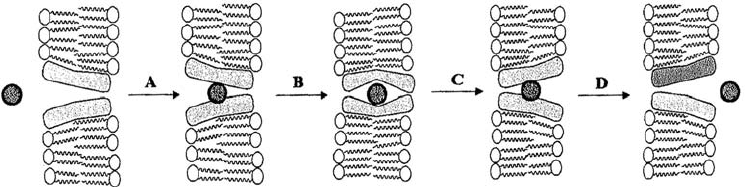
unless assisted by membrane-spanning transport proteins by the process of facilitated
diffusion (Figure 4.1). Like enzymes, these proteins are specific for a single/small number
of related solutes; another parallel is that they too can become saturated by too much
‘substrate’. As with simple diffusion, there is no expenditure of cellular energy, and
an inward concentration gradient is required. The transported substance tends to be
metabolised rapidly once inside the cell, thus maintaining the concentration gradient
from outside to inside.
Diffusion is only an effective method of internalising substances when their concen-
trations are greater outside the cell than inside. Generally, however, microorganisms
find themselves in very dilute environments; hence the concentration gradient runs in
the other direction, and diffusion into the cell is not possible. Active transport enables
the cell to overcome this unfavourable gradient. Here, regardless of the direction of the
gradient, transport takes place in one direction only, into the cell. Energy, derived from
Figure 4.1 In facilitated diffusion, substances can move across the plasma membrane by
binding to an embedded transport protein (shown shaded). No energy input is required, but
the diffusion can only occur from an area of high concentration to one of low concentration.
From Thomas, G: Medicinal Chemistry, an Introduction, John Wiley & Sons Inc., 2000.
Reproduced by permission of the publishers

JWBK011-04 JWBK011-Hogg August 12, 2005 15:53 Char Count= 0
84 MICROBIAL NUTRITION AND CULTIVATION
hydrolysis of adenosine triphosphate (see Chapter 6) is required to achieve this, and
again specific transmembrane proteins are involved. They bind the solute molecule with
high affinity outside of the cell, and then undergo a conformational change that causes
them to be released into the interior. Procaryotic cells can carry out a specialised form
of active transport called group translocation, whereby the solute is chemically modi-
fied as it crosses the membrane, preventing its escape. A well-studied example of this
is the phosphorylation of glucose in E. coli by the phosphotransferase system. Glucose
present in very low concentrations outside the cell can be concentrated within it by this
mechanism. Glucose is unable to pass back across the membrane in its phosphorylated
form (glucose-6-phosphate), however it can be utilised in metabolic pathways in this
form.
Often it may be necessary to employ extracellular enzymes to break down large
molecules before any of these mechanisms can be used to transport nutrients into the
cell.
Laboratory cultivation of microorganisms
Critical to the development of microbiology during its ‘golden age’ was the advance in
culturing techniques, enabling the isolation and pure culture of specific microorganisms.
The study of pure cultures made it possible to determine the properties of a specific
organism such as its metabolic characteristics or its ability to cause a particular disease.
It also opened up the possibility of classifying microorganisms, on the basis of the
characteristics they display in pure culture.
The artificial culture of any organism requires a supply of the necessary nutrients,
together with the provision of appropriate conditions such as temperature, pH and
oxygen concentration. The nutrients and conditions provided in the laboratory are usu-
ally a reflection of those found in the organism’s natural habitat. It is also essential that
appropriate steps are taken to avoid contamination (Box 4.1). In the next section we
shall describe the techniques used to isolate and propagate microorganisms in the labo-
ratory. The section refers specifically to the culture of bacteria; laboratory propagation
of algae, fungi and viruses will be referred to in the chapters devoted to those groups.
Box 4.1 Aseptic technique
Most commonly used culture media will support the growth of a number of different
bacteria. It is therefore essential when working in the microbiology laboratory that
suitable precautions are taken to prevent the growth of unwanted contaminants in
our cultures. These simple practical measures are termed aseptic technique, and it
is essential to master them if reliable experimental results are to be obtained. Any
glassware and equipment used is sterilised before work begins. Containers such as
tubes, flasks and plates are kept open for the minimum amount of time, and the
necks of bottles and tubes are passed through a flame to maintain their sterility.
The wire loops and needles used to transfer small volumes of microbial cultures
are sterilised by heating them to redness in a flame. Your instructor will normally
demonstrate aseptic technique to you in an early practical session.

JWBK011-04 JWBK011-Hogg August 12, 2005 15:53 Char Count= 0
LABORATORY CULTIVATION OF MICROORGANISMS 85
Obtaining a pure culture
Bacteria may be cul-
tured using either liquid
or solid media. Solid me-
dia are particularly use-
ful in the isolation of bac-
teria; they are also used
for their long-term stor-
age. Liquid (broth) cul-
tures are used for rapid
and large-scale produc-
tion of bacteria.
Microorganisms in the natural world do not live in pure
cultures; they exist as part of complex ecosystems com-
prising numerous other organisms. The first step in the
cultivation of microorganisms is therefore the creation of
a pure culture. A key development for the production of
pure cultures was the ability to grow microorganisms on
a solid medium. Koch had noticed that when a nutrient
surface such as cut potato was exposed to air, individual
microbial colonies grew up, and he inferred from this
that these had each arisen from the numerous divisions
of single cells.
It soon became apparent that a number of organisms would not grow on potatoes, so
Koch and his colleagues turned to gelatin as a means of solidifying a synthetic nutrient
A culture consisting en-
tirely of one strain of or-
ganism is called a pure
or axenic culture. In the-
ory, such a culture repre-
sents the descendants of
a single cell.
growth medium. Horizontal slabs were cut, and covered
to help keep them free from atmospheric contaminants.
Gelatin was a convenient means of solidifying media, as
it could be boiled and then allowed to set in the desired
vessel. There were two main drawbacks to its use, how-
ever; many organisms needed to be incubated at around
body temperature (37
◦
C), and gelatin melted before this
temperature was reached. Also, it was found that a num-
ber of bacteria were capable of utilising gelatin as a nu-
trient source, resulting in the liquefaction of the gel.
A more suitable alternative was soon found in the form of agar. This is a complex
polysaccharide derived from seaweeds, and was suggested by the wife of one of Koch’s
colleagues, who had used it as a setting agent in jam making. Agar does not melt
until near boiling point; this means that cultures can be incubated at 37
◦
C or above
without the medium melting. Moreover, when it cools, agar remains molten until just
A petri dish is the stan-
dard vessel for short-
term growth of solid
medium cultures in the
laboratory. It comprises
a circular dish with an
overlapping lid.
over 40
◦
C, allowing heat-sensitive media components
such as blood to be added. In addition, most bacteria can
tolerate a short exposure to temperatures in this range,
so they too can be inoculated into molten agar (see pour
plate method below). Crucially, agar is more or less in-
ert nutritionally; only a very few organisms are known
that are able to use agar as a food source; consequently,
it is the near ideal setting agent, resisting both thermal
and microbial breakdown. Agar soon became the setting
agent of choice, and has remained so ever since; shortly
afterwards, Richard Petri developed the two-part culture dish that was named after
him, and which could be sterilised separately from the medium and provided protection
from contamination by means of its lid,. This again is still standard equipment today,
although the original glass has been largely replaced by presterilised, disposable plastic.
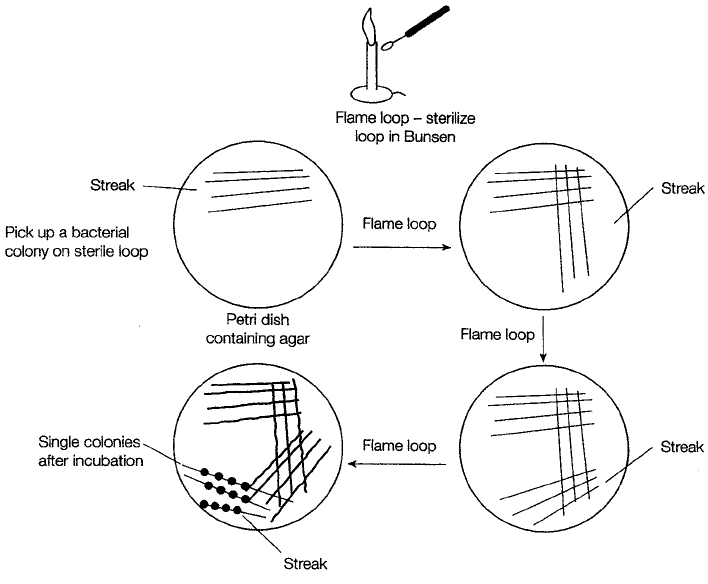
The standard method of obtaining a pure bacterial culture is the creation of a streak
plate (Figure 4.2). A wire inoculating loop is used to spread out a drop of bacterial
suspension on an agar plate in such a way that it becomes progressively more dilute;
JWBK011-04 JWBK011-Hogg August 12, 2005 15:53 Char Count= 0
86 MICROBIAL NUTRITION AND CULTIVATION
Figure 4.2 The streak plate. Streaking the sample across the agar surface eventually results
in individual cells being deposited. Repeated cycles of cell division lead to the production of
visible, isolated colonies. From Nicklin, J, Graeme-Cook, K & Killington, R: Instant Notes
in Microbiology, 2nd edn, Bios Scientific Publishers, 2002. Reproduced by permission of
Thomson Publishing Services
eventually, individual cells will be deposited on the agar surface. Following incubation
at an appropriate temperature, a succession of cell divisions occurs, resulting in the for-
mation of a bacterial colony, visible to the naked eye. Colonies arise because movement
is not possible on the solid surface and all the progeny stay in the same place. A colony
represents, in theory at least, the offspring of a single cell and its members are therefore
genetically identical. (In reality, a clump of cells may be deposited together and give
rise to a colony; this problem can be overcome by repeated isolation and restreaking of
single colonies.)
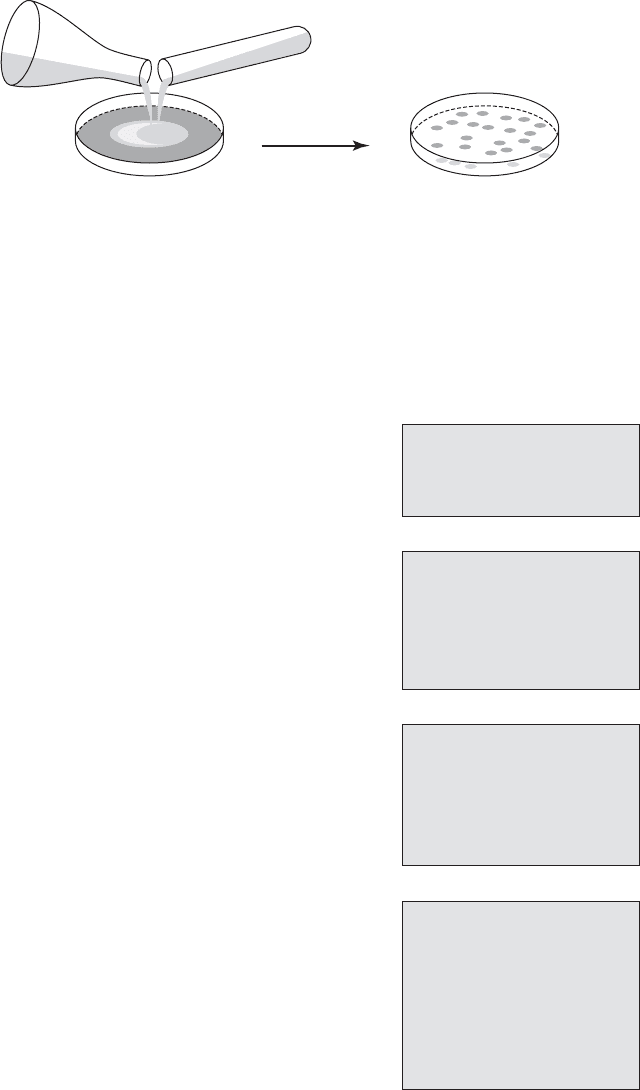
An alternative method for the isolation of pure cultures is the pour plate (Figure 4.3).
In this method, a dilute suspension of bacteria is mixed with warm molten agar, and
poured into an empty petri plate. As the agar sets, cells are immobilised, and once again
their progeny are all kept together, often within, as well as on, the agar. This method
is especially useful for the isolation of bacteria that are unable to tolerate atmospheric
levels of oxygen.
JWBK011-04 JWBK011-Hogg August 12, 2005 15:53 Char Count= 0
LABORATORY CULTIVATION OF MICROORGANISMS 87
Molten
agar
at 45–50°
Colonies grow on
surface and within
agar
Bacterial suspension
Mix, incubate
Figure 4.3 The pour plate. A sample of diluted bacterial suspension is mixed with molten
agar and poured into a petri dish. Most bacteria can tolerate a short exposure to the agar,
which is held at a temperature just above its setting point
Growth media for the cultivation of bacteria
A defined medium is one
whose precise chemical
composition is known.
A synthetic growth medium may be defined, that is, its
exact chemical composition is known, or undefined.A
defined growth medium may have few or many con-
stituents, depending on the nutritional requirements of
An undefined or com-
plex medium is one
whose precise chemi-
cal composition is not
known.
the organism in question. Examples of each are given
in Table 4.3. An undefined or complex medium may
have a variable composition due to the inclusion of
a component such as blood, yeast extract or tap wa-
ter (Table 4.4). Peptones are also commonly found in
complex media; these are the products of partially di-
gesting protein sources such as beef or casein. The
exact composition of a complex medium is neither
A fastidious organism is
unable to synthesise a
range of nutrients and
therefore has complex
requirements in culture.
known nor critically important. A medium of this
type would generally be chosen for the cultivation of
fastidious bacteria such as Neisseria gonorrhoeae (the
causative agent of gonorrhoea); it is easier and less ex-
pensive to supply the many nutrients required by such an
organism in this form rather than supplying them all in-
dividually. Bacteria whose specific nutrient requirements
are not known are also grown on complex media.
A selective medium is
one that favours the
growth of a particular or-
ganism or group of or-
ganisms, often by sup-
pressing the growth of
others.
Whilst media such as nutrient agar are used to sup-
port the growth of a wide range of organisms, others are
specifically designed for the isolation and identification
of particular types. Selective media such as bismuth sul-
phite medium preferentially support the growth of par-
ticular bacteria. The bismuth ion inhibits the growth of
Gram-positive organisms as well as many Gram-negative
types; this medium is used for the isolation of the