
Hogg S. Essential microbiology
Подождите немного. Документ загружается.


JWBK011-04 JWBK011-Hogg August 12, 2005 15:53 Char Count= 0
88 MICROBIAL NUTRITION AND CULTIVATION
Table 4.3 Defined growth media
(a) Medium for Acidithiobacillus ferrooxidans
FeSO
4
.7H
2
O40g
(NH
4
)
2
SO
4
2g
KH
2
PO
4
0.5 g
MgSO
4
.7H
2
O 0.5 g
KCl 0.1 g
Ca(NO
3
)
2
0.01 g
Distilled H
2
O (pH 3.0) to 1 litre
(b) Medium for Leuconostoc mesenteroides
Glucose 25 g Phenylalanine 100 mg
Sodium acetate 20 g Proline 100 mg
NH
4
Cl 3 g Serine 50 mg
KH
2
PO
4
0.6 g Threonine 200 mg
K
2
HPO
4
0.6 g Tryptophan 40 mg
NaCl 3 g Tyrosine 100 mg
MgSO
4
· 7H
2
O 0.2 g Valine 250 mg
MnSO
4
· 4H
2
O 20 mg Adenine 10 mg
FeSO
4
.7H
2
O 10 mg Cytosine 10 mg
Alanine 200 mg Guanine 10 mg
Arginine 242 mg Uracil 10 mg
Aspartic acid 100 mg Nicotinic acid 1 mg
Asparagine 400 mg Pyridoxine 1 mg
Cysteine 50 mg Riboflavin 0.5 mg
Glutamic acid 300 mg Thiamine 0.5 mg
Glycine 100 mg Ca pantothenate 0.5 mg
Histidine 62 mg Pyridoxamine 0.3 mg
Isoleucine 250 mg Pyridoxal 0.3 mg
Leucine 250 mg p-Aminobenzoic acid 0.1 mg
Lysine 250 mg Biotin 1 µg
Methionine 100 mg Folic acid 10 µg
Distilled H
2
O to 1 litre
Examples of defined (synthetic) media for (a) the iron-oxidising bacterium Acidithiobacillus ferrooxidans
and (b) the lactic acid bacterium Leuconostoc mesenteroides. Note how L. mesenteroides must be provided
with numerous amino acids, nucleotides and vitamins as well as glucose as a carbon source, whereas A.
ferrooxidans requires only mineral salts, including reduced iron to act as an energy source.
Table 4.4 Composition of an undefined growth medium
Calf brain infusion 200 g
Beef heart infusion 250 g
Proteose peptone 10 g
Glucose 2 g
NaCl 5 g
Na
2
HPO
4
2.5 g
H
2
O (pH 7.4) To 1 litre
Brain heart infusion broth contains three undefined components. It is
used for the culture of a wide variety of fastidious species, both
bacterial and fungal.

JWBK011-04 JWBK011-Hogg August 12, 2005 15:53 Char Count= 0
TEST YOURSELF 89
pathogenic bacterium Salmonella typhi, one of the few organisms that can tolerate
the bismuth. Specific media called differential media can be used to distinguish be-
tween organisms whose growth they support, usually by means of a coloured indica-
tor. MacConkey agar contains lactose and a pH indicator, allowing the differentiation
A differential medium al-
lows colonies of a partic-
ular organism to be dif-
ferentiated from others
growing in the same cul-
ture.
between lactose fermenters (red colonies) and non-
lactose fermenters (white/pale pink colonies). Many me-
dia act both selectively and differentially; MacConkey
agar, for example, also contains bile salts and the dye
crystal violet, both of which serve to inhibit the growth
of unwanted Gram-positive bacteria. Mannitol salt agar
is also both selective and differential. The high (7.5 per
cent) salt content suppresses growth of most bacteria,
whilst a combination of mannitol and an indicator permits the detection of mannitol fer-
menters in a similar fashion to that just described. Sometimes, it is desirable to isolate an
An enrichment culture
uses a selective medium
to encourage the
growth of an organism
present in low numbers.
organism that is present in small numbers in a large
mixed population (e.g. faeces or soil). Enrichment media
provide conditions that selectively encourage the growth
of these organisms; the use of blood agar in the isolation
of streptococci provides an example of such a medium.
Blood agar can act as a differential medium, in allow-
ing the user to distinguish between haemolytic and non-
haemolytic bacteria (see Chapter 7).
If we are to culture microorganisms successfully in the laboratory, we must provide
appropriate physical conditions as well as providing an appropriate nutrient medium.
In the next chapter, we shall examine how physical factors such as pH and temperature
influence the growth of microorganisms, and describe how these conditions are provided
in the laboratory.
Preservation of microbial cultures
Microbial cultures are preserved by storage at low temperatures, in order to suspend
growth processes. For short periods, most organisms can be kept at refrigerator temper-
ature (around 4
◦
C), but for longer-term storage, more specialised treatment is necessary.
Using deep freezing or freeze-drying, cultures can be kept for many years, and then resur-
rected and re-cultured. Deep freezing requires rapid freezing to −70
◦
Cto−95
◦
C, while
freeze-drying (lyophilisation) involves freezing at slightly less extreme temperatures and
removing the water content under vacuum. Long-term storage may be desirable to avoid
the development of mutations or loss of cell viability.
Test yourself
1 Heterotrophic organisms acquire their carbon in an form, whilst
autotrophic organisms acquire theirs in an
form.
2 Some autotrophs can derive energy from the Sun; these are termed
.

JWBK011-04 JWBK011-Hogg August 12, 2005 15:53 Char Count= 0
90 MICROBIAL NUTRITION AND CULTIVATION
3 The passage of solutes into a cell across a concentration gradient is known
as
.
4 Agar has a high
point and a relatively low point.
5 The use of agar as a setting agent was a crucial step in the development of
techniques.
6 Successive divisions of a single cell lead to the formation of a
on a
solid medium.
7 The chemical composition of an undefined medium is
.
8
organisms must have a wide range of organic nutrients supplied.
9
media encourage the growth of chosen species, whilst
media prevent the growth of unwanted forms.
10
(removal of the water content at low temperatures) is used in the
preservation of microbial cultures.

JWBK011-05 JWBK011-Hogg August 12, 2005 15:56 Char Count= 0
5
Microbial Growth
When we consider growth as applied to a multicellular organism such as a tree, a fish
or a human being, we think in terms of an ordered increase in the size of an individual.
Growth in unicellular microorganisms such as bacteria, yeasts and protozoans, however,
is more properly defined in terms of an increase in the size of a given population.
Biomass is the total amo-
unt of cellular material in
a system.
This may be expressed as an increase in either the number
of individuals or the total amount of biomass. Methods
employed in the measurement of growth of unicellular
microorganisms may be based on either of these. In this
chapter we shall describe some of these methods, before
considering the dynamics of microbial growth and some of the factors that affect it.
Estimation of microbial numbers
Several methods exist for the measurement of bacterial numbers, most of which are also
applicable to the enumeration of other unicellular forms such as yeasts. Such methods
fall into two main categories: those that count total cell numbers, and those that count
viable cells only.
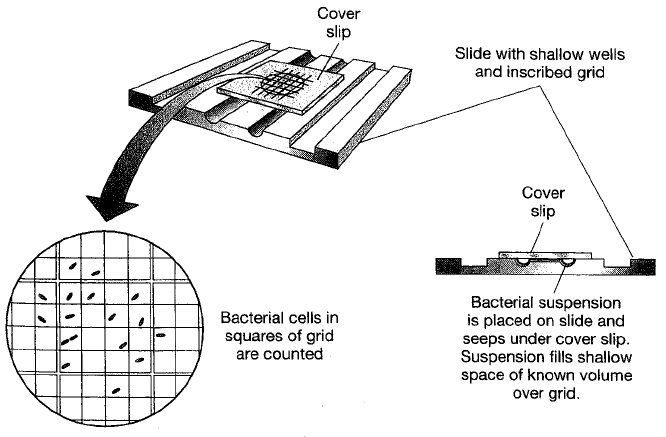
Total cell counts are generally done by direct microscopic examination. A specialised
glass slide is employed, which carries an etched grid of known area (Figure 5.1). The
depth of the liquid sample is also known, so by counting the number of cells visible in
the field of view, the number of cells per unit volume can be determined. The method
may be made more accurate by the use of a fluorescent dye such as acridine orange,
which binds to DNA, and hence avoids confusion with non-cellular debris. However,
such methods cannot differentiate between living and non-living cells. Their usefulness
is further limited by the fact that the smallest bacteria are difficult to resolve as indi-
vidual cells by light microscopy. Other total cell count methods use cell-sorting devices,
originally developed for separating blood cells in medical research. These pass the cell
suspension through an extremely fine nozzle, and a detector registers the conductivity
change each time a particle passes it. Again, no distinction can be made between viable
and non-viable cells.
A viable cell count, on the other hand, is a measure of the number of living cells in a
sample, or more specifically those capable of multiplying and producing a visible colony
of cells. It is most commonly estimated by spreading a known volume of cell suspension
onto an agar plate, and counting the number of colonies that arise after a period of
91
JWBK011-05 JWBK011-Hogg August 12, 2005 15:56 Char Count= 0
92 MICROBIAL GROWTH
Figure 5.1 Estimation of total cell numbers by direct microscopic measurement. The
Petroff-Hauser counting chamber is a specialised glass slide with an etched grid of known
area. A droplet of cell suspension is placed on top, followed by a coverslip. Since the depth of
liquid trapped is known, the volume covering the grid can be calculated. The number of cells
present in several random squares is counted, and an average value obtained. The method
does not distinguish between living and dead cells. From Black, JG: Microbiology: Principles
and Explorations, 4th edn, John Wiley & Sons Inc., 1999. Reproduced by permission of the
publishers
incubation (Box 5.1). The method is based on the premise that each visible colony has
derived from the repeated divisions of a single cell. In reality, it is accepted that this is
not always the case, and so viable counts are expressed in colony-forming units (cfu) ,
rather than cells, per unit volume. It is generally necessary to dilute the suspension before
plating out, otherwise the resulting colonies will be too numerous to count. In order
to improve statistical reliability, plates are inoculated in duplicate or triplicate, and the
mean value is taken.
Viable cell counts can also be made using liquid media, in the most probable number
(MPN) technique (Box 5.2). Here, a series of tubes containing a broth are inoculated
with a sample of a progressively more dilute cell suspension, incubated, and examined
for growth. The method is based on the statistical probability of each sample containing
viable cells. It is well suited to the testing of drinking water, where low bacterial densities
are to be expected.
Another method employed for the enumeration of bacteria in water is the membrane
filter test. Here, a large volume of water is passed through a membrane filter with a
pore size (0.45 µm) suitable for trapping bacteria (Figure 5.2). The filter is placed on an
appropriate solid growth medium and colonies allowed to develop.
None of the methods described above provides a particularly rapid result, yet some-
times it is desirable to have an estimate of bacterial numbers immediately. A useful
JWBK011-05 JWBK011-Hogg August 12, 2005 15:56 Char Count= 0
ESTIMATION OF MICROBIAL NUMBERS 93
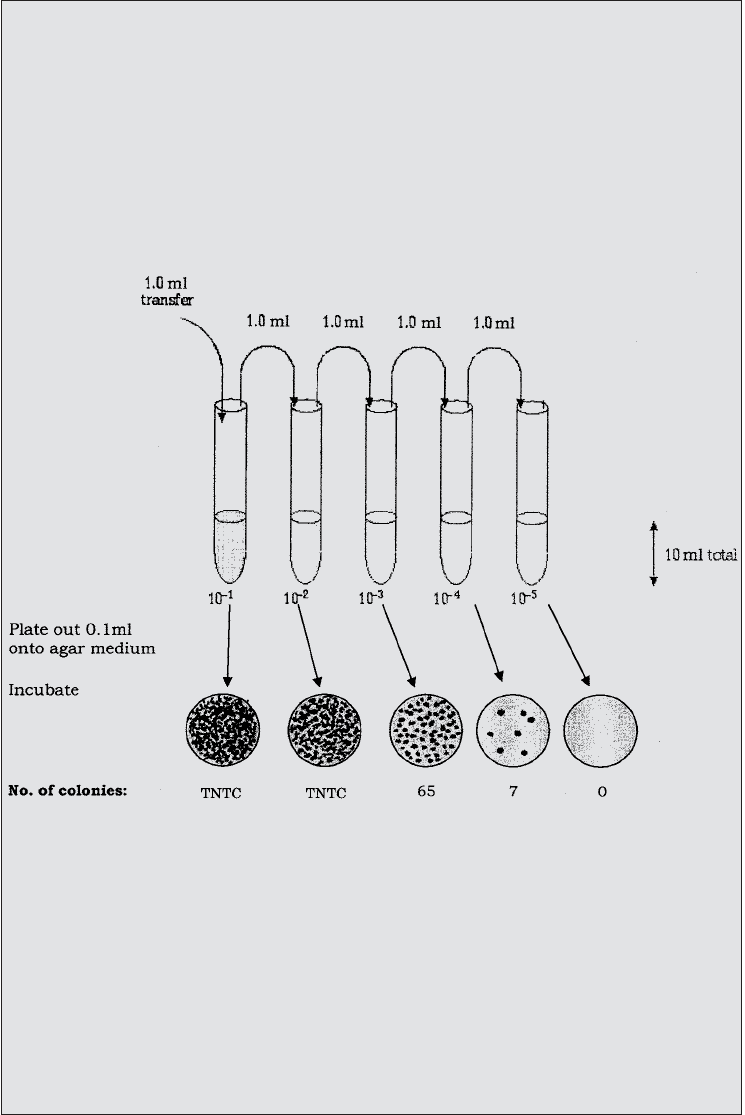
Box 5.1 Estimation of viable cell numbers
In order that the sample to be plated out contains an appropriate number of cells,
the original sample is subjected to serial dilution. In the example below, it is diluted
by a factor of ten at each stage to give a final dilution of 10
−5
(one in a hundred
thousand).
Samples of 0.1 ml of each dilution are plated out on a suitable solid medium and
colonies allowed to develop.
TNTC = too numerous to count
In the earlier tubes, the suspension of cells is too concentrated, resulting in too
many colonies to count. In the final tube, the suspension is so dilute that there are
no cells in the sample taken. The 10
−3
dilution is used to calculate the concentration
of cells in the original culture, as it falls within the range of 30−300 colonies regarded
as being statistically reliable.
Colony count (10
−3
dilution) = 65
∴ Number of cfu per ml diluted suspension = 65 × 10 = 650
∴ Number of cfu per ml original susp’n = 650 × 10
3
= 6.5 × 10
5
JWBK011-05 JWBK011-Hogg August 12, 2005 15:56 Char Count= 0
94 MICROBIAL GROWTH
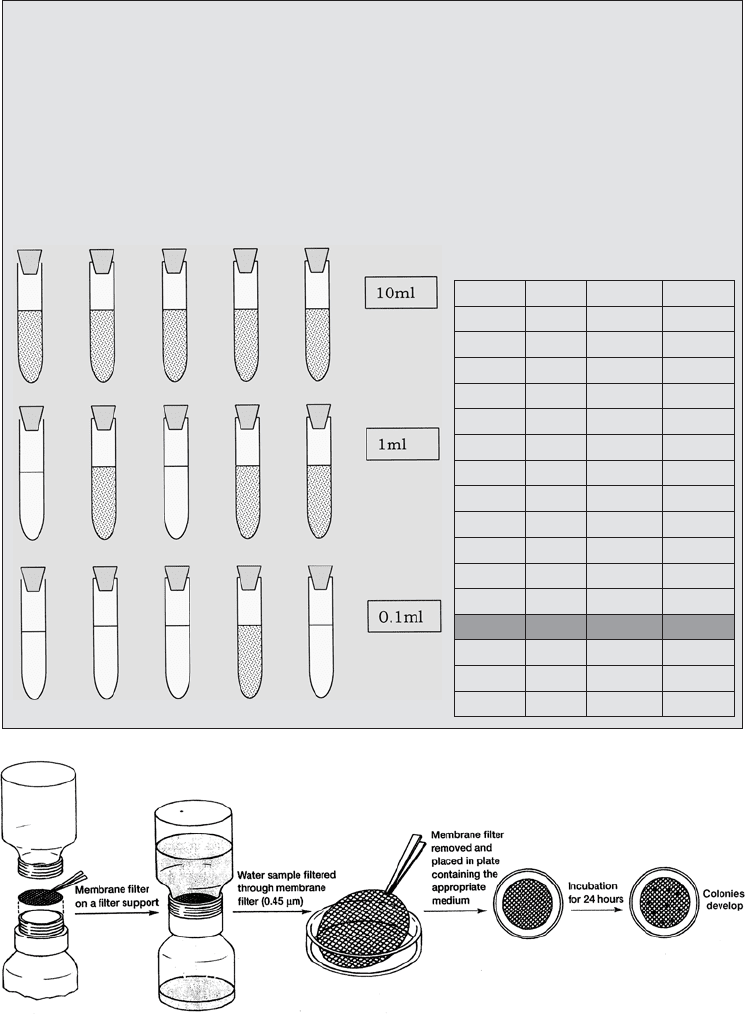
Box 5.2 The most probable number (MPN) method
In the example below, three sets of five tubes of broth were inoculated with 10 ml,
1 ml and 0.1 ml of a water sample. The tubes were incubated to allow any bacteria
present to multiply in number, and were scored as ‘growth’ (dark shading) or ‘no
growth’ (no shading). The cell density statistically most likely to give rise to the result
obtained (5-3-1) is then looked up on a set of MPN tables. The table (only part
shown) indicates that there is a 95% probability that the sample fell within the range
40−300 cells/ml, with 110 cells/ml being the most likely value.
Number of tubes out MPN
of five showing growth /100 ml
10 ml 1ml 0.1 ml
4 3 1 33
4 4 0 34
5 0 0 23
5 0 1 30
5 0 2 40
5 1 0 30
5 1 1 50
5 1 2 60
5 2 0 50
5 2 1 70
5 2 2 90
5 3 0 80
5 3 1 110
5 3 2 140
5 3 3 170
5 4 0 130
Figure 5.2 Estimation of cell numbers by membrane filtration. Microbial cells present in
a water sample are trapped on a membrane, which is then placed on an agar medium to
allow colony development. The technique is used to concentrate the cells present at low
densities in a large volume. From Prescott, LM, Harley, JP & Klein, DA: Microbiology 5th
edn, McGraw Hill, 2002. Reproduced by permission of the publishers
JWBK011-05 JWBK011-Hogg August 12, 2005 15:56 Char Count= 0
ESTIMATION OF MICROBIAL NUMBERS 95
Absorbance
Cell numbers/mass
Relationship no longer
linear at high cell densities
(a)
(b)
Light rays of
specific
wavelength
Light
source
Cell
suspension
Unscattered
light
Some of the light rays
are scattered by the
cell suspension
Photodetector
Digital display of
absorbance value
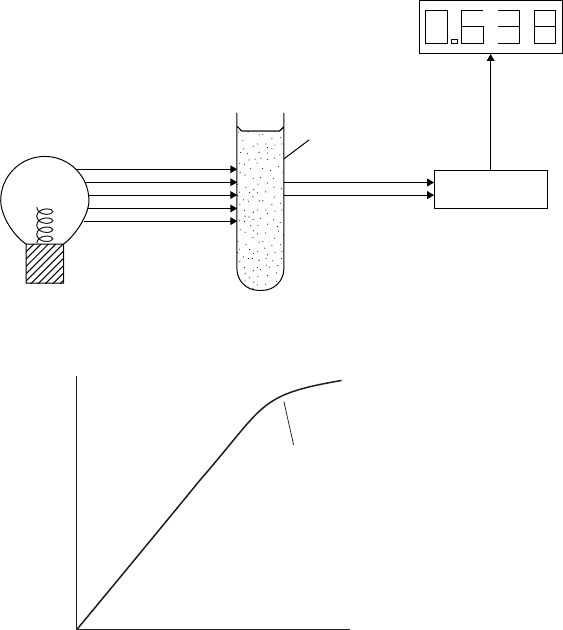
Figure 5.3 Indirect measurement of cell numbers by turbidimetric measurements. (a) Tur-
bidimetry offers an immediate estimate of bacterial density by measuring the degree to which
a culture scatters light shone through it in a spectrophotometer. Absorbance is a measure
of the amount of light scattered by the cell suspension. (b) Within certain limits, there is a
linear relationship between cell numbers and optical density. By determining cell numbers
or cell mass for samples of known optical density, a calibration graph can be produced
method for doing this is based on how cloudy or turbid the liquid growth medium
becomes due to bacterial growth. Turbidimetric methods measure the change in optical
density or absorbance of the medium, that is, how much a beam of light is scattered
by the suspended particulate matter (Figure 5.3). They can be carried out very quickly
by placing a sample in a spectrophotometer. Values of optical density can be directly
related to bacterial numbers or mass by reference to a standard calibration curve. Thus,
an estimate of bacterial numbers, albeit a fairly approximate one, can be obtained
almost instantaneously during an experimental procedure. Other indirect methods of
measuring cell density include wet and dry weight estimations, and the measurement of
cell components such as total nitrogen, protein or nucleic acid.

JWBK011-05 JWBK011-Hogg August 12, 2005 15:56 Char Count= 0
96 MICROBIAL GROWTH
Factors affecting microbial growth
In Chapter 4 we discussed the nutrient requirements of microorganisms. Assuming these
are present in an adequate supply, what other factors do we need to consider in order to
provide favourable conditions for microbial growth? As the following section shows,
growth may be profoundly affected by a number of physical factors.
Temperature
Microorganisms as a group are able to grow over a wide range of temperatures, from
around freezing to above boiling point. For any organism, the minimum and maximum
growth temperatures define the range over which growth is possible; this is typically
about 25–30
◦
C. Growth is slower at low temperatures because enzymes work less
efficiently and also because lipids tend to harden and there is a loss of membrane fluid-
ity. Growth rates increase with temperature until the optimum temperature is reached,
then the rate falls again (Figure 5.4). The optimum and limiting temperatures for an
organism are a reflection of the temperature range of its enzyme systems, which in turn
are determined by their three-dimensional protein structures (see Chapter 6). The op-
timum temperature is generally closer to the maximum growth temperature than the
minimum. Once the optimum value is passed, the loss of activity caused by denatu-
ration of enzymes causes the rate of growth to fall away sharply (see also Figures 6.3
and 6.4).
Optimum
growth
temperature
Decline in growth
rate due to
thermal desaturation
of proteins
Growth rate
Minimum growth
temperature (reduced
enzyme activity and
membrane fundity)
Maximum growth
temperature
Temperature
Figure 5.4 Effect of temperature on microbial growth rate. The factors governing the
minimum, optimum and maximum temperatures for a particular organism are indicated.
The curve is asymmetrical, with the optimum temperature being closer to the maximum
than the minimum

JWBK011-05 JWBK011-Hogg August 12, 2005 15:56 Char Count= 0
FACTORS AFFECTING MICROBIAL GROWTH 97
Growth Rate
Mesophile
Thermophile
Psychrophile
Extreme thermophile
Temperature
(°c)
Figure 5.5 Microorganisms can be categorised according to the temperature range at which
they grow
The majority of microorganisms achieve optimal growth at ‘middling’ temperatures
of around 20–45
◦
C; these are called mesophiles (Figure 5.5). Contrast these with ther-
mophiles, which have become adapted to not only surviving, but thriving at much higher
temperatures. Typically, these would be capable of growth within a range of about
40–80
◦
C, with an optimum around 50–65
◦
C. Extreme thermophiles have optimum
values in excess of this, and can tolerate temperatures in excess of 100
◦
C. In 2003,
a member of the primitive bacterial group called the Archaea (see Chapter 7) was
reported as growing at a temperature of 121
◦
C, a new world record! Psychrophiles
occupy the other extreme of the temperature range; they can grow at 0
◦
C, with optimal
growth occurring at 15
◦
C or below. Such organisms are not able to grow at tem-
peratures above 25
◦
Corso.Psychrotrophs, on the other hand, although they can
also grow at 0
◦
C, have much higher temperature optima (20–30
◦
C). Members of this
group are often economically significant due to their ability to grow on refrigerated
foodstuffs.
In the laboratory, appropriate temperatures for growth are provided by culturing
in an appropriate incubator. These come in a variety of shapes and sizes, but all are
thermostatically controlled and generally hold the temperature within a degree or two
of the desired value.
pH
Microorganisms are strongly influenced by the prevailing pH of their surroundings. As
with temperature, we can define minimum, optimum and maximum values for growth
of a particular type (Figure 5.6). The pH range (between minimum and maximum
values) is greater in fungi than it is in bacteria. Most microorganisms grow best around
neutrality (pH 7). Many bacteria prefer slightly alkaline conditions but relatively few