
Hogg S. Essential microbiology
Подождите немного. Документ загружается.

JWBK011-06 JWBK011-Hogg August 12, 2005 16:0 Char Count= 0
118 MICROBIAL METABOLISM
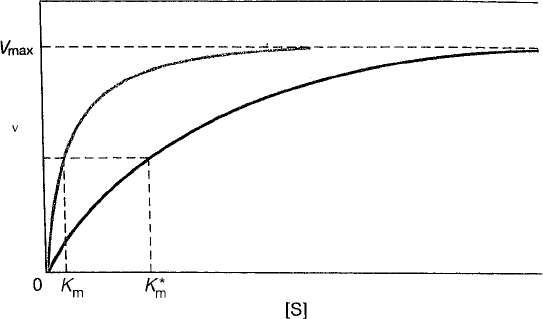
Figure 6.11 Competitive inhibition. In the presence of a competitive inhibitor (lower curve)
V
max
is reached eventually, but the apparent value of K
m
is increased. Since there are fewer
enzyme molecules in circulation, the apparent affinity for its substrate is diminished
The competitive inhibitor is able to act in this way because its molecular structure is
sufficiently similar to that of the substrate for it to be able to fit into the active site. The
effect is competitive because it depends on the relative concentrations of the substrate
and inhibitor. If the inhibitor is only present at a low concentration, its effect will be
minimal, since the number of enzyme–inhibitor interactions will be greatly outweighed
by reactions with the ‘proper’ substrate. The V
max
value for the enzyme is not reduced,
but it is only reached more gradually. The apparent affinity of the enzyme for its substrate
is decreased, reflected by an increase in the K
m
(Figure 6.11).
Not all inhibitors act by competing for the active site, however. Non-competitive
inhibitors act by binding to a different part of the enzyme and in so doing alter its
three-dimensional configuration (Figure 6.10b). Although they do not affect substrate
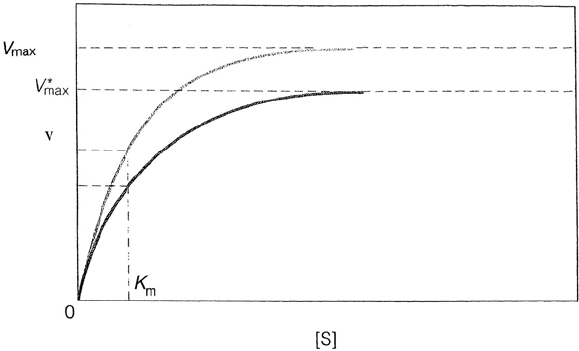
binding, they do reduce the rate at which product is formed. V
max
cannot be reached;
however, the value of K
m
, is unchanged (Figure 6.12). Such inhibitors may bind to either
the enzyme–substrate complex or to free enzyme. Both competitive and non-competitive
forms of inhibition are reversible, since the inhibitor molecule is relatively weakly bound
and can be displaced.
Irreversible inhibition, on the other hand, is due to the formation of a strong covalent
linkage between the inhibitor and an amino acid residue on the enzyme. As a result of its
binding, the inhibitor effectively makes a certain percentage of the enzyme population
permanently unavailable to catalyse substrate conversion.
Principles of energy generation
In this section, we shall consider how enzyme-catalysed reactions are involved in the
cellular capture and utilisation of energy.
Energy taken up by the cell, be it in the form of nutrients or sunlight, must be
converted into a usable form. A simple analogy is selling goods for cash, which you
can then use to buy exactly what you want. The ‘cash’ of cellular metabolism is a
JWBK011-06 JWBK011-Hogg August 12, 2005 16:0 Char Count= 0
PRINCIPLES OF ENERGY GENERATION 119
Figure 6.12 Non-competitive inhibition. Since product is not formed as efficiently in the
presence of a non-competitive inhibitor (lower curve), V
max
is not reached. K
m
is not altered
compound called adenosine triphosphate (ATP). ATP is by far the most important of a
class of compounds known as high-energy transfer compounds, which store the energy
*
from the breakdown of nutrients (or trapped by photosynthetic pigments) and release
it when required by the cell. In catabolic reactions, in which molecules such as glucose
are broken down, energy is released in the form of ATP, which can then be utilised in
anabolic (synthetic) reactions.
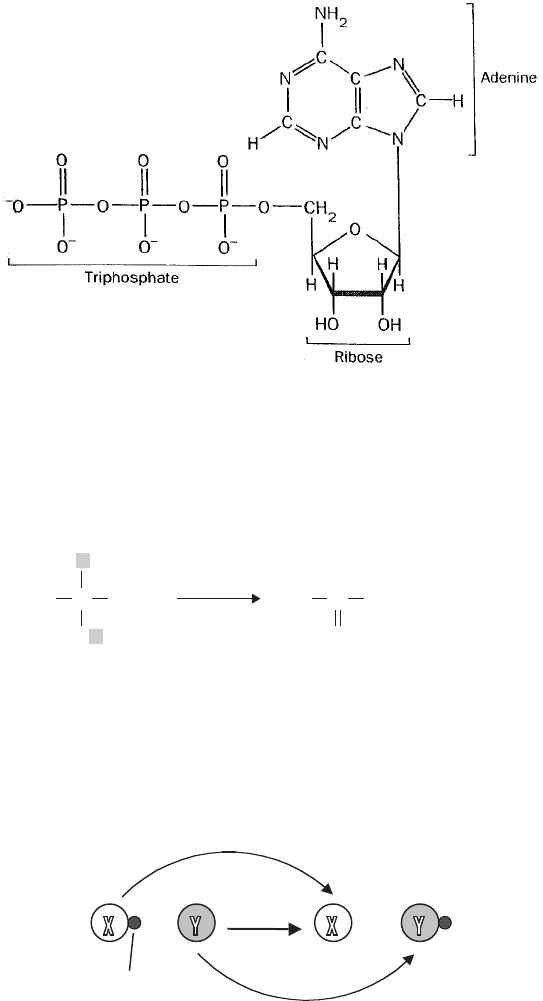
ATP has a structure very similar to the nucleotides found in RNA, except it has
two additional phosphate groups (Figure 6.13). The bond that links the third phos-
phate group requires a lot of energy for its formation, and is often referred to as a
‘high-energy’ phosphate bond. Importantly for the cell, when this bond is broken, the
same large amount of energy is released, so when ATP is broken down to ADP and
a free phosphate group, energy is made available to the cell. It should be noted that
‘high-energy’ refers to the amount of energy needed to make or break the bond, and
not to any intrinsic property of the bond itself. The process of adding or removing a
phosphate group is called phosphorylation or dephosphorylation, respectively.
Oxidation--reduction reactions
Many metabolic reactions involve the transfer of electrons from one molecule to another;
these are called oxidation-reduction or redox reactions. When a molecule (or atom or
ion) loses an electron, it is said to be oxidized. (Note, that despite the terminology,
oxygen does not necessarily take part in the reaction.) Conversely, when an electron is
gained, the recipient is reduced (Figure 6.14).
Many metabolic reactions involve the loss of a hydrogen atom; since this contains one
proton and one electron, the reaction is regarded as an oxidation, because an electron
*
Not all of the energy is converted into ATP. A proportion of it is lost as heat, some of which allows the
enzyme-mediated reactions to proceed at a faster rate.
JWBK011-06 JWBK011-Hogg August 12, 2005 16:0 Char Count= 0
120 MICROBIAL METABOLISM
Figure 6.13 Adenosine triphosphate (ATP). ATP is a nucleotide such as similar to those
depicted in Figures 2.20 and 2.21. Note the extra phosphate groups
has been lost:
C
OH
H
H
3
C COO
–
C
O
H
3
C COO
–
+ 2H
+
+2e
–
Lactate Pyruvate
The lactate in the example above, by losing two hydrogen atoms, has automatically
lost two electrons and thus become oxidised to pyruvate. Oxidation reactions are
Reduction
electron
Oxidation
Figure 6.14 Oxidation–reduction reactions. When one molecule is oxidised, another is
simultaneously reduced. In the example shown, ‘X’ loses an electron and thus becomes
oxidised. By receiving the electron, ‘Y’ becomes reduced
JWBK011-06 JWBK011-Hogg August 12, 2005 16:0 Char Count= 0
PRINCIPLES OF ENERGY GENERATION 121
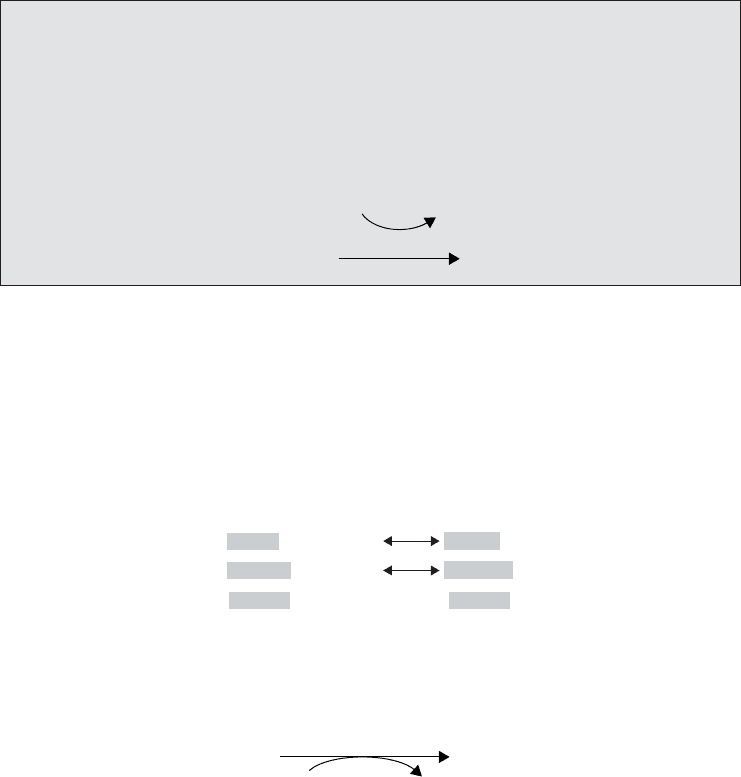
Box 6.1 Coupled reactions
Many reactions in metabolic pathways, including glycolysis, can only take place if
they are coupled to a secondary reaction. The oxidising power necessary for the
conversion of glyceraldehyde-3-phosphate into 1,3-diphosphoglycerate in step 6 of
glycolysis for example, is provided by the coenzyme NAD
+
. In the coupled reaction,
this becomes oxidised to NADH:
NAD
+
NADH
Glyceraldehyde-3-phosphate 1, 3-diphosphoglycerate
always associated with the transfer of energy from the oxidised substance to the reduced
substance.
Two important molecules that we shall encounter a number of times in the following
pages are the coenzymes nicotinamide adenine dinucleotide and nicotinamide adenine
dinucleotide phosphate; you will be relieved to learn that they are nearly always referred
to by their abbreviations, NAD
+
and NADP
+
, respectively! Both are derivatives of the
B vitamin niacin, and each can exist in an oxidised and a reduced form:
NAD
+
+ H
+
+ 2e
–
NADH
NADP
+
+ H
+
+ 2e
–
NADPH
Oxidised Reduced
They are to be found associated with redox reactions (see Box 6.1), acting as carrier
molecules for the transfer of electrons. In the oxidation of lactate shown above, the
oxidising power is provided by the reduction of NAD
+
, so the full story would be:
Lactate Pyruvate
NAD
+
NADH + H
+
As the lactate is oxidised, so the NAD
+
in the coupled reaction is reduced. It is said to
act as the electron acceptor. NAD
+
/NADH is generally involved in catabolic reactions,
and NADP
+
/NADPH in anabolic ones.
As the equation above shows, there can be no oxidation without reduction, and vice
versa; the two are irrevocably linked. The tendency of an compound to lose or gain
electrons is termed its redox potential (E
o
) (Box 6.2).
In the following section, we shall examine chemoheterotrophic metabolism, used by
the majority of microorganisms to derive cellular energy from the oxidation of carbo-
hydrates. Other groups have evolved their own systems of energy capture, and these
will be considered later in the chapter.
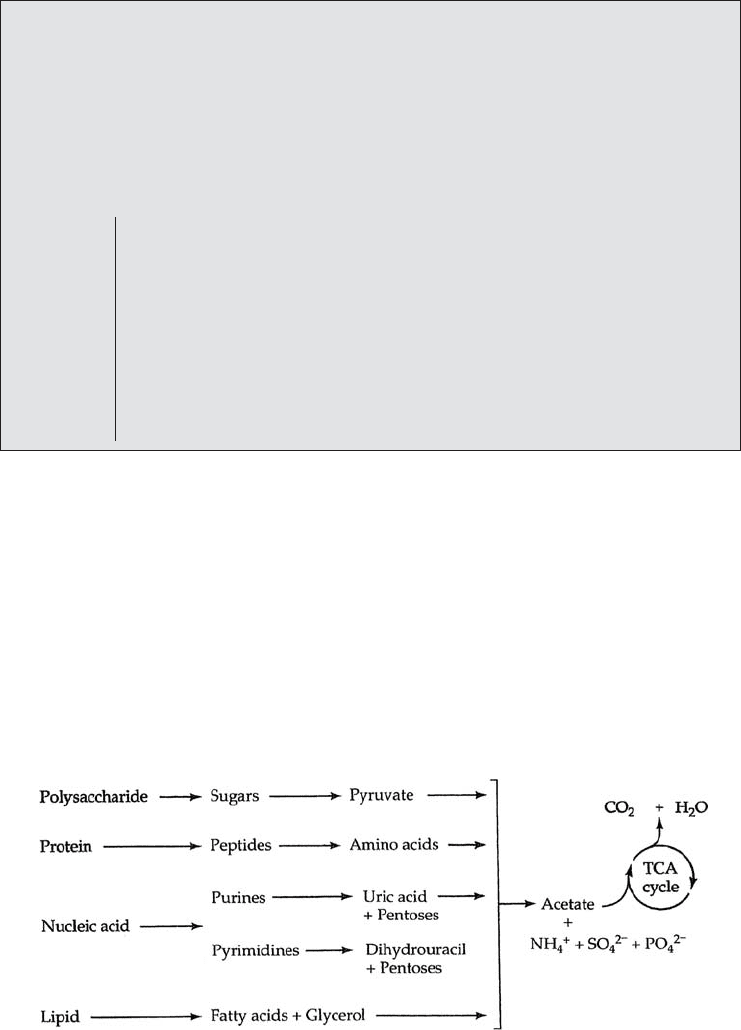
Figure 6.15 provides a summary of the catabolic (breakdown) pathways used
by heterotrophs. Complex nutrients such as proteins and polysaccharides must be
JWBK011-06 JWBK011-Hogg August 12, 2005 16:0 Char Count= 0
122 MICROBIAL METABOLISM
Box 6.2 Redox potentials
Substances vary in the affinity they have for binding electrons; this can be measured
as their oxidation--reduction potential or redox potential, relative to that hydrogen.
The flow of electrons in the electron transport chain (see Fig. 6.21) occurs because
the carriers are arranged in order of their redox potentials, with each having a
greater electron affinity (more positive redox potential) than its predecessor. Thus
electrons are donated to carriers with a more positive redox potential.
−
Strongly negative redox potential
(Good electron donors)
Reduction
Potential
0
+ Strongly positive redox potential
(Good electron acceptors)
enzymatically broken down and converted to substances that can then enter one of the
degradative pathways that lead to energy production.
Glucose is the carbohydrate most widely used as an energy source by cells, and the
processes by which it is broken down in the presence of oxygen to give carbon dioxide
and water are common to many organisms. These have been very thoroughly studied
and can be summarised:
C
6
H
12
O
6
+ 6O
2
−→ 6CO
2
+ 6H
2
O
Figure 6.15 Catabolic pathways in heterotrophs. Pathways for the catabolism of proteins,
nucleic acids and lipids as well as carbohydrates can all feed into the tricarboxylic acid cycle
JWBK011-06 JWBK011-Hogg August 12, 2005 16:0 Char Count= 0
PRINCIPLES OF ENERGY GENERATION 123
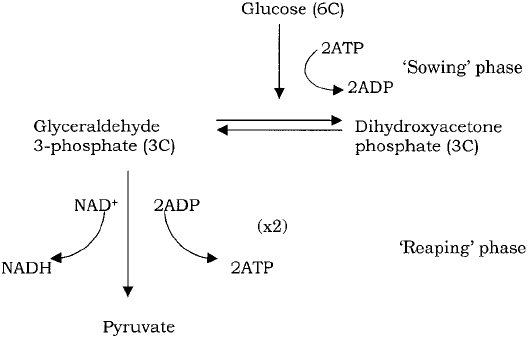
Figure 6.16 Glycolysis. Two molecules of ATP are ‘spent’ in the first stage of glycolysis, in
which glucose is converted into the 3-carbon compounds glyceraldehyde 3-phosphate and
dihydroxyacetone phosphate. During the second stage, four ATPs are produced per molecule
of glucose, so there is a net gain of two ATPs. In addition, reducing power is generated in the
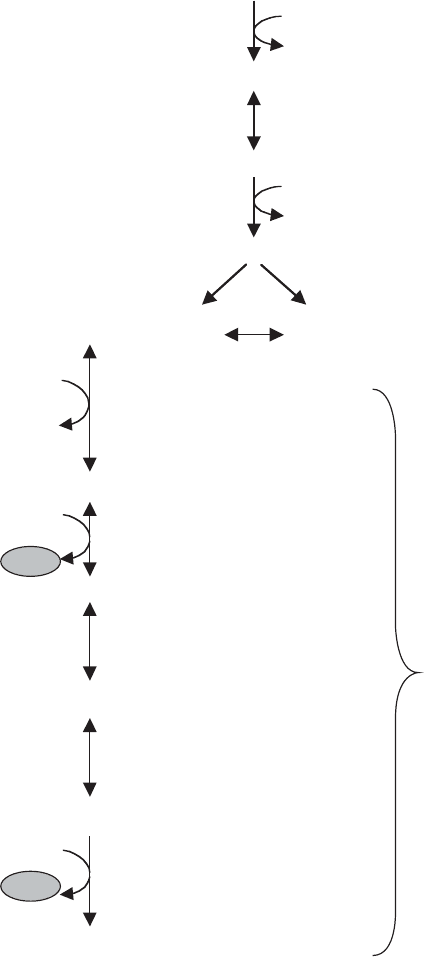
form of NADH (two molecules per molecule of glucose). See Figure 6.17 for a more detailed
depiction of the reactions involved in glycolysis
What this equation, crucially, does not show is that as a result of this process, energy is
released, and stored in the form of 38 molecules of ATP, so for completeness, we need
to add to the respective sides:
38ADP + 38Pi −→ 38ATP
(Pi = inorganic phosphate group)
The release of the energy contained within a molecule of glucose does not occur in a sin-
gle reaction, but happens gradually, as the result of numerous reactions linked together
in biochemical pathways, the first of which is glycolysis (Figure 6.16). Glycolysis can
occur with or without oxygen, and is common to both aerobic and anaerobic organ-
isms. Oxygen is essential, however, for aerobic respiration, by which ATP is generated
from the products of glycolysis. Anaerobes proceed down their own pathways follow-
ing glycolysis as we shall see, but these lack the ATP-generating power of the aerobic
process.
Why glucose?
By concentrating on glucose catabolism in this way, you may think we are ignoring the
fate of other nutrient molecules. If you take another look at Figure 6.15, however, you
will notice that the breakdown products of lipids, proteins and nucleic acids also find
their way into our pathway sooner or later, having undergone transformations of their
own.
JWBK011-06 JWBK011-Hogg August 12, 2005 16:0 Char Count= 0
124 MICROBIAL METABOLISM
Glycolysis
The initial sequence of reactions, in which a molecule of glucose is converted to two
molecules of pyruvate
∗
, is called glycolysis (Figures 6.16 and 6.17). In the first phase
of glycolysis, glucose is phosphorylated and its six-carbon ring structure rearranged,
before being cleaved into two three-carbon molecules. In the second phase, each of
these undergoes oxidation, resulting in pyruvate.
Also known as the Embden–Meyerhof pathway, glycolysis is used for the metabolism
of simple sugars not just by microorganisms, but by most living cells. The pathway,
which takes place in the cytoplasm, comprises a series of 10 linked reactions, in which
each molecule of the six-carbon glucose is converted to two molecules of the three-
carbon pyruvate, with a net gain of two molecules of ATP.
The full pathway of reactions is shown in Figure 6.17. Note how, in terms of energy,
glycolysis can be divided conveniently into a ‘sowing’ phase, in which two molecules of
ATP are expended per molecule of glucose, followed by a ‘reaping’ phase which yields
four molecules of ATP. The overall energy balance is therefore a gain of two molecules
of ATP for each molecule of glucose oxidised to pyruvate. In addition, the second phase
features the conversion of two molecules of NAD
+
to NADH, which, as we will see,
act as an important source of reducing power in subsequent pathways.
The reactions by which ATP is generated from ADP in the second phase of glycolysis
are examples of substrate-level phosphorylation, so-called because the phosphate group
is transferred directly from a donor molecule.
What happens next to the pyruvate produced by glycolysis depends on the organism
concerned, and on whether the environment is aerobic or anaerobic; we shall look at
these possibilities in due course.
Glycolysis is not the only way to metabolise glucose
Although glycolysis is widespread in both the microbial and nonmicrobial worlds, sev-
eral bacterial types use alternative pathways to oxidise glucose. For certain Gram-
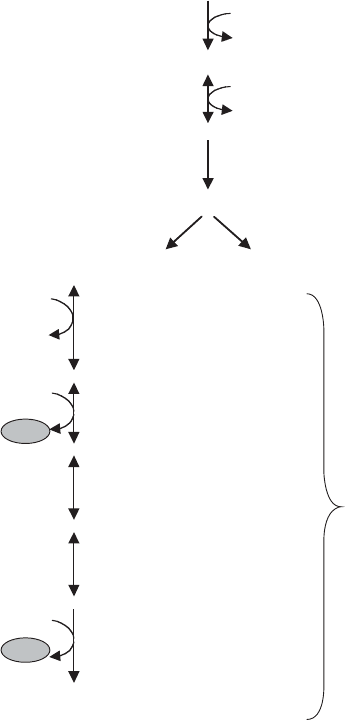
negative groups, notably the pseudomonads (see Chapter 7), the main route used is
the Entner–Doudoroff pathway, producing a mixture of pyruvate and glyceraldehyde-
3-phosphate (Figure 6.18). The former, like that produced in glycolysis, can enter a
number of pathways, while the latter can feed into the later stages of glycolysis. The
net result of catabolism by the Entner–Doudoroff pathway is the production of one
molecule each of ATP, NADH and NADPH per molecule of glucose degraded.
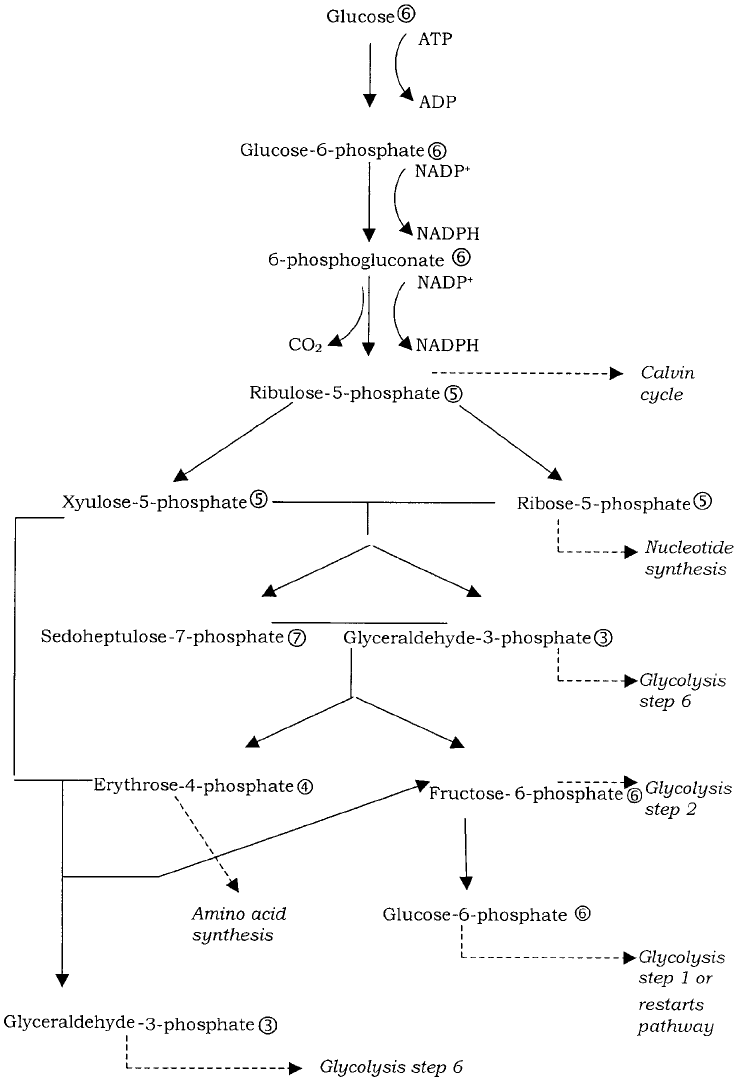
A secondary pathway, which may operate in tandem with glycolysis or the Entner–
Doudoroff pathway, is the pentose phosphate pathway, sometimes known as the hexose
monophosphate shunt (Figure 6.19). Like glycolysis, the pathway can operate in the
presence or absence of oxygen. Although glyceraldehyde-3-phosphate can once again
enter the glycolytic pathway and lead to ATP generation, for most organisms the path-
way has a mainly anabolic (biosynthetic) function, acting as a source of precursor
molecules for other metabolic pathways. The pentose phosphate pathway is a useful
∗
At physiological pH, carboxylic acids such as pyruvic acid and citric acid are found in their ionised form
(pyruvate, citrate); however long-established traditions persist, and you may well find reference elsewhere to
the ‘-ic acid’ forms.
JWBK011-06 JWBK011-Hogg August 12, 2005 16:0 Char Count= 0
PRINCIPLES OF ENERGY GENERATION 125
Glucose
ATP
hexokinase
ADP
Glucose 6-phosphate
phosphohexose
isomerase
Fructose 6-phosphate
ATP
phosphofructokinase
ADP
Fructose 1,6-bisphosphate
Glyceraldehyde Dihydroxyacetone
3-phosphate phosphate
triose phosphate
isomerase
NAD
+
glyceraldehyde 3-phosphate
NADH dehydrogenase
1,3-Bisphosphoglycerate
ADP
phosphoglycerate
ATP
kinase
3-Phosphoglycerate
phosphoglycerate
mutase
x 2
2-Phosphoglycerate
enolase
Phosphoenolpyruvate
ADP
pyruvate kinase
ATP
Pyruvate
Figure 6.17 Glycolysis: a more detailed look. Glycolysis comprises 10 separate enzyme-
catalysed reactions. Of the two 3-carbon compounds formed in the first stage, dihydroxyace-
tone phosphate cannot directly enter the later part of the pathway, but must first be converted
to its isomer glyceraldehyde-3-phosphate. For each molecule of glucose, two molecules of
each compound are therefore produced from this point onwards, and the yield of ATP and
NADH is likewise doubled
JWBK011-06 JWBK011-Hogg August 12, 2005 16:0 Char Count= 0
126 MICROBIAL METABOLISM
Glucose
ATP
ADP
Glucose 6-phosphate
NADP
+
NADPH
6-Phosphogluconate
2-keto 3-deoxy-6-phosphogluconate
Glyceraldehyde
Pyruvate
3-phosphate
NAD
+
NADH
ADP
ATP
Steps 6–10 of glycolysis (x 2)
ADP
ATP
Pyruvate
Figure 6.18 The Entner–Doudoroff pathway: an alternative way to metabolise glucose.
The products of the pathway are pyruvate and glyceraldeyde-3-phosphate (G3-P). There is
a loss of one molecule of ATP in the opening reaction, however when the G3-P joins the
later stages of glycolysis, two ATPs are generated, giving a net balance of +1. In addition,
the pathway yields one molecule each of NADH and NADPH. The intermediate compound
6-phosphogluconate can enter the pentose phosphate pathway and be decarboxylated to the
5-carbon compound ribulose-5-phosphate (see Figure 6.19)
source of reducing power in the form of NADPH. In addition it acts as an important
source of precursors in the synthesis of essential molecules; ribose-5-phosphate is an
important precursor in the synthesis of nucleotides, while the four-carbon erythrose
4-phosphate is required for the synthesis of certain amino acids and ribulose-5-
phosphate is an intermediate in the Calvin cycle of carbon fixation (see later in this
chapter).
JWBK011-06 JWBK011-Hogg August 12, 2005 16:0 Char Count= 0
Figure 6.19 The pentose phosphate pathway. Operating simultaneously with glycolysis,
the pathway serves as a source of precursors for other metabolic pathways. The metabolic
fate of intermediates is indicated in italics. Circled numbers next to each molecule denote
the number of carbons
127