
Hogg S. Essential microbiology
Подождите немного. Документ загружается.

JWBK011-11 JWBK011-Hogg August 12, 2005 19:21 Char Count= 0
278 MICROBIAL GENETICS
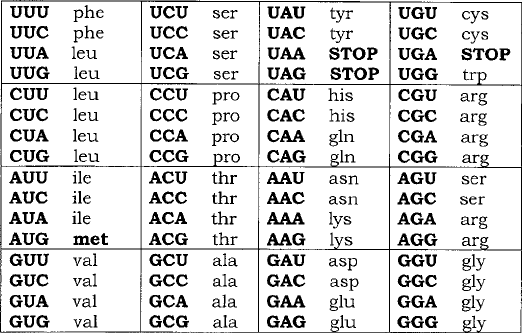
Figure 11.6 The genetic code. Apart from methionine and tryptophan, all amino acids can
be coded for by more than one triplet codon (for some, e.g. leucine, there may be as many as
six). The code is thus said to be degenerate. Three of the triplet sequences are stop codons,
and represent the point at which translation of the mRNA message must end. Translation
always begins at an AUG codon, meaning that newly-synthesised proteins always begin with
a methionine residue. See Box 2.4 for full names of amino acids
three nucleotides) may become disrupted. This would lead to a completely inappropriate
sequence of amino acids being produced. Frameshift mutations (see below) have this
effect. Since there are only 20 amino acids to account for, it follows that the genetic code
is degenerate, that is, a particular amino acid may be coded for by more than one triplet.
Amino acids such as serine and leucine are encoded by as many as six alternatives each,
whilst tryptophan and methionine are the only amino acids to have just a single codon
(Figure 11.6).
Transcription in procaryotes
In the first phase of gene expression, one strand of DNA acts as a template for the
production of a complementary strand of RNA. In the outline that follows, we shall
describe how mRNA is synthesised, but remember that sometimes the product of tran-
scription is rRNA or tRNA. An important point to note is that the coding strand is not
the same for all genes; some are encoded on one strand, some on the other. Whereas
in DNA replication the whole molecule is copied, an RNA transcript is made only of
specific sections of DNA, typically single genes. The enzyme RNA polymerase, unlike
DNA polymerase, is able to use completely single-stranded material, that is, no primer
is required. It is able to synthesise an mRNA chain from scratch, according to the coded
sequence on the template, and working in the 5
to 3
direction (Figure 11.7). In order
to do this the RNA polymerase needs instructions for when to start and finish. First,
it recognises a short sequence of DNA called a promoter, which occurs upstream of a
gene. A protein cofactor called sigma (σ ) assists in attachment to this, and is released
JWBK011-11 JWBK011-Hogg August 12, 2005 19:21 Char Count= 0
WHAT EXACTLY DO GENES DO? 279
Promoter Terminator
RNA polymerase
a)
b)
3’
5’
5’
mRNA
c)
d)
3’
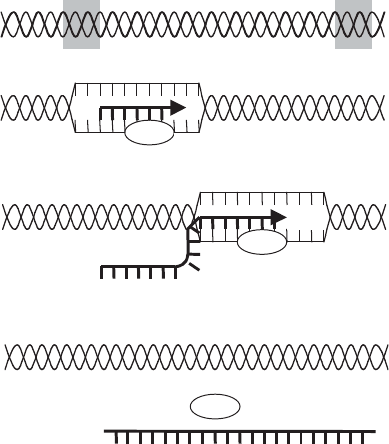
Figure 11.7 Transcription in procaryotes. (a) The gene to be transcribed is flanked by
a promoter and a terminator sequence. (b) Following localised unwinding of the double-
stranded DNA, one strand acts as a template for RNA polymerase to make a complementary
copy of mRNA. (c) The mRNA is extended; only the most recently copied part remains
associated with the DNA. (d) After reaching the termination sequence, both RNA polymerase
and newly synthesised mRNA detach from the DNA, which reverts to its fully double-
stranded state
again shortly after transcription commences. The promoter tells the RNA polymerase
where transcription should start, and also on which strand. The efficiency with which a
promoter binds the RNA polymerase determines how frequently a particular gene will
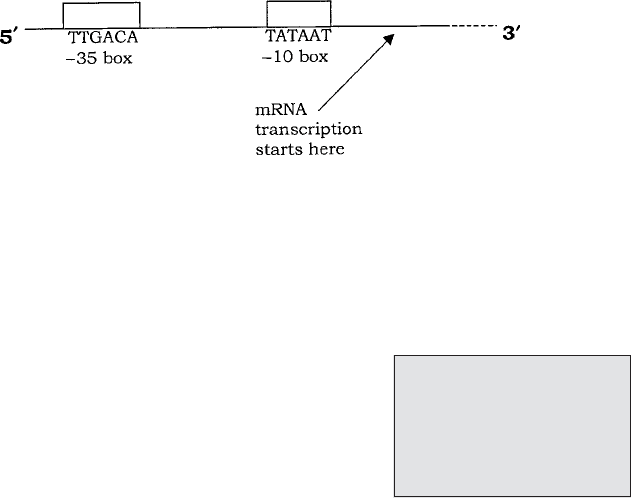
be transcribed. The promoter comprises two parts, one 10 bases upstream (known as
the Pribnow box), and the other 35 bases upstream (Figure 11.8). RNA polymerase
binds to the promoter, and the double helix of the DNA is caused to unwind a little
at a time, exposing the coding sequence on one strand. Ribonucleotides are added one
by one to form a growing RNA chain, according to the sequence on the template; this
occurs at a rate of some 30–50 nucleotides per second. Remember from Chapter 2 that
RNA has uracil rather than thymine, so that a ‘U’ is incorporated into the mRNA when-
ever an ‘A’ appears on the template. Transcription stops when a terminator sequence is
recognised by the RNA polymerase; both the enzyme and the newly synthesised mRNA
are released. Unlike the promoter sequence, the terminator is not transcribed. Some
termination sequences are dependent on the presence of a protein called the rho factor
(ρ). Groups of bacterial proteins having related functions may have their genes grouped
together. Only the last one has a termination sequence, so a single, contiguous mRNA
is produced, encoding several proteins (polycistronic mRNA).
JWBK011-11 JWBK011-Hogg August 12, 2005 19:21 Char Count= 0
280 MICROBIAL GENETICS
Figure 11.8 The promoter sequence in E. coli. RNA polymerase attaches at a point 35 nu-
cleotides upstream of the start of transcription; as the DNA unwinds, it binds to the Pribnow
box, situated at −10 nucleotides. The actual sequences may differ from gene to gene; the
sequences shown in the figure are consensus sequences. Note: only the non-template DNA
strand is shown
Eucaryotic genes gener-
ally contain non-coding
sequences (introns) in
between the coding se-
quences (exons).
Transcription in eucaryotes proceeds along similar
lines, but with certain differences. The most important of
these is that in eucaryotes, the product of transcription
does not act directly as mRNA, but must be modified
before it can undergo translation. This is because of the
presence within eucaryotic genes of DNA sequences not
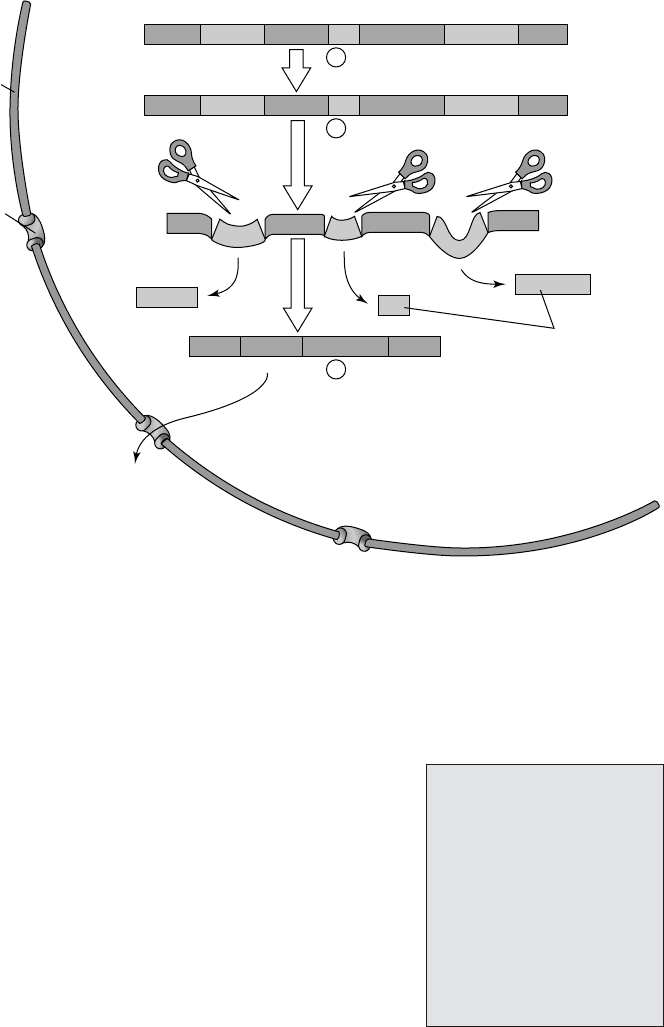
involved in coding for amino acids. These are called in-
trons (c.f. coding sequences = exons), and are removed to give the final mRNA by a
process of RNA splicing (Figure 11.9).
Translation
The message encoded in mRNA is translated into a sequence of amino acids at the
ribosome. The ribosomes are not protein-specific; they can translate any mRNA to
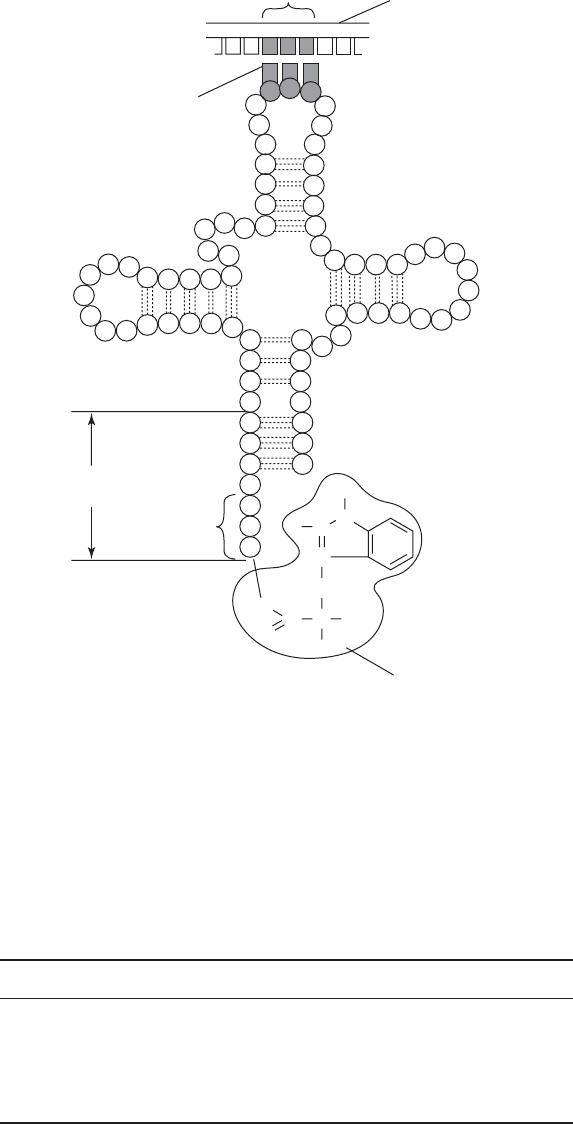
synthesise its protein. Amino acids are brought to the ribosome by a transfer RNA
(tRNA) molecule. Each tRNA acts as an adaptor, bearing at one end the complementary
sequence for a particular triplet codon, and at the other the corresponding amino acid
(Figure 11.10). It recognises a specific codon and binds to it by complementary base
pairing, thus ensuring that the appropriate amino acid is added to the growing peptide
chain at that point. Enzymes called aminoacyl-tRNA synthetases ensure that each tRNA
is coupled with the correct amino acid in an ATP-dependent process.
There is at least one type of tRNA for each amino acid, each with a three base
anticodon, enabling it to bind to the complementary triplet sequence on the mRNA.
However, there is not a different anticodon for each of the 61 possible codons, in fact
there are less than 40. To explain this, the wobble hypothesis proposed that certain
non-standard pairings are allowed between the third nucleotide of the codon and the
first of the anticodon (Table 11.1). This means that a single anticodon may pair with
more than one codon (Figure 11.11).
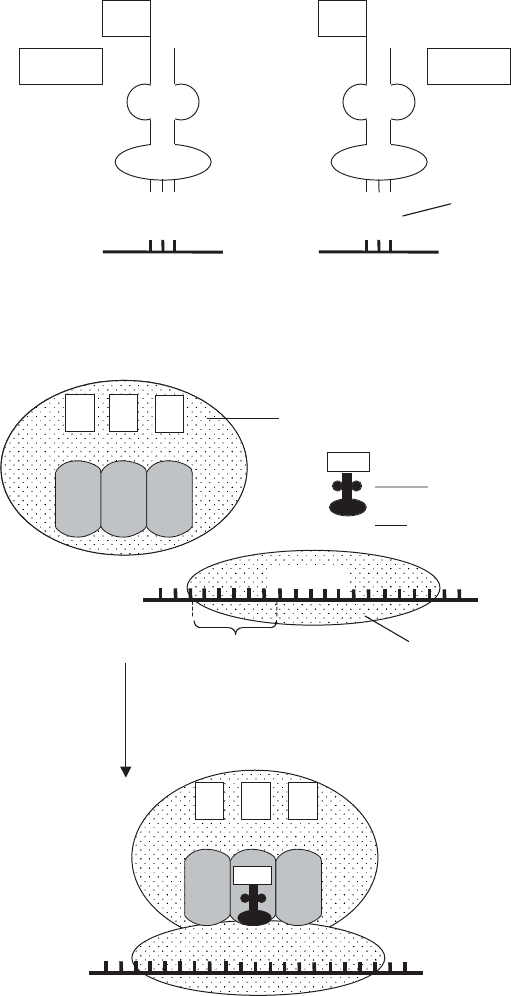
Translation starts when the small ribosomal subunit binds to a specific sequence
on the mRNA upstream of where translation is to begin. This is the ribosome bind-
ing site; in procaryotes this sequence is AGGAGG (the Shine–Dalgarno sequence).
JWBK011-11 JWBK011-Hogg August 12, 2005 19:21 Char Count= 0
WHAT EXACTLY DO GENES DO? 281
EI I IEE E
EI I IEE E
E
EE E E
I
I
I
I
I
I
E
E
E
mRNA
transcript
Eukaryotic
DNA
Entire gene (both introns and exons) is
transcribed to RNA by RNA polymerase enzymes
Processing enzymes remove introns
Exons are spliced together, without
introns, forming mRNA that can pass
through the nuclear membrane into
the cytoplasm and be translated.
Note that while introns were transcribed,
they will not be translated.
Excised
introns
Nucleus
Cytoplasm
Nuclear
membrane
Pore in
nuclear
membrane
C
B
A
Figure 11.9 Eucaryotic genes contain non-coding sequences. The product of transcription
(primary RNA transcript) cannot act as mRNA because it contains sequences that do not
code for the final polypeptide. These introns must be removed and the remaining coding
sequences (exons) spliced together to give the mature mRNA. From Black, JG: Microbiol-
ogy: Principles and Explorations, 4th edn, John Wiley & Sons Inc., 1999. Reproduced by
permission of the publishers
The initial amino acid in
the chain is always a
methionine, correspon-
ding to the AUG start
codon. In procaryotes
there is a modified form
called formylmethionine
(fMet); a special tRNA
carries it to the initiation
site.
This sets the ribosome in the correct reading frame to
read the message encoded on the mRNA. A tRNA car-
rying a formylmethionine then binds to the AUG start
codon on the mRNA. The large ribosomal subunit joins,
and the initiation complex is complete (Figure 11.12).
Proteins called initiation factors help to assemble the ini-
tiation complex, with energy provided by GTP.
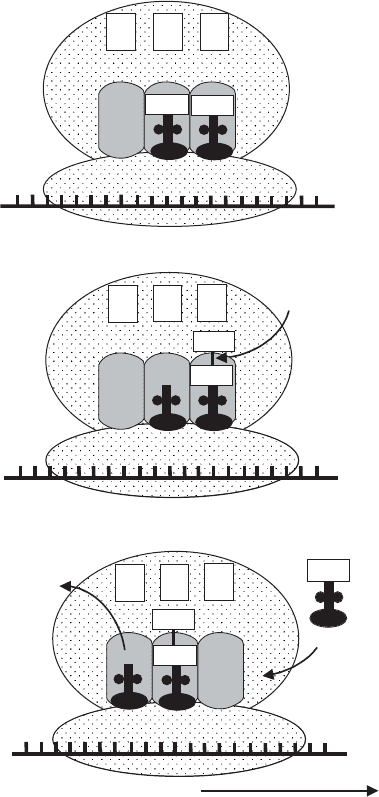
The positioning of the large subunit means that the
initiation codon (AUG) fits into the P-site, and the next
triplet on the mRNA is aligned with the A-site. Elon-
gation of the peptide chain (Figure 11.13) starts when
a second tRNA carrying an amino acid is added at the
A-site. Peptidyl transferase activity breaks the link between the first amino acid and its
tRNA, and forms a peptide bond with the second amino acid. The catalytic action is due
partly to the ribozyme activity of the large subunit rRNA. The ribosome moves along
JWBK011-11 JWBK011-Hogg August 12, 2005 19:21 Char Count= 0
282 MICROBIAL GENETICS
UGG
X
U
C
C
G
A
X
G
C
U G U
A C
A
G
C
C
U
G
G
A
G
G
U
C
X
A
ACC
X
U
C
A
G
A
C
C
G
C
G A G
C X C
A
A
G
G
G
X
X
G
G
A
U
UA
U
A
AU
G
G
C
G
U
C
G
C
A
C
C
A
Acceptor
arm
Amino acid
binding site
H
H
N
C
C
C
C
O
O
H
CH
2
NH
2
3′
5′
X = unusual or
modified bases
Amino acid (Trp)
5′ 3′
Anticodon
mRNA
Codon
Figure 11.10 Transfer RNA. The single-stranded tRNA adopts its characteristic clover-
leaf appearance due to partial base pairing between complementary sequences. The molecule
contains some modified nucleotides such as inosine and methylguanosine. Transfer RNA acts
as an adaptor between the triplet codon on the mRNA and the corresponding amino acid
(tryptophan in the example shown). It base-pairs with the mRNA via a complementary
anticodon, thus bringing the amino acid into position for incorporation into the growing
peptide chain. From Black, JG: Microbiology: Principles and Explorations, 4th edn, John
Wiley & Sons Inc., 1999. Reproduced by permission of the publishers
Table 11.1 The Wobble Hypothesis: Permitted Pairings and Mispairings
1
st
Anticodon Base 3
rd
Codon Base
CG
AU
U A or G
G U or C
I (inosine) U, C or A
JWBK011-11 JWBK011-Hogg August 12, 2005 19:21 Char Count= 0
WHAT EXACTLY DO GENES DO? 283
Ser
mRNA 5’
UCG
3’
AGC
UCG
A
GU
3’
5’
Ser
Non-
standard
pairing
Normal Wobble
tRNA
Figure 11.11 The wobble hypothesis. The codons AGC and AGU each encode the amino
acid serine. Both can be ‘read’ by the same tRNA anticodon due to the non-standard ‘wobble’
pairing allowed at the codon’s final base.
U A C
A U G
30s
subunit
A U G
fMet
mRNA 5’
tRNA
E
P
A
50s
subunit
Shine Dalgarno sequence
3’
U A C
Anticodon
P
E
A
3’
5’
fMet
Figure 11.12 Translation: formation of the initiation complex. The small (30S) ribosomal
subunit binds to the Shine–Dalgarno sequence, and a formylmethionine initiator tRNA
attaches to the AUG codon just downstream. The large ribosomal subunit then attaches so
that the fMet-tRNA enters the P-site
JWBK011-11 JWBK011-Hogg August 12, 2005 19:21 Char Count= 0
284 MICROBIAL GENETICS
U A C A G G
A U G U C C G G U A A G
U A C A G G
A U G U C C G G U A A G
tRNA leaves
E-site
5’
5’
5’
Peptide
bond
P
E
A
E
A
P
3’
Direction o
f
ribosome
3’
a)
b)
fMet
C G U
U A C A G G
A U G U C C G C A G U A A G
Uncharged
fMet
E
A
P
3’
Ala
New tRNA
c)
fMet
Ser
Ser
Ser
Figure 11.13 Translation: elongation of the peptide chain. (a) Transfer RNA enters the
A-site, carrying the amino acid corresponding to the next triplet on the mRNA (serine in
diagram). (b) Peptidyl transferase removes the formylmethionine from its tRNA and joins it
to the second amino acid. (c) The ribosome moves along the mRNA by one triplet, pushing
the first uncharged tRNA into the E-site, and freeing up the A-site for the next tRNA to enter
by one triplet so that the second tRNA occupies the P-site. The first tRNA is released
from its amino acid, and passes to the E-site before being released from the ribosome.
A third aminoacyl tRNA moves into the A-site, corresponding to the next codon on
the mRNA. Elongation continues in this way until a stop codon is encountered (UAG,
UAA, UGA). Release factors cleave the polypeptide chain from the final tRNA and the
ribosome dissociates into its subunits.

JWBK011-11 JWBK011-Hogg August 12, 2005 19:21 Char Count= 0
REGULATION OF GENE EXPRESSION 285
Regulation of gene expression
The proteins synthesised by microorganisms may broadly be divided into structural
proteins required for the fabric of the cell, and enzymes, used to maintain the essential
metabolic processes of the cell. It would be terribly wasteful (and possibly harmful) to
produce all these proteins incessantly, regardless of whether or not the cell actually re-
quired them, so microorganisms, in common with other living things, have mechanisms
of gene regulation, whereby genes can be switched on and off according to the cell’s
requirements.
Induction of gene expression
Enzymes whose produc-
tion can be switched
on and off are called
inducible enzymes. This
distinguishes them from
constitutive enzymes,
which are always pro-
duced regardless of pre-
vailing conditions.
The synthesis of many enzymes required for the
catabolism (breakdown) of a substrate is regulated by en-
zyme induction. If the substrate molecule is not present
in the environment, there is little point in synthesising
the enzyme needed to break it down. In terms of conser-
vation of cellular energy, it makes more sense for such
enzymes to be produced only when they are needed, that
is, when the appropriate substrate molecule is present.
The substrate itself therefore acts as the inducer of the en-
zyme’s synthesis. An example of this that has been stud-
ied in great depth concerns the enzyme β-galactosidase,
used by E. coli to convert the disaccharide lactose into
its constituent sugars:
Lactose −−−−−−−−→ Glucose + Galactose
β
-galactosidase
A group of functionally
related genes involved
in the regulation of en-
zyme synthesis and po-
sitioned together at the
same locus is called an
operon. It contains both
structural and regulatory
genes.
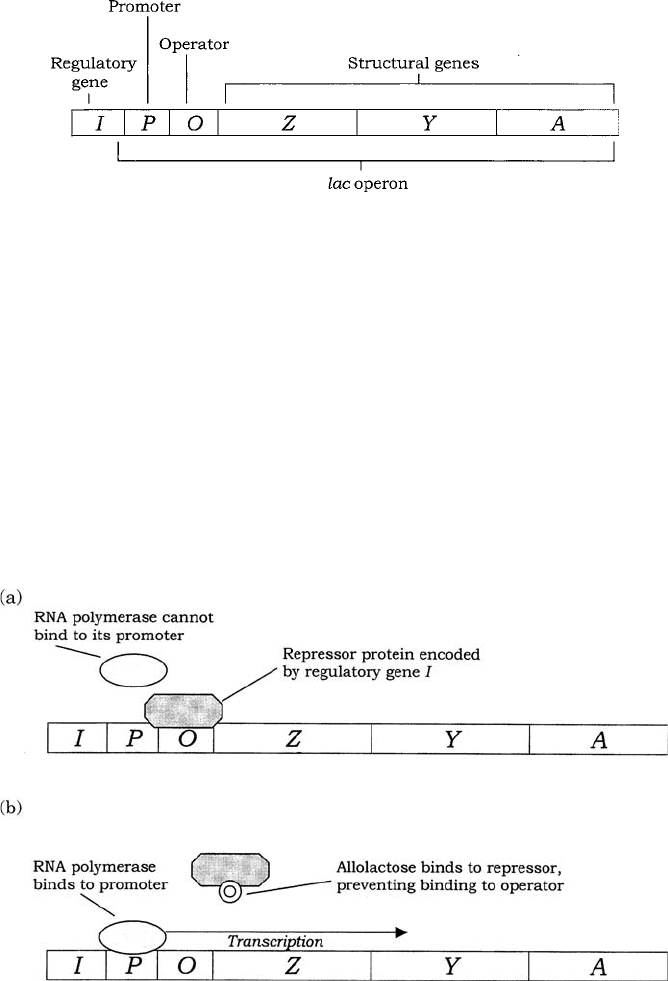
β-galactosidase has been intensively studied as part of
the lac operon of E. coli. This is made up of three
structural genes designated Z, Y and A, which are clus-
tered together and share a common promoter and ter-
minator (Figure 11.14). The genes code for, respectively,
β-galactosidase, a permease and a transacetylase. The
permease is necessary for the transport of lactose into
the cell, while the role of the transacetylase is not en-
tirely clear, although it is essential for the metabolism of
lactose. Grouping the three genes together in this way en-
sures an ‘all-or-nothing’ expression of the three proteins.
A repressor protein regu-
lates the transcription of
a gene by binding to its
operator sequence. It is
encoded by a regula-
tory gene.
Transcription of these structural genes into their re-
spective mRNAs is initiated by the enzyme RNA poly-
merase binding to the promoter sequence. However, this
is only possible in the presence of lactose; in its ab-
sence, a repressor protein binds to an operator site, adja-
cent to the promoter, preventing RNA polymerase bind-
ing to the promoter, and therefore preventing mRNA
JWBK011-11 JWBK011-Hogg August 12, 2005 19:21 Char Count= 0
286 MICROBIAL GENETICS
Figure 11.14 The lac operon comprises three structural genes under the control of a single
promoter and operator sequence. The role of the regulatory gene I is described in Figure 11.15
production. Production of the repressor protein is encoded by a regulator gene (I),
situated slightly upstream from the operon (Figure 11.15a).
How then, does the presence of lactose overcome this regulatory mechanism? Allo-
lactose, an isomer of lactose and an intermediate in its breakdown, attaches to a site
on the lac repressor, thereby reducing the latter’s affinity for the operator, and neutral-
ising its blocking effect (Figure 11.15b). The structural genes are then transcribed into
mRNA, which is subsequently translated into the three proteins described above, and
the lactose is broken down. In the absence of lactose, there are only trace amounts of
β-galactosidase present in an E. coli cell; this increases some 1000-fold in its presence.
Figure 11.15 The lac operon is inducible. (a) In the absence of the substrate lactose, the
lac operon is ‘switched off’, due to a repressor protein encoded by the regulatory gene I.
The repressor binds to the operator site, preventing the binding of RNA polymerase to the
promoter and therefore blocking transcription. (b) Allolactose acts as an inducer by binding
the repressor protein and preventing it from blocking the promoter site. Transcription of the
three structural genes is able to proceed unhindered

JWBK011-11 JWBK011-Hogg August 12, 2005 19:21 Char Count= 0
REGULATION OF GENE EXPRESSION 287
When all the lactose has been consumed, the repressor protein is free to block the
operator gene once more, and the needless synthesis of further β-galactosidase ceases.
The lac operon can also be induced by isopropyl β-thiogalactoside (IPTG); E. coli
is not able to break this down, so the genes remain permanently switched on. IPTG is
utilised as an inducer in cloning systems involving the expression of the lacZ gene on
pUC plasmids (Chapter 12).
The lac operon is subject to control by positive as well as negative regulator proteins.
Transcription of the operon only occurs if another regulatory protein called catabolite
activator protein (CAP) is bound to the promoter sequence (see Box 11.5). This is
dependent on a relatively high concentration of the nucleotide cAMP which only occurs
when glucose is scarce. The activation of the lac operon thus occurs only if lactose is
present and glucose is (almost) absent.
Repression of gene expression
The induction of gene expression, such as we have just described for the lac operon,
generally relates to catabolic (breakdown) reactions. Anabolic (synthetic) reactions,
such as those leading to the production of specific amino acids, by contrast, are often
controlled by the repression of key genes.
Enzyme repression mechanisms operate along similar lines to induction mechanisms,
but the determining factor here is not the substrate of the enzymes in question (lactose
in our example), but the end-product of their action. The trp operon contains a cluster
of genes encoding five enzymes involved in the synthesis of the amino acid tryptophan.
(Figure 11.16) In the presence of tryptophan, the cell has no need to synthesise its
Box 11.5 A choice of substrates
Glucose is central to the reactions of glycolysis (Chapter 6), and is utilised by E. coli
with high efficiency, because the enzymes involved are permanently switched on
or constitutive. The β-galactosidase required for lactose breakdown, however, must
be induced. What happens then, when E . coli is presented with a mixture of both
glucose and lactose? It would be more efficient to metabolise the glucose, with the
ready-to-use enzymes, but from what you have learnt elsewhere in this section (see
Figure 11.15b), the presence of lactose would induce formation of β-galactosidase
and subsequent lactose breakdown, a less energy-efficient way of going about
things. In fact, E. coli has a way of making sure that while the readily utilised glu-
cose is present, it takes precedence. It does this by repressing the formation of
β-galactosidase, a phenomenon known as catabolite repression. Thus, the pres-
ence of a ‘preferred’ nutrient prevents the synthesis of enzymes needed to
metabolise a less favoured one.
This is because glucose inhibits the formation of cAMP, which is required for the
binding of the CAP to its site on the lac promoter. When glucose levels drop, more
cAMP forms and causes CAP to bind to the CAP binding site. Thus, after a delay, the
enzymes needed for lactose catabolism are synthesised, and the lactose is utilised,
leading to a diauxic growth curve (see Chapter 5).