
Hogg S. Essential microbiology
Подождите немного. Документ загружается.

JWBK011-10 JWBK011-Hogg August 12, 2005 19:20 Char Count= 0
258 VIRUSES
Box 10.4 Plaque counts
The number of plaque forming units (pfu) per millilitre of suspension can be calcu-
lated by a plaque count by using the equation:
pfu/ml =
no. of plaques
dilution factor × volume (ml)
e.g. 100µlofa1in10,000 dilution gives 53 colonies when plated out.
Thus the original suspension had:
53
10
−4
× 0.1
= 5.3 × 10
6
pfu/ml
and human viruses, such as those that cause rabies and influenza. It has been said that the
chicken embryo did for virus culture what agar did for the growth of bacteria. Depending
on the virus in question, inoculation can be made into the developing embryo itself or
into one of the various membranes and cavities such as the chorioallantoic membrane
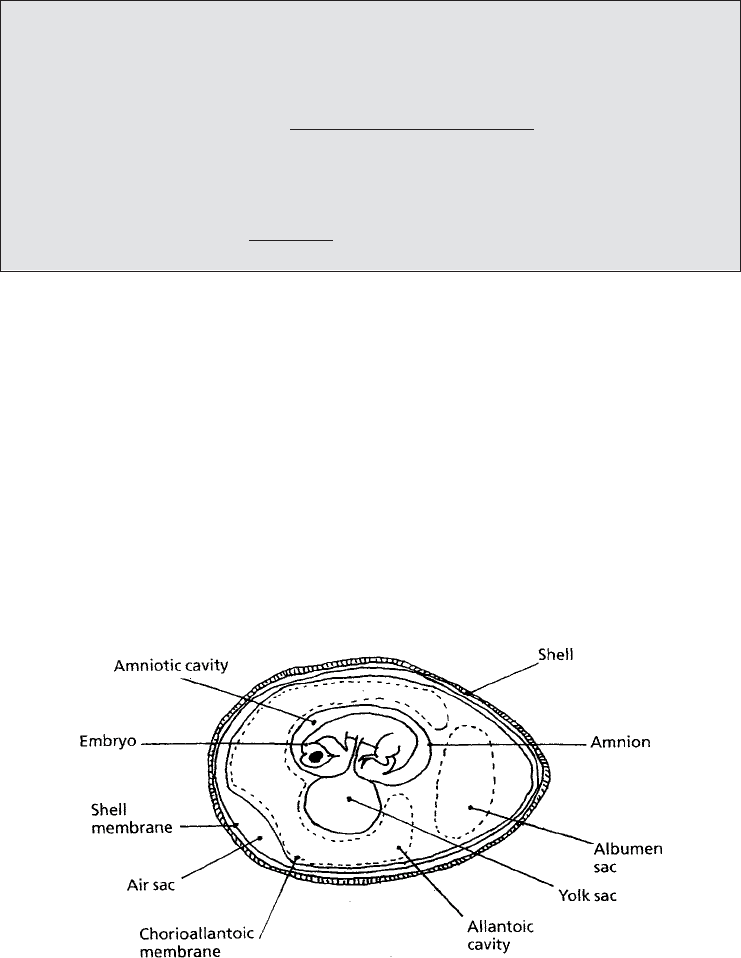
or the allantoic cavity (Figure 10.18). Viral propagation is demonstrated by death of
the embryo, or the appearance of lesions on the membranes.
In the 1950s, cell culture techniques advanced, thanks in part to the widespread avail-
ability of antibiotics, making the control of bacterial contamination much more readily
achieved. Cells are usually grown as monolayers in tissue culture flasks containing a
suitable liquid growth medium. Treatment with the protease trypsin dissolves the con-
nective tissue matrix between the cells, allowing them to be harvested, and used to
Figure 10.18 The culture of animal viruses in embryonated eggs. Viruses such as the in-
fluenza virus are cultured more effectively in eggs than in cell culture. The chorioallantoic
membrane provides epithelial cells that act as host to the virus. From Heritage, J, Evans,
EGV & Killington, RA: Introductory Microbiology, Cambridge University Press, 1996. Re-
produced by permission of the publishers
JWBK011-10 JWBK011-Hogg August 12, 2005 19:20 Char Count= 0
VIRAL DISEASES IN HUMANS 259
seed new cultures. Changes in cell morphology, known generically as cytopathic effects,
are indicators of viral infection, and may be used diagnostically in the identification of
specific viral types.
Plant viruses need to overcome the barrier presented by the cellulose cell wall of the
plant; in nature this is often achieved by the piercing mouthparts of an insect vector or
by entering areas of damaged tissue. Experimentally, viruses can be introduced into an
appropriate host by rubbing the surface of a leaf with the virus together with a mild
abrasive to create a minor wound.
Viral diseases in humans
Viruses are responsible for causing some of the most serious infectious diseases to affect
humans. Some important examples are listed in Table 10.3, and some are discussed in
a little more detail below.
Airborne transmission: influenza
Influenza is a disease of the respiratory tract caused by members of the Orthomyx-
oviridae. Transmission occurs as a result of inhaling airborne respiratory droplets from
an infected individual. Infection by the influenza virus results in the destruction of
epithelial cells of the respiratory tract, leaving the host open to secondary infections
from bacteria such as Haemophilus influenzae and Staphylococcus aureus. It is these
secondary infections that are responsible for the great majority of fatalities caused by
influenza. Generally, sufferers from influenza recover completely within 10–14 days, but
some people, notably the elderly and those with chronic health problems, may develop
complications such as pneumonia.
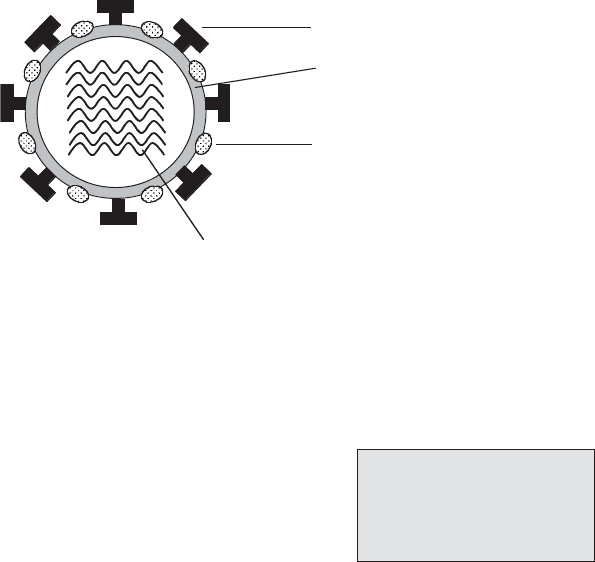
The influenza virus has an envelope, and a segmented (−) sense ssRNA genome
(Figure 10.19). The envelope contains two types of protein spike, each of which plays
a crucial role in the virus’s infectivity:
r
Neuraminidase is an enzyme which hydrolyses sialic acid, thereby assisting in
the release of viral particles.
r
Haemagglutinin enables the virus to attach to host cells by binding to epithelial
sialic acid residues. It also helps in the fusion of the viral envelope with the cell
membrane.
Both types of spike act as antigens, proteins that stimulate the production of antibodies
in a host. One of the reasons that influenza is such a successful virus is that the ‘N’
and ‘H’ antigens are prone to undergoing changes (antigenic shift) so that the antigenic
‘signature’ of the virus becomes altered, and host immunity is evaded. Different strains
of the influenza virus are given a code denoting which variants of the antigens they
carry; the strain that caused the 1918 pandemic, for example, was N
1
H
1
, while the one
responsible for the outbreak of ‘bird flu’ in SE Asia in 2003/4 was H
5
N
1
.

JWBK011-10 JWBK011-Hogg August 12, 2005 19:20 Char Count= 0
Table 10.3 Some important viruses of humans
Virus Family Disease Genome type
Adenovirus Adenoviridae Respiratory infections dsDNA
Ebola virus Filoviridae Haemorrhagic fever (−)ssRNA
Epstein–Barr virus Herpesviridae Infectious dsDNA
mononucleosis
Hepatovirus A Picornaviridae Hepatitis A (+)ssRNA
Herpes simplex Type I Herpesviridae Cold sores dsDNA
Herpes simplex Type II Herpesviridae Genital warts dsDNA
Human immunodeficiency Retroviridae Acquired immune deficiency (+)ssRNA*
virus (HIV) syndrome (AIDS)
Human papillomavirus Papovaviridae Warts dsDNA
Influenza virus Orthomyxoviridae Influenza (−)ssRNA
Lassa virus Arenaviridae Lassa fever (−)ssRNA
Morbillivirus Paramyxoviridae Measles (−)ssRNA
Norwalk virus Calciviridae Enteritis (+)ssRNA
Paramyxovirus Paramyxoviridae Mumps (−)ssRNA
Polio virus Picornaviridae Poliomyelitis (+)ssRNA
Rabies virus Rhabdoviridae Rabies (−)ssRNA
Rhinovirus Picornaviridae Common cold (+)ssRNA
Rotavirus Reoviridae Enteritis dsRNA
Rubella virus Togaviridae German measles (+)ssRNA
Smallpox virus Poxviridae Smallpox dsDNA
Varicella-Zoster Herpesviridae Chicken pox, shingles dsDNA
Yellow fever virus Flaviviridae Yellow fever (+)ssRNA
∗
The genome of HIV, like that of other retroviruses also has a DNA phase. See the text.
260
JWBK011-10 JWBK011-Hogg August 12, 2005 19:20 Char Count= 0
VIRAL DISEASES IN HUMANS 261
Neuraminidase
Haemagglutinin
Segmented ssRNA genome
Envelope
Figure 10.19 The influenza virus. The RNA segments are bound to protein, forming a
nucleocapsid, and are surrounded by further protein. The two types of spike assist in the
attachment and penetration of the virus into its host
Transmission by water or food: viral gastroenteritis
rota = ‘a wheel’,describ-
ing the distinctive ap-
pearance of this type of
virus.
Everybody must surely be familiar with the symptoms
of gastroenteritis – sickness, diarrhoea, headaches and
fever. The cause of this gastroenteritis may be bacterial
(e.g. Salmonella) or viral. The major cause of the vi-
ral form is the human rotavirus , which, together with
the Norwalk virus, is responsible for the majority of re-
ported cases. The rotavirus has a segmented, dsRNA genome, and is a non-enveloped
virus.
The virus damages the villi in the upper part of the intestinal tract, affecting normal
ion transport, and resulting in the characteristic water loss. Transmission of gastroen-
teritis is via the faecal–oral route, that is, by the ingestion of faecally contaminated food
or water. Poor hygiene practice or contaminated water supplies are usually to blame
for the perpetuation of the cycle. Normally, the condition is self-limiting, lasting only a
couple of days; the normal treatment is fluid replacement therapy. In areas where clean
water supplies are not available, however, the outcome can be much more serious. In the
Third World, the condition is a major killer; it is the principal cause of infant mortality,
and the cause of some five to ten million deaths per year.
Latent and slow (persistent) viral infections
After an infection has passed, a virus may sometimes remain in the body for long
periods, causing no harm. It may be reactivated, however, by stress or some change
in the individual’s health, and initiate a disease state. Well known examples of latent
viral infections are cold sores and shingles, both caused by members of the herpesvirus
family. A virus of this sort will remain with an individual throughout their lifetime.
Whereas latent virus infections are characterised by a sudden increase in virus pro-
duction, in persistent (slow) infections the increase is more gradual, building up over

JWBK011-10 JWBK011-Hogg August 12, 2005 19:20 Char Count= 0
262 VIRUSES
several years. Such infections have a serious effect on the target cells, and are generally
fatal. An example is the measles virus, which can re-manifest itself after many years in
a rare condition called subacute sclerosing panencephalitis.
Viruses and cancer
A number of chemical and physical agents are known to trigger the uncontrolled prolif-
eration of cells that characterise cancers, but in the last two decades it has become clear
that at least six types of human cancer can be virally induced. How do cells lose control
of their division, and how are viruses able to bring this about? It is now known that
cells contain genes called protooncogenes, involved in normal cell replication. They are
normally under the control of other, tumour-suppressor genes, but these can be blocked
by proteins encoded by certain DNA viruses. When this happens, the protooncogene
functions as an oncogene, and cell division is allowed to proceed uncontrolled. Retro-
viruses have a different mechanism; they carry their own, altered, version of the cellular
An oncogene is a gene
associated with the con-
version of a cell to a can-
cerous form.
oncogene, which becomes integrated into the host’s
genome and leads to uncontrolled cell growth. Retro-
virus oncogenes are thought to have been acquired orig-
inally from human (or animal) genomes, with the RNA
transcript becoming incorporated into the retrovirus
particle.
Emerging and re-emerging viral diseases
A zoonosis is a disease
normally found in an-
imals, but transmissible
to humans under certain
circumstances.
As a result of changes in the pathogen or in the host pop-
ulation, completely new infectious diseases may arise, or
we may experience the reappearance of diseases previ-
ously considered to be under control. These are known
as, respectively, emerging and re-emerging infections.
Changed patterns of human population movement are
often responsible for the development of such infections,
with the spread of smallpox to the New World by European colonisers being a famous
example. Frequently emerging virus infections are zoonotic in origin, that is, they are
transferred to humans from animal reservoirs. HIV, for example, is thought to have
developed from a similar virus found in monkeys.
While this book was in preparation, there was a sharp reminder of the ever-present
threat of emerging viral diseases, in the form of a new viral disease called severe acute res-
piratory syndrome (SARS). The outbreak of this disease began in Guangdong province
in southern China in November 2002. The Chinese authorities were heavily criticised
for not reporting the extent of the outbreak until some 3 months later, by which time
cases were appearing in many parts of the world, illustrating the role of increased inter-
continental travel in the spread of such a disease. At its peak in April 2003, over 1000
new cases of SARS were being reported per week. The cause of SARS was quickly iden-
tified as a member of the Coronaviridae (single-stranded RNA viruses). Transmitted
JWBK011-10 JWBK011-Hogg August 12, 2005 19:20 Char Count= 0
VIRAL DISEASES IN HUMANS 263
by droplets from coughs and sneezes, it produces flu-like symptoms, but has a mor-
tality rate of around 4 percent. Strict public health measures were brought into force,
including restrictions in flights to and from affected areas, and the number of reported
cases began to subside. In July 2003, the World Health Organisation announced that
the final country, Taiwan, had been removed from its list of SARS-infected countries.
By this time, SARS had claimed over 800 lives, mostly in China and Hong Kong, but
with a number of deaths occurring as far afield as Canada and South Africa. Although
apparently under control, isolated cases of SARS infections emerged in late 2003, and
early 2004, most of which could be linked to laboratory workers. In January 2004 the
Chinese authorities announced that a SARS vaccine was about to enter human clinical
trials.
Virus vaccines
Smallpox, once the scourge of millions, was in 1979 the first infectious disease to be
declared successfully eradicated. This followed a worldwide campaign of vaccination
by the World Health Organisation over the previous decade, and was made feasible by
the fact that humans are the only reservoir for the virus. Vaccination is a preventative
strategy that aims to stimulate the host immune system, by exposing it to the infectious
agent in question in an inactivated or incomplete form.
There are four main classes of virus vaccines:
r
Attenuated (=‘weakened’) vaccines contain ‘live’ viruses, but ones whose pathogenic-
ity has been greatly reduced. The aim is to mimic an infection in order to stimulate an
immune response, but without bringing about the disease itself. A famous example
of this type of vaccine is the polio vaccine developed by Albert Sabin in the 1960s.
The cowpox virus used by Edward Jenner in his pioneering vaccination work in the
late 18th century was a naturally occurring attenuated version of the smallpox virus.
r
Inactivated vaccines contain viruses which have been exposed to a denaturing agent
such as formalin. This has the effect of rendering them non-infectious, while at the
same time retaining their ability to stimulate an immune response. Vaccines directed
against influenza are of this type.
r
Subunit vaccines depend on the stimulation of an immune response by just a part of
the virus. Since the complete virus is not introduced, there is no chance of infection,
so vaccines of this type have the attraction of being very safe. Subunit vaccines are
often made using recombinant DNA technology (Chapter 12); the first example to
be approved for human use was the hepatitis B vaccine, which consists of part of the
protein coat of the virus produced in specially engineered yeast cells.
r
DNA vaccines are also the product of modern molecular biology techniques. DNA
coding for virus antigens is directly injected into the host, where it is expressed and
triggers a response by the immune system. Vaccines of this type have not so far been
approved for use in humans.

JWBK011-10 JWBK011-Hogg August 12, 2005 19:20 Char Count= 0
264 VIRUSES
Test yourself
1 Unlike bacteria, viruses are able to pass through a .
2 Viruses are incapable of
except when occupying a host cell.
3 A
is another name for an intact virus particle.
4 The nucleic acid of a virus is surrounded by a protein coat or
.In
some forms, this may in turn be surrounded by an
.
5 In some types of
virus, the genome is segmented.
6 Parvoviruses are unusual among DNA viruses in having a
genome.
7 Capsids may be either
or in shape.
8 The
scheme of classification orders viruses in terms of their method
of mRNA production.
9 The replication cycle of the T-even phages is described as
because
it results in the
of the host cell.
10 The time between infection of a host cell and the release of newly-synthesised
viral particles is called the
.
11 The DNA of
phages becomes integrated into the host genome,
where it is known as a
.
12 Enveloped viruses are taken into the host cell either by
with the
cell membrane or by a process of
.
13 The viral envelope is formed by the viral particle being engulfed in the host
, into which proteins encoded by the are in-
serted.
14 In order for the genome of ss-RNA virus to be replicated, a
strand
must be formed to act as a template.
15 Retroviruses contain the enzyme reverse
, which can synthesise
from an template.
16 The genome of most plant viruses is made of
.
17 Subviral particles found in plants and comprising RNA but no
are
known as
.

JWBK011-10 JWBK011-Hogg August 12, 2005 19:20 Char Count= 0
TEST YOURSELF 265
18 When bacteriophages infect bacterial cells, their presence can be detected as
on an agar plate.
19 The envelope of the influenza virus has two types of protein spike made of
and that play a part in the infectious process.
20 The surface antigens of viruses often undergo a gradual modification known
as
, which helps to protect them against the host immune
system.
21 Most cases of viral gastroenteritis in humans are caused by the
.
22 Shingles and cold sores, caused by herpesviruses, are examples of
viral infections.
23
infections of humans are transmitted from an animal source.
24
vaccines contain ‘live’ viruses whose has been reduced.
25 The hepatitis B vaccine is an example of a
vaccine, which depends
on stimulating the immune response without introducing the whole virus
particle.
JWBK011-10 JWBK011-Hogg August 12, 2005 19:20 Char Count= 0
266
JWBK011-11 JWBK011-Hogg August 12, 2005 19:21 Char Count= 0
Part IV
Microbial Genetics
267