
Hogg S. Essential microbiology
Подождите немного. Документ загружается.

JWBK011-11 JWBK011-Hogg August 12, 2005 19:21 Char Count= 0
288 MICROBIAL GENETICS
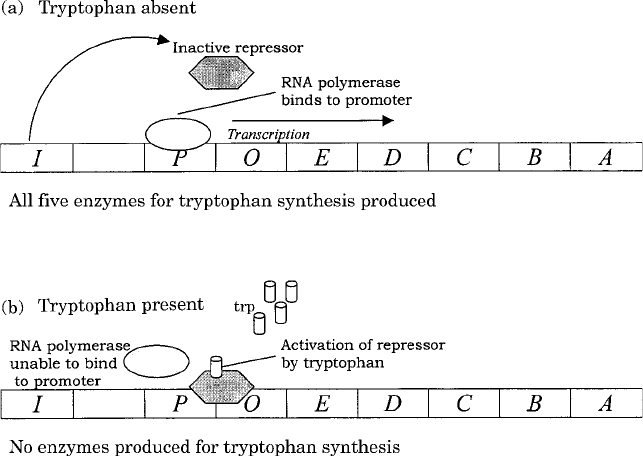
Figure 11.16 The trp operon. Five structural genes A-E encode enzymes necessary for
the synthesis of tryptophan. (a) In the absence of tryptophan, transcription of the operon
proceeds unhindered. Although a repressor protein is produced, it is inactive and unable to
bind to the operator sequence. (b) Tryptophan activates the repressor by binding to it. This
prevents RNA polymerase from binding to the promoter, and transcription is blocked
own, so the operon is switched off. This is achieved by tryptophan binding to and
activating a repressor protein, which in turn binds to the operator of the trp operon and
prevents transcription of the synthetic enzymes. The tryptophan here is said to act as a
corepressor. As tryptophan is used up and its level in the cell falls, the repressor reverts
to its inactive form, allowing transcription of the tryptophan-synthesising enzymes to
go ahead unhindered.
Global gene regulation
The systems of gene regulation discussed above apply to individual operons; sometimes,
however, a change in environmental conditions necessitates the regulation of many genes
at once. These global regulatory systems respond to stimuli such as oxygen depletion
and temperature change, and utilise a number of different mechanisms.
The molecular basis of mutations
Any alteration made to the DNA sequence of an organism is called a mutation. This may
or may not have an effect on the phenotype (physically manifested properties) of the

JWBK011-11 JWBK011-Hogg August 12, 2005 19:21 Char Count= 0
THE MOLECULAR BASIS OF MUTATIONS 289
organism. It may for example enable bacteria to grow without the need for a particular
growth supplement, or confer resistance to an antibiotic. Just how this happened was
for many years a source of debate. Since the mutant forms only became apparent after
the change in conditions (e.g. withdrawal of a nutrient, addition of antibiotic), have
some of the bacteria been induced to adapt to the new conditions, or are mutant forms
arising all the time at a very low frequency, and merely selected by the environmental
change? In 1943, Salvador Luria and Max Delbr
¨
uck devised the fluctuation test to settle
the matter (see Box 11.6). Results of the fluctuation test together with other evidence
led to the understanding that mutations occur spontaneously in nature at a very low
frequency. As we shall see later on in this section, however, they can also be induced
by a variety of chemical and physical agents. Any change to the DNA sequence is
heritable, thus mutations represent a major source of evolutionary variation. Bacteria
make marvellous tools for the study of mutations because of their huge numbers and
very short generation times.
Since the DNA sequence of a gene represents highly ordered coded information,
most mutations have a neutral or detrimental effect on the organism’s phenotype, but
occasionally a mutation occurs which confers an advantage to an organism, making
it better able to survive and reproduce in a particular environment. Mutants that are
favoured in this way may eventually become the dominant type in a population, and,
by steps like this, evolution gradually takes place.
Mutations occur spontaneously in any part of an organism’s genome. Spontaneous
mutations causing an inactivation of gene function occur in bacteria at the rate of about
one in a million for a given gene at each round of cell division. Most genes within a
given organism show similar rates of mutation, relative to their gene size; clearly a larger
‘target’ will be ‘hit’ more often than a small one.
How do mutations occur?
Figure 11.17(a) reminds us how the code in DNA is transcribed into messenger RNA
and then translated into a sequence of amino acids. Each time the DNA undergoes repli-
cation, this same sequence will be passed on, coding for the same sequence of amino
acids. Occasionally, mistakes occur during replication. Cells have repair mechanisms
to minimise these errors, but what happens if a mistake still slips through? In Figure
11.17(b), we can see the effect of one nucleotide being inserted into the strand instead
of another. When the next round of replication occurs, the modified DNA will act as
a template for a newly synthesised strand, which at this position will be made comple-
mentary to the new, ‘wrong’ base, instead of the original one, and thus the mistake will
be perpetuated.
A missense mutation al-
ters the sense of the mes-
sage encoded in the
DNA, and results in an in-
correct amino acid be-
ing produced at the
point where it occurs.
This is an example of the simplest type of mutation,
a point mutation, where one nucleotide has been substi-
tuted by another. The example shown is a missense muta-
tion, which has resulted in the affected triplet coding for
a different amino acid; this may or may not have an ef-
fect on the phenotype of the organism. RNA polymerase,
which transcribes the DNA sequence into mRNA, is un-
able to tell that an error has occurred, and faithfully
JWBK011-11 JWBK011-Hogg August 12, 2005 19:21 Char Count= 0
290 MICROBIAL GENETICS
Box 11.6 Settling an argument: the fluctuation test
Luria and Delbr
¨
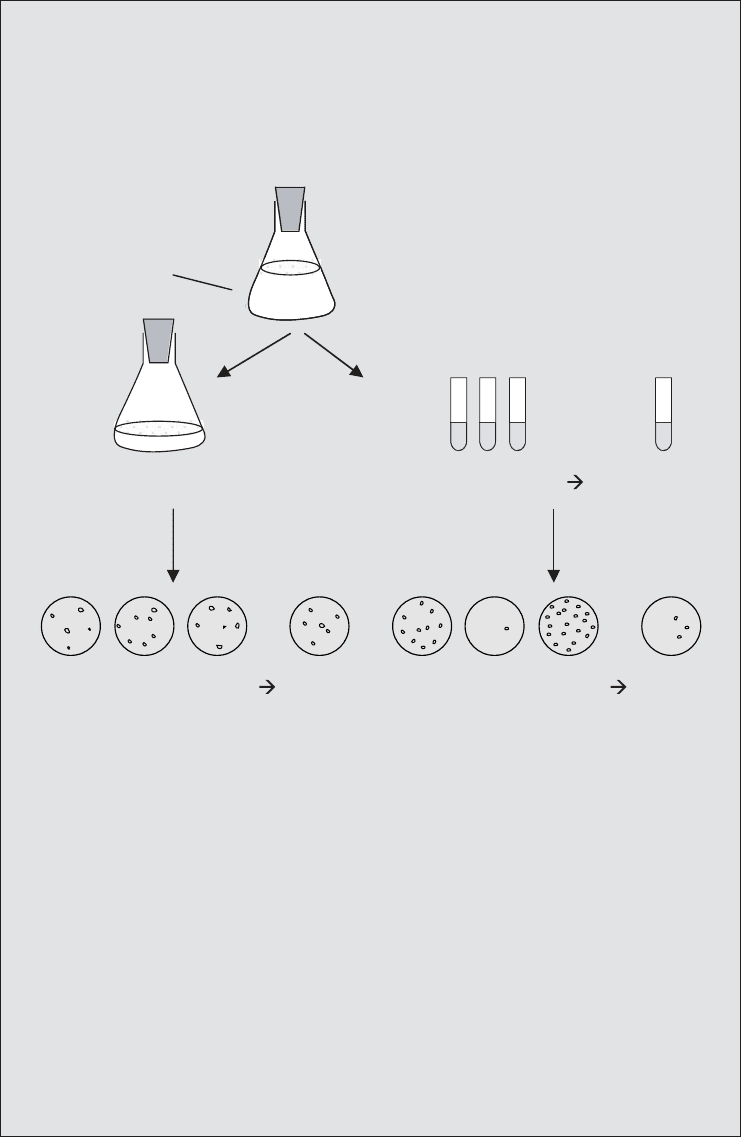
uck designed the fluctuation test to show whether resistance in E.
coli to the bacteriophage T1 was induced or occurred spontaneously.
Suppose we divide a broth culture of bacteria into two, then inoculate half into
a flask of fresh broth, and divide the other half between a large number of smaller
cultures in tubes
1 2 3 50 1 2 3 50
Half of culture grown
up in a single large
flask.
Half of culture divided
between 50 small tubes.
1 2 3 50
E. coli
culture
50 samples
plated out
onto agar
pates
Each sample
plated out onto
an agar plate.
Colony counts quite similar Colony counts highly variable
After allowing the bacteria to grow, samples are taken from tubes and flask, and
spread onto a selective agar medium (one covered with T1 phage). All the plates
deriving from the single bulk culture have roughly the same number of resistant
colonies, but the plates resulting from the smaller, tube cultures show very variable
colony counts. Although the average number of colonies across the 50 tubes is
similar to that obtained from the bulk culture, the individual plate counts varies
greatly, from none on several plates to over a hundred on another.
If the phage-resistance was induced by the presence of the phage, we would
expect all plates in the experiment to give rise to approximately the same number
of resistant colonies, as all cultures experienced the same exposure. If however, the
resistant forms were spontaneously arising all the time at a low level in the population,
the numbers of resistant colonies would be dependent on when, if at all, a mutation
had taken place in a particular tube culture. A mutant arising early in the incubation
period would give rise to more resistant offspring and therefore more colonies than
one that arose later.
JWBK011-11 JWBK011-Hogg August 12, 2005 19:21 Char Count= 0
THE MOLECULAR BASIS OF MUTATIONS 291
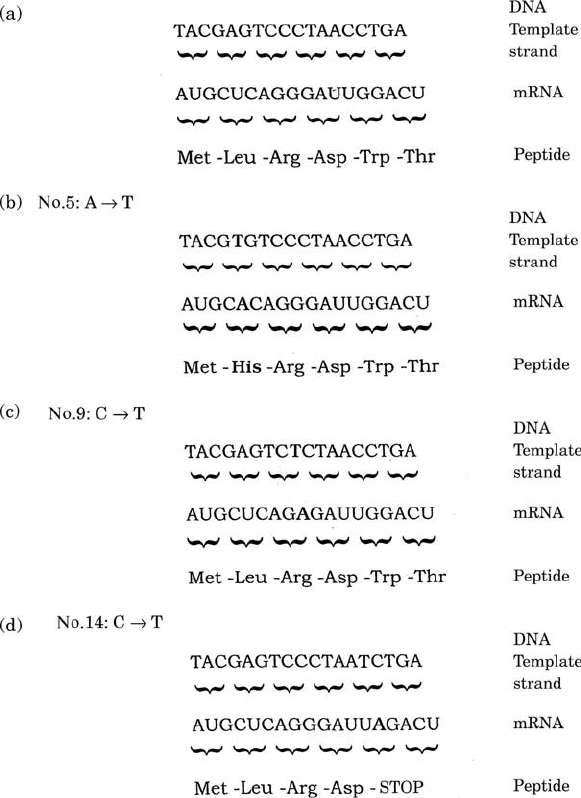
Figure 11.17 Mutations can alter the sense of the DNA message. (a) A short sequence of
DNA is transcribed into mRNA and then transcribed into the corresponding amino acids. (b)
A single base change from T to A results in a missense mutation, as a histidine is substituted
for a leucine. (c) A silent mutation has altered the DNA (and therefore mRNA) sequence, but
has not changed its sense. Both AGG and AGA are mRNA triplets that code for arginine. (d)
A nonsense mutation has replaced a tryptophan codon with a STOP codon, hence bringing
the peptide chain to a premature end

JWBK011-11 JWBK011-Hogg August 12, 2005 19:21 Char Count= 0
292 MICROBIAL GENETICS
transcribes the misinformation. The machinery of translation is similarly ‘unaware’ of
the mistake, and as a consequence, a different amino acid will be inserted into the
polypeptide chain. The consequence of expressing a ‘wrong’ amino acid in the protein
product could range from no effect at all to a total loss of its biological properties. This
can be understood in terms of protein structure (Chapter 2), and depends on whether the
amino acid affected has a critical role (such as part of the active site of an enzyme), and
whether the replacement amino acid has similar or different polar/non-polar properties.
You may recall from the beginning of this chapter that the genetic code is degenerate,
and that most amino acids are coded for by more than one triplet; this means that some
mutations do not affect the amino acid produced; such mutations are said to be silent,
as in Figure 11.17(c). These most commonly occur at the third nucleotide of a triplet.
A nonsense mutation re-
sults in a ‘stop’ codon
being inserted into the
mRNA at the point
where it occurs, and
the premature termina-
tion of translation.
Another type of point mutation is a nonsense muta-
tion. Remember that of the 64 possible triplet permuta-
tions of the four DNA bases, three are ‘stop’ codons,
which terminate a polypeptide chain. If a triplet is
changed from a coding to a ‘stop’ codon as shown in
Figure 11.17(d), then instead of the whole coding se-
quence being read, translation will end at this point, and
a truncated (and probably non-functional) protein will
result.
Mutations can add or remove nucleotides
Other mutations involve the insertion or deletion of nucleotides. This may involve
anything from a single nucleotide up to millions. Deletions occur as a result of the
A frameshift mutation re-
sults in a change to
the reading frame, and
an altered sequence of
amino acids results
downstream of the point
where it occurs.
replication machinery somehow ‘skipping’ one or more
nucleotides. If the deletion is a single nucleotide, or any-
thing other than a multiple of three, the ribosome will be
thrown out of its correct reading frame, and a completely
new set of triplet codons will be read (Figure 11.18). This
is known as a frameshift mutation, and will in most cases
result in catastrophic changes to the final protein prod-
uct. If the deletion is a multiple of three nucleotides, the
reading frame will be preserved and the effect on the
protein less drastic.
Mutations can be reversed
Just as it is possible for a mutation to occur spontaneously, so it is possible for the
nucleotide change causing it to be spontaneously reversed – in other words, a mutant
can mutate back to being a wildtype. This is known for obvious reasons as a reverse or
back mutation. When this happens, the original genotype and phenotype are restored.
Whereas a forward mutation results from any change that inactivates a gene, a back
mutation is more specific; it must restore function to a protein damaged by a specific
JWBK011-11 JWBK011-Hogg August 12, 2005 19:21 Char Count= 0
THE MOLECULAR BASIS OF MUTATIONS 293
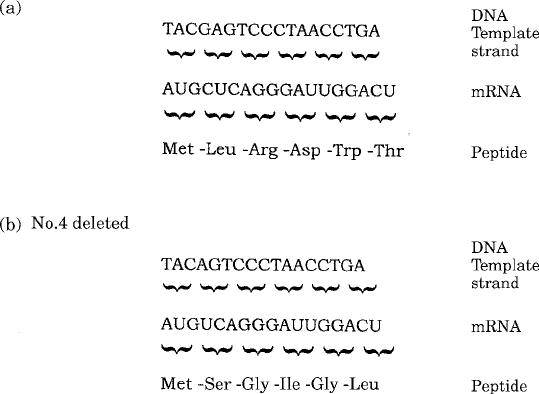
Figure 11.18 Frameshift mutations. (a) A short sequence of DNA is transcribed into
mRNA and then transcribed into the corresponding amino acids. (b) The fourth nucleotide
in the sequence is deleted, upsetting the groups of triplets or reading frame. This alters the
sense of the remainder of the message, leading to a completely different sequence of amino
acids
mutation. Not surprisingly, given this specificity, the rate of back mutations is much less
frequent.
It is possible for the wildtype phenotype to be restored, not through a reversal of the
original base change, but due to a second mutation at a different location. The effect of
this second mutation is to suppress the effects of the first one. These are called suppressor
or second site mutations. They are double mutants that produce a pseudowildtype; the
phenotype appears to be wildtype, but the genotype differs.
Mutations have a variety of mechanisms
Why are mistakes made every so often during DNA replication? One source of erro-
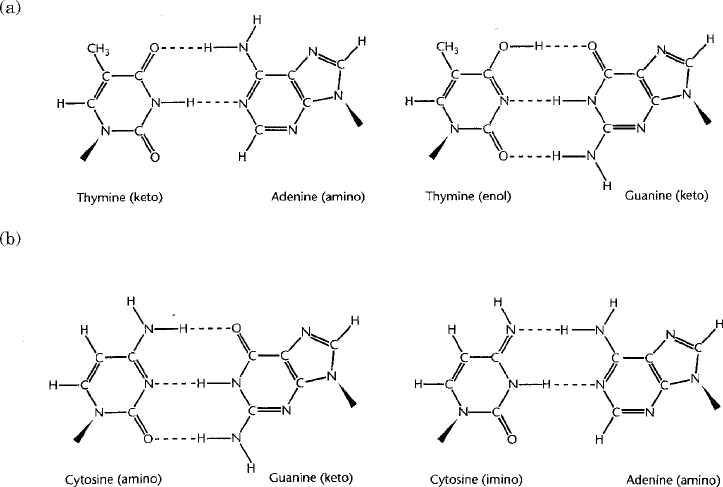
neous base incorporation is a phenomenon called tautomerism. Some of the nucleotide
bases occur in rare alternative forms, which have different base-pairing properties. For
example, as you will recall from Chapter 2, cytosine normally has an amino group that
provides a hydrogen atom for bonding with the complementary keto group of gua-
nine. Occasionally, however (once in about every 10
4
–10
5
molecules), the cytosine may
undergo a rearrangement called a tautomeric shift, which results in the amino group
changing to an imino group (
==
NH), and this now behaves in pairing terms as if it were
thymine, and therefore pairs with adenine (Figure 11.19a). Similarly, thymine might
undergo a tautomeric shift, changing its usual keto form (C
==
O) to the rare enol form
(COH). This then takes on the pairing properties of cytosine and pairs with guanine (Fig-
ure 11.19b). The result of such mispairing is that at subsequent rounds of replication,
JWBK011-11 JWBK011-Hogg August 12, 2005 19:21 Char Count= 0
294 MICROBIAL GENETICS
Figure 11.19 Rare forms of nucleotides may cause mispairing. If DNA replication takes
place whilst a base is in its rare alternative form, an incorrect base will be incorporated into
the newly synthesised second strand. (a) In its normal keto form, thymine pairs with adenine
in keeping with the rules of base-pairing. In its rare enol form, however, it preferentially
pairs with guanine. (b) Cytosine can likewise assume the rare imino form and mispair with
adenine
one half of the DNA molecules will contain a wrong base pair at that point. The fact
that spontaneous mutations occur much less frequently than the rate just quoted is due
to the DNA repair mechanisms discussed earlier in this chapter.
Mutations also occur in viruses
As we saw in Chapter 10, the genome of viruses can be composed of either DNA or
RNA, and these are subject to mutation just like cellular genomes. The rate of mutation
in RNA viruses is much higher than in those containing DNA, about a thousand times
higher, in fact. This is significant, because by frequently changing in this way, pathogenic
viruses are able to stay one step ahead of host defence systems.
Mutagenic agents increase the rate of mutations
In the early part of the 20th century, the existence of mutations was appreciated, but
attempts to gain a fuller understanding of them were hampered by the fact that they

JWBK011-11 JWBK011-Hogg August 12, 2005 19:21 Char Count= 0
THE MOLECULAR BASIS OF MUTATIONS 295
occurred so rarely. In the 1920s, however, it was shown that the mutation rate in both
barley plants and the fruit fly Drosophila was greatly increased as a result of exposure to
X-rays. In the following decades, a number of chemical and physical agents were shown
Chemical or physical
agents capable of in-
ducing mutations are
termed mutagens.
also to cause mutations. Mutagens such as these raise
the general level of mutations in a population, rather
than the incidence of mutation in at particular location
in the genome. They are extremely useful tools for the
microbial geneticist, but need to be treated with great
care because they are also mutagenic (and in most cases
carcinogenic) towards humans.
Chemical mutagens can be divided into five classes:
Base analogues
A base analogue is able to ‘mimic’ one of the four normal DNA bases by having a
chemical structure sufficiently similar for it to be incorporated into a DNA molecule
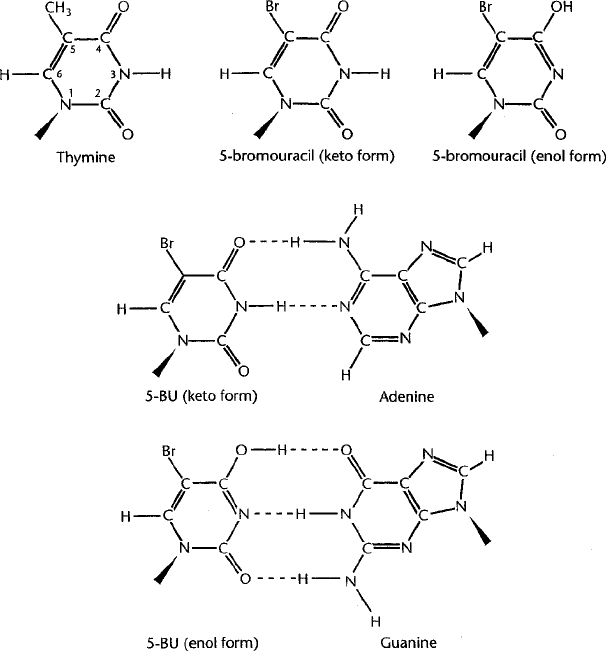
instead of that base during replication. One such base is 5-bromouracil (5-BU); in its
usual keto form, it acts like thymine (which it closely resembles – see Figure 11.20), and
therefore pairs with adenine, and is not mutagenic. However 5-BU is capable of tau-
tomerising to the enol form, which, remember, pairs with G, not A. Whereas for thymine
the enol form is a rarity, for 5-BU it is more common, hence mispairing with guanine
occurs more frequently. So, we get the same outcome as with spontaneous mutation –
the TA has been replaced by a CG – but its frequency is much increased. Several other
base analogues, such as 2-aminopurine, which mimics adenine, have similar effects to
5-BU. Mutations brought about by base analogues all result in a purine being replaced
by another purine, or a pyrimidine being replaced by another pyrimidine; this type of
mutation is called a transition.
Alkylating agents
As the name suggests, this group of mutagens act by adding an alkyl group (e.g. methyl,
ethyl) at various positions on DNA bases. Ethylethanesulphonate (EES) and ethyl-
methanesulphonate (EMS) are alkylating agents, used as laboratory mutagens. They
act by alkylating guanine or thymine at the oxygen atom involved in hydrogen bond-
ing. This leads to an impairment of the normal base-pairing properties, and causes
guanine for example to mispair with thymine.
Substitutions brought about by alkylating agents can be either transitions or trans-
versions.
Deaminating agents
Nitrous acid is a potent mutagen, which alters the base-pairing affinities of cytosine and
adenine by replacing an amino group with an oxygen atom. Transitions occur in both
directions, AT → GC and GC → AT. Note that although guanine is deaminated, its
base pairing properties are not affected.
Intercalating agents
These mutagens exert their effect by inserting themselves between adjacent nucleotides
in a single strand of DNA. They distort the strand at this site and cause either the addition
or, less commonly, deletion of a nucleotide. This leads to frameshift mutations, and often
JWBK011-11 JWBK011-Hogg August 12, 2005 19:21 Char Count= 0
296 MICROBIAL GENETICS
Figure 11.20 Base analogues mimic DNA base structure. In its keto form, the base analogue
5-bromouracil (5-BU) forms base pairs with adenine, but in the enol form it mispairs with
guanine. 5-BU differs from thymine only in the substitution of a bromine atom in place of a
methyl group. This makes the occurrence of a tautomeric shift more likely
during replication the bound mutagen interferes with new strand synthesis, leading to a
gross deletion of nucleotides. Ethidium bromide, commonly used for the visualisation of
small amounts of DNA in the molecular biology laboratory, is an intercalating agent; it
has a planar structure with roughly the same dimensions as a purine–pyrimidine pairing.
Hydroxylating agents
Hydroxylamine has a specific mutagenic effect, hydroxylating the amino group of cy-
tosine to cause the transition of GC → AT.
Base analogues and certain intercalating agents can only exert their mutagenic effects
if they are incorporated into DNA while it is replicating. Others, which depend on
altering base pairing by modifying the structure of DNA bases, are effective on both
replicating and non-replicating DNA.
JWBK011-11 JWBK011-Hogg August 12, 2005 19:21 Char Count= 0
THE MOLECULAR BASIS OF MUTATIONS 297
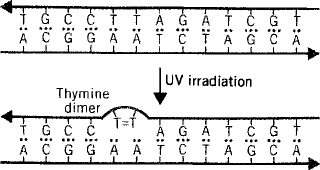
Figure 11.21 Thymine dimer formation. Absorption of UV light results in the formation
of dimers between adjacent thymine residues in the same strand. This can lead to errors
being introduced into the DNA sequence. From Gardner, EJ, Simmons MJ and Snustad, DP:
Principles of Genetics, 8th edn, John Wiley & Sons Inc., 1991. Reproduced by permission
of the publishers.
Physical mutagens
As mentioned at the start of this section, the first mutagenic agent to be demonstrated
were X-rays; along with ultraviolet light, they are the most commonly used physical
mutagen. X-rays, like other forms of ionising radiation, cause the formation of highly
reactive free radicals. These can bring about changes in base structure as well as gross
chromosomal alterations. DNA strands can be broken and reannealed incorrectly, to
produce errors in the sequence.
In recent years, we have all become much more aware of the possible perils of ex-
cessive exposure to sunlight. Ultraviolet light (UV) from the sun damages DNA in skin
cells, which can lead to them becoming cancerous. The specific action is on adjacent
pyrimidine bases (usually thymines) on the same strand, which are cross-linked to form a
dimer (Figure 11.21). This results in a distortion of the helix and interferes with replica-
tion. UV light is most effective at wavelengths around 260 nm, as this is the wavelength
most strongly absorbed by the DNA bases.
DNA damage can be repaired
All organisms have developed the means to repair damage to their DNA, in addition to
the proofreading mechanism described earlier
The most common way of dealing with mutations is by means of a method called
excision repair, in which enzymes recognise and cut out the altered region of DNA
and then fill in the missing bases, using the other strand as a template (Figure 11.22).
Mismatch repair is used to repair the incorporation of a base that has escaped the
proofreading system. In a situation such as this, it is not immediately obvious which
is the correct base and which is the mistake, so how does the cell know which strand
to replace? In E. coli, the old strand is distinguished from the new by the fact that
some of its bases are methylated. This only occurs some time after replication, so newly
synthesised strands will not have the methyl groups and can thus be recognised.
Less frequently, the alteration in DNA structure is simply reversed by direct repair
mechanisms, the best known of which is photoreactivation. This involves an enzyme