
Hogg S. Essential microbiology
Подождите немного. Документ загружается.

JWBK011-13 JWBK011-Hogg August 12, 2005 16:31 Char Count= 0
348 THE CONTROL OF MICROORGANISMS
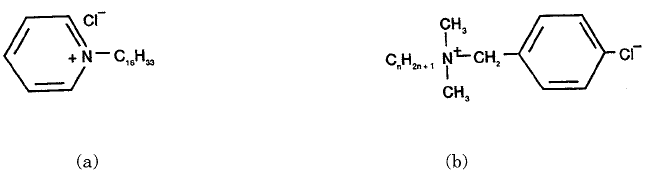
Figure 13.7 Quaternary ammonium compounds. (a) cetylpyridinium chloride and (b) ben-
zalkonium chloride. Although non-toxic and effective against a wide range of bacteria, qua-
ternary ammonium compounds are easily inactivated by soap
but it keeps the arithmetic simple) and that 10 per cent were killed each minute. After
one minute, 900 cells would remain, and after the second minute 10 per cent of these
would die, leaving us with 900 − 90 = 810 survivors. After a further minute, another
10 per cent of the survivors would be killed, so 810 − 81 = 729 would be left. A plot
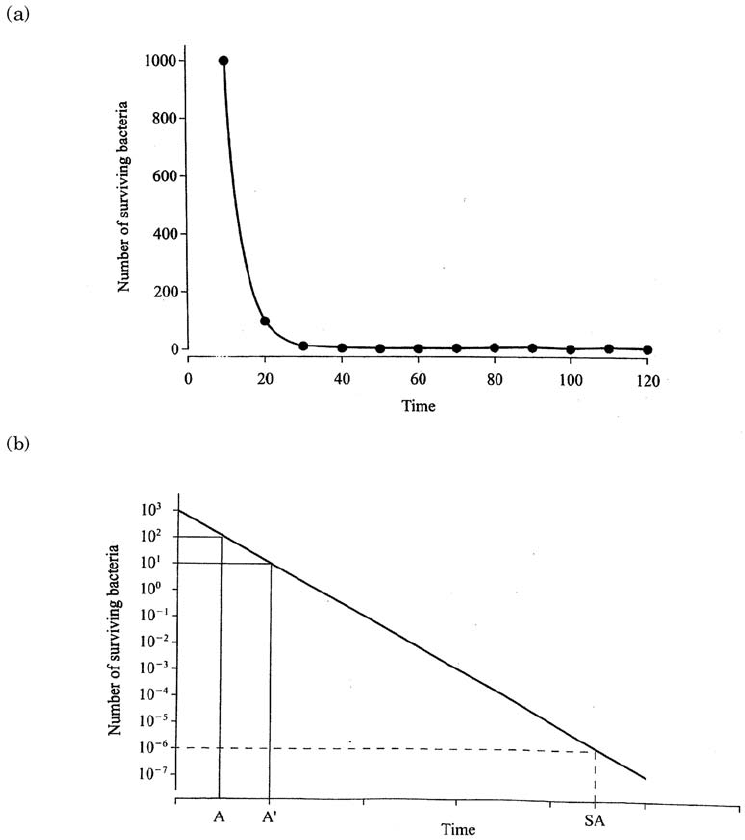
of the surviving cells against time of exposure gives a graph such as Figure 13.8. The
curve is exponential; theoretically, there will never be zero survivors, but after a while
we are going to have less than one cell, let us say one tenth of a cell, which clearly
can not happen. What this really means is that in a given unit volume, there will be a
one in 10 chance of there being a cell present. Sterility is generally assumed when this
figure falls as low as one in a million (see Figure 13.8b). Since only a proportion of
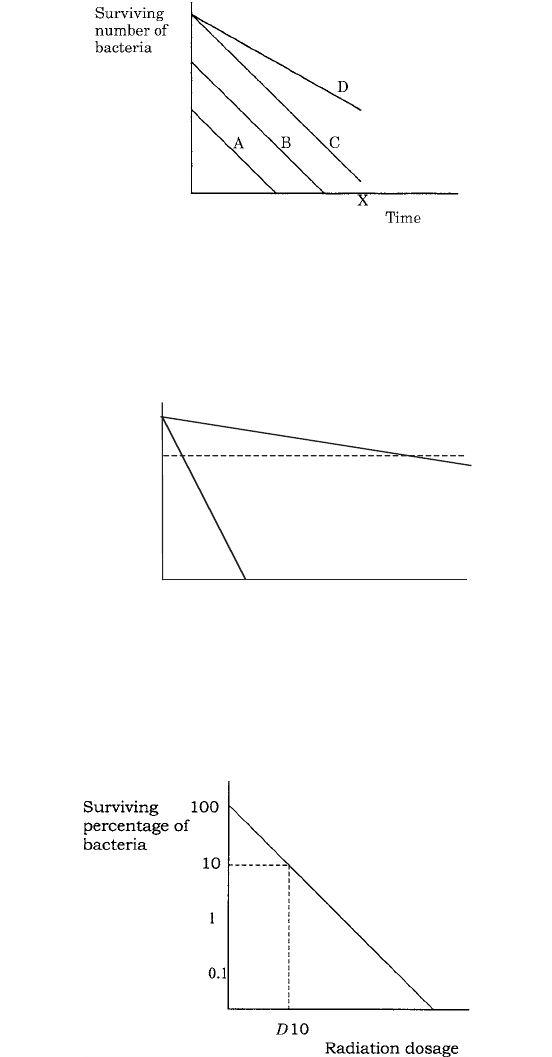
the surviving population is killed per unit time, it follows that the more cells you have
initially, the longer it will take to eliminate them (Figure 13.9).
The steepness of the slope in Figure 13.8(b) is an indication of the effectiveness of
heat sterilisation. The decimal reduction time or D value is the time needed to reduce the
population by a factor of ten (i.e. to kill 90 per cent of the population) using a particular
heat treatment. The D value applies to a particular temperature; at higher temperatures,
the rate of killing is enhanced, and so the Dvalue is reduced (Figure 13.10). The increase
in temperature required to reduce D by a factor of 10 is the Z value.
Since in real life, the microbial population is certain to be a mixed one, then the
critical factor is the death rate of the most resistant species, that is, the one with the
highest percentage of survivors per minute. Sterilisation protocols should therefore be
based on the rate of destruction of endospores.
It should be stressed that an effective treatment regime for one organism may be
wholly inappropriate for another, since organisms differ in their susceptibility to differ-
ent agents. Organism A may resist heat treatment better than organism B, but be more
sensitive to a particular chemical treatment.
Killing by irradiation
Microorganisms as a group are much more resistant to the effects of ionising radiation
than are higher organisms, and some more resistant than others. A plot of log surviving
numbers against time of irradiation is shown in Figure 13.11. The decimal reduction
value (D 10) is analogous to the D value used for heat sterilisation (see above).
JWBK011-13 JWBK011-Hogg August 12, 2005 16:31 Char Count= 0
THE KINETICS OF CELL DEATH 349
Figure 13.8 The kinetics of cell death. (a) During heat sterilisation, the number of living
cells decreases by the same proportion per unit time, giving an exponential curve. (b) When
plotted on a logarithmic scale, the decrease in numbers is seen as a straight line, whose
slope is a reflection of the rate of killing. The time period between A and A
is the decimal
reduction time (D): the time taken to reduce the population to one-tenth of its size. The total
period until the point SA is the sterility assurance value, when there is only a one in a million
probability of any cells having survived. From Hardy, SP: Human Microbiology, Taylor and
Francis, 2002. Reproduced by permission of Thomson Publishing Services
JWBK011-13 JWBK011-Hogg August 12, 2005 16:31 Char Count= 0
350 THE CONTROL OF MICROORGANISMS
Figure 13.9 Sterilisation time is dependent on starting population. Populations A, B and C
all have the same decimal reduction rate, but different starting populations, therefore after
a given time they have different numbers of survivors. Population D has the same starting
numbers as C, but because a smaller proportion are killed per minute, (i.e. the slope is less
steep), a greater number survive after time X
D-value
45
o
65
o
Surviving
percentage
of bacteria
100
10
1
0.1
10 20 30 40 50 60
Time (min)
Figure 13.10 D value is reduced at higher temperatures. The survival rate of a mesophilic
bacterium at three different temperatures. The D value is the time taken to reduce the
population to one tenth of its starting value: note how it falls from 50 min (45
◦
C) to 5 min
(65
◦
C)
Figure 13.11 Killing by irradiation. The decimal reduction value (D10) is the dose of
radiation necessary to reduce the population of microorganisms to one-tenth of its value.
The value for D10 differs greatly between organisms

JWBK011-13 JWBK011-Hogg August 12, 2005 16:31 Char Count= 0
TEST YOURSELF 351
Test yourself
1 An antimicrobial agent that kills microorganisms is termed one
that inhibits their growth is described as
.
2 Heat treatment at temperatures in excess of 100
◦
C is necessary to ensure the
destruction of
.
3 Steam heated under a pressure of 103 kPa in an autoclave reaches a temper-
ature of
◦
C.
4 During tyndallisation, the material being treated is heated to between 90
and 100
◦
C for about on three consecutive days. In the inter-
vening periods, it is left at
◦
C, to allow any surviving
to .
5 The traditional method for the
of milk was to heat at
for 30 minutes.
6 Moist heat is more effective than dry heat at the same temperature, because
water is needed for the
of .
7 Ultraviolet light is used mainly in the sterilisation of
, because it has
very poor
power.
8
radiation is used in many countries to irradiate foodstuffs.
9 Liquids may be sterilised by the use of
made of polycarbonate or
nitrocellulose.
10
is a gas used in the sterilisation of hospital equipment.
11 After disinfection, there is a possibility that some microorganisms will
.
12 Ethanol is most effective as a disinfectant at a concentration of
.
13 A number of chemical disinfectants are more effective when dissolved in
.
14 Chlorine and its derivatives are most widely used as disinfectants of
.
15 Tincture of
is an effective skin disinfectant.
16 The use of carbolic acid in operating theatres, introduced by
,
reduced the number of fatalities due to infections.

JWBK011-13 JWBK011-Hogg August 12, 2005 16:31 Char Count= 0
352 THE CONTROL OF MICROORGANISMS
17 The efficacy of a disinfectant can be measured as its coefficient.
18 Soaps and detergents are examples of
.
19
is assumed when it is reckoned to be less than a one in a million
chance of a microbial cell being present.
20 The time needed for a bacterial population to be reduced to one tenth at a
particular temperature is called the
.

P1: FCG/SPH P2: FCG/SPH QC: FCG/SPH T1: SPH
JWBK011-14 JWBK011-Hogg August 12, 2005 16:32 Char Count= 0
14
Antimicrobial Agents
In Chapter 1, we saw how by the end of the 19th century, the germ theory of infectious
diseases had finally gained widespread acceptance. It is hardly surprising then, that
the scientific community at that time should turn its collective mind towards ways of
controlling infections and the organisms that cause them. In the following pages we
shall discover how the development of chemical agents targeted against pathogenic
microorganisms had a dramatic impact on the treatment of infectious diseases in the
twentieth century.
The term chemotherapy is most closely associated in the minds of most people with
the treatment of cancer. In fact the term was first used by Paul Ehrlich to describe any
use of a drug or other chemical substance for the treatment of disease; thus, it has
much wider terms of reference. In our present discussion, we shall confine ourselves to
chemotherapy as it relates to the treatment of infectious diseases. It was Ehrlich who,
100 years ago, observed how certain dyes would stain bacteria but not the surrounding
tissues, leading him to formulate the idea of selective toxicity, whereby a substance
would selectively target harmful microorganisms but leave human tissues undamaged.
He tested hundreds of synthetic compounds in the search for his ‘magic bullet’ before
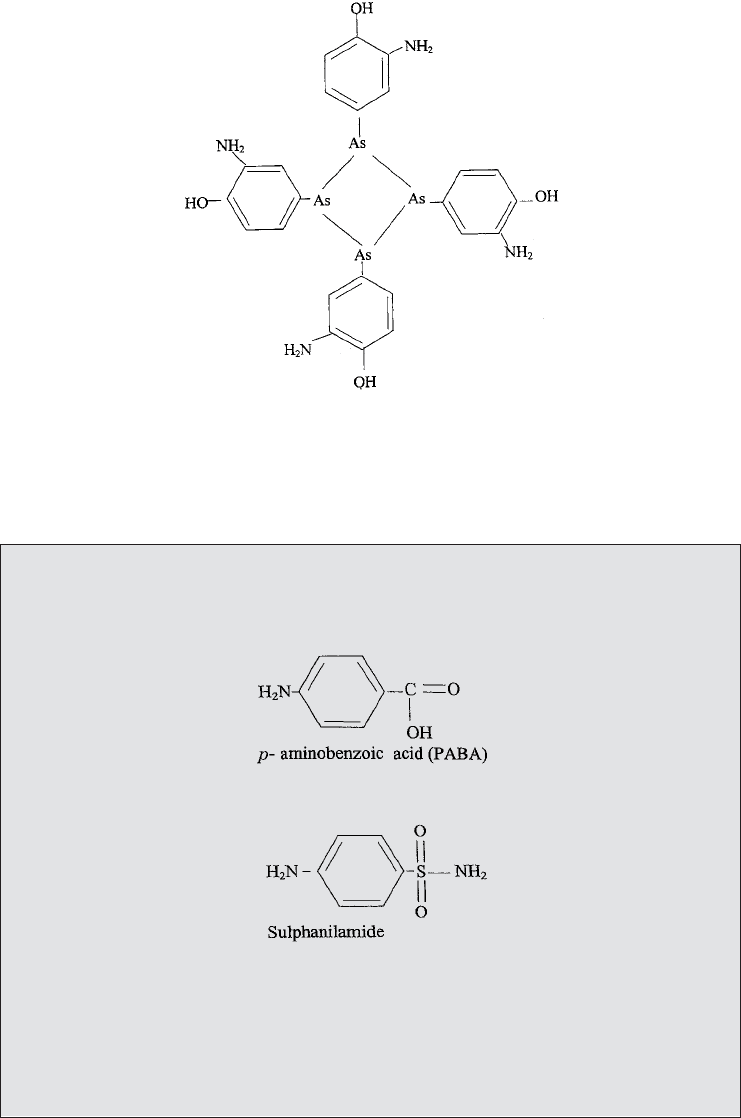
finding, in 1910, an arsenic-containing drug, Salvarsan, which was effective against
Treponema pallidum, the causative agent of syphilis (Figure 14.1).
It was another 20 years before another significant antimicrobial drug was developed,
when the German chemist Gerhard Domagk showed a synthetic dye, Prontosil, to be
active against a range of Gram-positive bacteria. The active component of prontosil
was shown soon afterwards to be sulphanilamide. In the following decade, numer-
ous derivatives of sulphanilamide were synthesised, many of which were more potent
antimicrobial agents than the parent molecule. This class of compounds is known col-
lectively as the sulphonamides, or sulfa drugs (Box 14.1). In the years leading up to the
Second World War, sulphonamides dramatically improved the mortality rates due to
pneumonia and puerperal fever.
A side-effect is an unde-
sirable and unintended
effect of a therapeutic
treatment on the recipi-
ent.
Nowadays, sulphonamides have largely been replaced
by antibiotics because of their side-effects, and because,
due to wholesale and indiscriminate use in the early
years, bacterial resistance to sulphonamides has become
widespread. Some synthetic compounds are still useful
as antimicrobial agents, however. Isoniazid is one of the
principal agents used in the treatment of tuberculosis. It
353
P1: FCG/SPH P2: FCG/SPH QC: FCG/SPH T1: SPH
JWBK011-14 JWBK011-Hogg August 12, 2005 16:32 Char Count= 0
354 ANTIMICROBIAL AGENTS
Figure 14.1 Salvarsan. Ehrlich’s ‘Compound 606’ proved to be a very effective treatment
for syphilis. The name derives from the facts that it brought salvation to sufferers, and that
it contained arsenic!
Box 14.1 Sulphonamides -- the deadly mimics
Sulphonamides exert their effect by fooling the bacterial cell into thinking they are
molecules of p-aminobenzoic acid (PABA) because of their similar structures (see
below).
PABA is a precursor of folic acid, which is required by cells as a coenzyme in
the synthesis of nucleic acids. The sulphonamide acts as a competitive enzyme
inhibitor (see Chapter 6), preventing the synthesis of folic acid, which in turn affects
nucleic acid metabolism and leads to cell death. Because of their close structural
resemblance to the PABA, the sulphonamides are said to be structural analogues;
another, equally descriptive name is antimetabolites.

P1: FCG/SPH P2: FCG/SPH QC: FCG/SPH T1: SPH
JWBK011-14 JWBK011-Hogg August 12, 2005 16:32 Char Count= 0
ANTIBIOTICS 355
is nearly always given in association with another antimicrobial agent because of the
high incidence of resistant forms of the mycobacteria that cause the disease. Like the
sulphonamides, isoniazid is a structural analogue, and is thought to inhibit the produc-
tion of mycolic acid in the mycobacterial cell wall (see Chapter 7).
The quinolones are synthetic substances related to nalidixic acid, and include
ciprofloxacin and norfloxacin. They interfere with nucleic acid synthesis by inhibiting
DNA gyrase, the enzyme responsible for unwinding DNA prior to replication (Chapter
11). Quinolones are used in the treatment of urinary infections, as are the nitrofurans.
These are active against certain fungi and protozoans as well as a range of bacteria.
Antibiotics
An antibiotic is a mi-
crobially produced sub-
stance (or a synthetic
derivative) that has an-
timicrobial properties.
The other major breakthrough in the treatment of infec-
tious diseases was of course the discovery of naturally
occurring antimicrobial agents, or antibiotics. These are
metabolites produced by certain microorganisms, which
inhibit the growth of certain other microorganisms. As
we shall see, the definition has been extended to in-
clude semisynthetic derivatives of these naturally occur-
ring molecules. Table 14.1 lists some commonly used
antibiotics.
One of the best known of all stories of scientific discovery is that of how Sir Alexander
Fleming discovered penicillin in 1928. Before we consider that, however, it is worth
noting that a number of treatments for infectious diseases practised over the preceding
Table 14.1 Some antibiotics and their microbial source
Antibiotic Microbial Source
Bacteria (Gram-positive)
Bacitracin Bacillus subtilis
Polymixin Bacillus polymixa
Actinomycetes
Gentamicin Micromonospora purpurea
Actinomycin D Streptomyces parvulus
Erythromycin Streptomyces erythreus
Streptomyces
Nystatin Streptomyces noursei
Rifamycin Streptomyces mediterranei
Streptomycin Streptomyces griseus
Tetracycline Streptomyces rimosus
Vancomycin Streptomyces orientalis
Fungi
Cephalosporins Cephalosporium acremonium
Griseofulvin Penicillium griseofulvum
Penicillin Penicillium chrysogenum

P1: FCG/SPH P2: FCG/SPH QC: FCG/SPH T1: SPH
JWBK011-14 JWBK011-Hogg August 12, 2005 16:32 Char Count= 0
356 ANTIMICROBIAL AGENTS
Box 14.2 Was Fleming lucky?
In the frequent retelling of the discovery of penicillin, much is made of the role
played by chance. It is true that the Penicillium mould in Fleming’spetri dish was an
accidental contaminant, but arguably the real stroke of luck was not so much the
fact that the contamination occurred but that it was observed by somebody who
immediately recognised its significance.
centuries can, with the benefit of hindsight, be regarded as a form of antibiotic therapy.
Many hundreds of years ago for example, the Chinese used mouldy soybean curd in the
treatment of boils and South American Indians controlled foot infections by wearing
sandals which had become furry with mould! In the late 19th century, Tyndall (see
Chapter 13) made the observation that a culture medium cloudy with bacterial growth
would clear when mould grew on the surface. Around the same time Pasteur and Joubert
demonstrated that cultured anthrax bacilli could be inactivated in the presence of certain
other microorganisms from the environment. By the early 1920s the search was on for
the isolation of a microbially produced antibacterial agent, and Gratia and Dath isolated
a substance from a soil actinomycete which came to be known as actinomycin. However,
although potent against a number of pathogens, actinomycin is too toxic to be useful
therapeutically.
Fleming was also looking for a naturally occurring antimicrobial agent. On one occa-
sion, he noticed that a plate culture of Staphylococcus aureus had become contaminated
by the growth of a mould; around it were clear areas, where the S. aureus did not grow.
The mould was subsequently identified as Penicillium notatum. and the substance that
had diffused through the agar from it, preventing bacterial growth, became known
as penicillin. Further investigation revealed that broth from a culture of the Penicil-
lium mould was inhibitory towards the growth of a number of other Gram-positive
pathogens, and remained so even when diluted several hundred times. Critically, when
tested on mice, it was, for the most part, harmless.
When it came to purifying the active ingredient and using it in vivo however, a num-
ber of problems were encountered. The penicillin proved to be impure, only produced in
minute amounts, and unstable in the acid conditions of the stomach, thereby limiting its
therapeutic potential. After publishing a few papers on the subject, Fleming ceased work
on penicillin and it was left to Howard Florey and Ernst Chain in 1939 to take up the
challenge of producing it in sufficient quantities and in a pure enough form for therapeu-
tic use. Early work in Oxford had to continue in the United States because of the German
air raids in Britain. The American entry into the Second World War in late 1941 meant
that the development of penicillin was awarded war project status, giving it greatly
added impetus. As a result of their endeavours, the yield of penicillin rose hugely (see
Box 14.3), and in 1945, Fleming, Chain and Florey shared the Nobel Prize for their work.
Other antibiotics were also isolated during this period, most notably streptomycin,
isolated by Selman Waksman from Streptomyces griseus, which was to prove so effective
against tuberculosis.
In 1942 there was only enough penicillin in the world to treat a few hundred in-
dividuals, but by the end of the Second World War production had grown to such an
extent that 7 million people a year could be treated. By the mid-1950s, such well-known

P1: FCG/SPH P2: FCG/SPH QC: FCG/SPH T1: SPH
JWBK011-14 JWBK011-Hogg August 12, 2005 16:32 Char Count= 0
ANTIBIOTICS 357
Box 14.3 How did Florey and Chain improve the yields of penicillin?
The work of Florey and Chain resulted in pure penicillin being produced on a large
scale, suitable for therapeutic use. Among their achievements were:
r
isolation of a better penicillin-producing species (P. chrysogenum, famously iso-
lated from a mouldy cantaloupe melon in Peoria Illinois!) and selection of mutant
strains induced by X-rays and UV irradiation
r
development of submerged culture technique, with sterile air being forced
through the medium to supply essential oxygen
r
improvements in medium composition
r
addition of precursors to the medium
r
refinements to recovery methods.
antibiotics as tetracycline, chloramphenicol and neomycin had been isolated. The dis-
covery of a few naturally occurring compounds had revolutionised the treatment of
infectious diseases.
New antibiotics are still being sought today; in Chapter 17 we discuss the stages in
the isolation, testing and development of a putative new antibiotic. Of the thousands
isolated so far, only a small proportion have proved to be of any real therapeutic or
commercial value. This is because, like the actinomycin mentioned above, most of the
substances isolated harm not only bacteria but humans too.
A key prerequisite for any chemotherapeutic agent is selective toxicity. An obvious
way of achieving this is for a compound to direct its effect against a metabolic or
physiological function found in microbial cells but not in the host. We shall look at some
examples of this later in this chapter. Those chemotherapeutic agents which inhibit the
same process in host as in pathogen, or which cause harm to the host in some other way,
are said to have side-effects. These may include directly toxic effects, hypersensitivity
(allergic) reactions or adverse effects on the host’s normal resident microflora.
One of the reasons why penicillin was, and continues to be, so successful, was that
the target of its action is unique to bacteria, so it its degree of selective toxicity is high.
What other properties should an antibiotic have?
Selective toxicity is the most important single attribute of an antibiotic, but ideally it
should also have as many of the following properties as possible:
r
antibiotics, like other chemotherapeutic agents, need to be soluble in body fluids,in
order to exert their effect by penetrating the body tissues. The compound must not
be metabolised so quickly that it is excreted from the body before having a chance
to act.