
Hogg S. Essential microbiology
Подождите немного. Документ загружается.

P1: FCG/SPH P2: FCG/SPH QC: FCG/SPH T1: SPH
JWBK011-14 JWBK011-Hogg August 12, 2005 16:32 Char Count= 0
368 ANTIMICROBIAL AGENTS
Bacterial lawn Paper disc
A
rea of clearing
paper disc
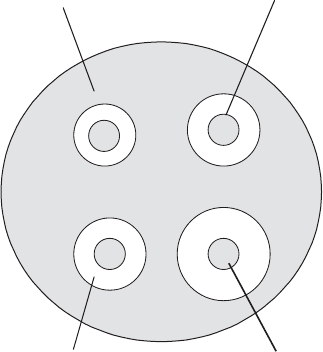
Figure 14.8 Antibiotic testing by disc diffusion. The bacterium to be tested is spread on
an agar plate, then paper discs impregnated with appropriate antibiotics are placed on the
surface. Following incubation, susceptibility to an antibiotic is indicated by a clear ring
surrounding the disc
In the disc diffusion method, paper discs impregnated with the antibiotic are placed
on the surface of an agar plate previously inoculated with the test organism (Figure 14.8).
The antibiotic diffuses radially outwards, becoming less concentrated as it does so. A
clear zone of inhibition appears where growth has been inhibited. The larger this is, the
more susceptible the organism. Conditions may be standardised so that susceptibility
(or otherwise) to the antibiotic can be determined by comparing the diameter of the
zone of clearing with standard tables of values. From this, a suitable concentration for
therapeutic use can be determined.
Antifungal and antiviral agents
We have focused our attention up to now on those antimicrobial agents which are
directed against bacteria, but of course these are not the only cause of infections. Below,
we review the relatively limited repertoire of compounds available for the treatment of
fungal and viral infections.
Antifungal agents
Fungi are eucaryotes, and therefore are unaffected by those agents which selectively
target uniquely procaryotic features such as peptidoglycans and 70S ribosomes. Therein
P1: FCG/SPH P2: FCG/SPH QC: FCG/SPH T1: SPH
JWBK011-14 JWBK011-Hogg August 12, 2005 16:32 Char Count= 0
ANTIFUNGAL AND ANTIVIRAL AGENTS 369
lies the problem: anything that damages fungal cells is likely to damage human cells
too.
Polyene antibiotics such as amphotericin and nystatin (both produced by species of
Streptomyces) act on the sterol components of membranes; their use is limited, because
human cells can also be affected by their action (to use a term we learnt earlier in this
chapter, they have a low therapeutic index). Nystatin is used topically against Candida
infections, while amphotericin B is generally used against systemic infections of fungal
origin. The latter substance can have a wide range of serious side-effects, but in some
cases infections are so severe that the physician is faced with no alternative. Synthetic
compounds such as the imidazoles have a similar mode of action to the polyenes; they
are effective against superficial mycoses (fungal infections of the skin, mouth and urino-
genital tract). Griseofulvin, a natural antibiotic produced by a species of Penicillium, is
another antifungal agent whose use is restricted; it works by interfering with mitosis and
not surprisingly has a range of side-effects. Although used to treat superficial infections,
it is taken orally.
Antiviral agents
In spite of the looming threat of resistant strains, there is no doubt that antibiotics have
been hugely successful in the control of bacterial diseases. We have, however, been a
lot less successful when it comes to finding a treatment for diseases caused by viruses;
a quick revision of their modus operandi (Chapter 10) should make it clear why this is
so. Viruses survive by entering a host cell and hijacking its replicative machinery, thus
a substance interfering with the virus is likely to harm the host as well. A number of
compounds have been developed however, which are able to act selectively on a viral
target.
All antiviral agents act by interfering with some aspect of the virus’s replication cycle.
A number of such compounds have been found, but only a few have been approved for
use in humans.
One of the first antiviral agents to be approved for use was amantidine, which inhibits
uncoating of the influenza A virus by preventing the formation of acid conditions in
the host cell’s endocytotic vesicles (see Chapter 10). Its specificity for the virus is due to
selective binding to M
2
, a matrix protein. Amantidine’s efficacy is dependent on admin-
istration within the early stages of an infection. It can be administered prophylactically,
but may have side-effects.
Most antiviral agents target nucleic acid synthesis, usually by acting as base ana-
logues. These are molecules that are incorporated into viral nucleotides instead of the
normal deoxynucleosides, disrupting synthesis because DNA polymerase is unable to
act on them. The majority of viruses encode their own DNA polymerases, and the base
analogues exert their effect by selectively inhibiting these, thus having little effect on
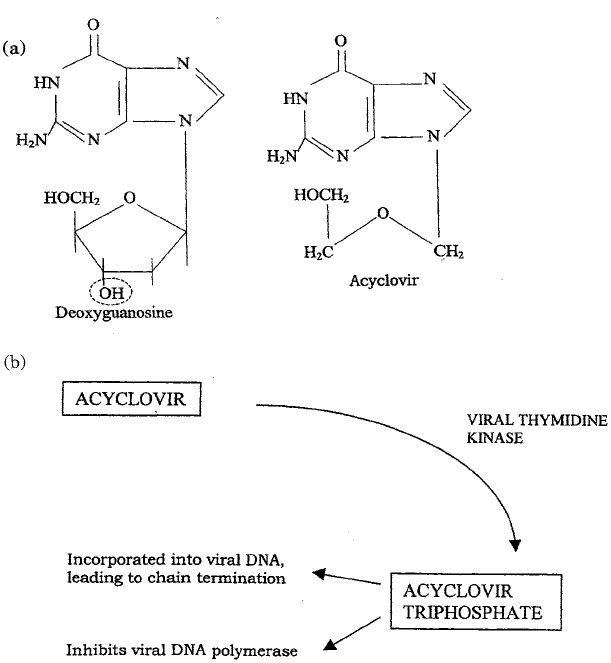
that of the host cell. An example is acyclovir, which is an analogue of guanosine; it is
converted to the nucleoside triphosphate by the action of thymidine kinase and then in
this form acts as a competitive inhibitor of the ‘correct’ version (Figure 14.9). When the
acyclovir nucleotide is incorporated into the viral DNA, there is no attachment point
for the next nucleotide, so further elongation of the chain is prevented. Acyclovir exerts
P1: FCG/SPH P2: FCG/SPH QC: FCG/SPH T1: SPH
JWBK011-14 JWBK011-Hogg August 12, 2005 16:32 Char Count= 0
370 ANTIMICROBIAL AGENTS
Figure 14.9 Acyclovir inhibits viral DNA synthesis. (a) Acyclovir has a similar structure to
the nucleoside deoxyguanosine, but lacks the -OH group (circled) necessary for chain exten-
sion. (b) Acyclovir needs to be phosphorylated to become active; virally encoded thymidine
kinase is required for this. Acyclovir triphosphate (ACV-T) selectively inhibits viral, but not
human, DNA polymerase. Any ACV-T that is incorported into viral DNA acts as a chain
terminator
its selective action by having a much higher affinity for the viral polymerase than that of
the host. It is used in the treatment of herpes simplex infections; unfortunately, in a sce-
nario echoing our experience with antibiotics, resistant strains of herpes simplex virus
have been shown to exist. This can be seen as even more serious than the emergence
of antibiotic resistant bacteria, because the choice of alternative antiviral agents is so
restricted. Vidarabine and azidothymidine (AZT) are other examples of base analogues.
AZT (Retrovir) was one of the first substances shown to have an effect against HIV,
which it does by preventing cDNA synthesis by the enzyme reverse transcriptase (see
Chapter 10).

P1: FCG/SPH P2: FCG/SPH QC: FCG/SPH T1: SPH
JWBK011-14 JWBK011-Hogg August 12, 2005 16:32 Char Count= 0
THE FUTURE 371
Zanamivir was approved by the US Food and Drug Administration (FDA) in 1999. It
belongs to a new class of synthetic compounds called neuraminidase inhibitors, which
act selectively against both influenza A and B viruses. They block the active site of the
enzyme neuraminidase, preventing the release of new virus particles from infected cells,
hence reducing the spread of the infection. Zanamivir is inhaled as a fine powder directly
into the lungs of patients who are in the early stages of infection.
The future
The development and widespread use of antibiotics must rank as the most remark-
able of all medical advances made in the 20th century. Overconfident assertions that
infectious diseases would soon be a thing of the past, however, now have a hollow ring
to them. Viruses have proved to be more difficult to deal with than bacteria, and many
viral diseases continue to elude effective treatment. Most alarmingly, the threat of re-
sistant strains casts a shadow over all the past achievements of antibiotics. The major
aim of scientists now must be to develop new antibiotics or other therapeutic strate-
gies at a pace greater than that at which bacteria are developing resistance. In 2000,
the FDA approved a new synthetic agent shown to be effective against both MRSA
and vancomycin-resistant Enterococcus faecalis. Linezolid (Zyvox), which works by
blocking the initiation of protein synthesis, belongs to a new class of antibiotics called
oxazolidinones. It is the first new anti-MRSA compound to be introduced for more than
40 years.
Another approach to countering resistant forms is to identify and target the mecha-
nism by which they combat antibiotic therapy. A team at Rockefeller University in New
York have identified two genes that enable resistant forms to rebuild their cell walls
after antibiotic treatment. By targeting these genes, they hope to restore the potency
of a cell wall inhibitor such as penicillin. Perhaps by the time you read this, other, less
conventional approaches will have yielded promising results (see Boxes 14.7 and 14.8),
but you can be just as sure that bacteria will have new tricks up their sleeves, and that
the battle of Man versus microorganisms will continue well into the new millennium.
Box 14.7 Bugs against bugs?
Scientists are always on the lookout for new weapons in the fight against infectious
diseases. The emergence of resistant strains of pathogens means that new solutions
continually need to be found. One novel line of research is hoping to utilise the
bactericidal powers of a defence system used by certain insects. A sap-sucking
species has been found that produces substances that interfere with bacterial pro-
tein synthesis. Most of these would harm protein synthesis in humans too, but certain
peptides appear to be more selective in their action, protecting mice from E. coli
and Salmonella infections. It may seem an unlikely source for a life saver, but then,
so was Penicillium!

P1: FCG/SPH P2: FCG/SPH QC: FCG/SPH T1: SPH
JWBK011-14 JWBK011-Hogg August 12, 2005 16:32 Char Count= 0
372 ANTIMICROBIAL AGENTS
Box 14.8 Bacteriophages: our secret weapon against infections?
If bacteriophages are viruses that infect bacterial cells, why aren’t they used in
the fight against bacteria that cause infectious diseases? The short answer is: in
some places they are! In the years following their discovery, there was consider-
able enthusiasm in some quarters for the notion that phages might be useful in the
treatment of bacterial diseases. A particular attraction of phages as therapeutic
agents is that they are extremely selective in their action, targeting one specific
cell type. Early studies and trials had mixed results and before too long, antibiotics
had revolutionised the treatment of infectious diseases in the West. This led to phage
therapy being forgotten for several decades, but its use continued in the Soviet bloc
countries, however, where even now phage preparations can be bought over the
counter.
Western interest revived in the 1980s in the wake of the upsurge in antibiotic-
resistant strains of bacteria, since when phages have attracted attention as possible
allies in the control of infectious diseases, including some not responsive to antibiotic
therapy. Several American companies have become involved in phage therapy,
some in collaboration with the former Soviet state of Georgia, where research has
been carried out over several decades.
Particular attention has been paid to veterinary applications, with a view to re-
ducing the amount of antibiotic usage in animals, and it is hoped that one day
phages may prove to be the weapon we need to fight antibiotic resistant strains
such as MRSA and VRE.
Test yourself
1 Following Fleming’s discovery of penicillin, and were
largely responsible for developing it and bringing it to large scale production.
2 It is essential for an antimicrobial agent to have
toxicity, otherwise
host cells will be affected as well as microorganisms.
3 Penicillins and cephalosporins both belong to the
group of antibi-
otics. They bind to the
enzyme, preventing of peptido-
glycan.
4
penicillins such as ampicillin have been developed to overcome
some of the problems inherent in naturally occurring forms, such as
and narrow .
5
was the first antibiotic to shown to be effective against Gram-
negative bacteria.
6
have a particularly broad range of specificity and act by preventing
extension of the peptide chain during protein synthesis.

P1: FCG/SPH P2: FCG/SPH QC: FCG/SPH T1: SPH
JWBK011-14 JWBK011-Hogg August 12, 2005 16:32 Char Count= 0
TEST YOURSELF 373
7 Antibiotics that affect protein synthesis target the differences between pro-
caryotic and eucaryotic
.
8 Aminoglycoside antibiotics inhibit protein synthesis by preventing attach-
ment of the
subunit.
9
is a member of the macrolide group of antibiotics, and is often
used instead of penicillin in the treatment of staphylococcal and streptococcal
infections in children.
10 Rifamycins affect mRNA production by inhibiting the enzyme
.
11 One of the antibiotic resistant organisms most frequently found in hospitals is
MRSA (
Staphylococcus aureus). Infections originating
in such environments are termed
infections.
12
is used against antibiotic-resistant infections; however bacteria
have been found that are also resistant to this agent.
13 Some bacteria are able to pump antibiotics out of the cell before they have had
time to act. They are able to do this by means of enzymes called
.
14 Antibiotic resistance acquired through bacterial conjugation is described as
resistance.
15 Genes for enzymes that inactivate antibiotics are usually carried on
.
16 The lowest concentration of an antibiotic that prevents growth of a microor-
ganism is described as its
.
17 In the disc diffusion method,
of develop as the antibiotic
diffuses outwards.
18 The usefulness of polyene antibiotics in fungal infections is limited because
human cells may also be affected. Such compounds are said to have a low
.
19 The antiviral agent acyclovir works by acting as a
.It
inhibits viral
.
20
has been used as a therapeutic agent in the treatment of AIDS. It
acts by inhibiting viral
.
P1: FCG/SPH P2: FCG/SPH QC: FCG/SPH T1: SPH
JWBK011-14 JWBK011-Hogg August 12, 2005 16:32 Char Count= 0
374
JWBK011-15 JWBK011-Hogg August 12, 2005 16:33 Char Count= 0
Part VI
Microorganisms in
the Environment
375
JWBK011-15 JWBK011-Hogg August 12, 2005 16:33 Char Count= 0
376

JWBK011-15 JWBK011-Hogg August 12, 2005 16:33 Char Count= 0
15
Microbial Associations
Symbiosis is sometimes
taken to mean a re-
lationship between dif-
ferent organisms from
which both participants
derive benefit. We use
the term in its broader
sense, as described in
the text.
We have stressed on more than one occasion during the
course of this book that microorganisms in nature do
not exist as pure cultures but alongside numerous other
organisms, microbial or otherwise, with which they may
have to compete in the never-ending struggle for survival.
In a number of cases, this coexistence may extend be-
yond merely sharing the same environmental niche; some
microorganisms form a close physical association with
another type of organism, from which special benefits
may accrue for one or both parties. Such associations
are termed collectively symbiosis (‘living together’) (Ta-
ble 15.1). Three general forms of symbiotic relationship
may be defined:
r
Parasitism: an association from which one partner derives some or all of its
nutritional requirements by living either in or on the other (the host), which
usually suffers harm as a result.
r
Mutualism: an association from which both participants derive benefit. The
relationship is frequently obligatory, that is, both are dependent upon the other
for survival. Non-obligatory mutualism is sometimes called protocooperation.
r
Commensalism: an association from which one participant (the commensal)
derives benefit, and the other is neither benefited nor harmed. The relationship
is not usually obligatory.
Microorganisms may be associated with plants, animals or other types of microorganism
in any of these types of symbiosis (Tables 15.2–15.4).
Microbial associations with animals
Termites are insects belonging to the order Isoptera that are found particularly in tropical
regions. Their famous ability to destroy trees and wooden structures such as buildings
and furniture is due to a resident population of flagellated protozoans in their hindgut,
which are able to break down cellulose. Termites lack the enzymes necessary to do
377