
Hunefeldt C., Harris B. A Brief History of Peru
Подождите немного. Документ загружается.


x
ACKNOWLEDGMENTS
O
ver the past few decades many publications have enriched our
understanding of Peru’s history, and I’ve used much of this
research published in English and Spanish to help compile the present
volume. My gratitude goes to all those colleagues from whom I have
drawn—their work is immense. In particular I want to thank my
Peruvian colleagues, whose work preceded mine and who were already
making efforts to assemble a general history of Peru, ranging from Jorge
Basadre’s work of the 1980s to that of Franklin Pease and María
Rostworowski on the Inca and the colonial period and to Carlos
Contreras’s, Marcos Cueto’s, and Nelson Manrique’s general republican
histories of Peru. In many ways their work has been a crucial guide to
this volume. Also important to the preparation of this book have been
the publications of Argentinean historian Tulio Halperin-Donghi,
including his history of contemporary Latin America, as well as work
by Frederick B. Pike, who as early as 1967 wrote the first comprehen-
sive general history of Peru in English, and Peter F. Klaren’s history of
Peru published in 2000. Without the insistence and persistence of edi-
tor Edward Purcell, the Peru project would never have become a part of
the series on national histories. Special thanks to him.

xi
Introduction
T
he arrival of the Spanish and Portuguese colonizers to the New
World in the 15th century began a series of drastic changes in most
of the territory we nowadays call Latin America. The changes were most
dramatic in those areas where high civilizations, namely the Aztec, the
Maya, and the Inca, had established cities, built large-scale infrastruc-
tures, and developed hierarchical societies. As the Spaniards occupied
and extended their control over more and more of the Inca Empire, they
introduced their way of life and their religion. The result was, and con-
tinues to be, a process that produced in modern Peru a fusion of differ-
ent cultures, characterized by the emergence of new racial mixtures and
an ongoing search for economic, political, and social progress.
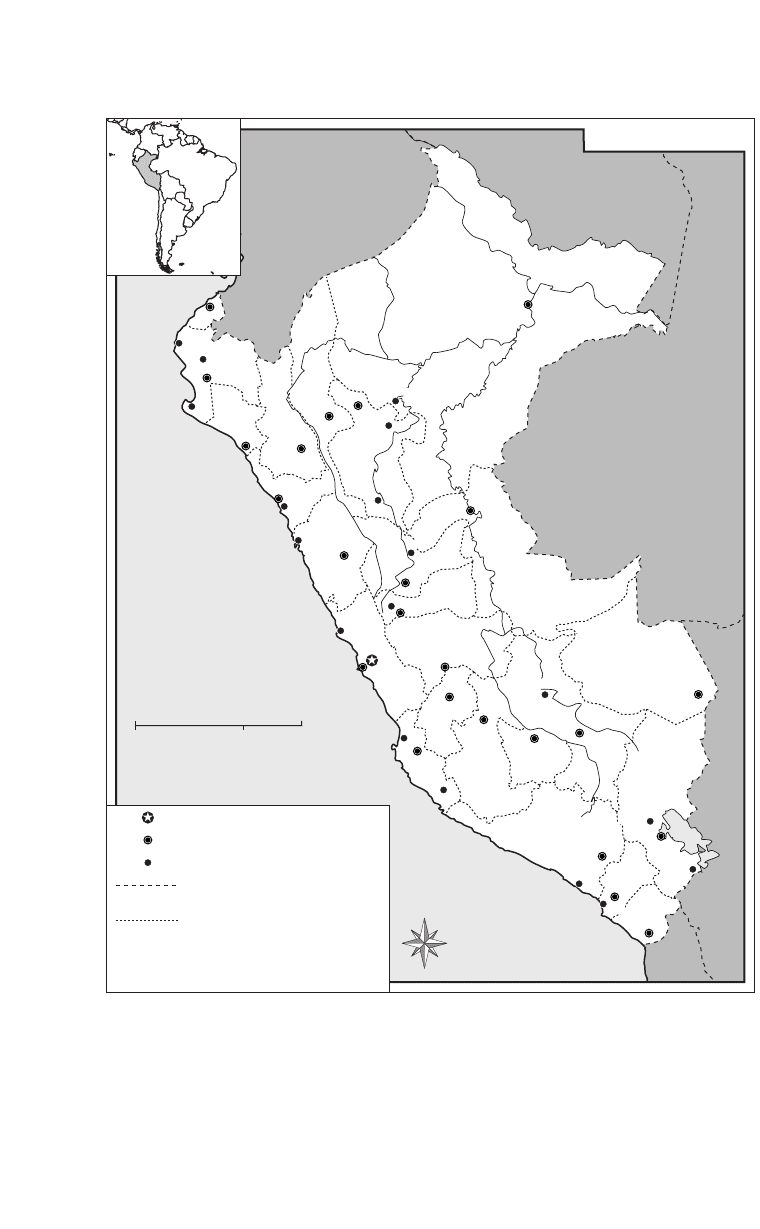
Peru is a rich country that stretches along a section of the Pacific
coast of South America and reaches eastward over the Andean moun-
tain spine to encompass a large section of Amazon basin rain forest. It
holds many natural resources, spread across one of the world’s most
diverse and extreme ecological landscapes, with altitudes ranging from
the sea level up to 20,000 feet. To the north are the countries of
Ecuador and Colombia; to the east lie Brazil and Bolivia; and directly to
the south, Peru borders Chile.
The great majority of Peru’s population of around 28 million people
lives in the coastal zone, where to seaward the cold waters of the
Humboldt current have created rich offshore fishing beds but are also
subject to the severe climate disruptions caused by the notorious El
Niño phenomenon. Much of today’s economic activity, from farming to
oil production, occurs along the coast, which historically was the
source of great wealth from such resources as deposits of nitrates and
bird guano, used worldwide for fertilizer.
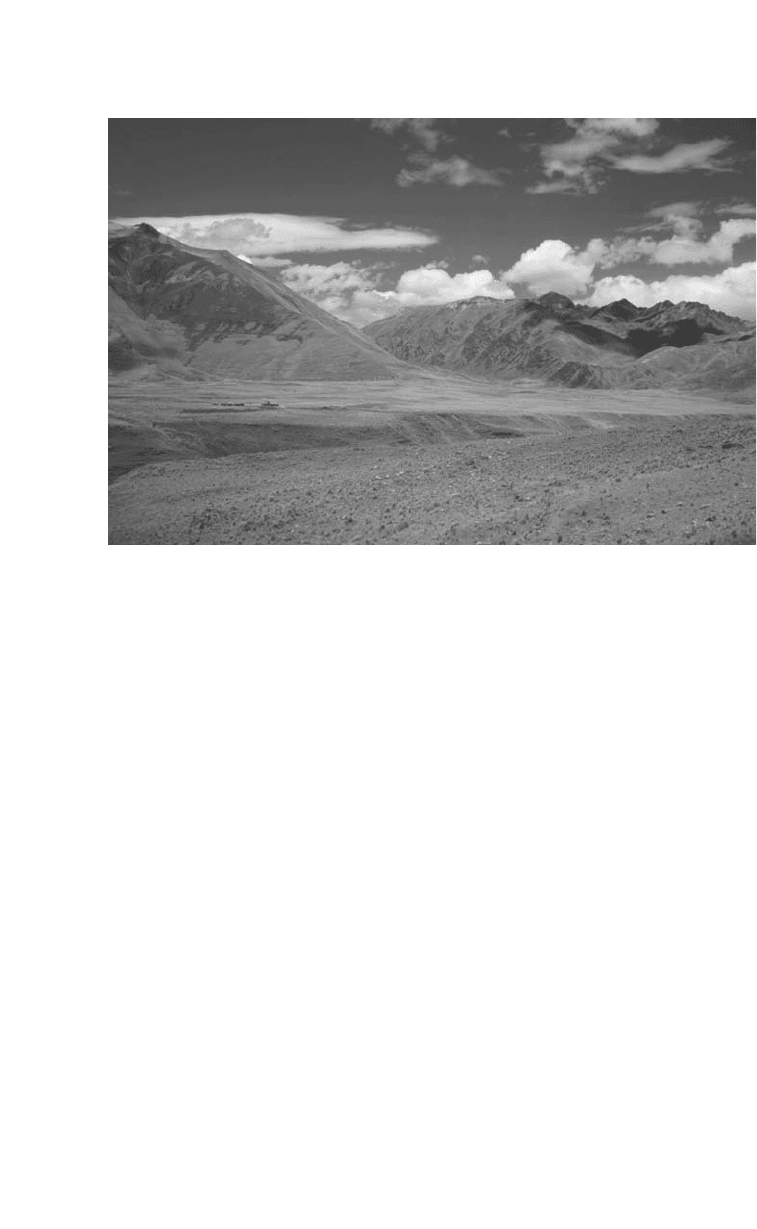
To the east the coast gives way to the high mountains of the Andes.
This region, known as the sierra, is characterized by an extraordinary
landscape of towering peaks, including the Huascarán at 20,000 feet,
interrupted by deep valleys and softened by areas of high plains called
the altiplano, or puna. The sierra, although dotted with a few cities, is
traditionally the home of much of Peru’s Indian population, many of
whom still live in relatively scattered communities. For many decades
after the arrival of Europeans, the fabulous silver mines of the sierra
produced millions and millions of dollars worth of booty for the
Spanish, and the region has continued—at a reduced level—to be the
source of mineral wealth.
Moving further eastward, the extremes of the sierra give way to the
gentle slopes of the montaña region and eventually to the rain forests
A BRIEF HISTORY OF PERU
xii
Modern Peru
Desaguadero
Moquegua
TUMBES
SAN
MARTÍN
LAMBAYEQUE
AMAZONAS
AYACUCHO
HUANCAVELICA
MOQUEGUA
Pucallpa
Quillabamba
Huancavelica
Ayacucho
Huánuco
Moyobamba
Chachapoyas
Cerro
de Pasco
Goyllarisquizga
R
i
o
H
u
a
l
l
a
g
a
Tarapoto
Santa
Lucia
LA LIBERTAD
Tingo
María
APURÍMAC
Nazca
HUÁNUCO
A
N
D
E
S
A
p
u
r
í
m
a
c
R
.
250 kilometers
0
250 miles
0
N
National capital
Departmental capital
City or town
Contemporary national
boundary
Contemporary departmental
boundary
Note: Callao is the capital of the constitutional
province of Callao.
A
N
D
E
S
Pacific
Ocean
Lima
Callao
Pisco
Ica
Nazca
Juliaca
Puno
Desaguadero
Puerto
Maldonado
Tacna
Ilo
Moquegua
Matarani
Tumbes
Talara
Sullana
PIURA
TUMBES
CAJAMARCA
SAN
MARTÍN
LAMBAYEQUE
AMAZONAS
LA LIBERTAD
ANCASH
HUÁNUCO
PASCO
UCAYALI
LORETO
CUZCO
APURÍMAC
AYACUCHO
HUANCAVELICA
AREQUIPA
ICA
MADRE DE DIOS
PUNO
MOQUEGUA
TACNA
LIMA
JUNÍN
Piura
Paita
Chiclayo
Yurimaguas
Tarapoto
Pucallpa
Iquitos
Abancay
Cuzco
Quillabamba
Huancavelica
Ayacucho
Arequipa
Huacho
Trujillo
Salaverry
Chimbote
Huánuco
Cajamarca
Moyobamba
Chachapoyas
Moyobamba
Chachapoyas
Cerro
de Pasco
Goyllarisquizga
Tingo
María
Huaráz
Huancayo
Santa
Lucía
Lake
Titicaca
Y
a
v
a
r
i
R
.
N
a
p
o
R
.
A
m
a
z
o
n
R
.
P
a
s
t
a
z
a
R
.
U
c
a
y
a
l
i
R
.
H
u
a
l
l
a
g
a
R
.
P
u
t
u
m
a
y
o
R
.
M
a
r
añ
ó
n
R.
A
p
u
r
í
m
a
c
R
.
U
r
u
b
a
m
b
a
R
.
CHILE
ECUADOR
COLOMBIA
BRAZIL
BOLIVIA
SOUTH
AMERICA
SOUTH
AMERICA
PERU
that mark the beginnings of the Amazon River basin, known as the
selva. Almost 60 percent of the total area of Peru is taken up by the
rain for
ests, and much of the region, which stretches from north to
south in a broad band, is still unexplored and thinly inhabited or
exploited.
To the far southeast is magnificent Lake Titicaca, the highest in the
world at 12,000 feet above sea level. Peru shares the lake with Bolivia.
In addition to its physical splendors, a rich historical heritage is
much in evidence in Peru, where, for example, Lima’s port city of
Callao was for three centuries the main Pacific port of the Spanish
Empire and a center for colonial administration. Similarly the splendor
and fascination of the Inca Empire are visible throughout the land, but
nowhere more so than in the former Inca imperial capital of Cuzco,
which holds well-preserved archaeological treasures and is a popular
tourist destination. Beyond Cuzco there is the magnificent Machu
Picchu, as well as other intriguing highland sites. Many archaeological
remains on Peru’s coast and in the Amazon basin also preserve evidence
of a complex and glorious past.
This inspiring history and the availability of abundant and varied
natural resources have stimulated the accomplishments of many mod-
ern Peruvians such as writers, doctors, engineers, and scientists. For
example, Lima has one of the largest and most-renowned research insti-
xiii
INTRODUCTION
A section of the high Peruvian plains known as the altiplano (Photofrenetic/Alamy)
tutes devoted to the study of the potato, a native plant domesticated in
the Andean region. In addition, there has been sophisticated medical
research over the past 100 years, and in general, Peru’s medical research
and teaching centers have a worldwide reputation.
These achievements are genuine; however, it is also true that Peru
has one of the highest rates of social inequality measured in terms of
income, standard of living, and access to resources. The nation’s unem-
ployment and underemployment rates are high, including many people
who work “independently” (that is, they are self-employed) and partic-
ipate in an “informal economy.” Thousands of these people eke out a
living on a hand-to-mouth basis, pay no taxes, and have no social secu-
rity, medical care, water, or electricity. Most of these people live in the
rapidly expanding barriadas, or shantytowns, around Lima.
The nation has also suf
fered from political inequities. After Peru
gained independence from Spain in the early 19th century, the right to
vote was restricted to a small number of literate males who owned
property, and it was not until 1948 that women gained the vote, along
with all males able to sign their names. By contrast, in today’s Peru vot-
ing is an enforced civic obligation.
A BRIEF HISTORY OF PERU
xiv
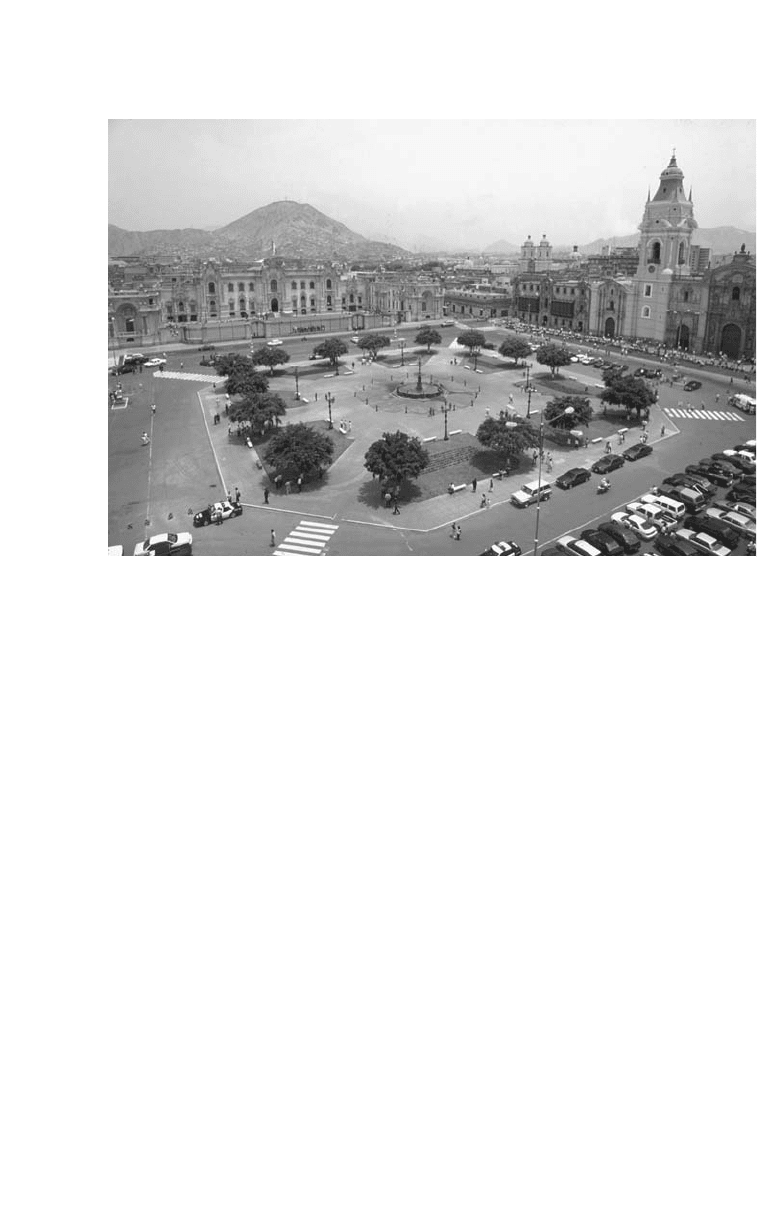
The main square of Lima, the capital of Peru. Lima has been the political and economic center
of the country since the city’s founding as the City of Kings (Ciudad de los Reyes) by Francisco
Pizarro in 1535. The population has increased dramatically in recent decades.
(Alejandro
Balaguer Photo)
The exclusion of illiterate peasants (most of whom lived in remote
provinces) from political life in Peru during most of the republican era
created not only a class rift between a majority of peasants and the rest
of Peru’s population but also reflected the nation’s ethnic-racial gap.
Almost immediately after Europeans arrived in Peru there began a
process of racial mixing that has continued over time. Gradually, the
majority of Peruvians became—in the biological sense—mestizos, or the
mixed-race descendants of both European and indigenous forebears.
However, the ethnic and cultural definitions of mestizo has come to be
more important in Peruvian society than the strictly genetic definition.
In modern Peru most would consider someone mestizo if he or she
speaks Spanish and adheres to social and cultural patterns of behavior
associated with the more Hispanic side of Peruvian life. This means that
people of purely indigenous genetic background may be regarded as
mestizo because of their language, behavior, and lifestyle. By the same
standard someone who is of mixed genetic background but lives entirely
as an indigenous person (for example, as a small farmer at a remote
highland location, speaking only Quechua, the native language of most
of Peru’s Indian population) will likely be regarded as indigenous—a
so-called cultural Indian, rather than mestizo. This cultural rather than
xv
INTRODUCTION
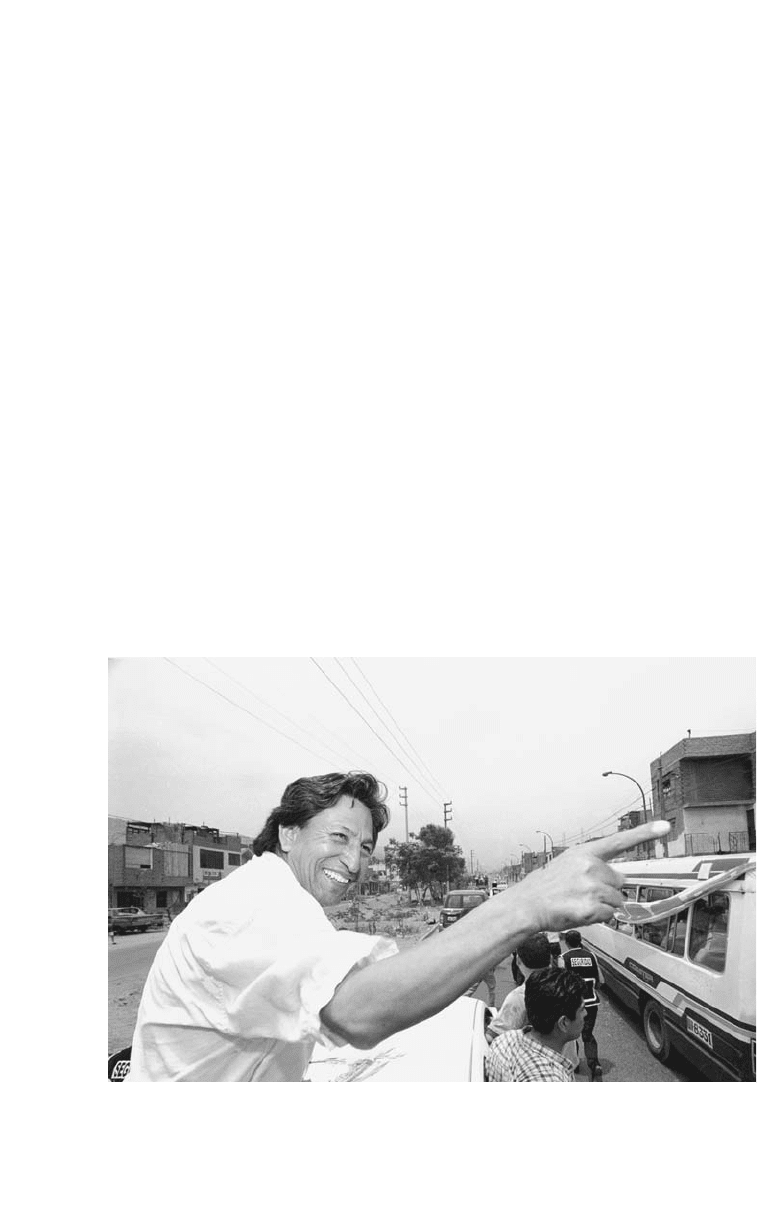
Alejandro Toledo, nicknamed “El Cholo” because of his Indian background, on the campaign
trail during his successful run for the presidency in 2001. He made a specific and direct
appeal to the Peruvians common Incan heritage, particularly of Pachacútec, the emperor who
expanded and consolidated the Inca Empire.
(Alejandro Balaguer Photo)

biological definition has become so widespread in Peruvian society that
the government ceased many decades ago to compile demographic
information on the basis of race.
When Alejandro Toledo ran for president in 2001, he called himself
Peru’s new Pachacútec in his public addresses. Pachacútec Inca
Yupanqui (Pachacuti) was the ruler who, according to early Spanish and
Indian chroniclers, expanded the empire (called Tawantinsuyu, mean-
ing “the realm of the four quarters”) and consolidated Incan predomi-
nance over many other ethnic groups around the mid-15th century.
Pachacútec is regarded as the founder of Inca splendor, well-being, and
success and in the minds of Peruvians is associated with times of inno-
vative change and the inauguration of a new era. Toledo also invoked the
Incan gods and sanctuaries (known as apu) for help in rescuing Peru
fr
om political corruption, economic crisis, and social malaise.
In doing so Toledo shocked the public. It was quite startling to hear
a presidential candidate invoke an ancestral past, hoping to gain the
ears and the votes of modern Peruvians in cities and rural communities.
Journalists, social scientists, and competing presidential candidates
criticized and even ridiculed Toledo’s use of indigenous symbols and
history; however, Toledo won the presidential election. The success of
his rhetoric bespeaks the vitality of a collective memory anchored in the
Inca past and a desire for change. Most of Peru’s history—as will
become clear in the following chapters—is tightly knit to Peru’s large
indigenous populations. The Inca people and a great variety of pre-
Incan cultures are, to a certain degree, still a part of Peru’s present day.
A BRIEF HISTORY OF PERU
xvi

1
Ancient Civilizations
(10,000
B
.
C
.–c.
A
.
D
. 1440)
W
hat we know about the ancient peoples of America is subject to
doubts and ongoing scrutiny. Most of our scant information
comes from reading the archaeological record, which is by nature frag-
mentary and limited. These conditions hold true in the case of South
America in general and Peru in particular.
The biggest questions about ancient Peruvians are basic—Who were
these people? Where did they come from? How did they live?—and
much speculation surrounds the process by which the American conti-
nents were occupied by humans. The intercontinental movements of
populations, from Asia to North America and from North America to
South America, have usually been explained in terms of theories, each
based on at least a slim set of empirical evidence, but none of it is in
itself complete enough to satisfy scientific scrutiny.
For example, Spanish chroniclers of the 16th and 17th centuries took
it for granted that native cultures originated locally and that the early
inhabitants of the continent were the descendants of a second Adam and
Eve. Diffusionist theorists in the late 18th and early 19th centuries
described a series of stages they believed explained how and even when
America was peopled. According to these theories, cultural evolution
explained the gradual geographical expansion of human populations,
with the implicit assumption that people who move from one place to
another had a higher cultural status and that, in consequence, the people
upon whom this expansion was imposed were culturally inferior. This
evolutionist view of human movements across spaces and continents
assumed an unproven inferiority (measured, of course, by Western stan-
dards) and tells us little about the interaction between peoples.
More modern scientific theories concentrate less on religious expla-
nations or invidious comparisons between cultures and rely more on
1

puzzling out conclusions from what we do know. It is reasonable, for
example, to conclude that ancient peoples came to North America
across a land bridge from Asia and then spread down and across the two
American continents, but almost no evidence has yet been found to
show the timing and mechanisms of this great migration.
It is also reasonable to suppose that relatively early on there were
sailors capable of voyaging long distances along the Pacific coasts and
that there was considerable contact between various peoples as a result.
The spread of common domesticated plants and common technologies,
such as pot making and metallurgy, suggests the existence of trade
routes over a vast territory.
The archaeological record is also clear that several pre-Columbian
cultures reached similar levels of development at almost the same time.
For example, the Chavín who lived in what is today Peru flourished at
the same time as the Olmec of Mexico, and both cultures appear to have
developed similar technologies and levels of social organization.
A BRIEF HISTORY OF PERU
2
Andean Prehistoric Cultures
Time Scale Coast Highlands Titicaca Basin
10,000
B
.
C
. Guitarrero
8000
B
.
C
. Pachamachay
6000
B
.
C
. Paijan Lauricocha
4000
B
.
C
. Waka Prieta Chinchoros
2000
B
.
C
. Salinar Kotosh Chinchoros
1000
B
.
C
. Gallinazo Kotosh Chiripa
500
B
.
C
. Paracas Chavín Pukara
0 Mochica Warpa
Nazca
A
.
D
. 250 Lima Recuay Huaricani
A
.
D
. 500 Pachacamac Tiwanaku
A
.
D
. 750 Huari Huari
A
.
D
. 1000 Chancay Killke Chiribaya
A
.
D
. 1250 Chimú Wanka
A
.
D
. 1500 Inca Inca Aymara
Source: Excerpted and summarized from Moseley (1992, 22–23)

Basing their ideas on recent excavations and findings, Peruvian
archaeologists have proposed a time line for the evolution of the vari-
ous pre-Inca cultures, from around 10,000
B
.
C
. to the emergence of the
Inca Empire around
A
.
D
. 1500. These civilizations flourished in three
main cultural regions: along the coast, in the highlands, and around the
Titicaca lake basin.
The Chavín
Vestiges of human hunter-gatherer societies in America can be traced
back to about 15,000 and maybe even 30,000 years ago, but the physi-
cal artifacts of such people are few, especially when measured with find-
ings from later cultures. The picture of ancient Peru starts to be
somewhat defined with the culture known today as the Chavín, which
may have reached its height around 500
B
.
C
. Peruvian and other muse-
ums hold innumerable archaeological pieces from the Chavín culture
and from other important contemporary cultures, such as the Paracas.
The Chavín culture is well known for its artistry and mastery in stone
sculpture, and the Paracas, for its pottery and textiles. Chavín art
apparently influenced many succeeding cultures, and the designs are
still borrowed and reproduced in modern jewelry and textiles.
The center of Chavín culture—which may have been primarily reli-
gious rather than political—appears to have been at the site of a large
temple, known now as Chavín de Huántar, located in the northern
highlands of modern-day Peru. There are other, similar temple sites in
the region, but the one at Chavín de Huántar is the largest and most
elaborate that has survived relatively intact. The quality of the architec-
ture and the decorative arts of the temple are impressive, and the entire
complex demonstrates sophistication and a high degree of social and
economic organization. The main temple is constructed and dressed
with precisely cut stones, and there is evidence that the facade was dec-
orated with intricately carved figures, which were mounted to project
from the walls, depicting eagles, serpents, jaguars, and mythical mon-
sters. The Chavín de Huántar complex, as well as other such temple
sites, demonstrate clearly that the Chavín were able to draw on and
focus a huge bank of human and economic resources.
The Mochica
None of the early Peruvian cultures controlled a territory as large as the
Inca culture would during the 15th century, and still little is known
3
ANCIENT CIVILIZATIONS