
Hunefeldt C., Harris B. A Brief History of Peru
Подождите немного. Документ загружается.


scheme, money and markets were unnecessary, and this form of cultiva-
tion reduced risk: If one crop at a certain altitude failed, communities
could always fall back on crops grown at other altitudes.
Even though local groups had some leeway and strived to be self-suf-
ficient, the Inca economy was essentially state run, and the central
authorities controlled a very large share of the empire’s labor force. The
Inca attempted to strictly control economic production and distribu-
tion, all the way from potatoes to gold, coca, vicuñas, and spondylus
shells. (Spondylus princeps are the red seashells that served as a trade
medium and wer
e highly valued for their use in religious rituals.)
Following the example of their Chimú predecessors, the Inca com-
bined two systems to exploit local produce and labor: the mit’a, which
was draft labor
, and the tribute, which could be paid as labor or in
kind. Laborers (mitayos) were drafted for public work, such as road
building and repair
, stone storage building construction, or military
service. Tribute was also usually paid in the form of labor, thus plac-
ing a huge pool of human economic resources in the hands of the cen-
tral imperial authorities.
Another source of labor recruitment rested in the mitimaes, large kin-
ship gr
oups of people from the provinces, sometimes entire ethnic
groups from as far away as modern-day Ecuador, who were transferred
wholesale to the Cuzco area. Not only did this practice of “importing”
laborers provide a work force for the empire’s capital city, but it also ful-
filled another function: By transferring large groups of people, the Inca
reduced the size of potentially disruptive ethnic groups, and at the same
time teaching them, while in Cuzco, Inca customs. It was a way of paci-
fying and acculturating conquered ethnic groups. The counterpart was
the practice of settling loyal ethnic groups in the territories from which
mitimaes had been removed.
Economic Exchange and Reciprocity
At the height of the empire, the Inca tried to regulate economic
exchange by applying the criteria of need and reward. For example,
when a locality or settlement experienced a bad harvest, the central
Inca government would provide relief from surpluses held in storage
from previous years. And, when a local leader served the Inca state well,
he might be rewarded with fine vicuña clothes or jewelry produced by
specialists in Cuzco—and sometimes even with a concubine chosen
from the acllahuasi, the house of religious women (acllas) devoted to
upholding and suppor
ting the state religion.
A BRIEF HISTORY OF PERU
24

However, there were some forms of economic activity outside the
strict control of the state. In some parts of the empire groups set up
their own markets for trade and exchange. For example, local mer-
chants used balsa rafts to trade along the Chincha coast, and they even-
tually also traded inland to Cuzco and as far away as parts of what is
today Bolivia. When traveling north, Chincha merchants took copper
with them; returning to Cuzco, they brought spondylus shells.
In a society where money and the notion of private property were
unknown, social relations often regulated the economy. Many ethnic
groups in the highlands did not use markets and merchants, but devel-
oped their own methods and traditions based on barter, a system sus-
tained by the basic principle of reciprocity, which also embodied an
intrinsic notion of equality. Exchange between groups was based on a
shared sense of balanced giving and taking and was sustained through
kinship relations involving local ayllus.
During the early stages, when the ruling Inca’s power was still far
from absolute, r
eciprocal exchange was vital to building the empire.
The Inca had to beg curacas to help him expand the state’s infrastruc-
ture. In return for their help, the Inca promised them concessions or
future benefits. At this stage, the Inca had no choice but to show a high
degr
ee of generosity on his side of the reciprocity scheme.
The supreme Incas originally had elicited labor from Cuzco’s curacas
with booty seized from the Chanca, and Incas continued gradually to
incr
ease their power using such mechanisms and resources. Eventually,
they were able to build fortresses and storage houses and to accumulate
enough wealth to support further military expansion. Apparently, the
only individuals or groups excluded from a reciprocity scheme were
yanas (assigned laborers) and the mitimaes.
Reciprocity also operated at the level of the Incan state’s relationship
to local ayllus and ethnic groups. In this case, the chances of unbal-
anced exchange wer
e high, since the state apparatus and the ruling
class of high-ranking Inca nobles usually sought to tip the balance in
their favor. As time went on, the Incan imperial state began regularly to
substitute religious rituals for goods in offering something for
exchange. Instead of returning a bag of potatoes for a bag of potatoes,
the Inca state returned a prayer for a bag of potatoes, thus distorting in
terms of real value the principle of reciprocal exchange.
The conquering Inca tried to use local curacas to administer new parts
of the empire whenever possible and to pull new groups into the system
of r
eciprocity, but the emperor also used coercion and cultural blackmail.
In order to encourage compliance with imperial demands, the Inca took
25
THE INCA: THE BUILDING OF AN EMPIRE

possession of local huacas (tombs, mummies, representations of deities,
and sacred objects) and moved them to Cuzco, where they were held
hostage. The Inca threatened reprisals against the huacas should the con-
quer
ed people attempt to rebel against Inca rule. Similarly, local curacas
might be taken to Cuzco to learn Incan ways and to become emissaries
between the conquer
ed ethnic group and the Inca state.
Religion
Religion was a key element in the structure and the functioning of the
Inca Empire. The supreme Inca’s fundamental power to rule the empire
rested on acceptance of the belief that he descended from the sun god
Inti. The Inca was supported by a very elaborate hierarchical structure
in which specialized priests served a variety of religious functions. The
highest-ranking religious authority in the Inca Empire was the villac
umu, considered the servant or slave of the Sun and a blood relative of
the ruling Inca. Below the villac umu in the religious hierarchy were the
guacarimachic, priests who were car
etakers of holy places and objects
known as the huacas, and the ayatapuc, priests who talked to the dead
A BRIEF HISTORY OF PERU
26
Inca Bridges
F
ew societies anywhere in the world during the 15th century could
boast of road and bridge network as extensive as that of the Inca.
Their system covered 10,000 miles and had been knit together from roads
originally built by the Chimú and Tiwanaku and extended by the Inca.
Chroniclers and European visitors in later centuries wrote detailed
descriptions of the many Incan bridges, their sizes, the materials used,
and the variety of their design and construction. Most bridges were
built using locally available raw materials, such as twisted grass ropes,
stones, and twigs.
One special kind of bridge was the oroya, a long double rope reach-
ing from one side to the other with a hanging basket in which passen-
gers sat to be pulled across. In the Lake Titicaca region, balsas (rafts)
made out of reeds were tied together to form a bridge.
The Inca stationed groups of maintenance workers near bridges and
along the roads that connected the empire. These caretakers also
counted the people using the roads and bridges and thus increased the
potential of the central government to control local movements.

and prophesied the future by reading portents from the pulsating hearts
and bowels of sacrificial llamas. There were also specialized diviners,
called the caviacoc or huatuc, who predicted the future while intoxi-
cated. These priests wer
e the pillars of Inca religious rituals and the
mediators between the earthly and the divine.
Women called the mamaconas and acllas were recruited from all over
the empir
e to offer support services for the state religion. They lived in
the acllahuasi; prepared the chicha, a potent corn-based liquor, for reli-
gious celebrations; and wove the Inca’
s fine clothes. Rituals and cere-
monies for the Moon and the soil were carried out by the Inca’s wife,
known as the coya, and the women of the Cuzco nobility. However,
these wer
e not their only tasks. Acllas were often given, if the Inca so
decided, as wives for deser
ving subjects as a way to satisfy the chain of
reciprocity obligations.
Religion was a key element that held hierarchies and social order in
place. It provided the ideological underpinnings of the empire. More
worldly affairs were judged by three basic principles: ama sua (no steal-
ing), ama llulla (no lying), and ama quella (no idling). Transgressions
to these principles were seen as an offense to the deities and severely
punished. Respecting the social order was key to appeasing the gods. In
the same vein, when the Inca became sick, it was believed that some-
thing was wr
ong in the empire, and vice versa.
Much of the Incan economy and the exchange of produce was linked
to the function of temples or sanctuaries to which people made regular
pilgrimages. In recent years archaeologists have uncovered some of
these impressive sites. For example, the Huaca Pariacaca, located in the
central eastern cordillera, attracted many people from the coastal areas.
Similarly, the temple of Pachacamac, located near the town of
Pachacamac on Peru’s coast, was regularly and frequently visited by
people from the highlands. Pachacamac had several local smaller
shrines among various ethnic groups, and there were shrines dedicated
to the children and wives of the idol as well. Chroniclers also point to
the existence of important huacas throughout Incan territory. Another
such huaca site is Choque Ispana, located close to the Pacific Ocean
(today’
s Huacho), which probably dates back to the Chavín period.
Here, too, people from the highlands and the coast joined their prayers
and probably used this sacred space to exchange goods as well.
Quite recently an astrophysicist, D. S. Dearborn, and a historian-
archaeologist, Brian S. Bauer, teamed up to uncover some of the most
stunning findings concerning Incan religion, especially by uncovering
the connections between astronomy and the ritual, social, and political
27
THE INCA: THE BUILDING OF AN EMPIRE

organization of the Inca Empire. Following the movements of the Sun
was an important expression of imperial religion, so the team con-
cluded that Incan astronomy was a key to understanding how the
indigenous population interpreted the movements of the heavens
through a native calendar. This understanding helps to explicate the
social and ritual organization of the imperial capital at Cuzco by which
the elites held their power.
Aside from the Sun, the Inca people and local ethnic groups also
observed other stars, in which they saw night skies inhabited by animal
images often associated with reproductive processes. Other natural
phenomena were also observed: eclipses, thunder, lightning, meteors,
and rainbows. As in other cultures, some of these phenomena inspired
fears, worries, or joy. When an eclipse occurred, people began scream-
ing and crying, and they would beat their dogs to make them howl. The
appearances of several comets during the reign of the Inca Huayna
Capac were interpreted as premonitions of his death, and Huayna
Capac himself is said to have had dreams and visions about the annihi-
lation of his people and his empire. The Indian narrator Juan de Santa
Cruz Pachacuti recorded that when the Inca was asleep, he saw himself
surrounded by large numbers of his soldiers who had been killed in
previous battles. Later, Huayna Capac saw a stranger who gave him a
closed box and rapidly disappeared. The box contained diseases that
were to kill himself and his people.
A basic aspect of Inca religious and political life was the careful
preservation of the mummies of their ancestors. Mummies were con-
sistently a part of almost all indigenous cultures of the region, where
the ultra-dry climate facilitated mummification of both humans and
animals. The Inca, like many previous cultures, respected and vener-
ated the mummified remains of their forebears, especially the royal
mummies, which were lavished with attention and care by their own
extended royal family groups, or panacas. When a new ruling Inca was
enthroned there wer
e celebrations with prayers, sacrifices, and fasting
during which the mummies of the new ruler’s predecessors (called
mallqui) were brought forth by their caretakers and seated ar
ound a
table where they were talked to and fed. The dead were regarded as an
ongoing part of life and a part of the Incan vision of the cosmos, which
was divided into three spheres, the hanaq pacha (the world above, the
sky), the kay pacha (the ground and humankind, the here and now),
and the ujqu pacha (the world beneath, the dead). All three worlds com-
municated thr
ough the divine Inca, and it was important to maintain
the unbroken line of authority that was represented by the mummies.
A BRIEF HISTORY OF PERU
28

An elaborate ritual calendar commemorated each deity and each
mummy. Each year counted 12 moons and the beginning of the year
was during the December solstice. Each year was divided into two
halves of six months, the semester of the Inca and the semester of the
Coya (the wife of the Inca), and the most important religious festivities
were the Coya Raymi in September, Capac Raymi in December, and the
Inti Raymi in June. In the Southern Hemisphere these months coincide
with the preparation of the soil for cultivation, the planting, and har-
vest. The religious calendar was closely knit into the agrarian cycle.
29
THE INCA: THE BUILDING OF AN EMPIRE
The Death of Huayna Capac,
According to the
Chronicler Father
BernabÉ Cobo
Shortly after this first arrival of the Spaniards in this land [c.
1525], while the Inca was in the province of Quito, smallpox
broke out among his subjects, and many of them died. Being fear-
ful, the Inca went into seclusion to fast as was the custom in such
times of hardship. . . . Then the Inca said that he would die, and
later he got smallpox. While he was very sick, his servants sent
two relay teams to Pachacama to ask what should be done for
the health of their lord.The sorcerers, who spoke with the devil,
consulted the idol, which answered that the Inca should be taken
out into the sun and then he would get well.This was done, but
with the opposite result, for when the Inca was put into the sun,
he died at once.
His death was deeply felt by all of his vassals. Funeral rites were
held for him with much weeping and solemn sacrifices; a thousand
persons were killed for his burial; they were to serve him in the other
life [as they believed], and its is stated that he was held in such high
esteem that these people were content to die, and besides those who
were designated, many others offered themselves of their own free
will. This is because [according to what could be ascertained] this
Inca was adored as a god in his lifetime, differently than others; and
never for any of his predecessors were such ceremonies held as for
him. . . . The heart of Huayna Capac was buried in Quito, and his
body was taken to Cuzco.At first it was in the temple of the Sun, and
later in Casana and other places....(Cobo, in Hamilton 1993,
160–162).
Given the strong religious roots of Inca society, it is not surprising
that when the Spaniards witnessed the display of mummies and what
they considered to be idolatries—aside from believing, of course, in the
superiority of their own god—they did everything they could to dis-
mantle the Inca belief system. Such dismantlement involved the
destruction of religious sites, the burning of mummies, and unyielding
persecution, to the point that today’s archaeologists and historians find
it hard to trace Inca religion and rituals. The Inca belief system was
closely related to nature, and by eliminating its physical and geograph-
ical references, the Spanish in a sense unanchored the visible sites of
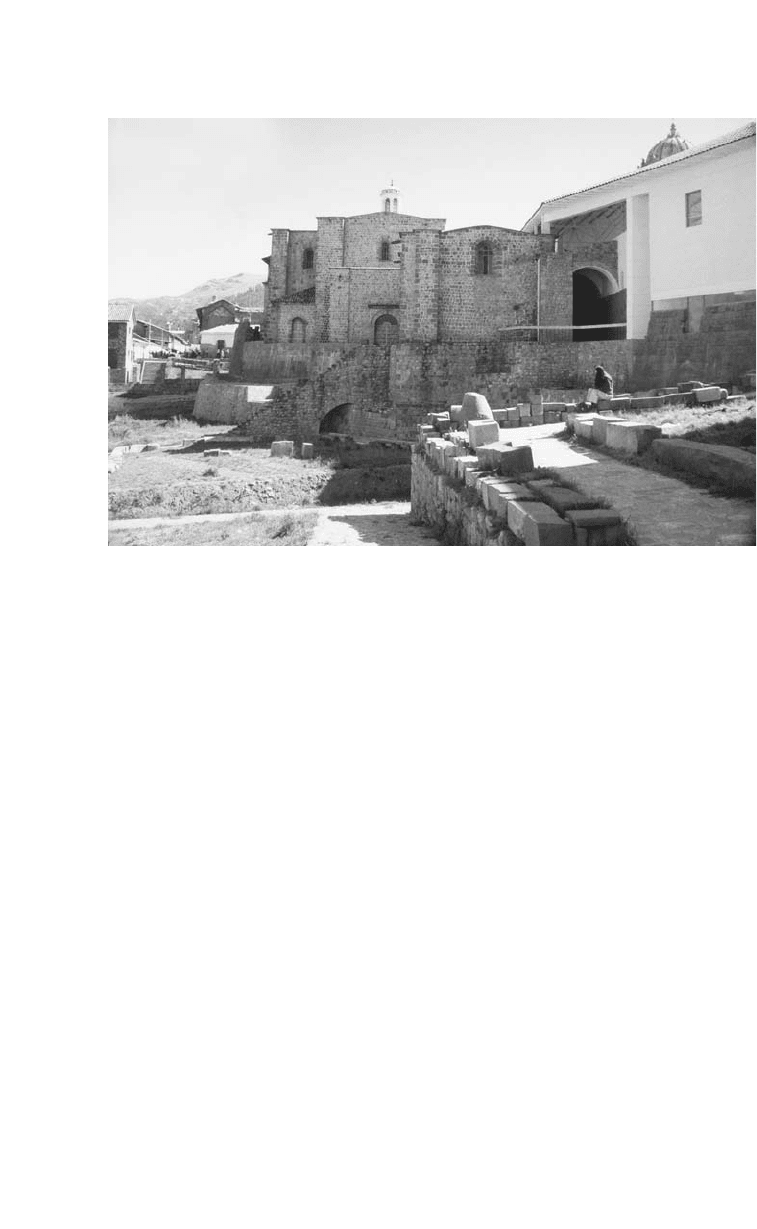
Inca religion. In many places new churches of the Christian god were
literally built upon the ruins of Inca temples.
Succession to Office and the Brothers’ War
Most Spanish chroniclers simply assumed that the Inca process of suc-
cession to high office followed European patterns. Today we know bet-
ter. Depending on the level of succession (from the low-level curacas to
the Inca himself), a variety of criteria functioned to define a successor
.
Quite frequently several criteria were at work in a single ethnic group.
In the earlier stages of Inca expansion, leaders (called sinchis) were
A BRIEF HISTORY OF PERU
30
The Santo Domingo Church in Cuzco, built by the Spanish in 1534 on top of an existing Inca
sun temple and using Inca-cut stones
(© Philip Baird, www.anthroarcheart.org)

selected according to their military skills. The elected leader may have
been the son of the chief most loved by his people. Sometimes the
brother of the chief would be chosen before the son came to power. In
some cases the most able man was chosen even if he was not related to
the chief. The successor may have been chosen after the chief died, but
sometimes the new leader was put in place while the chief was still in
command in order to benefit from the old chief’s experience and to
improve the new chief’s governing skills. Local succession patterns may
have been in place, but on occasion, the Inca himself would impose a
successor. In some places female and male descendants could claim to
succeed their fathers or mothers. Only persons with experience and
merit and, when available, close to the Inca were eligible, and every
appointment needed the supreme Inca’s final approval.
As the Inca Empire reached consolidation, stricter rules applied to
succession. Rulers were interested in better defining the qualifications
of a successor and the mechanisms through which a new Inca could
take power. Only by doing so could the supreme Inca prevent the con-
tinued and prolonged fights for succession resulting from the multiple
and varied sets of possibilities. Many criteria meant many candidates,
and many candidates meant political uncertainty. This was one of the
reasons why the death of an Inca was kept secret until it was clear who
would succeed him.
The predominant rule of succession among the Inca was to designate
the son of the supreme ruler’s “sister.” This “sister” was not necessarily
his blood sister but could also be his half sister, cousin, or any woman
from his lineage. Thus, succession followed a matrilineal logic, and
panacas and women in these royal clans were key to understanding polit-
ical life in the city. What we know about the brothers Huáscar and
Atahualpa, the last two independent Incas who died in the wake of the
Spanish conquest, helps to illustrate patterns of succession to high of
fice.
While in the north attempting to subdue a rebellion by a non-Incan
ethnic group, the ruling Inca, Huayna Capac, died from disease in
1525. He was apparently the victim of a European illness that spread as
an epidemic among the native population, even before the Europeans
themselves appeared. (Deadly, unknown germs were the first messen-
gers of Spanish presence in northern coastal Peru.) One of the Inca’s
sons, Atahualpa, had been with him in the north when the ruler died;
a second son, Huáscar, was in Cuzco. Unfortunately, when Huayna
Capac died, the line of succession had not been clarified. Subsequently
there were many misunderstandings between the two half brothers,
made worse by political conflicts among vested interests in the Cuzco
31
THE INCA: THE BUILDING OF AN EMPIRE
A BRIEF HISTORY OF PERU
32
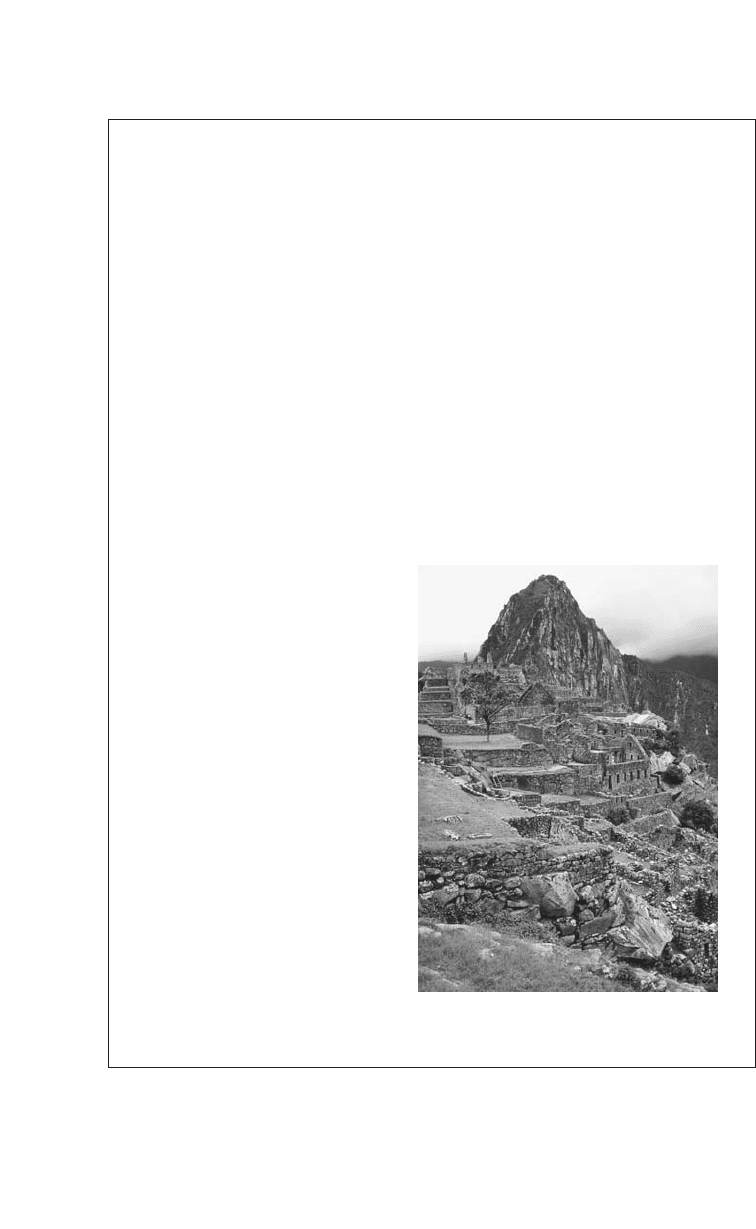
Machu Picchu
L
ocated about 50 miles from Cuzco, Machu Picchu is the best known
of all Incan historic sites in Peru and one of the most famous archae-
ological sites in all of South America. It had largely receded from outside
notice until the summer of 1911, when Hiram Bingham III, a history pro-
fessor at Yale University in the United States, was led to the site by
Indian guides. His subsequent writings about the magnificent buildings
and location popularized the place as a “lost city,” although Bingham’s
ideas about it have proved to be in error.
Bingham thought variously that Machu Picchu was the original center
of Inca civilization, the last stronghold of a 16th-century supreme Inca who
had resisted the Spanish conquerors, or perhaps an exotic residence for
ritual Inca virgins. Modern researchers have concluded that the story is
probably less romantic than any of Bingham’s explanations. Based on stud-
ies of artifacts, skeletal remains, and written records, the current opinion
holds that Machu Picchu was a
personal vacation estate of Inca
Pachacútec, and that it probably
never had a large population
and was likely all but abandoned
after the Inca’s death.
Whatever the exact nature
of its historic role in Inca times,
the complex was a marvel of
engineering, which included
extensive reforming of the
landscape as well as the more
obvious examples of superb
Inca stonemasonry and archi-
tecture. Today Machu Picchu is
a popular tourist destination,
and thousands each year trek
along the Inca Trail to reach the
city or take packaged tours to
experience the awe-inspiring
beauty of the site.
Machu Picchu, about 50 miles from Cuzco
in the Andes
(Photofrenetic/Alamy)
panacas and the generals who aligned with one or the other of the
brothers. The result was a year-long war that divided and completely
unsettled the empire. The Inca political and administrative system

relied on specific orders and directives from the supreme ruler, but dur-
ing the so-called Brothers’ War, no one knew who the supreme Inca
was. There were several battles between huge armies, and with the last
of these military clashes, Huáscar was in prison. The victor, Atahualpa,
carried out cruel revenge against Huáscar’s panaca in Cuzco.
Huáscar’
s mother was Raura Ocllo, a sister of Huayna Capac in Tupac
Yupanqui’s panaca, the Capac Ayllu. As her son, Huáscar was consid-
er
ed to belong to this extended royal family. On Atahualpa’s orders, all
members belonging to the Capac Ayllu, including male and female ser-
vants, were killed, and their belongings were confiscated. The mummy
of their ancestor, Inca Tupac Yupanqui, was burned. Among the Inca,
the burning of the mummy of an ancestor was considered the worst
punishment anyone could suffer. Atahualpa’s actions underline that
Inca lines of descent were not traced through patrilineal kinship ties, as
in Europe and elsewhere, but were matrilineal, that is through the ayllu
or panaca of the Inca’s mother. Descent from the paternal side did not
establish a kingship tie. Had Atahualpa considered himself a descen-
dant of T
upac Yupanqui, he would not have taken revenge against
Huáscar by dishonoring the mummy of his paternal grandfather.
33
THE INCA: THE BUILDING OF AN EMPIRE