
Hunefeldt C., Harris B. A Brief History of Peru
Подождите немного. Документ загружается.

about why a procession of quite distinct civilizations came and went, or
even when. There is some evidence, however, of continuity between
and among cultures, and several apparently flourished at the same time.
One of the best studied pre-Incan cultures is the Mochica (also
known as the Moche) of the northern coast of modern-day Peru. The
Mochica culture (approximately 200
B
.
C
. to
A
.
D
. 750 [Watanabe 1995,
193]) was paralleled in time by the Nazca culture to the south. Both
societies developed highly sophisticated irrigation systems and metal-
lurgy skills (especially with gold and copper) and had advanced levels
of political and social organization. The Mochica, however, left an
abundance of informative artifacts, many of which are extant and pro-
vide archaeologists with a relative wealth of material from which to
obtain knowledge of their way of life.
The Mochica were apparently a warrior society that had expanded
from its local base by force of arms. They were also accomplished agri-
culturalists who developed a productive agrarian system in the dry
region along Peru’s northern coast. The Mochica’s main urban centers
dotted an area that eventually stretched over approximately 300 miles,
and they cultivated a very large area of land. Through seed selection
they maximized the size and variety of crops, producing, for example,
six different varieties of cotton. Other agrarian produce highly appreci-
ated among the Mochica were ají (a native Peruvian chili), cassava,
yams, corn, beans, yerba mate, pumpkins, peanuts, cherimoyas, avoca-
dos, and cucumbers. The Mochica devised irrigation systems that made
the most of the arid climate along the coast, and they may have been
A BRIEF HISTORY OF PERU
4
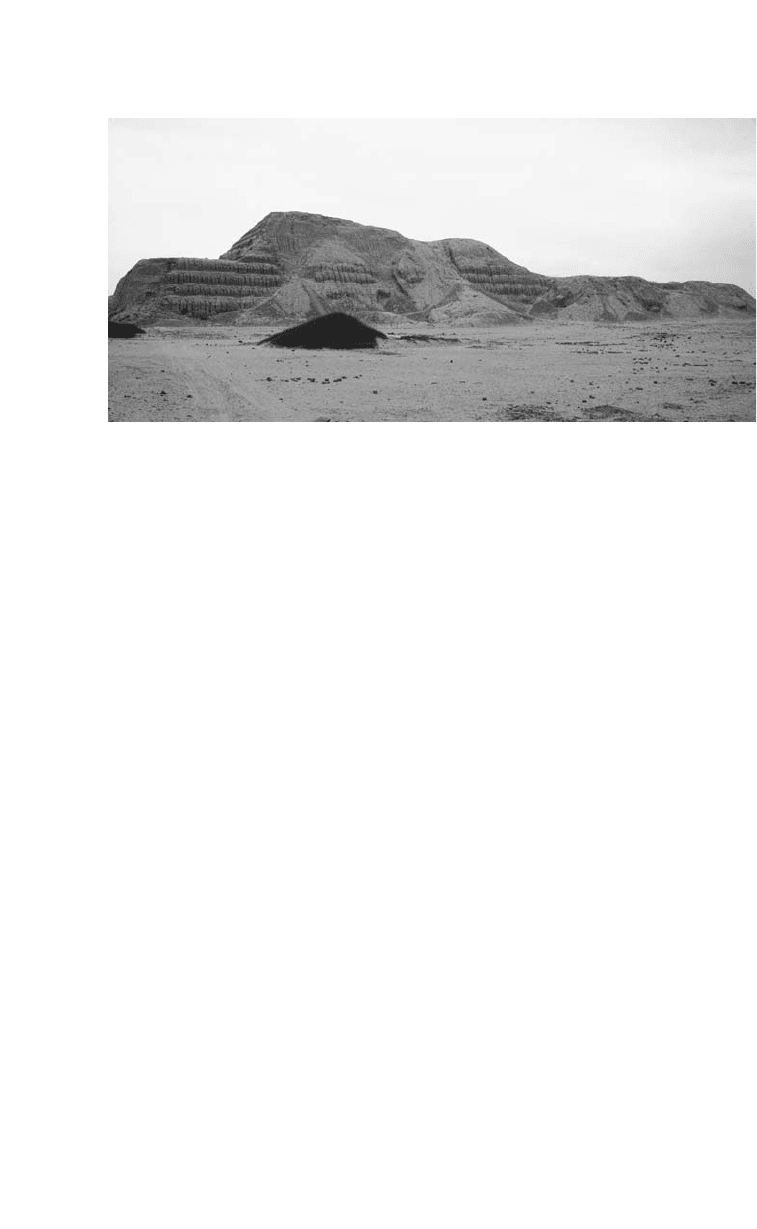
The remains of a huge Mochica pyramid built of millions of adobe bricks (© Philip Baird,
www.anthroarcheart.org)

among the first people to exploit as fertilizer the huge deposits of bird
droppings (known as guano) from coastal islands. They apparently
made frequent trips to gather guano for use on their fields. They also
were skilled fishermen, using reed boats and fish traps. One of their
major sources of food came from domesticated animals, including
ducks, turkeys, llamas, guinea pigs, monkeys, and dogs.
Some archaeologists, such as Rafael Larco in the 1940s, have gone so
far as to theorize that the Mochica (unlike the later Inca) had some
kind of writing in the form of markings on lima beans, but there is lit-
tle direct evidence of such a system. However, anthropologists know a
great deal about the daily life and economy of the Mochica because arti-
sans developed one of the most sophisticated potteries among pre-
Incan cultures. In fact, it has been possible to reconstruct much of the
Mochica material culture, belief system, and social life by studying
5
ANCIENT CIVILIZATIONS
The Lord of SipÁn
T
he relatively recent discovery, in 1987, of the tomb of the Lord of
Sipán (Señor de Sipán), near the Peruvian city of Chiclayo, brought
to light magnificent artifacts that demonstrate Mochica accomplishment
and sophistication. Experts agree that this tomb, which dates from
A
.
D
.
300 to 400, is the richest royal tomb ever found in the Western world.
It is often compared to the Tutankhamen finds in Egypt.
In April 1987 a team sponsored by the Bruning National Archaeological
Museum began excavations in Sipán, located in the Lambayeque Valley.
After working for several months, archaeologists Walter Alva Alva, Luis
Chero Zurita, and Susana Meneses de Alva uncovered the funerary
chambers of a person who had obviously been a very important
Mochica leader. Arrayed in full ritual attire and outfitted in magnificent
gold and silver decorations and objects, the remains of this Mochica
leader were surrounded by eight skeletons, presumably of some of his
servants, concubines, and soldiers. The Lord of Sipán himself lay in the
wooden coffin in which he had been buried more than 1,700 years ago.
The artifacts found with the leader led archaeologists to decipher many
features of this magnificent culture that had previously been mysteries.
In addition to gold and silver masks, necklaces, earrings, and other jew-
elry, the findings included spondylus shells from Guayaquil, which were
probably used in the ancient world as trade tokens. Ritual knives and
other religious objects were also present.
A BRIEF HISTORY OF PERU
6
The Nazca Lines
T
he Nazca culture flourished at approximately the same period as
the Mochica, and it is best remembered today for the extraordi-
nary linear images it produced in the dry desert of the Palpa Valley.The
valley floor has a base of light-colored sand, overlaid with brown rocks.
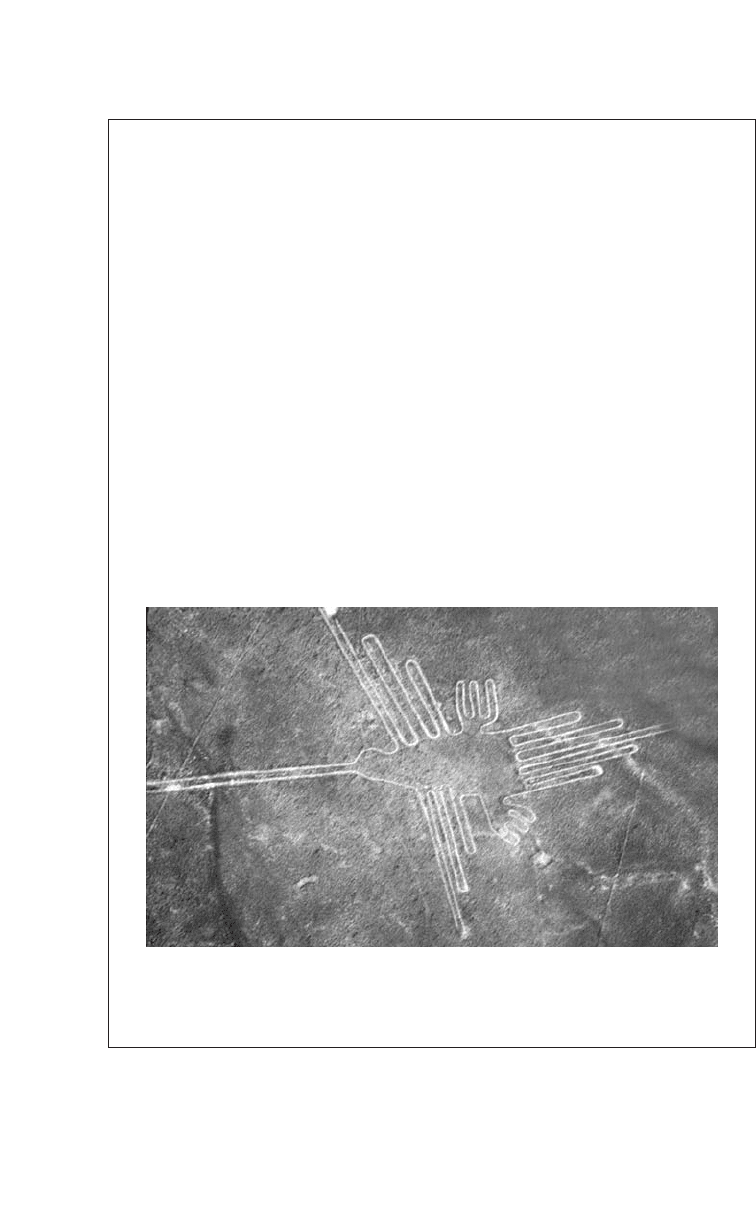
The Nazca created images of animals, such as a humming bird, a spider,
a monkey, and a pelican, by carefully removing the rocks to reveal the
lighter sand below. Later (perhaps as much as five centuries), the same
technique was used to draw geometric forms and lines, some miles long.
The lines and the forms they create are extremely difficult to per-
ceive from ground level and consequently were “discovered” by Paul
Kosok, an anthropologist from the United States, when he flew over the
valley in 1939. The lines were studied extensively by Maria Reiche, a
German mathematician, who believed the lines had been laid out to
serve as a calendar. Other theories hold that the lines were religious
symbols or sacred roads.Today the lines are a main tourist attraction.
An aerial view of the hummingbird figure outlined on the desert floor of the Palpa
Valley by the Nazca people. It is one of several such large-scale linear animal
images.
(© Philip Baird, www.anthroarcheart.org)
images from their pottery. They are most famous for their impressively
realistic ceramic representations of actual people, which offer detailed
information about almost all aspects of Mochica life. Archaeologist

Anne Marie Hocquenghem studied more than 500 portrait pieces of
Mochica ceramic pottery and found representations of the supernat-
ural, scenes of daily life, and images of the dead. Mochica pottery also
provides ample knowledge about their views on human sexuality and
social control.
Mochica religion centered on Ai Apaec, the supreme deity, who had
emerged from a cave and turned into a bean, cassava root, corn, and
potato on different occasions. Another important deity was the moon
god Si, or Shi in Mochica, revered for its beneficial influence on fishing.
The Mochica impressively engineered pyramid structures, presumed to
be religious in nature, including the Pyramids of the Sun and the Moon
(Huacas del Sol y la Luna) two of the largest adobe buildings in Andean
America, that together measure 1,050 feet long, 480 feet wide, and 180
feet high, containing an estimated total of 140 million adobe bricks.
The pyramids were uncovered by German archaeologist Max Uhle in
1899. Presumably, this impressive culture decayed because of heavy cli-
mate and ecological shifts that caused Mochica to migrate further north
around
A
.
D
. 750.
The Huari
The Huari (or Wari) were an aggressive culture, flourishing between
roughly
A
.
D
. 500 and 750, to some degree contemporaneous and over-
lapping with another culture, the Tiwanaku. The Huari dominated a
territory that stretched along the Pacific coast and into the western
highlands, from modern-day Cajamarca to Cuzco.
The Huari were one of the first ancient Peruvian civilizations to
cast a wide political net that folded in many distinct ethnic groups,
anticipating both the Tiwanaku and Inca Empires, although not
nearly so grand in scale or accomplishment. The Huari are also
believed to be among the first to establish walled cities built of stone
rather than the traditional adobe bricks, again anticipating the Inca.
The ruins of what may have been the Huari capital cover four square
miles near present day Huanta, not far inland from Lima. These ruins
were little known until the 1930s when they were rediscovered. Most
of the buildings are made of fieldstone held together with mud mor-
tar and faced with mud plaster.
The finest Huari art found to date is expressed in the form of painted
pottery, the most significant examples of which are huge jars that fea-
ture scenes of people and religious sites. An archaeological dig near the
modern Peruvian city of Ayacucho has yielded several examples of such
7
ANCIENT CIVILIZATIONS

jars. Impressive textiles with distinctive woven patterns have been
found at Huari sites along the coast.
The Tiwanaku
The Tiwanaku culture dated from
A
.
D
. 300 to 1200. The main site,
Tiwanaku (Tihuanaco), is located near Lake Titicaca. The modern-day
Aymara-speaking Indians of the region trace their origins to the
Tiwanaku. The city of Tiwanaku probably evolved from a fishing village
and may have been populated by 30,000 to 60,000 at its height. A large
stonework pyramid in the city, called the Akapana, was part of a reli-
gious complex that encompassed several temples.
Many smaller residential areas were built around the city. The best-
known secondary sites are at Lucurmata, Paqchiri, Huancani, places that
show evidence of public buildings and peasant houses. At its high point,
the empire that spread out from the ceremonial city of Tiwanaku extended
over southern Peru, Bolivia, northern Chile, and northwest Argentina,
covering a vast and varied geography. Archaeologically, Tiwanaku is best
known for its large stone sculptures representing anthropomorphic celes-
tial beings, felines, birds, fish, and geometrical designs.
Living in a challenging environment, the Tiwanaku responded by
domesticating plants that were well adapted to the climate, such as
quinoa, lima beans, and potatoes, as well as the versatile highland ani-
mal the llama. The Tiwanaku ate the meat (both fresh and dried) of the
llama, although fish and other lake animals were also part of their diet.
They developed fabric for clothing woven from llama wool. Llamas and
their smaller relations, the alpacas, were also the best beasts of burden
in an arid and steep landscape with narrow dirt roads. Based on a read-
ing of the intestines of llamas, Tiwanaku’s religious leaders interpreted
godly designs and intentions.
In order to increase the available land and produce higher yields,
Tiwanaku farmers cultivated raised and ridged fields called camellones.
Huaru-huaru is the Aymara word for this kind of farming. According to
ar
chaeologist Michael E. Moseley, the plant beds were long, narrow, and
elevated, about 45 feet wide and stretching sometimes as far as 600 feet.
To construct the beds, Tiwanaku farmers dug parallel ditches, throwing
the excavated soil into the middle to build up a raised, flat-topped
mound. The ditches served as drainage devices, and when filled with
water and heated by the sun, the ditches gave frost protection to plants
at night (Moseley 1992, 218–219). The city of Tiwanaku was supported
by about 16,000 acres of ridged fields. Intense sun during the day and
A BRIEF HISTORY OF PERU
8
icy cold nights provided (and still provide) local people with a natural
technology for dehydration and thus conservation of food. For these
reasons, Tiwanaku has been called “the political quintessence of high
montane adaptation and a true agropastoral state” (Moseley 1992, 228).
The Chimú
At its peak during the 14th and 15th centuries, the Chimor—Chimú
Empire, or confederation—extended along 500 miles of Pacific coast-
land from present-day Piura to Huarmey and was the second-largest
native state in South America. The area controlled by the Chimor was
one of the most thickly populated, with large cities and settlements of
all the Andean regions.
The capital city of Chan Chan, Chimor’s main urban seat, occupied
12 to 15 square miles and may have had a population of close to
100,000 at its height of development. The city was surrounded by a
high brick wall that enclosed houses, streets, temples, pyramids, and
reservoirs. The stone-lined reservoirs held more than 2 million gallons
of water, and the outer wall, although it has eroded over the centuries,
9
ANCIENT CIVILIZATIONS
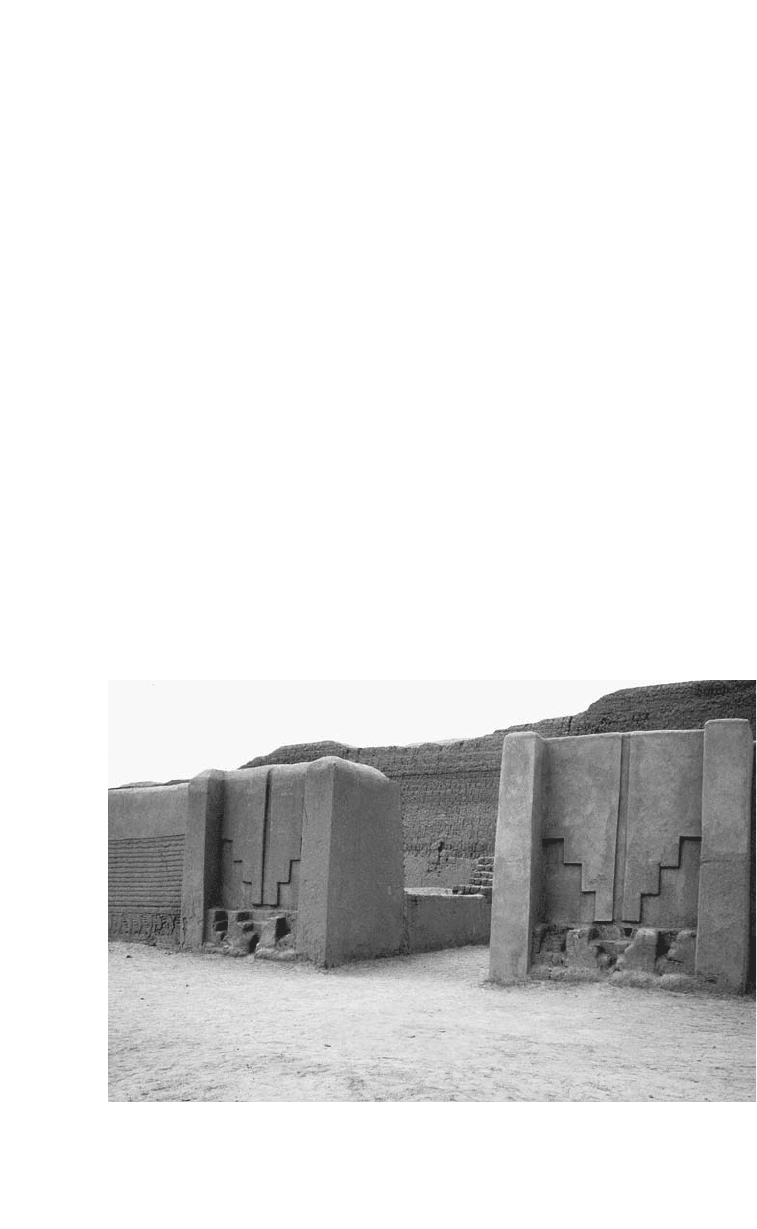
Gates through the massive wall surrounding the Chimú capital city of Chan Chan. The Chimú, a
highly sophisticated people, were conquered and absorbed by the Inca in the 1460s.
(© Philip
Baird, www.anthroarcheart.org)

still stands 30 feet tall. The ruins of Chan Chan are located just outside
the modern city of Trujillo.
Through highly sophisticated hydraulic techniques and the con-
struction of immense stone-covered irrigation trenches, the Chimú
managed to cultivate between 50 and 65 percent of the available coastal
valley land. Intervalley canals not only demonstrate great labor and
engineering skills but also represent sensitive claims to water and land.
The Chimú built a complex system of canals to allow cultivation of fer-
tile valley fields, although the system’s northern and southern branches
were never fully connected because of political divisions (Moseley
1992, 252). To expand their agricultural production, the Chimú also
created low-level parcels of farmland (called huachaques) by removing
the top layers of sand to r
eveal cultivatable soil. These parcels some-
times reached a depth of 35 feet, and sometimes covered areas of hun-
dreds of square miles.
Such large public works of agricultural and hydraulic engineering
required a massive use of labor, which the Chimú leaders acquired
through a draft system called the mit’a. The invention of this economic
and social device by the Chimú had far-reaching and long-lasting effects
in the region. Although it was adapted over the centuries to fit changing
cir
cumstances, mit’a labor became a key to the expansion of the Inca
Empire, which subsequently laid the foundation for the Europeanized
system, mita, of drafting Indian laborers into Spanish-owned mines and
haciendas during the colonial period. A modified form of the labor trib
-
ute system persisted in Peru until the late 19th century.
The Chimú, who were famous for their arts and crafts, organized
artisans hierarchically in what resembled a guild pattern. Leaders of
specific trades carried specific titles, such as “Lord of the Feathered
Clothes Makers.” Best known of all the Chimú’s skills was gold-
A BRIEF HISTORY OF PERU
10
The huge wall protecting Chan Chan was intricately decorated with designs in relief. (© Philip
Baird, www.anthroarcheart.org)

smithing, which reached a high level of artistry and workmanship and
produced many artifacts and luxury items. Unfortunately, because of
this great command of metallurgy, this pre-Inca culture has suffered
drastically from artifact thieves and grave robbers. When the Inca con-
quered the Chimú, they took the best gold and silversmiths to Cuzco
to decorate the Temple of the Sun (Coricancha) and to make luxury
and ceremonial objects, many of which were subsequently lost to
Spanish greed and expropriation.
In spite of fierce resistance, between 1462 and 1470 the Chimú
became part of the Inca Empire. The Chimú leader Minchancaman
became a vassal prince of the Inca and married the daughter of
Pachacútec. Minchancaman and approximately 40,000 Chimú came
under Inca rule, although Chimú traditions and practices strongly influ-
enced Inca life, such as the custom among both the Chimú and Inca that
the incoming heir to the throne could not inherit any of the wealth accu-
mulated by his predecessor. Each new leader had to start anew to build
his own temple and his own house and to acquire his own servants and
his own land. This practice pressured leaders to pursue wars of expan-
sion against neighboring ethnic groups. Consequently the Inca dismem-
bered the Chimor, and what little was left fell prey to the first pandemics
of European disease around 1500.
11
ANCIENT CIVILIZATIONS

2
The Inca: The Building of
an Empire (1440–1532)
T
he Inca, so-called after the name of their supreme hereditary ruler,
were the most important of the many indigenous tribes or ethnic
groups who lived in what became Peru. These people spoke the
Quechua language and probably originated near Lake Titicaca but
moved north at some point to the valley of Cuzco. Within a remarkably
short period of time, the Inca built a huge empire, stretching from mod-
ern-day Ecuador in the north to Chile and Argentina in the south. Their
political, military, economic, and engineering achievements were extra-
ordinary, especially for a people who lacked a written language, did not
know the wheel, and had limited technology. The remains of the Inca
Empire still impress and amaze.
Origins
When the Inca appeared on the horizon, several other local ethnic groups
occupied the southern Andes. Before the 14th century, Cuzco, which
became the principal Inca city, was a minor settlement of small ethnic
groups under the guidance of two chiefs, generically called Tocay Capac
and Pinahua Capac. The presence of the Huari is visible, and Cuzco may
have been one of the Huari’s administrative centers. According to reports
from early Spanish chroniclers, many different groups before the Inca had
roamed the region of Cuzco looking for new places to settle. Small group
leaders called curacas or sinchis were basically the heads of extended fam-
ily gr
oups known as ayllus. According to María Rostworowski, a well-
known Peruvian historian, some names of these groups are known: the
Lar
es, Poques, Sauariray, Antasaycs, and Guallas. These were joined
somewhat later by Alcavizas, Copalimaytas, and Culumchimas.
Cuzco, originally called Acamama, was divided into four neighbor-
hoods, termed barrios in Spanish and cancha in Quechua: the neigh-
12
borhood of the hummingbird (quinti cancha), the neighborhood of the
weavers (chumbi cancha), the neighborhood of the tobacco (sairi can-
cha), and yarumbuy cancha, which was probably inhabited by a mixed
population of both A
ymara and Quechua speakers. It was, and contin-
ues to be, very common in the Andean region to divide geographical,
social, or administrative entities into halves and quarters designated as
hanan and hurin (above and below) and icho and allauca (left and
right). This basic division was applied not only to ancient Cuzco and
other cities but to the entire Inca realm.
Why did the Inca gain such preeminence rather than some other eth-
nic gr
oup? Both the Lupaqa in the rich Titicaca basin and the Chanca,
for instance, had successfully defeated the Quechua, though briefly.
After many decades of research scholars seem to agree that the distinc-
tive feature of the Inca people—aside from their military prowess—was
their ability to negotiate politically with their neighbors. Coalition
building, as much as military expansion, enabled the Inca to become
the dominant power of their era. Inca expansion relied on a variety of
methods: negotiation with local curacas, as in the case of Chincha;
quick conquest, as occurr
ed with several ethnic groups in the Chincha
13
THE INCA: THE BUILDING OF AN EMPIRE
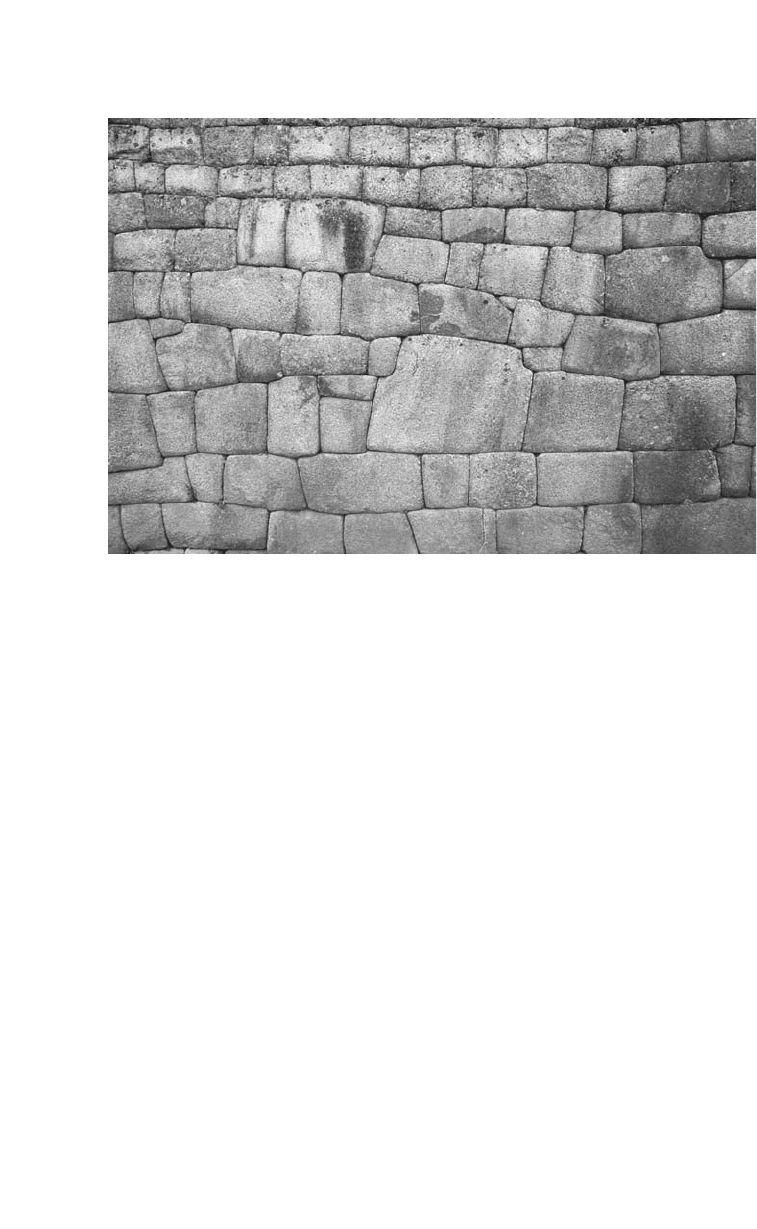
A section of Inca-built stone wall, demonstrating the extraordinary craftsmanship of Inca
masons.Walls, terraces, and public buildings were constructed of irregular blocks of stone, often
weighing hundreds of pounds each, that were fitted tightly together without mortar into
complex patterns.
(Nature Picture Library/Alamy)