
Hunefeldt C., Harris B. A Brief History of Peru
Подождите немного. Документ загружается.


mita provinces soon lost most of their population. Empty mita
provinces were then repopulated by the forced resettlement of another
indigenous population. These incoming Indians often did not own land
but worked for other peasant families. W
ith no land, their tribute pay-
ments were lower. Having no access to land also meant, at least in prin-
ciple, that they could not be recruited for mita obligations.
Indian r
esistance and high mobility led to labor shortage in the
mines, a continued problem for mine owners and the colonial state
alike. Mechanisms were invented to retain mita laborers or to hire more
expensive salaried labor
ers. To retain laborers, mine owners advanced
money to workers, making sure that mitayos would not be able to repay
the accumulated debt. As a consequence workers wer
e forced to stay in
the mines, and many were never able to return to their homes. For this
reason, over the course of time, mitayos brought their families with
them to the mines. Children and women ended up working in the
mines to supplement the meager income.
The Indian reducciones soon subsidized the extraction of ore. Slowly
the composition of the labor for
ce in the mines changed from a pre-
dominantly mita labor force to an increasing number of salaried and
mor
e specialized workers. Nonetheless, working conditions in the
mines did not improve. Hundreds of mitayos died from accidents in the
mine tunnels, and silicosis, a lung disease produced by ore dust, gr
eatly
lowered life expectancy among mine workers.
The Agrarian Landscape
In spite of the depopulation of vast areas of the Peruvian viceroyalty,
much of the local agrarian economy survived the immediate impact of
conquest. Moreover, the early encomiendas assigned to Spanish con-
quistador
es greatly relied on what was already in place, especially the
indigenous ways of organizing space and exchange. However, there
were also some salient changes. The redistributive role played by the
Inca state disappeared. Cuzco was replaced by Lima and Potosí; miti-
maes (indigenous groups displaced for labor) returned to their com-
munities of origin; and labor
-intensive farming tracts were abandoned,
thus reducing the total of usable agrarian land. The land formerly
assigned to the Inca or the Sun now reverted to the Spanish Crown. The
Spanish Crown in turn, reallocated those portions of land either to a
new encomendero or, eventually, to any Spaniard capable of paying for
it. In addition to laboring their own fields, Indians now had to work on
the land of the encomendero instead of the land of the Inca or the Sun.
A BRIEF HISTORY OF PERU
54

55
COLONIAL PERU
The allocation of land to private Spanish owners through a mechanism
called the composición de tierras initiated the development of the
haciendas (farming estates) and some haciendas also developed out of
the encomienda system.
An Indian’s of
ficial tribute obligations as imposed by the colonial
government involved the delivery of a large share of local produce and
The
Encomenderos’
Bounty
A
ccording to the regulations imposed around 1549, an encomendero
or encomendera (there were some women, usually inheriting wid-
ows, who had encomiendas) could request from every 1,000 Indians
under his or her control the following items and services over the
course of a year.
Tributes/payments in kind:
• 200 pesos in gold or silver
• 1,400 cotton robes
• 8 tablecloths
• 80 handkerchiefs
• 60 pounds of cotton thread
• 50 baskets of chilies
• 3 loads of potatoes at each harvest
• 1,200 chickens
• 100 eggs
• 24 pounds of fresh fish each Friday and holiday
• 60 ounces of salted fish
• 30 loads of salt
• 25 pigs
• 600 loads of carob
• wood and wood products
Personal services:
• The planting of 25 fanegas’ worth of grains, 10 of wheat, and two
of beans on communal lands (a fanega was equal to one and a
half bushels)
• 60 Indians delivered by the curaca to plant and harvest 10 fanegas
of wheat and corn on the land of the encomendero
• 15 Indians for domestic service
• 14 Indians to take care of cattle
• Indians for all transportation
A BRIEF HISTORY OF PERU
56
free labor, but the list of items an encomendero was legally allowed to
receive was accepted only grudgingly by encomenderos because it lim-
ited their exploitation of Indian labor and wealth. Since government
contr
ol over encomenderos was still weak by the mid-16th century,
encomenderos probably obtained higher revenues than those suggested
by the official regulations. Similarly haciendas were organized along
much the same lines. Instead of paying for labor used to cultivate the
hacienda lands, hacendados insisted that laborers had to pay in kind
and labor for their use of hacienda lands.
Thr
ee distinct phases are recognizable in the evolution of the rela-
tionship among encomiendas, Indian tributes, and state policies. Each
phase reshaped the agrarian landscape.
The first phase, fr
om 1532 to 1548, saw the most intense period of
civil strife among encomenderos and the feuding and warfare between
Almagr
o’s and Pizarro’s followers. During this first period there still was
no regulated taxation, and locally most of the preexisting patterns of
production, exchange, and consumption prevailed. Spanish settlers
adapted the practices of tribute and mita implemented by the Inca state
to obtain labor and produce from Indians but altered the top of the
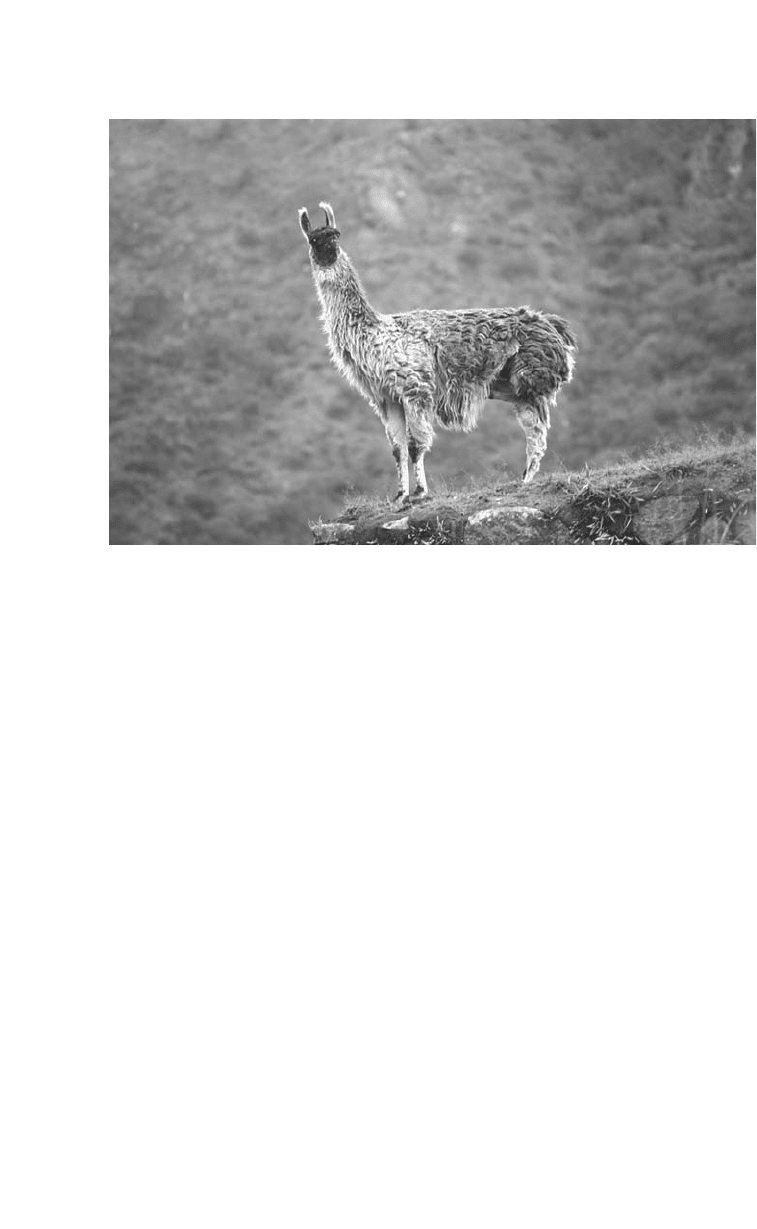
The llama was, and continues to be, a central symbol of the Andes. Much of the agriculture of
the region in the 16th century depended on the animal for food, fiber, and transportation.
(Photofrenetic/Alamy)

57
COLONIAL PERU
political ladder: the supreme Inca was replaced by the Spanish king,
and the elite Incan orejones, by the Spanish encomenderos.
In the second phase, from 1549 to 1570, the first regulator
y decrees
reached the colonies, and official tax regulations were implemented.
The lists of exactions varied according to local conditions and were
mainly paid in kind. Money was still a scarce commodity in the colo-
nial internal market. Slowly at first, and more rapidly with the growth
of mining production in Potosí, a tribute in money emerged.
The third phase, from 1570 to around 1630, witnessed the uniformity
of tribute payments in money and a state-organized mita system.
Gradually
, under Viceroy Toledo the Spanish Crown gained control over
the colonies and diminished the tremendous power of the encomenderos.
Although the mita labor system empowered encomenderos who were
in char
ge of organizing this labor draft, it was also a system that in the
long run hampered the encomenderos’ ability to obtain Indian labor,
especially for their own fields. Every Spaniard in the colonies,
encomendero or not, could, in principle, petition mita labor. This
included especially hacienda owners and obrajes (textile workshop)
owners. The higher the number of Spaniards requesting mita labor, the
less labor was available for the encomenderos and, eventually, the mines,
the economic endeavor the Spanish Cr
own was most interested in. A
higher demand for labor and a rapidly decreasing population made
labor more valuable than land itself. Without labor, encomenderos saw
their r
evenues dissipate as they were left with less agrarian produce to
sell in nearby cities and in the mines. As a result, and particularly in
Peru’s coastal cities, food prices increased, especially food prices for
Concentration of the
Tribute-Paying Population
T
he Indian population that owed tribute was densely concentrated.
In 1570, for example, only 5.8 percent of all highland encomiendas
were in Huamanga. But in this one province was 47 percent of the total
highland population, and there 55 percent of all cloth was produced; 29
percent of all wheat, 29 percent of all corn, and 33 percent of all pota-
toes were grown; and 58 percent of all chickens and 70 percent of all
sheep and llamas were raised (Urrutia 1985, 31, 36).

products consumed by the Spanish. Wheat, for instance, cost six reales
per fanega (a measure equivalent to about one and a half bushels) in
1558; in 1593 it cost six pesos, or eight times as much. On average
(depending on the actual silver content of the coins used) one peso was
equivalent to eight r
eales. For the sake of comparison the average trib-
ute amount paid by Indians amounted to four reales per semester.
Encomenderos responded by specializing their production and adding
cattle and sheep to their commer
cial ventures. To do this they needed
more land, in particular pasture land, which they gradually obtained
through the composición de tierras; by purchases from caciques; through
r
ental agreements turned into ownership, often through legal trickery and
dishonesty; and by the violent seizure of lands belonging to communities
and peasant families. Seemingly all this happened without much Indian
protest, in large measure because there were few Indians left to protest.
As a part of royal policies meant to limit the power of encomenderos,
around 1540 the Spanish Crown not only appointed corregidores but
also actively sought to incorporate non-encomenderos into the local
cabildos (municipalities) and sell smaller tracts of land to Spanish new-
comers. Gradually
, some encomiendas were split into smaller estates,
intr
oducing a more dispersed land tenure pattern with more people
(especially Spaniards) owning more land. Labor for the growing num-
ber of agrarian enterprises came through competition for Indian mita
labor and, increasingly, through the rapidly expanding slave trade.
Money to acquir
e landed property came from Spain’s rich merchants
and the Catholic Church.
With the power of the encomenderos diminished and the corregidores in
place to guard the Crown’
s interests, the colonial scheme seemed to be
finally in place. In reality this was far from true. Continued warfare in
Europe emptied royal coffers, and in order to produce income, the
Spanish Crown resorted to selling bureaucratic offices, among them the
office of corregidor. Earlier provisions forbidding corregidores to own land
within their jurisdictions were ignored. They bought land or obtained it
through illegal means, used Indian labor as much as possible, and in gen-
eral wrung the system for all the profits they could. Some oidores (judges
for the cour
ts of the audiencias) overlooked or even participated in con-
traband transactions, and administrative corruption down to the level of
the cabildo scribes became more evident after 1633, when more bureau-
cratic positions, especially in the state’
s accounting and treasury offices,
became available to the highest bidder in spite of stern resistance from
the Council of the Indies. Depending on the position, bids ranged from
2,500 pesos to up to 20,000 pesos, roughly the value of five to 50 slaves.
A BRIEF HISTORY OF PERU
58

59
COLONIAL PERU
Most bidders were Criollos, or
Creoles (American-born whites of
Spanish descent), rather than
Spaniards born in Iberia (peninsu-
lares), despite the rise in the number
of Spanish people coming to the
colonies, especially between 1550
and 1650 (Mörner 1976, 766–767).
This immigration itself spurr
ed the
demand for office as a means of fast
enrichment and enhanced social
standing. Toward the end of the 17th
century one could buy a place on an
audiencia, the high court. By 1700
the of
fice of viceroy in Mexico was
for sale, too. This general trend led to
A
Corregidor’s
Accounting
F
ollowing were the tradeoffs for a corregidor in the province of
Chancay on Peru’s northern coast around the mid-18th century.
Manuel de Elcorrobarrutia paid 16,000 pesos for his appointment,
plus an additional 4,000 pesos for fees and taxes. Paying an assistant and
an agent and a lawyer in Lima required yet another 7,000 pesos. He
estimated his personal living expenses at 15,000 pesos. Gratuities to
officials in Lima, entertainment for the viceroy when he visited Chancay,
and expenses for the audit and residencia (audit after tenure) cost 9,000
pesos. Interest on this total was 8,700 pesos. To distribute through
reparto (forced sale of goods to Indian peasants) 1,900 mules, the cor-
regidor anticipated paying 67,004 pesos. This amount purchased the
mules and paid for their feed and distribution, tax, salary for collection
agents, and interest. But he expected to receive only 80,000 pesos from
selling the mules and thus had to sell 46,724 pesos’ worth of other
items to cover his investment.With only 1,125 able-bodied adult males
in the province in 1754, each household had to contribute an average
of 112 pesos for this corregidor to break even after his tenure.And, these
were payments Indian peasants had to contribute aside from the trib-
ute and the mita owed to the colonial state (Burkholder and Johnson
2001, 88).
In many parts of Peru mules and
donkeys provided the principal means
of transportation for both people and
goods.This watercolor from the 19th
century shows a seller of grass fodder.
(Library of Congress)

A BRIEF HISTORY OF PERU
60
a closer alliance between Criollos and bureaucrats and also opened the
doors for Criollos to reach high office. It was also the beginning of an
emerging regionalism and era of rifts between the central power and
regional interests that would later lead to the continent’s fragmentation
into many nation-states as a result of the wars of independence.
Silver Mining, Mita, and Economic Changes
In 1545 what turned out to be nearly an entire mountain of silver
(Cerro Rico) was discovered at Potosí, then part of the Viceroyalty of
Peru and now in modern-day Bolivia. The fabulous mines of Potosí cre-
ated an incredible stream of wealth that flowed from the mountain to
Lima and eventually to Spain. Silver worth hundreds of millions of
pesos was removed from deep tunnels and galleries, refined, and con-
verted to coins in Potosí’s Mint (Casa de la Moneda). The cost, however,
was high on the Indian mitayos who provided the labor for the mines.
Almost as impor
tant as the silver mines at Potosí was the mercury
mine at Huancavelica, discovered in 1563. Mercury was crucial to the
processing of silver ore, and before mercury from Huancavelica became
available, it had been necessary to import mercury at great cost from
Europe and haul it over the Andes. The proximity of the silver and mer-
Annual Silver Exports from Callao, 1600–1780
Year Amount in Pesos
1600 2,444,376
1610 1,640,625
1620 573,453
1650 2,720,000
1675 1,837,155
1708 300,000
1739 586,043
1780 400,000
Note: The sharp fluctuations in value were owing to political conditions, fluctuations in the
production and availability of mercury, costs of maintaining the colonies, level of smuggling,
the diminution of the population in Potosí, and the decreasing availability of rich ores.
Source: Fisher (1977, 29–30)
cury mines in Peru, however, amplified the potential for exploitation of
the colony’s mineral wealth.
The several silver mines in and around Potosí were privately owned,
often by merchants who had acquired the mines when previous mine own-
ers failed to repay loans. The principal resource needed to work these
mines was labor. To achieve production and export goals, the mine owners
needed labor from approximately 13,500 mitayos. Mitayos, most often with
their entir
e families, were sent out by corregidores and encomenderos from
the pr
ovinces closest to Potosí. The amount of laborers provided by each
province could not exceed one-seventh of the male adult tributary popula-
tion between 18 and 50 years of age. Mitayos were required to stay for only
one year in the mines. Once Indians had fulfilled their mita duty, they were
not legally r
equired to become mitayos again until seven years had elapsed.
Mine owners wer
e required to pay for the transport costs of the mitayos
from their home community to the mine. In exchange for their labor,
mitayos were to receive a salary. This salary, however, was fixed at a lower
level than the curr
ent salaries for free labor and often was only a minimal
salary equal to the tribute payment. According to British historian Peter
Bakewell, the nominal daily salary for a mitayo was 2.75 reales, whereas a
mine owner could receive 8 reales (one peso) if he resold the labor of a
mitayo to another mine owner, a hacendado, or an obraje (textile factory)
61
COLONIAL PERU
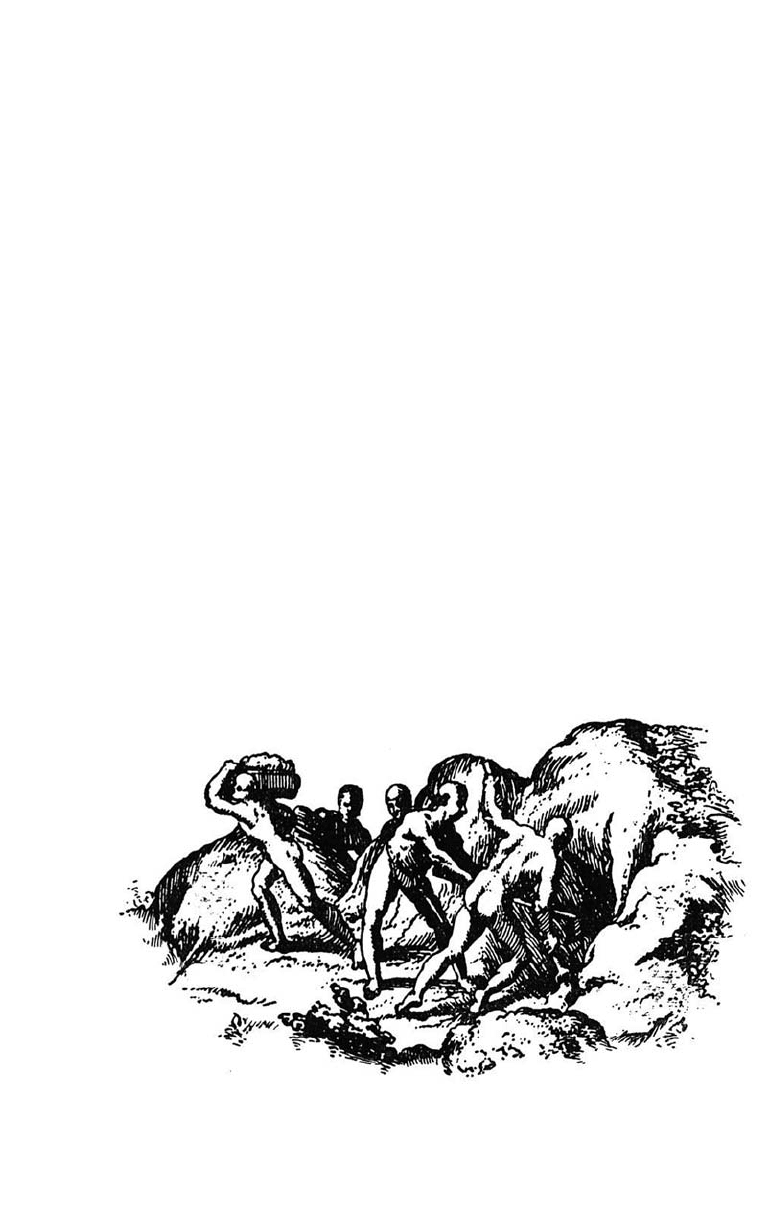
Preconquest Indian laborers work a surface mine with hand tools and crude equipment.When
the Spanish dispossessed the Indians and took over the mines, they slowly introduced more
sophisticated methods and specialization, especially in the lucrative silver mines at Potosí. The
labor, however, was supplied by Indians fulfilling their mita obligations.
(Art Today)

owner (1984, 101, 125). Thus, the earnings obtained from owing a mine
could be based on reselling Indian labor as well as extracting silver.
Although the daily hours of labor were supposedly regulated, few
mine owners obeyed the law. Most tried to lower mitayos’ salary as much
as they could. W
orking conditions were insecure, unhealthy, and, in gen-
eral, devastating. Every mitayo who possibly could tried to evade mita
labor in the mines or moved to provinces where mita labor in the mines
was not yet imposed. Often Indians turned to haciendas wher
e a Spanish
hacendado (himself interested in keeping the labor) could provide some
protection against the mining mita. Some Indians hired other Indians to
r
eplace them, often by paying a full salary to their surrogates.
Initially 81,000 Indians lived in the mitayo provinces, but by 1633, this
number had dr
opped to 40,115. In 1662 the number was down to 16,000
in 1662; in 1683 it was at 10,633. In response, Spanish mine owners,
with the colonial state’s endorsement, began looking for new mitayos in
other pr
ovinces, thus expanding the geographic area from which mitayos
were recruited, ever more removed from the mining sites. This pushed
Indians to seek new places to live and generated lar
ge numbers of
uprooted peasant families. Some settled on haciendas, others in existing
peasant communities to become tributaries without land. In the early
1680s the total Indian population of Upper Peru (modern Bolivia) was
half its size of 1570, and half the population in the 16 mita provinces
wer
e yanaconas (sharecroppers) or forasteros (landless peasants who had
migrated fr
om other communities) who paid tribute at a lower rate. This
situation alarmed colonial authorities and the Council of the Indies
because more Indians without land also meant less revenues to the state,
both from tribute payments and from silver production.
The colonial state recognized that this situation needed to change
and, after 1659, attempted to enforce new regulations. In 1670 Viceroy
Pedro Fernández de Castro, conde de Lemos even proposed to replace
mita labor with free labor. However, any proposed change encountered
strong resistance fr
om mine owners, and it was not until 1718 that the
Council of the Indies—after failing to apply any previous regulations—
reassessed the issue. Members of the council argued that mining in New
Spain was very successful without the mita. In consultation with offi-
cials in Lima and Charcas (the seat of colonial government for Bolivia
at the time), the council signed a decr
ee in 1719 that in writing abol-
ished the mita in the mines. But this decree was never applied in Potosí.
It was not until 1812—in the wake of liberal reform in Spain—that mita
was actually abolished. Indians continued to provide “free services” of
various kinds for many decades after this.
A BRIEF HISTORY OF PERU
62

The mita for the mercury mines in Huancavelica followed a similar
historical pattern but on a small scale. At the peak of the mines’ pro-
duction, 620 Indian mitayos labored in Huancavelica. Toward the end
of the 18th centur
y the number declined to only 165. Unlike the silver
mines in the Peruvian viceroyalty, the mercury mines of Almadén in
Spain were a state monopoly from very early on, around 1555. A simi-
lar pattern was put in place when the mercury mines in Huancavelica
were discovered. Only the transport of mercury to Potosí was allowed
to be taken over by private individuals, who were restricted to a certain
amount of mercury. Private entrepreneurs were allowed to extract the
mercury but were forced to sell the mercury to the state. The state
would then allocate mercury to individual silver mines and also orga-
nized the export of excess mercury. This state control was a way to keep
mercury prices low, assure a market to producers, and, most important,
regulate silver production.
The most efficient control on silver production, however, was the
mint in Potosí. Without minting, silver could not circulate in the
colonies or elsewhere. The image of the king on circulating coins was
also an endorsement of the silver content of the coins and thus a trust-
worthy medium of exchange. By controlling the minting process the
state not only knew how much silver was produced in the privately
owned silver mines but also cashed in one-fifth of the minted coins as
a tax (called the quinto real, or royal fifth) imposed and paid at the mint.
For many decades this tax—together with the Indian tribute—was the
major sour
ce of income for the Spanish Crown.
Besides the mita in the mines (mainly Potosí and Huancavelica, but
also in smaller mines in Puno and Orur
o), mitayos were also allocated
to other Spanish enterprises: road construction, textile workshops,
haciendas, urban water and sewage projects, and ditch cleaning. This
distribution of mita labor was often mediated by mine owners, who
“r
esold” mita labor to people willing to pay up to 365 pesos a year. With
around 40 reallocated Indians, mine owners could obtain an income
that was equivalent to the annual salary of a high bureaucrat within the
colonial state, basically without doing a thing. These reallocated
Indians were called indios de faltriquera.
Aside from labor the mines and the people working in the mines
needed a minimum sur
vival infrastructure: mules, horses, water,
clothes, food, and housing. Located at an altitude of approximately
15,000 feet, Potosí could not provide for itself; consequently, these
needs had to be provided for through imports from other regions in the
colonies and from Spain. Mules and horses were brought in from
63
COLONIAL PERU