
Hunefeldt C., Harris B. A Brief History of Peru
Подождите немного. Документ загружается.


tribute amounts owed to the Crown from each and to reinforce the idea
that the ultimate beneficiary of the conquest was the encomenderos’ king.
Pizarr
o’s initial settlement initiatives were contested, and conflict over his
division of the land and Indians was part of what led to the civil war. In it
A BRIEF HISTORY OF PERU
44
Encomendero
Lucas
MartÍnez Vegazo
L
ucas Martínez Vegazo was born in the city of Trujillo,in Extremadura,
Spain, in 1511 or 1512. Little is known about his childhood. He
learned to read and write at a time when Vasco Núñez de Balboa and
others where discovering new lands, and he grew up listening to the sto-
ries told by these first discoverers, most of them from his hometown.
He also witnessed the return of Francisco Pizarro to Trujillo as a rich
man.At age 19, Martínez left Spain and traveled to Panama and then to
Peru under the command of Pizarro. As a foot soldier, Martínez received
one of the smallest portions of gold or silver that Pizarro distributed to
his men from the Inca Atahualpa’s ransom. Martínez was given 3,330 gold
pesos and 135 silver coins from the treasure.
Martínez invested about 80 percent of his gold in a horse, which
transformed him from a foot soldier into a cavalry man, a promotion
that would guarantee him larger shares of future gold and silver distri-
butions. Martínez also participated in the sack of the Pachacamac tem-
ple as one of 14 horsemen, or caballeros, joining Hernando Pizarro.
After traveling throughout the Inca territory, Martínez reached
Cuzco in 1533 and participated in the Spanish takeover of the city and
partook of the distribution of urban lots (solares) to all Spaniards. In a
distribution of wealth in Cuzco, Martínez received 2,000 gold pesos, sil-
ver coins valued at 1,517 pesos, and fine clothes valued at 2 million
pesos. In 1535 he added an encomienda to his wealth with Indians from
Carumas under his command. In only five years the poor youngster from
Trujillo had become a caballero, a citizen of Cuzco, and an encomendero.
In the following years he served with Hernando de Soto and Juan
and Gonzalo Pizarro and was involved in several military expeditions to
defeat the last remnants of Inca resistance. He continued accumulating
more lands and Indians on his encomienda. By 1540 Martínez controlled
a total of 9,730 Indian children, women, and men in Tarapaca, Carumas,
Arica, Pica, Ilo, and Arequipa, of whom 1,208 were tribute payers, from
whom he obtained all kinds of crops, animals, labor, and clothes (Based
on Trelles 1982).

some of the principal encomenderos died during battles and skirmishes and
others, including Pizarro himself, were assassinated.
In spite of their important political role, encomiendas in the
V
iceroyalty of Peru never numbered more than 500, and by 1555 only
about 5 percent of approximately 8,000 Spaniards living in the viceroy-
alty were encomenderos with assigned Indians (Burkholder and Johnson
2002, 118). By the time civil strife in the vicer
oyalty abated, around
1569, the early encomenderos had lost much of their power and were
gradually r
eplaced by a new emerging group of Spanish bureaucrats, the
corregidores. Toward the end of the 16th century, encomiendas subsisted
only on the fringes of Spain’
s colonial dominions.
Colonial Administration and Organization
A viceroy, appointed as the representative of the king, was the most impor-
tant Spanish official in the colonies, and the overarching unit of Spanish
colonial administration was the viceroyalty. For most of its reign in the
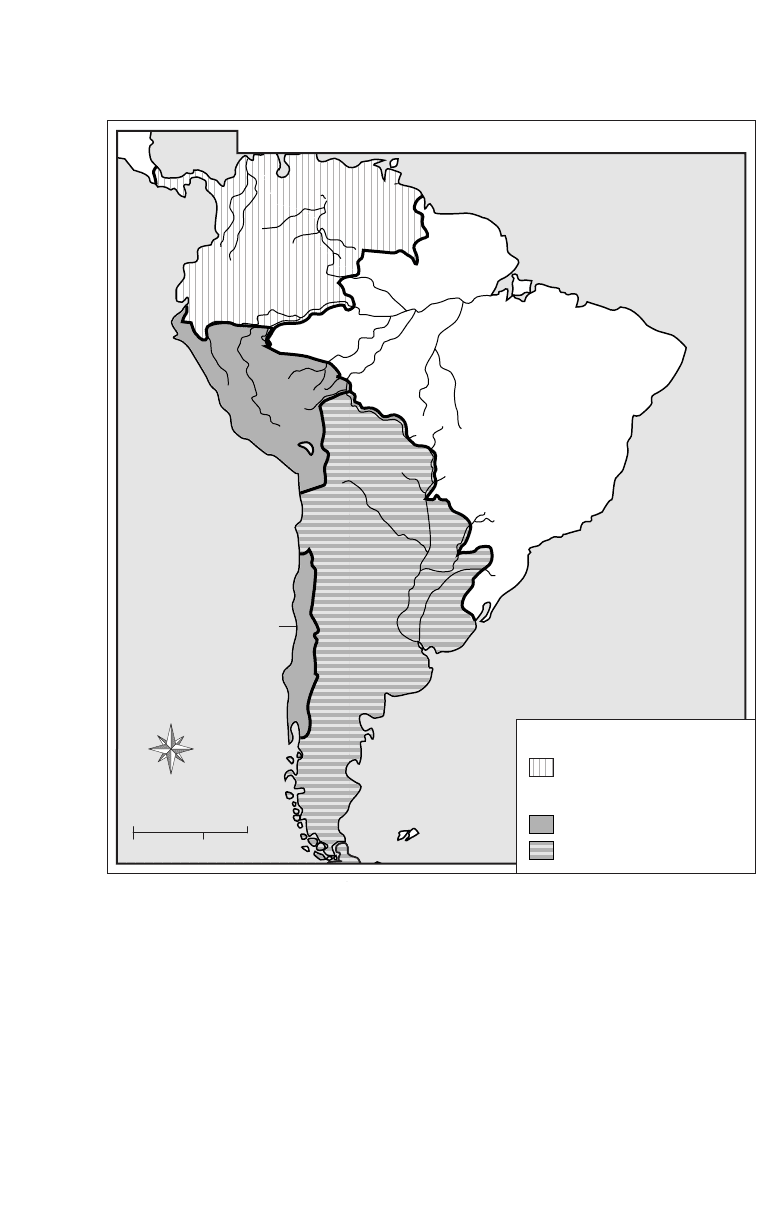
New World, Spain divided its American colonies into three viceroyalties:
New Spain (Mexico), Peru, and New Granada (Panama, Colombia,
Ecuador, and, temporarily, Venezuela). As affairs in the colonies grew
more complex and trade shifted to the Atlantic coast, a fourth viceroyalty,
Río de la Plata, was split off from the Viceroyalty of Peru in 1776.
Each viceroyalty was in turn divided into audiencias (the term referr
ed
not only to a territory within the larger viceroyalty but also to a high court
that exercised considerable executive functions). Until 1739, the
Viceroyalty of Peru covered a huge part of Spanish South America and
included eight audiencias: Panama, Lima, Santa Fe de Bogotá, Charcas,
Quito, Santiago de Chile, Buenos Aires, and Cuzco. When the Vicer
oyalty
of New Granada was created in 1739, however, the audiencias of Santa Fe
de Bogotá, Panama, and Quito fell under its jurisdiction. Then in 1776,
when the V
iceroyalty of Río de la Plata was established, the audiencias of
Char
cas, Buenos Aires, and Santiago de Chile became part of it.
Audiencias were subdivided into gobernaciones (town councils), and
the administrative head in each gobernación was called the gobernador.
The Audiencia of Lima, founded in 1542, had five gobernaciones (in
Huarochiri, T
arma, Huancavelica, El Callao, and Cuzco). Under the gob-
ernador
es were the corregidores, then the tenientes de gobernador (gover-
nor’
s assistants) and alcaldes mayores (mayors), and at the bottom were
the gobernador de indios (governor of the Indians), the alderman of the
cabildo de españoles (municipality of Spaniards), and the alderman of the
cabildo de indios (municipality of Indians). The cabildos were key to
45
CONQUEST AND THE BEGINNINGS OF COLONIAL LIFE
Spanish settlement in the colonies. At the outset the cabildos adminis-
tered town affairs, including local justice. The elected aldermen in the
cabildos distributed land among Spanish settlers and provided guidance
and eventually money to build and maintain public works. They also
super
vised local markets, police, weights, prices, and ceremonies, such
as holidays and religious processions.
From Spain, the Crown administered affairs in the Americas and
made colonial policy through the powerful Council of the Indies
(Consejo de Indias). Beneath the council were several administrative
bodies that dealt with specific areas. For example, the administration of
A BRIEF HISTORY OF PERU
46
0
0
400 kilometers
400 miles
Pacific
Ocean
Atlantic
Ocean
Caribbean
Sea
Spanish Viceroyalties in South America, 1776
Viceroyalty of New Granada,
including Captaincy General
of Venezuela
Viceroyalty of Peru
Viceroyalty of Río de la Plata
The Viceroyalties
RÍO DE
LA PLATA
PERU
NEW
GRANADA
RÍO DE
LA PLATA
Captaincy
General
of Chile
PERU
NEW
GRANADA
N

state finances for the colonies fell to a powerful Spanish merchant guild,
the Casa de Contratación, which was controlled by important Spanish
merchants engaged in the Atlantic and Pacific trade. The guild was
directly responsible to the Council of the Indies. Another powerful
financial institution, the Commission of Audits (Tribunal de Cuentas),
was also directly responsible to the Council of the Indies.
By around 1610 the colonial administrative structure in Spain had
developed even more specialized entities to deal with the increasingly
more complex affairs of the colonies. Departments of justice, civil
administration, military affairs, and finances all had their own admin-
istrative structures and worked independent of the Council of the
Indies. The Board of Finance (Junta de Hacienda) and the Commission
of Audits, both entities dealing with the financial administration of the
colonies, were also responsible to the viceroys, the captains-general
(military governors found in some places), and the gobernadores. Some
financial matters wer
e also dealt with by local royal banks (cajas reales)
controlled by the pr
ovincial gobernadores.
The New Laws
This bureaucratic structure, which was impressive by contemporary
standards, was geared toward reinforcing Spanish presence in its
colonies. Such control, however, was never fully accomplished in spite
of administrative sophistication. From the very beginning, the problems
the Spanish Crown would face over and over again were apparent: The
geographical distance from the center of power in Spain made the
colonies more independent than the Spanish Crown would have liked.
An inherent autonomy had dangerous separatist tendencies that
increased or diminished according to the loyalty of bureaucrats sent out
from Spain, and loyalty often depended on the salary a bureaucrat
received.
Although initially the corregidores, who numbered around 80 in the
Peruvian vicer
oyalty toward the end of the 16th century, fulfilled the
role envisioned for them by the Crown, they soon became a threat to
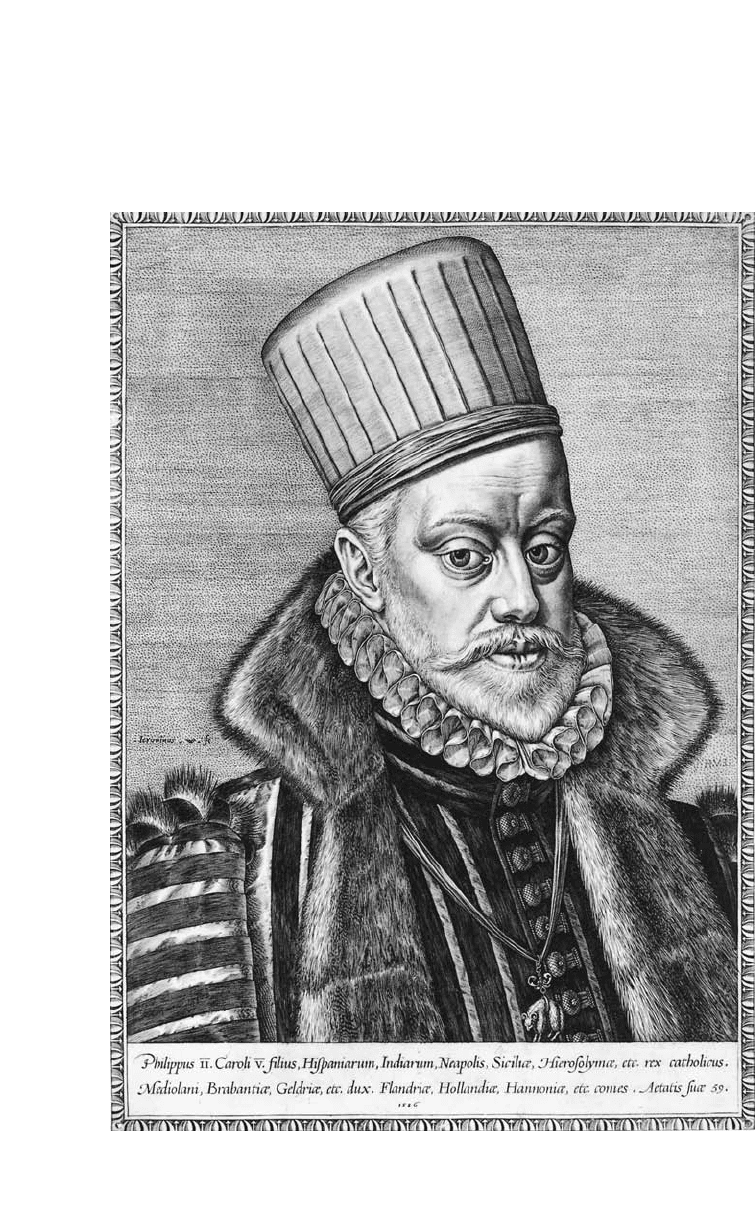
the Crown’s interests in the colonies. Around 1557 under Philip II, the
Crown went bankrupt and to raise money began selling offices in
the American colonies. The subsequent decline in professionalism
in the administrative ranks meant less efficiency and more corruption,
and it gave American-born Spaniards, or Creoles, the chance to acquire
power. Limeños, as residents of Lima were known, began purchasing
of
fices in the city council in 1561. By 1575 Lima-born whites held
47
CONQUEST AND THE BEGINNINGS OF COLONIAL LIFE
more offices than their peninsular-born counterparts. The only control
the Crown retained was limiting the tenure of positions and mandat-
ing that offices were not to be sold in perpetuity.
A BRIEF HISTORY OF PERU
48
King Philip II, who began selling the office of corregidor in colonial Peru to the highest bidders
after Spain went bankrupt in the 1550s
(Library of Congress)

Under this system local officials known as corregidores were no longer
state-appointed bureaucrats but powerful local agents who had received
loans from the merchants in the Casa de Contratación in Seville to buy
their positions. To repay their loans corregidores forced the sale of goods
at exorbitant prices on the indigenous population. The Indians suf
fered
extortion and punishment under these circumstances. Those Indians not
living on an encomienda or under the jurisdiction of a corregimiento, the
land under the corregidor’s command, had to pay their tributes directly to
the king thr
ough the royal bank. Due to the population decline, corrup-
tion, neglect, and the ongoing civil strife, tributes often went unpaid.
The Council of the Indies dealt with this situation by promulgating
the so-called New Laws (Leyes Nuevas). The New Laws were a collec-
tion of royal decrees meant to reform the encomienda system and, more
impor
tant, to limit the growing power of the encomenderos. The man
put in char
ge of implementing this more rigorous set of laws was Peru’s
first viceroy, Blasco Núñez Vela, with the help of Peru’s first archbishop,
Jerónimo de Loayza.
Both appointees arrived in Peru in March 1544, well after the news
about the provisions of the New Laws had reached the colonies. Núñez
Vela received a hostile reception when he officially proclaimed the laws in
the cities of Piura and Trujillo. Protests grew the closer he came to Lima,
and when he finally reached the capital, the audiencia members rebelled
against his authority
, deposed him, and sent him back on his way to Spain
under guard. Núñez Vela, however, escaped his captors and assembled an
armed force to reassert his authority in Lima. He never made it. He died
near Quito in a battle against one of the Pizarro brothers.
In 1546 Pedro de La Gasca (1485–1567?) was sent from Spain to try
again to implement the new legislation. La Gasca may have been one of
the first Spanish representatives to the colonies who was appointed for
merit. He had been born near Ávila in 1493 and was of humble origins.
He attended the University of Alcalá de Henares and the University in
Salamanca. In 1537 he became a vicar to the archbishop of Toledo and
eventually became a minister of the Inquisition and a visitador (inspec-
tor) of the kingdom of V
alencia. The Council of the Indies selected him,
rather than a military man, to bring peace efforts to the trouble-ridden
Peruvian viceroyalty.
La Gasca carried new orders, new appointments, and new goals in his
luggage. He had been appointed president of Lima’s audiencia, and as such,
he was to become a power
ful arbiter of ongoing disputes. Additionally, he
was to interrogate and judge past and present state officials; he could par-
don or punish transgressions, initiate new conquests, and renew or cancel
49
CONQUEST AND THE BEGINNINGS OF COLONIAL LIFE

existing encomiendas. His power was almost unlimited, all the more so
because he was allowed to use royal income to pay for any expenses he
considered necessary and engage in businesses on behalf of the Crown.
While on his way to Peru, La Gasca heard about the death of Núñez
Vela. He returned to Panama and began to organize his takeover of the
Peruvian viceroyalty. He wrote numerous letters to Peruvian
encomenderos and made sure each one of them also received the letter
signed by Charles V disappr
oving the encomenderos’ separatist stances.
He garner
ed support through his diplomatic efforts, but warfare could
not be avoided. Within a year of La Gasca’s arrival, the new viceroy
defeated Gonzalo Pizarro in 1548 at a small battle at Jaquijaguana near
Cuzco. Twenty people were killed, and Gonzalo Pizarro and his main
associates were captured and executed. Disloyal encomenderos lost their
pr
operties, and La Gasca—aided by the archbishop of Lima, Jerónimo
de Loayza—redistributed land and Indians to those who had proven
loyal to the king. Due to the tremendous opposition, the New Laws
were not fully implemented until the beginning of Viceroy Francisco de
Toledo y Figueroa’s reign (1569–81).
The makeover of the tribute system went hand in hand with an inter-
esting debate on who or what Indians were, how they should be treated,
and what their obligations would be. Some denied that Indians (and
blacks) had souls, were thus unredeemable for eternal salvation, and
thereby available as slaves. Others advocated treating Indians fairly as
human beings; without the voluntary submission of the indigenous
population to the Crown, they argued, Spain would never be able to
exercise real power, and the king would be considered a despot rather
than a benevolent father. The practical consequence of the second posi-
tion was the abolition of the encomienda system. The main spokesman
for this position was the friar Bartolomé de Las Casas, who debated the
issues befor
e the Council of the Indies. As a result of these discussions,
Indians were declared to have redeemable souls and to be potentially
loyal, thus protected vassals of the king.
Amid civil strife, ideological debates, and the gradual disappearance
of the encomiendas, the silver mines of Potosí in modern-day Bolivia
wer
e “discovered” in 1545 (the Indians had long known of their exis-
tence). The rapidly increasing profits from silver mining and substan-
tial reforms went hand in glove.
A BRIEF HISTORY OF PERU
50

4
Colonial Peru (1568–1700)
W
hile serious problems remained for the long term, by 1569, when
Francisco Toledo y Figueroa became viceroy, the colonial system
had begun to settle into a pattern that provided some measure of sta-
bility. The indigenous population, whose numbers went into a drastic
decline soon after the conquest, was manipulated and exploited for the
benefit of the Spanish colonists in Peru and of the Spanish Crown. The
backbone of the colonial economy came to be the mining of silver after
the discovery of one of the world’s richest silver sites at Potosí, but agri-
culture and to a lesser degree manufacturing were also important eco-
nomic endeavors.
The Viceroy and the Reducciones
The first attempts by the Spanish Crown to govern Peru through a
viceroy had failed to bring stability and order to the colony. Núñez Vela
was killed by rebels before he could claim his office, and the second
viceroy, the elderly Antonio de Mendoza (who had been viceroy of
Mexico for 15 years), died after a year in office. The third viceroy,
Andrés Hurtado de Mendoza, marqués de Cañete, was replaced after
only two years, a period during which he attempted to quell unrest
among the settlers with large-scale executions and deportations. His
successor, Diego López de Zúñiga, conde de Nieva, was perhaps the
most unfortunate choice of all. He had a taste for ostentation and dissi-
pation, and he was found one night lying mortally wounded in the gut-
ter outside the home of his mistress, presumably the victim of an
outraged husband.
However, the selection of Francisco de Toledo y Figueroa as fifth
viceroy of Peru proved to be fortuitous and ended the string of fail-
ures. Toledo was born in Oropesa, Spain, in 1515. At age 19 he
became one of the soldier-monks of the Order of Alcántara and fought
51

in the religious wars in Europe. He was closely attached to Charles V,
and he transferred his service to Philip II when the new king ascended
to the throne. Like his royal master, Toledo was intensely religious,
but he was also an able administrator.
When he came to the Peruvian viceroyalty in 1569, Toledo faced
great challenges. The state coffers were empty because few revenues
had been collected since 1552, pirates were approaching the extended
coasts of the viceroyalty, and two indigenous groups were in revolt—
the Araucanians to the south and the Incas in Vilcabamba.
Perhaps most ominous were the accounts he heard from everywhere
in the viceroyalty of a rapidly decreasing indigenous population. It was
clear that demographic disaster had hit the native population, although
modern scholars widely disagree as to its dimensions. Estimates of the
preconquest population of the Andes region range widely from 3 mil-
lion to 30 million people (or more). Estimating a population of around
9 million people in 1520, Noble D. Cook, a U.S. historian and demog-
rapher, states in Demographic Collapse: Indian Peru, 1520–1620 (1981)
that the population in the vicer
oyalty had plummeted to 1.3 million
natives a half century later and decayed still further to 600,000 by
1630. Peru’s indigenous population reached its lowest after the
1718–20 epidemics. Such astronomical death tolls were the result of
the devastation and disruption caused by military defeat, complicated
by its psychological effects and accelerated by the spread of European
diseases to which the Indians had no immunity. Epidemics continued
well into the 19th century. In Peru it was not until 1800 that the pop-
ulation showed signs of an upward curve, reaching a total of approxi-
mately 700,000 people at the turn of the century.
Viceroy Toledo disembarked at Paita on the northern Peruvian coast
in September 1569 and decided to continue his trip to Lima by land.
This trip was symbolic of his grand reform plan to personally visit all
of his new dominion. Others before him had undertaken a similar task
of evaluating the human and natural resources of the colony, but their
energy and will had failed. Toledo enlisted the help of 60 specially
appointed visitadores (inspectors) to travel and study the 14 provinces
into which the V
iceroyalty of Peru was initially divided (Lima, Trujillo,
Guayaquil and Puerto Viejo, Zamora, Loja and León, Quito and
Cuenca, Chachapoyas and Moyobamba, Huánuco, Huamanga and
Cuzco, Arequipa, Chucuito, La Paz, La Plata, and Potosí). Among
these visitadores were some of the most brilliant thinkers of their time,
mostly priests and lawyers, including Juan de Matienzo, Cristóbal de
Molina, Damián de la Bandera, and Cristóbal de Albornoz. The main
A BRIEF HISTORY OF PERU
52

goals of these visits were to regulate the tribute amounts Indians were
to pay, to manage the encomenderos and others who had mistreated or
abused Indians, and to assess the demographic disaster as tribute exac-
tions had to be lower
ed according to the reduced number of Indians in
each settlement.
A major result of the study was a new policy to relocate and concen-
trate the dispersed Indian population into pueblos (villages), where they
could be better contr
olled, counted, exploited for labor, and cared for.
These new villages were called reducciones. The idea was not new. A
r
oyal official named Lope García de Castro had previously proposed the
relocation of Indians in connection with the establishment of the cor-
r
egimientos. In the province of Huarochiri, for example, more than 100
small settlements had been conver
ted to 17 reducciones, each holding
between 1,000 and 1,700 people.
The establishment of reducciones often meant that different ethnic
gr
oups had to adapt their lifestyles and their lives together in the same
village under an increasingly strong colonial state presence. The reduc-
ciones, for example, partially dismantled the dispersed settlement pat-
tern of the Incas that was meant to ensure a varied diet with produce
from different ecological niches for local communities. As such, reduc-
ciones increased the risks of a bad harvest and disrupted peasant self-
suf
ficiency and long-established customs.
Reducciones were administered by local agents called corregidor
es,
and each reducción within a corregimiento had a curaca or cacique
(native chief) as r
epresentative and leader. These agents became the
hinges of a dual society with Spaniards on one side and Indians on the
other, or, as the sections were called then, the república de españoles and
the república de indios.
The relocation of the indigenous populations was key to organizing
tribute collection and, per
haps more important, to exploiting Indian
labor through the mita. Mit’a was originally a labor draft system used in
the Chimor kingdom and by the Inca. The Spaniar
ds, however, reintro-
duced the Europeanized, state-organized mita especially for the newly
discovered silver mines in Potosí (in present-day Bolivia).
A total of 13 pr
ovinces in the vicinity of the mines were subjected to
mita obligations. Every year in these pr
ovinces one-seventh of the adult
males subject to paying tribute had to labor in the mines (between the
ages of 18–50). Indians dreaded labor in the unsafe and unhealthy
mines and often escaped the reducciones to return to their former
homes. As mor
e and more peasants fled to their earlier communities
and some disappeared outright, never to be accounted for again, the
53
COLONIAL PERU