
Hunefeldt C., Harris B. A Brief History of Peru
Подождите немного. Документ загружается.


area; and when necessary, repressing local resistance, as in the Cañete
Valley and Collique. The Chimú were the most difficult rivals and
largest in number, but the Inca subdued them and coopted their lead-
ers. The political ability of the Inca people went hand in hand with the
empire’s ideological-religious underpinnings, Inca cosmology, and Inca
social policies. U.S. scholars Geoffrey W. Conrad and Arthur A.
Demarest have noted when writing of early Mexico and Peru that the
imperialism of both the Aztec and the Inca was driven by ideology,
mainly religion.
The pre-imperial past of the Inca is hazy. The Inca themselves told
elaborate mythological stories of their founding, the development of
their way of life, and their early expansion. According to this Inca tra-
dition, the sun god sent his son, Manco Capac, and his daughter, Mama
Ocllo, into the Andean world to educate the untutored and uncivilized
peoples who lived there.
The legend says that Manco Capac and his sister-wife Mama Ocllo
were first placed on an island in Lake Tititcaca, but they sought another
home. With the aid of a golden staff called a vara, they found it in the
valley of Cuzco, wher
e they settled down to raise their own family, a
new race of children of the sun. With the divine help of the sun god
who had sent them there, they began to spread the joys of civilization
among their new neighbors.
Manco Capac came to be known as the first Inca, or divine leader. He
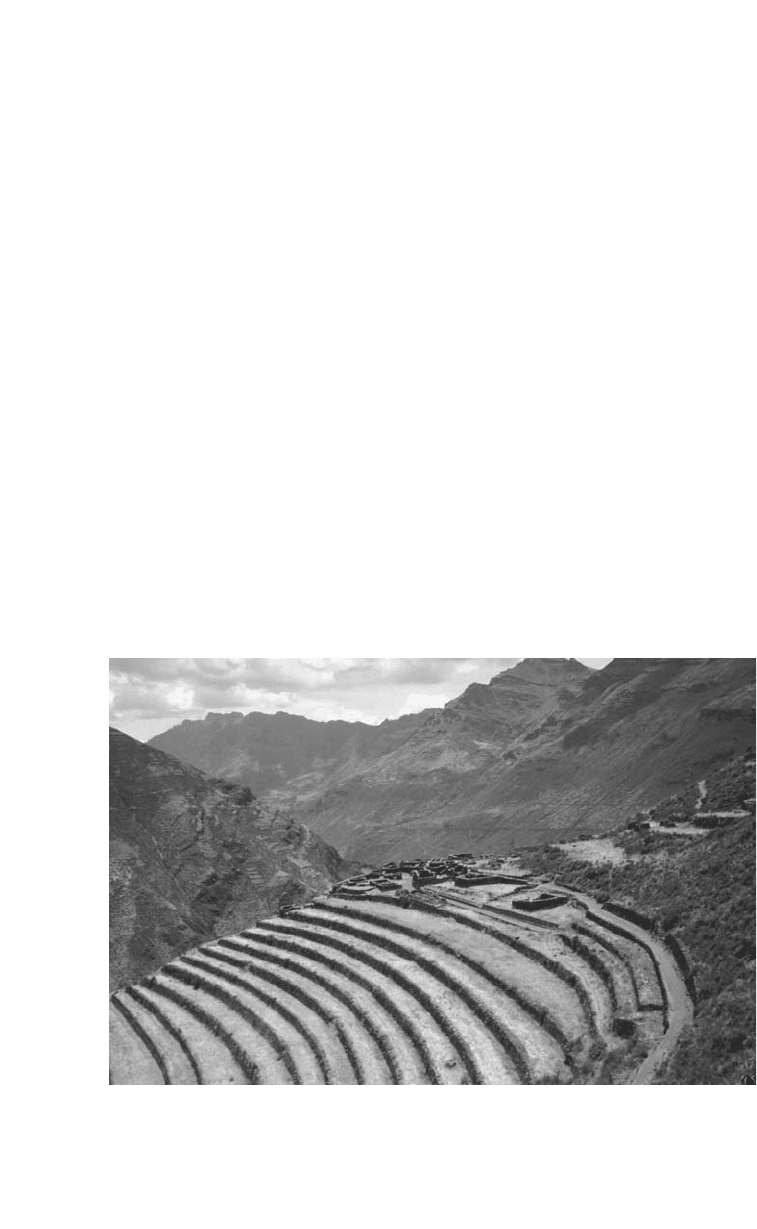
concentrated on teaching the men how to till the soil and plant seeds,
and he told them to connect streams and rivers with canals that would
water the fields and make them productive—a mythological explana-
tion of the origins of the elaborate Inca agricultural system of terracing
and irrigation. Meanwhile, Mama Ocllo taught the women how to spin
and weave, how to make clothing, and how to cook their food. Between
the couple, they instructed their new neighbors in all the arts of civi-
lized living, and soon (according to mythology) new converts
descended into the valley of Cuzco by the thousands to join the first
Inca and his wife.
The story smoothes over the conflicts and difficulties that must have
arisen, but it may describe accurately the system of interlocking social,
political, and economic structures that came to form the basis of Inca
life. The myth also explains Inca expansion: the Quechua speakers’
drive to conquer, subjugate, and incorporate an ever-widening circle of
neighboring peoples. According to the legend, the first Inca realized
that the valley of Cuzco was not large enough for all of his new follow-
ers; Manco Capac therefore trained some of his men in the arts of war,
A BRIEF HISTORY OF PERU
14

showing them how to make and use bows and arrows, spears, and war
clubs so they could convince unwilling neighbors by force. In a short
time, the influence of Inca culture extended for many miles beyond the
valley of Cuzco.
The Inca also had a variant founding myth, involving the legend of
the Ayar brothers, which also synthesized in popular memory earlier
legends about the origins of the Inca people. According to this version
of the legend, four brothers—Ayar Manco, Ayar Uchu, Ayar Cachi, and
Ayar Auca—came with their wives to Cuzco from Pacariqtambo (the
cave of the rising sun), located in today’s province of Paruro. The
Ayares, together with the Mara and Tampu tribes, had migrated north
in search of fertile lands, bringing their religious idols and precious
seeds with them on the long trip from Paruro. However, not all of the
brothers reached Cuzco. Ayar Cachi returned to the cave of the rising
sun, where he was betrayed by a servant and turned into a stone. Ayar
Uchu was turned into a stone on a mountain called Huanacauri, bor-
dering Cuzco, and Ayar Auca was turned first into a bird and subse-
quently also to stone. Ayar Capac did finally reach the mountain of
Huaynapata in Cuzco, and here his golden vara sank into the ground,
indicating he had found a fertile new home. But before founding Cuzco,
A
yar Capac had to conquer the original peoples living in Cuzco.
Such legends by nature do not reflect accurate historical events; they
selectively sum up long-term processes, especially when a group in
power—in this case the Inca—wants to perpetuate a certain founding
myth. For example, each successive ruling Inca repeated the founding
myth as part of a ritual upon his succession to the throne. The myths of
the Inca Empire that involve the stories of Mama Ocllo and Manco Capac
and the Ayar brothers have subsequently been interpreted and reinter-
preted to make them fit historical chronological reality. (Interpretations
of these myths range from psychological-anthropological interpretations
to the assumption that these myths were invented by one of the chroni-
clers, specifically Garcilaso de la Vega, to explain the origins of the Inca
Empire to the king of Spain.)
It seems safe to say the legends indicate that originally the Inca were
not from Cuzco but came from Lake Titicaca. They may have been sur-
vivors of the Tiwanaku culture, and they probably were not individuals
but entire ayllus with sophisticated knowledge of agricultural tech-
niques. The golden vara could have been more than a religious symbol;
it is—quite realistically—a way of detecting fertile land, especially for
the cultivation of corn. Fur
thermore, Manco Capac and Ayar Capac of
these two myths may be the same founding figure.
15
THE INCA: THE BUILDING OF AN EMPIRE

Inca Military Expansion
The founding myths take on a more precise historical contour in the
descriptions of Inca warfare against an ethnic group known as the
Chanca. The Chanca were made up of various minor ethnic groups that
may have been responsible for the decay of the earlier Huari Empire.
Historical sources disagree as to details of the Inca’s victory over the
Chanca, but there is a consensus that it served as the trigger for expan-
sion. The Chanca may have encroached on the edges of Inca territory
early in the Inca Viracocha’s reign, although their actual advance on
Cuzco may not have happened until Viracocha was an old man. When
the ruling Inca and two of his sons fled in the face of the powerful
Chanca, two other sons, Cusi Yupanqui (later renamed Pachacútec) and
Roca, supported by generals and important nobles, staged a defense.
They withstood the Chanca attacks on Cuzco, and according to the Inca
version of the battle, at a crucial moment even the stones of the city were
transformed into warriors under Pachacútec’s command. These stones
were collected after the attack and incorporated into shrines in the city.
The defeat of the Chanca left the Inca in command of the region.
The Inca, beginning as a small ethnic group in the vicinity of Cuzco,
proceeded to rapidly expand their domain. Shortly before the
A BRIEF HISTORY OF PERU
16
Betanzos’s Chronicle of
the Chanca War
A
chronicle written in 1551 by Juan de Betanzos contains detailed
information about the wars between the Inca and the Chanca.
The chronicler had direct access to the oral tradition of the panaca
(extended royal family) of Pachacútec through his wife, Cusimiray
Ocllo, who was related to Pachacútec. Cusimaray had been the concu-
bine of Francisco Pizarro, by whom she had a son, also named
Francisco. When Pizarro died, she married the Spaniard Juan de
Betanzos, fluent in Quechua and official interpreter in Cuzco. He wrote
the account of the war at the request of Peru’s first viceroy, Antonio
de Mendoza. His account remained unpublished and a part of it was
lost. Only recently was his complete chronicle rediscovered in a private
library in Palma de Mallorca. According to Betanzos, final Inca victory
over the Chanca was because of Prince Cusi Yupanqui, later renamed
Inca Pachacútec (as he is remembered in traditional indigenous songs).
17
THE INCA: THE BUILDING OF AN EMPIRE
Inca Empire
SOUTH
AMERICA
SOUTH
AMERICA
Pachacútec
Tupac Inca Yupanqui
Pachacútec and Tupac Inca Yupanqui
Huayna Capac
Inca Conquests
NORTH
COAST
QUITO
TUCUMÁN
QUITO
SOUTH
COAST
CHILE
TUCUMÁN
CHARCAS
CUZCO
CAJAMARCA
CHARCAS
CUZCO
CAJAMARCA
Pacific Ocean
Atlantic
Ocean
Lake TiticacaLake Titicaca
400 kilometers
0
400 miles
0
N

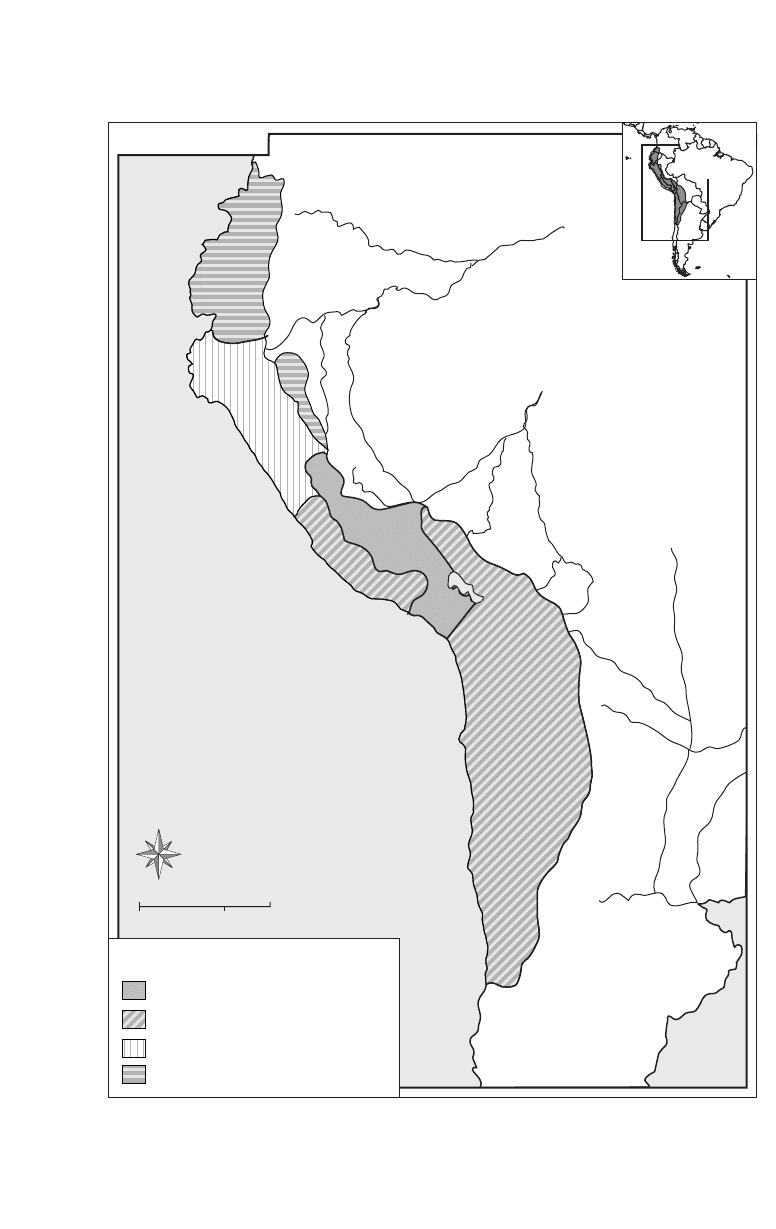
Spaniards arrived, they had gained control over an area that reached
from the west side of present-day Pasto in Colombia to the Bío Bío and
Maule Rivers in present-day northern Chile and in the southeast to the
regions of Tucumán and Mendoza in what is now Argentina. The
empire at its height covered a territory of around 3,000 miles. This
expansion—as dated by archaeological findings and chroniclers’
descriptions—happened in less than a century, approximately between
1440 and 1525.
The Inca had little time to consolidate their empire before the arrival
of the Spanish. In the outlying areas, Inca political institutions and con-
trol were rather weak. Incan expansion began in and around Cuzco and
incorporated, almost in concentric circles, more and more ethnic
groups. The farther from the imperial capital of Cuzco a group was
located, the less its people incorporated into the empire and settled into
the empire’s spheres of influence and ways of life.
Three successive Incas engaged in what has been described as “the
great expansion”: Pachacútec (1438–71), Tupac Inca Yupanqui
(1471–93), and Huayna Capac (1493–1525). Pachacútec incorporated
the Collao and highland regions of central Peru. Tupac Inca Yupanqui
expanded the empire to northern Ecuador and central Chile, a stretch
of 3,000 miles. Huayna Capac maintained and consolidated what his
predecessors had acquired. The resulting realm of the Incas was the
Tahuantinsuyo, which according to the organizational logic of the Inca
Empire, was divided for administrative purposes into four suyus, or
quar
ters: Chinchaysuyo (in the north), Antisuyo (east), Contisuyo
(west) and Collasuyo (south).
According to three early chroniclers at the end of the 16th and the
beginning of the 17th centuries—Pedro Cieza de León, Miguel Cabello
de Valboa, and Pedro Sarmiento de Gamboa—the campaigns of
Pachacútec and Tupac Inca Yupanqui followed this sequence: A first cam-
paign into the Chinchaysuyo incorporated the province of the Quechua
and saw an assault on the empire of Chimor and the subjugation of
Tumebamba (present-day Cuenca) and Quito. The second phase of this
campaign began in Quito and ran down to Huancavilca (present-day
coast of Ecuador), Bracamoros, Latacunga, and Tumbes and concluded
with the conquest of Chimor and its treasures in Chan Chan. A second
campaign brought the Inca into the Antisuyo, located to the east and
southeast of Cuzco. Here the Inca conquered less developed peoples such
as the Opataris, Manosuyos, Chunchos, and Chiponahuas. Usually Inca
war strategy involved careful scouting and intelligence gathering, fol-
lowed by rapid incursions. Most campaigns began by taking the nearby
A BRIEF HISTORY OF PERU
18
mountain or hills and then
descending to the valleys. Fray
Bernabé Cobo’s account of the
military endeavors of the Inca
slightly differs from the other
three. According to Cobo (who
wrote his chronicle around 1650,
later than Cieza, Sarmiento, or
Cabello), the Inca first conquered
the Antisuyo, then ventured into
the Collasuyo, followed by the
Chinchaysuyo, and then again
into the Collasuyo.
Soldiers for the Inca army
were recruited among ethnic
groups through mit’a assign-
ments. Inca leaders carefully
chose their soldiers fr
om among
those groups they trusted most.
Those ethnic groups that had
been part of the Inca Empire for a
longer period of time were thus
more tightly incorporated into
the empire and deemed more
reliable. Recruitment also took
local demographics into account.
Smaller ethnic groups had lower mit’a assignments than larger groups. A
higher concentration of population made the absence (or loss) of its
males less onerous to tributary groups. Ethnic groups in the Collasuyo
and Contisuyo had developed str
ong links to the Inca and were at the
same time more densely populated regions; it was especially from these
two regions, therefore, that the Inca recruited their soldiers.
Like the civil society, the army was organized in multiples of 10. Each
group was under the command of its own ethnic chief; however, mem-
bers of the pure Inca lineages held the highest ranks among the military
leaders. The army, which at its height numbered up to 200,000 men, was
divided into specialized squadrons, and each squadron carried one kind
of armament (slings, bow and arrows, war axes) or played music on
drums and trumpets made out of huge marine snails. During military
expeditions, all soldiers from one ethnic group marched together, with
those most loyal marching the closest to the Inca leader.
19
THE INCA: THE BUILDING OF AN EMPIRE
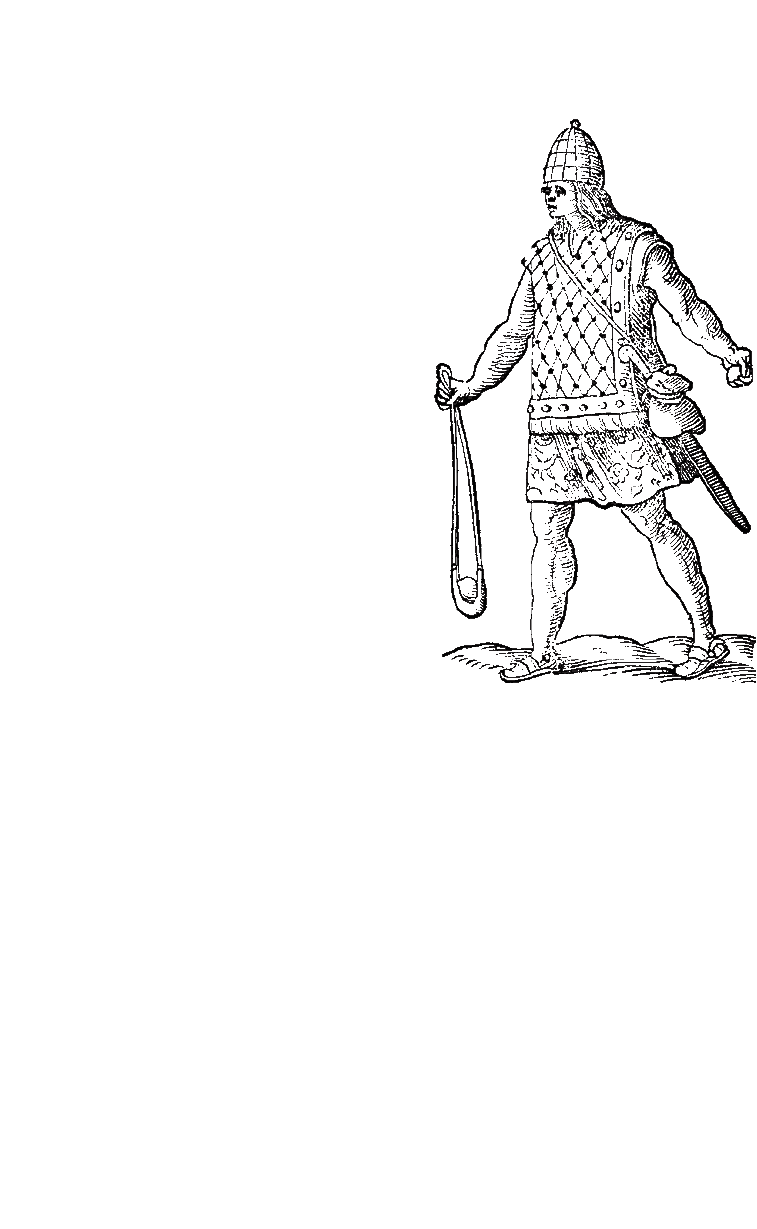
An Inca warrior, armed with a sling and
protected with simple textile body armor
(Vecellio’s Renaissance Costume Book)

Gonzalo Fernández de Oviedo, a Spanish chronicler, described the
sequence of arms used during a battle: First came the attack by men
carrying slings and egg-sized stones, then came soldiers carrying a kind
of lance; immediately behind them were soldiers with small lances.
Soldiers wore special protective clothes and adornments, according to
their ethnic background and their hierarchical niche in the army.
Sometimes soldiers painted their faces to scare the enemy, and often
they screamed and sang to show their strength, sometimes so loud that,
according to the chroniclers, birds would drop dead.
Even today there is no absolute certainty about the exact boundaries
of Incan dominance at the time the conquistadores arrived and even
less certainty about how much or how solidly the outlying areas had
been integrated into the empire. From available accounts, however, it
seems that throughout the approximately 100 years of Inca expansion,
there was no pax andina—no all-embracing social and political order
imposed by a central authority
. Local curacas, and even members of the
Incan nobility in Cuzco, headed many r
ebellions against Inca rule, and
the ruling Inca was often forced to mobilize his troops and resources
against them in order to pacify them and to restore his authority. The
more the Inca Empire expanded, the more difficult it became to control.
The Inca military, however, developed several strategies to maintain
order and subdue unrest. One technique was to collect and store on
hilltops tons of very dry wood, which could be burned as signal bea-
cons in case of rebellion, giving authorities in Cuzco a rough idea of the
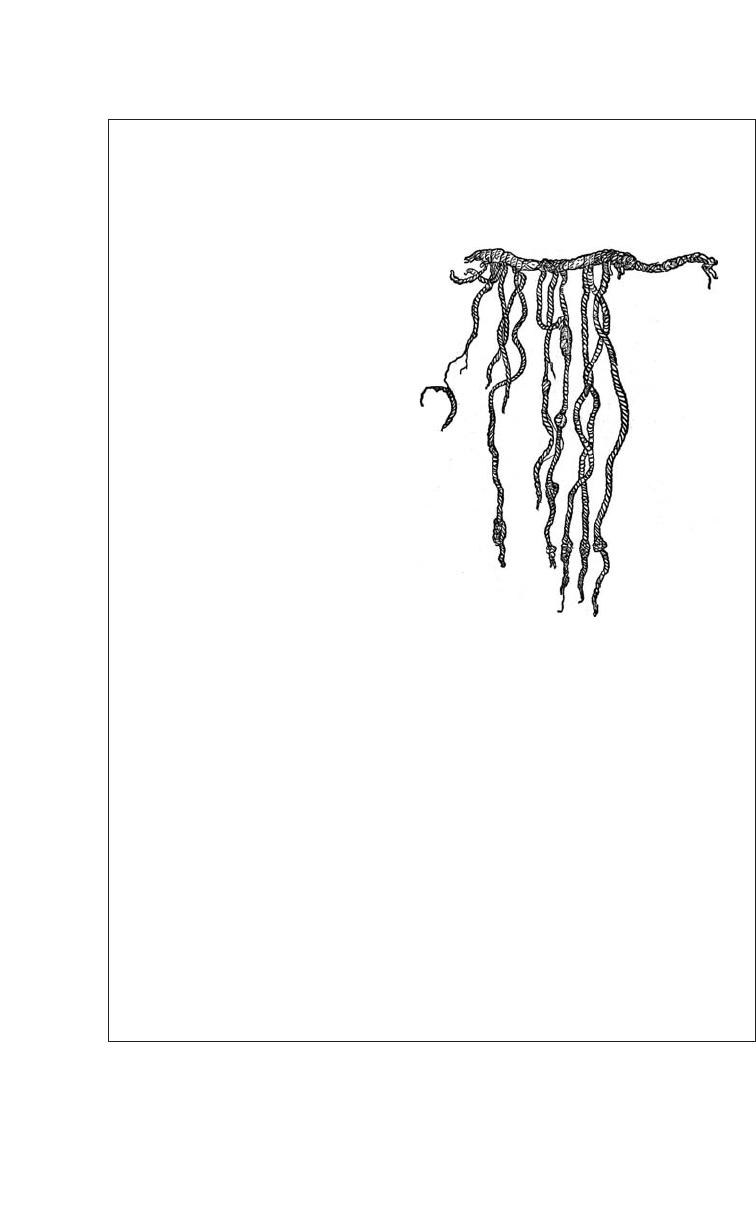
location of the outbreak. Once a chasqui (a relay runner in the state-
or
ganized system of couriers) arrived with more detailed information in
the form of the unique quipu (a knotted message string), troops were
dispatched. In spite of such strategies, however, the increasing unrest in
the empire was one of the main reasons why the Spaniards were able to
conquer the Inca quickly and thoroughly.
Imperial Inca Organization
At its height, the Inca Empire’s integrated social, political, administra-
tive, and economic system focused on the person of the Supreme Inca,
from whom all authority and power flowed, and was originally based
on close family kinship to the Inca, although the system expanded
greatly as military conquests brought more and more land and peoples
under Inca domination. The Inca evolved a hierarchical structure by
which the Inca at the top implemented his authority through 11
related royal family groups called panacas. Organized in part by
A BRIEF HISTORY OF PERU
20

Pachacútec as a way to stabilize the line of succession to the throne,
the panacas formed a royal court from which the empire’s highest-
ranking civil administrators, militar
y officers, and priests were drawn.
(The panacas also had important religious functions and had custody
of the sacr
ed mummified remains of previous ruling Incas.) This rela-
tively small number of closely related elite Inca officials lived near the
Supreme Inca in the heart of Cuzco. The great expansionist Inca
Pachacútec established Cuzco as the center of the empire, building
there the Coricancha (Temple of the Sun) and developing religious
sites in and around the city in order to emphasize the divine origin of
the ruling Inca. The most important officials were called apus, and
each suyu (quarter of the empire) had an administrative head desig-
nated as the suyuyoc apu. In addition, Cuzco itself had four apus, who
together with the suyuyoc apus formed the imperial council in Cuzco.
The system str
etched throughout the empire and eventually reached
down to the level of individual households, which were organized into
administrative units of 10. The members of the panacas were sup-
por
ted by more numerous lower-ranking nobles identifiable by their
distinctive ear piercings (they were later called orejones, or “big ears,”
by the Spanish). The next in the ruling hierarchy were “Incas of priv-
ilege,” also called “administrative Incas,” who implemented state pol-
icy and lived on the outskir
ts of Cuzco.
As the empire expanded and absorbed more and more territory and
population, the Inca’s authority was extended widely not only by
increasing the number of nobles eligible to hold office but also by co-
opting the curacas, the leaders of local conquered ethnic groups. The
r
esult was a large bureaucratic structure organized to manage the grow-
ing empire.
Inca administrative officials assigned to the provinces included
accountants who tallied tribute payments, storage houses, labor assign-
ments, and population growth; transportation and communication spe-
cialists who oversaw the maintenance of roads, bridges, and tambos,
and ran the imperial courier system (chasquis); and military adminis-
trators in charge of recruitment, training, and campaigning. The central
Inca state administration also r
egularly sent inspectors into the
provinces to report.
The empire’s leaders were trained in special schools, known as yachay-
huasi (houses of knowledge). Sons of the nobility, including the sons of
curacas from various ethnic groups, studied at the schools over the
course of four years, learning language, r
hetoric, religion, mathematics,
and the history of political and military strategy from their teachers.
21
THE INCA: THE BUILDING OF AN EMPIRE
A BRIEF HISTORY OF PERU
22
The Inca’s Tools of
Administration
T
he Inca relied on an effi-
cient system of supply,
communications, and account-
ing to administer the empire.
Stone buildings called tambos
were spaced every 10 to 15
miles along the empire’s exten-
sive road network.These were
used by official couriers and
travelers as places to rest and
resupply for another day’s jour-
ney. Imperial tambos for impor-
tant travelers were larger than
ordinary ones and were provi-
sioned by laborers under the
mit’a system. Smaller and less
sturdy tambos were used by
chasquis, relay runners who
carried packages and messages
from one place to another. In
three days and nights a mes-
sage sent from the coast could
reach the Inca in Cuzco. The systems of tambos and chasquis were the
Inca’s equivalent of a modern-day express courier or postal service.
Part of the empire’s administrative efficiency was based on the use
of the quipus, a remarkable system, probably adopted from the Chimú,
that employed knotted strings to record and communicate information.
The pattern of knots could carry complex messages or maintain
detailed accounts. Pedro de Cieza de León, one of the most quoted
chroniclers of the Inca past, commented that the accuracy and reliabil-
ity of the quipus—and of skill of the quipucamayocs (those in charge of
the quipus)—were demonstrated by their accuracy in accounting
exactly for all the ransom amounts the Incas had given to the Spaniards
after the arrival of the conquistador Francisco Pizarro.
The Incan quipu, a knotted string used to
tally and record accounts and to transmit
information among a people who had no
written language
(Narrative and Critical
History of America)
Land and Labor
Land and its produce in the Inca Empire were divided three ways: one-
third for the ruling Inca; one-third for Inti, the sun god; and one third
for the local population. The best and most productive land went to the
Inca and to Inti. The local farmers had to work these lands on behalf of
the emperor and the sun god, and they sent the harvest to Cuzco as a
form of imperial tax that supported the nobility and the system of
priests and temples.
The third of the land that remained for use by local farmers and
herders was parceled out to individual families in units called topos,
which comprised enough land to feed a family, although the size of indi-
vidual topos varied according to the characteristics and productivity of
the land. Couples r
eceived a topo when they married, and more land was
added to the original topo as children were born to the family. The
boundaries of each topo were designated in terms of natural features,
such as tr
ees, hills, rivers, ditches, or stones. In the highlands, families
or ayllus (kinship groups) often possessed land in several locations, giv-
ing rise to a pattern of discontinuous fields. This for
m of cultivation was
an adaptation to the difficult mountain environment and allowed a vari-
ety of crops to be grown at different altitudes. Seasonally, some members
of an ayllu left their homes to work in the more distant fields, r
eturning
with their crops at the end of the harvest cycle and thus were able to pro-
vide the home community with a plentiful and varied diet. In this
23
THE INCA: THE BUILDING OF AN EMPIRE
Inca farming terraces built into the side of a steep slope in order to maximize available crop
land. The Inca were highly skilled agriculturalists, who devised a complex but productive system
of farming at varying altitudes in order to boost harvests and guard against catastrophic crop
failure.
(Photofrenetic/Alamy)