
Hunefeldt C., Harris B. A Brief History of Peru
Подождите немного. Документ загружается.


credit and export subsidies, and successfully joined the regional trade
organization the Acuerdo de Cartagena. An alliance with cooperatives
partially solved the disputes over land ownership and tenure between
the agrarian middle class and the peasants. As a result, the government
continued to support industry in rural areas in spite of the prevailing
rhetoric about liberalization and privatization.
In the highlands former hacendados (and their heirs) regained access
to portions of their haciendas and became—with state aid—a part of a
new and more dynamic landed elite. The reduction of the landed estates
and hacendados’ own distrust of Indian and mestizo laborers succeeded
where centuries of sporadic uprisings and national trade policies had
failed: It forced hacendados to improve the technology of production.
Some worked in close connection with international agencies and
development projects. In some areas a complete new spectrum of mod-
ernizing owners—some of foreign origin—developed new agrarian-
based projects, such as trout, shrimp, and cheese.
New trends also appeared in the jungle, a region often overlooked as
part of the rural landscape. The jungle region has never been a priority
for agrarian reform for any government since 1969, but colonization
projects were started to ameliorate through relocation the pressure on
land in the highlands. In the “lower jungle” (selva baja), seven special
developmental projects carried out one of the most ambitious colo-
nization pr
ojects ever initiated, but the major development in the jun-
gle region was the emergence of a massive coca growing industry.
A mildly narcotic leaf used by the Inca for divination and ritual and
today, following custom, chewed by Indians and mestizos alike for its
stimulative effects, coca can be chemically altered to make cocaine. In
recent decades coca became one of Peru’s most important export crops
with a boom in cultivation and trade dating from the 1970s. Colombian
narcotraffickers moved into the regions bordering the Huallaga River,
from which they organized production and export of cocaine. In 1982
coca exports produced $850 million, which represented approximately
25 percent of Peru’s total agrarian production. Coca transactions carried
out in Peru in 1988 amounted to between $1.5 billion and $2 billion,
from which around $600 million to $800 million remained in Peru. In
that year half of the world’s supply of coca paste came from Peru.
The growing number of coca producers were outside any kind of
government control and immune to government-structured incentives.
The Shining Path, the military, and drug lords competed for control,
and from very early on the United States exerted pressure on Peruvian
governments to deal with the massive growth of coca production. The
A BRIEF HISTORY OF PERU
254

first attempts to curtail the production of coca had come under the
presidency of Morales Bermúdez in the 1970s. Many control and erad-
ication efforts followed, mostly funded by the United States. While the
Peruvian military was engaged in suppressing coca production, the
Shining Path managed to organize small coca producers, providing
them protection against drug traffickers and the military. The Shining
Path also exacted taxes from drug traffickers and allowed contacts
between peasants and drug traffickers only after they paid the imposed
taxes. The revenues obtained allowed the Shining Path to expand its
recruitment efforts by paying salaries to its members that were higher
than the official salaries of a general in the Peruvian army.
Open confrontations among the Shining Path, the military, and the
drug traffickers followed and reached a peak in 1986 with the takeover
by the Shining Path of the town of Tocache, the coca capital of the jun-
gle. Then in 1987 the competing marxist guerrilla group MRTA
attempted to oust the Shining Path from Tocache but was defeated. It
was calculated that at the time more than 100,000 acres were cultivated
with coca in the Peruvian Amazon, employing approximately a quarter
million people. In large measure because of the connections among
drug traffickers, coca producers, and terrorists, much of the money pro-
vided by the United States to eradicate coca production and dealers was
spent on fighting domestic terrorism rather than on alternative devel-
opment projects in the agrarian sector.
In tandem with this process native groups in the Amazon began to
organize politically. For the first time they had gained status as a social
force through organized action under the political leadership of leftist-
inspired organizations (the CUNA and the CCP). Violent struggles
between the state and Indian organizations, as well as among the mili-
tary, the police, and drug lords, became a vivid part of the redefinition
of political boundaries and actions.
Political Fallout of Agrarian Reform
Although rapid changes in Peru’s rural landscape over the past two
decades make it difficult to identify an overarching direction for politi-
cal development, there have been several trends.
In the past, immediate economic considerations and political pressures
often defined policy making. The urgency of change left little room for
anything but improvisation. Under numerous differing governmental
policies and bureaucratic inefficiency, patterns of land tenure and rural
organization irrevocably changed. An underlying feature of these changes
255
NEW STRUCTURES AND FUJIMORI

has been the overwhelming trend toward privatization of the associative
enterprises created in the wake of the agrarian reform. Nevertheless, pri-
vatization did not imply the dismissal of cooperative efforts. In some cases
cooperative initiatives represented a successful answer to organizing dis-
tribution and transportation and to providing better public services.
Another, more social, solution to agrarian questions was based on
the continued existence of peasant communities. In fact, the agrarian
reform and its varied consequences reinforced peasant communities: In
Puno peasant communities organized land invasions to assert their
rights on disputed lands from haciendas and associative enterprises; in
Junín peasant communities resorted to their traditional communal
organization to confront the Shining Path; and in Cajamarca and Junín
peasant communities developed and expanded entrepreneurship to
successfully manage their associative enterprises.
Along with patterns of land holding Peru’s political landscape
changed dramatically. It became obvious that there was no single state-
guided transformation of the agrarian sector but several quite distinct
initiatives brought to the political forefront by Indians, peasants, small
producers, and rural enterprises. The initiative shifted from the gov-
ernment to society’s organized social groups. Peasants and rural work-
ers took the lead in asserting social projects that they hoped would
reach beyond the government and beyond the Shining Path. Emerging
rural options offered visions of a country very different from that
encountered at the end of the 1960s.
It is likely that the Shining Path understood the meaning of this shift
much better than the Peruvian government did. To gain power and
exert influence the Shining Path not only took part in rural conflicts but
also tried to disrupt Peruvian society at several levels of civil organiza-
tion. The Shining Path encountered extensive resistance in those areas
with strong self-organization (the rondas in Cajamarca, the peasant
communities in Puno), and moved its headquar
ters to Lima, funding
itself by deals with the drug lords in the Amazon.
The Unexpected Fujimori
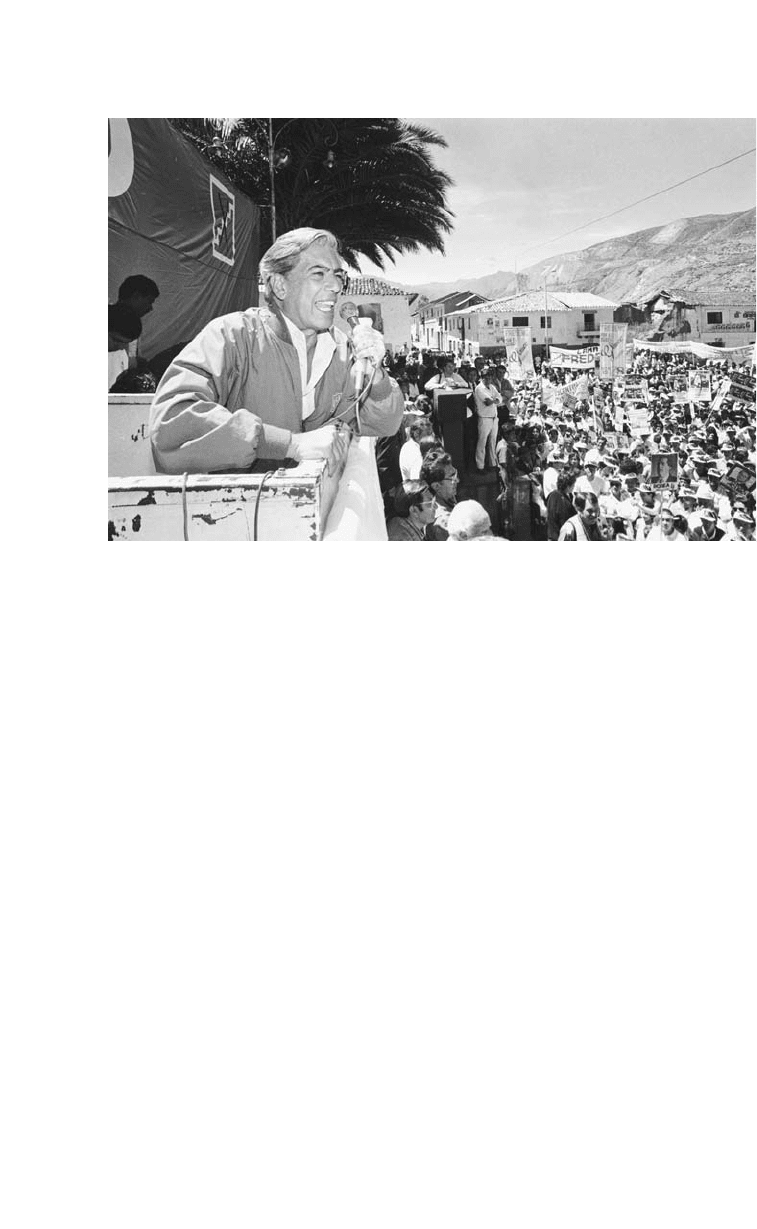
When one of Peru’s most brilliant writers and novelists, Mario Vargas
Llosa, ran for president in 1990, his most visible opponents were APRA
and some leftist groups. Vargas Llosa, who in his early writings showed a
leftist, aprista leaning, in 1990 became the chosen candidate of a rightist
alliance known as the FREDEMO (Fr
ente Democrático, or Democratic
Front). A kind of cultural revolution and a radical liberalism character-
A BRIEF HISTORY OF PERU
256
257
NEW STRUCTURES AND FUJIMORI
ized his electoral campaign. Vargas Llosa’s announcement of an austere
economic neoliberal adjustment policy, which called for a movement
toward a free-market economy and the elimination of most government
subsidies, estranged him from Peru’s popular classes, who feared the pos-
sible consequences of his economic plan: an even lower standard of liv-
ing, higher prices for essential goods, and unemployment.
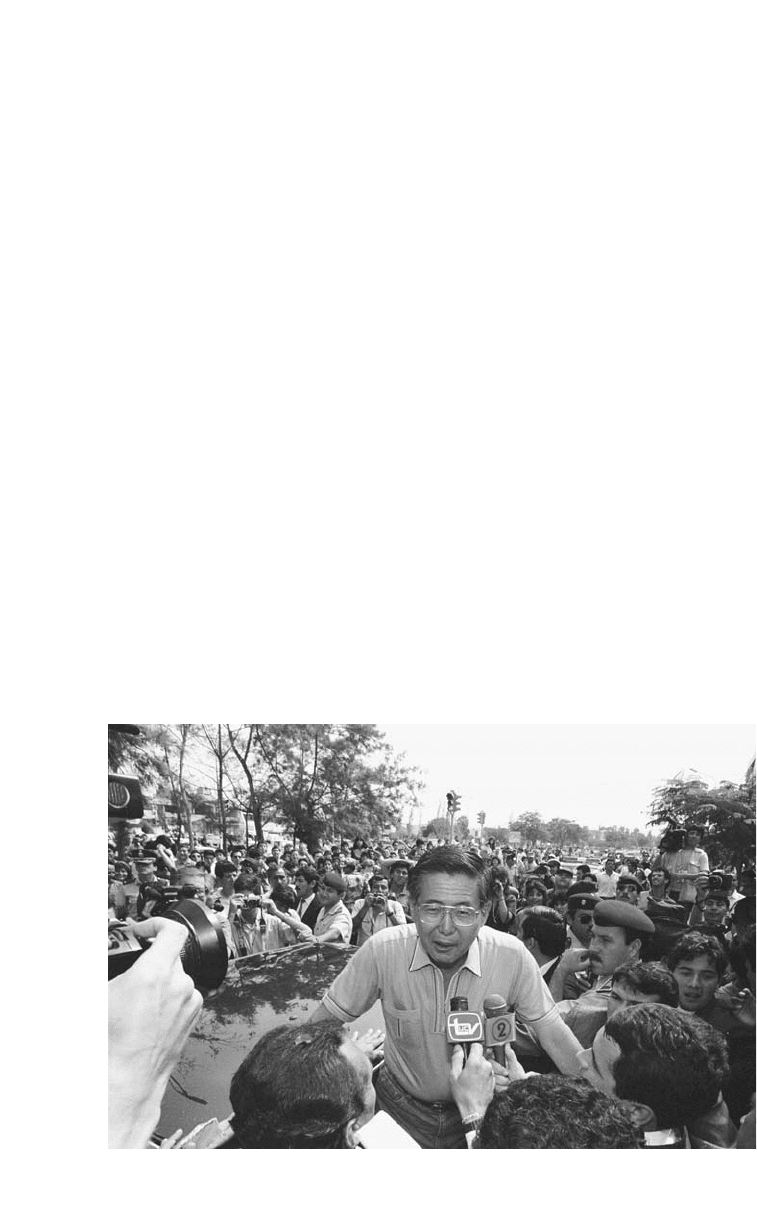
Out of these fears stoked by APRA and the Left emerged Alberto
Fujimori, who until then was practically unknown in political circles. He
was an agrarian engineer, the son of Japanese immigrants, partially edu-
cated in the United States, and a former chancellor of the National
Agrarian University. His campaign theme was straightforward and simple:
“Technology, honesty, and jobs.” Identified as part of a successful Japanese
colony in Lima whose members were known for their efficiency, disci-
pline, and honesty, Fujimori won the presidential elections with his
Cambio ’90 party. In the first voting round Vargas Llosa received 28 per-
cent of the votes and Fujimori only 25 percent. A second round was called
for, and APRA and the Left endorsed Fujimori’s candidacy. He polled 57
percent of the votes. No one could even guess what Fujimori would do.
Fujimori first moved to open Peru’s economy to the world. Once
again a market economy was given free rein, and the state retreated into
minimal administrative business and public services. Businesses
Internationally renowned novelist Mario Vargas Llosas gives a speech at a campaign stop
during his unsuccessful run for president in 1990.
(Alejandro Balaguer photo)
A BRIEF HISTORY OF PERU
258
became privatized, and efficiency ranked high in the presidential
rhetoric. Very closely following a concept that Vargas Llosa had
espoused during his presidential campaign, Fujimori engaged in a
“shock treatment” of the Peruvian economy, an austerity program he
considered necessary to reduce inflation and fiscal deficit, and thus, to
align internal prices with international prices. As expected, prices
increased. To make things worse, a cholera outbreak struck Lima, and
320,000 people were infected in 1991 alone.
Fujimori met increasing opposition in parliament, and twice he had to
change his minister of economics. In April 1992 he staged what has been
called an auto-coup by aligning with the military. He suspended the con-
stitution and shut down congress, the judiciary, and regional govern-
ments. Mostly as a result of international pressures Fujimori had to
announce elections for a new congress with a new constitution (the 12th
in Peru’s republican history) that allowed presidents to be reelected. In
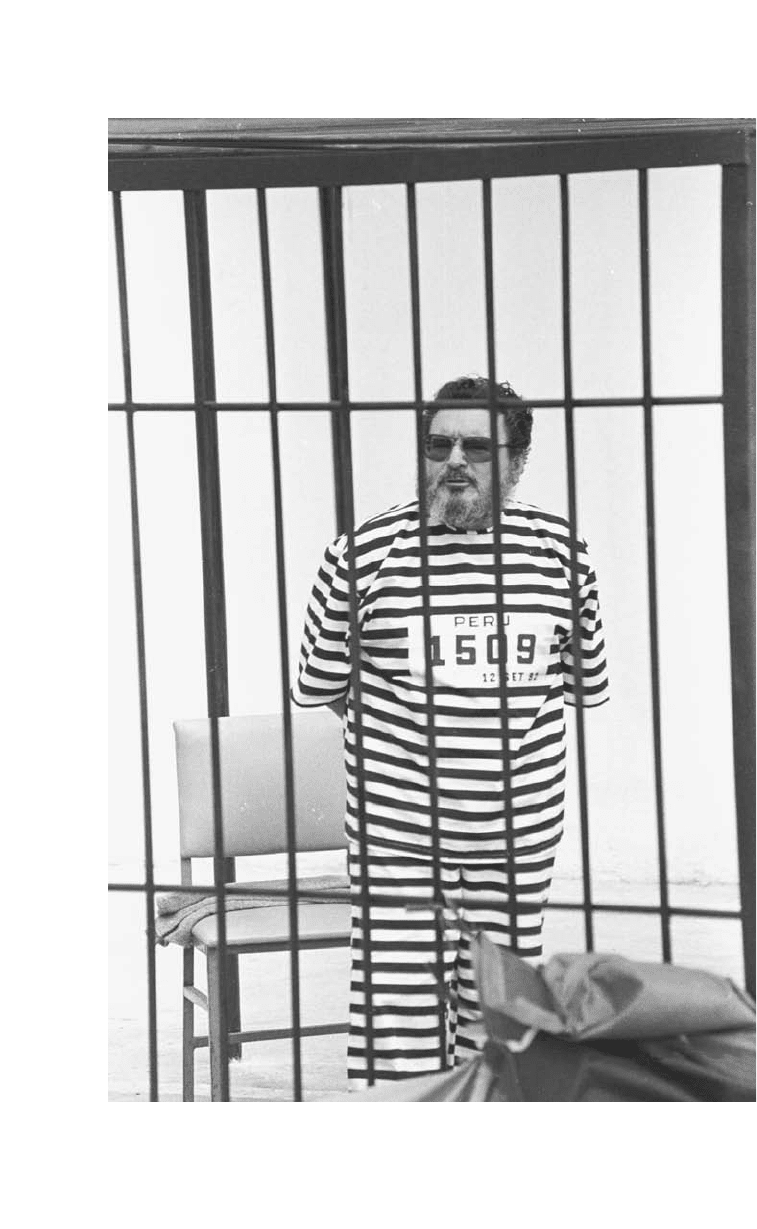
September 1992 the national police captured Shining Path leader
Abimael Guzmán and some of his closest followers. Although domestic
terrorist activities did not completely subside after this, the country suf-
fered much less from terrorist attacks and the fears they inspired.
With this political capital in his hands Fujimori began to fiercely pri-
vatize public enterprises. Between 1991 and 1998 the sale of state-owned
Alberto Fujimori, while campaigning for the presidency (Alejandro Balaguer photo)
259
NEW STRUCTURES AND FUJIMORI
Abimael Guzmán, the leader of the Shining Path terrorist organization, was captured and put
on public display in September 1992. The activities of Shining Path declined following
Guzmán’s and other leaders’ capture.
(Alejandro Balaguer photo)

A BRIEF HISTORY OF PERU
260
enterprises and bonds to private buyers amounted to $8.65 billion.
Capital from the United States, Spain, Chile, and China was most promi-
nent among these purchases. The most spectacular amount paid was
from Spain, when it purchased all Peruvian telephone services for more
than $2 billion. A Lima newspaper commented ironically that this was
the return of Atahualpa’s ransom. As a result, however, the number of
telephone lines increased from 643,000 to 1.92 million, and service
reached for the first time poor urban dwellers and small towns that had
never before seen a telephone.
Privatization also reached peasant communities. Farm cooperatives,
which carried an enormous debt on their shoulders, had to either
become shareholding enterprises or disappear. Still, in 1996 only
971,000 plots of land out of a total of 5.718 million were properly reg-
istered by their owners. By 1995, there were 6,872 highland and
Amazon native communities, who possessed 32.5 percent of the cul-
tivable land, when a new law allowed peasant communities to sell their
land. Export’s held steady throughout the 1990s, both in terms of what
was exported and the value of exports, which lent stability to the econ-
omy overall and reduced inflationary pressures on the middle and
lower classes.
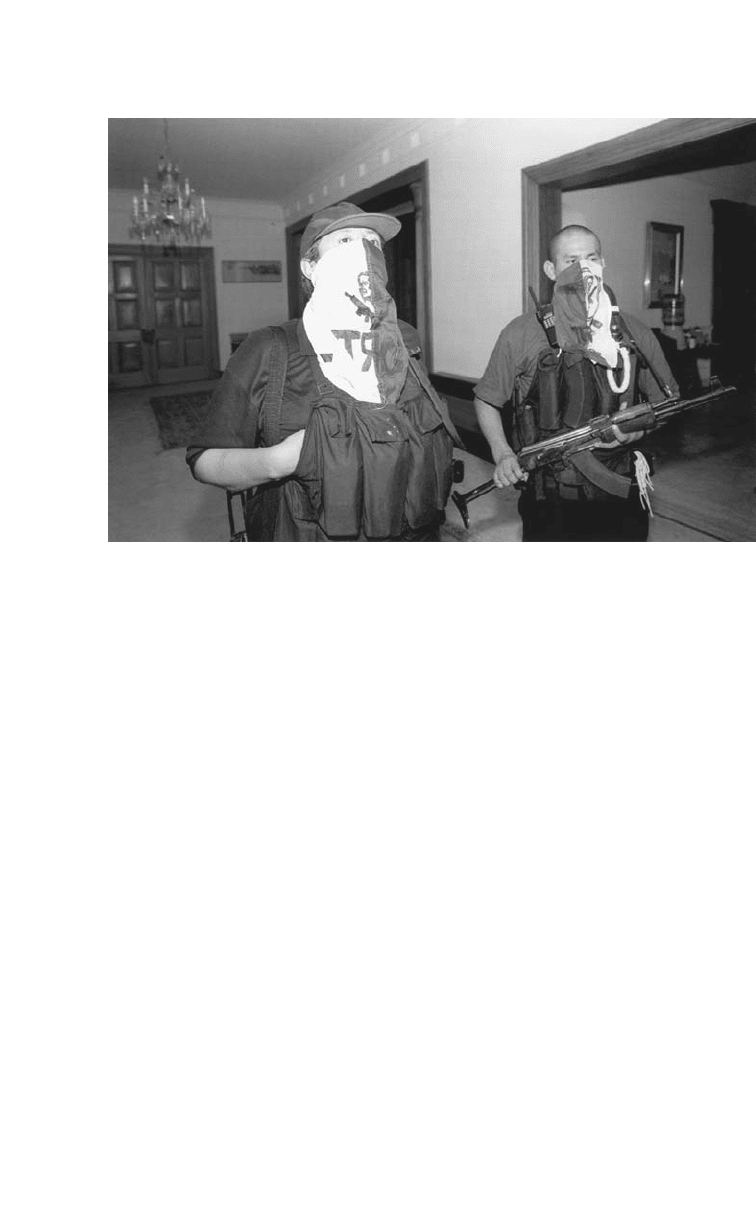
In December 1996, a year after Fujimori’s reelection, MRTA guerril-
las captured and occupied the official residence of the Japanese ambas-
sador in Lima, taking hostage 452 people who were attending a
celebration in honor of the Japanese emperor’s birthday. Fujimori had
left the building shortly before the attack and escaped capture, but his
Exports, 1990–1999 (Percentage of Total Exports)
1990 1997 1999
Sea produce 12.3 16.5 9.8
Agrarian products 4.9 6.9 4.6
Minerals 41.9 39.9 49.2
Petroleum 7.3 5.5 4.0
Nontraditional exports 28.0 30.0 30.6
Others 5.6 1.2 1.8
Total in billions of U.S. dollars $3.321 $6.814 $6.114
Source: Contreras and Cueto (2000, 358)
261
NEW STRUCTURES AND FUJIMORI
brother, several of Peru’s highest-ranking officials, and the Japanese
ambassador were there when the guerrillas occupied the compound.
The MRTA terrorists demanded the release of several hundred political
prisoners in return for the freedom of the hostages (they released most
of the women early on). After several months of fruitless negotiations,
followed closely around the world, Fujimori ordered an attack on the
embassy in April 1997. All terrorists were killed and all the hostages
rescued, save for one man who died of a heart attack. The triumph over
MRTA reaffirmed Fujimori’s popularity.
The Fall of Fujimori
After successfully sidestepping the single-term limit to the presidency by
having the constitution rewritten, Fujimori, now prepared for his cam-
paign for a third term as president. Despite the apparent successes of his
presidency, however, he faced increasing opposition, particularly since
the economic situation was worsening. El Niño hit again in 1997–98,
setting off another round of agricultural crises, and the financial collapse
In December 1996 members of the marxist guerrilla group MRTA captured the residence of
the Japanese ambassador in Peru and seized hostages.The MRTA negotiated with authorities
for several months and held frequent news conferences.Two of the terrorist leaders, Cerpa
(left) and Árabe (right), are shown here at one of the conferences with the media.All the
occupiers were subsequently killed in a government assault.
(Alejandro Balaguer photo)

of the Asian countries at the same time meant that anticipated new
investments from that source were cut off. The internal growth rate in
Peru moved close to zero, credit became tight, and unemployment rose.
Fujimori’s response was to tighten his control of the country, acting in
tandem with the military to consolidate power. To continue the fight
against terrorism, he declared several regions “emergency zones” and
placed army generals in command. The former rondas that had fought
against the Shining Path wer
e now invited—with much publicity—to
deliver social services. These maneuvers were labeled as “Fujipopulism”
or as Fujimori’s “Chinochet” policy, playing on his Asian heritage and
his adoption of an outlook similar to Chile’s general Augusto Pinochet,
who came to power by a coup d’état. Fujimori also moved to silence his
political opposition and exerted an increased control on mass media.
Fujimori’s chief opponent for election in 2000 was Alejandro Toledo
(1946– ), an Indian from a poor family with 15 brothers and sisters.
Toledo overcame the handicaps of his ethnic and economic background
with academic brilliance, winning a scholarship to the University of San
Francisco and eventually earning a Ph.D. in economics from Stanford
University in California. He had served as minister of labor under
Belaúnde Terry and as an adviser to the World Bank. During the cam-
paign, he was known as “El Cholo” (a denigrating term to refer to
acculturated Indians) in reference to his ethnic background. Fujimori
won more votes than Toledo, but he was just short of the 50 percent
needed to win outright. Although he alleged the vote had been fixed,
Toledo conceded the election and withdrew from the projected runoff.
Just when Fujimori seemed on the brink of a third term and
appeared to be in firm control, his hold on power and office began to
crumble in a hail of complicated scandals and public disgraces. Most of
the difficulty revolved around Vladimiro Montesinos, a rather shadowy
figure who served as the head of the notorious National Intelligence
Service (Servicio de Inteligencia Nacional, or SIN). A former army offi-
cer, Montesinos had for years been a power behind the scenes in Peru,
often manipulating politicians and office holders through the power of
his secret information and dossiers. During Fujimori’s administration,
he also headed many of the efforts to suppress the coca traffic between
Peruvian growers and Colombian drug lords.
However, in September 2000, the Peruvian public was treated to
the broadcast of a stolen video tape that showed Montesinos bribing
a congressman in a move that was designed to help cover up the sale
of arms to Colombian guerrillas. As the revelations began to pile up,
it became apparent that Montesinos had been playing the role of dou-
A BRIEF HISTORY OF PERU
262
263
NEW STRUCTURES AND FUJIMORI
ble agent for several years and had siphoned off millions upon mil-
lions of dollars into Swiss bank accounts. He was also accused of
sanctioning the worst of the repressive measures taken by the mili-
tary against innocent peasants during the war against the Shining
Path. Montesinos’s relationships with drug lords, the U.S. Central
Intelligence Agency, arms dealers, and politicians appeared to be a
labyrinth of manipulation and corruption, and Fujimori was closely
tied to his chief of intelligence.
Montesinos tried to flee to Panama but went into hiding in Peru
when his requests for asylum were refused. He eventually escaped to
temporary sanctuary in Venezuela. His disgrace, however, brought
Fujimori’s reign to an end: In November 2000, while in Asia for a meet-
ing of national leaders, Fujimori diverted his trip to Japan, where he
claimed residence based on his parents’ Japanese citizenship and faxed
to congress his resignation as president of Peru. The following June
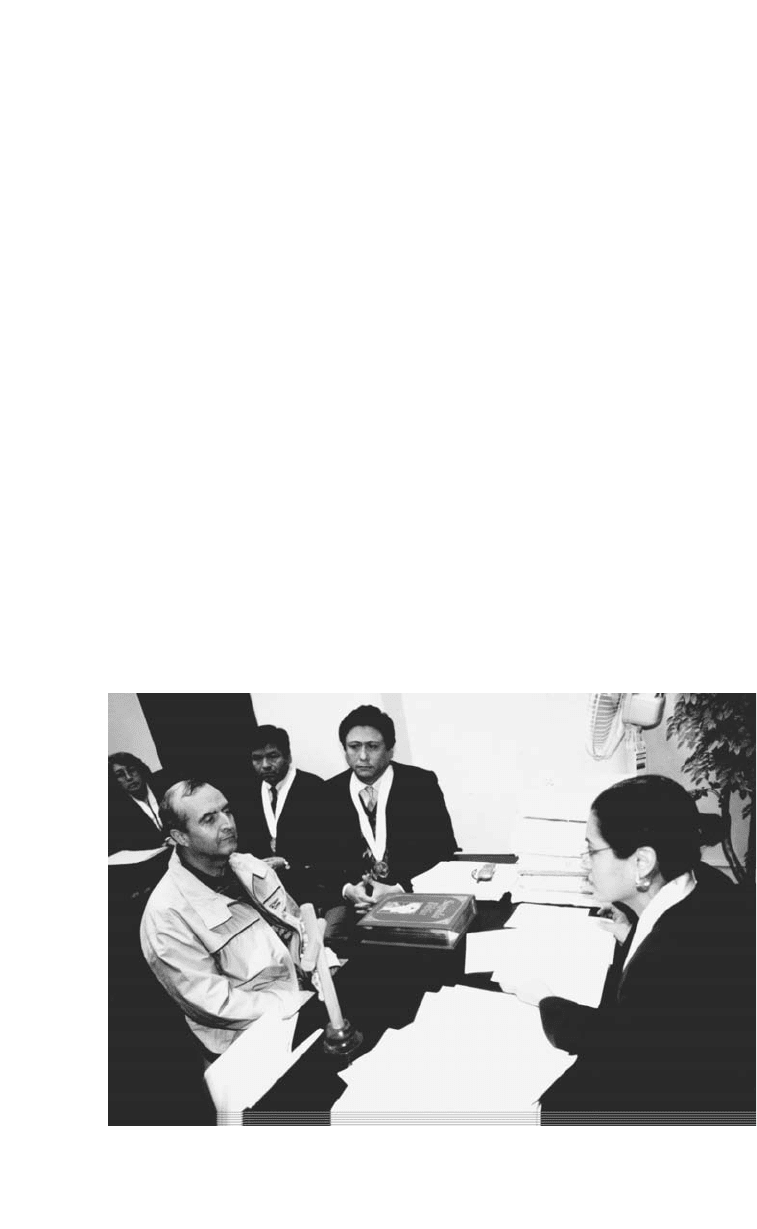
Montesinos was arrested in Venezuela and returned to Peru for trial.
Eventually he was convicted of embezzlement (on relatively minor
counts) and sentenced to prison. Fujimori remained in Japan, which
refused to extradite him, despite his being placed on the most-wanted
The corrupt former head of Peruvian intelligence,Vladimiro Montesinos, at his arraignment
before a Peruvian judge in June 2001 after his capture in Venezuela
(Alejandro Balaguer photo)