
Hunefeldt C., Harris B. A Brief History of Peru
Подождите немного. Документ загружается.

A BRIEF HISTORY OF PERU
234
when prices for export crops were declining and much of Latin America
was pursuing industrialization to replace imports.
In 1972 Velasco dissolved the National Agrarian Society (Sociedad
Nacional Agraria, or SNA), which for decades had been the bastion of
oligarchic political organization, and founded the Peruvian Peasant
Confederation (Confederación Campesina del Perú, CCP) and the
National Agrarian Confederation (Confederación Nacional Agraria,
CNA). The CCP and CNA were top-down organizations designed to
rebuild state–rural sector relations.
General Velasco regarded agrarian reform as a necessary first step
toward more sweeping reforms throughout society, very closely follow-
ing the ideas of Manuel González Prada and José Carlos Mariátegui.
From the beginning the agrarian reform was part of a more ambitious
plan of national development in which agriculture would assume its
traditional role of producing cheap food and labor. In the initial stages
of the agrarian reform in the early 1970s extreme optimists speculated
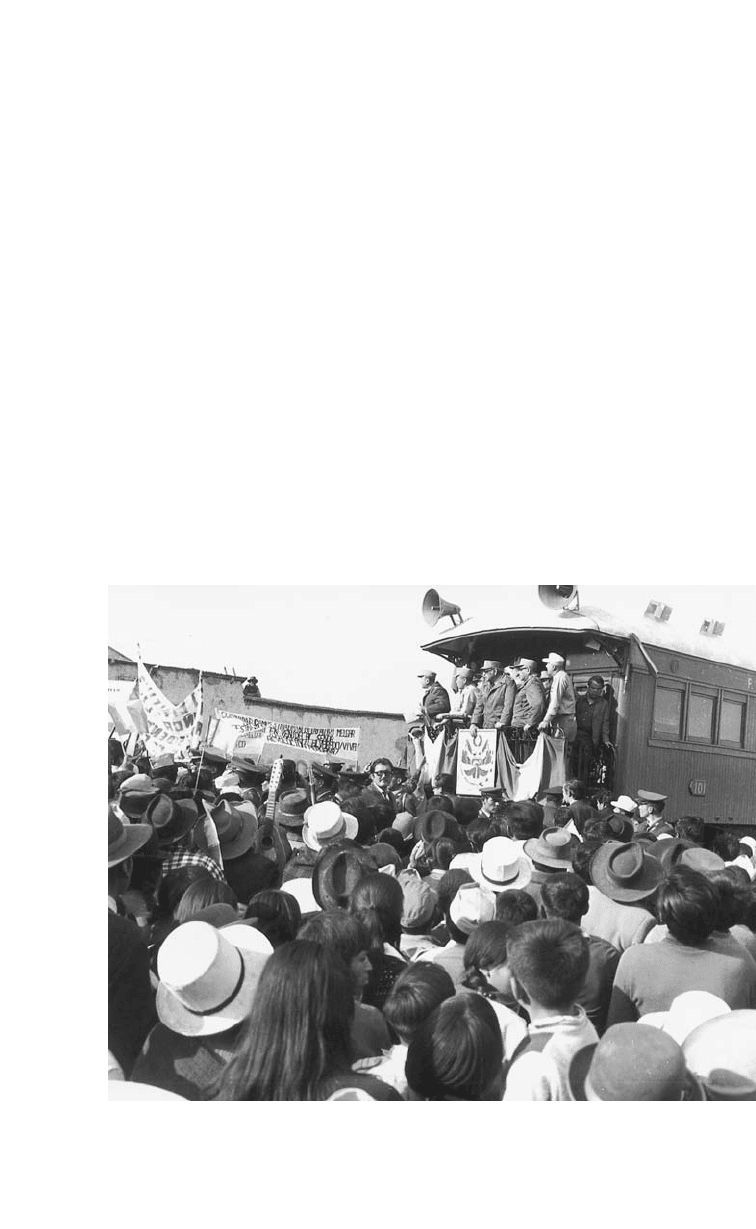
President Juan Velasco Alvarado, leaning on the sign in the center of the railcar, addresses a
crowd of peasants during his agrarian reform campaign in 1972.
(Reproduced with the
permission of the General Secretariat of the Organization of American States)

that export-oriented agrarian production would generate profits high
enough to repay the so-called agrarian debt, thus fueling other invest-
ments, particularly in industry. The 1971–75 plan was based on the
assumption of a 4.2 percent increase of agrarian production. Debt pay-
ments would go to former hacendados, who would then invest at least
half of their revenues in industrial development. Another portion of the
expected profits were meant to repay credits to the state.
As a result of their agrarian reform program the military expected to
gain popular support, destroy oligarchic domination, control conflict
and rural discontent, improve income distribution, stop massive migra-
tion to the cities, and create a stable supply for an expanding internal
market. This was quite in contrast to what actually happened. Very few
of the newly created cooperatives were able to repay accumulated debts.
In most cases debts skyrocketed, production stagnated, and exports
declined. Shortly after implementing the agrarian reform (and follow-
ing a historical pattern) Peru was forced to spend 25 percent of its
annual budget on food imports, in spite of the fact that peasants, small
landholders, and medium-sized entrepreneurs were still producing
cheap food for urban, industrial consumption. Industrial investments,
on the other hand, were utterly nonexistent since the 1960s.
Once again, invoking a glorious indigenous past Velasco sought peas-
ant support for his agrarian reform program. On June 24, 1969, he
expropriated the large modern sugar haciendas on Peru’s northern and
central coast. Previously observed as the holiday Día del Indio (Day of
the Indian), June 24 became known from then on as Día del Campesino
(Day of the Peasant). Large landowners were allowed to retain a maxi-
mum of 20 acres of their irrigated land, or 60 acres if the land did not
have irrigation. By 1979, 3.68 million acres of land had been expropri-
ated, about 30 percent of Peru’s total cultivable land, and expropriation
affected about 16,000 property owners. Expropriation not only included
land, but also machinery, livestock, and industrial installations.
Expropriation went hand in hand with accusations against former
owners, especially if they were known to have mistreated their workers.
Such owners were brought to popular courts presided over by the gov-
ernment. In a few cases former owners were compensated for their lost
properties. If the state recognized a debt toward former owners, it was
often repaid with state bonds at very low interest rates. The government
expected these bonds to be invested in industrial ventures by former
landowners. This never happened, thus the government’s attempts to
expand Peru’s industrialization in tandem with the agrarian reform
failed. Moreover debts to former owners were calculated based on their
235
AGRARIAN REFORM AND THE SHINING PATH

own tax reports; since most landowners either did not pay taxes at all
or had extremely undervalued their properties to evade tax payments,
they received little from the state.
“Land for those who work it” (“la tierra para quien la trabaja”) was
the general goal of the r
eform, consequently the expropriated land went
to some 369,000 peasant families. However, the yanaconas, landless
rural labor
ers, especially in the highlands, who had been laboring on
haciendas on a temporary basis, were excluded even though they were
most in need of land. The management of the new workers’ coopera-
tives was in the hands of state-appointed engineers and administrators.
In spite of its initial success, corruption, lack of foresight, and lack
of technological innovations eventually led to the partial dismantle-
ment of the agrarian reform. To a great extent discontent in the agrar-
ian sector emerged as a result of the unfulfilled promises and
expectations agrarian reform had generated. The flaws of the agrarian
reform and the rural discontent it brought about led to privatization of
land ownership within state-sponsored cooperatives, peasant invasion
of cooperatively managed enterprises, and the emergence of the radical
Maoist Shining Path terrorists. Privatization (basically on the coast)
and the violent confrontations between cooperatives and peasant com-
munities (basically in the highlands) were the outcome.
State control was meant to increase grassroots support; however, it
also had negative consequences, such as corruption, misuse of funds,
regional distortions, and managerial inconsistencies. As production fal-
tered, real and artificial scarcities of basic consumption products for the
urban population became commonplace, and some groups acquired
preferential treatment based on their links to the power structure. Rage
on the part of those left out or whose expectations were raised by the
reforms created a willingness to listen to radicals who promoted terror-
ism and from those who demanded privatization. Response to either
one of these alternatives greatly depended on who and where the lis-
tener was.
Each government following the Velasco regime since 1975 has
adopted differing policies toward the agrarian issue, each in turn tinged
by differing political ideologies and priorities.
Politics and Economics after 1975
In February 1975, amid a strike of the capital’s police forces, Lima was
ransacked. Violence was rampant, and the army was called into action
to stop massive looting. A few months later Velasco was replaced as
A BRIEF HISTORY OF PERU
236

president by General Francisco Morales Bermúdez (1975–1980), a for-
mer minister of economics. The leaders of the ruling military faction
were divided: Some generals wanted to deepen reforms and lead the
country into socialism; others thought that the reforms had gone too far
and that the time had come to return to the barracks. Economic crisis,
social protests, two national strikes in 1976 and 1977, and a general-
ized sentiment of the need to return to democracy led Morales
Bermúdez to establish the Constituent Assembly in 1978, charged with
writing a new constitution that would lead Peru back to democracy and
remove the military from government. The octogenarian Haya de la
Torre became president of the assembly. As such he signed the new con-
stitution a few days before dying, in August 1979.
New presidential elections followed in April 1980, and for the first
time—and without any resistance—illiterate Peruvians (who made up 20
percent of the population) were allowed to vote. A second round of elec-
tions was to take place if none of the candidates obtained a large major-
ity in the first round of elections. It came as a shock to many to learn that
former president Fernando Belaúnde Terry once again won the presi-
dency with 42 percent of the votes, in spite of a long campaign of defama-
tion directed against him after Velasco had literally dragged him out of
the presidency. APRA’s candidate only got 28 percent of the votes, and
Luis Bedoya Reyes, former mayor of Lima, received 11 percent.
After his reelection, Belaúnde Terry led a country that was very dif-
ferent from 1968, the year he was ousted. Immediately after taking
office, Belaúnde Terry decreed the reestablishment of the free press. All
journals and newspapers that had been expropriated by Velasco were
returned to their former owners. In 1980 Belaúnde once again held
municipal elections in order to expand his power into local communi-
ties. His party, the AP (Acción Popular), won the municipal elections,
and for the first time the United Left (Izquierda Unida) came in second
place, ahead of APRA and Bedoya’s party, the Popular Christian Party
(Partido Popular Cristiano, or PPC). The United Left was a conglomer-
ate of various marxist and non-marxist splinter groups under the lead-
ership of Alfonso Barrantes Lingán, a Cajamarca native who was elected
Lima’s first marxist mayor in 1983.
In his second term as president Belaúnde Terry did little to reverse the
reforms implemented by the military, nor did he move them much fur-
ther along. He began urban building projects in a lukewarm fashion, but
he had no funds to do more because interest on Peru’s huge external
debt was eating up revenues. He was faced also with a devastating agrar-
ian crisis (made worse by a strong El Niño weather pattern in 1983) and
237
AGRARIAN REFORM AND THE SHINING PATH

the drain on the economy of the gigantic, wasteful government bureau-
cracy. Moreover, during his second term, two militant guerrilla move-
ments emerged that were to play huge roles in Peruvian history during
the coming years: the Maoist-inspired Shining Path (Sendero Luminoso)
and the Marxist-Leninist Tupac Amaru Revolutionary Movement
(Movimiento Revolucionario Tupac Amaru, or MRTA).
Added to these problems was the effect of Belaúnde Terry’s policy of
easing import restrictions, which resulted in rapidly diminishing Peru’s
money reserves as spending on import goods shot up. The results were
devaluation of the Peruvian currency on the international exchange
market and severe price inflation at home. When Belaúnde Terry took
office in 1980, the exchange rate was 200 soles to the dollar. When he
finished his second term in 1985, the rate was 1,200 soles to the dollar.
Belaúnde Terry’s principal attempt at reform between 1980 and 1985
involved the dismantling of the associative enterprises. A new liberal
political policy of monetarism prevailed during Belaúnde Terry’s second
presidency. Liberal technocrats believed that the only way to increase
productivity was through private ownership. This meant a shift in
focus, from widespread political change and land distribution to a more
narrow concern with better and higher yields. Efficiency, not social jus-
tice, was on policymakers’ minds, and consequently, state subsidies
were eliminated.
In order to incorporate more beneficiaries into the process of agrar-
ian transformation—and thus ease social and political pressure—new
agrarian options were created. Traditionally held communal rights
within peasant communities in the highlands were made more flexible;
that is, land could be sold and/or mortgaged, a move that benefited
richer peasants within the peasant communities and alienated those
who did not have the money to purchase land. Through costly colo-
nization projects a narrow agrarian frontier was expanded into the
Amazon basin. However, this move exacerbated ethnic conflicts. Once
again, attempts to colonize the Amazon basin touched upon traditional
land rights of several Amazonian Indian groups.
In 1981 and 1982 statistics registered an increase in food production.
This was more a result of good weather, however, than of the policies
implemented. A decrease in output followed in the third year of
Belaúnde Terry’s term. Opposition to the government and ongoing
processes in the cooperatives resulted in the first national agrarian
strike and the formation of the United National Agrarian Congress
(Congreso Unitario Nacional Agrario, CUNA). The entire cabinet of
ministers resigned, and new ministers were appointed to office.
A BRIEF HISTORY OF PERU
238

In 1982 Peru had been hit by several natural disasters, and food pro-
duction declined dramatically by 9.3 percent in 1983. In 1984 and 1985
agrarian production increased again, in part because international
development agencies opened new avenues for private capital, espe-
cially on the coast and in the jungle region. Growth came hand in hand
with claims from former landowners to regain the land they had lost in
the early stages of the agrarian reform.
As a result of this turn of events privatization (or parcelization) of the
associative enterprises began—in spite of widespread resistance from
members of the cooperatives and from the defenders of socialist devel-
opment. The government countered this resistance with “agrarian devel-
opmentalism,” an approach based on higher productivity, increased
participation of producers, and broader consensus. Similarly more pri-
vate initiatives to commercialize agrarian production challenged existing
state monopolies.
The Shining Path and Alan García
Belaúnde Terry failed to recognize the potential danger of the Shining
Path terrorist group that rapidly expanded its influence in the face of
official neglect. The group took its name from Mariátegui’s party, which
had changed to the Communist Party of Peru for the Shining Path of
José Carlos Mariátegui. The Shining Path leaders were the children of
highland landowners who had lost their land in the wake of the agrar-
ian reform in the early 1970s, most of them university students and
teachers in provincial universities, mainly in Ayacucho/Huamanga,
where the movement originated. The principal leader, Abimael Guzmán
Reynoso, later known as Presidente Gonzalo, was a philosophy profes-
sor from Arequipa. He and his followers split from the mainline
Peruvian Communist Party and took Maoism as their ideological guide.
The Shining Path’s first violent action was the burning of ballot boxes
in the little town of Chuschi in 1980. Between 1980 and 1984 the group
operated only in the Department of Ayacucho, where it managed to get
a toehold among peasants, some of the poorest in the country. After
1984 it extended its activity to Lima with bombings and blackouts. In
1983 the military launched serious antiterrorist warfare against the
group. In Ayacucho alone it has been estimated that 10,561 people died
between 1980 and 1993, and more than 20,000 in the country overall.
More recent reports estimate about 60,000 in total.
Meanwhile APRA won the 1985 elections, and Alan García Pérez,
only 36 years old, became president with 46 percent of the votes. He
239
AGRARIAN REFORM AND THE SHINING PATH
A BRIEF HISTORY OF PERU
240
became the first elected aprista president and the youngest president in
Peru’s history. His closest opponent, Alfonso Barrantes Lingán of the
United Left (Izquierda Unida), renounced his right to a second round,
and Luis Bedoya Reyes only received 10 percent of the votes.
President García was an indefatigable orator—some Peruvians said
that he continued to sound more like a candidate than a president—but
rhetoric alone did not make for a good government. He managed to
keep the military out of the direct political game, and he also obtained
support from many leftist groups seeking to distance themselves from
the radicalism of the Shining Path. Heterodoxy characterized his eco-
nomic measures. At one time, in an attempt to deal with inflation, his
administration promulgated half a dozen different exchange rates for
differing monetary transactions. Through his monetary reform the
Peruvian sol became the inti (meaning “sun” in Quechua) and 1,000
soles became one inti. García and his prime minister and minister for
economics, Luis Alva Castro, were very successful at managing the
economy during the first two years of his term. Inflation dropped 60
percent per year; growth rates resembled those of the 1950s; and the
Shell Company found a huge gas deposit in Cuzco.
However, the ongoing price controls and fixed exchange rates that
the García administration kept in place led to fiscal deficit. García uni-
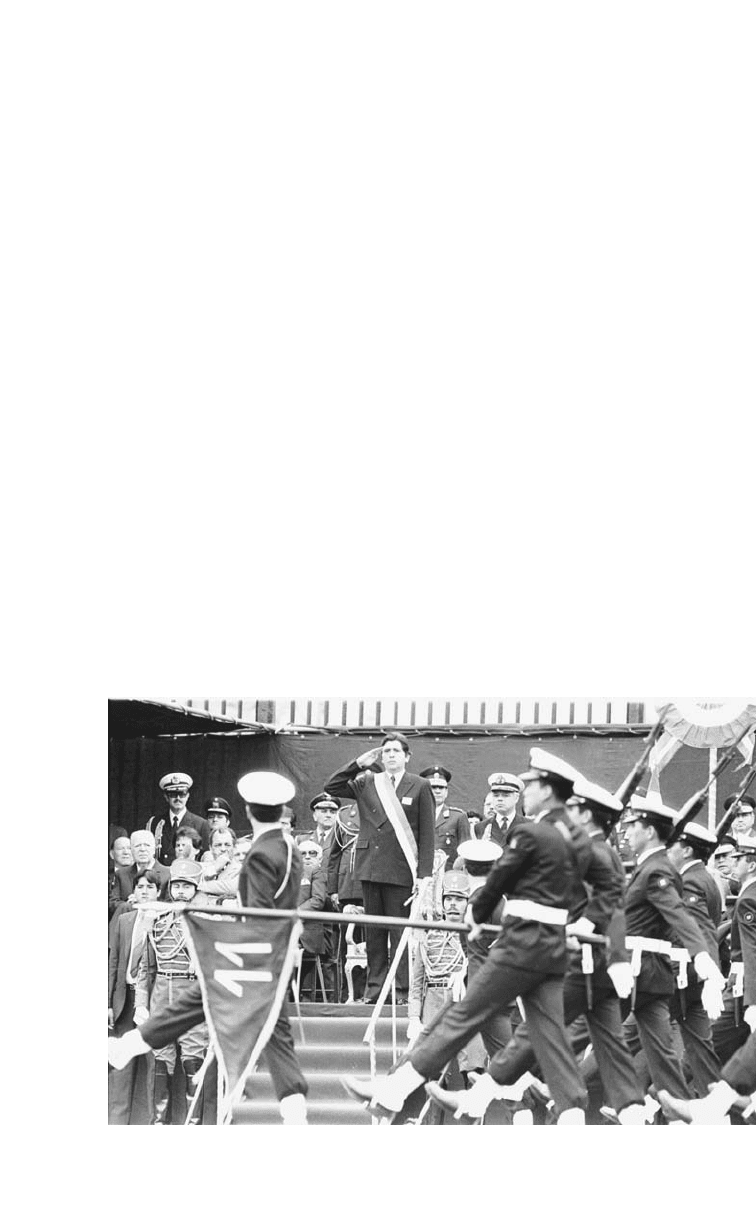
President Alan García Pérez, the first elected aprista presidential candidate and the youngest
president in Peruvian history, is shown here reviewing Peruvian troops.
(Alejandro Balaguer photo)

laterally fixed the repayment of Peru’s external debt at 10 percent of
Peru’s exports, an arrangement that came close to a moratorium on
repayment. Creditor reprisals followed, and Peru was left without lines
of international credit. Both the Interamerican Development Bank and
the World Bank stopped sending money. Peru’s external debt had dou-
bled since the end of Velasco’s regime, up to $20 billion.
In his presidential address in 1987 García announced the expropria-
tion of the banks, claiming that it was the banks that had restrained
Peru’s development by constricting the money supply and limiting
credit. The measure proved largely ineffective, in some cases because
banks sold their shares to their employees. At that point the Peruvian
economy entered a stage of utter confusion; the money needed to buy
a large house in 1985 would only buy a toothbrush in 1990. In 1990,
daily inflation was 2 percent; monthly inflation amounted to 60 per-
cent. The exchange rate soared from 13 intis per dollar to 175,000 intis
per dollar in 1990. Recession, poverty, and the collapse of public ser-
vices followed. Annual per capita income dropped to $997, and the
central bank reserves were down to $105 million.
Amid this economic chaos the Shining Path launched what its lead-
ership considered the final attack against the “fascist state.” By then the
Shining Path had increased not only the number of its followers from
the ranks of public universities, national schools, factories, and shanty-
towns but also its connections with drug dealers in the Amazon basin.
The Maoist guerrillas cashed in money from the drug dealers and also
from factory owners, who were forced to pay protection money in
monthly installments to avoid the bombing of their factories. Factory
owners hired guards to protect their properties, the so-called huachi-
man, a sort of a Spanish phonetic conversion of “watching man.”
Scornfully but not without humor, some analysts said that in Peru at
that time ther
e were three kinds of Peruvians: those who had a job,
those who were looking for a job, and those who watched over those
who had a job. The Shining Path was literally in charge of several
regions of the country, and it also controlled vast areas within the city
of Lima. Selective trials, judgments, and killings were its chosen strat-
egy to intimidate a whole population.
The Shining Path’s increasingly radical strategy led to its gradual
decline. It lost support from peasants in an array of efforts: when it tried
to forbid commercial activities in order to “starve the city,” when it
attempted to expel the church from the countryside, and when it began to
execute local authorities and to confront international aid organizations.
And in a moment of miscalculation the Shining Path lost support among
241
AGRARIAN REFORM AND THE SHINING PATH

urban shantytown dwellers when its terrorists publicly dynamited a
beloved leader, Elena Moyano. Likewise many people in more middle-
class residential areas had given the Shining Path silent support, but in
1988–90 when the terrorists began attacking the residences in these areas,
such people finally gathered in demonstrations against the Shining Path.
The government—that is, the military—reacted with increasing vio-
lence. Since around 1985, thousands of peasants were killed simply
because the day before a couple of terrorists had stopped in a commu-
nity to extort food. In June 1986 when an international socialist con-
gress was taking place in Lima, terrorist prisoners in three Lima jails
staged a mutiny. Following the president’s orders the army entered the
jails and slaughtered inmates, even after the terrorists had surrendered.
Yet this was still not the end of terrorism. Peru seemed on the edge of
an abyss. The police had registered 219 “subversive actions” in 1980; in
1989 the number rose to 3,149. Between 1988 and 1994 about 1 mil-
lion Peruvians—mainly from the middle class—emigrated, heading
especially to the United States. Those who remained took precautions
in case the Shining Path was taking over the country, as did Peru’s
neighboring countries. A national strike called by the Shining Path in
1990 paralyzed the nation.
Privatization and Parcelization
The specific problems of peasant communities were not addressed in
either the first or second periods of agrarian reform. These peasant
communities, approximately 5,000 of them, encompassed more than 1
million minifundistas, or small landholders, most of them with less than
two acres of land. Cooperatives called social interest agrarian associa-
tions (sociedades agrícolas de interés social, or SAISs) were intended to
incorporate peasant communities, but they did so in ver
y limited ways.
And it was particularly in these communities where appalling demo-
graphic conditions were recorded: Life expectancy averaged 46.6 years,
and infant mortality was 145 for every 1,000 births.
In a third phase of agrarian developments, privatization became
more intense when in 1985 APRA’s leader, Alan García, was elected
president. As Velasco had done before him, García put agriculture at the
forefront of his economic policy of national self-reliance. He intended
to provide new stimulation to food production and to incorporate the
so-called Indian regions in the highlands in his policies to reduce Peru’s
dependency on food imports. His plan included a new round of land
distribution, particularly for peasant communities, and economic poli-
A BRIEF HISTORY OF PERU
242

243
AGRARIAN REFORM AND THE SHINING PATH
cies designed to strengthen small-scale producers. His economic policy
package included price controls, state subsidies, credits (in some cases
with negative interest rates), and privileged exchange rates to allow for
the purchase of capital goods in order to improve peasants’ access to
modern technology.
Initially the García government supported and promoted associa-
tive enterprises; however, between 1986 and 1990 it also sponsored
privatization both within the agrarian production cooperatives
(cooperativas agrarias de producción, CAPs) and the SAISs. In 1985
parceleros (owners of small private plots of land within the coopera-
tives) formed the National Association of Par
cel Holders (Asociacion
Nacional de Parceleros, ANAPA), which from its inception defended
private property within the cooperatives and opposed state interfer-
ence altogether. It probably was the first time in Peruvian history
that organized sectors of rural workers directly imposed their will on
a government.
Notwithstanding policy vagaries under García, relative prices tended
to favor agrarian production. Food supply increased and better tech-
nologies became available; however, optimism and progress were short
lived. A decline in agricultural production came in 1987. Budget
deficits reached appalling heights and fueled desperate printing of new
money. Inflation followed, and no more money from abroad entered the
Peruvian economy. Social discontent, delayed payments to producers,
and price increases finally led to strikes in several provinces, including
Puno, Cuzco, Huaraz, and Ucayali. A once-promising interaction
between producers and government came to a standstill. In 1990 a
renewed drought further worsened political conditions.
In 1989 the Board of Agrarian Reform (Dirección General de Reforma
Agraria) claimed that 430 out of 609 associative enterprises had been
subdivided to parceleros. In 234 of the cases, mostly on Peru’s coast, offi-
cial r
ecognition had already been granted; 69 were still being processed;
and 127 had proceeded to divide land with no consultation whatsoever.
Land privatization within the cooperatives had far-reaching conse-
quences. It diminished the associative enterprises’ capacity to produce
enough for urban and industrial needs, for exports, and for the smaller
internal market. Particularly in cotton and sugar production, parceleros’
smaller holdings were not competitive in the international market. The
former members of the cooperatives also lost some of the social bene-
fits formerly guaranteed by the larger enterprises. The loss of social
benefits has been calculated at appr
oximately 25 percent of their real
income. Recreation, infrastructure, health, and education tended to be