
Hunefeldt C., Harris B. A Brief History of Peru
Подождите немного. Документ загружается.

A BRIEF HISTORY OF PERU
224
Such well-intended projects came to an end when the majority bloc in
congress drastically reduced the funds for the agrarian reform program.
More important in its long-term repercussions was Belaúnde Terry’s
commitment to education. Between 1960 and 1965 Peru’s spending on
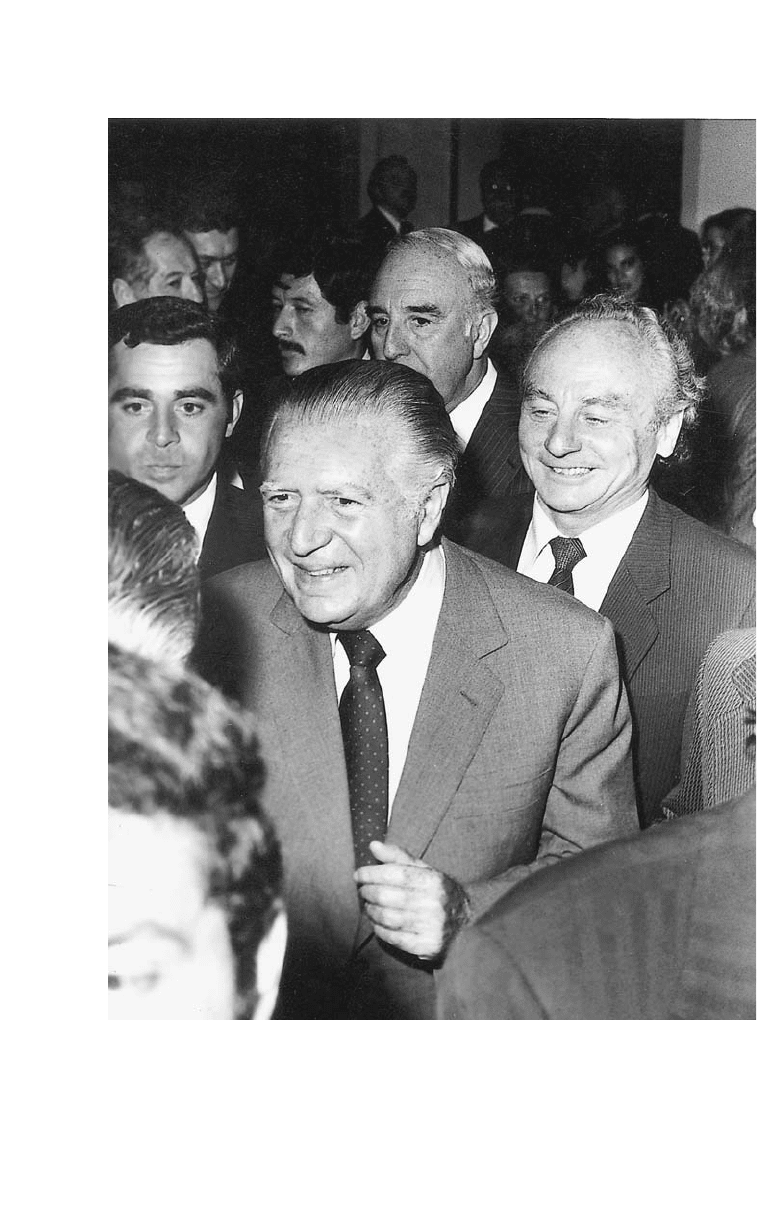
President Fernando Belaúnde Terry, center foreground (Joachim Hunefeldt)

225
DICTATORSHIPS AND REFORM
education increased by 85 percent, representing fully 5.1 percent of
gross national income and 33 percent of the budget, percentages much
higher than the average spending among underdeveloped countries
and close to amounts spent in developed countries. The number of
students increased by 50 percent and the number of teachers by 67
percent; however, educational content deteriorated. More Peruvians
earning a university degree found no outlet for what they had learned
because there were no jobs, and soon education stopped being an
avenue for social mobility. Graduating students became “learned
Land Distribution
in the 1960s
I
n the 1960s land distribution in Peru was more skewed than ever.
Most concentrated land holdings were devoted to producing agrar-
ian exports, whereas the appallingly small amount of land available to
produce food for Peruvians was dispersed. On the coast there were
approximately 40,000 landholders who owned plots of less than 25
acres and 27,000 landholders who had less than five acres. Quite in
contrast there were 181 landholders who held estates of more than
1,250 acres each.
In the highlands around 1960, there were 33,000 landowners. More
than 27,000 of these held farms of 75 acres or less, in an often arid
landscape subject to only seasonal rains and without irrigation sys-
tems. Within this category one-third, or nearly 10,000 landowners,
held less than five acres of land. In addition there was an entirely land-
less peasant population, the yanaconas. They were serfs, allowed to use
small tracts of lands within established haciendas, often no more than
a furrow or two, in exchange for working a certain number of days
throughout the year on the hacienda lands. Differentiation in terms of
land ownership in the highlands was not as marked as on the coast, but
it was dramatic nevertheless. The 1,233 highland landowners who
owned properties of 2,500 acres or more controlled nearly 80 percent
of land under cultivation or used for pasture. From this it seems quite
clear that there was basically no middle ground in Peru’s agrarian sec-
tor. In a different historical setting—France in the late 18th century—
such a dramatic inequality of land distribution had produced nothing
less than the French Revolution (Pike 1967, 312; based on the 1961
Peruvian census).

unemployed”; they were the future leaders of an increasingly more
radical left.
The international context during these years appeared to be promis-
ing for the Belaúnde Terry government. The end results of the Cuban
revolution (1956–59) had awakened nightmares about communism in
the United States, which offered help to American countries through
the recently founded Alliance for Progress, the Salvation Army, and the
International Development Agency. The United States, however, was
relatively hostile toward Belaúnde Terry, and the U.S. State Department
intended to wring guarantees to maintain the favored treatment
accorded to the International Petroleum Company (IPC). IPC held one
of the most favorable concession contracts in the world, a 50-50 profit-
sharing agreement with Peru, at a time when other governments
received 70 percent from foreign oil concerns. Internal pressure in Peru
to renegotiate the terms of the IPC concession—or proceed to expro-
priation—mounted. The Lyndon Johnson administration declined to
cooperate, and the Alliance for Progress funds that Belaúnde Terry’s
government had been expecting never materialized.
During these years the Catholic Church shifted gears. Liberation the-
ology, which emphasized ministry to the downtrodden and dispos-
sessed, replaced conservative clerical stands, and the lower clergy
installed hundreds of comunidades de base (base communities) among
Peru’
s poorest. As late as 1937 Lima’s archbishop had been heard to say,
“poverty is the most certain road to eternal felicity. Only the state which
succeeds in making the poor appreciate the spiritual treasures of
poverty can solve its social problems” (Pike 1967, 313). In contrast
Lima’s archbishop in 1959, Juan Landázuri Ricketts, had this to say
about poverty: “The Church sees that the present economic and social
order must be reformed and improved. . . . A living wage must be paid
to workers and there must be a better distribution of wealth; private
selfishness must be curbed, for there is no longer an excuse of the mis-
erable conditions in which rural labourers and the urban proletariat
live” (Pike 1967, 313).
Actions followed these words. Cuzco’s archdiocese had by 1956
divested itself of much land and sold it at below-market value to rural
laborers. U.S. Maryknoll priests and nuns in Peru’s southern highlands
helped establish credit and consumer cooperatives. By the beginning of
1964 a total of 365 credit cooperatives with 130,000 members from the
poverty-stricken rural regions boasted total savings of approximately
$35 million. Soon bicycles replaced horses and mules in the highlands,
and bike riders held transistor radios to their ears listening to church-
A BRIEF HISTORY OF PERU
226

sponsored lessons in reading and writing and culture, hygiene, sanita-
tion, or agricultural methods in Spanish, Aymara, and Quechua.
During these years Peru’s military redefined its role in society.
Instead of being the repressive arm of the state, it now aspired to help
the country achieve social and economic betterment, a goal that met
wide applause. The Center of High Military Studies (Centro de Altos
Estudios Militares, CAEM) had been established under the Odría
administration (1950–56). Military and civilian professors taught a
large variety of subjects but concentrated on identifying Peru’s prob-
lems and suggesting solutions. The CAEM produced some of the most
expert plans for future development. At the same time the military was
somewhat “democratized,” and army officers and soldiers were engaged
in dozens of development projects, advising with technological exper-
tise. Belaúnde Terry greatly contributed in redesigning the mission of
Peru’s military, and he sent many military officers, at government
expense, to study abroad and learn what they needed to participate in
the agrarian reform program.
In some regions agrarian reform was preceded by guerrilla move-
ments rumored to have had support from Cuba and the Soviet Union.
Guerrillas, operating on rugged terrain, had considerable nuisance
potential and managed to occupy some of the larger haciendas in the
regions where they operated. In Cuzco, aprista militant Luis de la
Puente Uceda and Trotskyist Hugo Blanco or
ganized a guerrilla group,
the Movement of the Revolutionary Left (MIR) in 1965, and Guillermo
Lobatón did something similar in the central highlands, founding the
Tupac Amaru group. For the first time in Peru’s history peasant unrest
encompassed the whole country. Peasants invaded haciendas, often pre-
ceded by a music band and holding a Peruvian flag, and began a well-
organized strike. As a result peasants came to control hundreds of
thousands of acres of land. For the time being the Peruvian government
was powerless to stop the popular movements. By the 1960s many peo-
ple in Peru, as well as some observers in the United States after the
Cuban revolution, understood that social structures needed to change
to prevent violent explosions. Notwithstanding these changing percep-
tions it was with U.S. help, bombardments of napalm, and the hesitant
intervention of Peru’s military, that the guerrilla movement was sub-
dued between 1965 and 1966.
In spite of growing internal unrest the Peruvian state continued eco-
nomic policies first implemented by Odría, and macroeconomic indica-
tors showed progress. Between 1950 and 1965 direct U.S. investments
in mining grew 379 percent; in nonmining ventures U.S. investment
227
DICTATORSHIPS AND REFORM

grew 180 percent, whereas in the rest of Latin America it grew only 111
percent. Only Mexico experienced higher direct U.S. investment.
Foreign investors owned 100 percent of Peruvian oil and iron produc-
tion, and foreign ownership of other industries was likewise significant:
copper up to 80 percent, zinc to 67 percent, fishing 30 percent, and
sugar 23 percent. In 1968 the U.S. Anderson Clayton firm controlled 83
percent of cotton exports. That same year 12 of the most important U.S.
corporations held 54 percent of Peru’s 10 most important export prod-
ucts. A similar situation existed in banking. By 1966 money held by for-
eign capital amounted to 62 percent. It has been calculated that the
Peruvian state subsidized foreign investments with about 10,000 mil-
lion soles, or 75 percent of public spending, in 1963.
A severe economic crisis in 1967 was the beginning of the end. The
coast suffered from a persistent drought, dollar reserves were close to
nothing after several years of external commerce deficits, foreign
investments had diminished, and the sol was devalued from 27 per dol-
lar to 39 per dollar. Fiscal crisis translated into increased taxes, the ces-
sation of public works, and—once again—increasing unemployment
rates. Peru’s external debt had grown from $237 million to $685 million
between 1963 and 1967.
Opposition parties, which were increasingly more divergent, used
the crisis to anticipate the 1969 elections by further discrediting
Belaúnde Terry’s government. However, this often senseless and
unfounded opposition had another effect: It completely discredited the
entire political system. A page (“escándalo de la página once”) fr
om a
new contract with IPC was literally lost. Allegedly, because it contained
clauses that transferred national wealth to a foreign firm, and the acute
political crisis resulting from the ongoing confrontations between the
legislative and executive branches brought the military back to power
in 1968 with General Juan Velasco Alvarado.
This time around, reforms would not be directed at isolated peasant
communities or untouched regions. A national awareness had grown,
and it was multiplied by technology. In the late 1960s transistor radios
had reached the hands of peasants in villages and rural migrants work-
ing in domestic service in Lima. Bicycles had replaced mules, and
trucks connected a vast and varied territory, despite insufficient roads.
More newspapers circulated with more ease within and among towns,
cities, and regions. Technology brought people closer and made the
exchange of ideas more fluid. More information led to a heightened
sense of shared problems, creating a political consciousness and a
nationalization of Peruvian culture.
A BRIEF HISTORY OF PERU
228

13
Agrarian Reform and
the Shining Path
(1968–1990)
T
he military dictatorship under General Juan Velasco Alvarado
(1968–75) launched a large-scale agrarian reform movement that
would have wide and long-lasting effects on modern Peru. Despite what
might have been expected of military rule, Velasco’s government
embraced left-leaning policies and took over or expropriated nearly all
major segments of the Peruvian economy. It attempted to redistribute
the land, thereby hoping to break Peru’s traditionally inequitable pat-
tern of land holding and thus the hold of the traditional oligarchy. The
1968 coup was in a sense the continuation of the self-redefined role of
the military. National strategy rather than military strategy was the
theme of the day, and what Peru’s military leadership envisaged was a
“socialism from above” in order to prevent “socialism from below.”
Unfortunately the nation again went bankrupt, this time due to the
costs of agrarian reform. Moreover, parcelization and the process of
expropriating and redistributing land led to a series of unexpected con-
sequences. Renewed attempts at land reform under APRA’s first elected
president, Alan García, only exacerbated conditions, stimulating vio-
lent response in the form of the Shining Path guerrilla movement.
The Corporatist State and Populism
Velasco encountered a dismal situation when he took over in 1968.
Between 1940 and 1961 Peru’s urban population had grown three times
as much as the rural population. During the following decade the urban
population grew 10 times as much as the rural population. Rural pop-
ulation growth almost came to a standstill. The reasons for this stagna-
tion were twofold. On one side the Peruvian government fostered
229

A BRIEF HISTORY OF PERU
230
industrialization, and in doing so it tried to create a cheap industrial
labor force. To reduce the cost of labor meant to decrease food prices so
the labor force could survive despite low wages. On the other side tech-
nological changes and state subsidies to food production in the United
States and Europe had turned these countries into exporters of food
after World War II, and Peru readily imported from them. Peru’s high-
land agriculture, with its rudimentary technology and vulnerability to
international market prices, could not compete with these increasingly
cheaper food imports. Some statistics document this process. Between
1954 and 1959 per-capita income on Peru’s coast grew 4 percent; in
Peru’s highlands it decreased by 7 percent. Between 1960 and 1969
gross national income grew by 350 percent, but agriculture in the high-
lands decreased its participation in the gross national income from 14
to 11 percent (Cotler 1978, 284–286). These circumstances forced
thousands of peasants to migrate to the cities, especially Lima, and
made Peru thereafter dependent on food imports.
During the preceding decades Peru had lagged behind other Latin
American countries with populist governments that had implemented
industrialization substitution policies and agrarian reform projects.
Lázaro Cárdenas in Mexico, Getúlio Vargas in Brazil, the Popular Front
party in Chile, and even Víctor Paz Estenssoro in Bolivia had been
active. In a sense Velasco wanted to catch up with history by engaging
in long-overdue reforms: a radical agrarian reform; a reform of Peru’s
enterprises by which he meant to turn over 50 percent of firm shares to
its workers; the nationalization of mining, fishing, and banking; educa-
tional reform; designation of Quechua as Peru’s second official lan-
Lima’s Unbridled Growth
W
hereas in the early 1940s about one-fourth of Peru’s population
lived in Lima, by 1970 half of Peru’s population lived in Lima, and
most of its inhabitants came from Peru’s most economically devastated
rural provinces. Lima became “Andeanized,” or as some put it
“Indianized.” There were few jobs for this massive influx of migrants,
and low-level self-employment and the often violent occupation of land
in Lima’s outskirts were the migrants’ solutions. Lima’s dramatic radial
growth was not guided by urban planning, and most newcomers to the
city had no water, no sewage, no electricity, and no roads.

guage; and organization of folklore festivals (Inkarri) together with a
reevaluation of Peru’s historic Andean figures, such as Tupac Amaru II.
Changes were undertaken from above and guided by the military
maxim that orders were to be obeyed, not discussed.
Velasco’s military government, self-labeled the Revolutionary
Government of the Armed Forces (Gobierno Revolucionario de la
Fuerza Armada), designed a government program called the Plan Inca.
By it the government intended to find a route of development for the
country that would be neither communist nor capitalist, a sort of state
capitalism with social redistribution to benefit the poorest in the coun-
try. The military was very much aware of who these poor were, both
because they had been engaged in development projects and because
soldiers for the army were drafted from all over the country. The sons
and daughters of rich people could pay to excuse themselves from
obligatory military service, but few sons and daughters from lower
income groups could do the same. Velasco himself was born in Piura in
1910 to a lower middle-class family, and he attended public school and
joined the army as a simple soldier.
To gain popular support Velasco created new union organizations for
peasants, students, workers, and professionals, such as the Central
Bureau of the Peruvian Workers Confederation (Confederación de
Trabajadores del Perú, CTP), the National Agrarian Confederation
(Confederación Nacional Agraria, CNA), and a state-sponsored entity
designed to mobilize popular groups referred to by the initials
SINAMOS. SINAMOS was short for Sistema Nacional de Apoyo a la
Movilización Social (National System of Social Mobilization) but some
also read it as sin amos, that is, “without masters,” underlining the rel-
ative independence of this entity. While mobilizing the masses Velasco
also silenced opposition voices. Congress remained closed; the
Supr
eme Court was supplanted by the Council of Justice (Consejo
Nacional de Justicia); and political parties and the free press were sup-
pressed. In spite of his dictatorial measures, Velasco counted on the
support of many prominent intellectuals and social scientists, many of
whom had been students at Lima’s San Marcos University during the
reform-oriented 1950s. Velasco’s policies were soon labeled in the
United States as the “Peruvian experiment” and in the Soviet Union as
“Peruvian socialism.”
Following his economic plan Velasco began extensive expropriations
of what the government considered strategic resources, beginning with
the oil fields in Talara; then the Cerro de Pasco Mining Corporation and
the Southern Peru Copper Corporation, with a total of 21,000 workers;
231
AGRARIAN REFORM AND THE SHINING PATH

and next the fishing industry. Huge public enterprises replaced these
privately owned enterprises, and all had mammoth administrative
headquarters in Lima.
A similar pattern applied to the distribution of what was produced.
The state became involved in the marketing and distribution of the prod-
ucts coming from these new public enterprises. More state-appointed
administrators had to be put in place to control the distribution of goods.
Moreover, maritime transport, the airlines, communications, energy, tele-
phones, and rail lines now became the property of the state or state-con-
trolled corporations. Only one bank, the Banco de Crédito, escaped
expropriation. Smaller industrial enterprises, not deemed to be strategic,
were reorganized.
According to Velasco’s plan, these enterprises were to become
“industrial communities,” in which workers became shareholders and
participated in the enterprise’s management and profits, or they might
directly become a “social property enterprise,” owned by the workers.
Surprisingly, public enterprises showed higher levels of efficiency than
the private enterprises did. By 1977 the public sector produced 50 per-
cent of the gross national income.
The overarching move toward industrialization was implemented
through import substitution policies, begun belatedly (compared with
other Latin American countries) in 1969 and meant to gradually
replace imports by national produce. Some imports were subjected to
high taxes; other imports were forbidden. The success of these policies
was uneven. Whereas, for instance, industrial production of stoves and
refrigerators prospered, domestic car assembly proved to be a disaster.
Internationally Velasco’s regime aligned with a pattern of leftist
regimes in Latin America: Salvador Allende was Chile’s president; the
Peronist Héctor Cámpora governed in Argentina; and Fidel Castro
was leader of Cuba. This leftward tilt brought Latin American coun-
tries closer to the Soviet Union and the Eastern European countries.
Soviet tanks and planes, Romanian buses, motorcycles from
Czechoslovakia, and medical equipment from Hungary and Cuba
reached Peru. Peru became one of the strongest voices for nonaligned
countries in the world.
Possibly Velasco’s most important success was the opening of politi-
cal opportunity for all Peruvians by expanding political participation.
In 1968–73, Peru ceased to be a country ruled by a powerful and back-
ward-looking minority. The agrarian reform programs, backed by the
reform of the educational system, nourished this heightened level of
political participation.
A BRIEF HISTORY OF PERU
232

233
AGRARIAN REFORM AND THE SHINING PATH
Agrarian Reform
Peru, as seen earlier, has a very diverse and heterogeneous countryside.
No simple reform model could encompass traditional haciendas, large
coastal plantations, peasant communities and communal property, and
small landholdings in the highlands. Even within each region (coast,
highland, Amazon basin) the rural landscape showed striking differ-
ences. What most rural sites had in common, though, was a process of
land concentration, resulting in an uneven land distribution. Three-
quarters of the cultivable land was controlled by one-half of 1 percent
of Peru’s population. Many peasants did not have enough land to feed
their families. For a long time Peru’s complex land patterns and the
power of large landowners frustrated reform. By the early 1970s, how-
ever, the government could no longer close its eyes to the plight of a
vast majority. Conditions seemed ripe for change.
The model used to unleash change was the associative enterprise, in
which former salaried rural workers and independent peasant families
would become members of different kinds of cooperatives. The military
government was ready and willing to invest huge amounts of money to
transform Peru’s agriculture to socialized ownership and management.
These state expenditures explain in some measure the enormous
increase of Peru’s external debt at the beginning of the 1970s. State
bankruptcy was partly caused by the cheap credit the government
extended to promote agrarian development, state subsidies, and admin-
istration expenditures to carry out the agrarian reform during a period
Reform Successes
C
ritics abounded when the agrarian reform was first implemented.
Statistics show that the agrarian reform had some success, how-
ever, not only in creating a wider political consciousness but also in eco-
nomic terms. A total of 2,889 units of production, involving 429,384
beneficiaries (roughly 30 percent of all peasants and agrarian produc-
ers), were allocated almost 4 million acres of land (out of a total of 9.3
million acres).About 40 percent of the economically active population
was directly or indirectly affected by the agrarian reform. In no other
country in Latin America and in few countries anywhere in the world
was land distribution so far reaching, not even in those places—such as
Castro’s Cuba and Allende’s Chile—where socialist governments were
in power.