
Hunefeldt C., Harris B. A Brief History of Peru
Подождите немного. Документ загружается.


neglected, unless some other forms of cooperation replaced privatiza-
tion tendencies.
Another important consequence of parcelization was the narrowing
of the labor market. Prior to parcelization, cooperatives provided tem-
porary and even permanent jobs to migrants from the cities and the
highlands. Migrants sold their labor much as they had done while the
haciendas still existed. The cooperatives employed a huge pool of tem-
porary, landless workers. But parceleros tended to prefer family labor in
order to r
educe labor costs.
Overall parceleros suffered from the same economic situation the
associative enterprises had to face but at an earlier stage: fluctuating
international prices, contr
olled internal prices, credit problems (both
with state banks and private capital), inefficient systems of distribution
resulting from an overabundance of intermediaries, delay in payments
coming from state agencies, and the lack of storage facilities.
Around 30 percent of the parceleros were concentrated in the coastal
provinces of Lima, Cañete, Huaral, Chillón, and Huaura. The
Depar
tments of La Libertad, Cajamarca, Piura, and Lambayeque—also
A BRIEF HISTORY OF PERU
244
The Disruption of
Rural Life
P
olicy shifts—from the socializing efforts of Juan Velasco Alvarado
to the market-oriented efficiency criteria of Fernando Belaúnde
Terry and the heterodox approaches of Alan García Pérez—deeply dis-
rupted rural processes, leading to growing distrust of the government
by the rural population. Over the years the state lost control.
Governmental policies had moved from strict state intervention to a
complete absence of the state in rural affairs.Two different processes,
which caused and at the same time were a consequence of state action,
intensely marked the rural landscape throughout these years. The first
was the privatization process in the big associative enterprises, con-
centrated but not exclusively located on the coast.The second was the
invasions of the social interest agrarian associations (SAIS) by peasant
communities in the highlands. Both processes reflect the state’s incom-
petence and laissez-faire attitude, the result of which were the emer-
gence of the Shining Path guerrilla movement and the increasing
mobilization of rural interest groups, including peasants.
245
AGRARIAN REFORM AND THE SHINING PATH
with large coastal areas—constituted a second region with important
levels of parcelization. In these areas the average property size per fam-
ily was 2.67 acres of highly fertile land. Thus, in terms of land redistri-
bution, the process of parcelization may have been even more
important than agrarian reform itself.
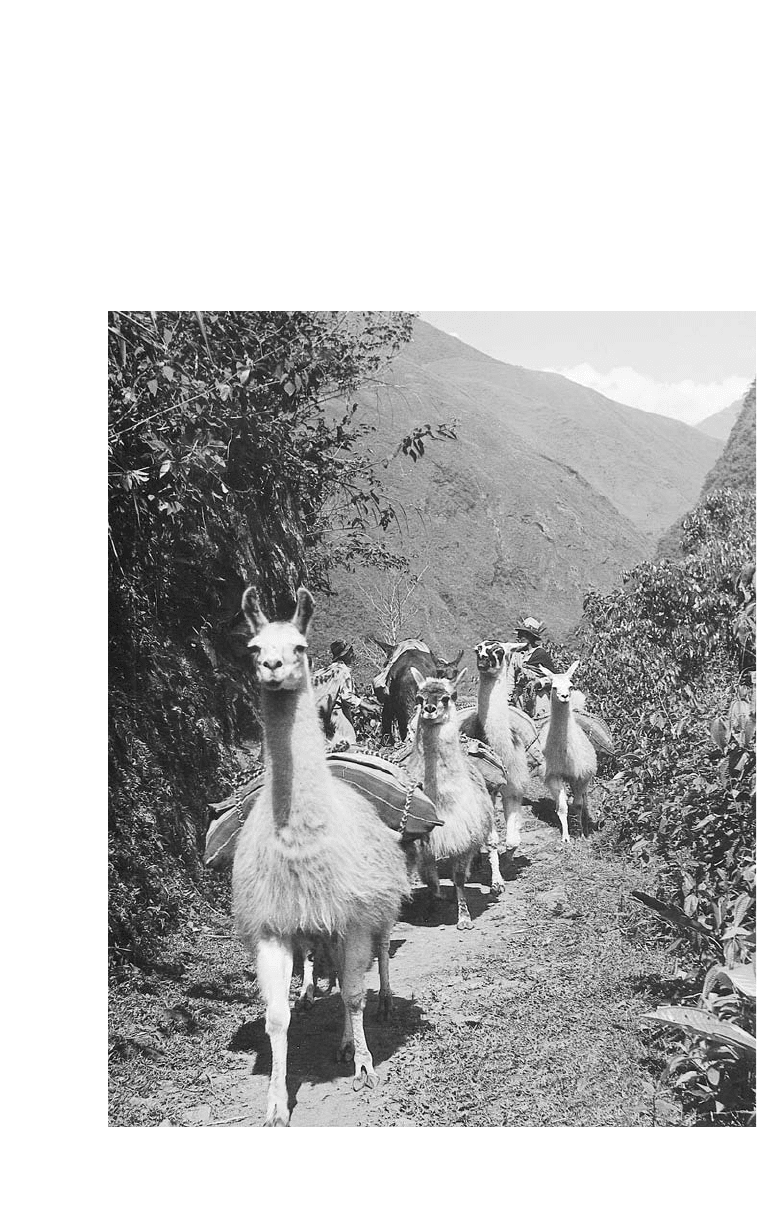
Many peasants in rural Peru still rely on llamas for both transportation and for their wool.
(Reproduced with the permission of the General Secretariat of the Organization of American States)

Yet even optimists recognized that there were limits to the capacity
of parceleros to expand production. As demographic pressure increased,
land fragmentation seemed to be unavoidable, given the limitations of
alternative means of subsistence. As soon as a parcelero’s property was
legalized—meaning that the state r
ecognized his or her property and
extended property rights—the parcelero was entitled to sell and divide
land. W
ithout official recognition property rights remain blurred, ham-
pering transactions to transfer landed property. The land market
remained restricted and state credit was not available without official
recognition. Control over official recognition and credit gave the state
some say in the viability of associative enterprises and the emerging
new patterns of land distribution.
In spite of the drawbacks of parcelization in Peru’s rural landscape,
there were some positive developments born out of this process. Having
experienced the benefits of cooperation, coastal peasants and small
landholders knew that there were social services and tasks that could
not be obtained through individual efforts. As a result many parceleros
began new cooperative efforts aimed at joining forces to achieve better
schooling, health ser
vices, and infrastructure, and the active agent was
the individual agrarian producer, not the state. This movement brought
the practices of coastal parceleros close to what peasant communities in
the highlands had been doing for centuries.
In several pr
ovinces cooperatives were diversified. The formation of
loosely defined organizations such as users’ agrarian cooperatives
(cooperativas agrarias de usuarios, CAUs), workers’ agrarian coopera-
tives (cooperativas agrarias de trabajadores, CATs), permanent agrarian
workers’ enterprises (empresas de trabajadores agrarios permanentes,
ETAPs), and even new peasant communities suggested a willingness to
solve problems that reached beyond the organizing capacity of smaller
units of pr
oduction or of individual producers. More than 200 CAUs
were founded throughout the country, and 80 percent of these even had
communal lands, which served for the payment of common services
and sometimes included land that could not be subdivided. Each new
entity defined its own commitments. Thus, after subdividing land, new
and original processes of cooperative reorganization were visible. In
some cases these new processes demonstrated great success in solving
managerial problems.
On the political front, though, parcelization produced polarization.
Although initially the National Agrarian Organization (Organización
Nacional Agraria, or ONA), the organization that included both
medium-sized and large landowners, favored the formation in 1985 of
A BRIEF HISTORY OF PERU
246

ANAPA for small landowners as a means to strengthen privatization
efforts, over the years the organizations came to stand for two distinct
ideas of desirable agrarian development: a rural sector populated with
small producers or a countryside in which market forces determined
the size of landed property. Although many seemed to believe the
answer was in small producers, in many places a new process of land
concentration had begun.
Conflicts in the Highlands
Parcelization basically occurred within CAPs located in the coastal
region. This agrarian reform was less significant in the highlands, where
the most heterogeneous rural landscapes were found, as opposed to on
the coast, where it intervened on behalf of salaried laborers by giving
them first access to production decisions and later control of land itself.
In the highlands agrarian reform was basically a result of ongoing fights
between community peasants (comuneros) and hacendados. Peasant
communities and agrarian workers, many of them laboring under
sharecropping arrangements, had been struggling for contr
ol of land
with hacendados and the big agro-industrial owners for decades. The
solution proposed by the government was to create SAIS agrarian coop-
eratives. These were aimed at consolidating enterprises on expropriated
haciendas by incorporating their labor force and the surrounding peas-
ant communities.
But in some highland regions agrarian and other progress, if any,
became impossible to track systematically. Peru’s central-southern
departments (such as Ayacucho, Apurímac, and Andahuaylas) became
closed to outside scrutiny because of the presence of the Shining Path.
Beyond general indicators and anecdotes little was known about the
region, and peasants there were victims both of the Shining Path and
military repression. Where the Shining Path controlled production no
links to the market existed, and links to the state were more tenuous
than ever. The only outside force present was the military. Many people
fled, or were killed—although no one knows for sure how many. The
peasant communities and small landholders of the highlands were not
only neglected by the agrarian reform but had never had political rights
in preceding centuries. It was among these producers and in their name
that the Shining Path started its terrorist activities. Only then did these
regions move to the center of political attention.
The diversity of change in the highlands and its results may be illus-
trated by looking at three quite distinct regions of Peru’s rural highlands:
247
AGRARIAN REFORM AND THE SHINING PATH

Cajamarca (in the northern highlands), Puno (in the southern highlands
on the frontier to Bolivia), and Junín (located in the central highlands).
Cajamarca was modernized before the advent of agrarian reform
through links to sugar production in the coastal departments of La
Libertad and Lambayeque. By 1972 Cajamarca had one of the highest
average plot sizes per household in the highlands: 0.64 acres—about
five times more than in Ayacucho and other highland regions. Between
1940 and 1981 the rural population decreased only from 86 percent to
79.8 percent. Nearly 3 percent of all the communities incorporated into
the new SAISs were located in Cajamarca. By 1988, 70 percent of the
agrarian enterprises had undergone parcelization in Cajamarca, follow-
ing the existing trend toward small holdings with high levels of pro-
ductivity. With a predominantly mestizo population and few peasant
communities, conflicts in this region were almost nonexistent.
In contrast to Cajamarca, Puno and Junín accounted for 25 percent
of all peasant communities in Peru. Internal organization of Puno’s
haciendas varied depending on market proximity and labor availability.
In general the haciendas had undergone a very slow process of mod-
ernization. Only a few were successfully integrated into expanding
wool export markets. Generations of hacendados had divided land
among many heirs or had sold it to other landowners and even peasants
before the agrarian reform. Thus the hacienda system in Puno and
Junín—quite in contrast to coastal haciendas and Cajamarca’s hacien-
das—had already been weakened. Under agrarian reform the larger
remaining haciendas were merged into new administrative units.
Puno had the highest percent of family beneficiaries through the for-
mation of SAISs between 1971 and 1988. There, 76 peasant communi-
ties received 18,800 acres, which represented 11.7 percent of all the
land given to peasant communities in Peru. In Puno, prior to the agrar-
ian reform, peasant communities and smaller communities called par-
cialidades controlled 19.5 percent of the department’s land. After
agrarian reform this per
centage jumped to 30 percent. The large asso-
ciative enterprises controlled 49 percent of the land, and medium-sized
properties accounted for the remainder. Inside the peasant communi-
ties land was divided among families. Thus, in spite of the increase of
available land, a tacit and rapid parcelization occurred. Annually 13.3
percent of peasant families left the region. This was the highest out-
migration rate nationwide. Average plot size in Puno’s peasant commu-
nities was less than one-sixth of an acre. Natural disasters periodically
accentuated poverty so that even those peasant communities that were
part of associative enterprises suffered.
A BRIEF HISTORY OF PERU
248

The result was an ever-escalating conflict with SAISs over land. Even
before the government intervened to solve the land problem, SAISs had
already given away 7.8 percent of their lands to peasant communities by
1982. García’s government recognized the tensions between SAISs and
peasant communities, and engaged in a thorough restructuring process.
When the restructuring process began between 1986 and 1987, 44 agrar-
ian enterprises came under scrutiny, and anticipating government inter-
vention, peasant communities invaded SAISs without official permission.
On a national level only 6 percent of all legally recognized peasant
communities participated as members in SAISs. Given the low partici-
pation of peasant communities in SAIS and CAPs, many demands for
hacienda lands (which were typically the most fertile in the respective
areas) forwarded by peasant communities remained dormant. Given
these patterns it is not surprising that conflicts arose between new asso-
ciative enterprises and peasant communities.
The few peasant communities in Puno and Junín that gained access
to land in the new SAISs soon encountered problems in their relation-
ships with SAIS management. Typical of Puno was the vía huacchillera,
a traditional cattle-raising pattern by which workers on former hacien-
das, sometimes linked to surrounding communities, would graze their
own cattle on the haciendas’ pastur
e lands. The incorporation of more
community members into the SAISs meant that more cattle had to be
fed than the meager pasture lands could supply. Soon the new SAISs
found themselves confronted with excess labor and declining salaries,
thus provoking conflicts between ex-hacienda laborers and community
peasants. Similar longstanding disputes over land between the former
haciendas and peasant communities had not been solved prior to the
creation of the SAIS. These quarrels made concerted action in the SAIS
practically impossible. Furthermore these disruptive forces acted as an
invitation to the Shining Path. In siding with one of the contending par-
ties, the Shining Path elicited new political loyalties.
Long-term changes in Junín were less dramatic. The reform created
cooperatives in which much of the haciendas’ former internal organi-
zation was retained, and even administrative personnel continued in
charge after 1969. This provided a line of continuity in management
going back to the 1920s. In contrast to conditions in Puno haciendas in
Junín were prosperous and intensely linked to coastal markets.
Nevertheless, even in Junín demographic pressure steadily increased. In
some peasant communities annual population growth was 2.69 per-
cent; average size of plots was less than one acre and sometimes less
than one-half acre. Junín peasants were doomed to look for alternative
249
AGRARIAN REFORM AND THE SHINING PATH

sources of income: commerce, artisanry, labor in Huancayo and Lima,
or work in the cooperatives.
In Junín pressure was exerted by peasant communities in SAISs
searching for changes in entrepreneurial leadership. The state proposed
that communal and multicommunal enterprises should be constituted
on the lands of the SAISs, thus strongly linking peasant communities to
the associative enterprises. In Puno pressure originated in peasant com-
munities that were not part of the agrarian enterprises, and changes
were forced through invasion.
Reactions in the three highland regions, thus, very much depended
on the kind of relationships that had developed between small produc-
ers and haciendas and among small producers, haciendas, and peasant
communities. In Cajamarca the hacienda system was firmly consoli-
dated, small producers had reasonable portions of land, and peasant
communities were almost absent. Parcelization thus followed a long-
term pattern of small landholding in the region. In Puno the haciendas
were in decay, and peasant communities were strong but had few
resources and many open litigations with former haciendas over
boundaries and land. The result was violent conflicts between the asso-
ciative enterprises and surrounding peasant communities. In Junín
modern haciendas and peasant communities had found ways to coex-
ist. Coinciding interests made the peasant communities’ incorporation
into SAIS a relatively smooth process. This was further facilitated by the
fact that associative enterprises in this region were—at least in their ini-
tial stage—economically successful. Conflicts in Junín resulted from
mismanagement. These very broadly described regional disparities had
their origins in disparate regional histories and would in the following
decades lead to different political options and viewpoints.
A BRIEF HISTORY OF PERU
250

14
New Structures
and Fujimori
(1990–2003)
A
grarian reform had long term effects on many of the basic power
relationships and political structures in Peru. Recent years have
witnessed widespread and fundamental shifts, although the nature and
ultimate direction of these shifts have seldom been clear to observers.
The emergence of ultraviolent groups, such as the Shining Path and
MRTA, had a dramatic impact on the nation, as did the election of
Alberto Fujimori (1938– ) in 1990 and his 10 years of increasingly
dictatorial rule.
Drift Toward New Structures
Agrarian reform, political violence, and government macroeconomic
policies radically changed rural Peru between 1990 and 2003. New
political and economic pressures were brought to bear on rural areas,
and many of the traditional political structures changed in response. In
the past workers on the big coastal plantations were organized either by
APRA or by parties of the Left. In the wake of agrarian reform of the
1980s, workers had learned patterns of cooperative entrepreneurial and
labor organization from state-created institutions such as the associa-
tive enterprises. They had become parceleros with their own political
or
ganization, ANAPA, whose goals were improvement and progress for
the parcelero, not just growth. In spite of all its internal disagreements
and sometime chaotic behavior
, ANAPA aimed to facilitate alliances
between industry, agriculture, and ranching. The importance of this
small and medium-sized peasants’ organization grew to the extent that
1990 presidential candidate Mario Vargas Llosa optimistically believed
that parceler
os could be a significant source of support for his campaign.
251

The 1990 elections proved otherwise. The election of ANAPA’s founder
and leader, Germán Gutiérrez Linares, as a deputy for Lima’s provinces
on the leftist coalition ticket of Izquierda Unida demonstrated that
political manipulation in the countryside was no longer easy.
CAPs, SAISs, and ETAPs continuously reexamined their internal
organization and, as a result, changed the ways in which their members
were represented and their interests defended against external pres-
sures. Mixed cooperatives that tended to combine the advantages of
individual effort and associative administration were able to reassess
levels of economic efficiency. Other CAPs completely changed their
legal composition by becoming joint stock companies whose members
not only had a new legal status but in some cases changed political affil-
iation, joining the political organizations of Peru’s large landowners.
New rifts were also visible in other areas. Regional agrarian federa-
tions began to compete successfully with long-standing power groups.
After 1984 the Regional Agrarian Federation of Piura and Tumbes
(Federación Regional Agraria de Piura y Tumbes, FRADEPT)—com-
posed of small and medium-sized producers, communal units of pro-
duction, peasant communities, and agrarian cooperatives—successfully
challenged one of Peru’s most important power groups, the Grupo
Romero. Although the federation controlled only 30 percent of cotton
production, the FRADEPT managed to establish cotton prices to the
benefit of many producers. This success propelled the emergence of
new associative models and redistributive patterns in several sectors of
the agricultural economy.
In the highlands the picture was more confusing. Until 1990 only 4
percent of the peasant communities benefited from land distribution
after peasants had invaded SAISs lands and organized communal enter-
prises. Elsewhere some invaded land was eventually abandoned result-
ing in much disorder. In part this was a result of the long-standing
boundary disputes between haciendas and peasant communities,
among peasant communities, between associative enterprises and peas-
ant communities, and between peasant communities and small land-
holders both within and outside peasant communities.
In Junín the Shining Path completely devastated the existing infra-
structure and then reorganized peasant production without addressing
conflicts over land or the distribution of land. Peasants reacted by try-
ing to reorganize their communities to confront the Shining Path, even
amid profound political unrest.
The Shining Path at its peak controlled about one-third of the coun-
try. In the face of this rural dominance the government organized
A BRIEF HISTORY OF PERU
252

poorly equipped peasant militias, called rondas campesinas. Rondas first
appeared in Cuyumalca (Cajamarca) in 1976 as a peasant response to
increasing cattle theft. The rondas suffered persecution from local state
authorities and the police until 1986, when they wer
e officially recog-
nized. In 1989, the Roman Catholic bishop José Antonio Dammert of
Cajamarca helped organize the first regional ronda organization, many of
whose leaders wer
e evangelical Protestants. Rondas had an air of popu-
lar justice or “dir
ect democracy” because their anger was often directed
against corrupt local judges and political authorities. They represented a
new political culture, which in the eyes of some analysts and peasant
communities aided the government in resisting the spread of the Shining
Path. By 1991 there were 3,435 ronda committees covering an area of
50,000 squar
e miles on the coast and the northern highlands, where few
peasant communities existed. Imitating the ronda campesina model, the
government tried to institute similar self-defense or
ganizations (some-
times called the rondas falsas) in other parts of the country, and some
ronda leaders received much journalistic coverage decr
ying the threat of
an imminent civil war between the rondas and the Shining Path.
SAISs no longer seemed to represent a viable alternative for peasant
communities. Peasant communities still organized within the Peruvian
Peasant Confederation (Confederación Campesina del Perú, known as
CCP), and the National Agrarian Confederation (Confederación
Nacional Agrania, known as CNA) turned its attention back to the
state. This was r
einforced by the promise of President Alberto Fujimori,
who had defeated Vargas Llosa in 1990, to support and defend peasant
communities. However, due to the experience of the agrarian reform, in
the course of the last two decades peasant communities’ expectations
have increased, and so has their capacity to exert pressure on the gov-
ernment. If the government does not listen, peasant communities are
now more ready to act in defense of their interests, either militarily by
forming militias and invading lands they have long been asking for, or
politically by seeking to participate in the government’s decisions about
fiscal and monetary policies. At the end of 1991, president Fujimori
issued a decree that ultimately dismantled the initial social character of
the agrarian reform. This decree removed all restrictions on the sale of
land and agrarian enterprises. It was the beginning of a long and thor-
ough privatization program that ultimately also included all previously
state-owned public enterprises.
At the other end of the social spectrum the agrarian middle class sur-
vived the agrarian reform and reorganized itself. It moved into export
crops on the coast and in the jungle region, obtained access to cheap
253
NEW STRUCTURES AND FUJIMORI