
Hunefeldt C., Harris B. A Brief History of Peru
Подождите немного. Документ загружается.


A BRIEF HISTORY OF PERU
64
Tucumán and Piura; water had to be channeled to the mining sites, and
ditches had to be built; clothes came from the obrajes in Quito and
Cuzco; food came from various haciendas and peasant communities;
wheat r
eached Potosí from Cochabamba. Mining production, in fact,
activated a wide circuit of internal commerce with a clear regional spe-
cialization. As more regions were drawn into the mining circuit, they
became new sites of a lively commercial exchange. When many people
in Quito worked to produce cloth for Potosí, other local people provided
the goods needed in these textile workshops. Often the emergence and
continued growth of haciendas, plantations, and obrajes occurred in the
wake of the expansion of mining pr
oduction and urban growth.
Producing Textiles in the Colonies
Even though the Spanish Crown never encouraged textile or any other
manufacturing industry in the colonies, textiles were produced there.
Organization of the Mines
H
istorian Peter Bakewell has described the specialization and diver-
sification of labor in the mines at Potosí that slowly developed in
colonial South America. When the Spanish took over the mines, they
adopted the unsophisticated methods and crude technology of the native
miners. During these early days the only specialists were probably the
guayradores, who ran windblown furnaces, and the operators of the ore-
crushing machine called a quimbalete. Otherwise, there was little appar-
ent distinction made between workers who cut the ore from the facings
and those who carried it to the surface. Native miners to whom the
Spanish owners leased portions of the mines were known as indios varas,
and they served as supervisors of the ordinary native workers, most of
whom were presumably yanaconas. The miners probably replaced their
native tools with European iron picks and bars early on, but not until the
second part of the 16th century were more efficient methods of mining
and extraction put in place and native miners trained for specialized
roles. The use of mercury in the refining process led to higher levels of
labor specialization in the mines and the replacement of the guayradores.
An additional consequence of this technological change was that Indian
mine workers lost the technical control of silver production (Bakewell
1984, 137–138).

65
COLONIAL PERU
Although not as important in terms of state revenues as mining, textile
workshops (obrajes) were an important part of the economy and had
long-term significance.
Major numbers of salaried workers—Indians, blacks, mestizos, and
even Spaniar
ds—worked in the obrajes side-by-side with mitayos. Obraje
Mining Cycles
A
ccording to Argentine historian Carlos S. Assadourian, mining in
Potosí underwent several cycles between 1540 and 1650. Mining
cycles greatly influenced other sectors of the colonial economy and the
ways in which remote regions interacted with one another.
During the first cycle, from 1540 to 1570, mines were dispersed and
privately owned, and ore was extracted using Indian technology (huayra).
Food for the miners and other needs were provided by encomenderos,
based on an in-kind tribute.
A second cycle occurred between 1570 and 1580, when the
Spanish colonial government created a monopoly on the purchase
and distribution of mercury, which was essential to refining the silver
ore by the newer amalgamation process.The need for food and other
services expanded during this period, and these essentials were pro-
vided by haciendas.The increased demand prompted more haciendas
to specialize in producing for the mines, and that in turn helped
reshape land tenure, as more land came into the hands of Spanish
landholders. Encomenderos received tribute in money, often directly
from the mine owners, and Indians were regrouped in reducciones
(large, consolidated villages) under 83 corregidores. More and more
mitayos became salaried laborers on a stable basis.As a result of these
developments a new regional division of labor stimulated the con-
sumption of imported merchandise, and Lima lost some of its hege-
mony. Mines remained dispersed and privately owned, but the
sources of capital expanded to accommodate the increasingly costly
investments in mining.
During a third cycle, from 1580 to 1650, no new technologies were
introduced, despite the diminishing silver content of the ore.The num-
ber of mitayos fell from 13,500 to approximatel
y 4,000, and the reduced
demand for food and other needs led to a decay of haciendas tied to
mining production but allowed the survival of haciendas whose markets
were in the growing urban centers. Revenues to the colonial govern-
ment declined also (Assadourian 1982, 18–55).

owners did not hesitate to use conscript labor if needed. In principle
Indians were barred from wearing Spanish clothes, but the Spanish Crown
had to allow for some local textile production in order to clothe the native
population. The government, however, did not want textiles produced in
the colonies to compete with imports from Spain. Colonial textile pro-
duction fluctuated sharply, therefore, but saw amazing peaks during times
of crisis in Europe and when the sea routes were temporarily blocked.
Sharp drops of textile production followed Crown-decreed shutdowns of
the obrajes to suppress competition: As the colonies became more self-suf-
ficient, less money enter
ed the Spanish economy and the royal coffers.
Economic and political fluctuations affected the large obrajes, espe-
cially those that pr
oduced high-quality cloth. The first decades of the
17th century were a particularly difficult time period for obrajes
because of more stringent government control in the form of visitas
(inspections), legal disputes among obraje owners, and labor shortages.
Mining was still at a peak, and most labor
ers were used in mining pro-
duction. Later, during most of the 18th century, in spite of prevailing
restrictions, obrajes expanded under Bourbon crown rule and even
r
eceived a large injection of church-owned capital, followed by an
increase in productivity and quality. As a consequence, internal regional
commerce expanded and labor conditions improved.
Quito and Cuzco were major textile producers from around 1550
onward. Obrajes with more than 1,000 workers produced cloth that was
expor
ted to the Atlantic coast port of La Plata. Textile production used
Andean technologies to transform cotton and, increasingly, sheep wool.
Whenever the textile production declined it also affected sheep and cot-
ton producers, who lost an important market for their products.
Whenever textile production expanded, herds and cotton fields multi-
plied. Puno’s economy, for example, depended on the export of its wool
to the Cuzco obrajes and followed their ups and downs very closely.
Lar
ge obrajes coexisted with smaller textile workshops, the so-called
obrajillos. Obrajillos were generally operated by peasant families and peas-
ant communities and as such were much less subject to state contr
ol or
economic policies. Nevertheless, it was the produce from obrajillos that
r
eached Potosí, clothed mitayos, and was part of the revenues received by
corregidores through the forced sale of goods—in this case, coarse cloth.
When Spain changed its international economic policies to adopt
fr
ee trade in 1778, it was a huge blow to the large obrajes in Peru.
Cuzco’s production of textiles dropped from 3 million varas (a linear
measur
ement of 33 inches) in 1770 to only 700,000 at the beginning of
the 19th century. The decree opened the door to competition from
A BRIEF HISTORY OF PERU
66

overseas, mainly British manufactures, and from the region, such as
obrajes in La Paz, La Plata, and Córdoba. While most large obrajes had
to shut down, the smaller obrajillos survived unchanged.
The economic influence of textile pr
oduction was perhaps even
wider than that of the mines. In contrast to mining, which was basically
the extraction and export of raw materials with little added value
beyond the smelting and minting processes, the textile industry
required more skill, from producing the raw materials to spinning,
weaving, coloring, and tailoring. It involved a wide array of specialized
artisans and thus created labor opportunities for the increasing number
of mestizos. Overall it encouraged a diversification of the social-occu-
pational structure and an incipient salaried labor force. When this
process was truncated by metropolitan rulings, the colonial internal
market was hampered.
Maritime Power and the Organization of Colonial Trade
Spanish merchants and the Spanish Crown were interested in main-
taining tight control over maritime commerce. Commercial centraliza-
tion—in other words, a monopoly—was the strategy the Crown used to
control the flow of goods from Spain to the colonies and back. After
mining, commerce was the most profitable economic endeavor during
colonial times and the main link between the colony and the mother-
land and between the merchant guilds in Seville, Lima, and Mexico
City. In spite of high revenues (or because of them), Spain’s monopo-
listic control of trade was riddled with problems and contradictions
that gradually led to its demise and to its replacement by free trade
toward the end of the 18th century. Before this happened, however, a
rich array of commercial activities developed that created what sociol-
ogist Immanuel Wallerstein has called the first “world economy.”
The Casa de Contratación, the Sevillian merchant guild, was estab-
lished in 1503, before the Council of the Indies even existed. When sil-
ver became a crucial part of the equation, the Crown saw the need to
tighten its control not only on commerce but also on the Seville-based
merchants. Hence the Crown made the Casa de Contratación an agency
of the state to implement the state’s control on commerce: It granted
licenses to engage in trade, regulated the amounts of goods exported,
accounted for revenues, and collected trade taxes.
Commercial monopoly was organized through the “fleet system,”
which reached its final form around 1560. Twice a year, the Spanish
fleet—after 1537 accompanied by warships guarding against pirate
67
COLONIAL PERU
A BRIEF HISTORY OF PERU
68
attacks—left Seville loaded with goods for the colonies. One fleet
docked at the ports of Portobello (Panama) and Cartagena (Colombia).
From Portobello the merchandise was carried by mules, horses, and
Indian porters across the isthmus of Panama and then reloaded on
ships on the western side to reach the ports on the Pacific coast of
South America. From Cartagena the merchandise reached its southern
destinations, Bogotá and Quito, by land.
The second fleet anchored in Veracruz (Mexico), and the merchan-
dise continued its way to Puerto Rico, Santo Domingo, and Cuba.
Commercial transactions took place in the ports of arrival. Merchants
from all over the colonial territory participated in the annual markets
(ferias), and it was also during these markets that the silver money des-
tined for Spain was handed over to pur
chase the arriving goods. Both
fleets rejoined in Havana to return to Seville.
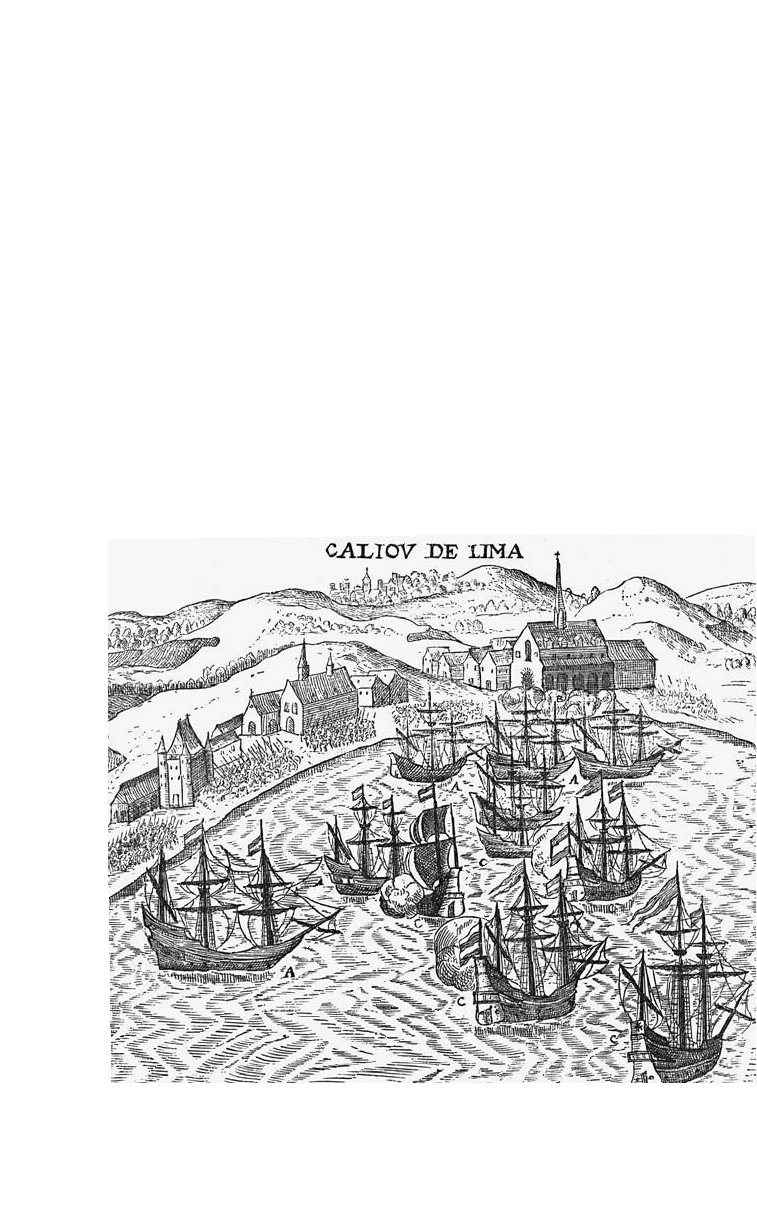
The Callao harbor in the 16th century was the main seaport for Lima, from which ships shuttled
silver and merchandise to and from Portobello, in Panama, as part of the Spanish fleet system.
The wealth of the Peruvian mines and income from the Indian tribute flowed to Spain, and
manufactured goods flowed back to the colonies.
(Narrative and Critical History of America)

As the trade cycle reached a peak, Lima became a lively place, espe-
cially between April and June. During this time Lima was filled with
new merchandise from all over the world. The fleet then returned to
Panama, loaded with the money from Lima’s merchants and the tributes
paid by the indigenous population. According to chronicler Bernabé
Cobo, 6 million ducados in silver bars, coins (reales), and tejos (disks)
of gold left Lima ever
y year until the beginning of the 17th century.
The fleet system was meant to protect the silver shipments from the
colonies to Spain and enforce the Crown’s monopoly. It consisted of, in
essence, a basic exchange of controlled goods: Spain would provide
manufactured items and food, and the colonies were to pay with silver
and some tropical products (hides, sugar, tobacco, and cochineal). The
ships were to be Spanish, and the benefits would increase fiscal rev-
enues and fill the pockets of Castilian merchants.
Several historical processes explain the decay of the fleet system and
with it the collapse of Spain’s monopoly on world trade. Spain proved
to be increasingly incapable of satisfying colonial demands, which were
ever better met by local production—of textiles, for example, as well as
traditionally Spanish goods such as wine, olive oil, and wheat—and by
smuggling—especially of manufactured goods from England and
France. Spain had to spend more and more money to protect its fleet
and port fortifications in the colonies. In spite of such efforts smuggling
increased, and along with the diversification of production inside the
colonies, it diminished the importance of Spain as a supplier. The prob-
lem was temporarily alleviated when toward the end of the 16th cen-
tury and the beginning of the 17th century, the Netherlands was added
to the kingdom of Charles V, filling the ships of the Spanish fleet with
more manufactured goods from northern Europe (mainly England).
Spain itself soon became a re-exporter of goods manufactured else-
where and a net exporter of silver, especially to England, to maintain its
balance of trade. In 1567 the Netherlands became involved in great
political turmoil, a turn of events that strengthened the hand of British
merchants and Queen Elizabeth’s piratical “sea dogs.” Costs to protect
the fleet skyrocketed. Still, the amount of merchandise kept growing,
from 17,000 tons in 1540 to 32,000 in 1585.
Crisis Ensues: The 17th Century
Spain was less prosperous in the 17th century than it had been previ-
ously, because many of the basic premises of the fleet system had
changed. The supply of silver had diminished, especially after 1630,
69
COLONIAL PERU

A BRIEF HISTORY OF PERU
70
and Lima-based merchants were no longer as dependent on products
coming from Spain because local intracolonial production had diver-
sified and increased. The defeat of the Spanish Armada by the English
in 1588 was a devastating blow to Spain’s monopoly. Thereafter, the
number of foreign ships in the fleet system kept increasing. Between
1579 and 1587 foreign ships accounted for 5.9 percent of all ships
leaving Seville; between 1588 and 1592 this percentage had increased
to 21.3 percent. By 1630 one-third of the fleet consisted of non-
Spanish ships. Toward the end of the 17th century, the majority of
merchants within the mercantile elite in Seville were foreigners who
had become “Spanish” through naturalization. In dire fiscal straits,
the Spanish Crown not only took to the selling of the “privilege” of
participating in the fleet, and thereby in colonial trade, but also
increased taxes.
Between 1585 and 1630, the avería, an export tax, was increased
fr
om 1.7 to 6.0 percent on the reported value of the merchandise. The
almojarifazgo, a tariff on expor
ted and imported goods, was as high as
15.5 percent for products leaving Spain and 17.5 percent for products
coming into Spain. To evade burdensome taxes Spanish merchants
underdeclared the value of their shipments. Increasingly, foreign ships
met the fleet in the open ocean, where they transferred their loads to
fleet ships, thus escaping the watchful eye of the Casa de Contratación
employees. Instability was further fueled by the outright confiscation of
private silver shipments to Spain in 1620, 1629, 1635–38, and 1649,
eroding confidence in the system. The consequences were the disinte-
gration of the nation’s tax system and bankruptcy. The Thirty Years War
and the long war in the Netherlands had consumed the Potosí silver. At
this point the fleet system was an international venture rather than an
enforced Spanish monopoly. The total volume of exchange, both in
terms of number of ships and amount of tons, had diminished by more
than 50 percent between the end of the 16th and the end of the 17th
centuries.
In the meantime port cities on the South American continent other
than Lima were gaining momentum. Between 1615 and 1700 Buenos
Aires grew from 1,000 inhabitants to 7,000 and flourished following a
surge of smuggling. As a consequence more money from Potosí went to
the eastern shores of the continent—to the detriment of Lima—and to
Portuguese, Dutch, and British merchants—to the detriment of Peru’s
and Spain’s merchants.
Inflation compounded these problems. Around 1640 the minting
house in Potosí and the local Spanish officials decided to replace some

of the silver contained in the silver peso with copper, thus tacitly dimin-
ishing the coin’s real value. The “strong peso” (peso fuerte) became the
“weak peso” (peso feble) and it did not take long for the alarm signals
to r
each European merchants.
Natural disaster also struck. In 1687 Lima was devastated by a series
of earthquakes. Even the viceroy, Melchor Navarro y Rocafull, duque de
la Palata, had to move to a tent on the Plaza de Armas, Lima’s central
plaza, for two months. Lima’s archbishop estimated the damage at 150
million pesos. Devastation also reached the coastal valleys, where irriga-
tion systems were destroyed, and the fields subsequently languished
through many years of drought. Wheat had to be imported from Chile
to prevent Lima inhabitants from starving. Another similarly devastating
earthquake happened on October 28, 1746. Lima and Callao were com-
pletely destroyed, 10,000 people were killed, and only 25 houses
remained (Hardoy 1951, 227, based on Bromley and Barbagelata, 1945).
By the end of the 17th century there were many signs that the econ-
omy of colonial Peru was in a state of decline, resulting primarily from
the continuing drop in silver production and the disappearance of Spain’s
trade monopoly. Economic woes, coupled with the effects of natural dis-
asters, pointed toward a similar decline in political life. Moreover, a
change in the ruling dynasty in Spain transferred power to the Bourbon
family, which tried—unsuccessfully—to reform the colonial system.
71
COLONIAL PERU

5
Colonial Institutions
and the Bourbon Reforms
(1700–1780)
A
s the Spanish colonial enterprise took root and began to mature, a
series of institutions developed that came to characterize life in
the colony. Lima, for example, grew into a cosmopolitan center of
Hispanic and Peruvian culture during the 17th and 18th centuries, and
it became a place where peruanos of racially and ethnically mixed back-
grounds encountered one another amid a bustling urban life. Among
the most impor
tant colonial institutions based in Lima was the Roman
Catholic Church, which in its various forms enjoyed wide powers and
deep influence throughout Peru from the very beginning of the Spanish
conquest. The church controlled many aspects of Peruvian society,
although when it became a political or economic threat, the govern-
ment made clear there were limits. After the Spanish Crown passed
from the House of Hapsburg to the French Bourbons at the beginning
of the 18th century, the new dynasty made vigorous attempts to reform
the administration of the colony and bring it more closely into the orbit
of the mother country but with only partial success. Stresses appeared
that would lead to serious fissures.
The City, the Church, and the Orders
Lima, originally called the City of the Kings (Ciudad de los Reyes), was
founded as the capital city of the Viceroyalty of Peru by Francisco Pizarro
on January 18, 1535, when he solemnly declared his intention to estab-
lish a city there on the coast for the service of God and the king. That
same day, Pizarro distributed city lots to his men, following the tradi-
tional grid plan common in Spain. Lima became a showcase of imperial
power—the administrative, ceremonial, economic, political, and social
72

73
COLONIAL INSTITUTIONS AND THE BOURBON REFORMS
center of a dominion that, at least during the first century of Spanish
presence, controlled a geographical space larger than the Inca Empire.
Almost all important colonial institutions including the viceroy, the
audiencia, the cabildo, the archbishopric, and the Inquisition were cen-
ter
ed in Lima. By contemporary standards Lima was a cosmopolitan
city with people from many different continents. According to the 1614
census, Lima counted more than 20,000 people and its black popula-
tion from different regions in Africa (and their mixed-blood descen-
dants) accounted for more than 50 percent of this. A total of 1,720
clergy members were counted in this same census.
Impressive ceremonies enhanced the image of the city. No fewer than
150 days a year were Sundays or holidays. Some festivities could last
several months, such as to mark the birth of a new heir to the Spanish
Crown. Typically the viceroy presided over a military parade marching
toward the cathedral. There the archbishop held a solemn mass, a Te
Deum. People then were in the streets celebrating, drinking, listening to
band music, and wearing their best attire. All guilds participated, and so
did slaves and freedmen and -women. At night there were more parades,
with the participation of the cavalry and presided over by the alcalde
(mayor) and the oídores (municipal judges). Celebrations reached a
peak with fir
eworks and bullfights. Many holidays and festivities were
religious and served to teach and reinforce Catholic ideas and principles.
Aside from churches, monasteries, and convents, one of the main
instruments of power of the Catholic Church was the Inquisition, an
Urban Catholicism
L
ima was the center of the Roman Catholic Church in Peru, and it
attracted hundreds of priests, nuns, and monks. The Franciscan
friar Buenaventura de Salinas y Córdoba, writing in 1630, claimed there
were at least 400 parish priests in the city, not counting those in the
port of Callao and the immediate surrounding countryside. He also
recorded the presence of 1,366 nuns, served by 899 female slaves
(known as donadas).The Augustinian Convent of the Incarnation alone
occupied an entire city block and housed 450 nuns, 50 no
vices, and 276
slaves. There were similar numbers of friars from the Dominican,
Franciscan, Mercedarian, and Jesuit orders, many of the latter serv-
ing as teachers in the city’s schools (Salinas y Córdoba 1646, in
Tibesar 1953).