
Hunefeldt C., Harris B. A Brief History of Peru
Подождите немного. Документ загружается.


A BRIEF HISTORY OF PERU
94
family were in the transportation business. As a curaca he was exposed
to the double pressures of the corr
egidor on one side and the requests
from his constituent Indians on the other.
Condorcanqui led a revolt that eventually put Spanish colonial dom-
ination in jeopardy, though it began as an attempt to end the corruption
of the corregidores. It started in 1780 in the small town of Tinta, near
Cuzco, where a corrupt and venal corr
egidor, Antonio Juan de Arriaga y
Gurbista, had for years abused the Indians under his jurisdiction and
extorted large sums from them. Condorcanqui seized the corregidor
,
threw him in jail, and six days later hanged him publicly in the plaza of
T
ungasuca. During the execution a pregonero (town crier) playing the
drums announced that fr
om there on the alcabala (internal tariff), cus-
toms, and mita in Potosí were abolished.
While confusing news of the uprising r
eached Cuzco and Lima,
Condorcanqui, who took the name Tupac Amaru II, began to organize
a rebellion with Tungasuca as his headquarters. Cuzco’s inhabitants
Tupac Amaru
A
ccording to historian John H. Rowe, José Gabriel Condorcanqui
was greatly influenced by his stay in Lima in 1777, when he lived
in the city while defending himself in a lawsuit against a rival who also
claimed descendancy from Tupac Amaru. New ideas from the
Enlightenment in Europe were then circulating among the city’s intel-
lectuals. In addition the impact of the revolt of the North American
colonies against Great Britain was fresh and significant. Despite the
efforts of the Peruvian colonial government to suppress books and dis-
cussion of these matters, Condorcanqui probably was exposed to these
ideas and events when he visited San Marcos University and spoke to
his limeño acquaintances. His wife later said that this was a visit that
opened his eyes.
Perhaps even more important influences were the contemporary
ideas of a neo-Incan revival and Incan nationalism that were also circu-
lating at the time. These ideas were circulating throughout the Andes
during the latter decades of the 18th century, when the descendants of
the Incan elites were making conscious efforts to rediscover and
reclaim their indigenous traditions, which included a “nostalgic” (in
Rowe’s characterization) affirmation of the glorious imperial Inca past
(Rowe 1976, summarized in Klarén 2000, 116).
95
REVOLTS AND THE WARS FOR INDEPENDENCE
decided to send troops to Tinta under the leadership of Fernando
Cabrera, the corregidor of Quispicanchis (another Cuzco province).
Cabr
era was defeated by Tupac Amaru’s troops at Sangarara, and the
rebels killed hundreds of royalists, including Cabrera, who died under
the rubble of the local church where he had taken refuge.
As the rebellion expanded Condorcanqui’s cousin, Diego Cristóbal
Tupac Amaru, joined the leadership of the rebel army, as did Tomasa
Titu Condemayta, the woman curaca of Acos, in Quispicanchis. Not all
curacas in and around Cuzco supported Condorcanqui, however, and
some actually joined the r
oyal army. Most notable of all was Mateo
García Pumacahua, the curaca of Chinchero, who would himself lead
an armed r
ebellion against royal troops 30 years later (in 1814–15).
As word spread of Tupac Amaru II’s rebellion, there were outbreaks of
violence throughout the highlands. Indians rose up and attacked the cor-
regidores, burned hated colonial institutions such as obrajes and
chur
ches, and killed anyone who was not an Indian. Tupac Amaru II him-
self tried in vain to include Creoles and mestizos and even slaves in his
rebellion, but as the situation grew more violent and more non-Indians
suffered, the Creole and mestizo population turned on the Indian leader
and his forces. Creoles might have agreed that corregidor Arriaga was a
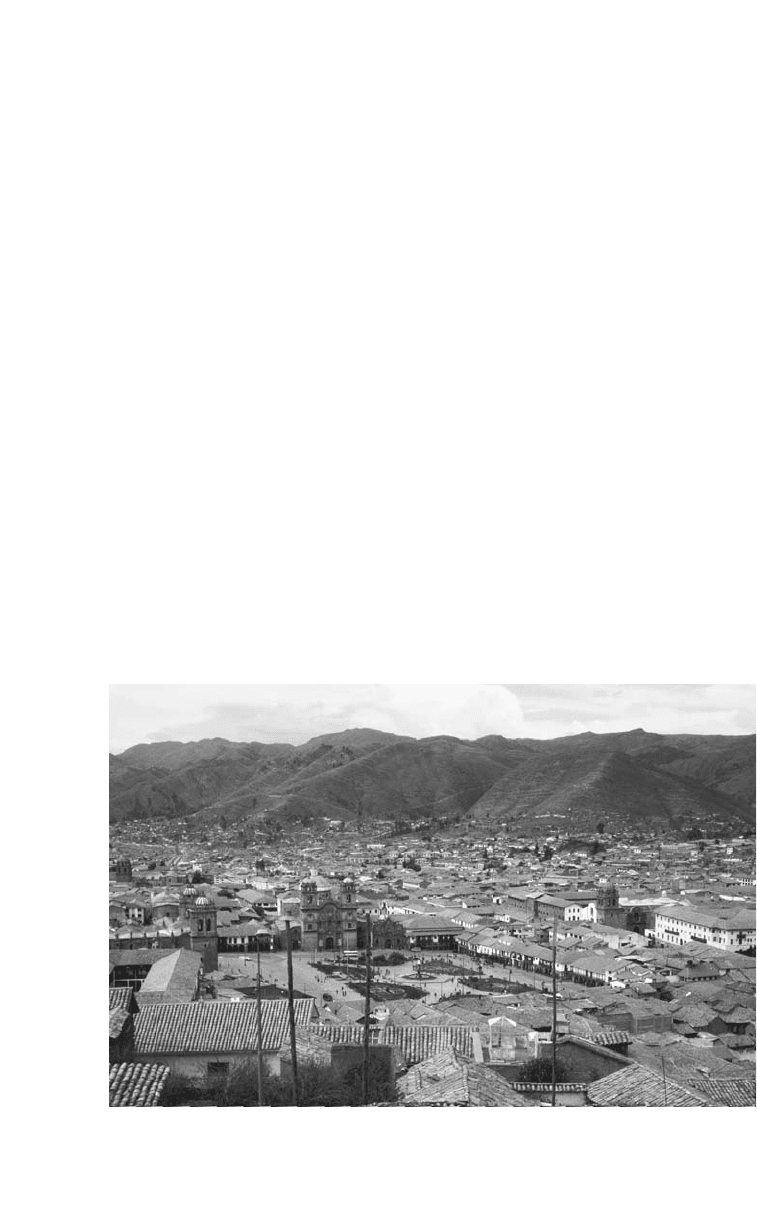
A modern view of Cuzco, which in 1781 was captured by the rebellious forces of José Gabriel
Condorcanqui, known as Tupac Amaru II, and became the center of his revolt against the
colonial Spanish government.
(Photofrenetic/Alamy)

corrupt state employee deserving to be put to death, they were less
inclined to relinquish their properties or their Indian workers. It has been
estimated that 100,000 people, around 10 percent of the viceroyalty’s
population, died in the uprising. Tupac Amaru II was defeated after
attempting to lay siege to Cuzco and captured in April 1781.
Soon after his capture, Tupac Amaru II was publicly executed. He
was torn apart by horses after he had been forced to witness the torture
and death of his children and wife. His dismembered body was dis-
played at several locations in and around Cuzco as an example to
would-be rebels. In spite of Condorcanqui’s defeat and horrendous
death, rebellion had spread to the highlands in Oruro and Tupiza.
Under the commander Tupac Catari ( Julián Apaza), Indian troops con-
tinued to attack colonial figures and institutions. The repercussions of
this upheaval reached Ayacucho in the south of modern-day Peru, and
even into modern-day northern Chile.
The Wars of Independence
Peru had for more than 300 years been the center of Spanish colonial
domination in South America, and Lima in particular had strong,
long-standing links with Madrid. Lima’s elites were tied through eco-
nomic, political, and even kinship interests to their counterparts in
Madrid. Moreover, the Tupac Amaru II rebellion had shown many
Creoles how shaky their hold on the colony was and how much they
needed Spain to legitimize and support their social and economic pre-
eminence. Peru took much longer than other Spanish colonies to
embrace the independence movement, and it remained for years a
bastion of Spain in the midst of other colonies that had proclaimed
their freedom. Yet as Madrid tried to reinstate its control on colonial
territory after the Tupac Amaru II uprising, the Spanish government
succeeded only in further alienating Peruvians. Increased taxes, the
reorganization of the administrative boundaries of the viceroyalty (via
the new intendant system), and the replacement of Creole high-state
administrators with Spaniards were issues that triggered the move-
ment toward independence.
Long-term structural conditions also explain what has been called
the “colonial crisis.” Although in the 16th century silver and labor were
abundant in the Peruvian viceroyalty by the 18th century both were
scarce. The population decline (reaching its low point around 1720)
affected all other economic endeavors in the colony, and Spain’s ability
to finance and wage wars in Europe in defense of its hegemony declined
A BRIEF HISTORY OF PERU
96
accordingly. In need of ever more
money, the Spanish Crown
increased the pressures on the
diminishing Peruvian indige-
nous population. As a result the
Peruvian viceroyalty witnessed
increasing rural unrest in the
decades leading up to indepen-
dence.
Historian Scarlett O’Phelan cites
more than 150 uprisings during
the 18th century. Growing unrest
was closely knit into the resur-
gence of what has been labeled an
“Andean renaissance,” or varieties
of Inca nationalism. This ideologi-
cal revival was based on a reinter-
pretation of preconquest history
that envisioned and celebrated a
benevolent Inca ruler and the exis-
tence of an ideal society, the
Tahuantinsuyo. The mounting dis-
content had converged in the Tupac
Amaru II rebellion, which in turn
set off continued distrust of everything indigenous by all non-Indians. In the
long run, this wariness hampered common political and military efforts for
independence, and to a large degree it explains why Peruvian Creole leaders
were inclined to wage a political revolution without a social revolution
(Manrique 1995, 37).
Peruvian intellectuals and politicians were also influenced by what
was happening in other parts of the world. The generation of thinkers
associated with the journal Mercurio peruano between 1790 and 1796
car
efully watched and commented on worldwide issues. Both the suc-
cessful war for independence against Britain by the North American
colonies and the French Revolution put ideas such as the right of self-
governance, popular sovereignty, the merits of nationalism, and the
desire to do things differently (and inherently better) in the minds of
many Peruvians. However, these Peruvians did not necessarily see
separation from Spain as the solution. Rather, they envisioned a more
moderate relationship in which the voices from the colonies could
and would be heard in Madrid. The most prominent figures among
97
REVOLTS AND THE WARS FOR INDEPENDENCE
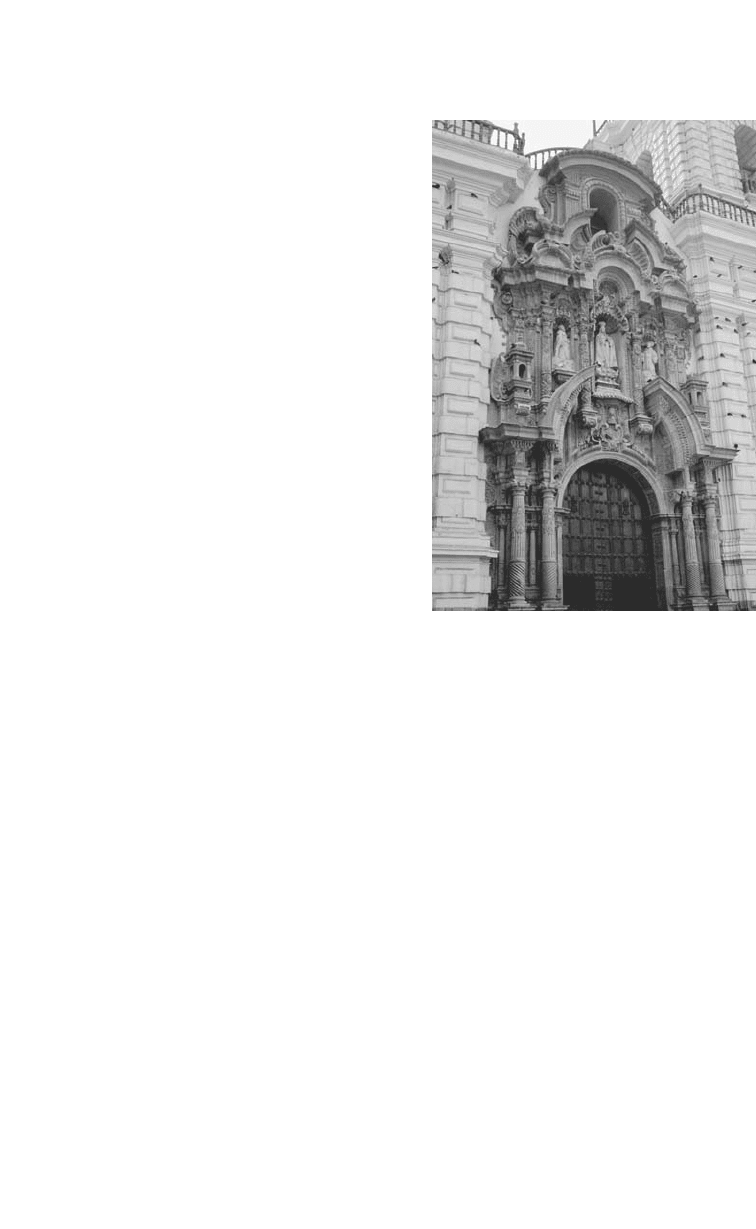
The entrance to the Church of San Francisco in
Lima, built in an 18th-century baroque style
that reflected the period of Bourbon rule in
Spain.
(Photofrenetic/Alamy)

these politicians and intellectuals were lawyers Manuel Lorenzo
Vidaurre and José Baquíjano y Carrillo, the priest Mariano José de
Arce, and the doctor Hipólito Unánue. One member of the group,
Vicente Morales Duárez, in 1810 became a representative from the
colonies in the Cortes de Cádiz, the assembly of elected representa-
tives that replaced Ferdinand VII after his deposition by Napoléon
Bonaparte in 1808.
Events in Europe played a crucial role in nudging Peru (and other
Spanish colonies in South America) toward independence. Spain was
thrown into chaos and turmoil when it was occupied by Napoléon
Bonaparte’s troops in 1808 and King Ferdinand VII was deposed. At
least temporarily, Spain was an occupied territory and had almost no
control over its colonies. The situation became even more confused in
1810 when a national assembly, known as the Cortes de Cádiz, was
called in the king’s absence, with Morales Duárez as its president. This
assembly drew up a new, quite liberal constitution that would affect
both Spain and the colonies. When this new constitution reached Peru
in 1812, it produced much discussion, unrest, and even open rebellion.
The new proposed form of government was to be a constitutional
monarchy, and the constitution abolished the Indian tribute and the
mita and required that elections take place. Depending on the popula-
tion size, the varied colonial dependencies were instructed to hold elec-
tions to nominate local bur
eaucrats and representatives (all the way
from cabildos to audiencias) and to send r
epresentatives to Spain. It was
the first time in colonial history that the colonies’ voices would be
heard in an open public forum in Spain.
Fernando de Abascal, the viceroy in Lima, refused to implement this
liberal constitution, an action that led to several upheavals throughout
Peru between 1812 and 1814. A Cuzco rebellion, co-led by the curaca
Mateo Pumacahua, embraced most of the southern Andes and covered
an ar
ea closely coincident with the region affected by the Tupac Amaru
II rebellion. By 1814, however, King Ferdinand was back on the
Spanish throne, and the rebellions in Peru were successfully sup-
pressed through military actions and their leaders publicly executed.
Four years later, in 1818, Viceroy Joaquín de la Pezuela was able to
report to Spain that in Peru few dared to discuss self-government or
talk about a Peruvian nation, whereas a strong support for Spain had
been demonstrated in very material ways. It has been calculated that
between 1777 and 1814, Lima’s merchant guild (the Tribunal del
Consulado), donated more than 5 million pesos to the Spanish Crown
toward the payment of Spain’s wars in Europe. Over the following
A BRIEF HISTORY OF PERU
98

years, until it went bankrupt, the guild continued to loan and donate
money to support the Spanish colonial government’s armed struggle
against the invading patriotic armies and to help suppress local upris-
ings (Manrique 1995, 62).
Outside forces now came into play and began to shape the direction
of the independence movement in Peru. The Spanish colonies to the
south (modern-day Argentina and Chile) had been liberated and
declared independent after successful military campaigns led by the
Argentine general José de San Martín, a veteran of the Spanish army
who had proved brilliant in organizing a disciplined army, composed
mostly of black slaves, mulattoes, and mestizos. In 1816, San Martín
had defeated a royalist Spanish army in Argentina, then crossed the
Andes into Chile and defeated the Spanish forces there in a series of bat-
tles the following year. San Martín’s goals, however, encompassed more
than gaining independence for Argentina and Chile. He understood
that as long as Spanish authorities retained control of Lima and the rest
of Peru, the newly won freedoms of the regions to the south would be
in peril. He recruited and trained a new 4,500-man army of Argentines,
Chileans, and expatriate Peruvians and he assembled a naval squadron,
commanded by the British admiral Lord Cochrane. In August 1820, San
Martín embarked on an invasion of Peru.
The patriot army landed at Pisco and then marched north and sur-
rounded Lima, the center of Spanish royalist power, while Lord
Cochrane blockaded the harbor at Callao. San Martín had hoped the
presence of his forces would stimulate an independence movement
among the Creole elite of Lima, but there was no organized response
from the limeños and only scattered support for the independence
movement from individuals.
San Martín was in a strong military position, but the Spanish viceroy
Joaquín de la Pezuela was still in command of a huge army and had
contr
ol of Lima. Moreover, earlier in 1820 the government in Spain had
promulgated a new, more liberal constitution that granted equal civil
status to Spanish subjects living in the colonies. In the eyes of the roy-
alists in Lima, this obviated the need for Peruvian separation and weak-
ened the patriot argument for independence. The situation was at a
stalemate, which prompted Pezuela to open negotiations with San
Martín, but in January 1821 Spanish general José de La Serna deposed
the viceroy and took control of the royalist government and army. La
Serna and San Martín had served together in Europe as officers in the
Spanish army fighting the French. They now entered into discussions
about the future of Peru, and for a short while appeared to reach an
99
REVOLTS AND THE WARS FOR INDEPENDENCE

A BRIEF HISTORY OF PERU
100
agreement to establish a constitutional monarchy, basing their ideas on
the political theories of 18th-century Enlightenment political philoso-
pher, Charles Montesquieu, who had believed only geographically small
and socially homogenous nations could function well as democracies.
From this point of view, Peru’s sprawling, diverse topography and the
acute racial, social, and economic divisions among the population made
it an unlikely candidate for any form of government except monarchy.
Female Camp Followers
F
lora Tristán (1803–44) was born to a Peruvian father and a Parisian
mother.A prominent pre-Marxist socialist, she fought for workers’
and women’s rights in France during the late 1830s and early 1840s.
Following is her description of the camp followers of South America,
rabonas as she calls them, which she recorded during a visit.
In Peru each soldier takes with him as many women as he likes: some
have as many as four. They form a considerable troop, preceding the
army by several hours so that they have time to set up camp, obtain
food and cook it.To see the female avant-garde set out gives one an
immediate idea of what these poor women have to suffer and the
dangerous life they lead.The rabonas are armed; they load onto mules
their cooking-pots
, tents and all the rest of the baggage, they drag
after them a horde of children of all ages, they whip their mules into
a gallop and run along side behind them, they climb high mountains,
they swim across rivers, carrying one or even two children on their
backs.When they arrive at their destination, they choose the best site
for the camp, then they unload the mules, erect the tents, feed the
children and put them to bed, light the fires and start cooking. If they
chance to be near an inhabited place, they go off in a detachment to
get supplies; they descend on the village like famished beasts and
demand food for the army.When it is given with a good grace they do
no harm, but when they are refused they fight like lionesses and their
fierce courage overcomes all resistance. Then they sack the village,
carry their loot back to the camp and divide it among themselves.
These women, who provide for all the needs of the soldier, who
wash and mend his clothes, receive no pay and their only reward is the
freedom to rob with impunity.They are of Indian race, speak the native
language, and do not know a single word of Spanish.The rabonas are
not marr
ied, they belong to nobody and are there for anybody who
wants them. . . . The rabonas adore the sun but do not observe any
r
eligious practices (Hahner 1998, 26).

The discussion, nonetheless eventually came to nothing, and La
Serna withdrew from Lima in order to consolidate the royalist forces.
He seized the silver mines in the highlands and established headquar-
ters in the old Incan imperial capital of Cuzco. Meanwhile, San Martín
occupied Lima. Despite a noticeable lack of enthusiasm for the cause of
independence on the part of the Creole elite, San Martín took a bold
step and declared Peruvian independence from Spain in a solemn cere-
mony in Lima’s central plaza on July 28, 1821. To this day, July 28 is cel-
ebrated as the Peruvian independence day, the equivalent of the Fourth
of July in the United States. Proclamations alone, however, do not win
wars, and Peru faced three more years of armed conflict before defini-
tively achieving independence.
San Martín discovered that he had little choice but to assume politi-
cal control of Lima himself as provisional governor, as the Creole lead-
ers he had counted on for support were slow to step forward and take
responsibility. In fact, many native-born Spaniards, as well as Peruvian-
born Creoles, fled Peru in the face of the dislocations caused by the war
for independence, and those who remained feared for their property
and lives if the large slave and Indian population of the city should be
infected with the idea of liberty and rise up against them. The Creole
elite of Lima also viewed San Martín’s army of black and mixed-race sol-
diers with fear and suspicion. Nonetheless, San Martín hoped to estab-
lish order and quell the fears of the white population by taking power.
His official decrees did little to win over the Creoles to the cause of
independence, however, especially after he mandated the liberation of
slaves born after July 28, 1821, a move that would eventually lead to
the full abolition of slavery. San Martín also abolished the Indian trib-
ute and the requirement that the Indian population render personal ser-
vices to whites, and he cancelled commercial monopolies. All of these
decrees struck at the heart of Creole security and power, and they
resulted in unsettling the political situation rather than achieving sta-
bility. The limeños distrusted San Martín and were pushed further into
opposition when they found themselves subjected to harsh state and
police control, and when food became scarce after vicer
egal troops sur-
rounded the city.
While San Martín and his army controlled northern Peru and the
central coast, Viceroy La Serna controlled the central and southern
highlands. With the military situation at a stalemate San Martín peti-
tioned in July 1822 the help of Bolívar, the “Liberator” of Granada
(Venezuela and Colombia). The generals met in Guayaquil. The
exact nature of their conversations remains a mystery; however, from
101
REVOLTS AND THE WARS FOR INDEPENDENCE
what little is known, Bolívar
offered to send only 800 men to
support San Martín’s efforts
even after San Martín offered to
submit to Bolívar’s command.
Disappointed, San Martín re-
turned to Lima only to find that
his ministers had been deposed
for their anti-Spanish policies
and attitudes. Many Peruvian
Creoles in Lima resented San
Martín’s monarchical aspira-
tions and even feared he would
crown himself king. San Martín,
however, was completely disillu-
sioned and renounced power.
Shortly afterward, he left the
American continent, never to
return.
The newly inaugurated congress that had been called by San Martín
before his departure drew up Peru’s first republican constitution in
1823 and chose José de la Riva Agüero as the nation’s first president.
After the promulgation of the new constitution, Riva Agüero launched
new military campaigns against the viceregal troops in the highlands
only to be defeated in battles at Moquegua and Torata. Empowered by
its victories, the viceregal army regained control of Lima and Callao. At
this point congress members decided to call once more upon Bolívar to
save the independence movement.
When Bolívar arrived in Peru, he encountered political chaos, dis-
sension, and lack of resources, and most serious of all, there was no
army in place. The so-called Army of the South, the only force made up
of Peruvian soldiers, had been defeated and subsequently disbanded. By
1823, only a few hundred soldiers remained of the army’s original
5,000. San Martín’s Chilean troops had returned to Chile, and the
Argentine troops from Río de la Plata were mutinous for the lack of pay
The patriots’ naval squadron, commanded by Thomas, Lord Cochrane,
had left Callao after not being paid, taking with it the last penny of the
national treasury. The only organized troops in place were Colombians
under General Antonio José de Sucre. Given the disarray, congress
transferred all powers to Bolívar over the objections of President Riva
Agüero, who fled Lima and set up a parallel government in the city of
A BRIEF HISTORY OF PERU
102
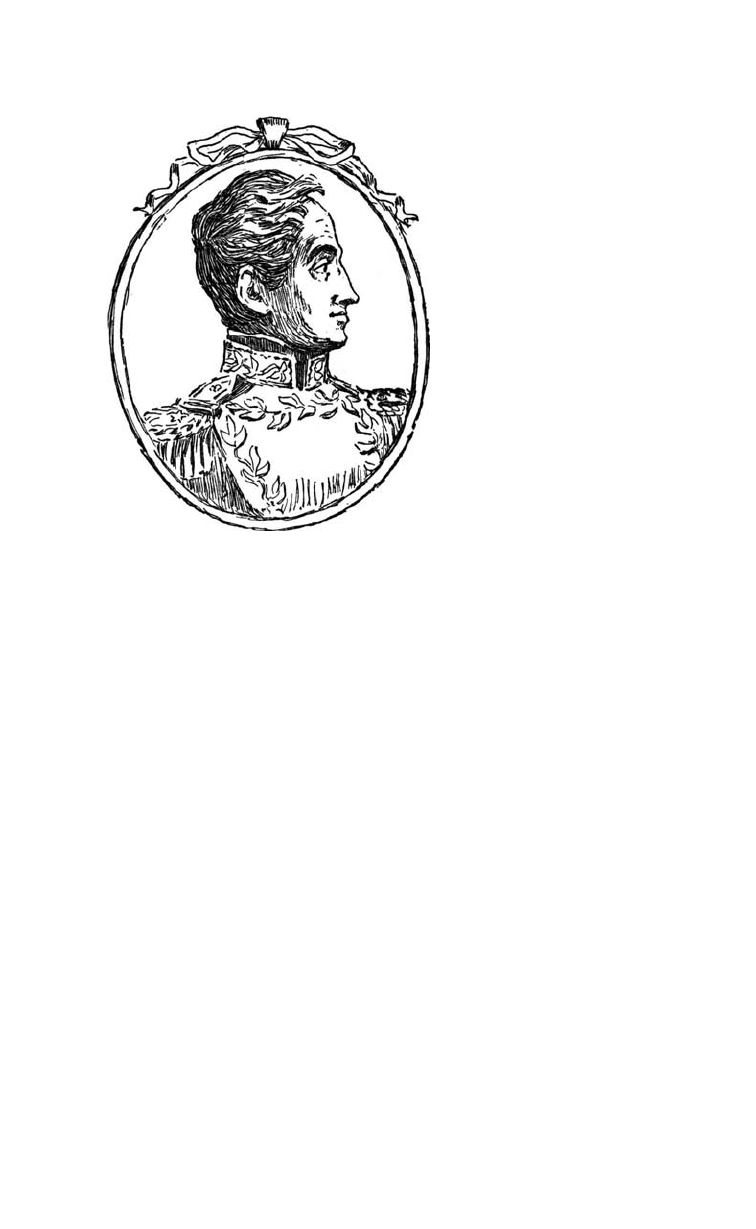
Simón Bolívar, the Liberator (Art Today)

103
REVOLTS AND THE WARS FOR INDEPENDENCE
Trujillo. Soon afterward, Lima’s congress discovered that Riva Agüero
had opened conversations with Viceroy La Serna to oust Bolívar. Riva
Agüero was officially exiled. His replacement, José Bernardo de Tagle,
marqués de Torre Tagle, also defected to the royalists, dying soon after.
Political unity was achieved only when Bolívar was vested with dicta-
torial power.
Bolívar’s prospects brightened when the royalist forces split and
one general withdrew his troops. In addition, international support
came from the United States, which under the Monroe Doctrine stood
as a guarantor for the independence of former Spanish colonies.
Meanwhile, Europe decided not to intervene in America in spite of
Spain’s insistence to the contrary. Moderate Peruvian Creoles, who
BolÍvar and Sucre
L
ate 19th-century U.S. historian Clements R. Markham described
Simón Bolívar, the Liberator, and General Antonio José de Sucre 70
years after they intervened in Peru’s struggle for independence.
Bolívar entered Quito on the 16th of June, annexed Guayaquil and
obtained leave from the obsequious congress of Colombia to proceed
to Peru. His age was then forty.
Bolívar was a little man, only five feet, four inches in height. His face
was long, with hollow cheeks and livid brown complexion, eyes sunk
deep in the head, body thin and meager. A large moustache and
whiskers covered part of his face. He was passionately fond of dancing
and lolling in a Spanish hammock. His character was made up of
vanity, ambition, profound dissimulation and a thirst for absolute
power. He had read little and was a bombastic writer. He never
smoked. His voice was loud and harsh, and he indulged in fits of
passion and personal abuse, his temper being fiery and capricious. His
manners were generally good, but not prepossessing.
Antonio José de Sucre, Bolívar’s second in command, was born in
Cumana, in Venezuela, on the 13th of June, 1793. . . . Entering the
army in 1811, he served with credit under Miranda, and afterward
under Piar [both Colombian presidents]. From 1814 to 1817 he was
on the staff of the Colombian army, and he afterwards commanded a
division sent to assist the province of Guayaquil. His great military
achievement, before his arrival in Peru, was the victory of Pichincha.
For two years and a half the destinies of Peru were placed under
the absolute control of these two men, Bolívar and Sucre (Markham
1892, 269–270).