
Kallen A. Understanding Biostatistics
Подождите немного. Документ загружается.


312 HAZARDS AND CENSORED DATA
From this we deduce the classical Greenwood formula approximation to the variance
for F
n
(t), which is V (F
n
(t)) ≈ F
c
n
(t)
2
σ
2
n
(t). When there are no censored data we have that
r
j+1
= r
j
− d
j
, and this variance expression becomes F
n
(t)(1 − F
n
(t))/n.
When we make inference about F(t) from the Kaplan–Meier estimator F
n
(t), we can use
large-sample theory, which is outlined in Appendix 11.A, to deduce that
(F
c
n
(t) − F
c
(t))
2
F
c
(t)
2
σ
2
n
(t)
∈ Asχ
2
(1).
Once we have this, we can do the same thing as we did when we described F (t) from complete
data, using the standard e-CDF. From this observation we can obtain confidence regions for
F (t) as well as confidence intervals for percentiles, using the methods discussed in Chapter 6.
11.9 Comments and further reading
A short introduction to what makes survival data special is given by Hougaard (1999), which
expands on some of the points made above. When it comes to textbooks on the analysis of this
kind of data, there is a choice available for almost any taste – theoretical, example-driven, for
dummies, etc. – and new books appear more or less every year. Some (historically) important
ones can be found among the references below.
The problem of competing risks is a controversial subject (Hougaard, 2000, Chapter 12).
The basic problem with analyzing a particular cause of death in the presence of competing
causes is that there is not sufficient information available to settle the problem, which is why we
need to make additional assumptions. This creates a philosophical dilemma regarding what can
legitimately be done: can we think about cause-specific survivals at all, using models that are
such that we can identify these (like an independence assumption, or using so-called copulas)
or should we restrict ourselves to what we actually can observe? Examples of advocates for
these two positions are Zheng and Klein (1994) and Prentice et al. (1978), respectively.
The paper that started it all, by Daniel Bernoulli, has been republished (Bernoulli, 2004)
in a review which starts with the following quote from the author in 1760: ‘I simply wish
that, in a matter which so closely concerns the well-being of the human race, no decision
shall be made without all the knowledge which a little analysis and calculation can provide.’
The data he used (Halley, 1693) can, at the time of writing, be found on the internet at
http://www.pierre-marteau.com/editions/1693-mortality.html. We should note that Bernoulli
added a ‘guesstimate’ to this table for the number of births.
A more detailed discussion on the smallpox model, its history and some generalizations
can be found in Dietz and Heesterbeek (2002), including a discussion on a dispute Bernoulli
had with the French mathematician d’Alembert. The latter advocated a simpler competing
risk model, in which you either die from smallpox or not. The model he suggested was the
general approach to competing risks we use today, whereas Bernoulli’s model is restricted
to infection-type diseases. Modeling competing risks is a first step toward the wider subject
of multi-state models, to which Andersen and Keiding (2002) provide an introduction, and
about which most reasonably advanced textbooks have something to say.
An introduction to the frailty problem in survival analysis is given by Aalen (1994),
whereas a more extensive discussion is found in the book by Hougaard (2000), who suggests
using a three-parameter family of distributions to describe frailty, as an alternative to the
gamma distribution.
REFERENCES 313
References
Aalen, O. (1975) Statistical inference for a family of counting processes, PhD thesis University of
California, Berkeley.
Aalen, O. (1978) Nonparametric inference for a family of counting processes. Annals of Statistics, 6(4),
701–726.
Aalen, O. (1994) Effects of frailty in survival analysis. Statistical Methods in Medical Research, 3(3),
227–243.
Andersen, P., Borgan, Ø., Gill, R. and Keiding, N. (1993) Statistical Models Based on Counting Pro-
cesses. New York: Springer.
Andersen, P.K. and Keiding, N. (2002) Multi-state models for event history analysis. Statistical Methods
in Medical Research, 11(2), 91–116.
Bernoulli, D. (2004) An attempt at a new analysis of the mortality caused by smallpox and of the
advantages of inoculation to prevent it. Reviews of Medical Virology, 14(5), 275–288.
Cox, D.R. and Oakes, D. (1984) Analysis of Survival Data Monographs on Statistics and Applied
Probability. London: Chapman & Hall.
Dietz, K. and Heesterbeek, J. (2002) Daniel Bernouilli’s epidemiological model revisited. Mathematical
Biosciences, 180, 1–21.
Fleming, T.R. and Harrington, D.P. (1991) Counting Processes and Survival Analysis. New York: John
Wiley & Sons, Inc.
Halley, E. (1693) An estimate of the degrees of the mortality of mankind, drawn from curious tables of
the births and funerals at the city of Breslau, with an attempt to ascertain the price of annuities upon
lives. Philosophical Transactions of the Royal Society, 17, 569–610.
Hougaard, P. (1999) Fundamentals of survival data. Biometrics, 55(1), 13–22.
Hougaard, P. (2000) Analysis of Multivariate Survival Data, Statistics for Biology and Health. New
York: Springer.
Kalbfleisch, J.D. and Prentice, R.L. (2002) The Statistical Analysis of Failure Time Data. Hoboken, NJ:
John Wiley & Sons, Inc.
Prentice, R.L., Kalbfleisch, J.D., Peterson, A.V., Flournoy, N., Farewell, V.T. and Breslow, N.E. (1978)
The analysis of failure time data in the presence of competing risks. Biometrics, 34, 541–554.
Zheng, M. and Klein, J.P. (1994) A self-consistent estimator of marginal survival functions based on
dependent competing risk data and the assumed copula. Communications in Statistics – Theory and
Methods, 23, 2299–2311.
314 HAZARDS AND CENSORED DATA
11.A Appendix: On the large-sample approximations of
counting processes
The natural mathematical framework for time-to-event data is the theory of counting processes,
as noted by the Norwegian statistician Odd Aalen (1975; see also 1978). For a comprehensive
account of the theory, see Andersen et al. (1993) or Fleming and Harrington (1991), each of
which contains references to earlier work. Other important books on the subject are Cox and
Oakes (1984) and Kalbfleisch and Prentice (2002). In this appendix we will give a heuris-
tic outline of some large-sample theory for counting processes with applications in practi-
cal statistics. Martingales and predictable processes in continuous time were introduced in
Appendix 4.A, where the variance process was given its proper name, the compensator. Recall
that if {ξ(t); t ≥ 0} is a martingale and {H (t); t ≥ 0} is a predictable process, then the process
defined by the integrals ξ
H
(t) =
t
0
H(s)dξ(s) is also a martingale. This integral is a stochastic
integral, which is a non-trivial thing to define since it involves two limiting processes, as
indicated in Box 11.8.
In order to review large-sample theory for counting processes, let (as before) N
n
(t)bethe
total number of observed events and Y
n
(t) the number at risk. If
n
(t) is the Nelson–Aalen
estimator of (t), the process {z
n
(t) =
√
n(
n
(t) − (t)); t ≥ 0} has compensator
z
n
(t) = n
t
0
1
Y
n
(s)
(1 − (s))d(s),
which converges to the function τ
0
(t) =
t
0
Y
C
(s)
−1
(1 − (s))d(s)asn increases. Here
Y
C
(t) is the limit of Y(t)/n. Using the CLT for martingales (see Appendix 4.A), we can
deduce that
{
√
n(
n
(t) − (t)); t ≥ 0}→{w(τ
0
(t)); t ≥ 0} in distribution,
where {w(t); t ≥ 0} denotes the Wiener process. To generalize this, consider a predictable
process H
n
(t) such that H
n
(t) → h(t) in probability, where h(t) is a function. We can then
define the stochastic integral
I
n
(t) =
√
n
t
0
H
n
(s)d(
n
(s) −(s)) =
t
0
H
n
(s)dz
n
(s),
whose compensator is
I
n
(t) =
t
0
H
n
(s)
2
dz
n
(s) →
t
0
h(s)
2
dτ
0
(s).
From the discussion above it follows that {I
n
(t); t ≥ 0}has the same asymptotic distribution as
the stochastic process {w(
t
0
h(s)
2
dτ
0
(s)); t ≥ 0}. If we combine this observation with equa-
tion (11.6) in Box 11.7 we obtain the limit theorem for the Kaplan–Meier estimator, which
says that
√
n(F (t) − F
n
(t))
F
c
(t)
=
t
0
H
n
(s)dz
n
(s),H
n
(t) =
F
c
n
(t−)
F
c
(t)
.

APPENDIX: ON THE LARGE-SAMPLE APPROXIMATIONS OF COUNTING PROCESSES 315
Box 11.8 Stochastic integrals
In order to define the integral I(g) =
∞
0
g(t)dx(t), where {x(t); t ≥ 0} is a stochastic
process with E(x(t)) = 0 for all t, we start by defining it for a piecewise constant function
such that g(x) = g
k
when t
k
<t≤ t
k+1
,as
I(g)(ω) =
n
k=1
g
k
k
x(ω),
k
x(ω) = x(t
k+1
,ω) − x(t
k
,ω).
If the increments
k
x over disjunct intervals are uncorrelated, it follows that
E(I(g)
2
) =
k
g
2
k
E((
k
x)
2
) =
k
g
2
k
k
V =
∞
0
g(t)
2
dV (t),
where V (t) = E(x(t)
2
). We can then show that this is also true for a more general class
of functions g(t), including continuous functions. The problem starts when we want to
allow g(t) to be a stochastic process, that is, a function that depend on ω as well. For a
piecewise constant process (fixed jump points) we would have
I(g)(ω) =
n
k=1
g
k
(ω)
k
x(ω),
but there is no general limiting process that allows us to define this in more general terms
unless we make some additional assumptions. One set of assumptions under which the
construction goes through is if the process {x(t); t ≥ 0} is a martingale, and the process
{g(t); t ≥ 0} is a predictable process.
Since H
n
(t) converges to h(t) = F
c
(t−)/F
c
(t) in probability, it follows from this that
{
√
n(F
n
(t) − F(t)); t ≥ 0}→{F
c
(t)w(τ(t)); t ≥ 0} in distribution,
where
τ(t) =
t
0
F
c
(s−)
F
c
(s)
2
1 − (s)
Y
C
(s)
d(s) =
t
0
dF (s)
Y
C
(s)F
c
(s)
.
For complete data we have that Y
C
(t) = F
c
(t−) and therefore that τ(t) = F (t)/F
c
(t). The
limiting distribution is then F
c
(t)w(F (t)/F
c
(t)), and if we compute the covariance structure for
this process, we see that it is F (s) ∧ F (t) −F (s)F (t). This means that the limiting distribution
is that of w
0
(F (t)), where w
0
(t) is the Brownian bridge, as was found in Appendix 6.A.3.

12
From the log-rank test to the Cox
proportional hazards model
12.1 Introduction
We will now address for censored time-to-event data what we outlined for complete data in
Chapter 8: how to compare two groups. The problem is really the same, we can compare
distributions by comparing the value of their e-CDFs at specific points, or by investigating
percentiles, but instead of using the conventional e-CDF, we use the Kaplan–Meier estimator
of the CDF with its associated variance. Because mean values usually are of minor interest
in this context (we often have only partial knowledge about the CDF for large times) there is
no t-test for this situation. There are, however, non-parametric tests, and as in our previous
discussion on complete data we will focus on the Wilcoxon test. In doing this we will find that
the Mantel–Haenszel test is buried inside most of these extensions; a variation of it, called
the log-rank test, provides the building blocks. This test is actually the important test in this
context, overshadowing the Wilcoxon test.
The most important models for time-to-event data are different from those for most other
data. They are models for hazards, the two key examples being the AFT model and the propor-
tional hazards model. The first of these is often analyzed within the framework of parametric
models, using particular distributions, such as the Weibull distribution. This distribution is
also useful for proportional hazards models, but in that context the use of parametric methods
is completely overshadowed by non-parametric methods.
Working under the assumption of a homogeneous world, it is a direct extension to go from
a two-group non-parametric test to a semi-parametric proportional hazards regression model.
In the case of the log-rank test this is better known as the Cox proportional hazards model,
or Cox model for short, one of the brightest stars in the firmament of biostatistics; nowadays
it is so important in cancer research, that when you do not use it for the analysis of survival
data, you may need to provide explicit excuses. The Cox model tries to explain the frailties in
terms of specified covariates, and the log-rank test is simply the case where we only have the
Understanding Biostatistics, First Edition. Anders K¨all´en.
© 2011 John Wiley & Sons, Ltd. Published 2011 by John Wiley & Sons, Ltd. ISBN: 978-0-470-66636-4
318 FROM THE LOG-RANK TEST TO THE COX PROPORTIONAL HAZARDS MODEL
group indicator variable available. The Cox model is a nonlinear model, and somewhat similar
to the logistic regression model for binary data. Like it, there are consequences of omitting
important and predictive covariates in the model, in that effects get diluted. We will end with
an example of this, which also gives us an opportunity to compare a regression model to a
stratified analysis in this setting.
12.2 Comparing hazards between two groups
In this section we will discuss some of the more immediate ways to compare two groups
with respect to a time-to-event variable with censored data. In order to illustrate the different
methods we will use the data described in the next example.
Example 12.1 In order to investigate whether a certain drug increases the risk of a particular
cancer, an experiment was carried out on 150 female rats from 50 litters. One pup from
each litter was chosen for drug treatment, together with two control animals. The rats were
followed for the occurrence of a tumor for 2 years, after which they were sacrificed; the
maximum observed time is therefore 104 weeks.
The overall result can be described as follows. Of the 50 drug-exposed rats, 21 died from
the cancer, whereas of the 100 controls, 19 died from the cancer. The probability of cancer
death in the drug-treated group is therefore estimated to be 0.42, whereas it is about half that
for the controls, 0.19. Using these numbers only, we apply Fieller’s method as described in
Section 5.4.2 to obtain a risk ratio of 2.21 with 95% confidence interval (1.31, 3.98).
This analysis is an end-point analysis of the occurrence of the event cancer death in
the presence of other causes of death. In fact, more rats died from other causes than from
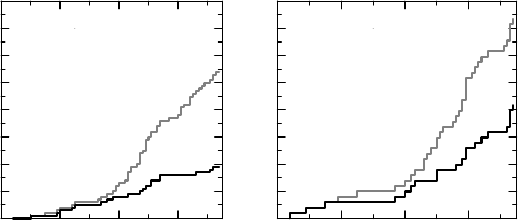
the particular cancer under study. This is illustrated in Figure 12.1, which shows the CIFs
(see Section 11.4), both for all-cause mortality and for cancer deaths. The (right) end-point
of the black curves corresponds to the result in Example 12.1.
To assess the effect of the drug, we want to analyze the cancer mortality in an environment
free of competing causes of death. This is what we (try to) do with the Kaplan–Meier estimator,
0
0.1
0.2
0.3
0.4
0.5
0.6
0.7
0.8
Cumulative Incidence Function
90705030
Time (weeks)
Control Group
0
0.1
0.2
0.3
0.4
0.5
0.6
0.7
0.8
90705030
Time (weeks)
Drug Treated Group
Figure 12.1 The cumulative incidence functions for the two groups. The gray curves show
the all-cause mortality, and the black curves show the mortality for a particular cancer. The
difference is the mortality for other causes.
NONPARAMETRIC TESTS FOR HAZARDS 319
0
0.1
0.2
0.3
0.4
0.5
0.6
0.7
0.8
0.9
1
Kaplan-Meier estimate
120100806040200
Time (weeks)
Control
Treated
0
0.2
0.4
0.6
0.8
Cumulative hazard
12080400
Time (weeks)
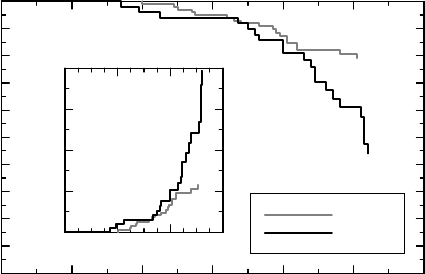
Figure 12.2 The larger graph shows the Kaplan–Meier estimates of the survival distribu-
tions for the drug-exposed rats (black) and their controls (gray). The inset graph shows the
corresponding Nelson–Aalen estimates of the cumulative hazards.
which are shown in Figure 12.2 for the two groups. From this graph the probabilities of cancer
death within 2 years are estimated to be 0.56 and 0.22 in the two groups, respectively. These
numbers differ from, and are higher than, those in Example 12.1. They also give a different
risk ratio, namely 2.49. With the same kind of analysis as in Example 12.1, but using Green-
wood’s variance estimate instead, the corresponding 95% confidence interval is (1.52, 4.45).
The difference between this analysis and the previous one is that the new estimates address
the mortality ratio when the only cause of death for the rats is the particular cancer, under the
assumption that competing risks of death act independently of the risk of interest. The inset
graph in Figure 12.2 displays the (Nelson–Aalen) estimates of the cumulative hazards. We see
that nothing happens for about 30 weeks, whereafter the cumulative hazard increases sharply,
most pronounced for the drug-treated group. From now on most of our discussion will be
concerned with comparing two CDFs, which means censoring relevant competing risks. We
will, however, make the occasional remark on the competing risk case as well.
With these analyses, both of which can be made more precise using profiling techniques
that take all variability into account, we have small p-values associated with the hypothesis
that the true relative risk is one.
An alternative way to compare F (t) and G(t) would be to compare some specified per-
centiles. To do this we can apply the methods described in Section 8.3, again modified so
that they use the Greenwood variance estimate for the Kaplan–Meier estimators. All such
comparisons of two survival functions are comparisons of a single aspect only, and we want
to find methods which use the full Kaplan–Meier estimates when we compare groups. It is to
this that we now turn.
12.3 Nonparametric tests for hazards
When we design tests to compare time-to-event data for two groups, we want these so con-
structed that they compare the hazards, not the CDFs. On a high level this is immaterial,

320 FROM THE LOG-RANK TEST TO THE COX PROPORTIONAL HAZARDS MODEL
because of the relationship between the hazard and the CDF, but because of the nature of
time-to-event data it is natural to model what holds true instantaneously. This also allows us
to handle censored data smoothly.
There are a number of tests available for this situation, many of them from the 1960s and
1970s. The first to attain widespread use was Gehan’s generalization of the Wilcoxon test,
which was constructed by extending the Mann–Whitney score (defined on page 219) in such
a way that it is set to zero when it is not known which of the two variables is the largest. At
about the same time Mantel used a Mantel–Haenszel type of argument to propose a test that
nowadays is known as the log-rank test. Further tests have been proposed by others, but most
are variations on a theme.
The test construction process starts with equation (11.1), which shows how we build
F (t) from knowledge about the hazard d(t) (which we denote d
F
(t) when we wish to
emphasize its relation to the CDF F (t)) and the proportion at risk F
c
(t−). The basic idea
for test construction is that, under a specific assumption about the relation between the two
distributions, we can express d(t) in the CDFs F (t) and G(t), thereby providing a test statistic
which should be close to zero if the model is correct.
To be more specific, we weight the differences dF (t) − F
c
(t−)d(t) with a particular
weight function w(t), which means that we define
=
∞
0
w(t)(dF (t) − F
c
(t−)d(t)). (12.1)
This is by definition zero when (t) =
F
(t), which is the important observation to bring
forward. The choice of weight function w(t) is subject to some constraints. First of all, we
want to use weights constructed from the CDFs of the problem. Second, we want w(t)tobe
estimated by predictable processes, so the function w(t) should be continuous from the left.
With these constraints an immediate choice would be to take
w(t) = a(
c
(t−)) (12.2)
for some function a(u). This is not a necessary choice; we could use some other function of
F
c
(t−) and G
c
(t−). The particular choice a(u) = u
ρ
defines, varying ρ ∈ [0, 1], the Fleming–
Harrington family (of tests). The two border cases ρ = 0 and ρ = 1 in this family are of
particular interest. As can be seen in Box 12.1, the choice ρ = 1 gives us the Wilcoxon test,
while the choice ρ = 0 is what defines the fundamental log-rank test.
In this section our discussion will address the null hypothesis of no group difference. In
other words, we assume that G(t) = F (t), which implies that the hazard for the first group
is the same as the hazard for the combined sample: d(t) = d
(t). Under this assumption
we wish to find an estimator of the parameter in the presence of right-censored data. The
obvious choice is to estimate d(t) with the Nelson–Aalen estimator of the combined sample,
which gives us the stochastic variable
ˆ
=
∞
0
ˆ
w(t)
dN
n
(t) − Y
n
(t)
dN
+
(t)
Y
+
(t)
. (12.3)
Here the single subscript n refers to data from the first group (with n subjects) and the
subscript + means that we sum over both groups. We have ignored a proportionality factor.
The expected value of
ˆ
is zero under the null hypothesis of no group difference, so we
can use this test statistic to test the null hypothesis. For this purpose we need to derive an
NONPARAMETRIC TESTS FOR HAZARDS 321
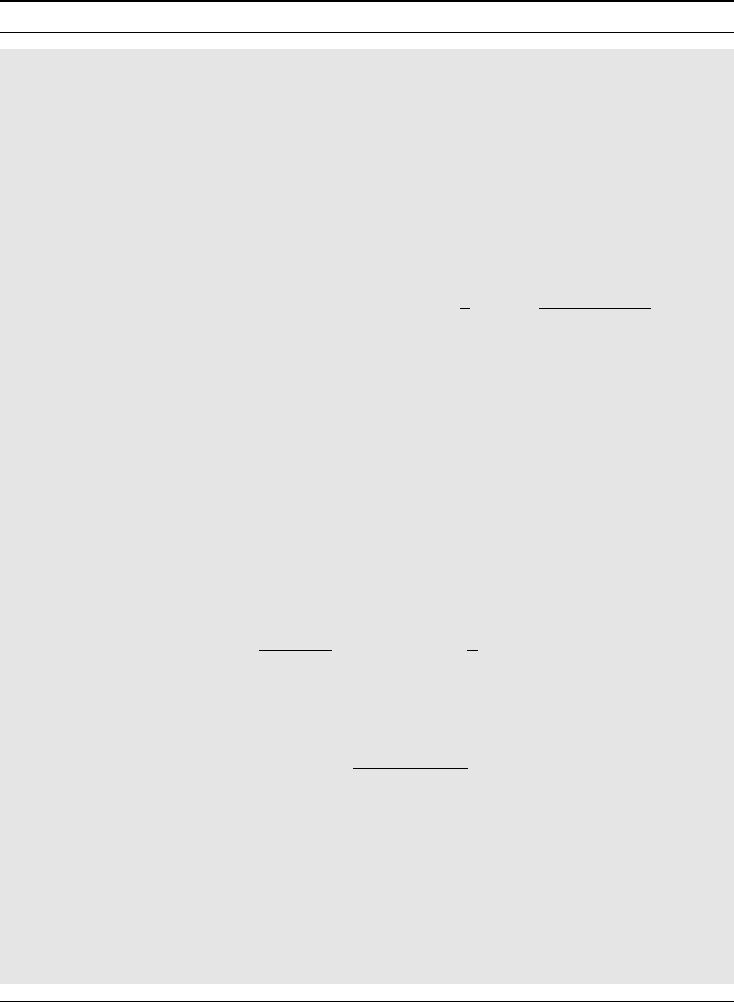
Box 12.1 The limits of the Fleming–Harrington family
The parameter defined by equation (12.1) is of particular interest in the following
two cases.
Case ρ = 1. If we take a(u) = u and change the order of integration in a double integral,
we find that
=
∞
0
c
(t−)dF (t) −
∞
t
dF (s)d(t) =
∞
0
(
c
(t−) −
t
0
d(s))dF (t)
=
∞
0
(1 − ((t−) + (t)))dF (t)
= 2
1
2
−
∞
0
G(t−) + G(t)
2
dF (t)
.
The condition = 0 is therefore equivalent to equation 8.6, which defines the
Wilcoxon test.
Case ρ = 0. If we take a(u) = 1 we find that
= 1 −
∞
0
F
c
(t−)d
(t) =
∞
0
(1 −
(t))dF (t),
which leads to the log-rank test. The name is justified because for continuous distribu-
tions the right-hand side can be written as 1 +
∞
0
ln(
c
(t))dF (t).
Like the Wilcoxon test, the log-rank test defines a rank test for complete data; it can
be written as
∞
0
1 −
t
−∞
d
mn
(s)
c
mn
(s−)
dF
n
(t) = 1 −
1
n
n
i=1
a(R
mn
(x
i
)),
where (assuming no ties) we have
a(k) =
k
i=1
1
n + m + 1 − i
.
These scores are the expected value of the kth-order statistic in a sample of size n + m
from a Exp(1) distribution and were originally introduced by Leonard Savage in order
to test the null hypothesis of equal distributions against the alternative that G(x) ≥ F (x)
with strict inequality at at least one point; he proved that it was the best test for the one-
parameter model (Lehmann alternative) G(x) = F (x)
θ
, θ>1. Note that if there are no
ties (and no censoring) then the Nelson–Aalen estimator for the cumulative hazard is
nm
(t
k
) = a(k).
estimate of its variance, and then appeal to the CLT. The choice of
ˆ
w(t) is not unique even if
we have decided on the weight function, because we can estimate
c
(t−) in different ways.
One choice is to use the Kaplan–Meier estimate for (t), lagged one time step to ensure
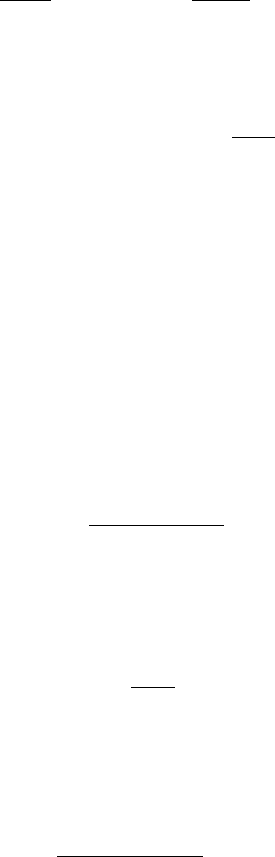
322 FROM THE LOG-RANK TEST TO THE COX PROPORTIONAL HAZARDS MODEL
predictability. Alternatively, we can estimate it by Y
+
(t)/(n + m). These different tests have
slightly different interpretations. If we use the Kaplan–Meier estimate we take weights from
an environment that is free of other risks, whereas if we use the second version we take weights
that depend on the competitive risks present when the data were collected. For the Wilcoxon
test, if we choose the Kaplan–Meier estimator when we estimate
c
(t−), we get either the
Prentice version of the Wilcoxon test for censored data, or a variant due to Peto and Peto
which depends on details we ignore. If we instead estimate it from the ‘at-risk’ function, we
derive Gehan’s version of the test, for which the test statistic is
∞
0
Y
+
(t)
n + m
dN
n
(t) − Y
n
(t)
dN
+
(t)
Y
+
(t)
.
In the sequel, when we refer to the Wilcoxon test for censored data, we mean this version.
The (partial) log-rank test (up to time t) can be written as
N
n
(t) −
t
0
ˆp(s)dN
+
(s), ˆp(t) =
Y
n
(t)
Y
+
(t)
.
The entity ˆp(t), which is a predictable process, is an estimate of the conditional probability
that an event which we know occurs at time t, occurs in the first group. The test is therefore
simply the difference between the number of events that have occurred in the first group and
our prediction of what should happen, conditional on the situation just before each event.
With this interpretation we see that the variance of the log-rank test can be derived from the
variance of the binomial distribution as
t
0
ˆp(s)(1 − ˆp(s))dN
+
(s).
We can use this to compute the p-value for the test of the null hypothesis, at least if there
are no ties. In the presence of ties we need to split these and, referring to the observation on
page 158, we have the adjusted formula:
t
0
ˆp(s)(1 − ˆp(s))
Y
+
(s) − N
+
(s)
Y
+
(s) − 1
dN
+
(s).
The only reason we mention this correction is that it helps us to understand how Nathan
Mantel arrived at the log-rank test. For this we write the integral explicitly as a sum. The
integral in equation (12.3), with
ˆ
w(t) = 1, is a sum over event times t
j
, namely
j
d
1j
−
n
1j
d
j
n
j
,
where n
ij
is the number at risk in group i at time t
j
, d
ij
the corresponding number of events in
the respective groups and n
j
,d
j
the total number at risk and number of events, respectively.
In this notation the variance above is given by
j
n
1j
n
2j
d
j
(n
j
− d
j
)
n
2
j
(n
j
− 1)
.