
Kenny Anthony. The Rise of Modern Philosophy: A New History of Western Philosophy. Volume 3
Подождите немного. Документ загружается.

idea of a perfectly wise and virtuous man, as perhaps the nature of human
frailty will admit.’
Smith and Reid
Adam Smith’s own place is in the history of economics rather than that of
philosophy, but he did hold chairs of logic and moral philosophy at Glasgow
University, and in 1759 he published a Theory of Moral Sentiments. In this work
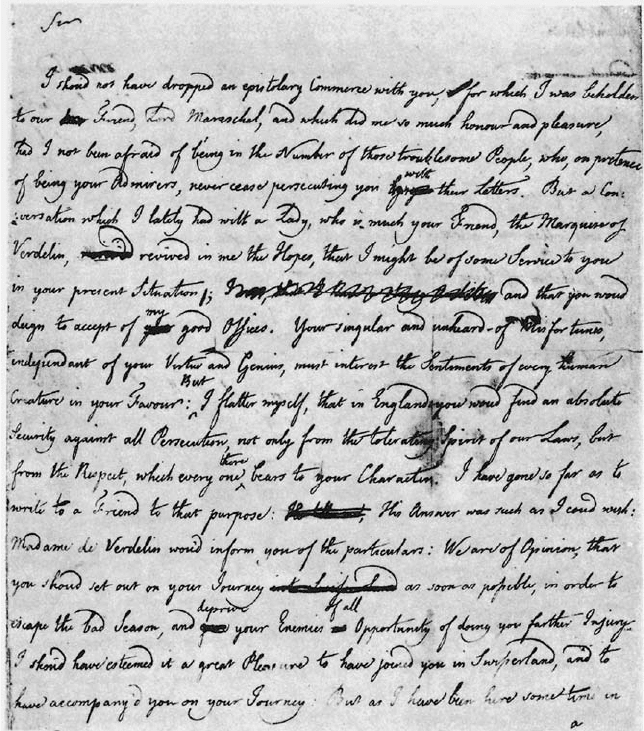
Hume’s draft of a letter to Rousseau inviting him to England
HUME TO HEGEL
86
he carried further Hume’s emphasis on the role of sympathy as a funda-
mental element in our moral judgements, presenting a more complex
analysis of sympathy itself and of its relationship to morality. Whereas, for
Hume, sympathy was essentially a sharing of pleasure or pain with another,
for Smith sympathy has a broader scope and can arise from the sharing of
any passion. Thus, our concern for justice arises from sympathy with
a victim’s resentment of harm. Our approval of benevolence arises from
sympathy both with the benefactor’s generosity and with the beneWciary’s
gratitude. Because of the role of sympathy in generating moral judgement,
the motive of an action matters more to us than outcome; hence utility,
though of the Wrst importance in economics, is not the ultimate criterion
for morality. ‘The usefulness of any disposition of mind is seldom the Wrst
ground of our approbation, and the sentiment of approbation always
involves in it a sense of propriety quite distinct from the perception
of utility’ (TMS, 189).
Moral judgement, he insists, is essentially a social enterprise: a person
brought up on a desert island ‘could no more think of his own character,
of the propriety or demerit of his own sentiments and conduct, of the
beauty or deformity of his own mind than of the beauty or deformity of his
own face’ (TMS, 110). We need the mirror of society to show us ourselves:
we cannot form any judgement of our own sentiments or motives unless
we can somehow distance ourselves from them. Hence:
I divide myself, as it were, into two persons ...The Wrst is the spectator, whose
sentiments with regard to my own conduct I endeavour to enter into, by placing
myself in his situation, and by considering how it would appear to me, when seen
from that particular point of view. The second is the agent, the person whom
I properly call myself, and of whose conduct, under the character of a spectator,
I was endeavouring to form some opinion. (TMS, 113)
This character, the impartial spectator whom Smith thus introduces into
ethics, was to make a frequent appearance in the pages of subsequent moral
philosophers.
While Adam Smith admired Hume and developed some of his philosoph-
ical ideas in an amicable manner, his successor at Glasgow as professor of
moral philosophy, Thomas Reid, (1710–96), was one of the earliest and Wercest
critics not only of Hume but of the whole tradition to which he belonged. In
1764 he published an Inquiry into the Human Mind on the Principles of Common Sense in
HUME TO HEGEL
87
response to Hume’s Treatise, and he followed this up in the 1780s with two
essays on the intellectual and active powers of man. The paradoxical conclu-
sions to which Hume’s investigations led made Reid call in question the basic
principles from which he began, and in particular the system of ideas
common to both the British empiricists and the continental Cartesians:
When we Wnd the gravest philosophers, from Des Cartes down to Bishop Berkeley,
mustering up arguments to prove the existence of a material world, and unable to
Wnd any that will bear examination; when we Wnd Bishop Berkeley and Mr Hume,
the acutest metaphysicians of the age, maintaining that there is no such thing as
matter in the universe—that sun, moon, and stars, the earth which we inhabit,
our own bodies, and those of our friends, are only ideas in our minds, and have no
existence but in thought; when we Wnd the last maintaining that there is neither
body nor mind—nothing in nature but ideas and impressions—that there is no
certainty, nor indeed probability, even in mathematical axioms: I say, when we
consider such extravagancies of many of the most acute writers on this subject,
we may be apt to think the whole to be only a dream of fanciful men, who have
entangled themselves in cobwebs spun our of their own brain.
The whole of recent philosophy, Reid maintains, shows how even the most
intelligent people can go wrong if they start from a false W rst principle.
Reid puts his Wnger accurately on the basic error of Desca rtes and Locke,
arising from the ambiguity of the word ‘idea’. In ordin ary language ‘idea’
means an act of mind; to have an idea of something is to conceive it, to have
a concept of it. But philosophers have given it a diVerent meaning, Reid says,
according to which ‘it does not signify that act of the mind which we call
thought or conception, but some object of thought’. Ideas which are Wrst
introduced as humble images or proxies of things end up by supplanting
what they represent and undermine everything but themselves: ‘Ideas seem
to have something in their nature unfriendly to other existences.’
Ideas in the philosophical sense—postulated intermediaries between the
mind and the world—are, in Reid’s view, mere Wctions. We do of course,
have conceptions of many things, but conceptions are not images, and in
any case it is not conceptions that are the basic building blocks of knowledge,
but propositions. Followers of Locke think that knowledge begins with bare
conceptions (‘simple apprehensions’), which we then put together to form
beliefs and judgements. But that is the wrong way of looking at things.
‘Instead of saying that the belief or knowledge is got by putting together and
comparing the simple apprehensions, we ought rather to say that the simpl e
HUME TO HEGEL
88
apprehension is performed by resolving and analysing a natural and original
judgement’ (I. 2, 4). This thesis that concepts are logically subsequent to
propositions, and result from their analysis, was an anticipation of a doctrine
popular with some analytic philosophers in the twentieth century.
When I see a tree, Reid argues, I do not receive a mere idea of a tree; my
vision of the tree involves the judgement that it exists with a certain shape,
size, and position. The initial furniture of the mind is not a set of discon-
nected ideas, but a set of ‘original and natural ju dgements’. These make up
what Reid calls ‘the common sense of mankind’. ‘Common sense’, before
Reid, was commonly used by philosophers as the name of an alleged inner
sense which discriminated between, and brought together, sense-data from
diVerent exterior senses. It was Reid who gave the expression the meaning
which it has borne in modern times, as a repository of commonly shared
unreasoned principles. In the gre atest part of mankind, Reid says, no higher
degree of reason is to be found, but it is a universal gift of heaven.
Among the common principles that Reid regards as the foundation of
reasoning are a number that had been called in question by the British
empiricists. Against Berkeley, he insists that size, shape, and motion inhere
in material substances. Against Locke, he insists that secondary qualities
also are real qualities of bodies: a colour I see is not identical with my
sensation of it, but is that sensation’s cause. Against Hume, he insists that
our conscious thoughts ‘must have a subject which we call mind’. And he
reaYrms the principle that whatever begins to exist must have a cause
which produced it (Essays on the Active Powers of the Human Mind, 8.3, 6).
Hume often wrote with a degree of contempt about the beliefs of ‘the
vulgar’—the belief, for instance, that objects continue to exist unperceived.
Reid believes that philosophers despise the vulgar at their peril, and that
they can discount their beliefs only because they have surreptitiously
changed the meaning of words. ‘The vulgar have undoubted right to give
names to things which they are daily conversan t about; and philosophers
seem justly chargeable with an abuse of language, when they change the
meaning of a common word, without giving warning.’
Reid said that ‘in the unequal contest betwixt common sense and
philosophy the latter will always come oV both with dishonour and loss’
(I, 1, 4). These should not be taken as the words of a philistine Luddite
opposed to science and technology. Like the ordinary language philo-
sophers of whom he was a precursor, he thought that it was only with
HUME TO HEGEL
89
respect to the meaning of words, not with respect to the truth or falsehood
of propositions, that the man in the street had the Wnal say. And when he
talks of ‘common sense’ he does not mean popular beliefs about nature, or
old wives’ gossip, but rather the self-evident principles which other philo-
sophers presented as intuitions of reason. Science itself was not a matter of
simple common sense, but rather of rational inquiry conducted in the light
of common sense; and the outcome of scientiWc investigation may well
trump individual prejudices of the vulgar.
Reid himself was an experimental scientist, who produced original results
in the geometry of visible objects, som e of them anticipat ing the develop-
ment of non-Euclidean geometries. What he wanted to show in his phil-
osophy was that the realism of the common man was at least as compatible
with the pursuit of science as the sophisticated and sophistical philosophy of
the rationalists and the empiricists.
The Enlightenment
Adam Smith and Thomas Reid were two distinguished ornaments of
what later came to be known as the Scottish Enligh tenment. Throughout
the Europe of the eighteenth century members of the intelligentsia saw
themselves as bringing the light of reason into regions darkened by
ignorance and superstition, but it was France which was seen by itself
and others as the home of the Enlightenment par excellence. The high point
of the French enlightenment was the publication in the 1750s and 1760s of
the seventeen volumes of the Encyclope
´
die, ou Dictionannaire raisonne
´
des arts et des
me
´
tiers, edited by Denis Diderot and Jean d’Alembert. But the ground for
this manifesto had been prepared for more than half a century by ot her
French thinkers.
Pierre Bayle (1647–1706) had brought out a Dictionnaire Historique et Critique
in which he showed, by detailed studies of biblical and historical person-
ages, the inconsistency and incoherence of much of natural and revealed
theology. The moral of his tour d’horizon was that religious faith was only
tenable if accompanied by general toleration, and that the teaching of ethics
should be made independent of religious instruction. Belief in human
immortality, or in the existence of God, was not something necessary for
virtuous living.
HUME TO HEGEL
90
Bayle’s scepticism was controverted by many, most notably by Leibniz
in his Theodicy. But his negative attitude to religious authority set the
tone for Enlight enment thinkers in Germany as well as in France. The
positive element in the Enlightenment—the attempt to achieve a scientiWc
understanding of the human social and political condition—owed more to
another, more systematic thinker, Charles de Secondat, Baron de Mon-
tesquieu (1689–1755).
Montesquieu’s great work was The Spirit of the Laws (1748), which built up
a theory of the nature of the state upon a mass of historical and socio-
logical erudition. This work, which took many years to write, had been
preceded by two shorter works—the Persian Letters of 1721, a satire on French
society, and a more pond erous treatise on the causes of the greatness and
decadence of the ancient Romans (1734).3
Montesquieu spent a period in England and acquired a great admir-
ation for the English Constitution. His Anglophile passion was shared by
later Enlightenment philoso phers, who saw themselves as heirs of Bacon,
Locke, and Newton rather than of Descartes, Spinoza, and Leibniz. The
Wrst philosophical publication of Voltaire (born in 1694 as Franc¸ois Marie
Arouet), the Philosophical Letters of 1734, is full of enthusiasm for the compara-
tive freedom and moderation of English political and ecclesia stical institu-
tions. His admiration for British tolerance was all the more sincere, since
before being exiled to England in 1726 he had already been imprisoned twice
in the Bastille in punishment for libellous pamphlets about senior noblemen.
Locke, Voltaire says in his thirteenth letter, is the Wrst philosopher to
have given a sober account of the human soul in place of the romantic
fantasies woven by earlier philosophers. ‘He has displayed to mankind
the human reason just like a good anatomist explaining the machinery
of the human body.’ In the years before the appearance of the Encyclope
´
die
Voltaire made himself a lively publicist for English science and philosophy,
publishing in 1738 his Philosophy of Newton. The very idea of an encyclopedia
came from England, where in 1728 one Ephraim Chambers had produced,
in two volumes Cyclopaedia; or, an Universal Dictionary of Arts and Sciences.
The two editors of the Encyclope
´
die were men of diVerent talents and
temperaments. D’Alembert was a gifted mathematician with original work
in Xuid dynamics to his credit. He aimed to bring to all the sciences the
3 Montesquieu’s political philosophy is treated in detail in Ch. 9.
HUME TO HEGEL
91
clarity and accuracy of arithmetic and geometry. He was an early propon-
ent of the ideal of a single gr eat uniWed science. ‘The Universe’, he wrote in
the introduction to the Encyclope
´
die, ‘would be only one fact and one great
truth for whoever knew how to embrace it from a single point of view.’ He
was more interested in the biological and social sciences than in physics,
and while d’Alembert was being fe
ˆ
ted by academies, Diderot spent a term
in prison because of a Letter on the Blind which questioned the existence of
design in the universe. The two men shared a faith in the inevitability
of scientiW c progress, a belief that the Christian religion was a great obstacle
to human betterment, and a fundamentally materialist view of human
nature. They gathered a group of like-minded thinkers as contributors to
the Encyclope
´
die, including, besides Montesquieu and Voltaire, Julien de La
Mettrie, a medical doctor who had recently published L’Homme Machine, the
Baron d’Holbach, an atheist who presided over a lavish philosophical salon,
and Claude Helve
´
tius, a determinist psychologist who became notorious
for a book arguing that human beings had no intellec tual powers distinct
from the senses.
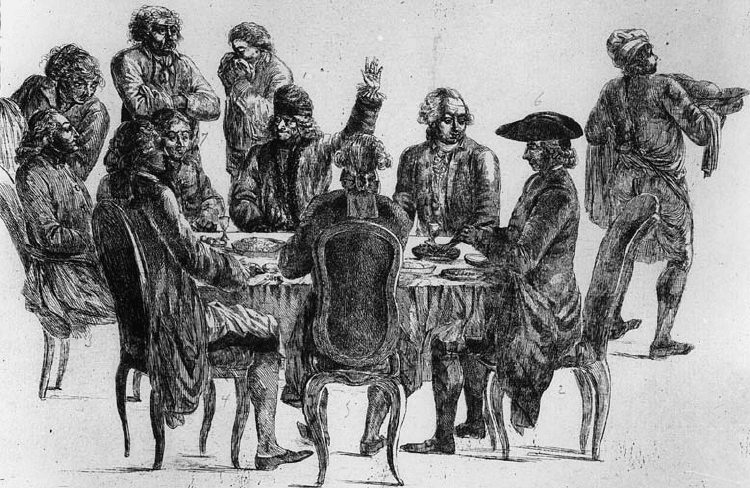
Engraving by Hubert of Voltaire dining with fellow philosophes
HUME TO HEGEL
92
While the Enlightenment philosophers were all anti-clerical, they were
not all atheists. Voltaire, for instance, thought that the world as explained
by Newton manifested the existence of God just as much as a watch shows
the existence of a watchmaker. When he publish ed his own Philosophical
Dictionary in 1764 he wrote, in the entry on atheism:
Atheism is a monstrous evil in those who govern; and also in learned men even if
their lives are innocent, because from their studies they can aVect those who hold
oYce; and that, even if not as baleful as fanaticism, it is nearly always fatal to
virtue . . . Unphilosophical mathematicians have rejected Wnal causes, but true
philosophers accept them; and as a well-known author has said, a catechism
announces God to children, and Newton demonstrates him to wise men. (PD, 38)
If God did not exist, Voltaire famously said, it would be necessary to invent
him—otherwise the moral law would carry no weight. But he did not
himself believe in a God who had freely created the world. Such a God would
have to bear responsibility for catastrophic evils similar to the earthquake
which struck Lisbon in 1755. The world was not a free creation, but a
necessary, eternal, consequence of God’s existence. To reject any accusation
of atheism, Voltaire called himself a ‘theist’, but the standard philosophical
term for those who believe in his type of divinity is ‘deist’.
Although they are often seen as precursors of the French Revolution, the
philosophes were not necessarily radical or even democratic. Diderot accepted
the patronage of Catherine the Great of Russia, and Voltaire was for three
years a chamberlain to Frederick II of Prussia. Their ideas of liberty resem-
bled those of the English revolutionaries of 1688 more than those of the
French revolutionaries of 1789. Freedom of expression was the freedom they
most treasured, and they had no objection in principle to autocracy,
although each of them was to Wnd that their chosen despots were less
enlightened than they had hoped. At home, both men were willing to take
risks in protesting against abuses by government, but they did not call for
any fundamental political changes. Least of all did they want an empower-
ment of the common people—the ‘rabble’, to use Voltaire’s favourite term.
Rousseau
One encyclopedist was willing to go much further—Jean-Jacques Rousseau,
who had contributed several articles on musical topics. Born in Geneva in
HUME TO HEGEL
93
1712, the son of a watchmaker, Rousseau was brought up a Calvinist, but
at the age of sixteen, a runaway apprentice, he became a Catholic in Turin.
This was at the instigation of the Baronne de Warens, with whom he
lived on and oV between 1729 and 1740. After short spells as a singing master
and a household tutor, he obtained a post as secretary to the French
ambassador in Venice in 1743. Dismissed for insubordination, he went
to Paris where he became close to Diderot, whom he visited regularly
during his imprisonment. He was also for a while on good terms with
d’Alembert and Voltaire. But he shocked the philosophes when in 1750
he published a prize essay which gave a negative answer to the question
whether the progress of the arts and sciences had had a beneWcial eVect on
morality. He followed this up four years later by a Discourse on the Origin and
Foundation of Inequality among Men. The theme of both works was that humanity
was naturally good, and corrupted by social institutions. The ideal human
being was the ‘noble savage’ whose simple goodness put civilized man
to shame. All this was, of course, at the opposite pole from the encyclo-
pedists’ faith in scientiWc and social progress: Voltaire called the Discourse
‘a book against the human race’.
Rousseau exhibited his contempt for social convention in a practical
form by a long-standing liason with a washerwoman, Therese Levasseur.
By her he had Wve children whom he dumped, one after the other, in a
foundling hospital. Having written an opera, Le Devin du village, which was
performed before Louis XV at Fontainebleau, he returned to Geneva in 1754
and became a Calvinist a gain, in order to regain his citizenship there.
Voltaire had returned from Berlin and was now settled in the Geneva
region, but the two philosophers were not destined to be good neighbours:
their mutual distaste became public with Rousseau’s Letter on Providence,
published in 1756. When, in 1757, d’Alembert published an encyclopedia
article on Geneva in which he deplored the city’s refusal to allow the
peformance of comedies, Rousseau published in reply a Letter to d’Alembert
in which he discoursed, in the style of Plato’s Republic, on the morally
corrupting inXuence of theatrical peformances. Rousseau had already
quarelled with Diderot for leaking an amatory conWdence, and his break
with the philosophes was complete when he published his Lettres Morales of 1861.
The period 1758 to 1761 was ver y productive for Rousseau, who spent
the years in retirement in a small French country house. He wrote a novel,
La Nouvelle He
´
loı
¨
se, which was an immediate best-seller when it appeared
HUME TO HEGEL
94
in Paris in 1761 He wrote also two philosophical treaties, one on educa-
tion entitled E
´
mile, and one on political philosophy, The Social Contract.
E
´
mile narrated the life of a child educated apart from other children, as
an experiment; The Social Contract began with the memorable words ‘Man is
born free, and is everywhere in chains.’4 These two works were published in
1762 and immediately caused an uproar because of their inXammatory
doctrines. E
´
mile was condemned by the Archbishop and Parliament of Paris
and it and The Social Contract were burnt in Geneva. With a warrant out for
his arrest in both cities, Rousseau Xed to Switzerland (of which Geneva was
not at that time a part). After seeking refuge in various continental cities
he was given sanctuary in England through the good oYces of David
Hume, who secured him a pension from King George III. But his paranoid
ingratitude turned Hume against him, and he returned to France, spending
the last years of his life (1770–78) in Paris. The main achievement of this
period was a book of autobiographical Confessions, which was published some
years after his death.
The year 1778 was also the time of Voltaire’s death. In his later years his
writings had become more explicitly anti-Christian. From his safe haven
at Ferney, near Geneva, he published his irreverent Pocket Philosophical
Dictionary (1765) and The Profession of Faith of Theists in 1768. He wrote also
historical works and dramas, and he died just after returning to Paris for
the triumphant Wrst night of his play Ire
`
ne. Rousseau and Voltaire, enemies
in life, now lie side by side in the crypt of the Pantheon, the mausoleum in
Paris dedicated to the great men of France.
The philosophers of the French Enlightenment, and Rousseau espe-
cially, have been regarded by many as responsible for the revolutionary
convulsions into which France and Europe were plunged soon after their
deaths. Thomas Carlyle, author of The French Revolution, was once reproached
by a businessman for being too interested in mere ideas. ‘There was once a
man called Rousseau’, Carlyle replied, ‘who wrote a book containing
nothing but ideas. The second edition was bound in the skins of those
who laughed at the Wrst.’5
4 Rousseau’s political philosophy is discussed in detail in Ch. 9.
5 Quoted in Alasdair MacIntyre, A Short History of Ethics (London: Routledge, 1976), p. 182.
HUME TO HEGEL
95