
Kenny Anthony. The Rise of Modern Philosophy: A New History of Western Philosophy. Volume 3
Подождите немного. Документ загружается.

I think, in the Wrst place, that I should abandon philosophical research if I
consented to Wnd time for teaching young students. I think, in the second
place, that I do not know the limits within which the freedom of my philosophical
teaching would be conWned, if I am to avoid all appearance of disturbing the
publicly established religion. (Ep, 48)
Spinoza never occupied an academic post, and never married. He con-
tinued to live a retired but comfortable life, welcoming from time to time
visiting scholars who came to pay their respects, such as G. W. Leibniz in
1676. He worked quietly on his major work, Ethics Demonstrated according to the
Geometrical Order. He had it Wnished by 1675 and took the text to Amsterdam
with the intention of having it printed; but he was warned by friends that
he might risk persecution as an atheist if he did so. He returned the book to
his desk and beg an work on a Political Treatise; but it, like several of his other
projects, remained incomplete at his death. He died in 1667 of phthisis, due
in part to the inhalation of glass dust, an occupational hazard for a lens-
grinder. A volume of posthumous works—including the Ethics, the Political
Treatise, plus the early Improvement of the Intellect and a number of letters—was
published in the year of his death. Within a year the volume was banned by
the States of Holland.
The Ethics sets out Spinoza’s own system in the way he had earlier set out
Descartes, on the model of Euclid’s geometry. It is in Wve parts: ‘Of God’;
‘Of the Nature and Origin of the Mind’; ‘Of the Origin and Nature of the
Passions’; ‘Of Human Bondage’; and ‘Of Human Freedom’. Each part begins
with a set of deWnitions and axioms and proceeds to oVe r formal proofs of
numbered propositions, each containing, we are to believe, nothing that
does not follow from the axioms and deWnitions, and concluding with
QED. The geometrical method cannot be regarded as a successful method
of presentation. The proofs often oVer little understanding of the conclu-
sions, and provide at best a set of hypertext links to other passages of the
Ethics. The philosophical meat is often packed into scholia, corollaries, and
appendices.
There is no doubt, however, that Spinoza was doing his best to make his
philosophy utterly transparent, with no hidden assumptions and none but
logical connections between one proposition and the next. If the Euclidean
clothing often wears thin, the work remains geometrical in a more
profound sense: it tries to explain the entire universe in terms of concepts
and relationships that can be mastered by the student of elementary
DESCARTES TO BERKELEY
66
geometry. If the project ultimately fails, it is not the fault of the philoso-
pher but of the nature of philosophy itself.
As the titles of the diVerent parts show, the treatise deals with many
other things besides ethics. The Wrst book is a treatise of metaphysics and
also a treatise of natural theology: it expounds a theory of the nature of
substance which is at the same time an ontological argument for the
existence of God. Whereas for Descartes there were two fundamental
kinds of substance, mental and material, for Spinoza there is only a single
substance (which may be called either ‘God’ or ‘Nature’) which possesses
both the attribute of thought and the attribute of extension. The human
mind and the human body, therefore, do not belong in two diVerent
worlds: the mind, as is explained in the second book, is man considered
as a mode of the attribute of thought, and the body is man considered as a
mode of the attribute of extension. Mind and body are inseparable: the
human mind is in fact simply the idea of the human body. On this
foundation, Spinoza builds up an epistemological theory of three levels
of knowledge: imagination, reason, and intuition.11
It is in the third book that we approach the topic of the book’s title.
Human beings, like all other beings, strive to maintain themselves in
existence and to repel whatever threatens their destruction. The conscious-
ness of this drive in humans is desire, and when the drive operates freely we
feel pleasure, and when it is impeded we feel pain. All the complex
emotions of humans are derived from these basic passions of desire,
pleasure, and pain. Our judgements of good and evil, and therefore our
actions, are determined by our desires and aversions; but the last two books
of the Ethics teach us how to avoid being enslaved by our passions (human
bondage) by an intellectual understanding of them (hum an freedom).
The key to this is the distinction between active and passive emotions.
Passive emotions, like fear and anger, are generated by external forces;
active emotions arise from the mind’s own understanding of the human
condition. Once we have a clear and distinct idea of a passive emotion it
becomes an active emotion; and the replacement of passive emotions by
active ones is the path of liberation. In particular we must give up the
passion of fear, and especially the fear of death. ‘A free man thinks of
11 Spinoza’s metaphysics is considered in detail in Ch. 6, his natural theology in Ch. 10, and
his epistemology in Ch. 4.
DESCARTES TO BERKELEY
67
nothing less than death; and his wisdom is a meditation not on death but
on life’ (Eth, 151).
Moral liberation depends, paradoxically, on the appreciation of the
necessity of all things. We will cease to feel hatred for others when we
realize that their acts are determined by nature. Returning hatred only
increases it; but reciprocating it with lov e vanquishes it. What we must do
is to take a God’s eye view of the whole necessary natural scheme of things,
seeing it ‘in the light of eternity’.12
Spinoza’s unique system can be looked at historically in several diVerent
ways. We can, if we wish, situate his theory of substance in relation to
Locke’s. Both Locke and Spinoza eliminate the Aristotelian notion of
substance: for Locke, individual substances vanish to a virtual zero, for
Spinoza substance expands so far that a single substance encompasses the
universe. But if we take Descartes as our point of comparison, we can say
that in drawing out the implications of Cartesian assumptions Spinoza
overtook Malebranche. Malebranche drew the conclusion that God was
the only agent in the universe; Spinoza went further and claimed that he
was the only substance. But when Spinoza says that this single substance is
‘God or Nature’, does this mean that he is a pantheist or an atheist? He has
been taken with equal justiWcation to be alleging that ‘God’ is just a code
word for the order of the natural universe, and to be claiming that when
scientists speak of ‘Nature’ they are all the time talking of God.
In philosophy the seventeenth century is the age of the revolt against
Aristotle. This revolt is carried to its ultimate length by Spinoza. The
hallmarks of Aristotelian scholasticism are the distinctions it makes and
the pairs of concepts with which it operates to explain human beings and
the material world: actuality and potentiality; form and matter; disposition
and activity; intellect and will; natural and rational powers; Wnal and
formal causes. All these distinctions are collapsed by Spinoza. Of Aristotle’s
repertoire we are left with the distinction between substance and accident,
and of the scholastic apparatus we are left with the distinction between
essence and existence. These are applied once, and once only, by Spinoza in
order to mark the relation between Wnite and inWnite being. Spinoza’s
system is at the furthest point from the medieval Aristotelianism of an
Aquinas.
12 Spinoza’s ethics is considered in detail in Ch. 8.
DESCARTES TO BERKELEY
68
Paradoxically, Spinoza and Aristotle meet at just one point—the highest
of all. The intellectual love of God that Spinoza presen ts in the last book of
his Ethics as the highest human activity is very similar to the joyful
contemplation of the divine that Aristotle holds out, in the tenth book
of his Ethics, as the supreme constituent of human well-being. In each case,
the beatiWc activity to which we are invited has seemed elusive to most
subsequent philosophers.
Spinoza’s philosophy is often regarded as the most extravagant form of
rationalism. He spelt out his system in Euclidean terms not just to
elucidate the logical relations between its various theses: for him logical
sequences were what held the uni verse together. He made no distinction
between logical and causal connections: for him, the order and connec-
tion of ideas are the same as the order and connection of things. Yet this
arch-rationalist exercised great inXuence during the Romantic era. It was
the German Romantic poet Novalis who proclaimed him a ‘God-intoxi-
cated man’ and thus endeared him, later, to Kierkegaard. Wordsworth and
Coleridge used to discuss his philosophy together in Somerset in 1797 and
were nearly arrested for their pains: a government informer sent to
investigate whether the two poets were French revolutionary agents was
perturbed to overhear them referring to Spy Nozy.13
Spinoza’s identiWcation of God and Nature left a mark on the verse of
both poets at this period. Wordsworth described himself as a worshipper of
Nature, and in his 1798 ‘Lines above Tintern Abbey’ he famously wrote:
I have felt
A presence that disturbs me with the joy
Of elevated thoughts; a sense sublime
Of something far more deeply interfused
Whose dwelling is the light of setting suns,
And the round ocean, and the living air,
And the blue sky, and in the mind of man,
A motion and a spirit, that impels
All thinking things, all objects of all thought
And rolls through all things.
In the same year Coleridge, in ‘Frost at Midnight’, predicts for his baby son
a life amid the beauties of sandy lakes and mountain crags, and tells him:
13 Coleridge, Biographia Literaria, Ch. 10.
DESCARTES TO BERKELEY
69
So shalt thou see and hear
The lovely shapes and sounds intelligible
Of that eternal language, which thy God
Utters, who from eternity doth teach
Himself in all, and all things in himself.
Leibniz
Gottfried Wilhelm Leibniz straddles the boundary between the seventeenth
and eighteenth centuries. Fifty-four of the seventy years of his life were
passed in the seventeenth, but his principal philosophical works were
composed and published in the eighteenth. Indeed, many of his most
signiWcant texts were not published until after his death, sometimes long
afterwards. He was not a systematic writer, and historians of philosophy
have struggled to construct a coherent and comprehensive system out of
brief pamphlets, occasional pieces, and fragmentary notes. But the power
of his intellect has never been questioned, and many subsequent philo-
sophers have acknowledged themselves to be in his debt.
Leibniz was the son of a professor of philosophy at Leipzig, who died in
1652, when he was six. He spent much of his childhood in the library left by
his father, reading precociously and voraciously. In adult life he showed
himself to be one of the best-read philosophers ever to have lived. His
interests were wide, including literature, history, law, mathematics, phys-
ics, chemistry, and theology. From the age of thirteen, however, logic and
philosophy had become his dominant passion. Already in his early teens, he
tells us, he found Suarez as easy to read as a novel, and while hiking he
would balance in his mind the rival merits of Aristotelianism and Cartes-
ianism.
In 1661 Leibniz entered Leipzig University. After being awarded the
baccalaureate in 1663 for a scholastic dissertation on the principle of
individuation (G IV. 15–26), he migrated Wrst to Jena to study mathematics,
and then to Altdorf to study law. As a sideline, at the age of nineteen he
published a small logical treatise, De Arte Combinatoria, in which he oVered
some improvements to standard Aristotelian syllogistic and proposed
a method of representing geometrical notions by an arithmetical code.
His method of resolving complex terms into simple ones would, he hoped,
produce a deductive logic of discovery, something that had so far eluded
logicians (G IV. 27–102).
DESCARTES TO BERKELEY
70
Leibniz took his doctorate at Altdorf in 1667, writing a thesis on ‘Hard
Cases in Law’. He was oVered a chair, but preferred to pursue a career as a
courtier and diplomat. He entered the service of the Archbishop of Mainz,
one of the electors of the Holy Roman Empire. He dedicated his next
academic publications to the archbishop: proposals for the rationalization
of German law and a new method of teaching jurisprudence. At the
archbishop’s suggestion he republished a forgotten Wfteenth-century trea-
tise denouncing scholastic philosophy; but he accompanied it with his own
defence of Aristotle against Descartes (G I. 15–27, 129–76). A Protestant in a
Catholic court, he wrote a number of theological works of an ecumenical
cast, concentrating on doctrines that were held in common by all Christian
denominations (G IV. 105–36).
In 1672 Leibniz was sent on a mission to Paris, to persuade Louis XIV to
lead a crusade into Egypt. Diplomatically his trip was abortive, but philo-
sophically it was fruitful. He met Arnauld and Malebranche, and began a
serious reading of Descartes and Gassendi. He was brieXy attracted by
Gassendi’s atomism and materialism, a Xirtation that he later regretted.
‘When I was a youth,’ he wrote in 1716, ‘I too fell into the snare of atoms
and the void, but reason brought me back’ (G VII. 377).
On a further diplomatic visi t in the following year, this time to London,
Leibniz was introduced to Boyle and Oldenburg. He exhibited a model of a
calculating machine to the other members of the Royal Society, who were
suYciently impressed to make him a Fellow. He returned to Paris and
remained there until 1676, in which year he invented the inWnitesimal
calculus, unawar e of Newton’s earlier but as yet unpublished discoveries.
On his way back to Germany he visited Spinoza in Amsterdam, and studied
the Ethics in m anuscript, writing substantial comments. But after the Ethics
had been published, and Spinoza was a target of general obloquy, Leibniz
played down their former intimacy.
From 1676 until his death Leibniz was a courtier to successive rulers of
Hanover, employed in many capacities, from librarian to mining engineer.
He resumed the ecumenical endeavours he had started at Mainz, and began
writing a book of non-sectarian Christian apologetic, for which he sought
advice from Arnauld and approval from the Vatican. In 1677 he wrote
under an alias a book which claimed, inter alia, that the Christian states of
Europe made up a single commonwealth of which the emperor was the
temporal head and the pope the spiritual head.
DESCARTES TO BERKELEY
71
This ecumenical project stalled when the duke who sponsored it died in
1680. Leibniz’s new employer was Duke Ernst August of Brunswick, whose
wife Sophia was the granddaughter of King James I and the sister of
Descartes’ Princess Elizabeth. He set Leibniz to compile the history of his
ducal house, an endeavour which involved archival searches throughout
Germany, Austria, and Italy. Leibniz took the task very seriously, tracing
the history of the region back to prehistoric times. The only part of the
work that was Wnished at his death was a prefatory description of the soil
and minerals of Saxony, a work of geology rather than genealogy.
It was in the winter of 1685 that Leibniz wrote the Wrst of his works
which became lastingly popular, The Discourse on Metaphysics. As soon as he
had written it he sent a summary to Arnauld, who gave it a frosty
welcome; perhaps for this reason he did not publish any of it for ten
years. He regarded it as the Wrst statement of his mature philosophical
position. Brief and lucid, it serves to this day as the best introduction to
Leibniz’s philosophical system, and contains many of his characteristic
doctrines.
The Wrst of these is that we live in the best of all possible worlds, a world
freely chosen by God who always acts in an orderly manner according to
reason. God is not, as Spinoza thought, the only substance: there are also
created individuals. Each individual through its history has many predi-
cates true of it, predicates whose totality deWnes it as the substance it is.
Each such substance, we are told, ‘expresses the universe after its own
manner’, encapsulating the world from a particular viewpoint. Human
beings are substances of this kind: their actions are contingent, not neces-
sary, and depending on free will. Our choices have reasons, but not
necessitating causes. Created substances do not directly act upon each
other, but God has so arranged matters that what happens to one sub-
stance corresponds to what happens to all the others. Consequently, each
substance is like a world apart, independent of any other thing save God.
The human mind contains, from its origin, the ideas of all things; no
external object, other than God, can act upon our souls. Our ideas,
however, are our own ideas and not God’s. So too are the acts of our
will, which God inclines without necessitating. God conserves us continu-
ally in being, but our thoughts occur spontaneously and freely. Soul and
body do not interact with each other, but thoughts and bodily events occur
in correspondence because they are placed in liaison by the loving
DESCARTES TO BERKELEY
72
providence of God. God has so ordered things that spirits, the most
precious items in the universe, live for ever in full self-consciousness; and
for those that love him he has prepared unimaginable felicity.
It will be seen from this brief summary that the Discourse embeds itself in
Aristotelian metaphysics and traditional Christianity, and that it includes
elements from recent continental philosophers carefully modiWed to
cohere with each other. Its main ideas were published in a learned journal
in 1695 under the title New System of Nature and of the Interaction of Substances.
Many savants published criticisms of it, to which Leibniz respon ded with
vigorous rebuttals. In 1698 he followed up with another journal article, ‘On
Nature itself ’, which clearly marked out his own system in contrast to
those of Descartes, Malebranche, and Spinoza, on which he had drawn for
his synthesis.
Having failed to bring together Catholics and Protestants (in spite of his
Systema Theologicum of 1686, which set out common ground between the
various confessions), Leibniz set himself the potentially easier task of achiev-
ing a reconciliation between Calvinist Protestants and Lutheran Protestants.
This again proved beyond his powers of argument and persuasion. So too
was his grandiose project of a European confederation of Christian states,
in which he tried in vain to interest successively Louis XIV of France and
Peter the Great of Russia. But his passion for ecumenism was undimin-
ished, and in the last year of his life he was encouraging those Jesuits who
were seeking an accommodation between Catholic Christianity and the
traditional beliefs and rituals of Chinese Confucians. He remained a Prot-
estant himself until his death, although he sometimes carried a rosary,
which on one occasion prevented him being thrown overboard as a
heretical Jonah during a storm on an Adriatic crossing.
Locke’s rejection of innate ideas in his Essay concerning Human Understanding
provoked Leibniz into an all-out attack on empiricism. This was completed by
1704 but in that year Locke died, and Leibniz decid ed not to publish. It saw the
light some Wfty years after his own death, under the title New Essays on Human
Understanding. The longest work published during Leibniz’s lifetime was Essays in
Theodicy, a vindication of divine justice in the face of the evils of the world,
dedicated to Queen Charlotte of Prussia. ‘Theodicy’ is a pseudo-Greek word
coined to express the project of justifying the works of God to man. The book
argues that in spite of appearances we do indeed live in the best of all possible
worlds. Its message was summed up by Alexander Pope in his Essay on Man:
DESCARTES TO BERKELEY
73
Of Systems possible, if ’tis confest
That Wisdom inWnite must form the best. . . .
Respecting Man, whatever wrong we call,
May, must be right, as relative to all . . .
All Nature is but Art, unknown to thee:
All Chance, Direction which thou canst not see;
All Discord, Harmony, not understood;
All partial Evil, universal Good:
And, spite of Pride, in erring Reason’s spite,
One truth is clear, ‘Whatever is, is RIGHT’.
Pope wrote that in 1734. A quarter of a century later Voltaire, shocked out
of optimism of this kind by the disaster of the Lisbon earthquake,
responded with his satirical Candide. In that novel the Leibnizian Dr Pangloss
responds to a series of miseries and catastrophes with the incantation: ‘All is
for the best in the best of all possible worlds.’ Candide replies: ‘If this is the
best, what must the others be like?’
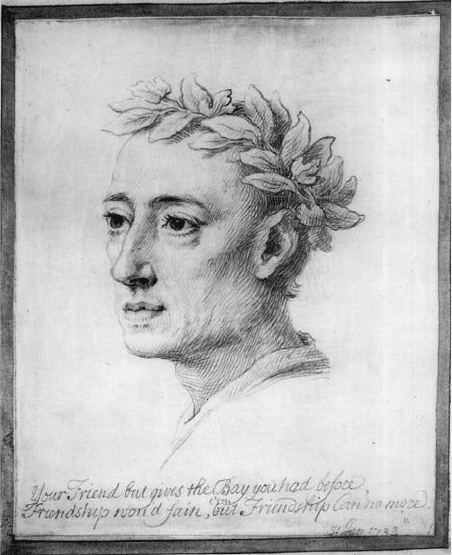
Drawing by Jonathan
Richardson of
Alexander Pope,
whose Essay on Man
must be the most
philosophical long
poem in English
DESCARTES TO BERKELEY
74
In 1714 two of Leibniz’s most important short treatises appeared:
the Monadology and The Principles of Nature and of Grace. The Monadology contains
a developed and polished form of the system adumbrated in the Discourse.
Whatever is complex, it argues, is made up of what is simple, and whatever
is simple is unextended, for if it were extended it could be further
divided. But whatever is material is extended, hence there must be simple
immaterial elements. These soul-like entities Leibniz called monads—these
are the ‘worlds apart’ of the Discourse. Whereas for Spinoza there was
only one substance, with the attributes of both mind and extension, for
Leibniz there are inWnitely many substances, with the properties only
of souls.
Like Malebranche, Leibniz denied that creatures could be causally
aVected by other creatures. ‘Monads’, he said, ‘have no windows, by
which anything could come in or go out.’ Their life is a succession of
mental states or perceptions, but these are not caused by the external world.
A monad mirrors the world, not because the world shines into it, but
because God has programmed it to change in synchrony with the world.
A good clockmaker can construct two clocks which will keep such perfect
time that they forever strike the hours at the same moment. In relation to
all his creatures, God is such a clockmaker: at the very beginning of things
he pre-established the harmony of the universe.
In the same year as Leibniz wrote the Monadology, Queen Anne of
Britain died. The British Act of Settlement of 1701 had settled the succes-
sion on the heirs of Sophie, the Electress of Hanover, and her son, the
Elector Georg Ludwig, became King George I of England. Leibniz did
not follow his employer to London but was left behind in Hanover. He
might well have been unwelcome in England, because of his quarrel
with Newton over the ownership of the inWnitesimal calculus. The
Royal Society had intervened in the dispute and awarded the priority to
Newton in 1712.
Leibniz died in 1716, leaving behind a mass of unpublished papers and a
number of incomplete projects, the most ambitious of which was a
comprehensive encyclopedia of human knowledge. This was to be the
combined work of religious orders, such as the Benedictines and the Jesuits,
and the recently founded learned societies, such as the Royal Society, the
Acade
´
mie des Sciences in Paris, and the Prusssian Academy of which Leibniz
had himself been the Wrst president. Nothing came of the project, and now,
DESCARTES TO BERKELEY
75