
Klipp E., Herwig R., Kowald A., Wierling C., Lehrach H. Systems Biology in Practice: Concepts, Implementation and Application
Подождите немного. Документ загружается.


tory networks (Section 3.5.2) that are essential for the analysis of transcriptome
data.
3.5.1
Introduction
A graph, G (V, E ), is composed of a set of vertices (or nodes),V, and a binary relation,
E,onV. A visual representation of a graph consists of a set of vertices, whereby each
pair is connected by an edge whenever the binary relation holds. If there is an edge
from vertex i to j, we denote it with (i, j) B E. If the edges have a specific direction,
then G(V, E ) is called a directed graph; otherwise, it is called an undirected graph.
A directed graph allows so-called self-loops, i.e., edges from a vertex to itself.
Computationally, a graph containing n vertices can be represented in two ways: as
an adjacency list or as an adjacency matrix (Cormen et al. 2001). An adjacency list
stores for each vertex i the list of vertices connected to vertex i. An adjacency matrix
is an nxn binary matrix defined as A a
ij
, where
a
ij
1 there is an edge from vertex i to vertex j
0 else
. In the case of an undirected
graph, A is symmetric. Commonly, the adjacency-list presentation is preferred if the
graph structure is sparse and there are not many edges compared to the number of
vertex pairs, i.e., jEj << jVj
2
, because then the amount of memory is far less than
when using a matrix representation. A weighted graph consists of a graph, G (V, E ),
together with a real-valued weight function w:E!<. Weighted graphs are used,
e.g., to represent gene regulatory networks (cf. Chapter 9).
The degree of a vertex i, d (i), in an undirected graph is the number of edges con-
nected to i, d i i; j2E;j 1; :::; n
. The degree of a vertex i in a directed
graph is defined as the sum of its in-degree and out-degree. The in-degree of vertex i
is defined as the number of edges entering vertex i, and the out-degree is the num-
ber of edges leaving it. The degree of a vertex i can be computed from the adjacency
matrix as the sum of the i-th row (out-degree) and the i-th column sums (in-degree).
Topological properties of interaction graphs are commonly used in applications to
characterize biological function (Jeong et al. 2001; Stelling et al. 2002; Przulj et al.
2004). For example, lethal mutations in protein-protein interactions are defined by
highly connected parts of a protein interaction graph whose removal disrupts the
graph structure.
A path of length l from a vertex v
0
to a vertex v
i
in a graph G(V, E ) is a sequence of
vertices v
0
,…,v
l
such that (v
i–1
, v
i
) B E for i =1,…,l. A path is a cycle if l 6 1 and
v
0
= v
l
. A directed graph that contains no cycle is called a directed acyclic graph. The
weight of a path in a weighted directed graph is the sum of the weights of all edges
constituting the path. The shortest path from vertex v
0
to vertex v
l
is the path with
the minimal weight. If all weights are equal, then the shortest path is the path from
vertex v
0
to vertex v
l
with the minimal number of edges.
An important practical problem consists of the identification of substructures of a
given graph. An undirected graph is connected when a path exists for each pair of
vertices. If a subset of a graph is connected, it is called a connected component.
100
3 Mathematics in a Nutshell

3.5.2
Regulatory Networks
Regulatory networks are graph-based models for a simplified view on gene regula-
tion (cf. Chapter 8). Transcription factors are stimulated by upstream signaling cas-
cades and bind on cis-regulatory positions of their target genes. Bound transcription
factors promote or inhibit RNA polymerase assembly and thus determine whether
and to what extent the target gene is expressed. The modeling of gene regulation via
genetic networks has been widely used in practice (for a review, see de Jong 2002).
We give here a brief introduction to some basic principles.
3.5.2.1 Linear Networks
The general model of gene regulation assumes that the change of gene expression of
gene x
i
at time t can be described by the following equation
dx
i
t
dt
r
i
f
X
n
j1
w
ij
x
j
t
X
m
k1
v
ik
u
k
tb
i
!
l
i
x
i
t; (3-100)
where
f is the activation function,
x
i
(t) is the gene expression of gene i at time t,
r
i
is the reaction rate of gene i,
w
ij
is the weight that determines the influence of gene j on gene i,
u
k
(t) are the external inputs (e.g., a chemical compound) at time t,
v
ik
is the weight that determines the influence of external compound k on gene i,
b
i
is a lower base level of gene i, and
l
i
is the degradation constant for gene i.
The activation function, f, is a monotone function, assuming that the concentra-
tion of the gene is monotonically dependent on the concentrations of its regulators.
Often, these functions have sigmoid form, such as f (z) = (1 + e
–z
)
–1
. If this function
is the identity, i.e., f (z)=z, then the network is linear. Additionally, common simpli-
fications include constancy in the reaction rates, no external influence, and no degra-
dation, so that Eq. (3-100) reduces to
dx
i
t
dt
X
n
j1
w
ij
x
j
t
b
i
: (3-101)
These models have been investigated, for example, by D’Haeseleer et al. (1999).
The interesting parameters are the weights w
ij
, which are estimated by statistical
methods (cf. Section 3.4.4).
3.5.2.2 Boolean Networks
Boolean networks are qualitative descriptions of gene regulatory interactions. Gene
expression has two states: on (1) and off (0) (Kauffman 1993; Akutsu et al. 1999,
101
3.5 Graph and Network Theory

2000, Cormen et al. 2001). Let x be an n-dimensional binary vector representing the
state of a system of n genes. Thus, the state space of the system consists of 2
n
possi-
ble states. Each component, x
i
, determines the expression of the i-th gene. With
each gene i we associate a Boolean rule, b
i
. Given the input variables for gene i at
time t, this function determines whether the regulated element is active or inactive
at time t + 1, i.e.,
x
i
t 1b
i
xt; 1 i n : (3-102)
Equation (102) describes the dynamics of the Boolean network. The practical feasi-
bility of Boolean networks is heavily dependent on the number of input variables, k,
for each gene. The number of possible input states of k inputs is 2
k
. For each such
combination, a specific Boolean function must determine whether the next state
would be on or off. Thus, there are 2
2k
possible Boolean functions (or rules). This
number rapidly increases with the connectivity. For k = 2 we have four possible input
states and 16 possible rules; for k = 3, we have eight possible input states and 256
possible rules, etc.
In a Boolean network each state has a deterministic output state. A series of states
is called a trajectory. If no difference occurs between the transitions of two states,
i.e., output state equals input state, then the system is in a point attractor. Point at-
tractors are analogous to steady states (cf. Section 3.2.3). If the system is in a cycle of
states, then we have a dynamic attractor. The Boolean rules for one and two inputs
as well as examples for the dynamic behavior of Boolean networks are given in Chap-
ter 10, Section 10.3.3.
There have been algorithms to reconstruct or reverse engineer (cf. Chapter 9)
Boolean networks from time series of gene expression data, i.e., from a limited
number of states. Among the first was REVEAL developed by Liang et al. (1999). Ad-
ditionally, properties of random Boolean networks were intensively investigated by
Kauffman (1993), e.g., global dynamics, steady states, connectivity, and the specific
types of Boolean functions.
3.5.2.3 Bayesian Networks
Bayesian networks are probabilistic descriptions of the regulatory network (Hecker-
man 1998; Friedman et al. 2000; Jensen 2001). A Bayesian network consists of (1) a
directed acyclic graph, G (V, E ) (cf. Section 3.5.1), and (2) a set of probability distribu-
tions. The n vertices (n genes) correspond to random variables x
i
,1^ i ^ n. For ex-
ample, in regulatory networks the random variables describe the gene expression le-
vel of the respective gene. For each x
i
, a conditional probability p(x
i
|L(x
i
)) is defined,
where L(x
i
) denotes the parents of gene i, i.e., the set of genes that have a direct reg-
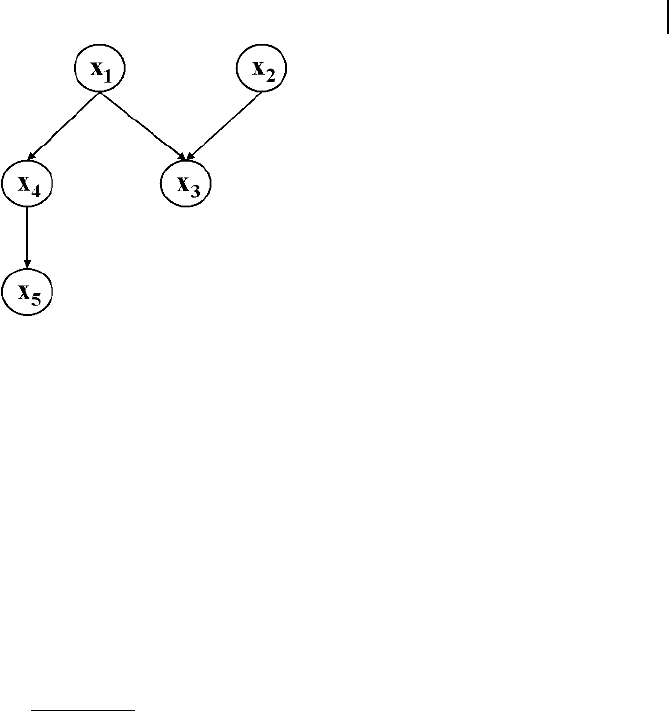
ulatory influence on gene i. Figure 3.11 gives an example of a Bayesian network con-
sisting of five vertices.
The set of random variables is completely determined by the joint probability dis-
tribution. Under the Markov assumption, i.e., the assumption that each x
i
is condi-
tionally independent of its non-descendants given its parents, this joint probability
distribution can be determined by the factorization via
102
3 Mathematics in a Nutshell
p x
Q
n
i1
p x
i
L x
i
: (3-103)
Here, conditional independence of two random variables x
i
and x
j
given a random
variable x
k
means that px
i
; x
j
x
k
j
= px
i
x
k
j
px
j
x
k
j
or, equivalently, px
i
x
j
; x
k
=
px
i
x
k
j
. The conditional distributions given in Eq. (3-103) are typically assumed to
be linearly normally distributed, i.e., p x
i
L x
i
N
P
k
a
k
x
k
; s
2
, where x
k
is in
the parent set of x
i
. Thus, each x
i
is assumed to be normally distributed around a
mean value that is linearly dependent on the values of its parents.
The typical application of Bayesian networks is learning from observations. Given
a training set T of independent realizations of the n random variables x
1
,…,x
n
, the
problem is to find a Bayesian network that best matches T. A common solution is
to assign a score to each calculated network using the a posteriori probability of the
calculated network, N, given the training data (cf. Section 3.4.1) by log P(N| T)=
log
PTN
j
PN
PT
= log PTN
j
log PNconst, where the constant is indepen-
dent of the calculated network and PTN
j
=
R
PTN;Y
j
P Y N
j
d Y is the mar-
ginal likelihood that averages the probability of the data over all possible parameter
assignments to the network. The choice of the a priori probabilities P (N) and
P(Y| N) determines the exact score. The optimization of the a posteriori probability is
beyond the scope of this introduction. For further reading, see e.g., Friedman et al.
2000; Jensen 2001; and Chickering 2002.
3.6
Stochastic Processes
The use of differential equations for describing biochemical processes makes certain
assumptions that are not always justified. One assumption is that variables can at-
tain continuous values. This is obviously a simplification, since the underlying biolo-
gical objects, molecules, have a discrete nature. As long as molecule numbers are
sufficiently large this is no problem, but if the involved molecule numbers are only
103
3.6 Stochastic Processes
Fig. 3.11 Bayesian network. The network structure
determines, e.g., the conditional independencies
i x
1
; x
2
; i x
3
; x
4
x
1
; i x
5
; x
3
x
4
j
. The joint probability
distribution has the form

on the order of dozens or hundreds, the discreteness should be taken into account.
Another important assumption of differential equations is that they treat the de-
scribed process as deterministic. Random fluctuations are normally not part of dif-
ferential equations. Again, this presumption does not hold for very small systems.
A solution to both limitations is to use a stochastic simulation approach that expli-
citly calculates the change of the number of molecules of the participating species
during the time course of a chemical reaction. If we consider the following set of
chemical reactions
A !
k
1
B C
C D !
k
2
E
and denote the number of molecules of the different species X
i
with #X
i
, then the
state of the system is given by S = (#A, #B, #C, #D, #E). If the first reaction takes
place, the system changes into a new state given by S
*
= (#A–1, #B+1, #C+1, #D,
#E). The probability that a certain reaction m occurs within the next time interval dt
is given by the following equation, where a
m
is given by the product of a mesoscopic
rate constant and the current particle number, and o (dt) describes other terms that
can be neglected for small dt (Gillespie 1992).
P S
; t dt S; ta
m
dt o dt:
(3-104)
One approach to proceed within this stochastic framework is to develop a so-called
master equation. For each possible state (#A, #B, #C, #D, #E) a probability variable
is created. Using Eq. (3-104) and the definition of the a
m
’s, a system of coupled differ-
ential equations can be developed that describes the reaction system. The variables
of this system represent transition probabilities, and the equation system itself is
called a master equation. However, because each state requires a separate variable,
the system becomes quickly intractable as the number of chemical species and the
number of each kind of molecule grows.
It was therefore a major breakthrough when Gillespie developed exact stochastic
simulation algorithms (Gillespie 1977). These algorithms are exact in the sense that
they are equivalent to the results of the master equation, but instead of solving the
probabilities for all trajectories simultaneously, the simulation method calculates
single trajectories. Calculating many individual trajectories and studying the statis-
tics of these trajectories can provide the same insights as obtained with the master
equation. Gillespie developed two exact stochastic simulation algorithms, the direct
method and the first reaction method. For this introductory text, we will discuss in
detail only the direct method.
104
3 Mathematics in a Nutshell

3.6.1
Gillespie’s Direct Method
At a given moment in time, the system is in a certain state S and the algorithm com-
putes which reaction happens next and how long it takes until it occurs. Once this is
known, there is enough information to update the state and current time. Both ques-
tions are answered by picking random numbers from appropriate probability distri-
butions. It can be shown (Gillespie 1977) that in a system with n reactions, the prob-
ability that the next reaction is m and that it occurs at time t is given by
P m; tdt a
m
e
t
P
n
i1
a
i
dt : (3-105)
Integrating this equation over all possible reaction times gives us the probability
distribution for the reactions (Eq. (3-106)), and integration over all n possible reac-
tions yields the probability distribution for the waiting times (Eq. (3-107)).
P reaction m
a
m
P
n
i1
a
i
(3-106)
P tdt
X
n
i1
a
i
e
t
P
n
i1
a
i
dt : (3-107)
The pseudocode for the direct method can now be written as follows:
1. Initialize (define mesoscopic rate constants, set initial numbers of molecules, set
time to zero).
2. Calculate a
m
’s (given by the product of mesoscopic rate constants and molecule
number).
3. Choose next reaction m according to Eq. (3-106), i.e., proportional to normalized
reaction rate.
4. Obtain waiting time t by picking a random number from an exponential distribu-
tion with parameter
P
i
a
i
according to Eq. (3-107).
5. Update the number of molecules (state) according to the stoichiometry of reaction
m. Advance time by t.
6. Go to step 2.
3.6.2
Other Algorithms
The direct method described above requires the generation of two random numbers
per iteration, and the computation time is proportional to the number of possible re-
actions. Gillespie’s other algorithm, the first reaction method, works slightly differ-
ently in that it generates a putative waiting time for each possible reaction (again
chosen from an exponential distribution). The reaction to occur is the one with the
105
3.6 Stochastic Processes

smallest waiting time. The algorithm requires n random numbers per iteration
(n = number of reactions) and the computation time is again proportional to the
number of reactions. Gibson and Bruck (2000) succeeded in considerably improving
the efficiency of the first reaction method. Their elegant algorithm, called the next
reaction method, uses only a single random number per iteration, and the computa-
tion time is proportional to the logarithm of the number of reactions. This makes
the stochastic approach amenable for much larger systems.
However, notwithstanding these improvements, stochastic simulations are com-
putationally very demanding, especially if the reaction system of interest contains a
mixture of participating species with large and small molecule numbers. In this case
the simulation will spend most of its time performing reactions of the species with
large molecule numbers (large a
m
’s), although for these species a stochastic treat-
ment is not really necessary. Even worse, the high reaction rates of those species lead
to very short time intervals, t, between individual reactions, so that the simulated
reaction time advances very slowly. Gillespie has formulated another approximate
method that achieves significant speed improvements with only moderate losses in
accuracy (Gillespie 2001). This t-leap method can in principle also be used in cases
of mixed reaction systems, but it loses efficiency because the length of the appropri-
ate time step is determined by the species with the smallest number of molecules
and is on the order of waiting times for exact algorithms. However, a recent software
development using the t-leap method for the fast reactions of a mixed system and
the next reaction method for the slow reactions provides a solution to these problems
(Puchalka and Kierzek 2004). The use of this software package, STOCKS, is de-
scribed in Chapter 14, Section 14.1.8.
3.6.3
Stochastic and Macroscopic Rate Constants
The mesoscopic rate constants used for stochastic simulations and the macroscopic
rate constants used for deterministic modeling are related but not identical. Macro-
scopic rate constants depend on concentrations, while the stochastic constants de-
pend on the number of molecules. A dimension analysis shows how the classical
rate constants for reactions of the first and second orders have to be transformed to
be suitable for stochastic simulations.
3.6.3.1 First-order Reaction
Imagine a first-order decay of a substance X. The reaction rate, v, is given by
v =–k7X, with k being the rate constant. The dimensions for the deterministic de-
scription are
mol
L s
=
1
s
mol
L
and for the stochastic framework
molecules
s
=
1
s
molecules.
The dimension of the rate constant is in both cases 1/s, and thus no conversion is
necessary.
106
3 Mathematics in a Nutshell

3.6.3.2 Second-order Reaction
This time we imagine a substance that is produced by the reaction of one molecule
of X and one molecule of Y. The reaction rate is given by v = k 7X7Y. The dimen-
sions for the deterministic equation are
mol
L s
=
L
s mol
mol
2
L
2
and for the stochastic case
molecules
s
=
1
s molecules
molecules
2
. To convert the macroscopic rate constant from
L
s mol
into
1
s molecules
, the numerical value has to be divided by the reaction vol-
ume and the Avogadro constant (to convert moles into molecules). Thus, a classical
second-order rate constant of 1 M
–1
s
–1
, which has been measured, e.g., in a reaction
volume of 10
–15
L, converts to a mesoscopic rate constant of 1.66610
–9
molecule
–1
s
–1
.
107
References
References
Akutsu, T., Miyano, S. and Kuhara, S. Identifi-
cation of genetic networks from a small num-
ber of gene expression patterns under the
Boolean network model (1999) In: R. B. Alt-
man et al., eds. Proceedings of the Pacific
Symposium on Biocomputing ‚99. Singapore,
pp 17–28.
Akutsu, T., Miyano, S. and Kuhara, S. Infer-
ring qualitative relations in genetic networks
and metabolic pathways (2000) Bioinformatics
16, 727–734.
Bronstein, I.N. and Semendjajew, K.A.
Taschenbuch der Mathematik (1987) 23rd edi-
tion Edition Nauka, Moscow.
Chickering, D.M. Learning equivalence
classes of Bayesian network structures (2002)
J. Machine Learning Res. 2, 445–498.
Cormen,T.H., Leiserson, C.E., Rivest, R.L.
and Stein, C. Introduction to algorithms
(2001) 2nd Edition Edition MIT Press, Cam-
bridge, Mass.
de Jong, H. Modeling and simulation of ge-
netic regulatory systems: a literature review
(2002) J. Comput. Biol. 9, 67–103.
D’Haeseleer, P.,Wen, X., Fuhrman, S., and
Somogyi, R. (1999) Linear modeling of
mRNA expression levels during CNS develop-
ment and injury. In: Pacific Symposium on
Biocomputing 1999, eds. Altman, R.B. et al.,
pp. 41–52.
Friedman, N., Linial, M., Nachman, I. and
Pe’er, D. Using Bayesian networks to analyze
expression data (2000) J. Comput. Biol.7,
601–620.
Gibson, M.A. and Bruck, J. Efficient exact
stochastic simulation of chemical systems
with many species and many channels (2000)
J. Phys. Chem. 104, 1876–1889.
Gillespie, D.T. Exact stochastic simulation of
coupled chemical reactions (1977) J. Phys.
Chem. 81, 2340–2361.
Gillespie, D.T. A rigorous derivation of the che-
mical master equation (1992) Physica A 188,
404–425.
Gillespie, D.T. Approximate accelerated
stochastic simulation of chemically reacting
systems (2001) J. Chem. Phys. 115, 1716–
1733.
Heckerman, D. A tutorial on learning with
Bayesian networks (1998) In: M. I. Jordan, ed.
Learning in graphical models, Kluwer, Dor-
drecht, the Netherlands
Jensen, F.V. Bayesian networks and decision
graphs (2001) Springer, New York.
Jeong, H., Mason, S.P., Barabasi, A.L. and
Oltvai, Z.N. Lethality and centrality in pro-
tein networks (2001) Nature 411, 41–42.
Kahlem, P., Sultan, M., Herwig, R., Stein-
fath, M., Balzereit, D., Eppens, B.,
Saran, N.G., Pletcher, M.T., South, S.T.,
Stetten, G., Lehrach, H., Reeves, R.H. and
Yaspo, M.L. Transcript level alterations reflect
gene dosage effects across multiple tissues in
a mouse model of down syndrome (2004)
Genome Res. 14, 1258–67.
Kauffman, S.A. The origins of order: Self-orga-
nization and selection in evolution (1993)
Oxford University Press, New York.

108
3 Mathematics in a Nutshell
Liang, S., Fuhrman, S. and Somogyi, R.
REVEAL, a general reverse engineering algo-
rithm for inference of genetic network archi-
tecture’ (1999) in R. B. Altman et al., ed. Pro-
ceedings of the Pacific Symposium on Bio-
computing ’98. Singapore, pp 18–28.
Przulj, N.,Wigle, D.A. and Jurisica, I. Func-
tional topology in a network of protein interac-
tions (2004) Bioinformatics 20, 340–348.
Puchalka, J. and Kierzek, A.M. ‘Bridging the
gap between stochastic and deterministic re-
gimes in the kinetic simulations of the bio-
chemical reaction networks’ (2004) Biophysi-
cal Journal 86, 1357–1372.
Stelling, J., Klamt, S., Bettenbrock, K.,
Schuster, S. and Gilles, E.D. Metabolic net-
work structure determines key aspects of func-
tionality and regulation (2002) Nature 420
190–193.

4
Experimental Techniques in a Nutshell
Introduction
In this chapter we will give a brief description of the experimental techniques
used in modern molecular biology. In the same way that Chapter 2 is only an in-
troduction to biology, this chapter is only an introduction to the large arsenal of
experimental techniques that are used and is not meant to be a comprehensive
overview. However, we felt that for readers without an experimental background it
might be interesting and helpful to get a basic idea of the techniques that are
used to actually acquire the immense biological knowledge that is nowadays avail-
able. A basic knowledge of the techniques is also indispensable for understanding
experimental scientific publications or for simply discussing experiments with col-
leagues.
In the first part of this chapter, elementary techniques will be explained that have
already existed for many years but nevertheless still form the basic workhorses of
every day lab work. In the second part, techniques that have been developed more re-
cently are discussed. Some of these techniques are of special interest because they
are able to generate large quantities of data (high-throughput techniques) that can
be used for quantitative modeling in systems biology.
4.1
Elementary Techniques
4.1.1
Restriction Enzymes and Gel Electrophoresis
We have seen in Chapter 2 that the genes that code for the proteins of a cell are all lo-
cated on very long pieces of DNA, the chromosomes. To isolate individual genes, it is
therefore necessary to break up the DNA and isolate the fragment of interest. How-
ever, until the early 1970s this was a very difficult task. DNA consists of only four dif-
ferent building blocks – the nucleotides adenine, thymine, guanine, and cytosine –
making it a very homogeneous and monotonous molecule. In principle the DNA
can be broken into smaller pieces by mechanical shear stress. This can be achieved
109