
Klipp E., Herwig R., Kowald A., Wierling C., Lehrach H. Systems Biology in Practice: Concepts, Implementation and Application
Подождите немного. Документ загружается.

In steady state it holds that
dS
dt
Nv 0 (5-72)
(Reder 1988). The right equality sign denotes a linear equation system for determi-
nation of the rates v. This equation has nontrivial solutions only for Rank N < r
(Chapter 3, Section 3.1). The kernel matrix K fulfilling
NK 0 (5-73)
can express the respective linear dependencies (Heinrich and Schuster 1996). The
choice of the kernel is not unique. It can be determined using the Gauss algorithm
described in Chapter 3 (Section 3.1). It contains as columns r – Rank N basis vectors.
Every possible set of steady-state fluxes can be expressed as a linear combination of
the columns k
i
of K
J
X
rRankN
i1
a
i
k
i
: (5-74)
The coefficients must have respective units (M7s
–1
or mol7L
–1
7s
–1
).
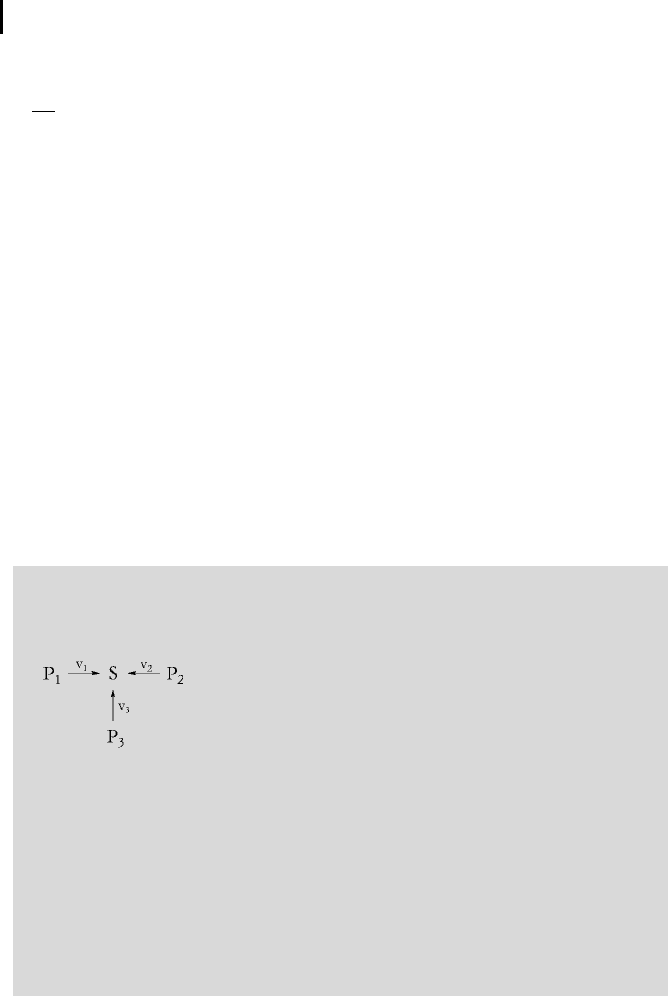
Example 5-6
For the system
(5-75)
the stoichiometric matrix is N = (1 1 1). We have r = 3 reactions and Rank N =1.
Each representation of the kernel matrix contains 3 – 1 = 2 basis vectors, e.g.,
K k
1
k
2
with k
1
1
1
0
0
@
1
A
; k
2
1
0
1
0
@
1
A
; (5-76)
and for the steady state flux it holds that
J a
1
k
1
a
2
k
2
: (5-77)
160
5 Metabolism

Example 5-7
The stoichiometric matrix for the running example is given in Eq. (5-71). It com-
prises r = 8 reactions and has Rank = 5. Thus the kernel matrix has three linearly
independent columns. A possible solution of Eq. (5-73) is
K k
1
k
2
k
3
with k
1
1
1
0
0
0
0
2
0
0
B
B
B
B
B
B
B
B
B
B
@
1
C
C
C
C
C
C
C
C
C
C
A
; k
2
1
1
0
0
0
2
0
0
0
B
B
B
B
B
B
B
B
B
B
@
1
C
C
C
C
C
C
C
C
C
C
A
; k
3
0
1
1
1
1
0
0
0
0
B
B
B
B
B
B
B
B
B
B
@
1
C
C
C
C
C
C
C
C
C
C
A
: (5-78)
If the entries in a certain row are zero in all basis vectors, we have found an equili-
brium reaction. In any steady state, the net rate of the respective reaction must be
zero.
Example 5-8
For the reaction system in Eq. (5-66), the stoichiometric matrix reads
N
1 101
0220
0001
0
@
1
A
with r = 4 and Rank N = 3. Its kernel consists only of one
column K =(1 1 1 0)
T
. Hence it yields v
4
P
1
i1
a 0 0. In any steady state, the
rates of production and degradation of S
3
must equal.
Example 5-9
For the running example, the entry in the last row of the kernel matrix, Eq. (5-78),
is always zero. Hence, in steady state the rate of reaction v
8
must always vanish.
If all basis vectors contain the same entries for a set of rows, this indicates an un-
branched reaction path. In each steady state, the net rate of all respective reactions is
equal.
161
5.2 Metabolic Networks
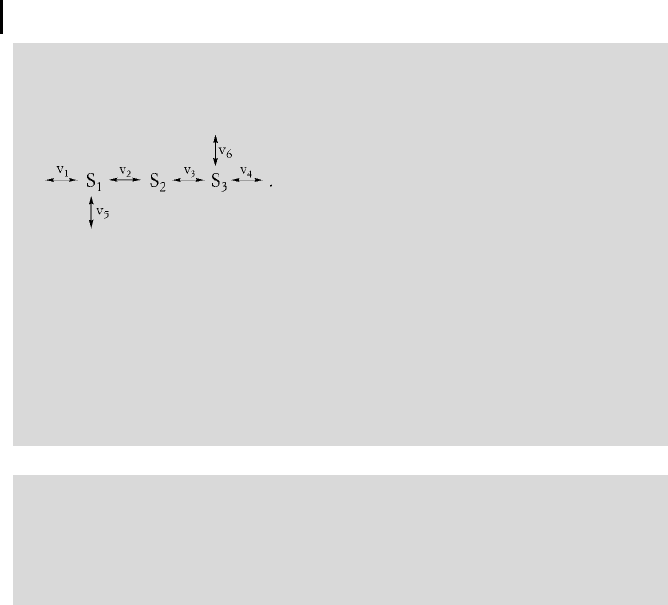
Example 5-10
Consider the reaction scheme
(5-79)
The system comprises r = 6 reactions. The stoichiometric matrix reads
N
1 10 010
0110 00
00 1101
0
@
1
A
with Rank N = 3. Thus the kernel matrix is spanned
by three basis vectors, e.g., k
1
=(11100–1)
T
, k
2
=(100010)
T
, and
k
3
= (–1 –1 –1 –1 0 0)
T
. The entries for the second and third reactions are al-
ways equal; thus, in any steady state the fluxes through reactions 2 and 3 must be
equal.
Example 5-11
In the glycolysis model, the entries for the third, fourth, and fifth reactions are
equal for each column of the kernel matrix (Eq. (5-78)). Therefore, reactions 3–5
constitute an unbranched pathway. In steady state, they must have equal rates.
Up to now, we have not been concerned about (ir)reversibility of reactions in the
network. If a certain reaction is considered irreversible, this has no consequences
for the stoichiometric matrix N but rather for the kernel K. The set of vectors be-
longing to K is restricted by the condition that some values may not become nega-
tive (or positive, depending on the definition of flux direction). If in Example 5-9 re-
action 4 is considered irreversible, then the columns of K must not contain a nega-
tive entry in the fourth row. Choosing k
3
=(aaaa00)
T
with a > 0 fulfills this
condition.
5.2.3
Elementary Flux Modes and Extreme Pathways
The definition of the term “pathway” in a metabolic network is not straightforward.
A descriptive definition of a pathway is a set of subsequent reactions that are in each
case linked by common metabolites. Typical examples include glycolysis or amino
acid synthesis. More detailed inspection of metabolic maps such as the Boehringer
map (Michal 1999) shows that metabolism is highly interconnected. Pathways that
have been known for a long time from biochemical experience are hard to recognize.
It is even harder to discover new pathways, e.g., in metabolic maps that have been
reconstructed from sequence data for bacteria.
162
5 Metabolism
This problem has been elaborated in the concept of elementary flux modes (Hein-
rich and Schuster 1996; Pfeiffer et al. 1999; Schilling et al. 1999; Schuster et al.
1999, 2000, 2002). Here, the stoichiometry of a metabolic network is investigated to
find out which direct routes are possible that lead from one external metabolite to
another external metabolite. The approach takes into account that some reactions
are reversible, while others are irreversible.
A flux mode M is set of flux vectors that represent such direct routes through the
metabolic networks. In mathematical terms it is defined as the set
M {v B R
r
| v lv*, l > 0}, (5-80)
where v *isanr-dimensional vector (unequal to the null vector) fulfilling two condi-
tions: (1) steady state, i.e., Eq. (72), and (2) sign restriction, i.e., the flux directions in
v* fulfill the prescribed irreversibility relations.
A flux mode M comprising v is called reversible if the set M ' comprising –v is also
a flux mode. A flux mode is an elementary flux mode if it uses a minimal set of reac-
tions and cannot be further decomposed, i.e., the vector v cannot be represented as a
nonnegative linear combination of two vectors that fulfill conditions (1) and (2) but
contain more zero entries than v. The number of elementary flux modes is equal to
or higher than the number of basis vectors of the null space.
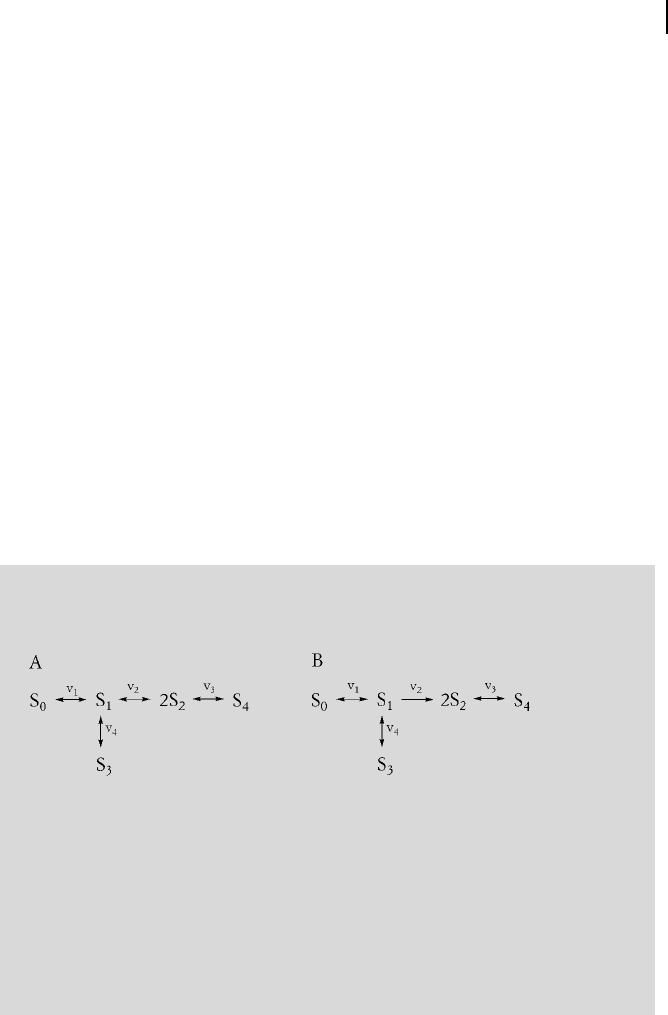
Example 5-12
The systems A and B differ by the (ir)reversibility of reaction 2.
(5-81)
The elementary flux modes connect the external metabolites S
0
and S
3
,S
0
and S
4
,
or S
3
and S
4
. For case A and case B, they read
v
A
1
1
1
0
0
B
B
@
1
C
C
A
;
1
0
0
1
0
B
B
@
1
C
C
A
;
0
1
1
1
0
B
B
@
1
C
C
A
;
1
1
1
0
0
B
B
@
1
C
C
A
;
1
0
0
1
0
B
B
@
1
C
C
A
;
0
1
1
1
0
B
B
@
1
C
C
A
and v
B
1
1
1
0
0
B
B
@
1
C
C
A
;
1
0
0
1
0
B
B
@
1
C
C
A
;
1
0
0
1
0
B
B
@
1
C
C
A
;
0
1
1
1
0
B
B
@
1
C
C
A
:
(5-82)
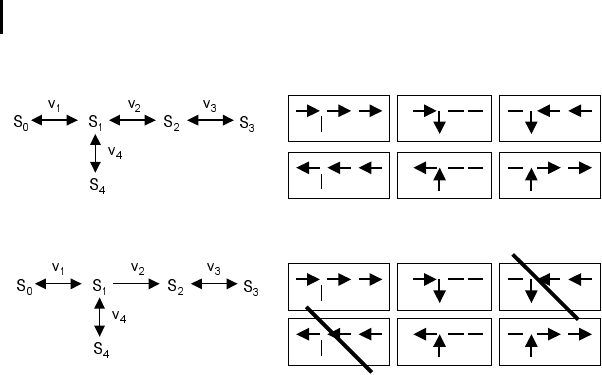
The possible routes are illustrated in Fig. 5.8.
The set of elementary flux modes is uniquely defined. Pfeiffer et al. (1999) have
developed the software Metatool to calculate the elementary flux modes for meta-
bolic networks.
163
5.2 Metabolic Networks
The concept of extreme pathways (Schilling et al. 2000; Schilling and Palsson 2000;
Wiback and Palsson 2002) is analogous to the concept of elementary flux modes, but
here all reactions are constrained by flux directionality, while the concept of elemen-
tary flux modes allows for reversible reactions. To achieve this, reversible reactions
are broken down into their forward and backward components. This way, the set of
extreme pathways is a subset of the set of elementary flux modes and the extreme
pathways are systemically independent.
Elementary flux modes can be used to understand the range of metabolic path-
ways in a network, to test a set of enzymes for production of a desired product and
detect non-redundant pathways, to reconstruct metabolism from annotated genome
sequences and analyze the effect of enzyme deficiency, to reduce drug effects, and to
identify drug targets.
5.2.4
Flux Balance Analysis
Flux balance analysis (FBA) (Varma and Palsson 1994 a, 1994b; Edwards and Pals-
son 2000a, 2000 b; Ramakrishna et al. 2001) investigates the theoretical capabilities
and operative modes of metabolism by involving further constraints in the stoichio-
metric analysis. The first constraint is set by the assumption of a steady state (Eqs.
(5-72) and (5-73)). The second constraint is of a thermodynamic nature, respecting
the irreversibility of reactions as considered in the concept of extreme pathways. The
third constraint may result from the limited capacity of enzymes for metabolite con-
version. For example, in the case of a Michaelis-Menten-type enzyme (Eq. (5-32)),
the reaction rate is limited by the maximal rate, i. e., 0 ^ v ^ V
max
. In general, the
constraints imposed on the magnitude of individual metabolic fluxes read
a
i
v
i
b
i
: (5-83)
164
5 Metabolism
Elementary Flux Modes
Fig. 5.8 Schematic representation of elementary flux modes for the
reaction network depicted in Eq. (5-81).

Further constraints may be imposed by biomass composition or other external
conditions. The constraints confine the steady-state fluxes to a feasible set but
usually do not yield a unique solution. The determination of a particular metabolic
flux distribution has been formulated as a linear programming problem. The idea is
to maximize an objective function Z that is subject to the stoichiometric and capacity
constraints:
Z
P
r
i1
c
i
v
i
! max : (5-84)
where c
i
represents weights for the individual rates. Examples of such objective func-
tions are maximization of ATP production, minimization of nutrient uptake, maxi-
mal yield of a desired product, maximal growth rate, or a combination thereof.
Example 5-13
Maximization of ATP consumption in our running example (Example 5-1) neces-
sitates
Z v
1
v
2
v
4
v
6
v
7
v
8
! max (5-85)
under the conditions of Eq. (5-78) and the maximal rates given in Example 5-1.
5.2.5
Conservation Relations: Null Space of N
T
If a substance is neither added to nor removed from the reaction system (neither
produced nor degraded), its total concentration remains constant. This also holds if
it interacts with other compounds by forming complexes. We have seen already as
an example the constancy of the total enzyme concentration (Eq. (5-29)) when deriv-
ing the Michaelis-Menten rate equation. This was based on the assumption that
enzyme production and degradation take place on a much larger timescale than the
catalyzed reaction.
For the mathematical derivation of the conservation relations (Heinrich and
Schuster 1996), we consider a matrix G fulfilling
GN 0 : (5-86)
Due to Eq. (5-68) it follows that
G
_
S GNv 0 : (5-87)
Integrating this equation leads directly to the conservation relations
GS const : (5-88)
165
5.2 Metabolic Networks

The number of independent rows of G is equal to n – Rank N, where n is the num-
ber of metabolites in the system. G
T
is the kernel matrix of N
T
; hence it has proper-
ties similar to those of K. Matrix G can also be found using the Gauss algorithm. It
is not unique, but every linear combination of its rows is again a valid solution. It ex-
ists a simplest representation G =(G
0
I
n–Rank N
). Finding this representation may
be helpful for simple statement of conservation relations, but this may necessitate
renumbering and reordering of metabolite concentrations (see below).
Example 5-14
Consider a set of two reactions comprising a kinase and a phosphatase reaction:
(5-89)
The metabolite concentration vector reads S =(ATP ADP)
T
, and the stoichio-
metric matrix is N
11
1 1
, yielding G = (1 1). From the condition GS = const.
follows ATP + ADP = const. Thus we have a conservation of adenine nucleotides
in this system. The actual values of ATP + ADP must be determined from the in-
itial conditions.
Example 5-15
For the glycolysis model with the stoichiometric matrix given in Eq. (5-71), the
only possible representation of the conservation matrix is given by multiples of
G 000111
: (5-90)
This means that again the sum of concentrations of adenine nucleotide-contain-
ing substances remains constant (AMP + ADP + ATP = const.).
Importantly, conservation relations can be used to simplify the system of differen-
tial equations
_
S Nv describing the dynamics of our reaction system. The idea is to
eliminate linearly dependent differential equations and to replace them by appropri-
ate algebraic equations. Below, the procedure is explained systematically (Reder
1988).
First we have to reorder the rows in the stoichiometric matrix N as well as in the
concentration vector S such that a set of independent rows is on top and the depen-
dent rows are at the bottom. Then the matrix N is split into the independent part N
0
and the dependent part N', and a link matrix L is introduced in the following way:
N
N
0
N
0
LN
0
I
Rank N
L
0
N
0
: (5-91)
166
5 Metabolism
I
Rank N
is the identity matrix of size RankN. The differential equation system may
be rewritten accordingly
_
S
_
S
indep
_
S
dep
!
I
RankN
L
0
N
0
v ; (5-92)
and the dependent concentrations fulfill
_
S
dep
L
0
_
S
indep
: (5-93)
Integration leads to
S
dep
L
0
S
indep
const: (5-94)
This relation is fulfilled during the entire time course. Thus we may replace the
original system by a reduced differential equation system
_
S
indep
N
0
v (5-95)
supplemented with the set of algebraic equations (Eq. (5-94)).
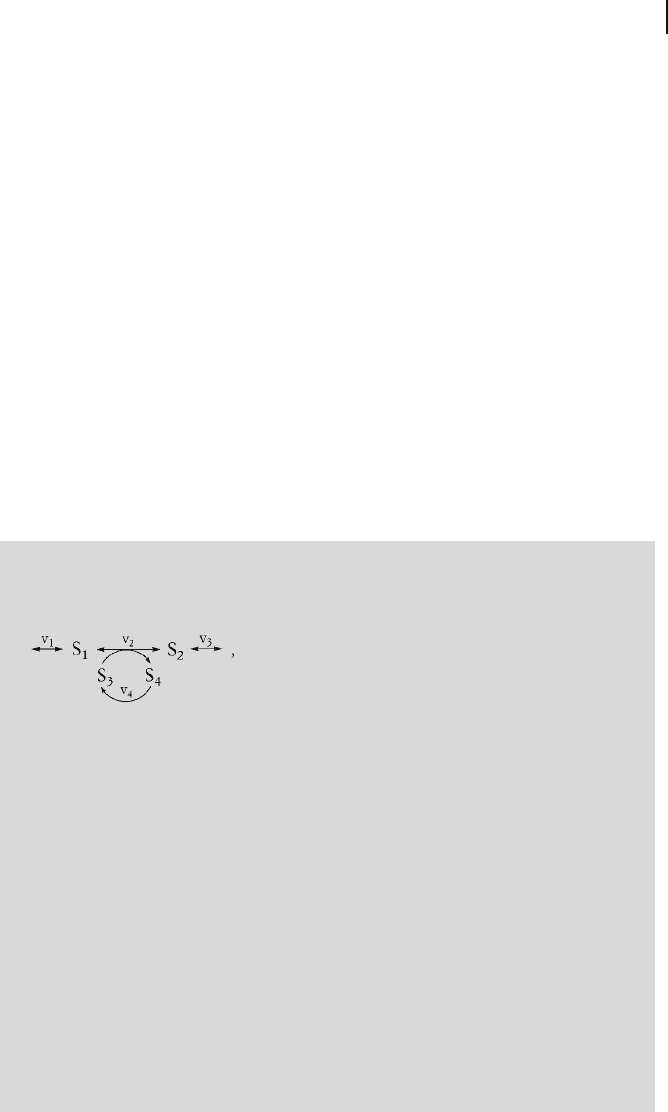
Example 5-16
For the reaction system
(5-96)
the stoichiometric matrix, the reduced stoichiometric matrix, and the link matrix
read
N
1 10 0
0110
0 101
01 01
0
B
B
@
1
C
C
A
; N
0
1 100
0110
0 101
0
@
1
A
; L
10 0
01 0
00 1
001
0
B
B
@
1
C
C
A
; L
0
001
:
The conservation relation S
3
+ S
4
= const. is expressed by G = (0 0 1 1). The ODE
system
_
S
1
v
1
v
2
_
S
2
v
2
v
3
_
S
3
v
4
v
2
_
S
4
v
2
v
4
can be replaced by the differential-algebraic system
_
S
1
v
1
v
2
167
5.2 Metabolic Networks
_
S
2
v
2
v
3
_
S
3
v
4
v
2
S
3
S
4
const:
which has one differential equation less.
5.2.6
Compartments and Transport across Membranes
Eukaryotic cells contain a variety of organelles, e.g., the nucleus, mitochondria, or
vacuoles, that are separated by membranes. Reaction pathways may cross the com-
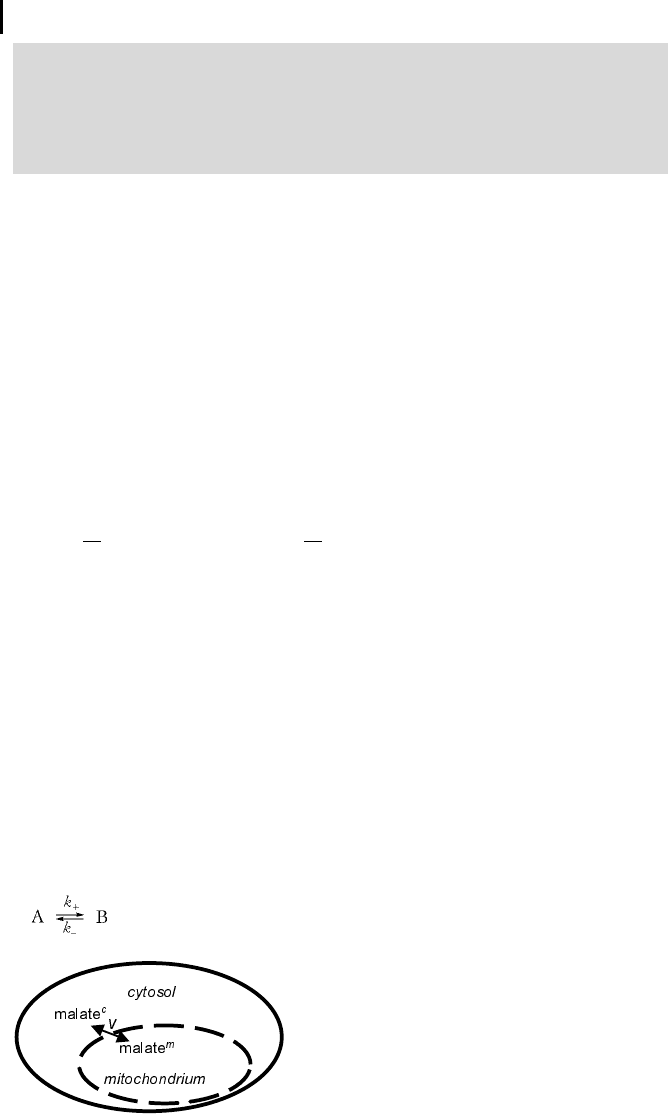
partment boundaries. If a substance, say malate, occurs in two different compart-
ments, e.g., in the cytosol and in mitochondria, the respective concentrations can be
assigned to two different variables, c
mito
malate
and c
cytosol
malate
(see Figure 5.9). Transport
across the membrane has to be considered formally as a reaction with rate v. It is im-
portant to note that both compartments have different volumes, V
mito
and V
cytosol
.
Thus transport of a certain amount of malate from one compartment into the other
changes the concentrations by a different amount:
V
mito
d
dt
c
mito
malat
v and V
cytosol
d
dt
c
cytosol
malat
v ; (5-97)
where V7c denotes the substance amount in moles.
5.2.7
Characteristic Times
An important feature of metabolism is the wide range of timescales in which cellular
processes may occur. Some modifications may happen within seconds, while other
processes take hours or even longer. Even on the level of enzymatic reactions, we
may find large differences in the time they need to respond to changes. For the meta-
bolic reactions the time regime is characterized by the kinetic constants. We will pre-
sent different quantitative measures for their temporal description.
A time constant for the isolated first-order reaction
(5-98)
168
5 Metabolism
Fig. 5.9 Metabolites may be present in different orga-
nelles of the cell, e.g., malate is present in cytosol and
mitochondrion. In this case it is appropriate to con-
sider two compartments and assign malate in the dif-
ferent compartments two different species (malate
c
,
malate
m
)

can be derived simply in the following way. Assume that the reaction is in equili-
brium with A = A
0
, B = B
0
determined by the temperature T. A small increase of T
leads to a perturbation of the equilibrium, a concentration shift x(t)=A
0
– A(t), and
eventually a new equilibrium: A = A
n
, B = B
n
. Due to the mass action law, during re-
laxation it holds that
d B
n
x
dt
k
A
n
xk
B
n
x: (5-99)
In the new equilibrium, the concentration changes vanish
dB
n
dt
k
A
n
k
B
n
0 (5-100)
and it results in
dx
dt
k
k
x : (5-101)
Integration leads to
x x
0
e
k
k
t
: (5-102)
The initial shift of x at t = 0 is given by
x
0
A
0
A
n
: (5-103)
Setting
1
t
k
k
(5-104)
determines t as the relaxation time for the decrease of x from its initial value to the
1/e-fold value. It results in
x A
0
A
n
e
t=t
: (5-105)
The relaxation time as introduced in Eqs. (5-104) and (5-105) concerns concentra-
tion changes. In general, one can distinguish between time constants for reaction
rates and time constants for the change of concentrations.
A more general definition of a time constant for reactions is given by Higgins
(1965). The response time is defined as
t
j
X
i
n
ij
iv
j
iS
i
!
1
: (5-106)
169
5.2 Metabolic Networks