
Klipp E., Herwig R., Kowald A., Wierling C., Lehrach H. Systems Biology in Practice: Concepts, Implementation and Application
Подождите немного. Документ загружается.

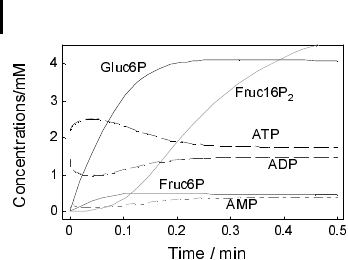
In this chapter it will be illustrated how metabolic models such as this model of
upper glycolysis can be described and analyzed. We will present possible choices for
rate equations and give reasoning for these choices. The information contained in
the network structure, i.e., in the stoichiometry, shall be extracted: Are there main
routes through the network? Which fluxes are possible in steady state? Will sub-
stances be produced or consumed, or are there conservation relations for metabolite
concentrations? Metabolic control analysis will enable us to assess the influence of
parameter changes in one part of the network on changes of variables (here, steady-
state fluxes or concentrations) at any place of the network.
5.1
Enzyme Kinetics and Thermodynamics
This chapter deals with the deterministic kinetic modeling of individual biochemical
reactions. The basic quantities are the concentration S of a substance S (i.e., the
number n of molecules of this substance per volume V) and the rate v of a reaction
(i.e., the change of concentration S per time t). This type of modeling is macroscopic
or phenomenological compared to the microscopic approach, where single mole-
cules and their interactions are considered.
Chemical and biochemical kinetics rely on the assumption that the reaction rate v
at a certain point in time and space can be expressed as a unique function of the con-
centrations of all substances at this point in time and space. Classical enzyme ki-
netics assumes for simplicity’s sake a spatial homogeneity (the “well-stirred” test
tube) and no direct dependency of the rate on time:
vtvSt: (5-10)
In more advanced modeling approaches moving towards whole-cell modeling,
spatial inhomogeneities are taken into account, paying tribute to the fact that many
components are membrane-bound or that cellular structures hinder the free move-
ment of molecules. However, in most cases one can assume that diffusion is rapid
enough to allow for an even distribution of all substances in space.
140
5 Metabolism
Fig. 5.2 Time courses of concentrations for
the running model presented (Example 5-1).
Parameters are stated there. Initial values:
Gluc6P(0) = 1 mM, Fruc6P(0) = 0 mM,
Fruc1,6P
2
(0) = 0 mM, ATP(0) = 2.1 mM,
ADP(0) = 1.4 mM, AMP(0) = 0.1 mM.
Enzymes catalyze biochemical reactions. Enzymes are proteins, often in complex
with cofactors (Chapter 2, Section 2.1). They have a catalytic center, are usually
highly specific, and remain unchanged by the reaction. One enzyme molecule cata-
lyzes about a thousand reactions per second (the so-called turnover number ranges
from 10
2
s
–1
to 10
7
s
–1
). This leads to a rate acceleration of about 10
6
-to10
12
-fold
compared to the uncatalyzed, spontaneous reaction.
5.1.1
The Law of Mass Action
Biochemical kinetics is based on the mass action law, introduced by Guldberg and
Waage in the 19th century (Waage and Guldberg 1864; Guldberg and Waage 1867,
1879). It states that the reaction rate is proportional to the probability of a collision of
the reactants. This probability is in turn proportional to the concentration of reac-
tants to the power of the molecularity, i.e., the number in which they enter the speci-
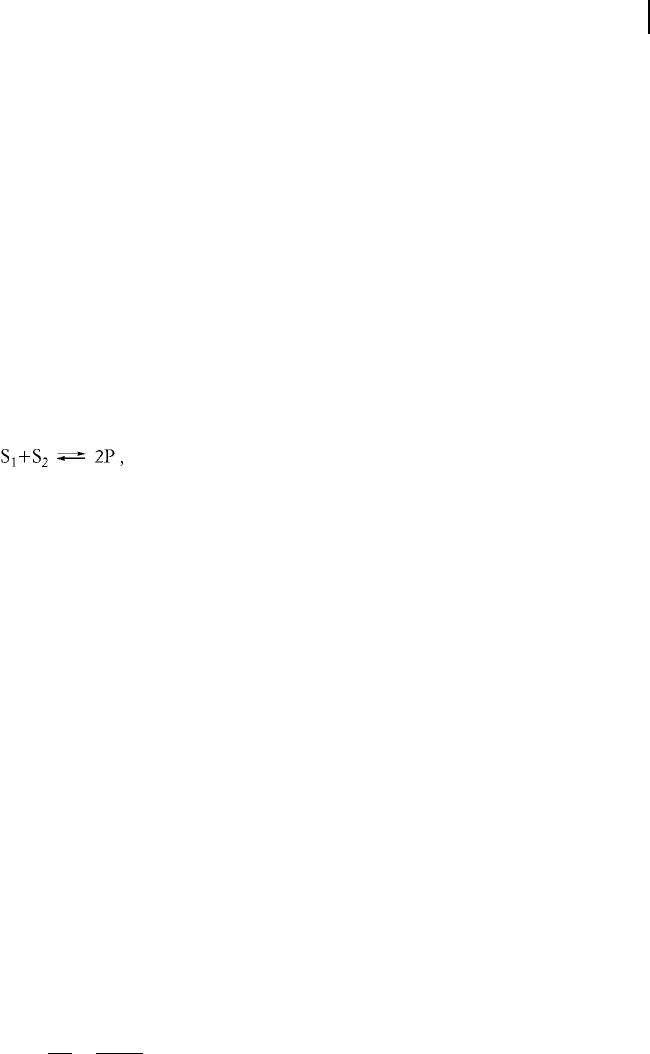
fic reaction. For a simple reaction like
(5-11)
the reaction rate reads
v v
v
k
S
1
S
2
k
P
2
: (5-12)
v is the net rate, v
+
the rate of the forward reaction, v
–
the rate of the backward reac-
tion, and k
+
and k
–
are the respective proportionality factors, the so-called kinetic or rate
constants. The molecularity is 1 for each substrate of the forward reaction and 2 for the
backward reaction. If we measure the concentration in moles per liter (mol7L
–1
or M)
and the time in seconds (s), then the rates have the unit M7s
–1
. Accordingly, the rate
constants for bimolecular reactions have the unit M7s
–1
. Rate constants of monomole-
cular reactions have the dimension s
–1
. The general mass action rate law for a reaction
with substrate concentrations S
i
and product concentrations P
j
reads
v v
v
k
Q
i
S
m
i
i
k
Q
j
P
m
j
j
; (5-13)
where m
i
and m
j
denote the respective molecularities of S
i
and P
j
in this reaction
(Heinrich and Schuster 1996).
The equilibrium constant K
eq
(we will also use the simpler symbol q) characterizes
the ratio of substrate and product concentrations in equilibrium (S
eq
and P
eq
), i.e.,
the state with equal forward and backward rates. The rate constants are related to K
eq
in the following way:
K
eq
k
k
Q
P
eq
Q
S
eq
: (5-14)
141
5.1 Enzyme Kinetics and Thermodynamics

The relation between the thermodynamic description and the kinetic description
of biochemical reactions will be outlined in Section 5.1.2.
The dynamics of the concentrations for Eq. (5-11) is described by the ODEs
d
dt
S
1
d
dt
S
2
v
d
dt
P 2 v : (5-15)
The time course of S
1
, S
2
and P is obtained by integration of these ODEs.
Example 5-2
The kinetics of a simple decay such as
(5-16)
is described by v = kS and
d
dt
S =–kS. Integration of this ODE from time t =0
with the initial concentration S
0
to an arbitrary time t with concentration S(t),
R
S
S
0
dS
S
=
R
t
t0
kdt;yields the temporal expression S(t)=S
0
e
–kt
.
5.1.2
Reaction Kinetics and Thermodynamics
An important purpose of metabolism is to extract energy from nutrients, which is nec-
essary for the synthesis of molecules, for growth, and for proliferation. We distinguish
between energy-supplying reactions, energy-demanding reactions, and energetically
neutral reactions. The principles of reversible thermodynamics and their application
to chemical reactions allow understanding of energy circulation in the cell. This is
eased by the assumption that biological reactions usually occur in hydrous solution at
constant pressure and constant temperature with negligible volume changes.
Whether a reaction occurs spontaneously or not, in which direction a reaction pro-
ceeds, and the position of the equilibrium are important characteristics of a bio-
chemical process. The first law of thermodynamics, i. e., the law of energy conserva-
tion, tells us only that the total energy of a system remains constant during any pro-
cess. The second law of thermodynamics declares that a process occurs sponta-
neously only if it increases the total entropy of the system. Unfortunately, entropy is
usually not directly measurable. A more suitable measure is the Gibbs free energy
G, which is the energy capable of carrying out work under isotherm-isobar condi-
tions, i.e., at constant temperature and constant pressure. The change of the free en-
ergy is given as
DG DH TDS ; (5-17)
142
5 Metabolism

where DH is the change in enthalpy, DS is the change in entropy, and T is the abso-
lute temperature in Kelvin. DG is a measure for the driving force, the spontaneity of
a chemical reaction. If DG < 0 then the reaction proceeds spontaneously under re-
lease of energy (exergonic process). If DG > 0 then the reaction is energetically not
favorable and will not occur spontaneously (endergonic process). DG = 0 means that
the system has reached its equilibrium. Endergonic reactions may proceed if they ob-
tain energy from a strictly exergonic reaction by energetic coupling. Free energy is
usually given for standard conditions (DG
0
), i. e., for a concentration of the reaction
partners of 1 M, temperature T = 298 K, and, for gaseous reactions, a pressure of p =
98.1 kPa = 1 atm. The unit is kJ mol
–1
. For the free energy difference, a set of rela-
tions holds as follows. The free energy difference is related to redox potential E
red/ox
:
DG nF E
red=ox
; (5-18)
where n is the number of transferred charges and F is the Faraday constant (96,500
coulomb). The free energy difference for a reaction can be calculated from the differ-
ence of the sums of free energies of its products P and its substrates S:
DG
P
G
P
P
G
S
: (5-19)
The enzyme cannot change the free energies of the substrates and products of a
reaction, nor their differences, but it changes the so-called reaction path, thereby
lowering the activation energy for the reaction. The transition state theory explains
this (Haynie 2001). It has been observed that many substances or mixtures are ther-
modynamically unstable, since DG 5 0 (see Tab. 5.1). Nevertheless, they can be
stored under normal conditions for a long time. The reason is that during the course
of a reaction, the metabolites must pass one or more transition states of maximal
free energy, in which bonds are solved or newly formed. The transition state is un-
stable; the respective molecule configuration is called an activated complex. It has a
lifetime of around one molecule vibration, 10
–14
…10
–13
s, and it can hardly be ex-
perimentally verified. The difference DG
=
of free energy between the reactants and
143
5.1 Enzyme Kinetics and Thermodynamics
Tab. 5.1 Values of DG
0
' for some important reactions
Reaction DG
0
'/(kJ mol
–1
)
2H
2
+O
2
? 2H
2
O –474
2H
2
O
2
? 2H
2
O+O
2
–99
PP
i
+H
2
0 ? 2P
i
–33.49
ATP + H
2
0 ? ADP + P
i
–30.56
Glucose-6-phosphate + H
2
0 ? Glucose + P
i
–13.82
Glucose + P
i
? Glucose-6-phosphate + H
2
0 +13.82
Glucose-1-phosphate ? Glucose-6-phosphate –7.12
Glucose-6-phosphate ? Fructose-6-phosphate +1.67
Glucose + 6 O
2
? 6CO
2
+6H
2
0 –2890
Source: Lehninger 1975
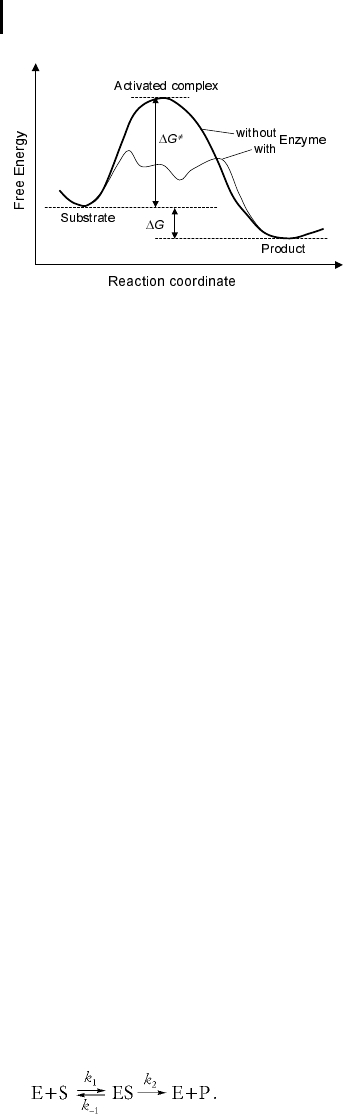
the activated complex determines the dynamics of a reaction: the higher this differ-
ence, the lower the probability that the molecules may pass this barrier and the lower
the rate of the reaction. The value of DG
=
depends on the type of altered bonds, on
steric, electronic, or hydrophobic demands, and on temperature.
Figure 5.3 presents a simplified view of the reaction course. The substrate and the
product are situated in local minima of the free energy; the active complex is as-
signed to the local maximum. The free energy difference DG is proportional to the
logarithm of the equilibrium constant of the respective reaction:
DG RT ln K
eq
; (5-20)
(R – gas constant, 8.314 J mol
–1
K
–1
). The value of DG
=
corresponds to the kinetic
constant k
+
of the forward reaction (Eqs. (12)–(14)) by DG
=
=–RT ln k
+
, while DG
=
+ DG is related to the rate constant k
–
of the backward reaction.
The interaction of the reactants with an enzyme may alter the reaction path and
thereby lead to lower values of DG
=
. Furthermore, the free energy may assume
more local minima and maxima along the path of reaction. They are related to un-
stable intermediary complexes. Values for the difference of free energy for some bio-
logically important reactions are given in Tab. 5.1.
The detailed consideration of enzyme mechanisms by applying the mass action
law for single events has led to a number of standard kinetic descriptions, which will
be explained in the following sections.
5.1.3
Michaelis-Menten Kinetics
Brown (1902) proposed the first enzymatic mechanism for the reaction of invertase,
which holds for all one-substrate reactions without backward reaction and without
effectors in general:
(5-21)
144
5 Metabolism
Transition State
Fig. 5.3 Presentation of the change of free
energy along the course of reaction. The sub-
strate and the product are situated in local
minima of the free energy; the active complex
is assigned to the local maximum. The en-
zyme may change the reaction path and
thereby lower the barrier of free energy.

It comprises a reversible formation of an enzyme-substrate complex ES from the
free enzyme E and the substrate S and an irreversible release of the product P from
the enzyme E. The respective system of ODEs for the dynamics of this reaction reads
as follows:
dS
dt
k
1
E S k
1
ES (5-22)
dES
dt
k
1
E S k
1
k
2
ES (5-23)
dE
dt
k
1
E S k
1
k
2
ES (5-24)
dP
dt
k
2
ES : (5-25)
The rate of the reaction is equal to the negative rate of decay of the substrate as
well as to the rate of product formation:
v
dS
dt
dP
dt
: (5-26)
This ODE system (Eqs. (5-22)–(5-26)) cannot be solved analytically. Assumptions
have been used to simplify this system in a satisfactory way. Michaelis and Menten
(1913) assumed that the conversion of E and S to ES and vice versa is much faster
than the decomposition of ES into E and P (so-called quasi-equilibrium between the
free enzyme and the enzyme-substrate complex), or in terms of the constants
k
1
; k
1
p k
2
: (5-27)
Briggs and Haldane (1925) assumed that during the course of reaction a state is
reached where the concentration of the ES complex remains constant. This assump-
tion is justified only if the initial concentration of the substrate is much larger than
the concentration of the enzyme, S(t =0)p E; otherwise, this steady state will never
be reached. They suggested the more general assumption of a quasi-steady state of
the ES complex:
dES
dt
0 : (5-28)
An expression for the reaction rate will be derived using the ODE system in Eqs.
(5-22)–(5-25) and the assumption of a quasi-steady state for ES. Adding Eqs. (5-23)
and (5-24) results in
dES
dt
dE
dt
0orE
total
E ES : (5-29)
145
5.1 Enzyme Kinetics and Thermodynamics

In this reaction, enzyme is neither produced nor consumed; it may be free or in-
volved in the complex, but its total concentration remains constant.
Introducing Eq. (5-29) into Eq. (5-23) under the steady-state assumption (Eq. (5-28))
yields
ES
k
1
E
total
S
k
1
S k
1
k
2
E
total
S
S
k
1
k
2
k
1
: (5-30)
For the reaction rate, this yields
v
k
2
E
total
S
S
k
1
k
2
k
1
: (5-31)
In enzyme kinetics it is convention to present Eq. (5-31) in a simpler form, which
is important in both theory and practice:
v
V
max
S
S K
m
: (5-32)
Equation (5-32) is the expression for Michaelis-Menten kinetics. The parameters
have the following meaning: the maximal velocity,
V
max
k
2
E
total
; (5-33)
is the maximal rate that can be attained when the enzyme is completely saturated
with substrate. The Michaelis constant,
K
m
k
1
k
2
k
1
; (5-34)
is equal to the substrate concentration that yields the half-maximal reaction rate. For
the quasi-equilibrium assumption (Eq. (5-27)), it holds that K
m
k
1
k
1
=
. The mean-
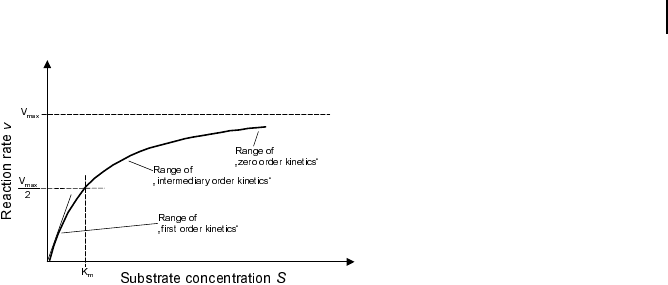
ing of the parameters can be seen from the plot of rate versus substrate concentra-
tion (Fig. 5.4). The plot has a hyperbolic shape.
Reaction v
1
, Eq. (5-2), is described with Michaelis-Menten kinetics.
5.1.3.1 How to Derive a Rate Equation
Below we will present some enzyme kinetic standard examples. Individual mechan-
isms for your specific enzyme of interest may be more complicated or merely differ
from these standards. Therefore, we summarize here the general way of deriving a
rate equation.
1. Draw an illustration of all steps to consider (e. g., Eq. (5-21)). It contains all sub-
strates and products (S and P) and n free or bound enzyme species (E and ES).
146
5 Metabolism
2. The right sites of the ODEs for the concentrations changes sum up the rates of all
steps leading to or away from a certain substance (e.g., Eqs. (5-22)–(5-25)). The
rates follow mass action kinetics (Eq. (5-12)).
3. The sum of all enzyme-containing species is equal to the total enzyme concentra-
tion E
total
(the right side of all differential equations for enzyme species sum up to
zero). This constitutes one equation.
4. The assumption of a quasi-steady state for n – 1 enzyme species (i. e., setting the
right sides of the respective ODEs equal to zero) together with step 3 results in n
algebraic equations for the concentrations of the n enzyme species.
5. The reaction rate is equal to the rate of product formation (e.g., Eq. (5-26)). Intro-
duce the respective concentrations of enzyme species resulting from step 4.
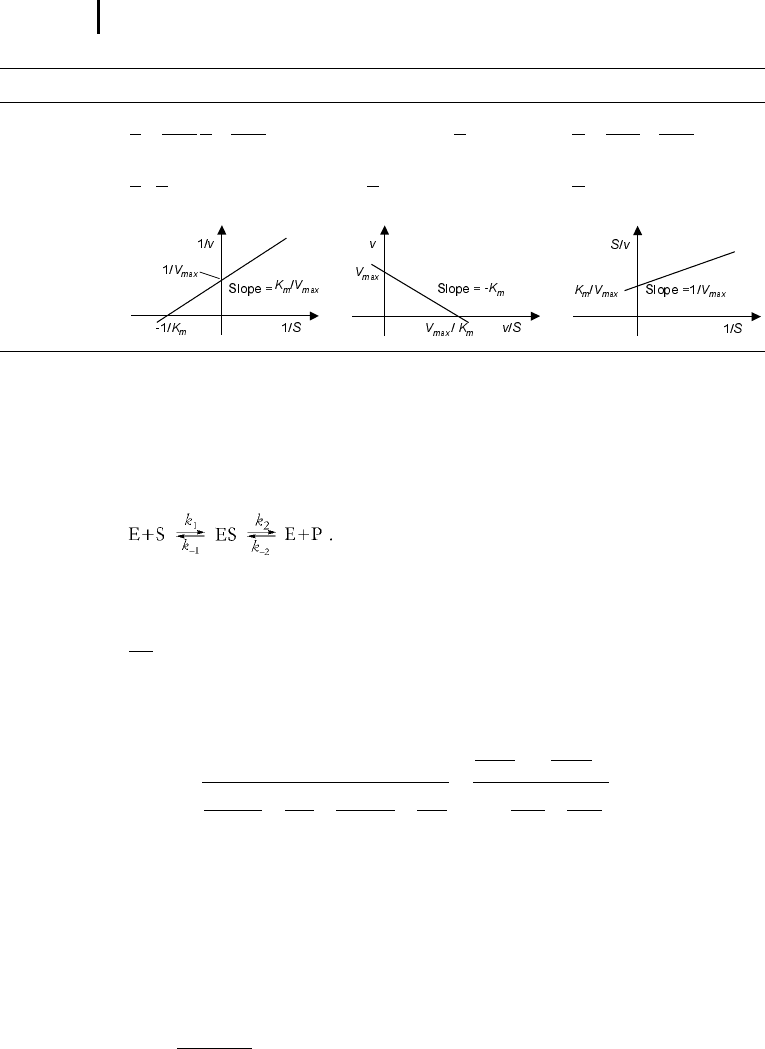
5.1.3.2 Parameter Estimation and Linearization of the Michaelis-Menten Equation
To assess the values of the parameters V
max
and K
m
for an isolated enzyme, one mea-
sures the initial rates for different initial concentrations of the substrate. Since the
rate is a nonlinear function of the substrate concentration, one has to determine the
parameters by nonlinear regression. Another way is to transform Eq. (5-32) to a
linear relation between variables and then apply linear regression.
The advantage of the transformed equations is that one may read the parameter
values more or less directly from the graph obtained by linear regression of the mea-
surement data. In the Lineweaver-Burk plot (Lineweaver and Burk 1934) (Tab. 5.2),
the values for V
max
and K
m
can be obtained from the intersections of the graph with
the ordinate and the abscissa, respectively. The Lineweaver-Burk plot is also helpful
for discrimination of different types of inhibitions (see below). The drawback of the
transformed equations is that they may be sensitive to errors for low or high sub-
strate concentrations or rates. Eadie and Hofstee (Eadie 1942) and Hanes and Woolf
(Hanes 1932) have introduced other types of linearization to overcome this limita-
tion.
147
5.1 Enzyme Kinetics and Thermodynamics
Michaelis Menten Kinetics
Fig. 5.4 Dependence of reaction rate v on
substrate concentration S in Michaelis-
Menten kinetics. V
max
denotes the maximal
reaction rate that can be reached for a large
substrate concentration. K
m
is the sub-
strate concentration that results in a half-
maximal reaction rate. For low substrate
concentrations, v increases almost linearly
with S, while for high substrate concentra-
tions v is almost independent of S.
5.1.3.3 The Michaelis-Menten Equation for Reversible Reactions
In practice, many reactions are reversible. The enzyme may catalyze the reaction in
both directions. Consider the following mechanism:
(5-35)
The product formation is given by
dP
dt
k
2
ES k
2
P v ; (5-36)
and the respective rate equation reads
v E
total
Sq P
Sk
1
k
1
k
2
1
k
2
k
2
k
1
k
2
P
k
1
V
for
max
K
mS
S
V
back
max
K
mP
P
1
S
K
mS
P
K
mP
: (5-37)
While the parameters k
+1
and k
+2
are the kinetic constants of the individual reac-
tion steps, the phenomenological parameters V
for
max
and V
back
max
denote the maximal ve-
locity in forward or backward direction, respectively, under zero product or substrate
concentration, and the phenomenological parameters K
mS
and K
mP
denote the sub-
strate or product concentration causing half maximal forward or backward rate.
They are related in the following way:
K
eq
V
for
max
K
mP
V
back
max
K
mS
(5-38)
(Haldane 1930). Reaction v
3
, Eq. (5-4), is of the reversible Michaelis-Menten type.
148
5 Metabolism
Tab. 5.2 Different approaches for the linearization of Michaelis-Menten enzyme kinetics.
Lineweaver-Burk Eadie-Hofstee Hanes-Woolf
Transformed
1
v
K
m
V
max
1
S
1
V
max
v V
max
K
m
v
S
S
v
S
V
max
K
m
V
max
equation
New variables
1
v
;
1
S
v,
v
S
S
v
; S
Graphical
representation
5.1.4
Regulation of Enzyme Activity by Protein Interaction
Enzymes can immensely increase the rate of a reaction, but this is not their only
function. Enzymes are involved in metabolic regulation in various ways. Their pro-
duction and degradation are often adapted to the current requirements of the cell.
Furthermore, they may be targets of effectors, both inhibitors and activators.
The effectors are proteins or other molecules that influence the performance of
the enzymatic reaction. The interaction of effector and enzyme changes the reaction
rate. Such regulatory interactions that are crucial for the fine-tuning of metabolism
will be considered here (Schellenberger 1989).
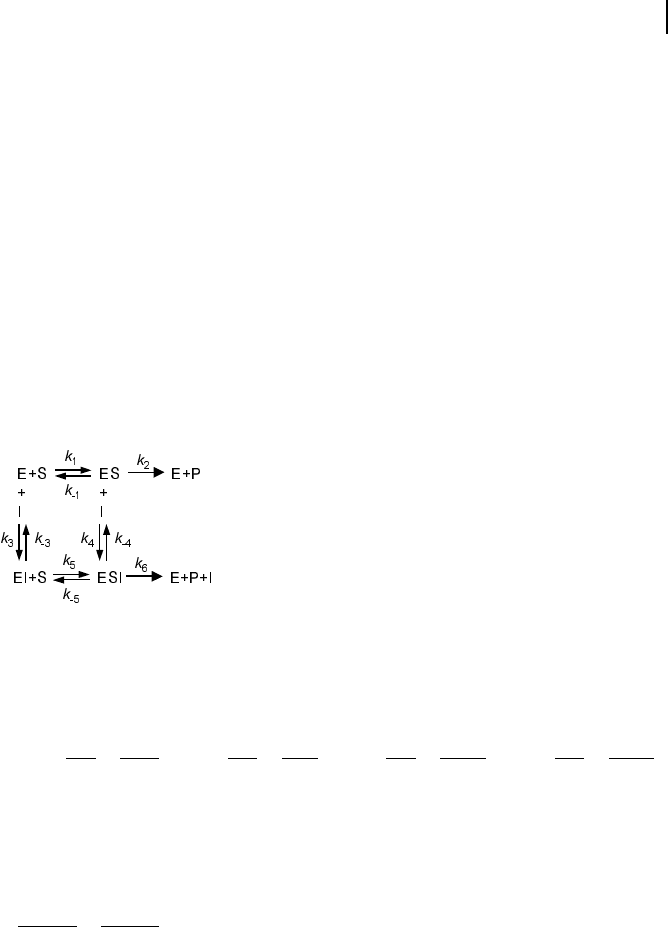
Basic types of inhibition are distinguished by the enzyme’s state, in which the en-
zyme may bind the effector (i. e., the free enzyme E, the enzyme-substrate complex
ES, or both), and by the ability of different complexes to release the product. The
general pattern of inhibition is schematically represented in Fig. 5.5. The different
types result if some of the reactions cannot occur.
The rate equations are derived according to the following scheme:
1. Consider binding equilibriums between compounds and their complexes:
K
m
k
1
k
1
E S
ES
; K
I;3
k
3
k
3
E I
EI
; K
I;4
k
4
k
4
ES I
ESI
; K
I;5
k
5
k
5
EI S
ESI
(5-39)
Note that if all reactions can occur, the Wegscheider condition (Wegscheider 1902)
holds in the form
k
1
k
4
k
1
k
4
k
3
k
5
k
3
k
5
; (5-40)
which means that the difference in the free energies between E and ESI is indepen-
dent of the choice of the reaction path (via ES or EI).
2. Take into account the moiety conservation for the total enzyme (include only those
complexes that occur in the course of reaction):
E
total
E ES EI ESI : (5-41)
149
5.1 Enzyme Kinetics and Thermodynamics
Fig. 5.5 General scheme of inhibition in Michaelis-Menten
kinetics. Reactions 1 and 2 belong to the standard scheme of
Michaelis-Menten kinetics. Competitive inhibition is given if
in addition reaction 3 (and not reactions 4, 5, or 6) occurs. Un-
competitive inhibition involves reactions 1, 2, and 4, and non-
competitive inhibition comprises reactions 1, 2, 3, 4, and 5.
Appearance of reaction 6 indicates partial inhibition.