
Klipp E., Herwig R., Kowald A., Wierling C., Lehrach H. Systems Biology in Practice: Concepts, Implementation and Application
Подождите немного. Документ загружается.


5.3.1.3 Response Coefficients
The steady state is determined by the values of the parameters. A third type of coeffi-
cient expresses the direct dependence of steady-state variables on parameters. The re-
sponse coefficients are defined as
R
j
m
p
m
J
j
iJ
j
ip
m
and R
i
m
p
m
S
i
iS
i
ip
m
; (5-140)
where the first coefficient expresses the response of the flux to a parameter perturba-
tion while the latter describes the response of a steady-state concentration.
Example 5-23
What is the influence of a perturbation of the Michaelis constant of ATP in reac-
tion 1, K
ATP,1
, on the steady-state flux of reaction 6 or on the concentration of
Fruc1,6P
2
?
5.3.1.4 Matrix Representation of the Coefficients
Control, response, and elasticity coefficients are defined with respect to all rates,
steady-state concentrations, fluxes, or parameters in the metabolic system and in the
respective model. They can be arranged in matrices:
C
J
C
j
k
no
; C
S
C
i
k
; R
J
R
j
m
; R
S
R
i
m
; e e
k
i
; p p
k
m
: (5-141)
Matrix representation can also be chosen for the response coefficients as well as
for all types of non-normalized coefficients. The arrangement in matrices allows ap-
plying of matrix algebra in control analysis. In particular, the matrices of normalized
control coefficients can be calculated from the matrices of non-normalized control
coefficient as follows:
C
J
dg J
1
non
C
J
dg J
C
S
dg S
1
non
C
J
dg J
R
J
dg J
1
non
R
J
dg p
R
S
dg S
1
non
R
S
dg p
e dg J
1
non
e dg S
R
S
dg S
1
non
R
S
dg p : (5-142)
The symbol dg stands for the diagonal matrix, e.g., dg J
J
1
00
0 J
2
0
00J
r
0
@
1
A
.
180
5 Metabolism

5.3.2
The Theorems of Metabolic Control Theory
We are interested in calculating the control coefficients for a system under investiga-
tion. Usually, the steady-state fluxes or concentrations cannot be expressed explicitly
as a function of the reaction rates. Therefore, flux- and concentration-control coeffi-
cients cannot simply be determined by taking the respective derivatives, as we did
for the elasticity coefficients in Example 5-19.
Fortunately, the work with control coefficients is eased by of a set of theorems.
The first type of theorem, the summation theorems, makes a statement about the to-
tal control over a flux or a steady-state concentration. The second type of theorem,
the connectivity theorems, relates the control coefficients to the elasticity coeffi-
cients. Both types of theorems together with dependency information encoded in
the stoichiometric matrix contain enough information to calculate all control coeffi-
cients as function of the elasticities.
We will first introduce the theorems and then present a hypothetical perturbation
experiment to illustrate the summation theorem. Finally, the theorems will be math-
ematically derived.
5.3.2.1 The Summation Theorems
The summation theorems make a statement about the total control over a certain
steady-state flux or concentration. The flux-control coefficients fulfill
P
r
k1
C
J
j
v
k
1 ; (5-143)
where r is the number of reactions. The flux-control coefficients of a metabolic net-
work for one steady-state flux sum up to 1. This means that all enzymatic reactions
can share the control over this flux. For the concentration-control coefficients, we
have
P
r
k1
C
S
i
v
k
0 : (5-144)
The control coefficients of a metabolic network for one steady-state concentration
are balanced. This means again that the enzymatic reactions can share the control
over this concentration, but some exert a negative control while others exert a posi-
tive control. Both relations can also be expressed in matrix formulation. For the flux-
control coefficients, we have
C
J
1 1 ; (5-145)
and for the concentration control coefficients, we have
C
S
1 0 : (5-146)
181
5.3 Metabolic Control Analysis
The symbols 1 and 0 denote column vectors with r rows containing as entries only
ones or zeros, respectively.
The summation theorems for the non-normalized control coefficients read
non
C
J
K K (5-147)
and
non
C
S
K 0 : (5-148)
A more intuitive derivation of the summation theorems is given in the following
example according to Kacer and Burns (1973).
Example 5-24
The summation theorem for flux-control coefficients can be derived using a
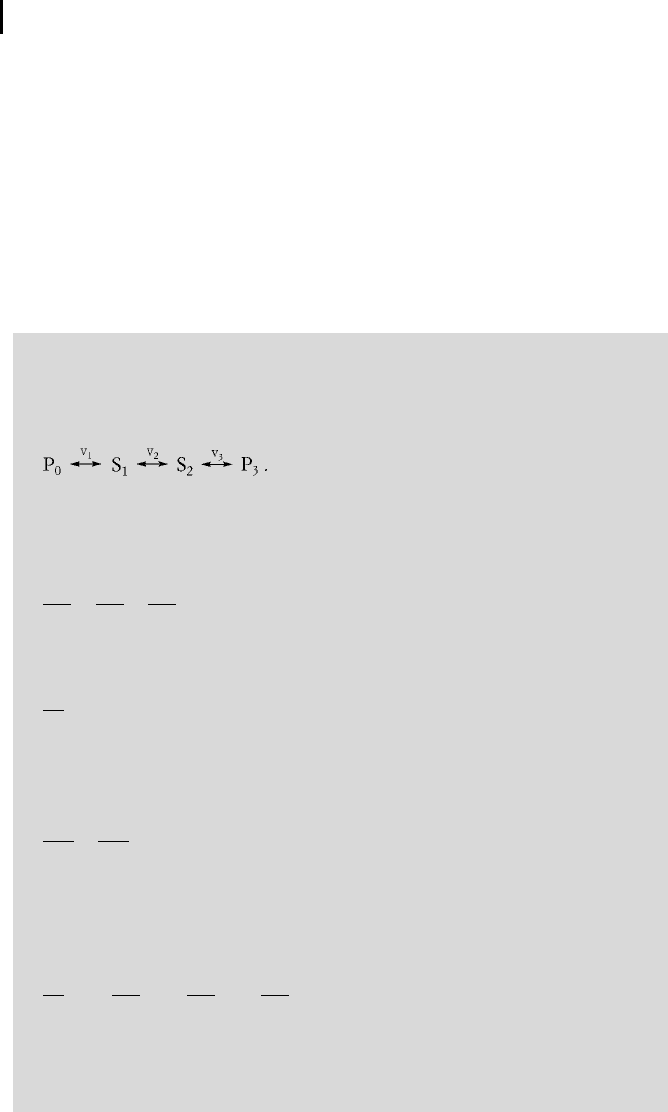
thought experiment. Consider the unbranched pathway
(5-149)
What happens to steady-state fluxes and metabolite concentrations if we perform
a directed experimental manipulation of all three reactions leading to the same
fractional change a of all three rates?
dv
1
v
1
dv
2
v
2
dv
3
v
3
a : (5-150)
The flux must increase to the same extent:
dJ
J
a : (5-151)
But since producing and degrading reactions increase to the same amount, the
concentrations of the metabolites remain constant
dS
1
S
1
dS
2
S
2
0 : (5-152)
The combined effect of all changes in local rates on the system variables S
1
, S
2
,
and J can be written as the sum of all individual effects caused by the local rate
changes. For the flux it holds that
dJ
J
C
J
1
dv
1
v
1
C
J
2
dv
2
v
2
C
J
3
dv
3
v
3
: (5-153)
Using Eqs. (5-155) and (5-156), it follows that
a a C
J
1
C
J
2
C
J
3
; (5-154)
182
5 Metabolism

and, therefore, it holds that
1 C
J
1
C
J
2
C
J
3
: (5-155)
This is just a special case of Eq. (143). In the same way, for the change of concen-
tration S
1
, we obtain
dS
1
S
1
C
S
1
1
dv
1
v
1
C
S
1
2
dv
2
v
2
C
S
1
3
dv
3
v
3
: (5-156)
By means of Eqs. (5-155) and (5-152), we find
0 C
S
1
1
C
S
1
2
C
S
1
3
: (5-157)
A similar result holds for the change of concentration S
2
:
0 C
S
2
1
C
S
2
2
C
S
2
3
: (5-158)
Although shown here only for a special case, these properties hold in general for
systems without conservation relations. The general derivation is given in Section
5.3.2.3.
5.3.2.2 The Connectivity Theorems
Flux-control coefficients and elasticity coefficients are related by the expression
P
r
k1
C
J
j
v
k
e
v
k
S
i
0 : (5-159)
Note that the sum runs over all rates v
k
. Considering the concentration S
i
of a
fixed metabolite and a fixed flux J
j
, each term contains the elasticity e
S
i
v
k
describing
the direct influence of a change of S
i
on the rates v
k
and the control coefficient ex-
pressing the control of v
k
over J
j
.
The connectivity theorem between concentration-control coefficients and elasticity
coefficients reads
P
r
k1
C
S
h
v
k
e
v
k
S
i
d
hi
: (5-160)
Again, the sum runs over all rates v
k
, while S
h
and S
i
are the concentrations of two
fixed metabolites. The symbol d
hi
0; if h 6 i
1; if h i
is the so-called Kronecker symbol.
In matrix formulation, the connectivity theorems read
C
J
e 0 (5-161)
183
5.3 Metabolic Control Analysis

and
C
S
e I (5-162)
where I denotes the identity matrix of size n6 n. For non-normalized coefficients, it
holds that
non
C
J
non
e L 0 (5-163)
and
non
C
S
e L L (5-164)
where L is the link matrix that expresses the relation between independent and de-
pendent rows in the stoichiometric matrix (Eq. (5-91)). A very comprehensive repre-
sentation of both summation and connectivity theorems for non-normalized coeffi-
cients is given by the following equation:
non
C
J
non
C
S
K eL
K0
0 L
: (5-165)
As mentioned above, the summation and connectivity theorems together with the
structural information of the stoichiometric matrix are sufficient to calculate the con-
trol coefficients for a metabolic network as function of the elasticities. This shall be
illustrated for a small network in the next example.
Example 5-25
To calculate the control coefficients, we study the following reaction system:
(5-166)
The flux-control coefficients obey the theorems
C
J
1
C
J
2
1 and C
J
1
e
1
S
C
J
2
e
2
S
0 ; (5-167)
which can be solved for the control coefficients
C
J
1
e
2
S
e
2
S
e
1
S
and C
J
2
e
1
S
e
2
S
e
1
S
: (5-168)
Since usually e
S
1
< 0 and e
S
2
> 0 (see Example 5-20), both control coefficients as-
sume positive values C
J
1
> 0 and C
J
2
> 0. This means that both reactions exert a
positive control over the steady-state flux and that acceleration of any of them
leads to increase of J, which is in accordance with common intuition.
184
5 Metabolism

The concentration control coefficients fulfill
C
S
1
C
S
2
0 and C
S
1
e
1
S
C
S
2
e
2
S
1 ; (5-169)
which yields
C
S
1
1
e
2
S
e
1
S
and C
J
2
1
e
2
S
e
1
S
: (5-170)
With e
S
1
< 0 and e
S
2
> 0, we get C
S
1
> 0 and C
S
2
< 0, i. e., increase of the first reaction
causes a rise in the steady-state concentration of S, while acceleration of the sec-
ond reaction leads to the opposite.
5.3.2.3 Derivation of Matrix Expressions for Control Coefficients
After having introduced the theorems of metabolic control analysis, we will derive ex-
pressions for the control coefficients in matrix form. These expressions are suited
for calculating the coefficients even for large-scale models. We start from the steady-
state condition
Nv S p; p0 : (5-171)
Implicit differentiation with respect to the parameter vector p yields
N
iv
iS
iS
ip
N
iv
ip
0 : (5-172)
Since we have chosen reaction-specific parameters for perturbation, the matrix of
non-normalized parameter elasticities contains nonzero entries in the main diagonal
and zeros elsewhere (compare Eq. (5-138)).
iv
ip
iv
1
ip
1
00
0
iv
2
ip
2
0
::::
00
iv
r
ip
r
0
B
B
B
B
B
B
B
B
@
1
C
C
C
C
C
C
C
C
A
: (5-173)
Therefore, this matrix is regular and has an inverse. Furthermore, we consider the
following Jacobian matrix:
M N
iv
iS
: (5-174)
185
5.3 Metabolic Control Analysis

The Jacobian matrix M is a regular matrix if the system is asymptotically stable
and contains no conservation relations. The case with conservation relations is con-
sidered below. Here, we may pre-multiply Eq. (5-172) by the inverse of M and rear-
range to get
iS
ip
N
iv
iS
1
N
iv
ip
M
1
N
iv
ip
non
R
S
: (5-175)
As indicated, iS/ip is the matrix of non-normalized response coefficients for con-
centrations. Post-multiplication by the inverse of the non-normalized parameter elas-
ticity matrix gives us
iS
ip
iv
ip
1
N
iv
iS
1
N
non
C
S
: (5-176)
This is the matrix of non-normalized concentration-control coefficients. The right
(middle) side contains no parameters. This means that the control coefficients do
not depend on the particular choice of parameters to exert the perturbation as long
as Eq. (5-138) is fulfilled. The control coefficients are dependent on the structure of
the network, represented by the stoichiometric matrix N, and on the kinetics of the
individual reactions, represented by the non-normalized elasticity matrix iv/iS.
The implicit differentiation of
J vS p; p (5-177)
with respect to the parameter vector p leads to
iJ
ip
iv
ip
iv
iS
iS
ip
I
iv
iS
N
iv
iS
1
N
!
iv
ip
non
R
J
: (5-178)
This yields, after some rearrangement, an expression for the non-normalized flux-
control coefficients:
iJ
ip
iv
ip
1
I
iv
iS
N
iv
iS
1
N
non
C
J
: (5-179)
The normalized control coefficients are (by use of Eq. (5-142))
C
J
I dgJ
1
iv
iS
N
iv
iS
1
N
!
dgJ
(5-180)
and
C
S
dgS
1
N
iv
iS
1
N
!
dgJ
: (5-181)
186
5 Metabolism

These equations can easily be implemented for numerical calculation of control
coefficients or used for analytical computation (see Example 5-26). They are also sui-
ted for derivation of the theorems of MCA. The summation theorems for the control
coefficients follow from Eq. (5-180) or Eq. (5-181) by, respectively, post-multiplying
with the vector 1 (the row vector containing only 1’s) and consideration of the rela-
tions (dgJ)71=J and NJ = 0. The connectivity theorems result from post-multiply-
ing Eq. (5-180) or Eq. (5-181) with the elasticity matrix e dgJ
1
iv
iS
dgS, and
using that multiplication of a matrix with its inverse yields the identity matrix I of re-
spective type.
If the reaction system involves conservation relations, we eliminate dependent
variables as explained in Section 5.2.5. In this case the non-normalized coefficients
read
non
C
J
I
iv
iS
LN
0
iv
iS
1
N
0
(5-182)
non
C
S
LN
0
iv
iS
1
N
0
(5-183)
and the normalized control coefficients are obtained by applying Eq. (5-142).
Example 5-26
Consider the simple reaction system of Example 5-25 and let the rate equations
be v
1
= k
1
P
0
– k
–1
S
1
and v
2
= k
2
S
1
– k
–2
P
2
. Then, the steady-state condition
J = v
1
= v
2
results in
J
k
1
k
2
P
0
k
1
k
2
P
2
k
1
k
2
(5-184)
and
S
1
k
1
P
0
k
2
P
2
k
1
k
2
: (5-185)
The stoichiometric matrix is N = (1 –1) and the non-normalized elasticity coeffi-
cients read
iv
iS
iv
1
iS
1
iv
2
iS
1
0
B
B
@
1
C
C
A
k
1
k
2
: (5-186)
Introducing these expressions into Eq. (5-180) yields
187
5.3 Metabolic Control Analysis

C
J
k
1
k
2
P
0
k
1
k
2
P
2
k
1
k
2
0
0
k
1
k
2
P
0
k
1
k
2
P
2
k
1
k
2
0
B
B
@
1
C
C
A
1
(5-187)
10
01
k
1
k
2
1 1
k
1
k
2
1
1 1
!
dgJ
k
1
k
2
P
0
k
1
k
2
P
2
k
1
k
2
0
0
k
1
k
2
P
0
k
1
k
2
P
2
k
1
k
2
0
B
B
@
1
C
C
A
1
1
k
1
k
2
k
2
k
1
k
2
k
1
dgJ
1
k
1
k
2
k
2
k
1
k
2
k
1
meaning that the flux-control coefficients are C
J
1
k
2
k
1
k
2
; C
J
2
k
1
k
1
k
2
.For
the concentration-control coefficients we have
C
S
k
1
P
0
k
2
P
2
k
1
k
2
1
1 1
k
1
k
2
1
1 1
!
dgJ
(5-188)
k
1
P
0
k
2
P
2
k
1
k
2
1
1
k
1
k
2
1 1
k
1
k
2
P
0
k
1
k
2
P
2
k
1
k
2
0
0
k
1
k
2
P
0
k
1
k
2
P
2
k
1
k
2
0
B
B
@
1
C
C
A
k
1
k
2
P
0
k
1
k
2
P
2
k
1
k
2
k
1
P0k
2
P
2
1 1
or
C
S
1
k
1
k
2
P
0
k
1
k
2
P
2
k
1
k
2
k
1
P
0
k
2
P
2
; C
S
2
k
1
k
2
P
0
k
1
k
2
P
2
k
1
k
2
k
1
P
0
k
2
P
2
(5-189)
To investigate the implications of control distribution, we will now analyze the
control pattern in an unbranched pathway
(5-190)
with linear kinetics v
i
= k
i
S
i–1
– k
–i
S
i
(with S
0
= P
0
, S
r
= P
r
) and equilibrium con-
stants q
i
= k
i
/k
–i
. In this case, one can calculate an analytical expression for the
steady-state flux
188
5 Metabolism

J
P
0
Q
r
j1
q
j
P
r
P
r
l1
1
k
l
Q
r
ml
q
m
; (5-191)
as well as an analytical expression for the flux control coefficients
C
J
i
1
k
i
Q
r
ji
q
j
P
r
l1
1
k
l
Q
r
ml
q
m
: (5-192)
Let us consider two very general cases. First, assume that all reactions have the
same individual kinetics, k
+
= k
i
, k
–
= k
–i
for i =1,…,r, and that for the equilibrium
constants, which are also equal, it holds that q = k
+
/k
–
> 1. In this case the ratio of
two subsequent flux-control coefficients is
C
J
i
C
J
i1
k
i1
k
i
q
i
q > 1 : (5-193)
Hence, the control coefficients of the preceding reactions are bigger than the con-
trol coefficients of the succeeding reactions, or flux-control coefficients are higher in
the beginning of a chain than in the end. This conforms to the frequent observation
that flux control resides in the upper part of an unbranched reaction pathway.
Now assume that the individual rate constants might be different but that all equi-
librium constants are equal to 1, q
i
= 1 for i =1, …, r. This implies that k
i
= k
–i
.
Furthermore, Eq. (5-192) simplifies to
C
J
i
1
k
i
P
r
l1
1
k
l
Now consider the relaxation time t
i
= 1/(k
i
+ k
–i
) (compare Section 5.2.7) as a mea-
sure of the rate of an enzyme. The flux-control coefficient reads
C
J
i
t
i
t
1
t
2
::: t
r
: (5-194)
This expression helps to elucidate two aspects of metabolic control. First, all en-
zymes participate in the control since all enzymes have a relaxation time. No one en-
zyme has all the control or determines the flux through the pathway alone. Second,
slow enzymes with a higher relaxation time exert in general more control than fast
enzymes with a short relaxation time.
The predictive power of flux-control coefficients for directed changes of flux is illu-
strated in the following example.
189
5.3 Metabolic Control Analysis