
Klipp E., Herwig R., Kowald A., Wierling C., Lehrach H. Systems Biology in Practice: Concepts, Implementation and Application
Подождите немного. Документ загружается.

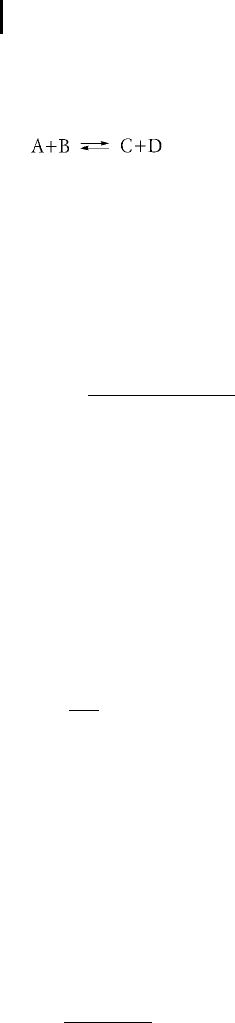
This definition is applicable to reactions with more than one substrate or product
and even with nonlinear rate expressions. For example, the response time for the re-
action
(5-107)
is given by
t k
A Bk
C D
1
: (5-108)
Time constants for metabolite concentrations have been defined in different ways.
Reich and Sel’kov (1975), considered the turnover time, i.e., the time that is necessary
to convert a metabolite pool once:
t
turn
i
S
i
P
r
j1
n
ij
v
j
n
ij
v
j
: (5-109)
To this end, every reaction is split into a forward (v
+
j
) and a backward (v
–
j
) reaction
with v
j
= v
+
j
– v
–
j
. Accordingly, the stoichiometric coefficients of substance S
i
are as-
signed to the individual reaction directions (n
+
ij
, n
–
ij
).
Assume that we have an “empty” pathway, i. e., a pathway that consists of a set of
enzymes but has no metabolites available. At once, the first substrate is added. Fol-
lowing Easterby (1973, 1981), the transition time describes the time necessary to
build up the intermediate pools. It is a measure of the time it takes to reach steady-
state concentrations. For each intermediate it holds that
t
i
S
SS
i
J
; (5-110)
where S
i
SS
and J denote concentration and flux in the final steady state. The transi-
tion time of the complete pathway is the sum of the transition time of all intermedi-
ates, t
P
n
i1
t
i
.
A measure for the time necessary to return to a steady state after a small perturba-
tion is the transition time according to Heinrich and Rapoport (1975). Let
d(t)=S (t)–
S be the deviation from steady-state concentrations. Then the transition
time is defined as
t
R
1
0
t d t
dt
R
1
0
d tdt
: (5-111)
This definition is applicable if d(t) vanishes asymptotically for large t.
170
5 Metabolism

Llorens and et al. (1999) have introduced a more general definition. Let f denote a
function such as a flux or a concentration that shall be analyzed after perturbation.
The characteristic time can be calculated in analogy to center of mass as
T
R
1
0
t
df
dx
dt
R
1
0
df
dx
dt
: (5-112)
This definition may be applied even for oscillating response to the perturbation.
As an example, the characteristic times for Gluc6P, Fruc6P, and Fruc1,6P
2
in the
running example are given in Tab. 5.4. Whatever definition we apply, characteristic
times may differ by orders of magnitude for reactions or concentrations in realistic
reaction networks.
5.2.8
Approximations Based on Timescale Separation
Differing timescales in reaction networks allow for reducing the systems in terms of re-
ducing the number of differential equations (and replacing them by algebraic equa-
tions). This is implicitly based on the assumption that we choose to consider a window
of the timescale while neglecting faster or slower processes. Assume that we consider a
process that takes place within minutes. Variables that are changed by faster processes
(say within seconds) reach a quasi-steady state after a short transitional period.Variables
that are changed by slower processes (processes proceeding within years, e.g., seasonal
changes) may be considered as constant. A common example for neglecting slow pro-
cesses in metabolic modeling is to assume that enzyme concentrations are constant.
Their production and degradation is considered to be much slower than the reactions
they catalyze. Two types of approximations are used: quasi-steady-state approximations
and quasi-equilibrium approximations. A more general mathematical consideration of
the effect of timescale separation is given in Heinrich and Schuster (1996).
5.2.8.1 The Quasi-steady-state Approximation
Consider a complex system of processes, e.g., a reaction network. If a metabolite par-
ticipates in a very fast process (compared to the other processes), it may approach a
steady state very quickly. After this transitional period, its concentration S may be
171
5.2 Metabolic Networks
Tab. 5.4 Characteristic times (in min) for the metabolites of the running example. For the mea-
ning of the quantities, see text.
s
i
(Eq. (5-110)) s (Eq. (5-111)) T (Eq. (5-112))
Gluc6P 0.0855 0.0724 0.0890
Fruc6P 0.0096 0.0171 0.0583
Fruc1,6P
2
0.1095 0.1653 0.1657
considered as constant, i. e.
_
S = 0. Since this variable is still involved in the complex
system, this state is considered as quasi-steady state. The condition
_
S = 0 allows one
to replace the differential equation for the change of S by an algebraic equation de-
scribing how S depends on the other variables of the system.
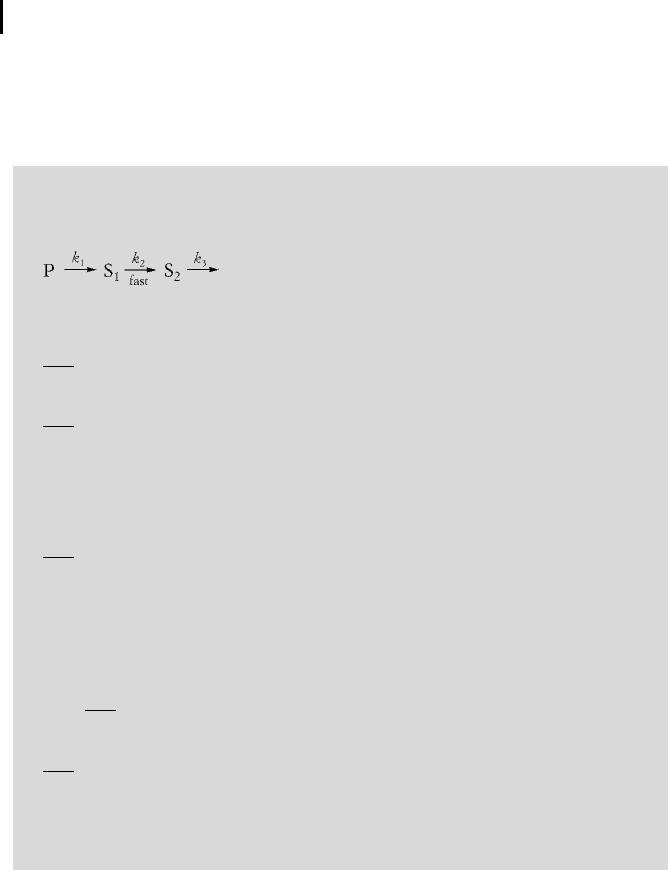
Example 5-17
Assume a pathway consisting of faster and slower reactions
(5-113)
described by the differential equation system
dS
1
dt
Pk
1
S
1
k
2
dS
2
dt
S
1
k
2
S
2
k
3
: (5-114)
If the second reaction is fast, i. e., k
2
>> k
1
, k
3
, we may assume a quasi-steady state
for S
1
:
dS
1
dt
0 : (5-115)
This enables us to calculate the concentration of S
1
and to simplify the differential
equation system. Now it comprises only one differential equation and one alge-
braic expression:
S
1
Pk
1
k
2
(5-116)
dS
2
dt
Pk
1
S
2
k
3
: (5-117)
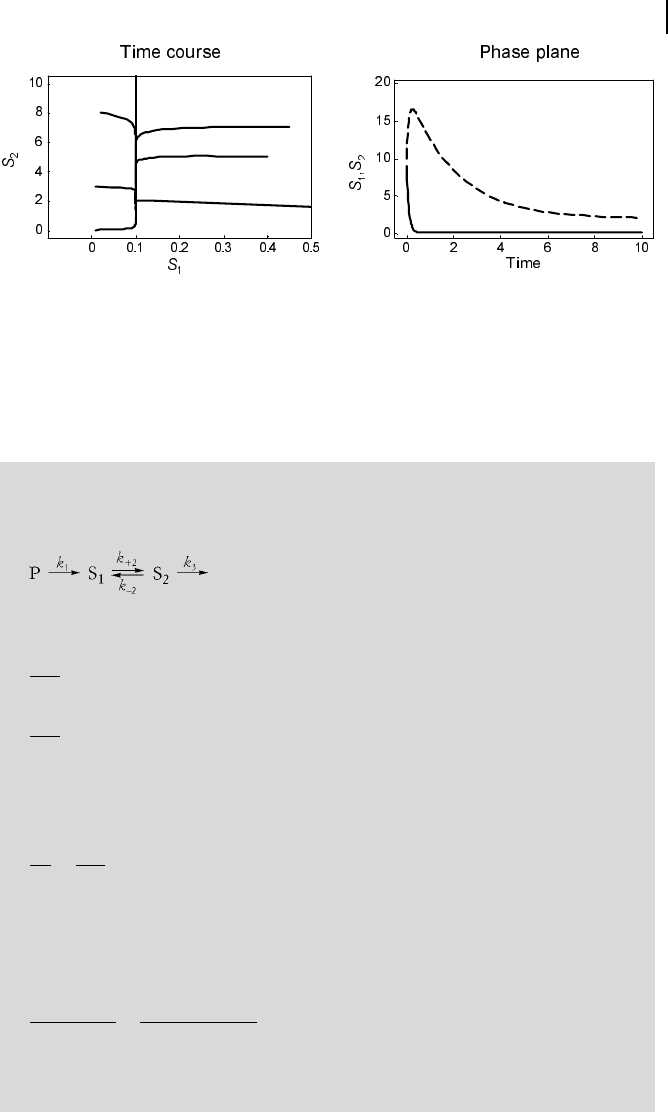
In Fig. 5.10, one can see that the introduced simplification describes the real be-
havior sufficiently well after an initial period.
5.2.8.2 Quasi-equilibrium Approximation
We again assume a coupling of slow and fast processes. The pathway is supposed to
contain two substrates that can be converted rapidly and reversibly one into the
other, such as the hexoses glucose-6-phosphate and fructose-6-phosphate in glycoly-
sis. After a short transition period, their concentrations reach equilibrium. In mathe-
matical terms, the differential equation for the concentration change of one of the
substrates may be replaced by an algebraic expression for the concentration ratios in
equilibrium. Since both substrates are still involved in the larger network, this is
again only a quasi-equilibrium.
172
5 Metabolism
Example 5-18
The pathway
(5-118)
is described by the differential equation system
dS
1
dt
Pk
1
S
1
k
2
S
2
k
2
dS
2
dt
S
1
k
2
S
2
k
2
S
2
k
3
: (5-119)
The conversion is much faster than the other reactions, i.e., k
+2
, k
–2
>> k
1
, k
3
.
After a short period of time, it holds that
S
2
S
1
k
2
k
2
q
2
; (5-120)
where q
2
is the equilibrium constant of the second reaction. The second reaction
operates close to equilibrium, although a non-vanishing flux (v
2
=0) may pass
this reaction. We may sum up the concentrations of S
1
and S
2
, and it holds that
dS
1
S
2
dt
d 1=q
2
1
S
2
dt
Pk
1
S
2
k
3
: (5-121)
The simplified equation system consists of a differential equation and an alge-
braic equation
173
5.2 Metabolic Networks
Fig. 5.10 Time course and phase plane for the reaction system pre-
sented in Eq. (5-113). Parameter values k
1
=1,k
2
= 10, k
3
= 0.5.
Initial conditions for the time course S
1
(0) = S
2
(0) = 10. It is obvious
that S
1
reaches the quasi-steady state very quickly compared to the
S
2
. Trajectories in the phase plane are shown for different initial con-
ditions.
dS
2
dt
q
2
Pk
1
S
2
k
3
1 q
2
(5-122)
S
1
S
2
q
2
: (5-123)
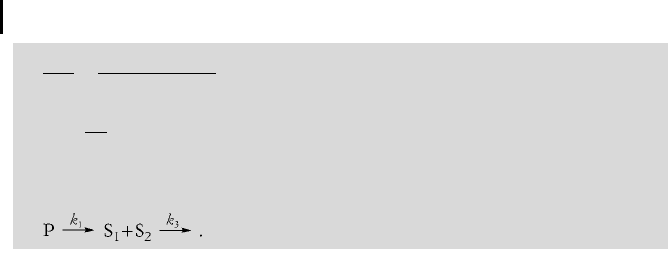
Symbolically, the reaction scheme reduces to
(5-124)
As demonstrated, both types of approximations reduce the number of ODEs in
the mathematical model by replacing some of them by algebraic equations. Applying
these approximations systematically leads to skeleton models of the considered me-
tabolic pathway, which preserve important features of the general models but are ea-
sier to analyze and perceive.
5.3
Metabolic Control Analysis
Metabolic control analysis (MCA) is a powerful quantitative and qualitative frame-
work for studying the relationship between steady-state properties of a network of
biochemical reactions and the properties of the individual reactions. It investigates
the sensitivity of steady-state properties of the network to small parameter changes.
MCA is a useful tool for theoretical and experimental analysis of control and regula-
tion in cellular systems.
MCA was independently founded by two different groups in the 1970s (Kacser
and Burns 1973; Heinrich and Rapoport 1974) and was further developed by differ-
ent groups (e.g., Heinrich et al. 1977; Van Dam et al. 1977; Fell 1979, 1992; Kohen
et al. 1983; Kholodenko 1984; Fell and Sauro 1985; Hofmeyr et al. 1986; Sauro et al.
1987; Westerhoff et al. 1987; Westerhoff and van Dam 1987; Cornish-Bowden 1989;
Hofmeyr 1989, 1995; Small and Fell 1990; Cascante et al. 1991, 1995, 2002; Heinrich
and Reder 1991; Kahn and Westerhoff 1991; Kholodenko et al. 1992, 1995a, 1995 b,
1998; Hofer and Heinrich 1993; Kholodenko and Westerhoff 1993, 1994; Snoep et
al. 1994; Bier et al. 1996; Heinrich and Schuster 1996, 1998; Hofmeyr and Cornish-
Bowden 1996; Thomas and Fell 1996; Schuster and Westerhoff 1999; and Brugge-
man et al. 2002–to mention only some of the work). A milestone in formalization
was provided by Reder (1988). Originally intended for metabolic networks, MCA
now also has applications for signaling pathways, gene expression models, and hier-
archical networks (Kholodenko et al. 2000; Hofmeyr and Westerhoff 2001; Brugge-
man et al. 2002; Westerhoff et al. 2002; Liebermeister et al. 2004).
Metabolic networks are very complex systems that are highly regulated and exhibit
interactions such as feedback inhibition or common substrates for distant reactions.
Many mechanisms and regulatory properties of isolated enzymatic reactions are
known. The development of MCA was motivated by a series of questions like the fol-
174
5 Metabolism

lowing: Can their properties or their behavior in the metabolic network be predicted
from the knowledge about isolated reactions? Which individual steps control a flux
or a steady-state concentration? Is there a rate-limiting step? Which effectors or
modifications have the most prominent effect on the reaction rate? In biotechnologi-
cal production processes, it is of interest which enzyme(s) are to be activated in order
to increase the rate of synthesis of a desired metabolite. There are also related pro-
blems in health care. For example, concerning metabolic disorders such as overpro-
duction of a metabolite, which reactions should be modified in order to downregu-
late this metabolite while perturbing the rest of the metabolism as weakly as possi-
ble?
In metabolic networks, the steady-state variables, i.e., the fluxes and the metabolite
concentrations, are controlled by parameters such as enzyme concentrations, kinetic
constants (e.g., Michaelis constants and maximal activities), and other model-specific
parameters. The relations between steady-state variables and kinetic parameters are
usually nonlinear. Up to now, no general theory exists that predicts the effect of large
parameter changes in a network. The approach presented here is basically restricted
to small parameter changes. Mathematically, the system is linearized at steady state,
which yields exact results if the parameter changes are infinitesimally small.
We will first define a set of mathematical expressions that are useful to quantify
control. Later we will show the relations between these functions and their applica-
tion for prediction of reaction network behavior.
5.3.1
The Coefficients of Control Analysis
Biochemical reaction systems are networks of metabolites connected by chemical re-
actions. Their behavior is determined by the properties of their components – the in-
dividual reactions and their kinetics – as well as by the network structure – the in-
volvement of compounds in different reactions or, in short, the stoichiometry.
Hence, the effect of a perturbation exerted at a reaction in this network will depend
on both the local properties of this reaction and the embedding of this reaction in
the global network.
Let y (x) denote a quantity that depends on another quantity y. The effect of the
change Dx on y is expressed in terms of coefficients:
c
y
x
x
y
Dy
Dx
Dx!0
: (5-125)
In practical applications, Dx might be identified, e.g., with one percent change of
x and Dy with the percentage change of y. The pre-factor x/y is a normalization factor
that makes the coefficient independent of units and the magnitude of x and y. In the
limiting case Dx ?0, the coefficient defined in Eq. (5-125) can be written as
175
5.3 Metabolic Control Analysis
c
y
x
x
y
iy
ix
; (5-126)
which is mathematically equivalent to
c
y
x
i ln y
i ln x
: (5-127)
Two distinct types of coefficients, local and global coefficients, reflect the relations
among local and global changes. Elasticity coefficients (sensitivities) are local coeffi-
cients pertaining to individual reactions. They can be calculated in any given state.
Control coefficients and response coefficients are global quantities. They refer to a
given steady state of the entire system. After a perturbation of y, the relaxation of x to
a new steady state is considered.
The general form of the coefficients in control analysis as defined in Eq. (5-126)
contains the normalization x/y. The normalization has the advantage that we get rid
of units and can compare, e.g., fluxes belonging to different branches of a network.
The drawback of the normalization is that x/y is not defined as soon as y = 0, which
may happen for certain parameter combinations. In those cases it is favorable to
work with non-normalized coefficients. Throughout this chapter we will usually con-
sider normalized quantities. If we use non-normalized coefficients, they are flagged
as
non
c. In general, the use of one or the other type of coefficient is also a matter of
the personal choice of the modeler.
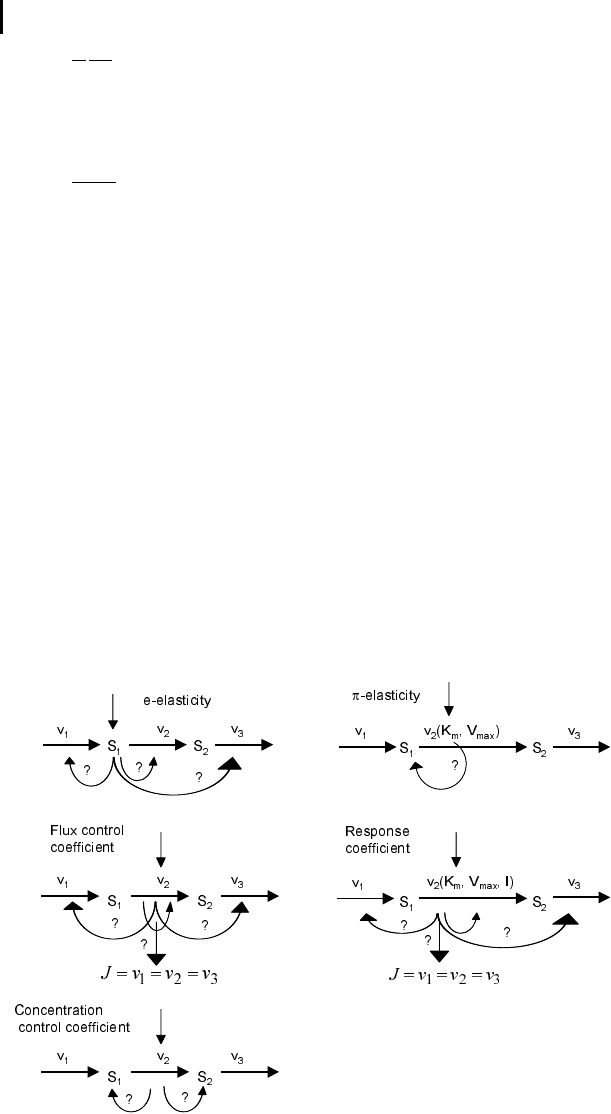
A graphical representation of changes reflected in the different coefficients is
shown in Fig. 5.11.
176
5 Metabolism
Fig. 5.11 Schematic representation of perturbation
and effects quantified by different coefficients of me-
tabolic control analysis.

5.3.1.1 The Elasticity Coefficients
An elasticity coefficient quantifies the sensitivity of a reaction rate to the change of
a concentration or a parameter. It measures the direct effect on the reaction velo-
city, while the rest of the network is kept fixed. The sensitivity of the rate v
k
of a re-
action to the change of the concentration S
i
of a metabolite is calculated by the e-
elasticity:
e
k
i
S
i
v
k
iv
k
iS
i
: (5-128)
While the e-elasticity involves the derivative with respect to a variable, the metabo-
lite concentration, the p-elasticity
p
k
m
p
m
v
k
iv
k
ip
m
(5-129)
is defined with respect to parameters p
m
such as kinetic constants, concentrations of
enzymes, or external metabolites.
Example 5-19
In the glycolysis model, the rate of reaction 1 depends on the ATP concentration.
The sensitivity is given by the elasticity
e
1
ATP
ATP
v
1
iv
1
iATP
: (5-130)
Since Eq. (5-2) defines the dependency of v
1
on the ATP concentration, it is easy
to calculate that
e
1
ATP
ATP
v
1
i
iATP
V
max;1
ATP
K
ATP;1
ATP
ATP
v
1
V
max;1
K
ATP;1
ATP
V
max;1
ATP
K
ATP;1
ATP
2
ATP
K
ATP;1
ATP
: (5-131)
The elasticities of all (other) rates with respect to any metabolite concentration
can be calculated similarly. Whenever the rate does not depend directly on a con-
centration (like v
1
and AMP), the elasticity is zero.
Example 5-20
Typical values of elasticity coefficients will be explained for an isolated reaction
transforming substrate S into product P. The reaction is catalyzed by enzyme E
with the inhibitor I and the activator A as depicted below:
177
5.3 Metabolic Control Analysis

(5-132)
Usually, the elasticity coefficients for metabolite concentrations are in the follow-
ing range:
e
v
S
i ln v
i lnS
> 0 and e
v
P
i ln v
i lnP
0 : (5-133)
In most cases, the rate increases with the concentration of the substrate (com-
pare, e.g., Eq. (5-131)) and decreases with the concentration of the product. An ex-
ception from e
v
S
> 0 occurs with substrate inhibition (Eq. (5-44)), where the elasti-
city will become negative for S > S
opt
. The relation e
v
P
= 0 holds if the reaction is
either irreversible or the product concentration is kept fixed at zero by external
mechanisms. The elasticity coefficients with respect to effectors I or A should
obey
e
v
A
i ln v
i lnA
> 0 and e
v
I
i ln v
i lnI
< 0 ; (5-134)
since this is essentially what the notions activator and inhibitor mean.
For the most kinetic types, the reaction rate v is proportional to the enzyme con-
centration E. For example, E is a multiplicative factor in the mass action rate law
(Eq. (5-12)) as well as in the maximal rate of the Michelis-Menten rate law
(Eq. (5-33)). Therefore, it holds that
e
v
E
i ln v
i lnE
1 : (5-135)
More complicated interactions between enzymes and substrates, such as meta-
bolic channeling (direct transfer of the metabolite from one enzyme to the next
without release to the medium), may lead to exceptions to this rule.
5.3.1.2 Control Coefficients
When defining control coefficients, we refer to a stable steady state of the metabolic
system characterized by steady-state concentrations S = S( p) and steady-state fluxes
J = v(S ( p), p). Any sufficiently small perturbation of an individual reaction rate by a
parameter change, v
k
?v
k
+ Dv
k
, drives the system to a new steady state in close
proximity with J ? J + DJ and S ?S + DS. A measure for the change of fluxes and
concentrations are the control coefficients.
178
5 Metabolism

Example 5-21
Consider the glycolysis model in the running example. We may ask, what is the
impact of a change in the rate of ATP consumption, reaction 7, on the steady flux
through the upper glycolysis, i.e., through reaction 1 or through reactions 3, 4,
and 5? Or, what is the effect of an acceleration of the rate of reaction 3 on the con-
centrations of ATP or of Fruc6P? We cannot calculate these effects directly as we
did for the elasticities in Example 5-19.
The flux-control coefficient for the control of rate v
k
over flux J
j
is defined as
C
j
k
v
k
J
j
iJ
j
iv
k
; (5-136)
while the concentration-control coefficient of concentration S
i
with respect to v
k
reads
C
i
k
v
k
S
i
iS
i
iv
k
: (5-137)
The control coefficients quantify the control that a certain reaction v
k
exerts on the
steady-state flux J or on the steady state concentration S
i
, respectively.
It should be noted that the rate change, Dv
k
, is caused by the change of a para-
meter p
k
that has a direct effect solely on v
k
. Thus it holds that
iv
k
ip
k
6 0 and
iv
l
ip
k
0 l 6 k
: (5-138)
Example 5-22
In the glycolysis model, the Michaelis constant of ATP in reaction 1, K
ATP,1
,isa
parameter that directly influences only reaction 1.
Such a parameter might be the enzyme concentration, a kinetic constant, or the
concentration of a specific inhibitor or effector. Hence, the definition of the flux-con-
trol coefficients in extenso is
C
j
k
v
k
J
j
iJ
j
=ip
k
iv
k
=ip
k
: (5-139)
As long as Eq. (5-138) holds, the value of the control coefficient does not depend
on the choice of the perturbed parameter.
179
5.3 Metabolic Control Analysis