
Klipp E., Herwig R., Kowald A., Wierling C., Lehrach H. Systems Biology in Practice: Concepts, Implementation and Application
Подождите немного. Документ загружается.


3. The reaction rate is equal to the rate of product formation:
v
dP
dt
k
2
ES k
6
ESI : (5-42)
Equations (5-39)–(5-41) comprise four independent equations for the four un-
known concentrations of E, ES, EI, and ESI. Their solution can be inserted into
Eq. (5-42). The effect of the inhibitor depends on the concentrations of substrate and
inhibitor and on the relative affinities to the enzyme. Table 5.3 lists the different
types of inhibition for irreversible and reversible Michaelis-Menten kinetics together
with the respective rate equations.
In the case of competitive inhibition, the inhibitor competes with the substrate for
the binding site (or inhibits substrate binding by binding elsewhere to the enzyme)
without being transformed itself. An example of this type is the inhibition of succi-
nate dehydrogenase by malonate. The enzyme converts succinate to fumarate, form-
ing a double bond. Malonate has two carboxyl groups, like the proper substrates, and
may bind to the enzyme, but the formation of a double bond cannot take place. Since
substrates and the inhibitor compete for the binding sites, a high concentration of
one of them may displace the other one. For very high substrate concentrations, the
same maximal velocity as without inhibitor is reached, but the effective K
m
value is
increased.
In the case of uncompetitive inhibition, the inhibitor I binds only to the ES com-
plex. The reason may be that the substrate binding causes a conformational change,
which opens a new binding site. Since S and I do not compete for binding sites, an
increase in the concentration of S cannot displace the inhibitor. In the presence of
inhibitor, the original maximal rate cannot be reached (lower V
max
). For example, an
inhibitor concentration of I = K
I,4
halves the K
m
value as well as V
max
. Uncompeti-
tive inhibition occurs rarely for one-substrate reactions, but more frequently in the
case of two substrates. One example is inhibition of arylsulfatase by hydrazine.
Noncompetitive inhibition is present if substrate binding to the enzyme does not
alter the binding of the inhibitor. There must be different binding sites for substrate
and inhibitor. In the classical case, the inhibitor has the same affinity to the enzyme
with or without bound substrate. If the affinity changes, this is called mixed inhibi-
tion. A standard example is inhibition of chymotrypsin by H
+
ions.
If the product can also be formed from the enzyme-substrate-inhibitor complex,
the inhibition is only partial. For high rates of product release (high values of k
6
),
this can even present an activating instead of an inhibiting effect.
Competitive, uncompetitive, and noncompetitive inhibition also apply for the re-
versible Michaelis-Menten mechanism. The respective rate equations are also listed
in Tab. 5.3.
150
5 Metabolism
151
5.1 Enzyme Kinetics and Thermodynamics
Tab. 5-3 Types of inhibition for irreversible and reversible Michaelis-Menten kinetics.
Name
Implementation Equation – irreversible Equation – reversible case Characteristics
Competitive
inhibiton
I binds only to free E;
P-release only from ES-complex
k
4
k
5
k
6
0
v
V
max
S
K
m
i
3
S
v
V
f
max
S
K
mS
V
r
max
P
K
mP
S
K
mS
P
K
mP
i
3
K
m
changes,V
max
remains;
S and I compete for the binding
place; high S may out compete I
Uncompetitive
inhibition
I binds only to the ES-complex;
P-release only from ES-complex
k
3
k
5
k
6
0
v
V
max
S
K
m
S i
4
v
V
f
max
S
K
mS
V
r
max
P
K
mP
1
S
K
mS
P
K
mP
i
4
K
m
and V
max
change, but their
ratio remains; S may not out
compete I
Noncompetitive
inhibition
I binds to E and ES;
P-release only from ES
K
I;3
K
I;4
; k
6
0
v
V
max
S
K
m
Si
3
v
V
f
max
S
K
mS
V
r
max
P
K
mP
1
S
K
mS
P
K
mP
i
4
K
m
remains,V
max
changes;
S may not out compete I
Mixed inhibition I binds to E and ES;
P-release only from ES
K
I;3
6 K
I;4
; k
6
0
v
V
max
S
K
m
i
4
S i
3
K
m
and V
max
change;
K
I,3
> K
I,4
: competitive-
noncompetitive inhibition;
K
I,3
< K
I,4
: noncompetitive-
uncompetitive inhibition
Partial inhibition I may bind to E and ES;
P-release from ES and ESI
K
I;3
6 K
I;4
; k
6
6 0
v
V
max
S 1
k
6
I
k
2
K
I;3
K
m
i
4
S i
3
K
m
and V
max
change; if k
6
> k
2
,
activation instead of inhibition.
Abbreviations: K
I;3
k
3
k
3
; K
I;4
k
4
k
4
; i
3
1
I
K
I;3
; i
4
1
I
K
I;4
5.1.5
Inhibition by Irreversible Binding of Inhibitor to Enzyme
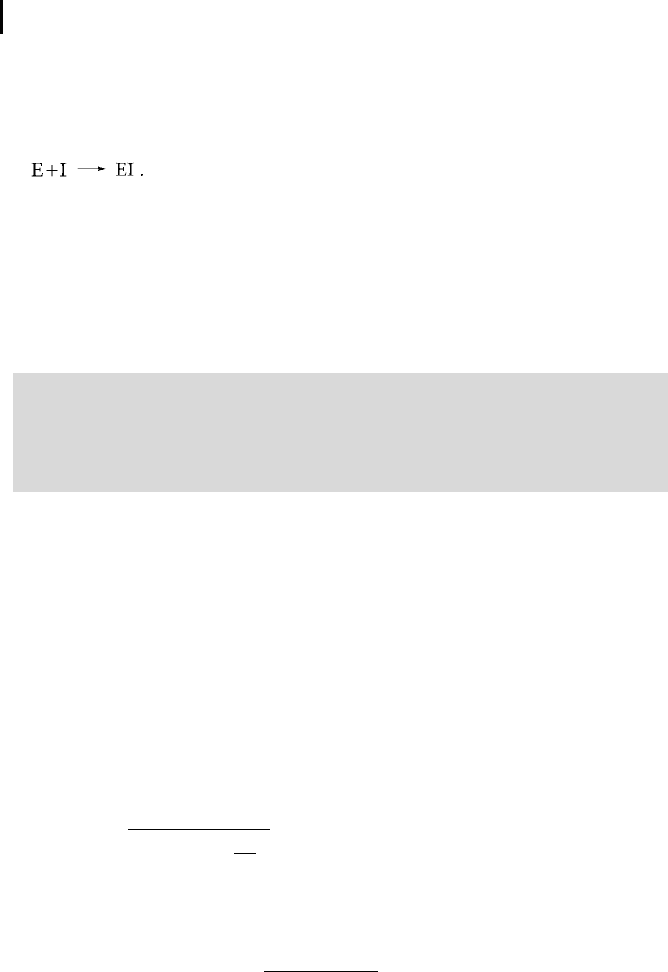
An irreversible inhibitor binds irreversibly to the active site of the enzyme:
(5-43)
This prevents binding of the appropriate substrate and may destroy the catalytic
center and lead to a denaturation of the enzymes. In any case, an initial inhibitor
concentration of I
0
decreases the effective concentration of the enzyme from the in-
itial concentration E
0
to the value E
0
– I
0
. A molar excess of inhibitor leads to com-
plete loss of catalytic activity. At a molar excess of enzyme, this yields a reduction of
maximal velocity to V'
max
= k
2
(E
0
– I
0
).
Example 5-3
Covalent binding of iodacetate to SH groups of proteins:
E–SH+I7CH
2
7CO
–
2
! E–S–CH
2
7CO
–
2
+HI
5.1.6
Substrate Inhibition
A common characteristic of enzymatic reactions is the increase of the reaction rate
with increasing substrate concentration S up to the maximal velocity V
max
. But in
some cases, a decrease of the rate above a certain value of S is recorded. A possible rea-
son for this is the binding of a further substrate molecule to the enzyme-substrate com-
plex, yielding the complex ESS, which cannot form a product. This kind of inhibition is
reversible if the second substrate can be released. The rate equation can be derived
using the scheme of uncompetitive inhibition by replacing the inhibitor by another
substrate. It reads,
v k
2
ES
V
max
S
K
m
S 1
S
K
I
: (5-44)
This expression has a maximum at
S
opt
K
m
K
I
p
with v
opt
V
max
1 2
K
m
=K
I
p
: (5-45)
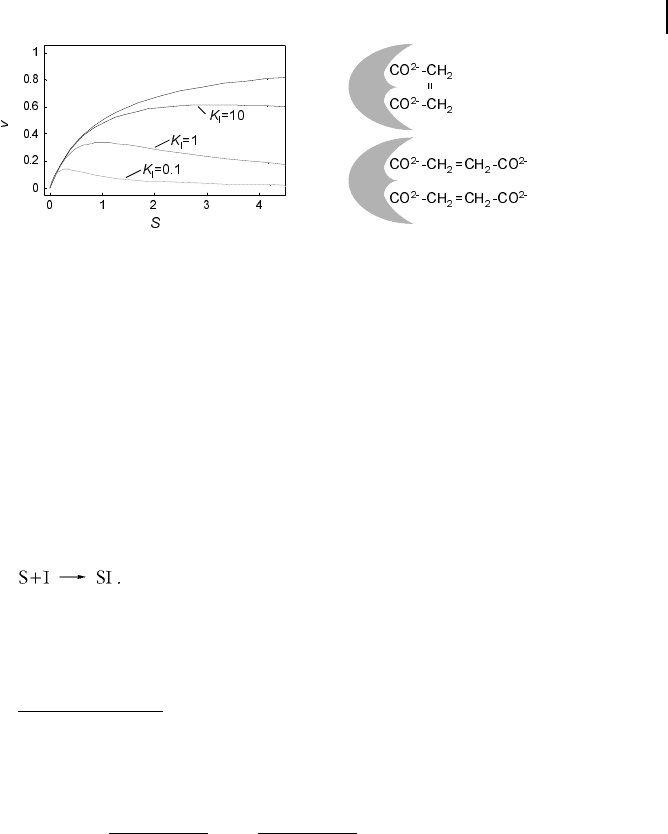
The dependence of v on S is shown in Fig. 5.6. A typical example for substrate in-
hibition is the binding of two succinate molecules to malonate dehydrogenase,
which possesses two binding pockets for the carboxyl group. This is schematically re-
presented in Fig. 5.6.
152
5 Metabolism
5.1.7
Inhibition by Binding of Inhibitor to Substrate
The reaction rate is also decreased if an inhibitor forms a tight complex with the sub-
strate:
(5-46)
The effective substrate concentration is decreased to S
eff
= S
0
– SI. According to
the mass action law, for the actual concentrations it holds that
I
0
SIS
0
SI
SI
K
I
: (5-47)
This allows calculating of the effective enzyme concentration:
S
eff
S
0
I
0
S
0
K
I
2
I
0
S
0
K
I
2
2
S
0
I
0
s
: (5-48)
At high substrate concentrations, the reaction rate in the presence of an inhibitor
reaches the maximal velocity of the non-inhibited reaction. The Lineweaver-Burk
plot is nonlinear.
5.1.8
Binding of Ligands to Proteins
Every molecule that binds to a protein is a ligand, irrespective of whether it is the subject
of a reaction or not. Below we consider binding to monomer and oligomer proteins. In
oligomers, there may be interactions between the binding sites on the subunits.
153
5.1 Enzyme Kinetics and Thermodynamics
Fig. 5.6 Plot of reaction rate v against substrate
concentration S for the case of substrate inhibi-
tion. The upper curve shows Michaelis-Menten
kinetics without inhibition, and the lower curves
show kinetics for the indicated values of binding
constant K
I
. Parameter values: V
max
=1,K
m
=1.
The left part visualizes a possible mechanism for
substrate inhibition. The enzyme (gray object)
has two binding pockets to bind different parts
of a substrate molecule (upper scheme). In the
case of high substrate concentration, two differ-
ent molecules may enter the binding pockets,
thereby preventing the specific reaction (lower
scheme).
Consider binding of one ligand (S) to a protein (E) with only one binding site:
(5-49)
The binding constant K
B
is given by
K
B
ES
E S
: (5-50)
The reciprocal of K
B
is the dissociation constant K
D
. The fractional saturation Y of
the protein is determined by the number of subunits that have bound ligands, di-
vided by the total number of subunits. The fractional saturation for one subunit is
Y
ES
E
total
ES
ES E
K
B
S
K
B
S 1
: (5-51)
The plot of Y versus S at a constant total enzyme concentration is a hyperbola, like
the plot of v versus S in the Michaelis-Menten kinetics. In a process where the bind-
ing of S to E is the first step, followed by product release, and where the initial con-
centration of S is much higher than the initial concentration of E, the rate is propor-
tional to the concentration of ES and it holds that
v
V
max
ES
E
total
Y : (5-52)
If the protein has several binding sites, then interactions may occur between these
sites, i.e., the affinity to further ligands may change after binding of one or more li-
gands. This phenomenon is called cooperativity. Positive or negative cooperativity de-
notes an increase or decrease, respectively, in the affinity of the protein to a further
ligand. Homotropic or heterotropic cooperativity denotes that the binding to a cer-
tain ligand influences the affinity of the protein to a further ligand of the same or an-
other type, respectively.
5.1.9
Positive Homotropic Cooperativity and the Hill Equation
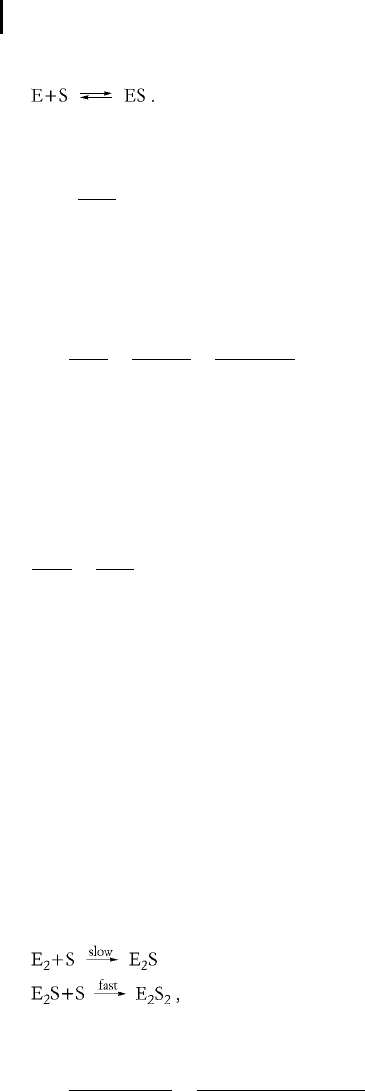
Consider a dimeric protein with two identical binding sites. The binding to the first
ligand facilitates the binding to the second ligand:
(5-53)
where E is a monomer and E
2
a dimer. The fractional saturation is given by
Y
E
2
S 2 E
2
S
2
2 E
2;total
E
2
S E
2
S
2
2 E
2
2 E
2
S 2 E
2
S
2
: (5-54)
154
5 Metabolism
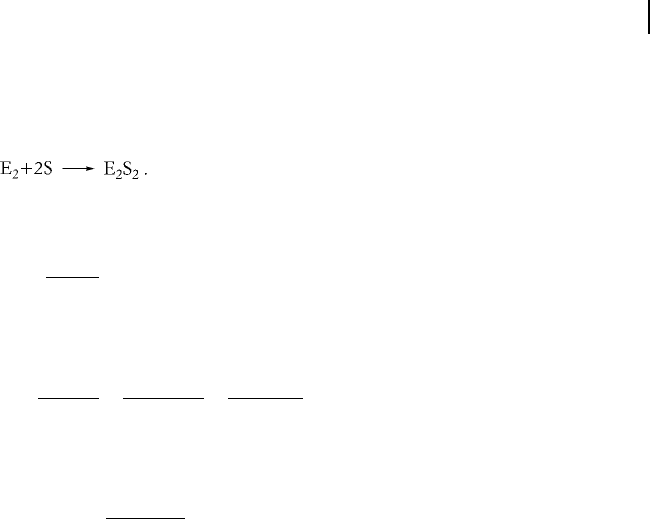
If the affinity to the second ligand is strongly increased by binding to the first
ligand, then E
2
S will react with S as soon as it is formed, and the concentration of E
2
S
can be neglected. In the case of complete cooperativity, i.e., every protein is either
empty or fully bound, Eq. (5-53) reduces to
(5-55)
The binding constant reads
K
B
E
2
S
2
E
2
S
2
; (5-56)
and the fractional saturation is
Y
2 E
2
S
2
2 E
2;total
E
2
S
2
E
2
E
2
S
2
K
B
S
2
1 K
B
S
2
: (5-57)
Generally, for a protein with n subunits it holds that
v V
max
Y
V
max
K
B
S
n
1 K
B
S
n
: (5-58)
This is the general form of the Hill equation. It implies complete homotropic coop-
erativity. Plotting the fractional saturation Y versus substrate concentration S yields a
sigmoid curve with the inflection point at 1/K
B
. The quantity n (often “h” is used in-
stead) is termed the Hill coefficient.
The derivation of this expression was based on experimental findings concerning
the binding of oxygen to hemoglobin (Hb) (Hill 1910, 1913). In 1904 Bohr and co-
workers found that the plot of the fractional saturation of Hb with oxygen against
the oxygen partial pressure had a sigmoid shape. Hill (1909) explained this with in-
teractions between the binding sites located at the hem subunits. At this time it was
already known that every subunit hem binds one molecule of oxygen. Hill assumed
complete cooperativity and predicted an experimental Hill coefficient of 2.8. Today it
is known that hemoglobin has four binding sites but that the cooperativity is not
complete. The sigmoidal binding characteristic has the advantage that Hb binds
strongly to oxygen in the lung with a high oxygen partial pressure, while it can re-
lease O
2
easily in the body with low oxygen partial pressure.
5.1.10
The Monod-Wyman-Changeux Rate Expression for Enzymes with Sigmoid Kinetics
In 1965 Monod and colleagues presented a model explaining sigmoidal enzyme ki-
netics taking into account the interaction of subunits of an enzyme (Monod et al.
1965). A more comprehensive model has been presented by Koshland et al. (1966).
The model of Monod et al. uses the following assumptions: (1) the enzyme consists
155
5.1 Enzyme Kinetics and Thermodynamics
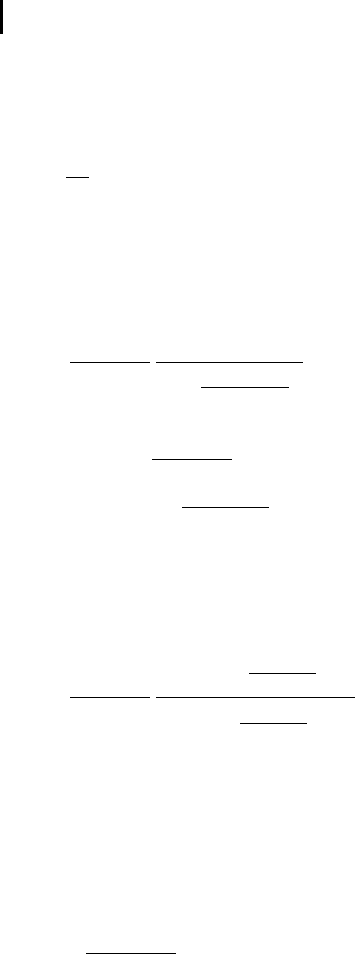
of n identical subunits, (2) each subunit can assume an active (R) or an inactive (T)
conformation, (3) all subunits change their conformations at the same time (con-
certed change), and (4) the equilibrium between the R and the T conformations is
given by an allosteric constant:
L
T
0
R
0
: (5-59)
The index i for T
i
and R
i
denotes the number of bound substrate molecules. The
binding constants for the active and inactive conformations are given by K
R
and K
T
,
respectively. If substrate molecules can bind only to the active form, i.e., if K
T
=0,
then the rate can be given as
V
V
max
K
R
S
1 K
R
S
1
1
L
1 K
R
S
n
; (5-60)
where the factor
V
max
K
R
S
1 K
R
S
corresponds to the Michaelis-Menten rate expression,
while the factor 1
L
1 K
R
S
n
1
is a regulatory factor.
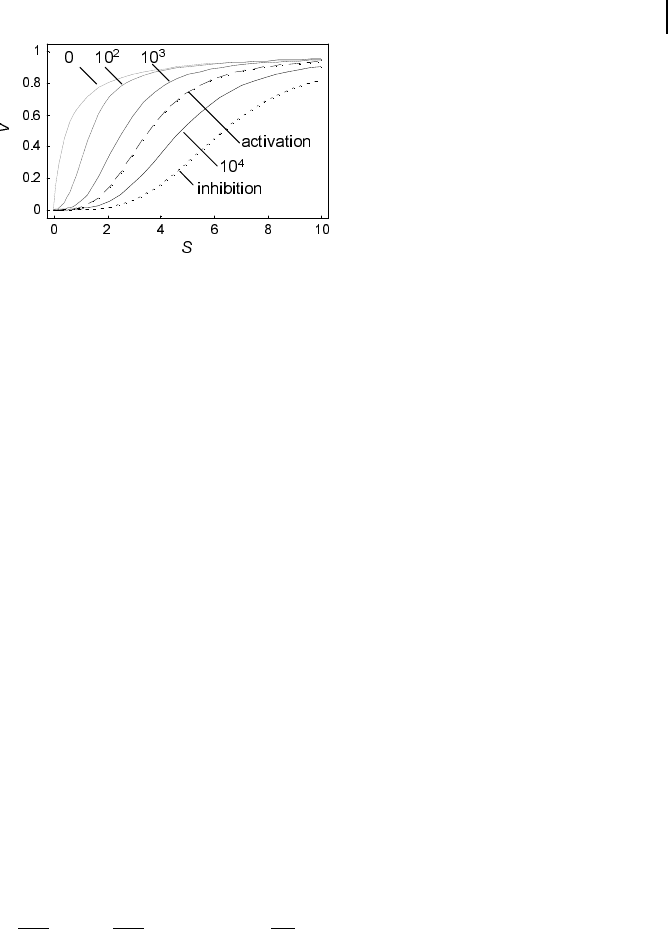
For L = 0 the plot v versus S is a hyperbola as in Michaelis-Menten kinetics. For
L > 0 one gets a sigmoid curve shifted to the right. A typical value for the allosteric
constant is L % 10
4
.
In the case that the substrate can also bind to the inactive state (K
T
= 0), one gets
V
V
max
S
1 K
R
S
K
R
K
T
L
1 K
T
S
1 K
R
S
n1
1 L
1 K
T
S
1 K
R
S
n
: (5-61)
Up to now we have considered only homotropic and positive effects in the model
of Monod, Wyman, and Changeux. But this model is also well suited to explain the
dependence of the reaction rate on activators and inhibitors. Activators A bind only
to the active conformation, and inhibitors I bind only to the inactive conformation.
This shifts the equilibrium to the respective conformation. Effectively, the binding to
effectors changes L:
L
0
L
1 K
I
I
n
1 K
A
A
n
: (5-62)
K
I
and K
A
denote binding constants. The interaction with effectors is a heterotro-
pic effect. An activator weakens the sigmoidity, while an inhibitor strengthens it as
shown in Figure 5.7.
As an example, the kinetics of the enzyme phosphofructokinase, which catalyzes
the transformation of fructose-6-phosphate and ATP to fructose-1,6-bisphosphate,
156
5 Metabolism
can be described by the model of Monod, Wyman, and Changeux. AMP, NH
4
, and
K+ are activators, while ATP is an inhibitor (see Example 5-1).
5.2
Metabolic Networks
In this section we will discuss basic structural and dynamic properties of metabolic
networks. We will introduce a stoichiometric description of networks and learn how
moieties and fluxes are balanced within networks.
The basic elements of a metabolic network model are (1) the substances with their
concentrations and (2) the reactions or transport processes changing the concentra-
tions of the substances. In biological environments, reactions are usually catalyzed
by enzymes, and transport steps are carried out by transport proteins or by pores.
Thus they can be assigned to identifiable biochemical compounds.
Stoichiometric coefficients denote the proportion of substrate and product molecules
involved in a reaction. For example, for the reaction depicted in Eq. (5-11), the stoi-
chiometric coefficients of S
1
,S
2
, and P are –1, –1, and 2. The assignment of stoichio-
metric coefficients is not unique. We could also argue that for the production of one
mole P, half a mole of each S
1
and S
2
have to be used and therefore choose –1/2,
–1/2, and 1. Or, if we change the direction of the reaction, then we may choose 1, 1,
and –2.
The change of concentrations in time can be described using ODEs. For the reac-
tion depicted in Eq. (5-11) and the first choice of stoichiometric coefficients, we have
dS
1
dt
v ;
dS
2
dt
v ; and
dP
dt
2 v : (5-63)
This means that the degradation of S
1
with rate v is accompanied by the degrada-
tion of S
2
with the same rate and by the production of P with the double rate.
157
5.2 Metabolic Networks
Fig. 5.7 Model of Monod,Wyman, and Chan-
geux: Dependence of the reaction rate on sub-
strate concentration for different values of the
allosteric constant L, according to Eq. (5-60).
Parameters: V
max
=1,n =4,K
R
=2,K
T
=0.The
value of L is indicated at the curves. Obviously,
increasing the value of L causes stronger sig-
moidity. The influence of activators or inhibi-
tors (compare Eq. (5-62)) is illustrated with the
dotted line for K
I
I = 2 and with the dashed line
for K
A
A =2(L =10
4
in both cases).
5.2.1
Systems Equations
For a metabolic network consisting of m substances and r reactions, the systems dy-
namics is described by systems equations (or balance equations, since the balance of
substrate production and degradation is considered):
dS
i
dt
X
r
j1
n
ij
v
j
for i 1; ::; m (5-64)
(Glansdorff and Prigogine 1971; Reder 1988). The quantities n
ij
are the stoichio-
metric coefficients of metabolite i in reaction j. Here, we assume that the reactions
are the only reason for concentration changes and that no mass flow occurs due to
convection or to diffusion. The balance equations (Eq. (5-64)) can also be applied if
the system consists of several compartments. In this case, every compound in differ-
ent compartments has to be considered as an individual compound, and transport
steps are formally considered as reactions transferring the compound belonging to
one compartment into the same compound belonging to the other compartment.
The stoichiometric coefficients n
ij
assigned to the substances S
i
and the reactions
v
j
can be combined into the so-called stoichiometric matrix
N n
ij
for i 1; ::; m and j 1; ::; r ; (5-65)
where each column belongs to a reaction and each row to a substance.
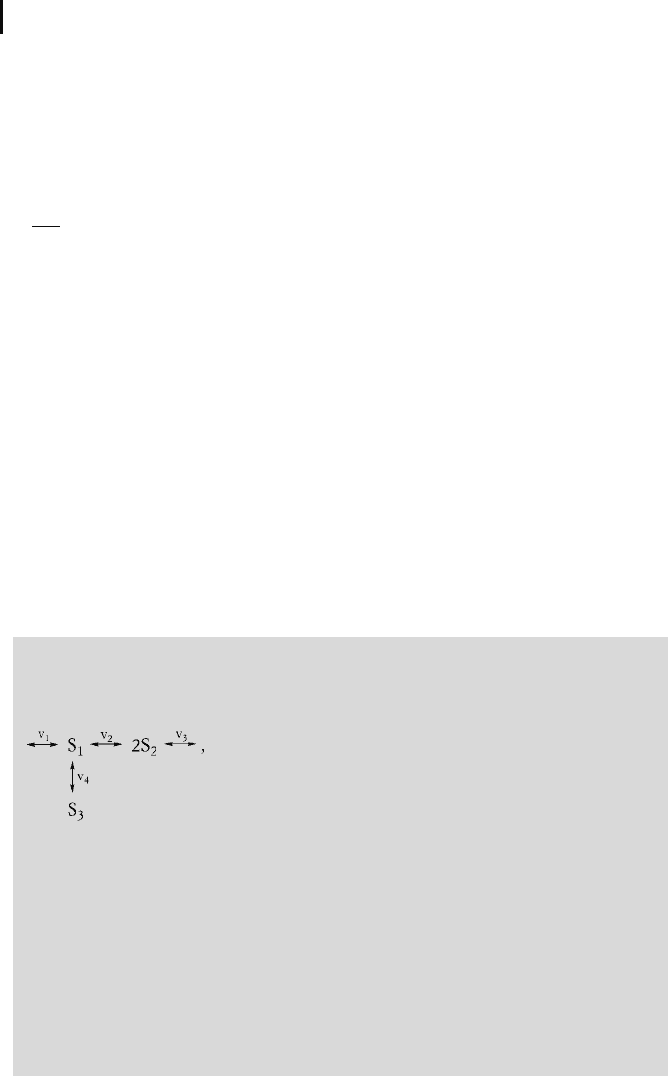
Example 5-4
For the simple network
(5-66)
the stoichiometric matrix reads
N
1 101
0210
0001
0
@
1
A
: (5-67)
Note that in Eq. (5-66) all reactions may be reversible. In order to determine the
signs of N, the direction of the arrows is artificially assigned as positive “from left
to right” and “from the top down.” If, for example, the net flow proceeds from S
3
to S
1
, the value of rate v
4
is negative.
158
5 Metabolism

Altogether, the mathematical description of the metabolic system consists of a vec-
tor S =(S
1
, S
2
,…,S
n
)
T
of concentration values, a vector v =(v
1
, v
2
,…,v
r
)
T
of reaction
rates, a parameter vector p =(p
1
, p
2
,…,p
m
)
T
, and the stoichiometric matrix N. If the
system is in steady state, we can also consider the vector
J
=(J
1
, J
2
,…,J
r
)
T
containing
the steady state fluxes. With these notions, the balance equation reads
dS
dt
Nv : (5-68)
Example 5-5
For our running example (Example 5-1) of the upper glycolysis model, the con-
centration vector is
S
Gluc6P
Fruc6P
Fruc1,6P
2
ATP
ADP
AMP
0
B
B
B
B
B
B
@
1
C
C
C
C
C
C
A
; (5-69)
the vector of reaction rates is v =(v
1
, v
2
,…,v
8
)
T
, the parameter vector is given by
p Glucose; V
max;1
; K
ATP;1
; K
Glucose;1
; k
2
; V
f
max;3
; V
r
max;3
; K
Gluc6P;3
; K
Fruc6P;3
;
V
max;4
; K
F6P;4
; k
4
; k
5
; k
6
; k
7
; k
8f
; k
8r
T
; (5-70)
and the stoichiometric matrix reads
N
1 1 100000
00110 0 0 0
000110 0 0
1 1010 11 1
1101011 2
00000001
0
B
B
B
B
B
B
@
1
C
C
C
C
C
C
A
: (5-71)
5.2.2
Information Contained in the Stoichiometric Matrix N
The stoichiometric matrix contains important information about the structure of the
metabolic network. Using the stoichiometric matrix, we can calculate which combi-
nations of individual fluxes are possible in steady state (i.e., calculate the admissible
steady-state flux space). We may easily discover dead ends and unbranched reaction
pathways. In addition, we may find out the conservation relations for the included re-
actants.
159
5.2 Metabolic Networks