
Klipp E., Herwig R., Kowald A., Wierling C., Lehrach H. Systems Biology in Practice: Concepts, Implementation and Application
Подождите немного. Документ загружается.


6
Signal Transduction
Introduction
Throughout intercellular communication or cellular stress response, the cell senses
extracellular signals. They are commuted to intracellular signals and sequences of
reactions. Different external changes or events may stimulate signaling. Typical sig-
nals are hormones, pheromones, heat, cold, light, osmotic pressure, and appearance
or concentration change of substances such as glucose, K
+
,Ca
+
, or cAMP.
On a molecular level, signaling involves the same type of processes as metabo-
lism: production or degradation of substances, molecular modifications (mainly
phosphorylation, but also methylation and acetylation), and activation or inhibition
of reactions. From a modeling point of view, there are some important differences
between signaling and metabolism. First, signaling pathways serve for information
processing and transfer of information, while metabolism provides mainly mass
transfer. Second, the metabolic network is determined by the present set of enzymes
catalyzing the reactions. Signaling pathways involve compounds of different types,
and they may form highly organized complexes and may assemble dynamically
upon occurrence of the signal. Third, the quantity of converted material is high in
metabolism (amounts are usually given in concentrations on the order of µMor
mM) compared to the number of molecules involved in signaling processes (the typi-
cal abundance of proteins in signal cascades is on the order of 10 to 10
4
molecules
per cell). Finally, the different amounts of components have an effect on the concen-
tration ratio of catalysts and substrates. In metabolism this ratio is usually low; the
enzyme concentration is much lower than the substrate concentration, which gives
rise to the quasi-steady-state assumption used in Michaelis-Menten kinetics (Chapter
5, Section 5.1). In signaling processes, amounts of catalysts and their substrates are
frequently in the same order of magnitude.
Modeling of the dynamic behavior of signaling pathways is often not straightfor-
ward. Knowledge about components of the pathway and their interaction is still lim-
ited and incomplete. The interpretation of experimental data is context- and knowl-
edge-dependent. Furthermore, the effect of a signal often changes the state of the
whole cell, and this implies difficulties for determination of system limits. But in
many cases we may apply the same tools as introduced in Chapter 5.
201
6.1
Function and Structure of Intra- and Intercellular Communication
Cells have a broad spectrum of receiving and processing signals; therefore, not all
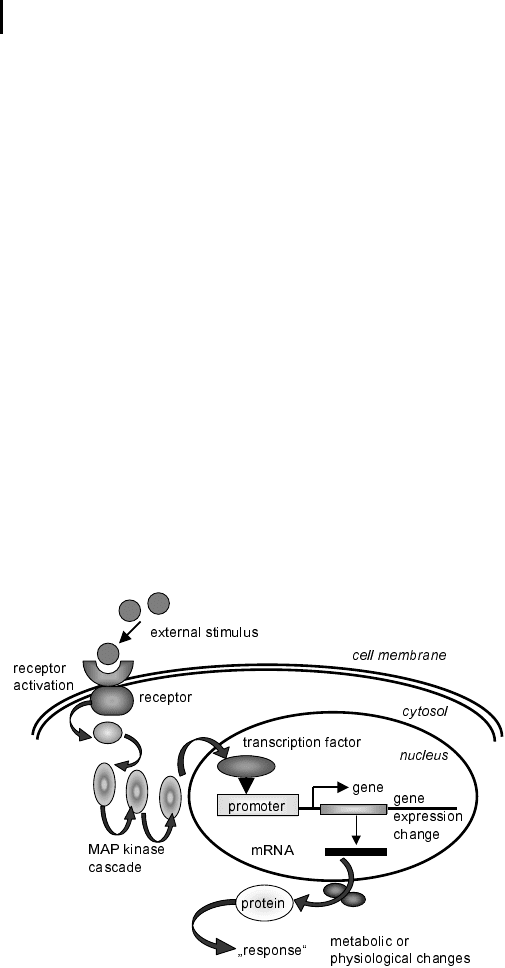
of them can be considered here. A typical sequence of events in signaling pathways
is shown in Fig. 6.1 and proceeds as follows. The “signal” (a substance acting as a
ligand or a physical stimulus) approaches the cell surface. Cells have developed two
different modes of importing a signal. First, the stimulus may penetrate the cell
membrane and bind to a respective receptor in the cell interior. Another possibility
is that the signal is perceived by a transmembrane receptor. If the target of the sig-
nal is a receptor, it does not cross the membrane. Instead, the receptor changes its
own state from susceptible to active and then triggers subsequent processes within
the cell. The active receptor stimulates an internal signaling cascade. This cascade
frequently includes a series of changes in protein phosphorylation states. The se-
quence of state changes crosses the nuclear membrane. Eventually, a transcription
factor is activated or deactivated. The transcription factor changes its binding prop-
erties to regulatory regions on the DNA upstream of a set of genes, and the tran-
scription rate of these genes is altered (typically increased). Either the newly pro-
duced proteins or the changes in protein concentration cause the actual response
of the cell to the signal. In addition to this downstream program, signaling path-
202
6 Signal Transduction
Signaling paradigm
Fig. 6.1 Visualization of the signaling paradigm
(for description, see text). The receptor is stimu-
lated by a ligand or another kind of signal, and it
changes its own state from susceptible to active.
The active receptor initiates the internal signal-
ing cascade, including a series of protein phos-
phorylation state changes. Subsequently, tran-
scription factors are activated or deactivated.
The transcription factors regulate the transcrip-
tion rate of a set of genes. The absolute amount
or the relative changes in protein concentrations
alter the state of the cell and trigger the actual
response to the signal.
ways are regulated by a number of control mechanisms including feedback and
feed-forward modulation.
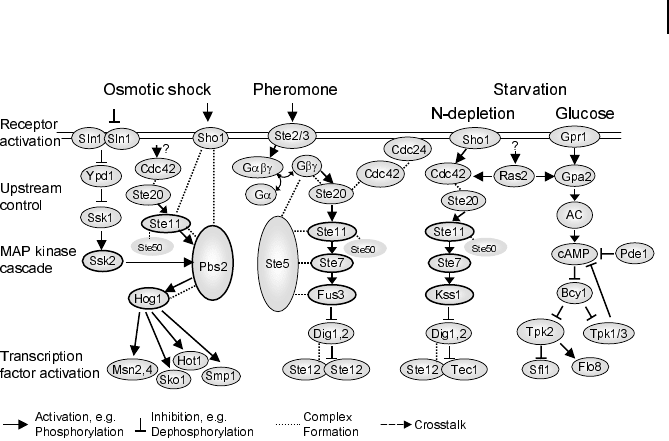
This is the typical picture; however, many pathways may work in a completely dif-
ferent manner. As an example, an overview of signaling pathways that are stimulated
in yeast stress response is given in Fig. 6.2.
6.2
Receptor-Ligand Interactions
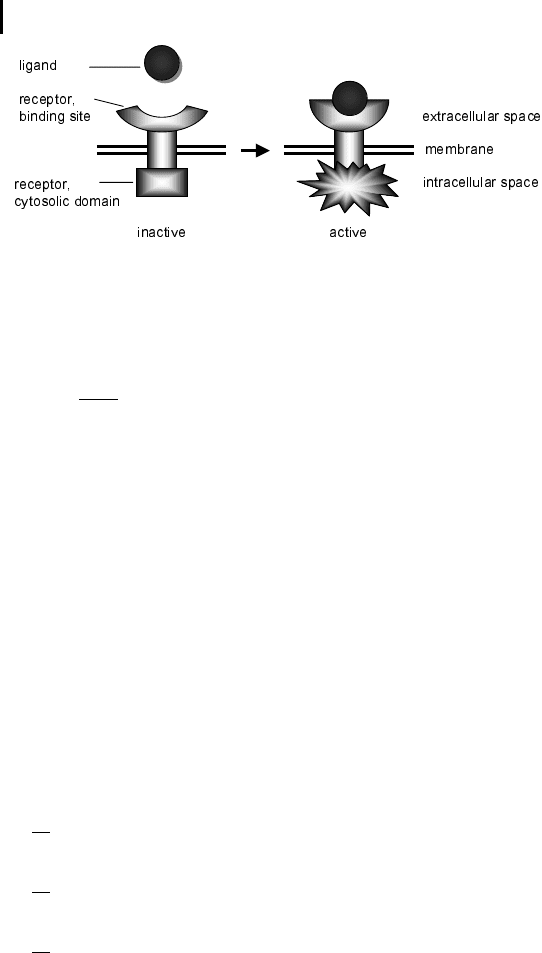
Many receptors are transmembrane proteins; they receive the signal and transmit it.
Upon signal sensing, they change their conformation (see Fig. 6.3). In the active
form they are able to initiate a downstream process within the cell. The simplest con-
cept of the interaction between receptor R and ligand L is reversible binding to form
the active complex LR:
L+Rv LR . (6-1)
203
6.2 Receptor-Ligand Interactions
Signaling Pathways in Baker‘s Yeast
Fig. 6.2 Overview of signaling pathways in
yeast: HOG pathway activated by osmotic
shock, pheromone pathway activated by a pher-
omone from cells of opposite mating type, and
pseudohyphal growth pathway stimulated by
starvation conditions. In each case, the signal
interacts with the receptor. The receptor acti-
vates a cascade of intracellular processes in-
cluding complex formations, phosphorylations,
and transport steps. A MAP kinase cascade is a
particular part of many signaling pathways; its
components are indicated by bold border. Even-
tually, transcription factors are activated that
regulate the expression of a set of genes. Be-
sides the indicated connections, further interac-
tions of components are possible. For example,
crosstalk may occur, i.e., the activation of the
downstream part of one pathway by a compo-
nent of another pathway. This is supported by
the frequent incidence of proteins like Ste11 in
the scheme.
The dissociation constant is calculated as
K
D
L R
LR
: (6-2)
Typical values for K
D
are 10
–12
M…10
–6
M.
Cells have the ability to regulate the number and the activity of specific receptors,
e.g., in order to weaken the signal transmission during long-term stimulation. Bal-
ancing production and degradation regulates the number of receptors. Phosphoryla-
tion of serine/threonine or tyrosine residues of the cytosolic domain by protein ki-
nases mainly regulates the activity. Hence, a more realistic scenario for ligand-recep-
tor interaction is depicted in Fig. 6.4.
We assume that the receptor is present in the inactive state R
i
or the susceptible
state R
s
. The susceptible form can interact with the ligand to form the active state
R
a
. The inactive or susceptible form is produced from precursors (v
pi
,v
ps
), and all
three forms may be degraded (v
di
,v
ds
,v
da
). The rates of production and degradation
processes, as well as the equilibria between the different states, might be influenced
by the cell state, e.g., by the cell cycle stage. In general, the dynamics of this scenario
can be described by the following set of differential equations:
d
dt
R
i
v
pi
v
di
v
is
v
si
v
ai
d
dt
R
s
v
ps
v
ds
v
is
v
si
v
sa
v
as
d
dt
R
a
v
da
v
sa
v
as
v
ai
: (6-3)
For the production terms, we may assume either constant values or (as mentioned
above) rates that depend on the actual cell state. The degradation terms might be
assumed to be linearly dependent on the concentration of their substrates
(v
d*
=k
d*
7R
*
). This may also be a first guess for the state changes of the receptor
(e.g., v
is
=k
is
7R
i
). The receptor activation is dependent on the ligand concentration
204
6 Signal Transduction
Fig. 6.3 Schematic representation of receptor activation.
(or any other value related to the signal). A linear approximation of the respective
rate is v
sa
=k
sa
7R
s
7L. If the receptor is a dimer or oligomer, it might be sensible to
include this information into the rate expression as v
sa
k
sa
R
s
K
b
L
n
1 K
b
L
n
, where
K
b
denotes the binding constant and n the Hill coefficient (Chapter 5, Eq. (5-58)).
Example 6-1
An experimentally confirmed example for the activation of receptor and G protein
of the pheromone pathway has been presented by Yi and colleagues (2003) for the
binding of the pheromone a-factor to the receptor Ste2 in yeast. Concerning the
receptor activation dynamics, they report a susceptible and an active form of the
receptor, but no inactive form (R
i
= 0, v
*i
=v
i*
= 0). The remaining rates are deter-
mined as follows:
v
ps
k
ps
v
ds
k
ds
R
s
v
da
k
da
R
a
v
sa
k
sa
R
s
L
v
as
k
as
R
a
; (6-4)
with the following values for the rate constants: k
ps
4 (molecules per cell) s
–1
,
k
ds
4 10
4
s
1
, k
da
4 10
3
s
1
, k
sa
2 10
6
M
1
s
1
, and k
as
1 10
2
s
1
.
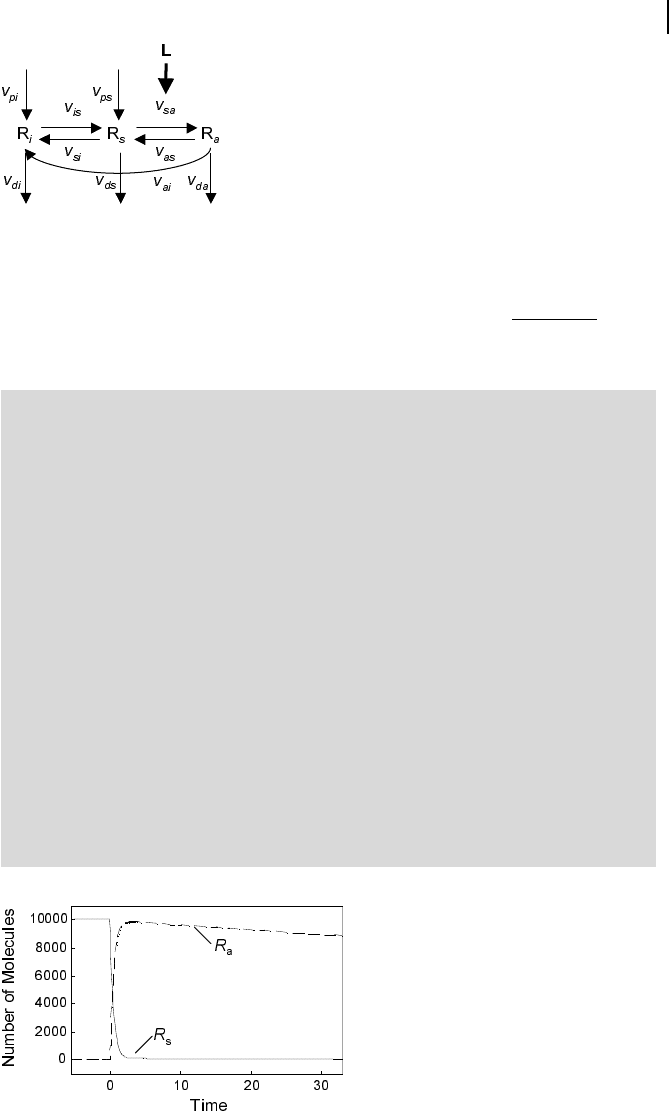
The time course of receptor activation is depicted in Fig. 6.5.
205
6.2 Receptor-Ligand Interactions
Fig. 6.4 Schematic representation of processes involved in
receptor activation by a ligand. L = ligand, R
i
= inactive recep-
tor, R
s
= susceptible receptor, R
a
= active receptor. v
p*
= pro-
duction steps, v
d*
= degradation steps, other steps = transition
between inactive, susceptible, and active state of receptor.
Fig. 6.5 Time course of active (solid line)
and susceptible (dashed line) receptor after
stimulation with 1 mM a-factor at t = 0. The
total number of receptors is 10,000. The
concentration of the active receptor in-
creases immediately and then declines
slowly, while the susceptible receptor is
effectively reduced to zero.
6.3
Structural Components of Signaling Pathways
Signaling pathways constitute often highly complex networks, but it has been discov-
ered that they are frequently composed of typical building blocks. These components
include Ras proteins, G protein cycles, phosphorelay systems, and MAP kinase cas-
cades. In this chapter we will discuss their general composition and function as well
as modeling approaches.
6.3.1
G Proteins
G proteins are essential parts of many signaling pathways. The reason for their
name is that they bind the guanine nucleotides GDP and GTP. They are heterotri-
mers, i. e., they consist of three different subunits. G proteins are associated to cell
surface receptors with a heptahelical transmembrane structure, the so-called G pro-
tein–coupled receptors (GPCR). Signal transduction cascades involving (1) such a
transmembrane surface receptor, (2) an associated G protein, and (3) an intracellular
effector that produces a second messenger play an important role in cellular com-
munication and are well studied (Neer 1995; Dohlman 2002). In humans, such G
protein–coupled receptors mediate responses to light, flavors, odors, numerous hor-
mones, neurotransmitters, and other signals (Blumer and Thorner 1991; Dohlman
et al. 1991; Buck 2000). In unicellular eukaryotes, receptors of this type mediate sig-
nals that affect such basic processes as cell division, cell-cell fusion (mating), mor-
phogenesis, and chemotaxis (Blumer and Thorner 1991; Banuett 1998; Dohlman et
al. 1998; Wang and Heitman 1999).
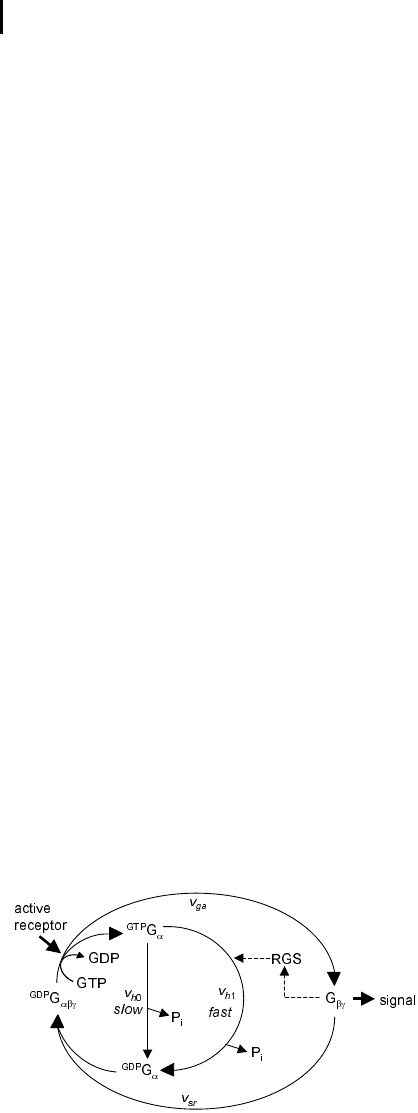
The cycle of G protein activation and inactivation is shown in Fig. 6.6. When GDP
is bound, the G protein a subunit (Ga) is associated with the G protein bg heterodi-
mer (Gbg) and is inactive. Agonist binding to a receptor promotes guanine nucleo-
tide exchange; Ga releases GDP, binds GTP, and dissociates from Gbg. The disso-
ciated subunits Ga or Gbg, or both, are then free to activate target proteins (down-
stream effectors), which initiates signaling. When GTP is hydrolyzed, the subunits
206
6 Signal Transduction
G-Protein Cycle
Fig. 6.6 Activation cycle of G
protein. Without activation, the
heterotrimeric G protein is bound
to GPD. Upon activation by the
activated receptor, an exchange of
GDP with GTP occurs and the G
protein is divided into GTP-bound
Ga and the heterodimer Gbg.Ga-
bound GTP is hydrolyzed, either
slowly in reaction v
h0
or fast in re-
action v
h1
, supported by the RGS
protein. GDP-bound Ga can re-
associate with Gbg (reaction v
sr
).
are able to re-associate. Gbg antagonizes receptor action by inhibiting guanine nu-
cleotide exchange. RGS (regulator of G protein signaling) proteins bind to Ga, sti-
mulate GTP hydrolysis, and thereby reverse G protein activation. This general
scheme can also be applied to the regulation of small monomeric Ras-like GTPases,
such as Rho. In this case, the receptor, Gbg, and RGS are replaced by GEF and GAP
(see Section 6.3.2).
Direct targets include different types of effectors, such as adenylyl cyclase, phos-
pholipase C, exchange factors for small GTPases, some calcium and potassium
channels, plasma membrane Na
+
/H
+
exchangers, and certain protein kinases (Neer
1995; Offermanns 2000; Dohlman and Thorner 2001; Meigs et al. 2001). Typically,
these effectors produce second messengers or other biochemical changes that lead
to stimulation of a protein kinase or a protein kinase cascade (or, as mentioned, are
themselves a protein kinase). Signaling persists until GTP is hydrolyzed to GDP and
the Ga and Gbg subunits re-associate, completing the cycle of activation. The
strength of the G protein–initiated signal depends on (1) the rate of nucleotide ex-
change, (2) the rate of spontaneous GTP hydrolysis, (3) the rate of RGS-supported
GTP hydrolysis, and (4) the rate of subunit re-association. RGS proteins act as
GTPase-activating proteins (GAPs) for a variety of different Ga classes and thereby
shorten the lifetime of the activated state of a G protein and contribute to signal de-
sensitization. Furthermore, they may contain additional modular domains with sig-
naling functions and contribute to diversity and complexity of the cellular signaling
networks (Dohlman and Thorner 1997; Siderovski et al. 1999; Burchett 2000; Ross
and Wilkie 2000).
Example 6-2
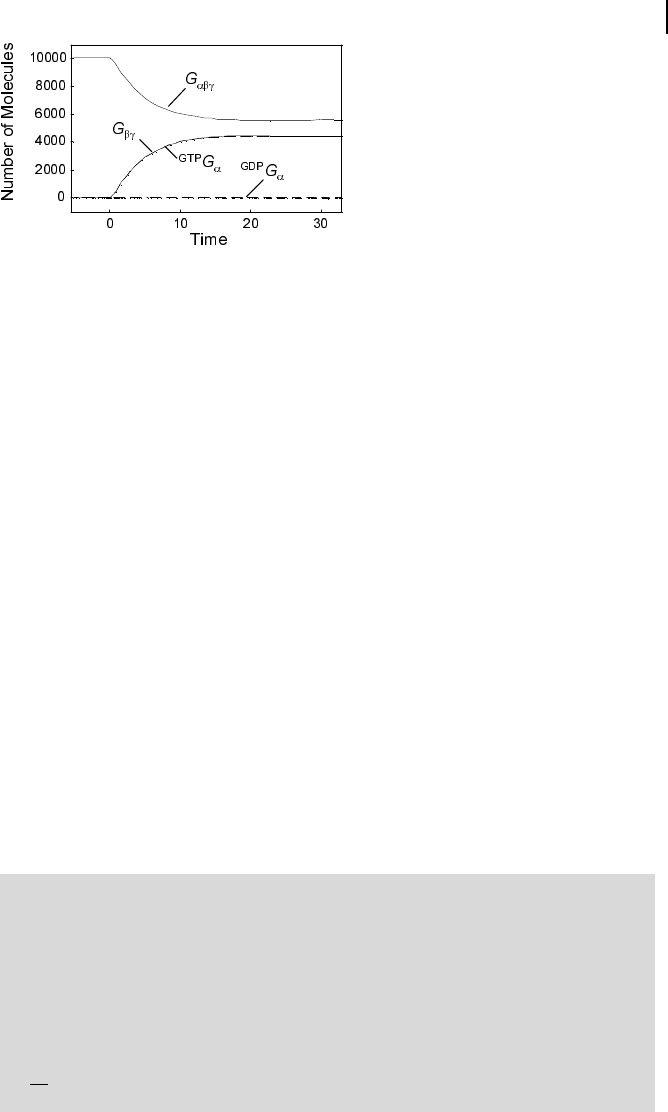
The model of the heterotrimeric G protein cycle of the yeast pheromone pathway
was already mentioned in Example 6-1 and is linked to the receptor activation
model via the concentration of the active receptor. The G protein cycle model
comprises two ODEs and two algebraic equations for the mass conservation of
the subunits Ga and Gbg. This gives
d
dt
G
v
ga
v
sr
207
6.3 Structural Components of Signaling Pathways
Fig. 6.7 Time course of G protein activa-
tion. The total number of molecules is
10,000. The concentration of GDP-bound
Ga is low for the whole period due to fast
complex formation with the heterodimer
Gbg.
d
dt
G
GTP v
ga
v
h0
v
h1
G
t
G
G
GTP G
GDP
G
total
G
G
: (6-5)
The rate equations for the G protein activation, v
ga
, the hydrolysis of G
GTP, v
h0
and v
h1
, and the subunit re-association, v
sr
, follow simple mass action kinetics:
v
ga
k
ga
R
a
G
v
hi
k
hi
G
GTP; i 0,1
v
sr
k
sr
G
G
GDP : (6-6)
The parameters are k
ga
1 10
5
(molecules per cell)
–1
s
–1
, k
h0
0:004 s
1
,
k
h1
0:11 s
1
, and k
sr
1 (molecules per cell)
–1
s
–1
. Fig. 6.7 shows the respective
simulation. Note that in the original work two different yeast strains have been
considered. For the strains with a constantly active RGS (SST2
+
) or with a deletion
of RGS (sst2D), the rate constants k
h1
and k
h0
have been set to zero, respectively.
6.3.2
Ras Proteins
Small G proteins are monomeric G proteins with molecular weight of 20–40 kDa.
Like heterotrimeric G proteins, their activity depends on the binding of GTP. More
than 100 small G proteins have been identified. They belong to five families: Ras,
Rho, Rab, Ran, and Arf. They regulate a wide variety of cell functions as biological
timers that initiate and terminate specific cell functions and determine the periods
of time (Takai et al. 2001).
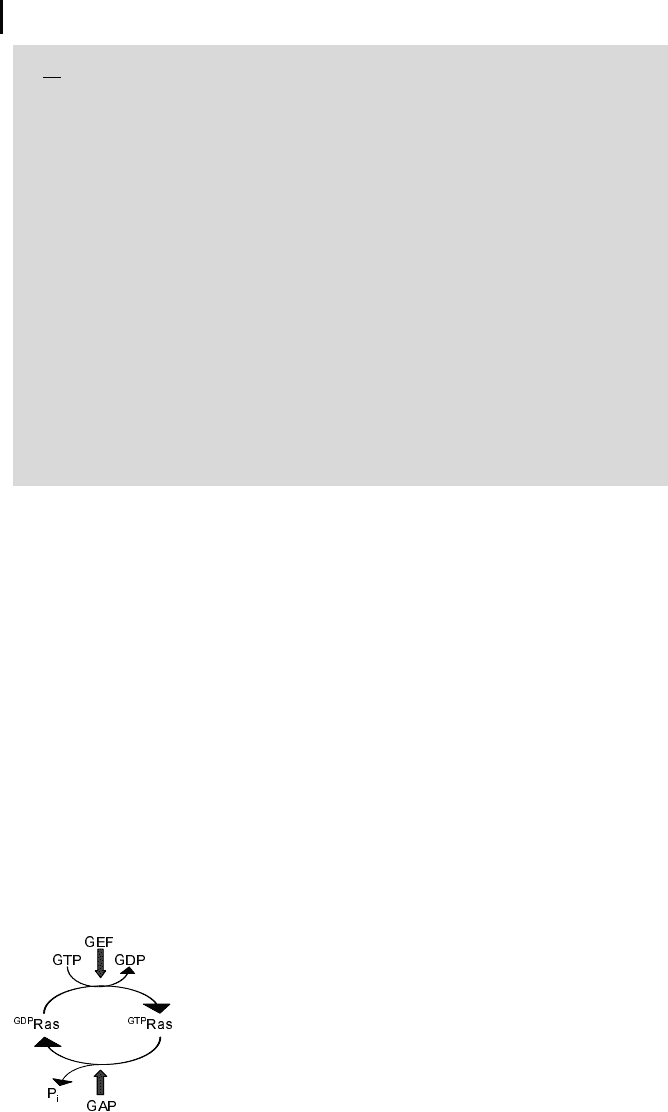
Ras proteins cycle between active and inactive states (Fig. 6.8). The transition
form GDP-bound to GTP-bound states is catalyzed by a guanine nucleotide ex-
change factor (GEF), which induces exchange between the bound GDP and the cellu-
lar GTP. The reverse process is facilitated by a GTPase-activating protein (GAP),
which induces hydrolysis of the bound GTP (Schmidt and Hall 2002).
208
6 Signal Transduction
Ras-Protein
Fig. 6.8 The Ras activation cycle. GEF supports the transition from
GDP-bound to GTP-bound states to activate Ras, while GAP induces
hydrolysis of the bound GTP, resulting in Ras deactivation.
Mutations of the Ras proto-oncogenes (H-Ras,N-Ras,K-Ras) are found in many
human tumors. Most of these mutations result in the abolishment of normal
GTPase activity of Ras. The Ras mutants can still bind to GAP, but they cannot cata-
lyze GTP hydrolysis. Therefore, they stay active for a long time.
6.3.3
Phosphorelay Systems
Most phosphorylation events in signaling pathways take place under consumption
of ATP. Phosphorelay (or phosphotransfer) systems employ another mechanism:
after an initial phosphorylation using ATP (or another phosphate donor), the phos-
phate group is transferred directly from one protein to the next without further con-
sumption of ATP (or external donation of phosphate). Examples are the bacterial
phosphoenolpyruvate:carbohydrate phosphotransferase (Postma et al. 1989, 1993;
Rohwer et al. 2000; Francke et al. 2003), the two-component system of E. coli, or the
Sln1 pathway involved in osmoresponse of yeast (Klipp et al. 2004).
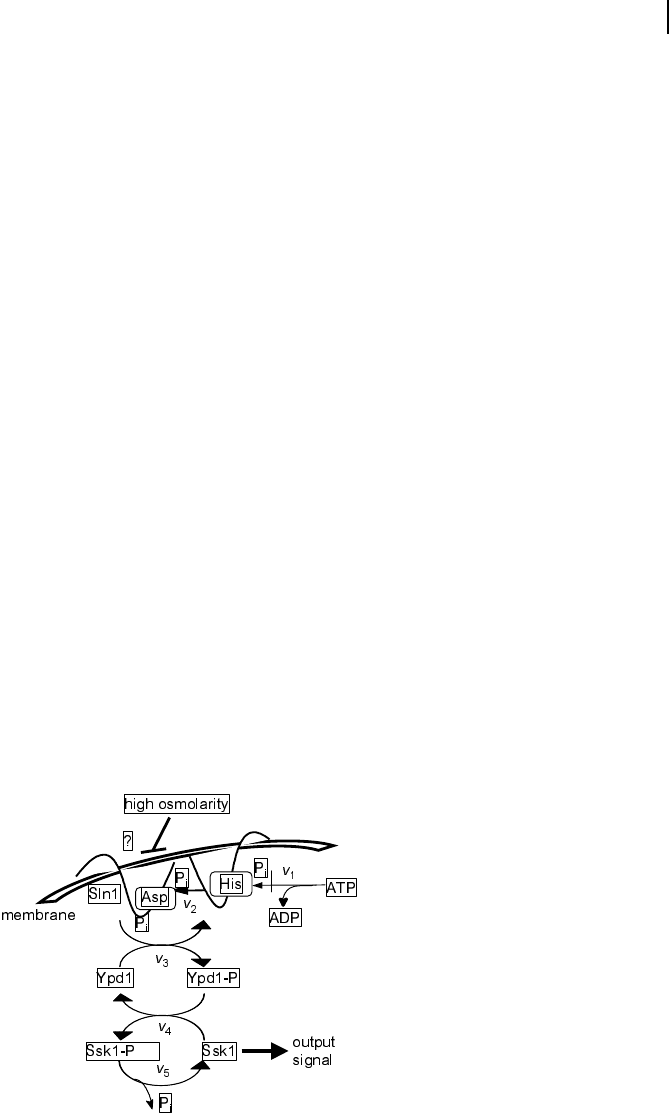
Figure 6.9 shows a scheme of a phosphorelay system from the high osmolarity gly-
cerol (HOG) signaling pathway in yeast. This pathway is organized as follows (Hoh-
mann 2002). It involves the transmembrane protein Sln1,which is present as a dimer.
Under normal conditions, the pathway is active, since Sln1 continuously autopho-
sphorylates at a histidine residue, Sln1H-P, under consumption of ATP. Subsequently,
this phosphate group is transferred to an aspartate group of Sln1 (resulting in Sln1A-
P), then to a histidine residue of Ypd1, and finally to an aspartate residue of Ssk1. Ssk1
is continuously dephosphorylated by a phosphatase. Without stress, the proteins are
present mainly in their phosphorylated form. The pathway is blocked by an increase in
the external osmolarity and a concomitant loss of turgor pressure in the cell. The phos-
phorylation of Sln1 stops, the pathway runs out of transferable phosphate groups, and
the concentration of Ssk1 rises. This constitutes the downstream signal.
209
6.3 Structural Components of Signaling Pathways
Phosphorelay-System
Fig. 6.9 Schematic representation of a
phosphorelay system. (a) Phosphorelay
system belonging to the Sln1-branch of
the HOG pathway in yeast. (b) General
scheme of phosphorylation and depho-
sphorylation.