
Klipp E., Herwig R., Kowald A., Wierling C., Lehrach H. Systems Biology in Practice: Concepts, Implementation and Application
Подождите немного. Документ загружается.


The temporal behavior of the Sln1-phosphorelay module in yeast can be described
with the following set of ODEs.
d
dt
Sln1 k
1
Sln1 k
3
Sln1A-P Ypd1
d
dt
Sln1H-P k
1
Sln1 k
2
Sln1H-P
d
dt
Sln1A-P k
2
Sln1H-P k
3
Sln1A-P Ypd1
d
dt
Ypd1 k
4
Ypd1-P Ssk1 k
3
Sln1A-P Ypd1
d
dt
Ypd1-P k
4
Ypd1-P Ssk1 k
3
Sln1A-P Ypd1
d
dt
Ssk1 k
5
Ssk1-P k
4
Ypd1-P Ssk1
d
dt
Ssk1-P k
5
Ssk1-P k
4
Ypd1-P Ssk1 : (6-7)
For the ordinary differential equation (ODE) system in Eq. (6-7), the following con-
servation relations hold:
Sln1
total
Sln1 Sln1H-P Sln1A-P
Ypd1
total
Ypd1 Ypd1-P
Ssk1
total
Ssk1 Ssk1-P : (6-8)
The existence of conservation relations is in agreement with the assumption that
production and degradation of the proteins occur on a larger timescale than the
phosphorylation events.
The temporal behavior of the Sln1 phosphorelay system is represented for an ex-
ternal stimulus of 200 s. Before the stimulus, the concentrations of Sln1, Ypd1, and
Ssk1 are at low levels. After stimulation, they increase one after the other up to a
maximal level that is determined by the total concentration of each protein. After re-
moval of stimulus, all three concentrations return quickly to their initial values.
It is often discussed whether the low number of molecules involved in signaling
cascades justifies stochastic rather than deterministic modeling of temporal beha-
vior. We can use the phosphorelay model to compare deterministic and stochastic si-
mulations. Figure 6.10 also shows simulations using the Next Reaction Method,
which is based on the Gillespie algorithm (see Chapter 3). Curves in the upper panel
show one simulation for low total molecule numbers per species, and in the lower
panel one simulation for the experimentally determined number of molecules per
cell is shown (Ghaemmaghami et al. 2003). In both cases, the median for a multi-
210
6 Signal Transduction
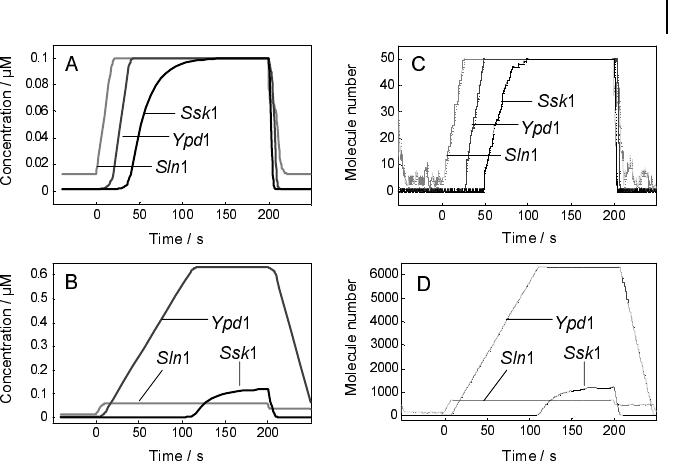
tude of simulations (not shown) tends towards the deterministic solution. For low
molecule numbers, the stochastic curves show pronounced variance before onset
and after conclusion of stress, but extremely low variance during stress. It is obvious
that the switch from phosphorylated to non-phosphorylated states follows a strong
order from one level to the next. While the deterministic simulation pretends a uni-
form behavior, the stochastic simulation typifies the individual behavior of different
cells. For higher molecule numbers (here: realistic numbers), both simulation types
are equally informative.
6.3.4
MAP Kinase Cascades
Mitogen-activated protein kinases (MAPKs) are a family of serine/threonine kinases
that transduce signals from the cell membrane to the nucleus in response to a wide
range of stimuli. Independent or coupled kinase cascades participate in many differ-
ent intracellular signaling pathways that control a spectrum of cellular processes, in-
cluding cell growth, differentiation, transformation, and apoptosis. MAPK cascades
are widely involved in eukaryotic signal transduction, and these pathways are con-
served from yeast to mammals.
211
6.3 Structural Components of Signaling Pathways
Fig. 6.10 Time course of the phosphorelay
system after stimulation for 200 s. The results
for deterministic simulation (panels A and B)
and for stochastic simulation (panels C and D)
are shown. Parameter values for all cases:
k1 = 0.4 s
–1
,k2=1s
–1
,k3=50µM
–1
s
–1
;
k4 = 50 µM
–1
s
–1
; k5 = 0.5 s
–1
. Total concentra-
tions in the deterministic simulation: panel A:
Sln1
total
= 0.1 µM,Ypd1
total
= 0.1 µM, Ssk1
total
=
0.1 µM; panel B: Sln1
total
= 0.06 µM,Ypd1
total
=
0.62 µM, Ssk1
total
= 0.12 µM. Total molecule
numbers for stochastic simulation: panel C:
Sln1
total
: 50,Ypd1
total
: 50, Ssk1
total
: 50; panel D:
Sln1
total
: 656,Ypd1
total
: 6300, Ssk1
total
: 1200.
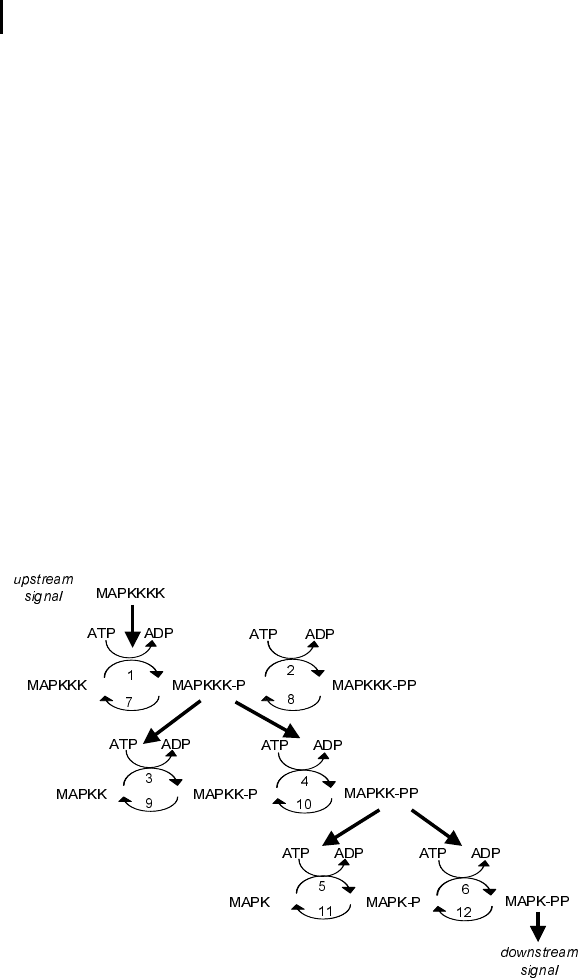
A general scheme of a MAPK cascade is depicted in Fig. 6.11. This pathway
consists of several levels (usually three), where the activated kinase at each level
phosphorylates the kinase at the next level down the cascade. The MAP kinase
(MAPK) is at the terminal level of the cascade. It is activated by the MAPK kinase
(MAPKK) by phosphorylation of two sites: conserved threonine and tyrosine resi-
dues. The MAPKK is itself phosphorylated at serine and threonine residues by the
MAPKK kinase (MAPKKK). Several mechanisms are known to activate MAPKKKs
by phosphorylation of a tyrosine residue. In some cases the upstream kinase may
be considered a MAPKKK kinase (MAPKKKK). Dephosphorylation of either resi-
due is thought to inactivate the kinases, and mutants lacking either residue are al-
most inactive. At each cascade level, protein phosphatases can inactivate the corre-
sponding kinase, although in some cases it is a matter of debate whether this reac-
tion is performed by an independent protein or by the kinase itself as autodepho-
sphorylation. Ubiquitin-dependent degradation of phosphorylated proteins is also
reported.
Although they are conserved through species, elements of the MAPK cascade
were given different names in various studied systems. Some examples are repre-
sented in Tab. 6.1 (see also Wilkinson and Millar 2000).
212
6 Signal Transduction
MAP kinase cascade
Fig. 6.11 Schematic representation of the MAP kinase cascade. An
upstream signal (often by a further kinase called MAP kinase kinase
kinase kinase) causes phosphorylation of the MAPKKK. The phos-
phorylated MAPKKK in turn phosphorylates the protein at the next
level. Dephosphorylation is assumed to occur continuously by phos-
phatases or autodephosphorylation.

In the following we will present typical modeling approaches and then discuss
functional properties of signaling cascades. The dynamics of a MAPK cascade may
be represented by the following ODE system:
d
dt
MAPKKK v
1
v
7
d
dt
MAPKKK-P v
1
v
7
v
2
v
8
d
dt
MAPKKK-P
2
v
2
v
8
(6-9)
d
dt
MAPKK v
3
v
9
d
dt
MAPKK-P v
3
v
9
v
4
v
10
d
dt
MAPKK-P
2
v
4
v
10
(6-10)
d
dt
MAPK v
5
v
11
d
dt
MAPK-P v
5
v
11
v
6
v
12
d
dt
MAPK-P
2
v
6
v
12
: (6-11)
Please note that it is not clear whether MAPKKK-P
2
and v
2
,v
8
exist at all. In this
case their value may be simply set to zero.
The variables in the ODE system fulfill a set of moiety conservation relations, irre-
spective of the concrete choice of expression for the rates v
1
…v
12
. It holds that
213
6.3 Structural Components of Signaling Pathways
Tab. 6.1 Names of the components of MAP kinase pathways in different organisms and different
pathways.
Organism Budding yeast Xensopus
oocytes
Human, cell cycle regulation
HOG
pathway
Pheromone
pathway
p38
pathway
JNK
pathway
MAPKKK Ssk2/Ssk22 Ste11 Mos Rafs (c-, A-
and B-),
Tak1 MEKKs
MAPKK Pbs2 Ste7 MEK1 MEK1/2 MKK3/6 MKK4/7
MAPK Hog1 Fus3 p42 MAPK ERK1/2 p38 JNK1/2

MAPKKK
total
MAPKKK MAPKKK-P MAPKKK-P
2
(6-12)
MAPKK
total
MAPKK MAPKK-P MAPKK-P
2
(6-13)
MAPK
total
MAPK MAPK-P MAPK-P
2
: (6-14)
The conservation relations reflect that we do not consider production or degrada-
tion of the involved proteins in this model. This is justified by the supposition that
protein production and degradation take place on a different timescale than signal
transduction.
The choice of the expressions for the rates is a matter of the elaborateness of ex-
perimental knowledge and of modeling taste. We will discuss different possibilities
here. Assuming only mass action results in linear and bilinear expression such as
v
1
k
1
MAPKKK MAPKKKK (6-15)
v
7
k
7
MAPKKK-P : (6-16)
The kinetic constants k
i
are first-order (i 7) and second-order (i 6) rate con-
stants.
In these expressions, the concentrations of the donor and acceptor of the trans-
ferred phosphate group, ATP and ADP, are not explicitly considered but are included
in the rate constants k
1
and k
7
. Considering ATP and ADP explicitly results in
v
1
k
1
MAPKKK MAPKKKK ATP (6-17)
v
7
k
7
MAPKKK-P : (6-18)
In addition, we have to be concerned about the ATP-ADP balance and add three
more differential equations:
d
dt
ATP
X
6
i1
v
i
v
x
d
dt
ADP
X
6
i1
v
i
v
x
d
dt
P
X
12
i7
v
i
v
x
: (6-19)
Here we find two more conservation relations: the conservation of adenine nu-
cleotides, ATP ADP const:, and the conservation of phosphate groups:
MAPKKK-P 2 MAPKKK-P
2
MAPKK-P 2 MAPKK-P
2
MAPK-P 2 MAPK-P
2
3 ATP 2 ADP P const: (6-20)
One may take into account that enzymes catalyze all steps (e.g., Huang and Ferrell
1996) and therefore consider Michaelis-Menten kinetics for the individual steps
214
6 Signal Transduction
(e.g., Kholodenko 2000). Taking again the first and seventh reactions as examples for
kinase and phosphatase steps, we get
v
1
k
1
MAPKKKK
MAPKKK
K
m1
MAPKKK
(6-21)
v
7
V
max 7
MAPKKK-P
K
m7
MAPKKK-P
; (6-22)
where k
1
is a first-order rate constant, K
m1
and K
m7
are Michaelis constants, and
V
max7
denotes a maximal enzyme rate. Reported values for Michaelis constants are
15 nM (Kholodenko 2000), 46 nM and 159 nM (Force et al. 1994), and 300 nM
(Huang and Ferrell 1996). For maximal rates, values of about 0.75 nM7s
–1
(Kholo-
denko 2000) are used in models.
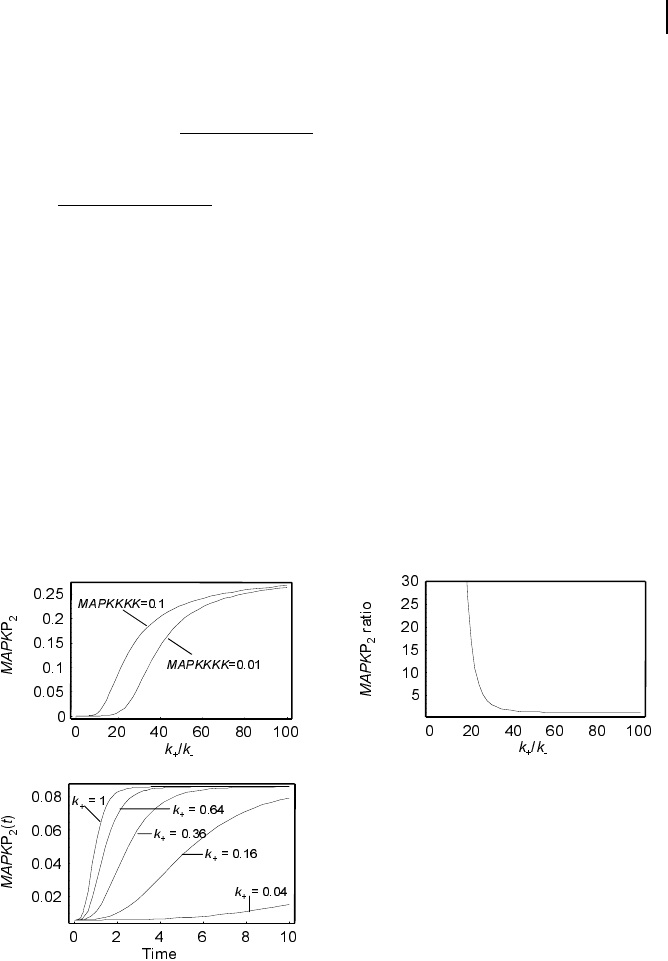
The performance of MAPK cascades, i.e., their ability to amplify the signal and to
notably enhance the concentration of the double-phosphorylated MAPK and the
speed of activation, depends crucially on the kinetic constants of the kinases, k
+
, and
phosphatases, k
–
, and, moreover, on their ratio (see Fig. 6.12). If the ratio k
+
/k
–
is
low (phosphatases stronger than kinases), then the amplification is high, but at very
low absolute concentrations of phosphorylated MAPK. High values of k
+
/k
–
ensure
215
6.3 Structural Components of Signaling Pathways
Fig. 6.12 Parameter dependence of MAPK cas-
cade performance. In the upper row steady-state
simulations are shown for changing values of
rate constants for kinases, k
+
, and phospha-
tases, k
–
(in arbitrary units). Left panel: Absolute
values of the output signal MAPK-PP depending
on the input signal (high: MAPKKKK = 0.1 or
low: MAPKKKK = 0.01) for varying ratio of k
+
/k
–
.
Right panel: ratio of the output signal for high
versus low input signal (MAPKKKK = 0.1 or
MAPKKKK = 0.01) for varying ratio of k
+
/k
–
.
Lower row, left panel: time course of MAPK acti-
vation for different values of k
+
and a ratio
k
+
/k
–
= 20.

high absolute concentrations of MAPK-P
2
, but with negligible amplification. High
values of both k
+
and k
–
ensure fast activation of downstream targets.
Frequently, the proteins of MAPK cascades interact with scaffold proteins. In this
case, a reversible assembly of oligomeric protein complexes that include both enzy-
matic proteins and proteins without known enzymatic activity precedes the signal
transduction. These non-enzymatic components can serve as scaffolds or anchors to
the plasma membrane and regulate the efficiency, specificity, and localization of the
signaling pathway.
6.3.5
Jak-Stat Pathways
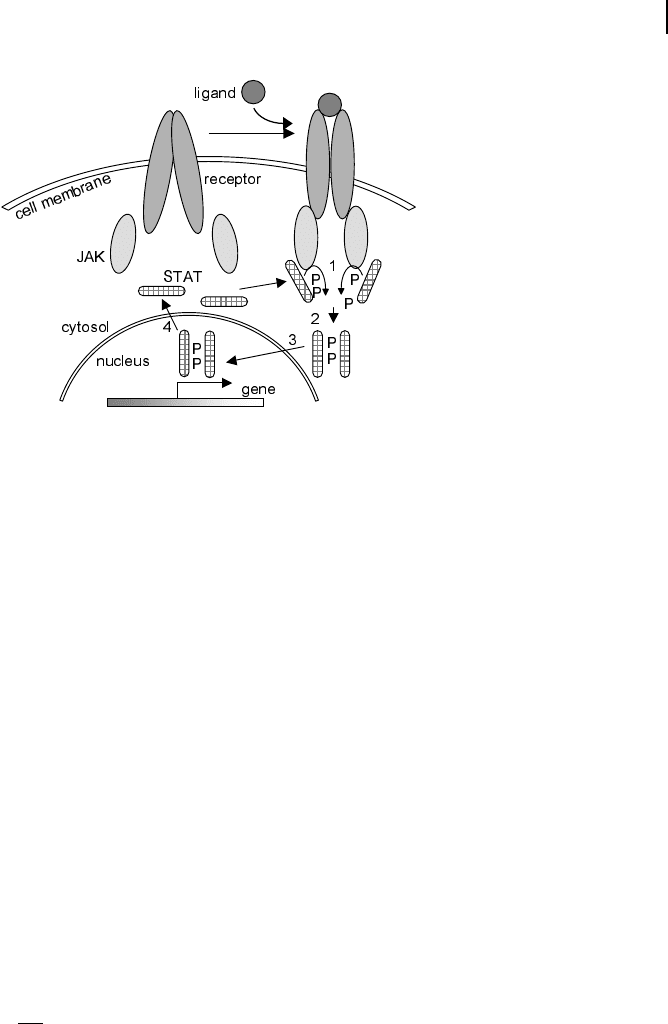
Jak-Stat pathways play an important role in regulating immune responses and cellu-
lar homeostasis in human health and disease (Kisseleva et al. 2002; Schindler 2002).
They are activated by cytokines, a large family of extracellular ligands. The family of
structurally and functionally conserved receptors involves four Jaks and seven Stats.
As is the case for many types of receptor families, downstream signaling entails tyro-
sine phosphorylation. Stat stands for “signal transducer and activator of transcrip-
tion”, because this class of proteins functions as both signal transducer and tran-
scription activator. They are inactive as a monomer, and activation involves phos-
phorylation and dimerization.
A mathematical model of the Jak-Stat pathway presented by Swamaye and collea-
gues (2003) presupposes the binding of the ligand (here, the hormone Epo) to the re-
ceptor (EpoR), which results in phosphorylation of Jak2 and of the cytoplasmatic do-
main of EpoR. The model involves the recruitment of monomeric Stat5 (x
1
= Stat5)
to the phosphorylated and thereby activated receptor, EpoR
A
. Upon receptor recruit-
ment, monomeric Stat5 is tyrosine-phosphorylated (x
2
= Stat5-P). It dimerizes in a
second step to yield x
3
and migrates in the third step to the nucleus (x
4
), where it
binds to the promoter of target genes. After it has fulfilled its job, it is dephosphory-
lated and exported to the cytoplasm (fourth step). Using simple mass action kinetics
for the four steps indicated in Fig. 6.13, the respective ODE system reads:
dx
1
dt
k
1
x
1
EpoR
A
2k
4
x
4
dx
2
dt
k
2
x
2
2
k
1
x
1
EpoR
A
dx
3
dt
k
3
x
3
1
2
k
2
x
2
2
dx
4
dt
k
4
x
4
k
3
x
3
: (6-23)
The parameter t represents the time Stat5 molecules have to reside in the nucleus
with x
t
4
x
4
t t. This model has been used to show that recycling of Stat5 mole-
216
6 Signal Transduction
cules is an important event in the activation cycle and is necessary to explain experi-
mental data.
6.4
Signaling: Dynamic and Regulatory Features
A nice overview of dynamic and regulatory features of modules of signaling path-
ways is given by Tyson et al. (2003). In line with this work, we show here the beha-
vior of simple motifs of signaling pathways. We will also present measures for the
characterization of the dynamics of components of signaling pathways.
6.4.1
Simple Motifs
Here, we consider motifs of many signaling networks, which stand symbolically for
the action pairs of protein synthesis and degradation or phosphorylation and depho-
sphorylation. The shape of response curves depends on network structure and re-
spective implementation in mathematical expression. A set of the simplest motifs as
well as their implementation and respective behavior are represented in Tab. 6.2.
The dynamics of such a network depends on the concentrations of the signal S
and the responder R
dR
dt
fS; R: (6-24)
with S = signal strength (e. g., mRNA concentration) and R = response magnitude
(e.g., protein concentration), as well as on the individual kinetics. Assuming linear
217
6.4 Signaling: Dynamic and Regulatory Features
Jak-Stat pathway
Fig. 6.13 The Jak-Stat signaling
pathway. Upon ligand binding,
receptor-associated Jaks become
activated and mediate phospho-
rylation of specific receptor tyro-
sine residues. This leads to the
recruitment of specific Stats,
which are then also tyrosine-
phosphorylated. Activated Stats
are released from the receptor,
dimerize, translocate to the
nucleus, and bind to enhancers.
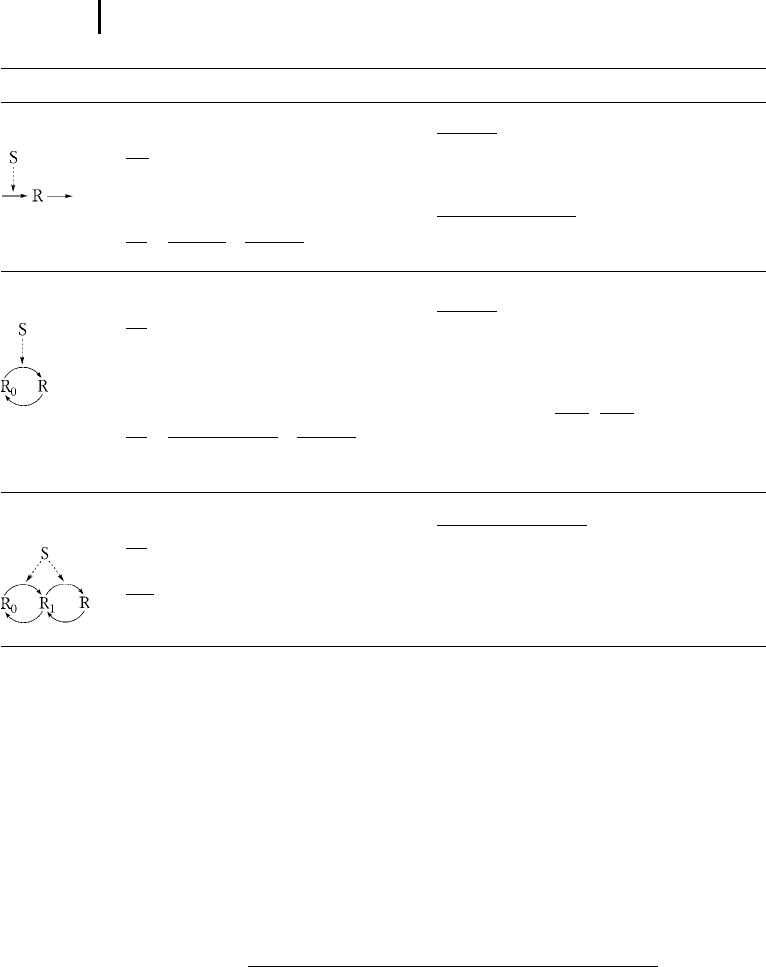
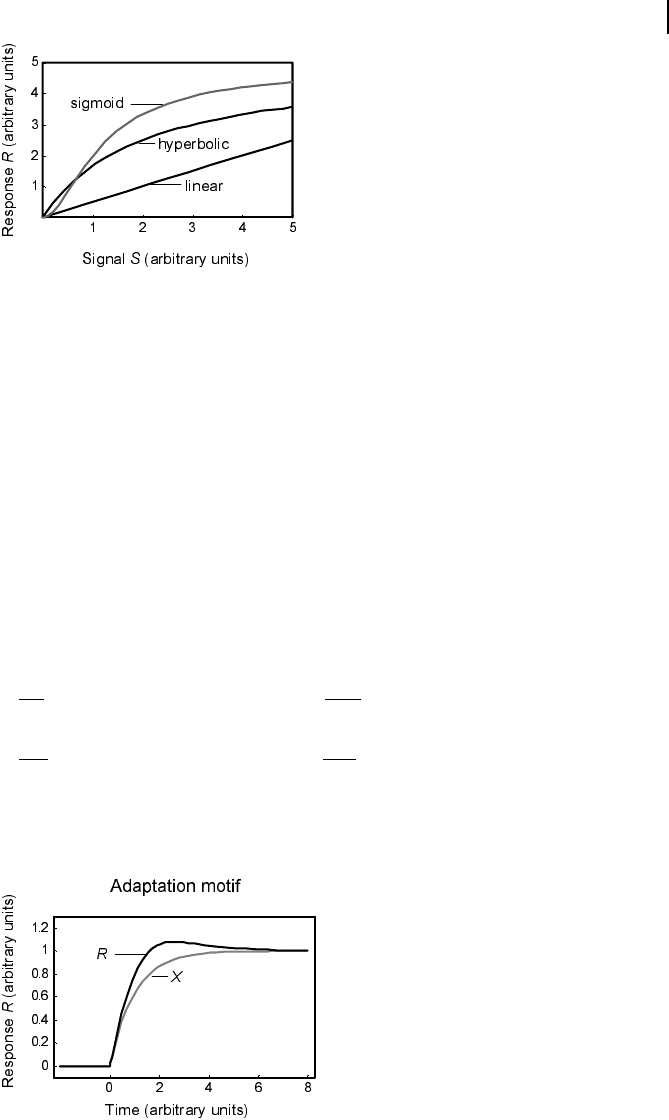
kinetics for all steps of the linear mechanism in Tab. 6.2 leads to a linear response in
terms of steady-state values (R
ss
= steady-state values). Figure 6.14 shows the depen-
dencies of steady-state concentrations on the signal strength. Assuming Michaelis-
Menten kinetics implies a hyperbolic response. On the other hand, a hyperbolic re-
sponse can be caused by the network structure. Consider the one-loop mechanism
depicted in Tab. 6.2. Consideration of the conservation relation for the different forms
of R (R+R
0
= R
total
) and the assumption of linear kinetics cause a hyperbolic re-
sponse. Description of the one-loop mechanism with Michaelis-Menten kinetics gives
rise to a switch-like sigmoidal response curve based on a quadratic solution for steady
state (only the following solution applies for 0 < R<R
total
). The function G with
Gu; v; J; K
2uK
v u vJ uK
v u vJ uK
2
4 v u
uK
q
(6-25)
used in Tab. 6.2 is the so-called Goldbeter-Koshland function (Goldbeter and Kosh-
land 1981, 1984), which is frequently applied in modeling switch-like behavior.
All three types of response (linear, hyperbolic, sigmoidal) are gradual, i.e., the re-
sponse increases continuously with signal strength, and reversible, i.e., the steady-
218
6 Signal Transduction
Tab. 6.2 Simple signaling motifs, their kinetic implementation, and characterization of behavior.
Scheme Kinetic Steady state Response
Linear
Linear
dR
dt
k
0
k
1
S k
2
R
R
ss
k
0
k
1
S
k
2
Linear
Michaelis-Menten
dR
dt
V
1
S
K
m1
S
V
2
R
K
m2
R
R
ss
V
1
K
m2
S
V
2
K
m1
SV
2
V
1
Hyperbolic
One loop
Linear
dR
dt
k
1
SR
t
Rk
2
R
R R
0
R
total
R
ss
R
total
k
1
S
k
2
k
1
S
Hyperbolic
Michaelis-Menten
dR
dt
k
1
SR
total
R
K
m1
R
total
R
k
2
R
K
m2
R
R R
0
R
total
R
ss
R
total
Gk
1
S; k
2
;
K
m1
R
total
;
K
m2
R
total
Sigmoid
Two loops
Linear
dR
dt
k
3
SR
1
k
4
R
dR
1
dt
k
1
SR
0
k
2
k
3
SR
1
k
4
R
R R
0
R
total
R
ss
R
total
k
1
k
3
S
2
k
2
k
4
k
1
Sk
4
k
1
k
3
S
2
Sigmoid
state value depends only on the actual value of the signal but not on its history
(whether it was increased or decreased); moreover, the response is switched off
(downregulated) if there is no more signal S. The response of these motifs directly
transmits what the signal stipulates. There is no intrinsic stimulation or downregu-
lation.
6.4.2
Adaptation Motif
Combination of a simple linear response element with a second signaling pathway
yields perfectly adapted signal-response curves. This results in the following effect:
although the signaling pathway exhibits a transient response to changes in signal
strength, its steady-state response R
ss
is independent of S. Tyson and colleagues
(2003) called them sniffer due to their similarity to the sense of smell.
dR
dt
k
1
S k
2
X R with R
ss
k
1
k
4
k
2
k
3
dX
dt
k
3
S k
4
XX
ss
k
3
S
k
4
: (6-26)
The time course is represented in Fig. 6.15.
219
6.4 Signaling: Dynamic and Regulatory Features
Fig. 6.14 Signal-response curves for different sig-
naling motifs. Shown are linear, hyperbolic, and
sigmoid curves.
Fig. 6.15 Temporal profile of the adaptation
motif.