
Klipp E., Herwig R., Kowald A., Wierling C., Lehrach H. Systems Biology in Practice: Concepts, Implementation and Application
Подождите немного. Документ загружается.


Example 10-1
Consider a “soup” containing a million molecules. For a sequence of length N =5
from an alphabet with l = 4 letters, there are 4
5
= 1024 possibilities for different
sequences S
i
, and the mean abundance per sequence is about 1000. The number
of possibilities in the case of a string length N = 20 is about 10
12
, meaning that on
average only one of a million possible sequences is present in the soup. In the lat-
ter case, a mutation would (most probably) result in a new sequence that was not
present before. In the first case, a mutation of one molecule would result in an in-
crease of the abundance of another already-present sequence.
A basic assumption of this concept is that there is a master sequence S
m
, having
the maximal selective value f
m
. The selective value f
i
of any other sequence S
i
de-
pends on the Hamming distance h (the number of different symbols at correspond-
ing places in sequences) between S
i
and the master sequence S
m
: f
i
= f
i
(h(S
i
,S
m
))
– the smaller the distance h, the greater the selective value f
i
.
10.1.1.1 Self-replication Without Interaction
Assume that DNA molecules perform identical replication and are also subject to de-
cay. The time course of their concentration x
i
is determined by the ordinary differen-
tial equation (ODE)
dx
i
dt
a
i
x
i
d
i
x
i
a
i
d
i
x
i
; (10-2)
where a
i
and d
i
are the rate constants for the replication and the decay. For constant
values of a
i
and d
i
and an initial concentration x
i
0
for t = 0, the solution of Eq. (10-2)
is given by
x
i
tx
0
i
e
a
i
d
i
t
: (10-3)
Depending on the difference f
i
= a
i
– d
i
, Eq. (10-3) describes a monotonous increase
(a
i
> d
i
), a decrease (a
i
< d
i
), or a constant concentration (a
i
= d
i
), respectively. Therefore,
the difference f
i
can be considered as the selective value (also called excess productivity).
10.1.1.2 Selection at Constant Total Concentration of Self-replicating Molecules
In Eq. (10-3) the dynamics of species S
i
is independent of the behavior of the other
species. However, selection will happen only if there is interaction between the spe-
cies, leading to selective pressure. This is given if, e.g., the number of building
blocks (mononucleotides) is limited or if the concentration may not exceed a certain
maximum. In the latter case, the total concentration of species can be kept constant
by introducing a term describing elimination of supernumerary individuals or dilu-
tion by flow-out of the considered volume. This is called selection at constant organi-
zation (Schuster et al. 1978). Assuming that the dilution rate is proportional to the
actual concentration of the species, it follows that
340
10 Evolution and Self-organization

dx
i
dt
f
i
x
i
j x
i
: (10-4)
Under the condition of constant total concentration
P
i
x
i
x
total
const:
or
P
i
dx
i
dt
0
it follows that
j
P
i
f
i
x
i
P
k
x
k
f : (10-5)
Since f
i
denotes the excess productivity of species S
i
, j =
f x is the mean excess
productivity. Introducing Eq. (10-5) into Eq. (10-4) yields the selection equation
dx
i
dt
f
i
f
x
i
: (10-6)
This is a system of coupled nonlinear ODE. Nevertheless, it is easy to see that the
concentrations increase over time for all species with f
i
>
f and that the concentra-
tions decrease for all species with f
i
<
f . The mean excess productivity
f is, therefore,
a selection threshold. Equation (10-6) shows that the concentrations of species with
high selective value increase with time. Hence, the mean excess productivity also in-
creases according to Eq. (10-5). Successively, the selective values of more and more
species become lower than
f , their concentrations start to decrease, and eventually
they die out. Finally, only the species with the highest initial selective value survives,
the so-called master species.
The explicit solution of Eq. (10-6) reads
x
i
t
x
total
x
0
i
e
f
i
t
P
j
x
0
j
e
f
j
t
: (10-7)
The species with the highest excess productivity is the master sequence S
m
. In the
current scenario, it will survive and the other species will die out.
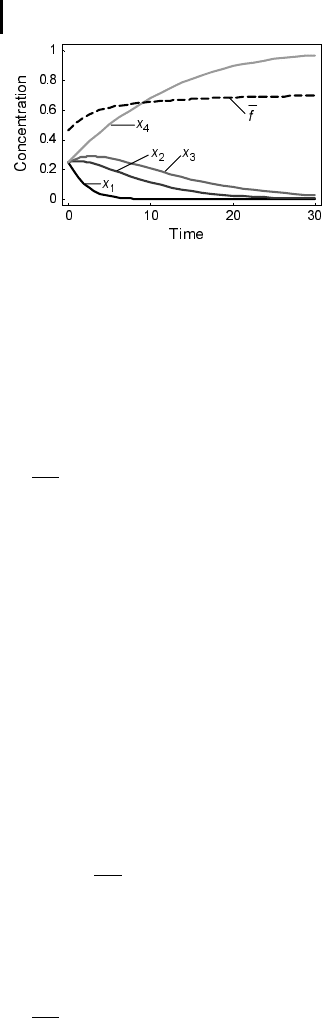
Example 10-2
Consider n = 4 competing sequences with equal initial concentrations x
i
0
= n/4
and different selective values f
1
< f
2
< f
3
< f
4
. This results in the temporal behavior
depicted in Fig. 10.1.
For t =0, f
1
<
f < f
2
< f
3
< f
4
holds; hence, the concentration x
1
decreases, while
the other concentrations increase. With time progression, f
2
and f
3
fall one after
the other under the rising threshold
f , and the respective concentrations x
2
and
x
3
eventually decrease. Concentration x
4
always moves up until it asymptotically
reaches the total concentration. Species 4 is the master species, since it has the
highest selective value.
341
10.1 Quasispecies and Hypercycles
10.1.1.3 Self-replication with Mutations: The Quasispecies Model
Up to now we considered only the case of identical self-replication. However, muta-
tions are an important feature of evolution. In the case of erroneous replication of se-
quence S
i
, a molecule of sequence S
j
is produced that also belongs to the space of
possible sequences. The right-hand side of Eq. (10-4) can be extended in the follow-
ing way:
dx
i
dt
a
i
q
i
x
i
d
i
x
i
X
j6i
m
ij
x
j
jx
i
: (10-8)
The expression a
i
q
i
x
i
denotes the rate of identical self-replication, where q
i
^ 1is
the ratio of correctly replicated sequences. The quantity q
i
characterizes the quality
of replication. The term d
i
x
i
denotes again the decay rate of sequence S
i
, and j x
i
is
the dilution term ensuring constant total concentration. The expression
P
j6i
m
ij
x
j
characterizes the synthesis rate of sequence S
i
from other sequences S
j
by mutation.
Since every replication results in the production of a sequence from the possible
sequence space, the rate of erroneous replication of all sequences must be equal to
the synthesis rate of sequences by mutation. Therefore, it holds that
P
i
a
i
1 q
i
x
i
P
i
P
j6i
m
ij
x
j
: (10-9)
Taking again into account the constant total concentration and Eq. (10-9) yields
0
X
i
dx
i
dt
X
i
a
i
x
i
X
i
d
i
x
i
j
X
i
x
i
: (10-10)
This way, for j Eq. (10-5) holds again. The selection equation for self-replication
with mutation reads
dx
i
dt
a
i
q
i
d
i
f
x
i
X
j6i
m
ij
x
j
: (10-11)
Equation (10-11) differs from Eq. (10-6) by an additional coupling term that is due
to the mutations. A high precision of replication requires small coupling constants
342
10 Evolution and Self-organization
Fig. 10.1 Time course of concentration of four
competing sequences performing identical repli-
cation as described in Eq. (10-7). Initial concen-
trations are x
i
0
= n/4; the selective values are
f
1
= 0.01, f
2
= 0.52, f
3
= 0.58, f
4
= 0.7. The dashed
line shows the mean excess productivity
f that in-
creases with time.

(m
ij
). For small m
ij
one may expect behavior similar to that in the case without muta-
tion: the sequences with the high selective value will accumulate, sequences with
low selective value die out. But the existing sequences always produce erroneous se-
quences that are closely related to them and differ only in a small number of muta-
tions. A species and its close relatives that appeared by mutation are referred to as
quasispecies. Therefore, there is not selection of a single master species, but rather
of a set of species. The species with the highest selective value and its close relatives
form the master quasispecies distribution.
In conclusion, the quasispecies model does not predict the ultimate extinction of
all but the fastest replicating sequence. Although the sequences that replicate more
slowly cannot sustain their abundance level by themselves, they are constantly re-
plenished as sequences that replicate faster mutate into them. At equilibrium, re-
moval of slowly replicating sequences due to decay or outflow is balanced by replen-
ishing, so that even relatively slowly replicating sequences can remain present in fi-
nite abundance.
Due to the ongoing production of mutant sequences, selection acts not on single
sequences but rather on so-called mutational clouds of closely related sequences, the
quasispecies. In other words, the evolutionary success of a particular sequence de-
pends not only on its own replication rate but also on the replication rates of the mu-
tant sequences it produces and on the replication rates of the sequences of which it
is a mutant. As a consequence, the sequence that replicates fastest may even disap-
pear completely in selection-mutation equilibrium, in favor of more slowly replicat-
ing sequences that are part of a quasispecies with a higher average growth rate (Swe-
tina and Schuster 1982). Mutational clouds as predicted by the quasispecies model
have been observed in RNA viruses and in in vitro RNA replication (Domingo and
Holland 1997; Burch and Chao 2000).
10.1.1.4 The Genetic Algorithm
The evolution process in the quasispecies concept can also be viewed as a stochastic
algorithm. This can be used as a strategy for a computer search algorithm. The evo-
lution process produces consequent generations. We start with an initial population
S(0) = {S
1
(0), …, S
n
(0)} at time t = 0. A new generation S (t + 1) is obtained from the
old one S(t) by random selection and mutation of sequences S
i
(t), where t corre-
sponds to the generation number. Assume that all f
i
^ 1, which can be ensured by
normalization. The model evolution process can be described formally in the follow-
ing computer program–like manner.
1. Initialization. Form an initial population S(0) = {S
1
(0), …, S
n
(0)} by choosing ran-
domly for every sequence i =1,…,n and for every position k =1,…,N in the se-
quence a symbol from the given alphabet (e.g., A, T, C, G or “0” and “1”).
2. Sequence selection for the new generation. Select sequences by choosing ran-
domly numbers i' with the probability f
i'
and add a copy of the old sequence S
i'
(t)
to the new population as S
i'
(t + 1).
3. Control of population size. Repeat step 2 until the new population has reached
size n of the initial population.
343
10.1 Quasispecies and Hypercycles

4. Mutation. Change with a certain probability for every sequence S
i
(t) with
i =1,…,n and for every position s
ik
(t) with k =1,…,N the current symbol to an-
other symbol of the alphabet.
5. Iteration. Repeat steps 2–4 for successive time points.
The application of this algorithm allows for a visualization of the emergence of
quasispecies and the master quasispecies distribution from an initial set of se-
quences during time.
10.1.1.5 Assessment of Sequence Length for Stable Passing-on of Sequence Information
The number of possible mutants of a certain sequence depends on its length N.
Since the alphabet for DNA molecules has four letters, each sequence has 3N neigh-
boring sequences (mutants) with a Hamming distance of h = 1. For mutants with ar-
bitrary distance h, there are N
h
3
h
N
h
possibilities. Therefore, the number of se-
quences belonging to a quasispecies can be very high.
The quality measure q entering Eq. (10-8) for a sequence of length N can be ex-
pressed by the probability p
q
of correct replication of the individual nucleotides. As-
suming that this probability is independent of position and type of the nucleotide,
the quality measure reads
q p
N
q
: (10-12)
Mathematical investigation confirms that stable passing-on of information is pos-
sible only if the value of the quality measure is above a certain threshold q >1/s. The
parameter s is the relative growth rate of the master sequence, which is referred to as
superiority. The generation of new species and, therefore, development during evolu-
tion, is possible only with mutations. But too-large mutation rates lead to destruction
of information already accumulated. The closer q is to 1, the longer sequences may
replicate in a stable manner. For the maximal length of a sequence, Eigen and cowor-
kers (Eigen 1971a) determined the relation
N 1 p
q
< lns : (10-13)
During evolution self-reproducing systems became more and more complex and
the respective sequences became longer. Hence, the accuracy of replication also had
to increase. Since the number of nucleotides in mammalian cells is about N &10
9
,
Eq. (10-13) implies that the error rate per nucleotide is on the order of 10
–9
or lower.
This is in good agreement with the accuracy of the replication in mammalian cells.
Such a level of accuracy cannot be reached by simple self-replication based on chemi-
cal base pairing; it necessitates help from polymerases that catalyze the replication.
For uncatalyzed replication of nucleic acids, the error rate is at least 10
–2
, which im-
plies a maximal sequence length of N&10
2
.
344
10 Evolution and Self-organization
10.1.1.6 Coexistence of Self-replicating Sequences: Complementary Replication of RNA
As we have seen, only mutation and selection cannot explain the complexity of cur-
rently existing sequences and replication mechanisms. Their stable existence necessi-
tates cooperation between different types of molecules in addition to their competition.
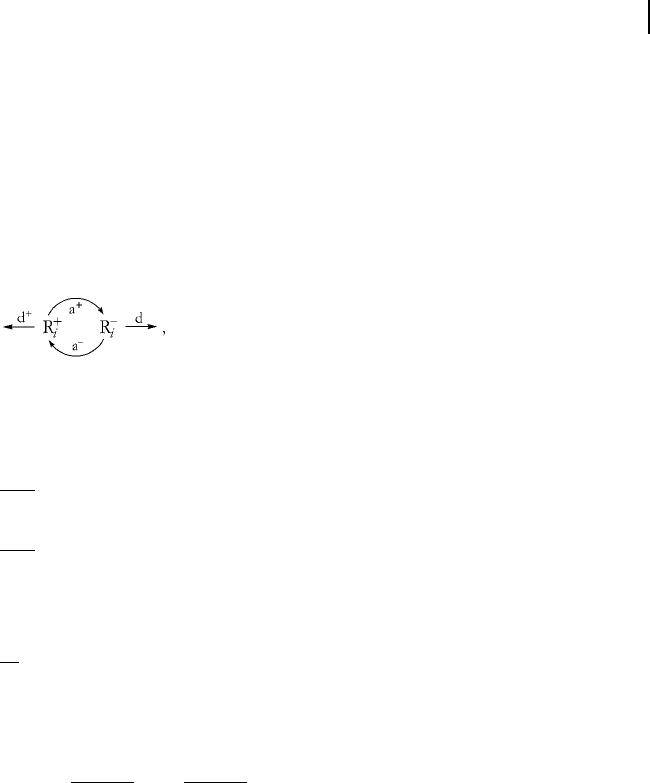
Consider the replication of RNA molecules, a mechanism used by RNA phages.
The RNA replicates by complementary base pairing. There are two complementary
strands, R
i
+
and R
i
–
. The synthesis of one strand always requires the presence of the
complementary strand, i.e., R
i
+
derives from R
i
–
and vice versa. Thus, both strands
have to cooperate for replication.
For a single pair of complementary strands we have the following scheme:
(10-14)
with the kinetic constants a
+
and a
–
for replication and the kinetic constants d
+
and
d
–
for degradation. Denoting the concentrations of R
i
+
and R
i
–
with x
+
and x
–
, respec-
tively, the corresponding ODE system reads
dx
dt
a
x
d
x
dx
dt
a
x
d
x
(10-15)
and in matrix notation holds
d
dt
x
x
d
a
a
d
x
x
: (10-16)
The eigenvalues of the Jacobian matrix in Eq. (10-16) are
l
1=2
d
d
2
d
d
2
2
a
a
s
: (10-17)
They are always real, since the kinetic constants have nonnegative values. While
l
2
(the “–” solution) is negative, l
1
(the “+” solution) may assume positive or nega-
tive values depending on the parameters:
l
1
< 0 for a
a
< d
d
l
1
> 0 for a
a
> d
d
: (10-18)
The solution of Eq. (10-16) reads
x tb
1
e
l
1
t
b
2
e
l
2
t
; (10-19)
with concentration vector x x
; x
T
and eigenvectors b
1
; b
2
of the Jacobian.
345
10.1 Quasispecies and Hypercycles
According to Eq. (10-19) a negative eigenvalue l
1
indicates the extinction of both
strands R
i
+
and R
i
–
. For a positive eigenvalue l
1
, the right site of Eq. (10-19) comprises
an exponentially increasing and an exponentially decreasing term, the first of which
dominates for progressing time. Thus, the concentrations of both strands rise expo-
nentially. Furthermore, the growth of each strand depends not only on its own ki-
netic constants but also on the kinetic constants of the other strand.
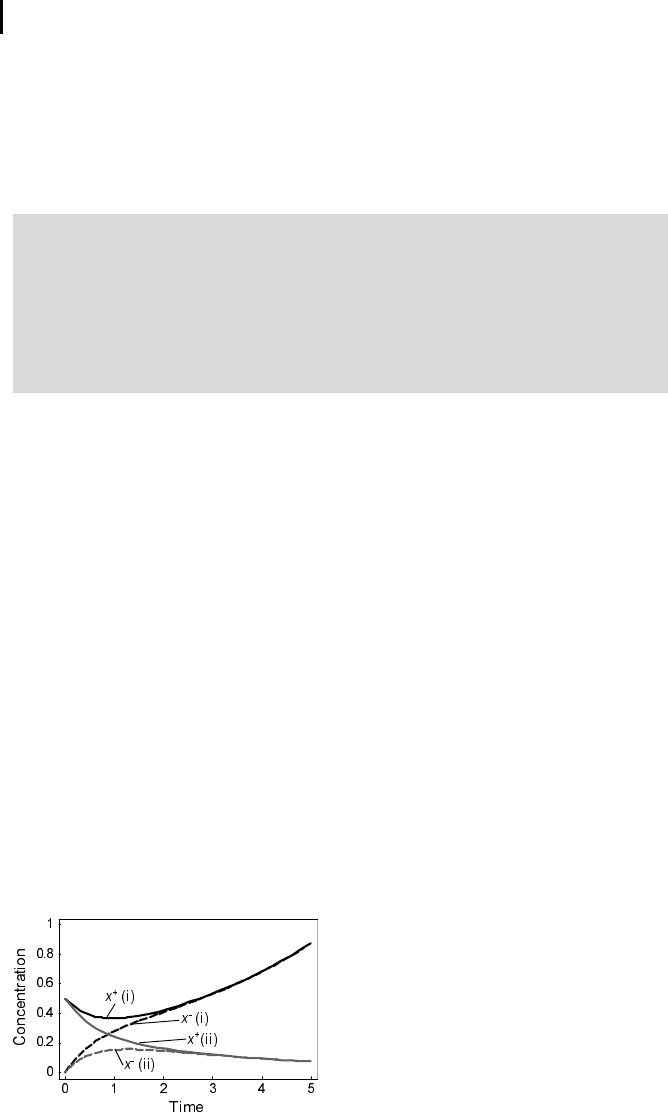
Example 10-3
For the simple case that both strands have the same kinetic properties (a
+
= a
–
= a
and d
+
= d
–
= d), the temporal behavior is shown in Fig. 10.2.
If a > d, the exponential increase dominates and both strands accumulate. If
a < d, both strands become extinct. In both cases, the initial concentration differ-
ences eventually become negligible and both strands behave identically.
10.1.2
The Hypercycle
The hypercycle model describes a self-reproducing macromolecular system in which
RNAs and enzymes cooperate in the following manner. There are n RNA species;
the i-th RNA codes for the i-th enzyme (i =1,2,…,n). The enzymes cyclically in-
crease the replication rates of the RNAs, i.e., the first enzyme increases the replica-
tion rate of the second RNA, the second enzyme increases the replication rate of the
third RNA, …, and eventually the n-th enzyme increases the replication rate of the
first RNA. In addition, the described system possesses primitive translation abilities,
in that the information stored in RNA sequences is translated into enzymes, analo-
gous to the usual translation processes in contemporary cells. M. Eigen and P.
Schuster consider hypercycles to be predecessors of protocells (primitive unicellular
biological organisms). The action of the enzymes accelerates the replication of the
RNA species and enhances the accuracy. Although the hypercycle concept may ex-
plain the advantages of the cooperation of RNA and enzymes, it cannot explain how
it arose during evolution. A special problem in this regard is the emergence of a ge-
netic code.
346
10 Evolution and Self-organization
Fig. 10.2 Concentration time courses for com-
plementary replication of RNA molecules accord-
ing to Eq. (10-15). Both strands have the same
kinetic properties. Parameters in case (i) are
a = 1 and d = 0.75 (black lines, solid: +strand,
dashed: –strand); both strands accumulate. In
case (ii) it holds that a = 0.75 and d = 1 (gray
lines, solid: +strand, dashed: –strand); both
strands become extinct with time.
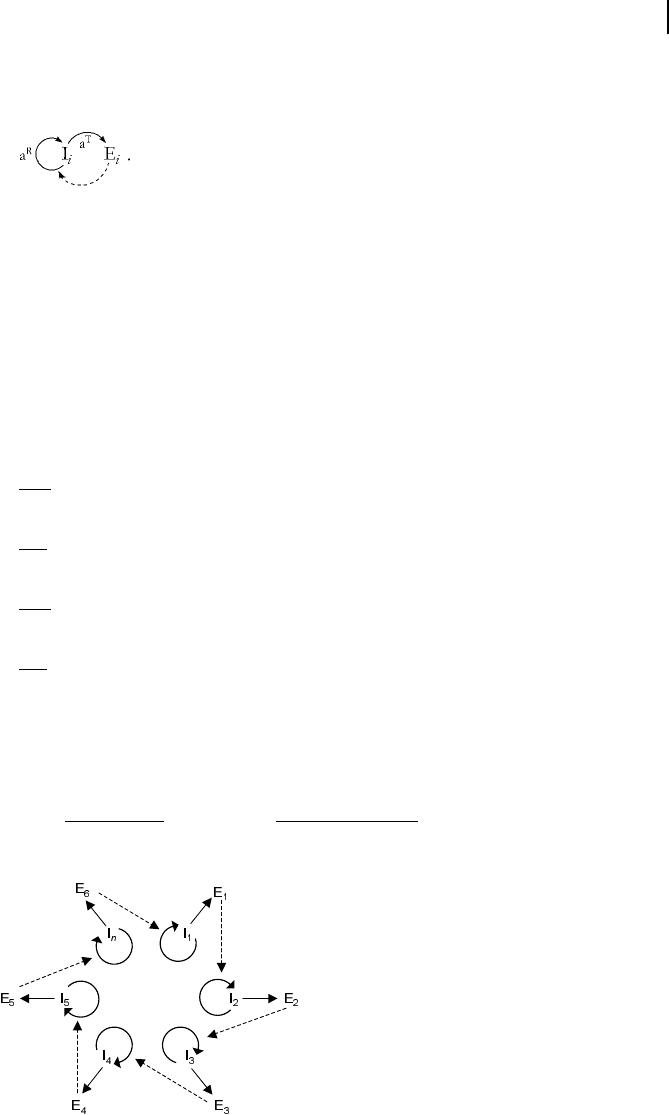
The simplest cooperation between enzymes and nucleotide sequences is given
when (1) the enzyme E
i
is the translation product of the nucleic acid I
i
and (2) the
enzyme E
i
primarily catalyzes the identical replication of I
i
as depicted below
(10-20)
a
T
and a
R
are the kinetic constants of translation and replication.
In general, a hypercycle involves several enzymes and RNA molecules. In addi-
tion, the mentioned macromolecules cooperate to provide primitive translation abil-
ities so that the information, coded in RNA sequences, is translated into enzymes,
analogous to the usual translation processes in biological objects. The cyclic organi-
zation of the hypercycle (Fig. 10.3) ensures its structure stability.
In the following, we will consider the dynamics for the competition of two hyper-
cycles of the type depicted in Eq. (10-20). Under the conditions of constant total con-
centration and negligible decay of compounds, the ODE system for RNAs with con-
centrations I
1
and I
2
and enzymes E
1
and E
2
reads
dE
1
dt
a
T
1
I
1
j
E
E
1
dI
1
dt
a
R
1
I
1
E
1
j
I
I
1
dE
2
dt
a
T
2
I
2
j
E
E
2
dI
2
dt
a
R
2
I
2
E
2
j
I
I
2
: (10-21)
For the ODE system in Eq. (10-21) it is assumed that all reactions follow simple
mass action kinetics. Since the total concentrations of RNAs and enzymes are con-
stant (I
1
+ I
2
= c
I
and E
1
+ E
2
= c
E
), it follows for the dilution terms that
j
E
a
T
1
I
1
a
T
2
I
2
c
E
and j
I
a
R
1
I
1
E
1
a
R
2
I
2
E
2
c
I
: (10-22)
347
10.1 Quasispecies and Hypercycles
Fig. 10.3 Schematic representation of the hyper-
cycle consisting of RNA molecules I
i
and enzymes E
i
(i =1,…,n). The i-th RNA codes for the i-th enzyme
E
i
. The enzymes cyclically increase RNA’s replication
rates, namely, E
1
increases the replication rate of I
2
,
E
2
increases the replication rate of I
3
, …, and, even-
tually, E
n
increases the replication rate of I
1
.
There are three steady-state solutions to Eq. (10-21) under consideration of Eq. (10-
22) with nonnegative concentration values. The following two steady states are stable:
(i) E
i
1
0; I
i
1
0; E
i
2
c
E
; I
i
2
c
I
(ii) E
i
1
c
E
; I
i
1
c
I
; E
i
2
0; I
i
2
0 ; (10-23)
and the third steady state is not stable (a saddle). In both stable steady states, one of
the hypercycle survives and the other one becomes extinct.
Example 10-4
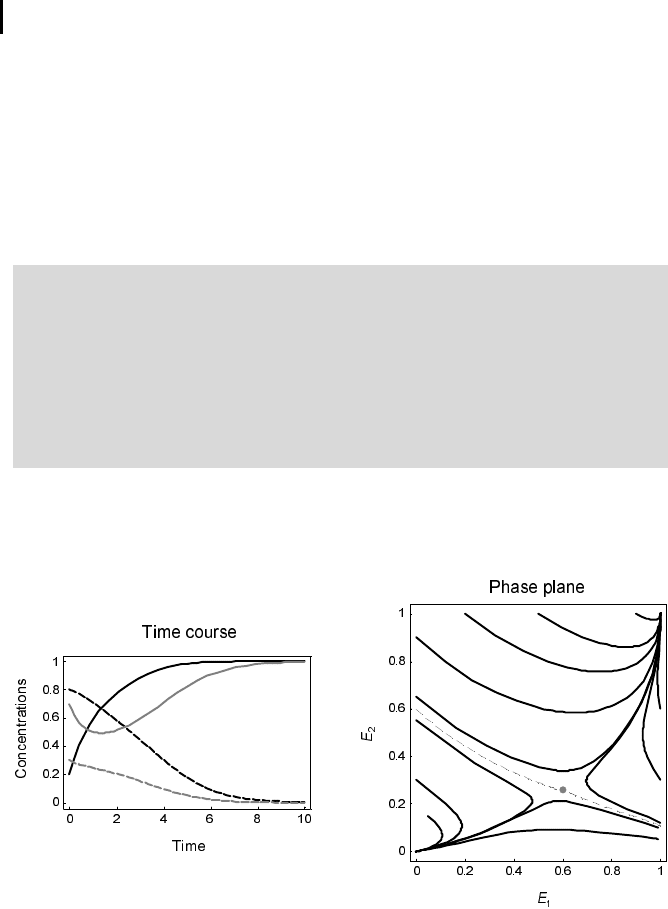
Let’s consider the dynamics of two competing hypercycles as described in
Eq. (10-21). Here, the chosen parameters allow for better growth of the first hyper-
cycle (a
T
1
> a
T
2
, a
R
1
> a
R
2
). Nevertheless, it is not always the case that the first hyper-
cycle survives and the second hypercycle dies out. The final steady state depends
strongly on the initial conditions. The temporal behavior can be illustrated as a
time course and in the phase plane as shown in Fig. 10.4.
For competing hypercycles the dynamics depends on both the individual kinetic
parameters of the hypercycles and the initial conditions. Both steady states are attrac-
348
10 Evolution and Self-organization
Fig. 10.4 Dynamics of competing two-compo-
nent hypercycles as given in Eq. (10-21). Para-
meters: a
T
1
=1,a
R
1
=1,a
T
2
=0.75,a
R
2
=0.75,c
I
=1,
c
E
= 1. Left panel: time course of RNA and en-
zymes for the initial conditions I
1
(0) = 0.7,
E
1
(0) = 0.2. The solid and dashed lines represent
quantities of the first and second cycles,while the
black and gray lines stand for enzyme and RNA
concentrations, respectively. For the given para-
meters and initial conditions, the first hypercycle
succeeds,while the second hypercycle dies out.
Right panel: phase plane representation for the
first hypercycle (values for the second hypercycle
are determined by the condition of constant total
concentrations for enzymes and RNAs). Depend-
ing on the initial conditions, the system evolves to-
wards one of the stable steady states (Eq. (10-23)).
The gray dot at point (0.6, 0.257) marks the saddle
point, and the dotted gray line separates the basin
of attraction of both stable steady states.

tive for a certain region of the concentration space. If the initial state belongs to the
basin of attraction of a steady state, the system will always move towards this state.
The hypercycle with less favorable parameters and a lower growth rate may survive
if it is present with high initial concentration. Nevertheless, the steady state that en-
sures the survival of the hypercycle with higher growth rates has a larger basin of at-
traction, and this hypercycle may also win with a lower initial concentration.
The dependence on initial conditions in the selection of hypercycles is a new prop-
erty compared to the identical or complementary self-replication without catalysts. If
a new hypercycle would emerge due to mutation, the initial concentrations of its
compounds are very low. It can only win against the other hypercycles if its growth
rate is much larger. Even then it may happen that it becomes extinct – depending on
the actual basins of attraction for the different steady states. This dependence leads
to the possibility that during evolution even non-optimal systems may succeed if
they are present in sufficiently high initial concentrations. This is called once forever
selection, favoring the survival of systems that had good conditions by chance, inde-
pendent of their actual quality. This behavior is quite different from the classical Dar-
winian selection process.
Even the non-optimal hypercycles advantageously combine the properties of polynu-
cleotides (self-reproduction) with the properties of enzymes (enhancement of speed
and accuracy of polynucleotide replication). The cyclic organization of the hypercycle
ensures its structural stability. This stability is enhanced even if hypercycles are orga-
nized into compartments (Eigen et al. 1980a). This way, external perturbations by para-
sites can be limited and functionally advantageous mutations can be selected for.
In conclusion, one may state that the considered models cannot explain the real
life-origin process, because these models are based on various plausible assumptions
rather than on strong experimental evidence. Nevertheless, quasispecies and hyper-
cycles provide a well-defined mathematical background for understanding the first
molecular-genetic systems evolution. These models can be considered a step towards
the development of more realistic models.
10.2
Other Mathematical Models of Evolution
10.2.1
Spin-glass Model of Evolution
The quasispecies concept as model of evolution (Section 10.2.1) implies a strong as-
sumption, i. e., that the Hamming distance between the particular and unique mas-
ter sequences determines the selective value. Only one maximum of the selective va-
lue exists. Using the physical spin-glass concept, we can construct a similar model
wherein the fitness function can have many local maxima.
D. Sherrington and S. Kirkpatrick (1975, 1978) proposed a simple spin-glass
model to interpret the physical properties of the systems, consisting of randomly in-
teracting spins. This well-known model can be described briefly as follows:
349
10.2 Other Mathematical Models of Evolution