
Kosevich A.M. The crystal lattice
Подождите немного. Документ загружается.

4.4 Dependence of Frequency Distribution on Cr ystal Dimensionality
137
The Distribution Functions of 2D Crystal Vibrations. The distribution functions of
2D crystal vibrations have singularities similar to 3D crystal singularities. They are at
the edges of the eigenfrequency spectrum and coincide with the frequencies that divide
the regions of closed and open isofrequency curves (Fig. 4.3). Full analysis of the sin-
gularities in a 2D case is little different from th a t presen ted in Section 4.3. Therefore
we restrict ourselves only to a qualitative ch aracterization of the singularities, empha-
sizing their difference from those in a 3D crystal. A low-frequency (long-wave) limit
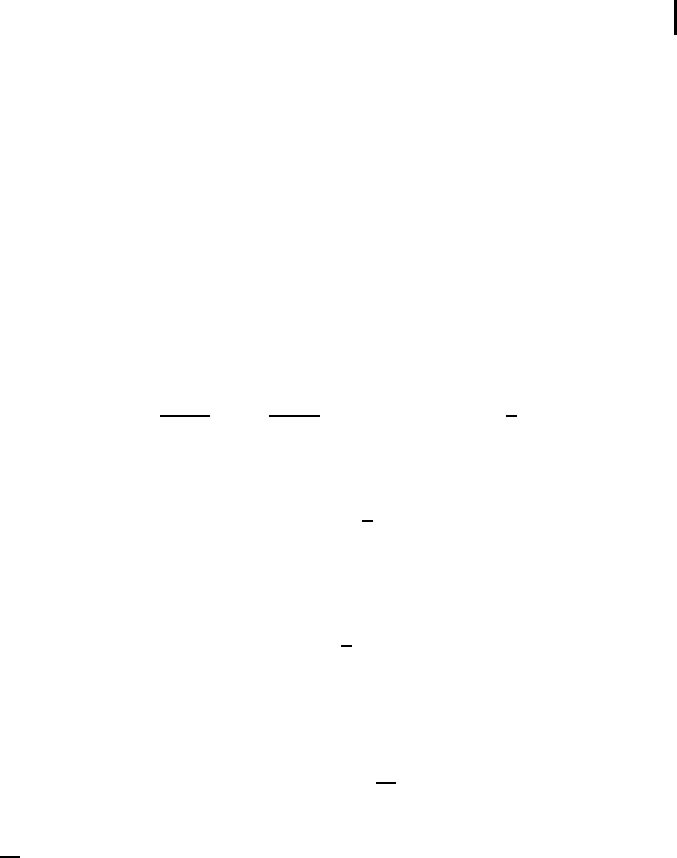
of the dispersion law for each branch in the isotropic approximation is
ε = s
2
k
2
= s
2
(k
2
x
+ k
2
y
). (4.4.1)
The behavior of the density of vibrational states g(ε) for ε → 0 is estimated by
(4.4.1) using the following chain of equations
g(ε)dε =
S
0
(2π)
2
d
2
k =
S
0
(2π)
2
dk
x
dk
y
∼ a
2
kdk∼
a
s
2
dε ,
where S
0
is the unit cell area of a 2D lattice. Thus, in the two-dimensional case
g(ε) → g(0)=const ∼
a
s
2
at ε → 0. (4.4.2)
Taking into account the relation between the two frequency distribution functions
(4.2.5), we see that
ν(ω) → 2Nωg(0) ∼ N
a
s
2
ω as ω → 0. (4.4.3)
The behavior of the density of states (4.4.2) and the frequency spectrum (4.4.3) in
the extremely low-frequency region differs from (4.3.2) and (4.3.3) for a 3D crystal.
As follows from (4.3.4) near the edge of the high-frequency spectrum we can write
ε = ε
m
− γk
2
, to obtain g(ε)dε ∼ a
2
kdk ∼
a
2
γ
dε. Consequently, the limiting
behavior of the vibration density is analogous to (4.4.2): g(ε) → g(ε
m
)=constant ∼
a
2
γ
at ε → ε
m
, i. e., the function g(ε) has a break at the point ε = ε
m
,since
g(ε) ≡ 0 at ε > ε
m
. This singularity of the vibration density also differs from the
dependence (4.3.6) that is typical for a 3D crystal.
We examine the vicinity of the frequency ω
c
corresponding to the analog of a con-
ical point in a 3D crystal, a point near which the isofrequency cu rves differ little fro m
hyperboli (Fig. 4.8a). The dispersion law near the frequency ω
c
can be written, similar
to (4.1.5), as
ω = ω
c
+ γ
1
k
2
1
−γ
2
k
2
2
, γ
1
γ
2
> 0. (4.4.4)
We repeat the reasoning used in calculating the functions g(ε) and ν(ω) near the
frequency ω
c
in a 3D cry stal. Let us draw two straight lines k
2
= ±Q that cut off part
of the space near the point we are interested in and calculate a 2D volume (the area Σ
138
4 Frequency Spectr um and Its Connection with the Green Function
in a 2D k-space) limited by these straight lines and the curve ω( k)=ω = constant.
We set for definiteness γ
1
> 0 and γ
2
> 0.Forω < ω
c
(curve 1 in Fig. 4.8a), we
then get
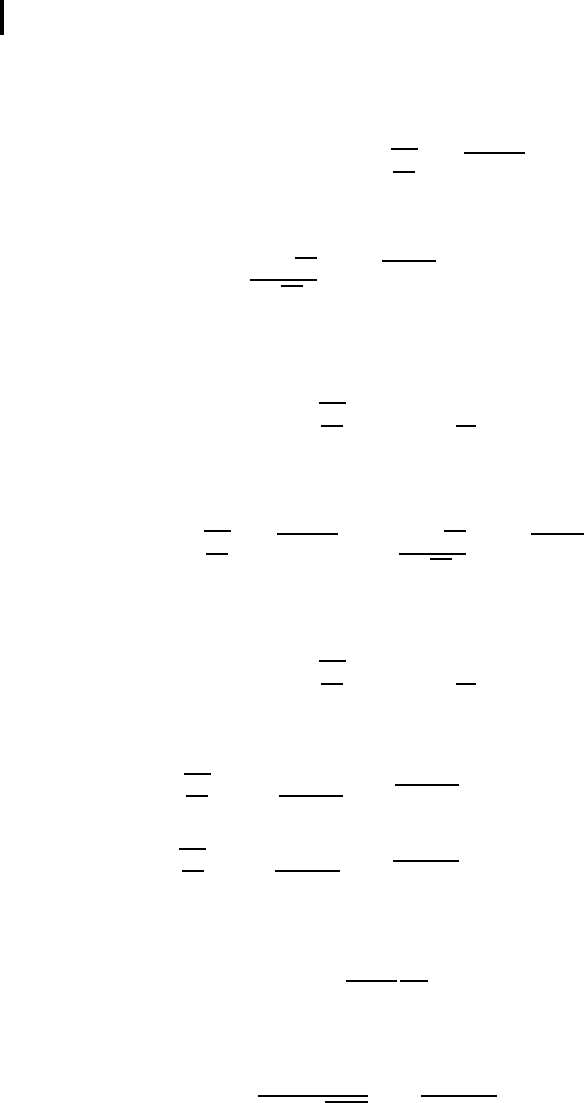
Σ
1
(ω)=
dk
x
dk
y
= 4
γ
2
γ
1
Q
k
0
k
2
2
− k
2
0
dk
2
=
4k
2
0
√
γ
2
√
γ
1
Q/k
0
1
y
2
−1 dy ,
(4.4.5)
where k
2
0
=(ω
c
− ω)/γ
2
.
Near the singular point, when k
0
Q we have from (4.4.5):
Σ
1
(ω)=2
γ
2
γ
1
Q
2
−k
2
0
ln
Q
k
0
. (4.4.6)
For ω > ω
c
(curve2inFig.4.8a)
Σ
2
(ω)=4
γ
2
γ
1
Q
0
q
2
0
+ k
2
dk
2
=
4q
2
0
√
γ
2
√
γ
1
Q/q
0
0
y
2
+ 1 dy ,
where q
2
0
=(ω − ω
c
)/γ
2
and, thus, near the singular point (q
0
→ 0), we have
Σ
2
(ω)=2
γ
2
γ
1
Q
2
+ q
2
0
ln
Q
q
0
. (4.4.7)
The terms in (4.4.6), (4.4.7) that lead to a singular behavior at |ω − ω
c
|→0 are
Σ
1
(ω)=2
γ
2
γ
1
Q
2
−
ω
c
− ω
γ
2
log
√
ω
c
−ω
, ω < ω
k
;
Σ
2
(ω)=2
γ
2
γ
1
Q
2
+
ω −ω
k
γ
2
log
√
ω − ω
k
, ω > ω
k
.
(4.4.8)
Since the frequency spectrum is
ν(ω)=
S
(2π)
2
dΣ
dω
,
where S is the crystal area, from (4.4.8) we directly derive the logarithmic singularity
at ω → ω
c
ν(ω)=
S
(2π)
2
√
γ
1
γ
2
log
ω
c
|ω − ω
c
|
. (4.4.9)
4.4 Dependence of Frequency Distribution on Cr ystal Dimensionality
139
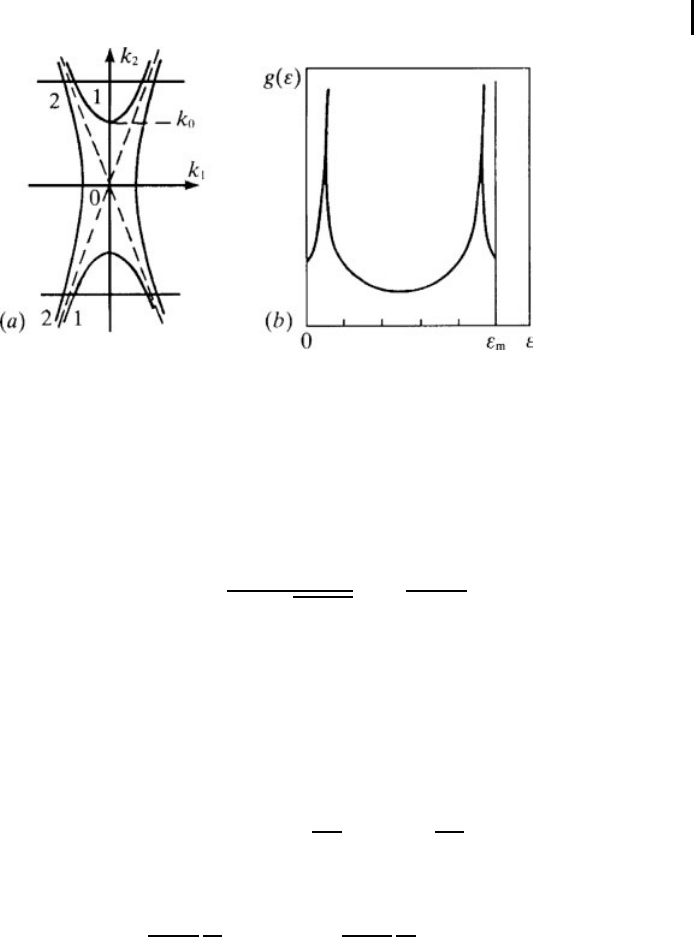
Fig. 4.8 Singularities of the frequency distribution in a 2D crystal:
(
a
) isofrequency lines near the critical point of the 2D dispersion law;
(
b
) density of states in a 2D lattice with nearest-neighbor interaction.
Using (4.2.5), we see that the vibration density of a 2D crystal g(ε) also has a
logarithmic singularity at ε = ε
c
= ω
2
c
and its singular part is symmetric in the
vicinity of this point:
g(ε)=
S
0
(2π)
2
√
γ
1
γ
2
ε
c
log
ε
c
|ε −ε
c
|
1/2
. (4.4.10)
As indicated in Chapter 3, there should exist no less than two such singular points.
If γ
1
= γ
2
two singular points merge to form one singularity.
For the simplest models the vibration density of a 2D crystal can be calculated
explicitly, e . g., in a scalar model for a crystal lattice with interaction of nearest neigh-
bors only. The dispersion law of vibrations is simple in this case and, for a rectangular
lattice with period a along the x-axis and period b along the y-axis, can be written as
ε = ω
2
1
sin
2
ak
x
2
+ ω
2
2
sin
2
bk
y
2
. (4.4.11)
We write the definition of the de nsity of vibration states
g(ε)=
ab
(2π)
2
d
dε
dk
x
dk
y
=
ab
(2π)
2
d
dε
k
y
(ε, k) dk, (4.4.12)
where k
y
(ε, k
x
) is the solution to (4.4.11) considered as an equation relative to k
y
.
The 2D integral in (4.4.12) is calculated in the area limited by the isofrequency curve
ε = constant and situated in one unit cell of the k-plane. The integration limits of
the last integral in (4.4.12) depend on whether the isofrequency curve intersects the
boundaries of the reciprocal lattice unit cell. If such a curve is closed and does not
intersect the unit cell boundaries the integration limits are obtained from the condition
140
4 Frequency Spectr um and Its Connection with the Green Function
k
y
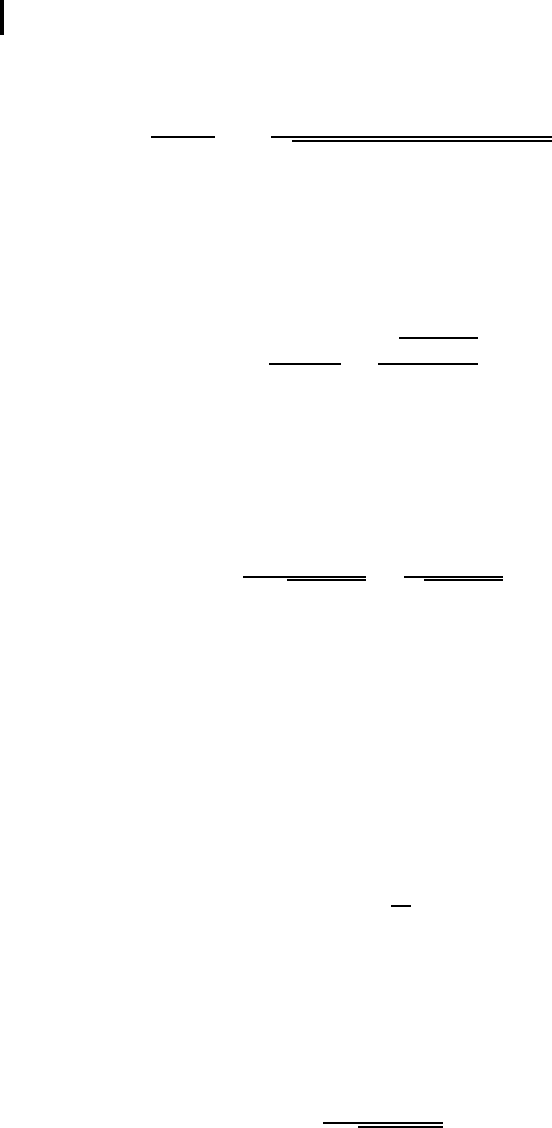
(ε, k)=0. The change of the integration variables in (4.4.12) results in
g(ε)=
1
(πω
1
)
2
x
0
(ε)
−x
0
(ε)
dx
(ξ
2
−sin
2
x)(η
2
−ξ
2
+ sin
2
x)
, (4.4.13)
where ξ
2
= ε/ω
2
1
, η
2
=(ω
2
/ω
1
)
2
and sin x
0
= ξ.
We know that the isofrequency curve is closed at frequencies that are near edges of
the vibration spectrum. Thus, (4.4.13) describes the behavior of the vibration distri-
bution in these parts of the spectrum. The density of states g(ε) is shown in the form
of a total elliptic integral of the first kind K(k):
g(ε)=
2
π
2
ω
1
ω
2
K
ε(ε
m
− ε)
ω
1
ω
2
, (4.4.14)
where ε
m
= ω
2
1
+ ω
2
2
.AsK(0)=π/2, (4.4.14) agrees with (4.4.2). Calculating
the vibration distribution in the middle part of the eigenfrequency spectrum, we set
for definiteness η > 1. Then for ω
2
1
< ε < ω
2
2
the isofrequency curve intersects
the reciprocal lattice unit cell boundaries k
x
= ±π/a, and the density of states is
determined by (4.4.13) with x
0
= π/2. Simple calculation shows that
g(ε)=
2
π
2
ε(ε
m
− ε)
K
ω
1
ω
2
ε(ε
m
−ε)
. (4.4.15)
We note that (4.4.5) and (4.4.15) are symmetrical relative to permutation of ω
1
and
ω
2
. Thus, their applicability conditions are: (4.4.14) is valid for 0 < ε(ε
m
− ε ) <
ω
2
1
ω
2
2
, and (4.4.15) – for ε(ε
m
− ε) > ω
2
1
ω
2
2
(Fig. 4.8b).
The elliptic integral K(k) has a logarithmic singularity at the point k = 1.This
singularity is typical for the function g(ε) at ε = ω
2
1
and ε = ω
2
2
. The behaviors of
the functions (4.4.14), (4.4.15) near these points can be considered as a partial case of
the general relation (4.4.10).
One-Dimensional Structure. In the case of a linear chain where only the nearest
neighbors interact, an analog of (4.4.11) is the dispersion law
ε = ε
m
sin
2
ak
2
, (4.4.16)
where ε
m
is the upper-band boundary of the possible frequency squares. It is important
that the dependence of the frequency ω on k given by (4.4.16), determines a monotonic
function in the range of values of the quasi-wave vector (0, π/a) . This means that in
the internal points of the interval (0, ω
m
), the frequency distribution functions ν(ω)
and g(ε) of a 1 D crystal with the dispersion law (4.4.16) have no singularities. Indeed,
from the definition of the vibration density g(ε) and (4.4.16) it follows that
g(ε)=
1
π
ε(ω
2
m
− ε)
. (4.4.17)
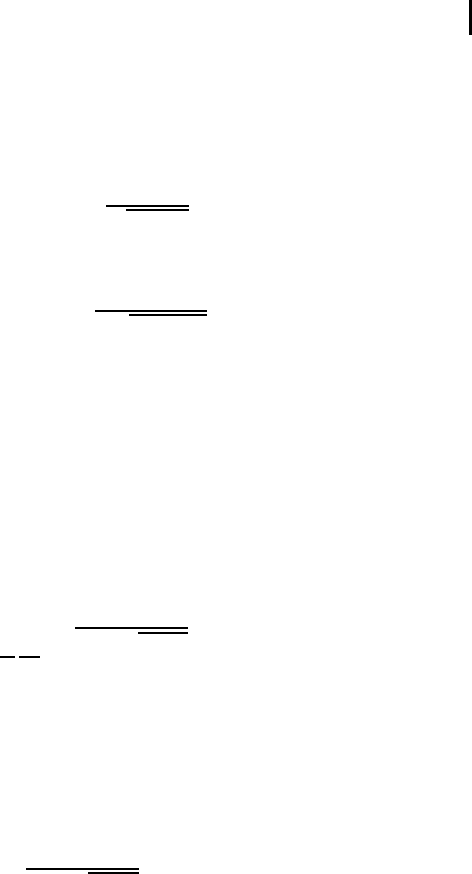
4.5 Green Function for the Vibration Equation
141
Thus, the spectral characteristics of a 1D crystal differ from those of a 3D (and 2D)
one in that they have no singularities inside the continuous spectrum band. At the
ends of the continuous spectrum interval the singularities are more pronounced than
those of 3D and 2D crystals. It is clear from (4.4.17) that for ε → ε
∗
,whereε
∗
is a
continuous spectrum edge,
g(ε) ∼
1
|ε − ε
∗
|
. (4.4.18)
The frequency spectrum function of a 1D crystal with the nearest-neighbor interac-
tions is
ν(ω)=
2N
π
ω
2
m
−ω
2
, (4.4.19)
where N is the number of atoms in the chain.
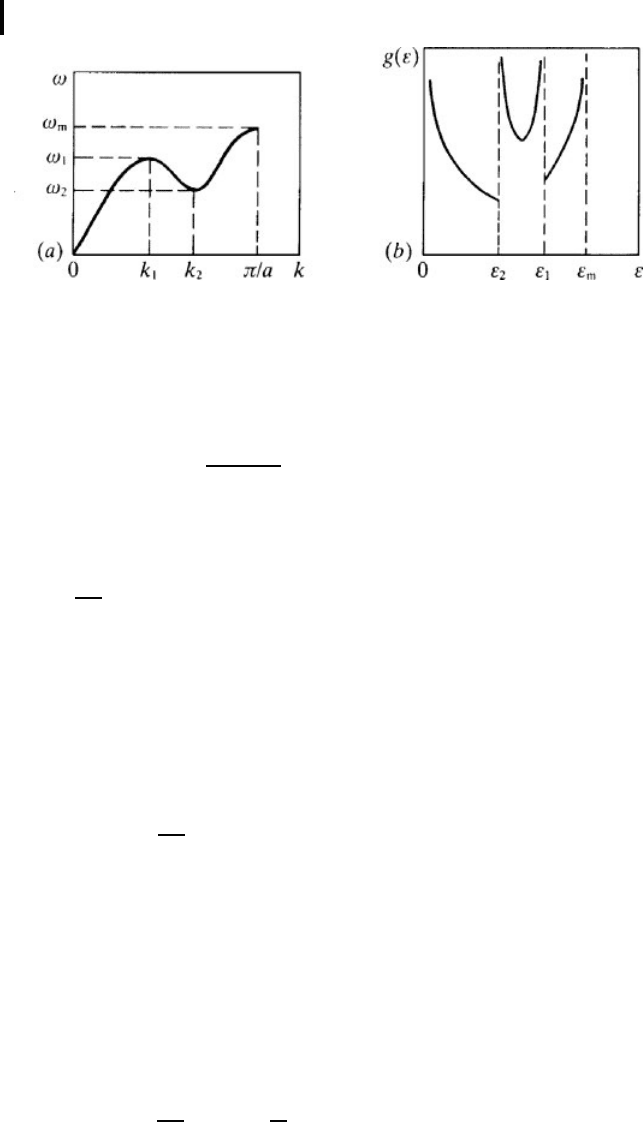
If the dispersion law of a lD crystal is a nonmonotonic function ω(k) such as in
Fig. 4.9a the spectral characteristics of 1D crystal vibrations at the points ω = ω
1
and ω = ω
2
, will have distinctive singularities. Indeed, suppose that near k = k
1
and
ω = ω
1
the dispersion law is then given by
ω
2
= ω
2
1
− γ
2
1
(k − k
1
)
2
.
The contribution of this part of the dispersion law to the density of states is then
easily determined to be
δgε =
a
π
dk
dε
a
2πγ
1
√
ε
1
− ε
, ε < ε
1
;
0, ε > ε
1
.
Similarly, if we write the dispersion law near the points k = k
2
and ω = ω
2
in
the form of ω
2
= ω
2
2
− γ
2
2
(k − k
2
)
2
, the corresponding contribu tion to the vibration
density is
δgε =
0, ε < ε
2
= ω
2
2
;
a
2πγ
2
√
ε − ε
2
, ε > ε
2
.
A plot of the density of states for a 1D crystal in the case when the interval (0, ω
m
)
has two singular points ε = ε
1
(maximum) and ε = ε
2
(minimum) is given in Fig. 4.9b.
4.5
Green Function for the Vibration Equation
The singularities of the spectrum of crystal vibrations can be analyzed, apart from
the geometric method, by the analytical one, which is based on the mathematical
structure of the equations of crystal lattice motion. The so-called Green dynamic
142
4 Frequency Spectr um and Its Connection with the Green Function
Fig. 4.9 Spectrum of vibrations of a 1D crystal: (
a
) dispersion curve;
(
b
) singularity of the density of states.
function is used for this purpose. It is defined as follows. The equations of free
vibrations of a monato mic crystal lattice (1.1.12) are represented as
m
d
2
u(n, t)
dt
2
+
∑
n
A(n − n
)u(n
, t)=0. (4.5.1)
The Green function for unbounded crystal vibrations or the Green function of
(4.5.1) is called a solution to an inhomogeneous equation vanishing at infinity
m
d
2
dt
2
G
ik
(n, t|n
0
)+
∑
n
α
ij
(n − n
)G
jk
(n
, t|n
0
)=−mδ
ik
δ(t)δ
nn
0
, (4.5.2)
where δ(t) is th e Dirac δ-function.
By virtue of space homogeneity of an unbounded crystal, the solution to the equa-
tion d epends on the difference n − n
0
: G(n, t|n
0
)=G(n − n
0
, t). The Green func-
tion of any linear equation allows one to find a partial solution to an inhomogeneous
equation describing the induced motion of the system concerned. If the motion of
crystal atoms is determined by the force mf
i
(n, t):
m
d
2
dt
2
u
i
(n, t)+
∑
n
α
ik
(n − n
)u
k
(n
, t)=mf
i
(n, t), (4.5.3)
the partial solution to this equation is
u
i
(n, t)=−
∑
n
G
ik
(n − n
, t −t
) f
k
(n
, t) dt
. (4.5.4)
However, use of the Green function is not limited to (4.5.4) alone. The Green
function gives rich information on the properties of a system whose free motion is
described by a homogeneous equation (4.5.1).
In a scalar model, the Green function G(n, t) is a solution to the equation
m
d
2
dt
2
G(n, t)+
1
m
∑
n
α(n − n
)G(n
, t)=−δ(t) δ
n0
. (4.5.5)
4.5 Green Function for the Vibration Equation
143
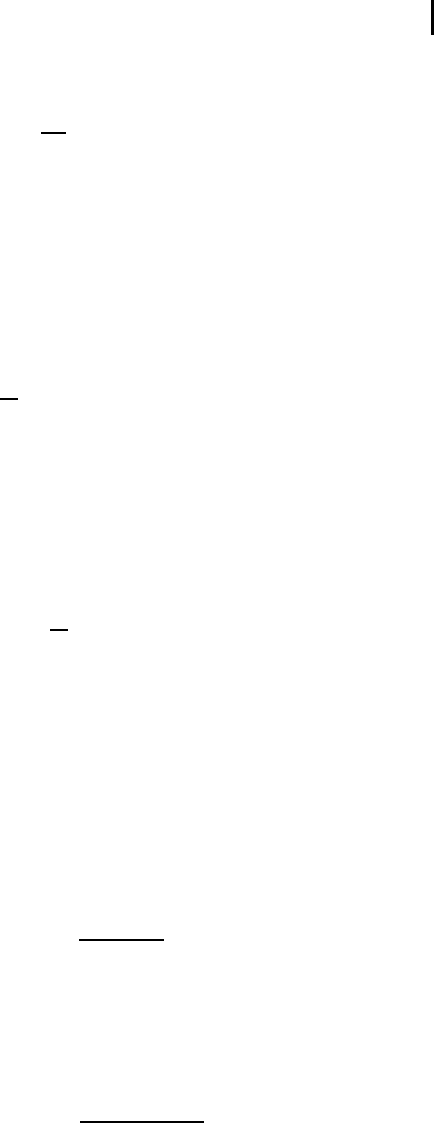
We represent G(n, t) as the Fourier integral
G(n, t)=
1
2π
+∞
−∞
G
ω
2
(n)e
−iωt
dω;
G
ω
2
(n)=
+∞
−∞
G(n, t)e
iωt
dt,
(4.5.6)
and call the function G
ε
(n) ,whereε = ω
2
, the Green function of stationary crystal
vibrations. This function is defined as an appropriate solution to the equation with
behavior at infinity
εG
ε
(n) −
1
m
∑
n
α(n − n
)G
ε
(n
)=δ
n0
. (4.5.7)
The Green function of stationary vibrations is dependent on ε, i. e., it depends only
on the frequency squared. Thus, judging from (4.5.6), (4.5.7), the frequency sign
in the argument of the time Fourier transformation of the Green function is of no
importance. However, in fact this is n ot so. By an a lyzing (4.5.1), (4.5.7), it is easy
to obtain the Green function for the vibrations of an ideal crystal. We perform the
following Fourier transformation of the function G
ε
(n)
G
ε
(n)=
1
N
∑
k
G(ε, k)e
ikr (n)
;
G(ε, k)=
∑
n
G
ε
(n)e
−ikr (n)
,
(4.5.8)
determining the Green func tion in (ε, k) representation. We now perform an analo-
gous transformation of (4.5.7)
ε − ω
2
(k)
G(ε, k)=1, (4.5.9)
where, as before, the function ω(k) gives the dispersion law of a crystal. It follows
from (4.5.9) that the Fourier components o f the Green function are
G(ε, k)=
1
ε − ω
2
(k)
. (4.5.10)
The fo r mu la (4.5.1 0 ) determines th e Green fu nction in (ε, k) representation. For
some methods of theoretical calculation of ideal crystal properties, this representation
is fundamental. As (4.5.10) is important, we write it in the general case when various
vibration branches in a crystal exist
G
ij
(ε, k)=
3
∑
α=1
e
i
(k, α)e
j
(k, α)
ε − ω
2
α
(k)
. (4.5.11)
144
4 Frequency Spectr um and Its Connection with the Green Function
The form of the functions (4.5.10), (4.5.11) and, in particular, the appearance of
characteristic denominators is not specific only for the crystal vibrations but reflects
the general features of the Green function for systems with collective excitations. We
thus analyze the function G(ε, k).
The function G(ε, k) regarded as a function of the variable ε has a pole at the point
ε = ω
2
(k) , i. e., at a point where ω coincides with the frequency o f one, the eigen-
vibrations. We, therefore, arrive at the following important property of the Green
function. The poles of the Fourier components of the Green function are determined
by the spectrum of crystal eigenfrequencies or, in other words, by its dispersion law.
Using (4.5.8), we obtain the Green function for stationary vibrations (in a scalar
model) in the form
G
ε
(n)=
1
N
∑
k
e
ikr (n)
ε − ω
2
(k)
. (4.5.12)
Assuming quasi-continuity of the spectrum of the k-vector values we may rewrite
(4.5.12) in the form of an integral:
G
ε
(n)=
V
0
(2π
3
)
e
ikr (n)
d
3
k
ε − ω
2
(k)
, (4.5.13)
where V
0
is the unit cell volume.
The generalization of (4.5.12) is obvious in view of (4.5.11):
G
ij
ε
(n)=
1
N
∑
k,α
e
i
(k, α)e
j
(k, α)
ε − ω
2
α
(k)
e
ikr (n)
. (4.5.14)
Changing (4.5.14) to an integral form is accomplished analogously to the transfor-
mation from (4.5.12) to (4.5.13).
We now return to a scalar model. If the value of the parameter ε does not get into
the band of crystal eigenfrequency squares (in our case ε > ω
2
m
) the formula (4.5.13)
unambiguously determines a certain function n dependent on the parameter ε.
However, the case 0 < ε < ω
2
m
, i. e., when the frequency ω is in the continuous
spectrum interval, is more interesting. As the Fourier components of the Green func-
tion have a pole, the integral (4.5.13) is meaningless (it diverges). More exactly, it
is senseless in its literal interpretation when the parameter ε is considered to be real.
However, this singularity of the vibrational system behavior is typical for any reso-
nance system when damping (dissipation) of the eigenvibrations is neglected, and it
results in infinitely large amplitudes of vibrations as soon as the frequency of the ex-
citation force coincides with one of the eigenfrequencies of the system. It is known
how to overcome this difficulty. It is necessary to take into account at least small
damping of the eigenvibration existing in the system. For unbounded systems with
distributed parameters, whose eigenvibrations have the form of waves with a contin-
uous frequency spectrum, equations such as (4.5.13) can be regularized by choosing
special conditions at infinity. Formally, this reduces to the fact that the parameter ε
4.6 Retarding and Advancing Green Functions
145
should be regarded as complex rather than real, but with a vanishingly small imaginary
part. Adding even a small imaginary part to ε removes the divergence of the integral
(4.5.13), but generates some new problems
2
.
In discussing the general properties of the function G(ε, k ), we focus on one purely
mathematical point. Let us represent the equation for stationary vibrations (1.1.17) in
the matrix (operator) form εu −
1
m
Au = 0. Equation (4.5.7) for the Green function
of stationary vibrations can be written in the same style: εG −
1
m
AG = I,whereI is
the unit operator.
The solution to this equation can be easily found
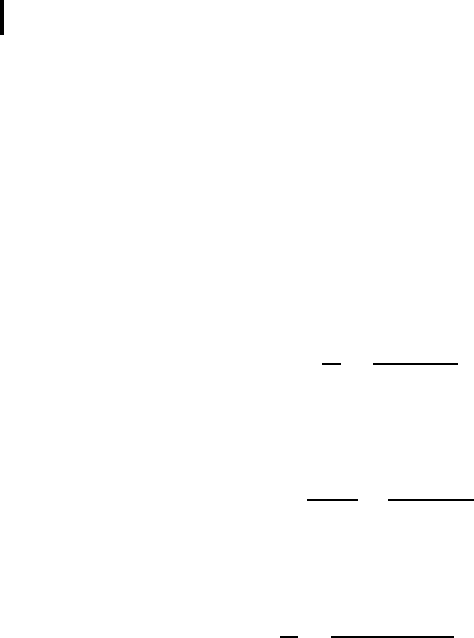
G(ε)=
εI −
1
m
A
−1
, (4.5.15)
if we introduce an inverse operator notation (the operator M
−1
is inverse to M).
The Green function in the matrix (or operato r) form (4.5.15) is sometimes called a
resolvent.
The formula (4.5.6) does not specify the representation where the Green function
is written , but it implies that the matrix G(ε) is diagonal in a representation in which
the operator A is diagonal. For a vibrating crystal this is a k-representation where
(4.5.10), (4.5.11) are derived.
4.6
Retarding and Advancing Green Functions
We return to (4.5.6), substitute (4.5.13) in it, and write the Green function as a
function of time
G(n, t)=
V
0
(2π)
4
e
ikr (n)−iωt
ω
2
− ω
2
(k) −iγ
dωd
3
k. (4.6.1)
To regularize the integral (4 .6.1) we h ave just explicitly separated a small imaginary
component iγ .
Let us consider only the frequency transformation in (4.6 . 1), resulting in the integral
G
k
(t)=
∞
−∞
e
−iωt
dω
ω
2
−ω
2
(k) −iγ
. (4.6.2)
The coordinate representation of the Green function is determined by an obvious
transformation involved in (4.6.1)
G(n, t)=
V
0
(2π)
3
G
k
(t)e
ikr (n)
d
3
k. (4.6.3)
2) In particular, the Fourier component of the Green function becomes depen-
dent on the sign of ω.
146
4 Frequency Spectr um and Its Connection with the Green Function
The integral (4.6.2) is easily calculated by the residues method. The integration
should be performed over a closed path consisting of the real axis of the variable ω
and an arc of the infinitely remote semicircle. As the convergence o f the integral and
its vanishing for an infinite semicircle is provided by the exponential factor, for t < 0
we should close the path above the real axis, and for t > 0 below it. As a result,
for t < 0 the integral (4.6.2) is determined by residues in the upper half-plane of a
complex variable ω,andfort > 0 this integral equals the sum of residues in the lower
half-plane.
Since the imaginary shift in the complex plane ω is determined by p arameter γ,
the integration result in (4.6.2) is determ ined completely by the sign of the param eter
γ. The relation between th e sign s of γ and ω is then very important. In (4.6.1) and
(4.6.2), no assumptions were made with regard to the sign o f γ, so that the ambiguity
in choosing the dependence of the sign of γ on the sign of ω indicates the a mbiguity
in determination of the Green function by (4.6.1).
Let us assume that the sign of γ changes together with the sign of the frequency,
i. e., we admit γ = γ
0
sign(ω). The Fourier component of the Green function for
which a new notation G(ω, k) was used, to avoid confusion with (4.5.10), then takes
the form
G(ω, k)=
1
ω
2
− ω
2
(k) −iγ sign(ω)
. (4.6.4)
It is readily seen that for γ
0
< 0 (4.6.4) determines a function of the complex
variable ω analytic in the upper semi-plane and at γ
0
> 0, in the low semiplane.
Integrating in ( 4.6.2), we find the time dependence of the Green functions generated
by the Fourier components (4.6.4). For γ
0
< 0,wehave
G
R
k
(t)=
0, t < 0;
−
sin [ω(k)t]
ω(k)
, t > 0.
(4.6.5)
By using the transformation (4.6.3), we get a retarding Green function G
R
(n, t).
This function describes the perturbation arising at any crystal point, with an instan-
taneous force applied at the coordinate origin. At infinity, it corresponds to waves
diverging from the origin.
When γ
0
> 0,wehavetodetermine
G
A
k
(t)=
−
sin [ω(k)t]
ω(k)
, t < 0;
0, t > 0
(4.6.6)
to derive by means of (4.6.3) an advancing Green function G
A
(n, t). The advancing
Green function describes the crystal perturbations for t < 0 that generate a force con-
centrated at the origin at time t = 0. At infinity, it corresponds to waves converging to