
Kosevich A.M. The crystal lattice
Подождите немного. Документ загружается.

4.7 Relation Between Density of States and Green Function
147
the origin. The choice between waves diverging and converging at infinity is the com-
plementary physical factor that can be formulated as additional conditions at infinity
and makes the sign of the parameter γ
0
meaningful.
Finally, we consider the Green function for stationary vibrations for which there is
no energy flow at infinity (diverging and converging waves have the same amplitude,
thus, generating stagnant waves). However, for the stationary vibrations understood
literally, the time Fourier component of the Green function is determined by the fre-
quency square and does not depend on the sign of ω. Thus, the imaginary addition iγ
in (4.6.1) for the corresponding Green function should also be independent of the
sign ω,i.e.,γ may be regarded as independent of ω.
We set γ = |γ| > 0 for all ω. Then using (4.5.10), we introduce the parameter γ
just into the argument of the Green function (4.5.10) and, instead of (4.6.4), we obtain
G(ω, k)=G(ε − i |γ|, k). (4.6.7)
We substitute (4.6.7) into (4.6.2) and integrate over frequency. As a result we obtain
G
k
(t)=
i
2ω(k)
e
−iω(k)t
, t < 0;
e
+iω(k)t
, t > 0.
(4.6.8)
The Green function (4.6.8), of course, has a singularity at t = 0, but is nonzero for
any other t.
4.7
Relation Between Density of States and Green Function
In the definition (4.2.14) of the function g(ε), we compare the sum on the r.h.s. o f
(4.2.14) with the expression (4.5.14) for the Green function. It is clear that the density
of states can be directly determined by the imaginary part of the Green function for
stationary vibrations with the coinciding arguments (n = 0)
g(ε)=
1
π
lim
γ→+0
Im G
ll
ε− iγ
(0). (4.7.1)
In determining (4.7.1), we used the property of the polarization vectors (1.3.2).
Thus the crystal vibrational density is determined by the imaginary part of the Green
function for stationary vibrations taken at zero. As all Green functions have the same
singularities, the vibrational density can be associated with the imaginary part of any
of them, e. g., be determined through a retarding Green function. We again consider
only one branch of vibrations (more exactly a scalar model) and analyze the (ω, k)-
representation (4.6.4) for the function G
R
ω
(n) . We take into account the relation
lim
γ→0
Im
1
ω
2
− ω
2
(k)+i |γ|sign ω
= lim
γ→+0
γ
(ω + iγ)
2
− ω
2
(k)
,
148
4 Frequency Spectr um and Its Connection with the Green Function
and, by analogy with the discussion above, we obtain
g(ω
2
)=
1
π
lim
γ→+0
G
R
ω+iγ
(0). (4.7.2)
To elucidate the meaning of the operations indicated in (4.7.1) and (4.7.2), we move
over from a summation to an integration in (4.2.14) for a scalar model
g(ε)=
1
π
V
0
(2π)
3
lim
γ→+0
Im
d
3
k
ε − iγ − ω
2
(k)
, (4.7.3)
where the integration is over one unit cell in k-space.
If we now change the integration variable z = ω
2
(k) in (4.7.3), the formula will
transform into the obviou s equality
g(ε)=
1
π
lim
γ→+0
Im
ω
2
m
0
g(z) dz
ε − iγ − z
.
Indeed, for the real function g(ε) and the real variables ε and z, the following iden-
tity always holds
lim
γ→+0
g(z) dz
ε ± iγ −z
= P. V.
g(z) dz
ε − z
∓iπg(ε) , (4.7.4)
where P.V. means the principal value of the integral.
Relations (4.7.1), (4.7.2), important in real systems, are valid only for a homoge-
neous crystal. In order to analyze the crystal vibration spectrum with defects breaking
the space homogeneity of the system, we generalize these formula to an inhomoge-
neous case and clarify some formal mathematical po in ts resulting in a relatio nship
such as (4.7.1).
We consider a certain problem on the eigenvalues for a linear Hermitian operator
ˆ
L
in an unbounded crystal
ˆ
Lϕ −λϕ = 0. (4.7.5)
The Green function of (4.7.5) is said to be the function
G
λ
(n, n
)=
∑
s
ϕ
∗
s
(n)ϕ
s
(n
)
λ −λ
s
, (4.7.6)
where ϕ
s
(n) and λ
s
are the normalized eigenfunctions and eigenvalues of the opera-
tor
ˆ
L,
ˆ
Lϕ
s
− λϕ
s
= 0;
∑
n
|ϕ
s
(n)|
2
= 1.
As the eigenfunctions for the ideal crystal vibrations are determined by (1.3.3), it is
easy to see that (4.7.6) lead s directly to (4.5.12).
4.8 The Spectrum of Eigenfrequencies and the Green Function of a Deformed Crystal
149
We set in (4.7.6) n = n
and sum the relation o btained over all lattice sites:
∑
G
λ
(n, n)=
∑
s
1
λ −λ
s
. (4.7.7)
We introduce the density of eigenvalues g(λ) for the operator
ˆ
L and, displacing the
parameter λ from the real axis, rewrite (4.7.7) as
1
N
∑
G
λ−iγ
(n, n)=
g(z) dz
λ −iγ −z
. (4.7.8)
Finally, we u se the identity (4.7.4) and apply it to the r.h.s. of (4.6.7) to obtain
g(λ)=
1
π
lim
γ→+0
Im
1
N
∑
n
G
λ−iγ
(n, n). (4.7.9)
The formula (4.7.9) is the desired generalization of (4.7.1 ) to the case of a spatially
inhomogeneous system.
The relation between the density of eigenvalues of a certain Hermitian operator and
the corresponding Green function (4.7.9) can be written in a more invariant form, if
one uses the Green operator concept. The Green function (4.7.6) can be regarded as
the site representation of the Green operator (resolvent)
ˆ
G
λ
=(λ −
ˆ
L)
−1
, (4.7.10)
given in the space of th e eigenfunctions of the Hermitian operator
ˆ
L.
The sum involved on the r.h.s. of (4.7.9) should then be regarded as the trace of the
Green operator
∑
n
G
λ
(n, n)=Tr
ˆ
G
λ
.
Thus,
g(λ)=
1
π
lim
γ→+0
Im
1
N
Tr
ˆ
G
λ−iγ
. (4.7.11)
Since the trace operation is invariant with respect to choice of representation,
(4.7.11) permits us to calculate the density of eigenvalues g(λ) in any representation
of the Green operator.
4.8
The Spectrum of Eig enfrequencies and the Green Function of a Deformed
Crystal
Generalizing (4.7.1) to the case of inhomogeneous crystal vibrations, we go over to
the relation (4.7.9) or its abstract formulation (4.7.11).
If the matrix
ˆ
L in (4.7.10) describes the dynamic force matrix of a deformed crys-
tal, and λ coincides with the vibration eigenfrequency square, then (4.7.11) directly
150
4 Frequency Spectr um and Its Connection with the Green Function
describes the squared frequency distribution in this crystal. However, (4.7.11) is ap-
plicable to a nonideal crystal only in the case when the crystal potential energy experi-
ences deformation (perturbation). However, situations when the crystal kinetic energy
is also perturbed are possible. If we include the kinetic energy perturbation of sta-
tionary vibrations in the matrix
ˆ
L, the kinetic energy will be a function of the squared
frequency:
ˆ
L =
ˆ
L(λ). In this case, (4.7.11) is invalid and it should b e g eneralized.
We consider the linear eq uation
ˆ
Lϕ −λϕ = 0, (4.8.1)
whose Green operator (resolvent) is determined by (4.7.10)
G(λ)=
λ −
ˆ
L(λ)
−1
. (4.8.2)
Let ϕ
s
be the eigenfunctions and α
s
the e igenvalues of
ˆ
L (s is the number of a
corresponding state):
ˆ
L(λ)ϕ
s
= α
s
(λ)ϕ
s
.
The value of λ corresponding to the eigenvalues of the problem (4.8.1) is found as
a solution to the equation
α
s
(λ)=λ.
We denote the roots of this equation by λ
sr
,wherer is the root number. Then the
density of eigenvalues of the problem (4.8.1) reads
ν(λ)=
∑
sr
δ(λ − λ
sr
). (4.8.3)
We use the notation ν(λ) for the eigenfrequency distribution function in the general
case, leaving the notation g(λ) for the density of eigenfrequencies of crystal vibrations
(λ = ω
2
) no rmalized to unity.
Using the formula (4.7.11) we consider the Green matrix (4.8.2) as a function of
the eigenvalue G(λ −iγ) at γ → 0:
G(λ −iγ)=
λ − iγ −
ˆ
L(λ)+iγ
d
ˆ
L
dλ
−1
=
λ −
ˆ
L(λ)
1 −
d
ˆ
L
dλ
−1
−iγ
1 −
d
ˆ
L
dλ
−1
=
1 −
d
ˆ
L
dλ
−1
λ −
ˆ
L(λ)
1 −
d
ˆ
L
dλ
−1
−iγ
−1
.
(4.8.4)
We rewrite (4.8.4) in a somewhat different form:
1 −
d
ˆ
L
dλ
G(λ −iγ )=
λ −
ˆ
L(λ)
1 −
d
ˆ
L
dλ
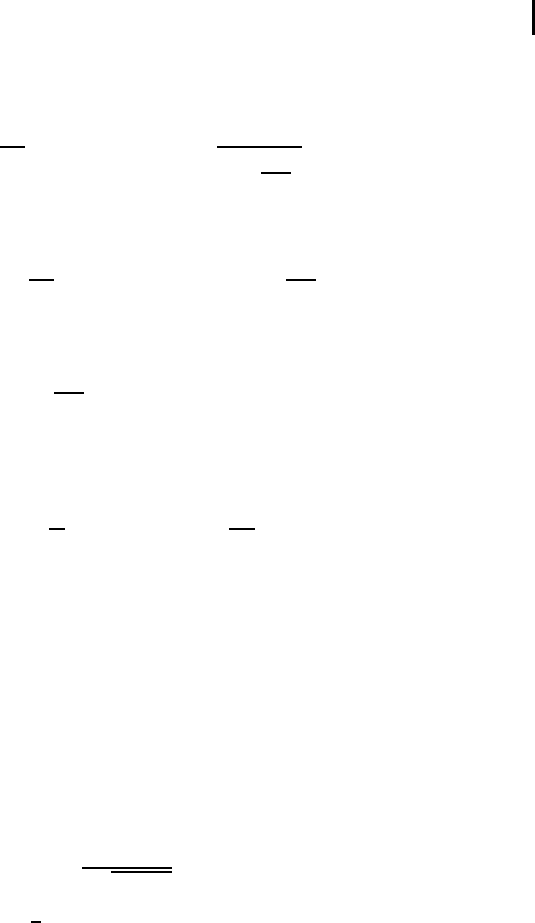
−1
−iγ
−1
. (4.8.5)
4.8 The Spectrum of Eigenfrequencies and the Green Function of a Deformed Crystal
151
We calculate the trace of the operator (4.8.5) by the means of the eigenfunctions
ˆ
L:
Tr
1 −
d
ˆ
L
dλ
G(λ −iγ)
=
∑
s
λ − α
s
(λ)
1 −
dα
s
dλ
−iγ
−1
, (4.8.6)
and make the necessary limiting transition:
lim
γ→+0
Im Tr
1 −
d
ˆ
L
dλ
G(λ −iγ)
= π
∑
s
1 −
dα
s
dλ
δ(λ −α
s
(λ)). (4.8.7)
Finally, we make use of the expression for the δ-fu nction of a complex argument:
1 −
dα
s
dλ
δ(λ −α
s
(λ)) =
∑
r
δ(λ − λ
sr
). (4.8.8)
Thus, returning to the definition (4. 8.3) and comparin g it with (4 .8.7) and (4.8.8),
we find the final relation:
ν(λ)=
1
π
lim
γ→+0
Im Tr
1 −
d
ˆ
L
dλ
G(λ −iγ)
. (4.8.9)
Equation (4.8.9), suggested by Chebotarev (1980), generalized (4.7.11) to the case
of an arbitrary matrix
ˆ
L and is the basis for describing the spectrum of deformed
crystal vibrations.
4.8.1
Problems
1. Find Green function for stationary vibrations of a one-dimensional crystal with
nearest-neighbor interactions.
Solution.
G
ε
(n)=
i
ε
ω
2
m
− ε
e
−iakn
, n < 0;
e
iakn
, n > 0,
where ak = 2arcsin(
√
ε/ω
m
).
2. Find the Green function for stationary vibrations of a 1D crystal, accounting for
the interactions of not only the nearest neighbors, when ω = ω(k) is a nonmonotonic
function in the interval 0 < k < π/a.
5
Acoustics of Elastic Superlattices: Phonon Crystals
5.1
Forbidden Areas of Frequencies and Specific Dynamic States in such Areas
While studying the vibration spectrum of a crystal lattice we have seen that the vibra-
tion eigenfrequencies always occupy a finite interval of possible frequencies or several
finite intervals of frequencies. In the case of a monatom ic crystal lattice one speaks
of the bands of acoustic vibrations. Every one of these bands has got some upper
limit. Denote the largest of them ω
max
. The frequencies of mechanical vibrations
of the crystal with such a lattice can not be higher than ω
max
. Values of frequencies
ω > ω
max
are forbidden.
In a polyatomic lattice, vibrations of the optical type exist always and their frequen-
cies are as a rule higher than the frequencies of acoustic vibrations. In any case, the
optical vibrations are higher than the acoustic vibrations at least at small enough val-
ues of the vector k. Therefore, there is a forbidden band (gap) in the region of small
k between the acoustic and optical frequencies. This gap disappears in many cases at
the values of k close to boundaries of the Brillouin zones (see Fig. 3.2).
However, there are crystals whose vibration spectrum has got a frequency gap sep-
arating the high-frequency and low-frequency bands at any k. Such a situ ation can
be found in many molecular crystals where the frequencies close to intermolecular
vibrations of the single molecule lie higher than the frequencies of usual mechanical
vibrations (acoustic and optical types). The forbidden gap can exist even in “conve-
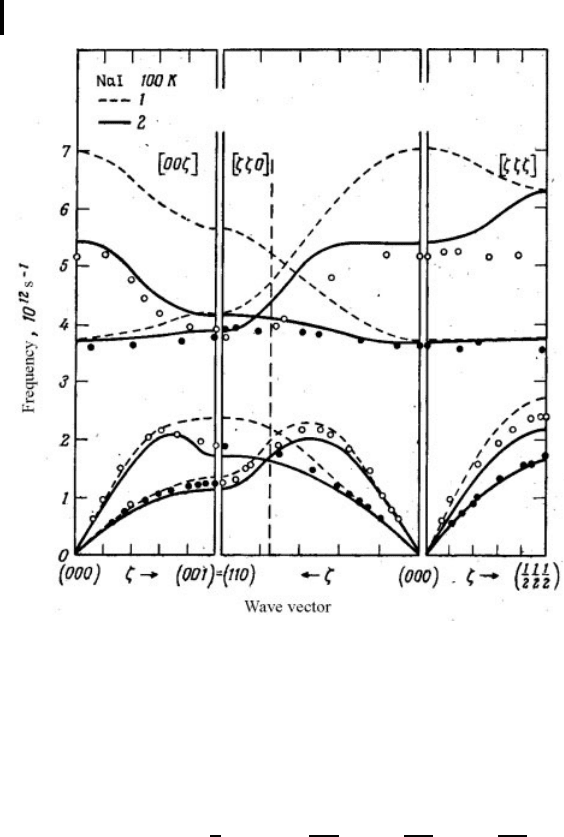
nient” crystals of NiO type see Fig. 5.1.
Thus, crystal eigenvibrations can not possess frequencies within forbidden gaps.
But what response of the crystal would be expected to an external periodical perturba-
tion with the frequency belonging to such a band? Consider a primitive cubic lattice
occupying the half space z < 0 and having a plane boundary surface z = 0 where the
z-axis is chosen along the edge of the elementary cube (parallel to the axis of sym-
metry C
4
). We confine ourselves to the scalar model and interactions of the nearest
neighbors. Then, both the equation of motion (2.1.13) and the dispersion relation take
The Crystal Lattice: Phonons, Solitons, Dislocations, Superlattices, Second Edition. Arnold M. Kosevich
Copyright
c
2005 WILEY-VCH Verlag GmbH & Co. KGaA, Weinheim
ISBN: 3-527-40508-9
154
5 Acoustics of Elastic Superlattices: Phonon Crystals
Fig. 5.1 Experimental points and dispersion curves calculated for the
crystal NaI (Woods et al. 1960).
the following forms
mω
2
u(n)=α
∑
n
0
[u(n) − u(n + n
0
)], (5.1.1)
ω
2
=
1
3
ω
2
m
sin
2
ak
x
2
+ sin
2
ak
y
2
+ sin
2
ak
z
2
; (5.1.2)
here the number-vector n
0
connects the site n with the six nearest neighbors and ω
m
is the maximum frequency of the eigenvibrations : ω
2
m
= 4α/m.
Suppose that the lattice under consideration contacts along the plane z = 0 some
medium in which bulk mechanical vibrations with high frequencies can be excited.
This may be the same cubic lattice with another elastic coefficients α(n) or a poly-
atomic lattice where the high-frequency vibrations of the optical type exist. In elec-
trically active crystals (like ionic or ferroelectric crystals) similar vibrations can be
excited by the electromagnetic waves that do not act directly on the lattice under con-
sideration. In any case, suppose that the mechanical vibrations in the half-space z > 0
possess the frequencies exceeding all possible frequencies of the lattice under consid-
eration. These vibrations create on the interface boundary z = 0 some distribution of
5.2 Acoustics of Elastic Superlattices
155
forces like a traveling wave. Let the perturbation wave propagate along the x-axis and
have the form
f (n, t)= f
0
e
ikan
x
−iωt
. (5.1.3)
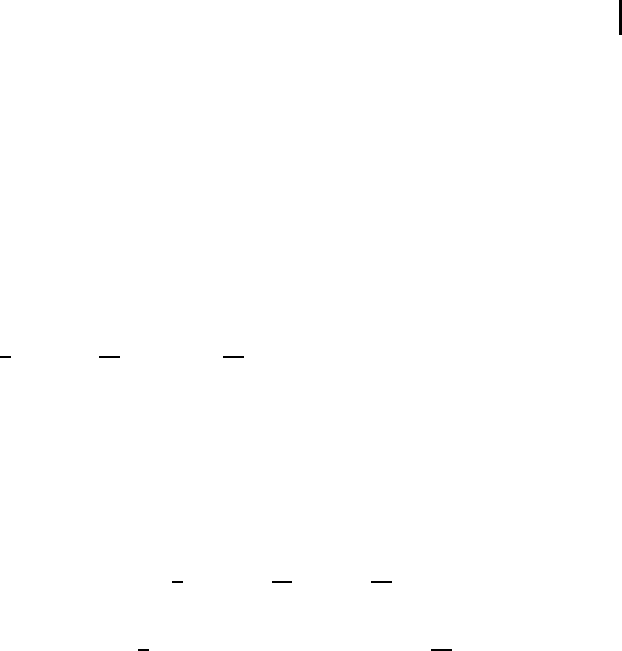
Perturbation (5.1.3) on the plane z = 0 is perceived by the lattice considered as a
definite boundary condition. Under any condition of the type (5.1.3) a solution to the
linear dynamic equation of the motion (5.1.1) takes the form
u = w(n
z
)e
ikan
x
−iωt
, (5.1.4)
where the function w(n
z
) obeys the equation
ω
2
−
1
3
ω
2
m
sin
2
ak
2
w(n)=
1
12
ω
2
m
[2w(n) −w(n −1) − w(n + 1)]. (5.1.5)
Since the maximum frequency corresponds to ak
z
= π and we are interested in the
vibrations with ω > ω
m
the solution to (5.1.5) in the half-space z < 0 should be
taken in the form
w(n)=(−1)
n
e
κan
, n < 0. (5.1.6)
We substitute (5.1.6 ) into (5.1.5) and come to the expression
ω
2
=
1
3
ω
2
m
sin
2
ak
2
+ cosh
2
aκ
2
. (5.1.7)
At the frequencies ω
2
>
2
3
ω
2
m
the parameter κ is real (cosh
2
aκ
2
> 1)andwemust
choose κ > 0 in (5.1.7).
Solution (5.1.7) describes crystal vibrations with an amplitude decaying exponen-
tially when the distance from the boundary surface increases. This p roperty of the
solution discussed is its principal difference from the eigenvibrations of an infinite
crystal lattice. The vibrations under consideration represent an example of localized
vibrations. If the localization takes place near a boundary surface of the crystal one
calls them surface vibrations. We consider another example of localized vibrations
later. Frequencies of the localized vibrations in all such examples lie outside of the
continuous spectrum of the eigenvibrations of the crystal lattice (above the frequency
spectrum or inside the gaps).
5.2
Acoustics of Elastic Superlattices
We have paid attention to a possibility of existence of the forbidden bands (gaps)
in the v ibration spectrum of a crystal lattice. Now it is natural to raise a question
whether such a possibility is connected with microscopic (atomic) periodicity of the
crystal or it is the general consequence of any periodicity independently of a value
156
5 Acoustics of Elastic Superlattices: Phonon Crystals
of the period. In dynamics of a crystal lattice the period of the crystal structure a
takes part in the analysis as a parameter and its value arises only at the estimation of
the elastic moduli of crystals. As to peculiarities of the vibrational spectrum they are
determined by the dimensionless parameter ak,wherek isavalueofthewavevector.
Therefore, the peculiarities of th e frequency spectrum, in particular the problem o f
the existence of gaps, depend not on a concrete value of a, but on its relation to the
wavelength. Consider this fact and consider longwave and low-frequency (acoustic)
vibrations putting ak 1.
The dynamics of a crystal in the ( k, ω)-area ak 1 and ω ω
D
does not dif-
fer from the dynamics of a continuum media and can be described by the theory of
elasticity. Consequently, the vibration spectrum of a homogeneous crystal coincides
with the spectrum of sound waves; it is continuous and without any gaps. However,
if the homogeneity of the crystal is broken and a macroscopic periodicity comes into
existence the situation changes markedly.
Consider a one-dimensional structure consisting of periodically arranged (along the
x-axis) layers of elastic isotropic materials of two types [d
α
are the thickness of layers
(α = 1, 2), s
α
is the velocity of the sound wave in the α layer, and the structure period
is d = d
1
+ d
2
]. The periodic structure under consideration has a macroscopic period
d, which, by definition, greatly exceeds the interatomic distance a. Such a periodic
structure will be called an elastic superlattice (SL). Sometimes a macroscopic periodic
structure consisting of alternating elastic materials that differ in their elastic moduli
and sound speeds is called a phonon crystal.
The field of the elastic wave u( r, t) propagating perpendicular to the layer plane is
determined by a standard wave equation. In a system of isotropic blocks, the waves of
two possible polarizations are independent, and we can restrict ourselves to analysis
of dynamic equations for the scalar fields u
α
∂
2
u
α
∂t
2
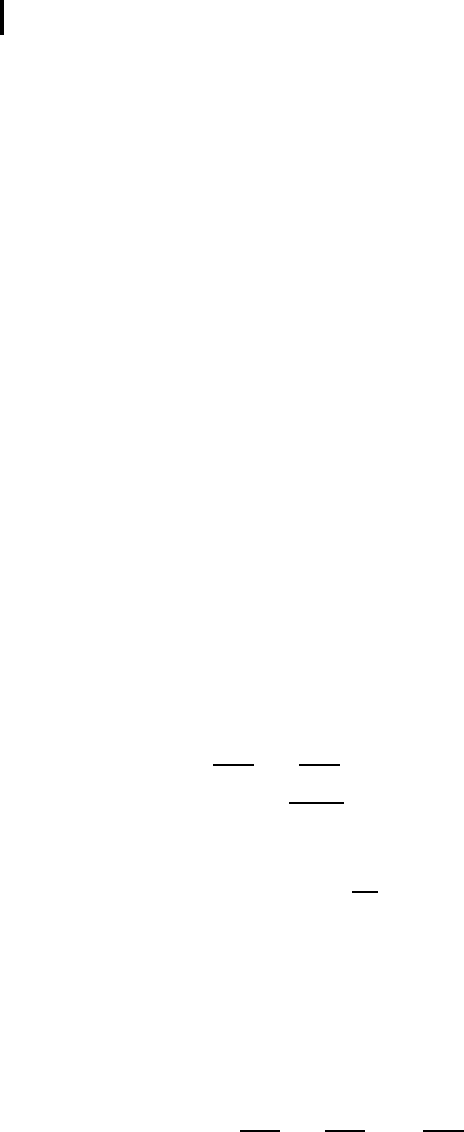
− s
2
α
∂
2
u
α
∂x
2
= 0, α = 1, 2. (5.2.1)
The velocity of a wave is s
α
=
µ
α
/ρ
α
(µ
α
and ρ
α
are the elastic moduli and mass
densities, respectively).
Equation (5.2.1) should be solved using the boundary conditions according to which
the displacements u
α
and stresses σ
α
= µ
α
∂u
α
∂x
are continuous at all boundaries of the
blocks.
Suppose that the elastic properties of two materials differ slightly and introduce the
notation δs
2
1
= s
2
1
− s
2
and δs
2
2
= s
2
2
− s
2
where the average speed squared s
2
is
determined by the condition
s
2
d = s
2
d
1
+ s
2
2
d
2
. (5.2.2)
Take into account δs
2
α
s
2
and rewrite (5.2.1) in the form
∂
2
u
α
∂t
2
− s
2
∂
2
u
α
∂x
2
= δs
2
α
∂
2
u
α
∂x
2
. (5.2.3)
5.2 Acoustics of Elastic Superlattices
157
Each of the vibration eigenmodes appearin g in a periodic structure with a period d
is characterized by the quasi-wave number k. In the zero approximation with respect
to the small parameter δs/s 1 the solution to (5.2.3) has the form of a plane wave
u(x, t)=
1
√
L
e
ikx−iωt
, L = Nd , (5.2.4)
where N is the number of layers in the SL, and the frequency is proportional to the
wave number: ω = sk.
However, one should remember that a periodical perturbation (boundary conditions)
exists even in this approximation. This means that a frequency of solution (5.2.4) is
a periodical function of k with the period of the reciprocal lattice 2π/d.Inorderto
combine the sound dispersion relation ω = sk with su ch a periodicity let u s an alyze a
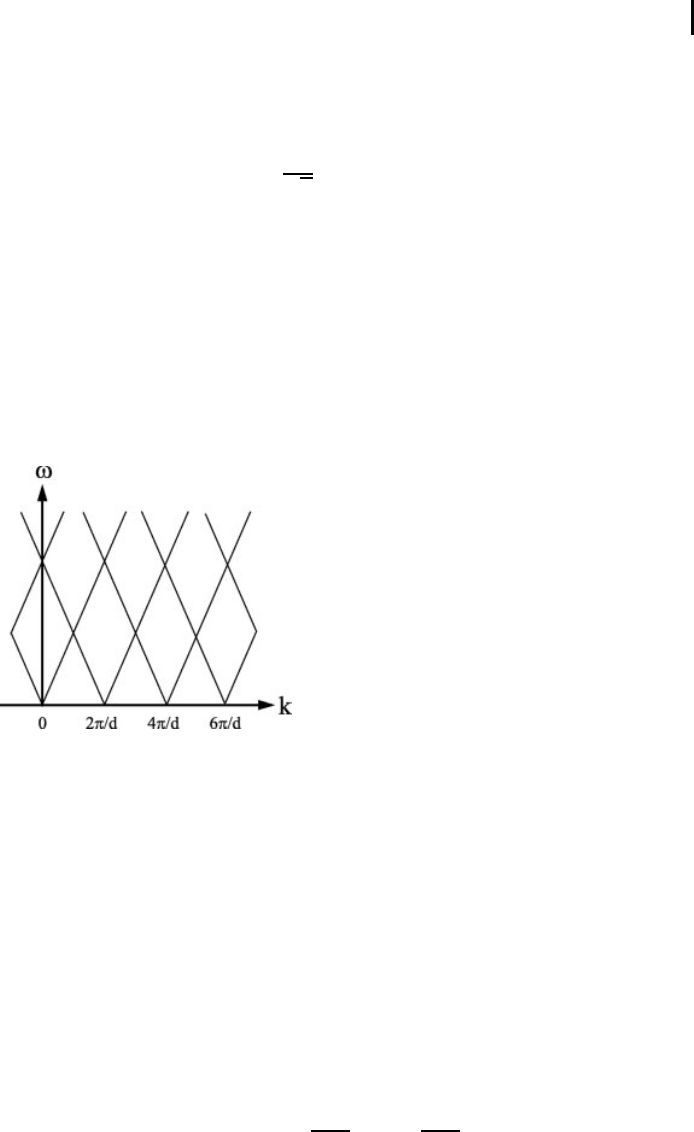
set of diagrams of this dispersion relation shifted by the value 2πn/d(n = 1, 2.3, . . .)
along the x-axis (see Fig. 5.2). Figure 5.3a represents the diagrams of the same dis-
persion relations inside one Brillouin zone.
Fig. 5.2 ω-k relations in the periodic-zone scheme.
One can see that a crossover situation that was met earlier in Chapter 3 appears
in the center of the zone (k = 0) and at its boundaries (k = ±π/d). There is a
degeneracy of frequencies at the k mentioned. The degeneracy is a consequence of the
supposition neglecting differences between parameters of two layers. The term in the
r.h.p. of (5.2.3) plays the role of a small perturbation that can remove the degeneracy.
It is convenient to combine two equations (α = 1, 2) introducing the discontinuous
function U(x)=U(x + d) that inside the interval of one period equals (x = nd + ξ):
U(ξ)=
δs
2
1
,0< ξ < d
1
;
δs
2
2
, d
1
< ξ < d .
(5.2.5)
Then, the equations of SL vibrations with the frequency ω can be represented as
ω
2
u = −s
2
d
2
u
s
dx
2
+ U(x)
d
2
u
s
dx
2
. (5.2.6)