
Kosevich A.M. The crystal lattice
Подождите немного. Документ загружается.

6.1 Occupation-Number Representation
169
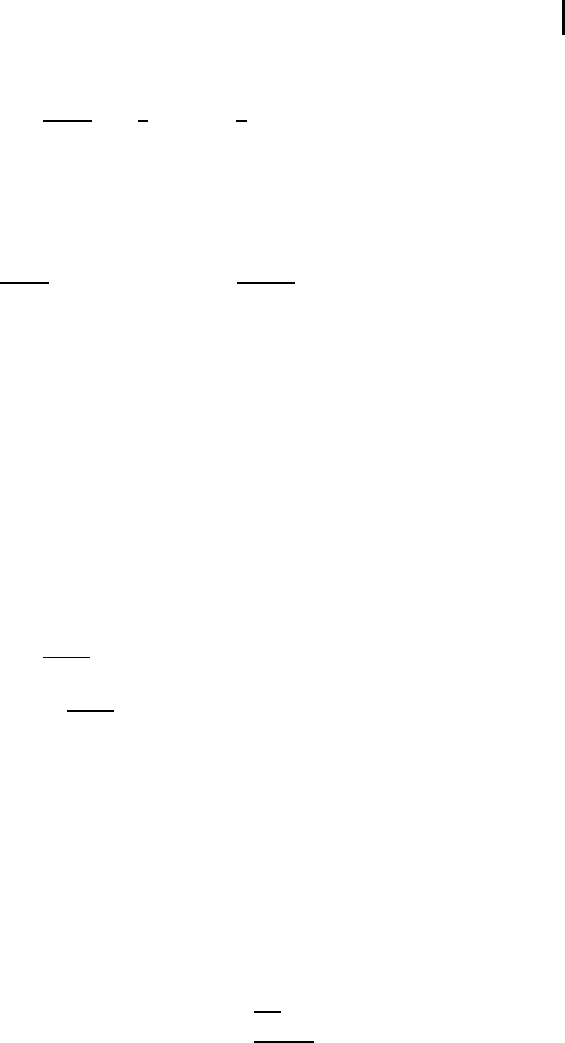
according to the definition of a time derivative of the operator
da(k)
dt
=
i
¯h
[H, a
k
]=
i
¯h
¯hω(k)[a
†
k
a
k
, a
k
]
= iω(k)[a
†
k
, a
k
]a
k
= −iω(k)a
k
.
Similarly, we obtain “the equation of motion” for the operator a
†
k
. Writing these equa-
tions simultaneously we obtain
da(k)
dt
= −iω(k)a(k),
da
†
(k)
dt
= iω(k)a
†
(k) . (6.1.18)
We note that the equations of motion (6.1.18) for the operators a
k
and a
†
k
are first-
order differential equations, whereas (1.6.6) for the normal coordinates are equations
of the second order.
The explicit time dependence of the operators follows from (6.1.18)
a
k
(t)=e
−iω(k)t
a
k
(0), a
†
k
(t)=e
iω(k)t
a
†
k
(0). (6.1.19)
To determine the action of the operators a
k
and a
†
k
on the occupation numbers, we
use the matrix of the coordinate and the momentum of a 1D harmon ic oscillator. If
M is the mass, ω the frequency, and n is the state number or the energy level number
(6.1.11) of a harmonic oscillator, the nonzero matrix elements of its coordinate X and
the momentum Y are
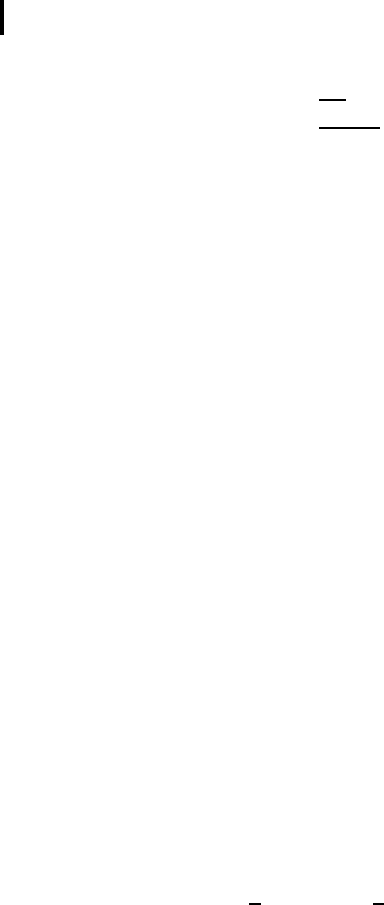
1
X
n−1,n
=
¯hn
2Mω
1/2
e
−iωt
, Y
n−1,n
= −iωMX
n−1,n
,
Xn, n −1 =
¯hn
2Mω
1/2
e
iωt
, Y
n, n−1
= iωMX
n, n−1
.
(6.1.20)
Using (6.1.20) in the case M = 1 and the linear relations (6.1.13), it is easily seen
that the matrix elements of the operators a
k
and a
†
k
are nonzero only for transitions in
which the corresponding occupation numbers N
k
(with the same value of k) change
by unity.
We denote by
|...N
k
...≡|N
k
= Ψ
{N}
k
(Q)
the wave function of some crystal state that is the eigenfunction of the operator a
†
k
a
k
and is characterized by a set of occupation numbers N
k
. Then, only the following
elements of these operators are nonzero:
N
k−1
|a
k
| N
k
=
N
k
e
−iω(k)t
,
N
k
+ 1
a
†
k
N
k
=
N
k
+ 1e
iω(k)t
.
(6.1.21)
1) We use the ordinary matrix elements representation A
mn
= m |A| n =
ψ
∗
m
(Q)Aψ
n
(Q)dQ,whereψ
n
(Q) ≡|n are the corresponding normal-
ized wave functions (Q is a set of coordinates).
170
6 Quantization of Crystal Vibrations
Using (6.1.21), we get
a
k
|N
k
=
N
k
e
−iω(k)t
|N
k
−1,
a
†
k
|N
k
=
N
k
+ 1e
iω(k)t
|N
k
+ 1.
(6.1.22)
Thus, the operator a
k
transforms the function w ith the occupation number N
k
into
the function with the occupation number N
k
−1, i. e., reduces the o ccupation number
by unity, and the operator a
†
k
increases it by unity.
We denote by A the mean value of the operato r A in a certain quantum state |N
k
:
A = N
k
|A| N
k
. (6.1.23)
On the basis of (6.1.21) or (6.1.22) we can conclude how to calculate the quantum-
mechanical average for the operator A that has the form of the sum of products of
any number of the operators a
k
and a
†
k
. If the number of operators a
k
in this product
does not equal the number of operators a
†
k
(with the same value of k ), the mean value
(6.1.23) vanishes automatically. In particular,
a
k
= a
†
k
= 0, a
k
a
k
= a
†
k
a
†
k
= 0. (6.1.24)
At the same time, (6.1.1 0) follows n aturally from (6.1.21) and its generalization
a
†
k
a
k
= N
k
δ
kk
, a
k
a
†
k
=(N
k
+ 1)δ
kk
, (6.1.25)
is consistent with commutation relations (6.1.8).
6.2
Phonons
Let us consider the ground state of a crystal corresponding to the least vibration en-
ergy. The obvious definition of the ground state: N
k
= 0 for all k follows from the
form of energy levels (6.1.12) and the fact that N
k
are non-negative numbers. The
energy of the ground state
E
0
=
1
2
∑
k
¯hω(k)=
¯h
2
ω
m
0
ων(ω) dω, (6.2.1)
is called the zero-point energy and the vibrations with N
k
= 0 are called zero lattice
vibrations.Let|0 be the wave function of the ground state. Then, according to
(6.1.22)
a
k
|0 = 0. (6.2.2)
Thus, the wave function of the ground state (the state vector) is the eigenfunction
not only of the binary operator a
†
k
a
k
, but also of the operator a
k
. In the latter case it
corresponds to a zero eigenvalue.

6.2 Phonons
171
Any excited state corresponds to a certain set of nonzero integers N
k
.Asfol-
lows from (6.1.22), the wave function of the excited state |N
k
can be obtained by an
N
k
-fold action of the op e rator a
†
k
on the ground-state vector |0.
On writing the vibration energy (6.1.12 ) in the form
E = E
0
+
∑
k
¯hω(k)N
k
, (6.2.3)
it becomes clear that a weakly excited (with small vibrations) crystal state is equivalent
to an ideal gas of quasi-particles, the energy of each particle being ¯hω(k),andtheir
numbers in different states being given by the set N
k
. The quasi-particles arise due to
the quantization of vibrational collective excitations, which represent the elementary
excitations of a vibrating crystal.
Using the de Broglie principle and the general statements of mechanics, the motion
of an individual quasi-particle can be characterized by the velocity v = ∂ω/∂k and
the quasi-momentum
p = ¯hk. (6.2.4)
We call the quantity (6.2.4) a quasi-momentum, as k is a quasi-wave vector and its
specific properties in a periodic structure are automatically extended to the vector p.
The quasi-particles introduced in this way are called phonons and the operator a
†
k
a
k
is the operator of the number of phonons. The names of the operators a
k
and a
†
k
reflect the properties of (6.1.22): the operator a
k
decreases by unity the number of
these phonons with quasi-wave vector k, and the operator a
†
k
increases by unity the
number of these phonons in the crystal are called the annihilation (or absorption) and
the creation (emission) operators of a phonon.
If the creation and annihilation o perators of particles obey the commutation rela-
tions (6.1.8), the corresponding particles are described by Bose statistics. In our case
this assertion p roves the fact represented by (6.1.10), implying that in a state with
quasi-wave vector k there can be any number of phonons.
We note that in terms of thermodynamics a weakly excited state of the crystal is
equivalent to an ideal gas of phonons, whose Hamiltonian has the form
H = E
0
+
∑
k
¯hω(k)a
†
α
(k)a
α
(k) . (6.2.5)
The ground state of a crystal is a phonon vacuum and its physical properties are
manifest in the existence of zero vibrations. The intensity of zero vibrations is char-
acterized by the squared amplitude of each normal vibration that is determined by the
same formula as for a 1D harmonic oscillator. Let us consider the square of the shift at
the n-th site, i. e., the squared operator (6.1.15) and find its mean value in the ground
state. Taking into account (6.1.24), (6.1.25) we obtain
u
2
0
= 0|u
2
(n)|0 =
¯h
2mN
∑
k
1
ω(k)
. (6.2.6)
172
6 Quantization of Crystal Vibrations
When a crystal is excited, phonons appear and their number depends on a specific
choice of N
k
, but phonon gas characteristics involve only the mean occupation num-
bers. We denote the phonon mean number in the corresponding state through f
α
(k)
and call it the f
α
(k) phonon distribution function.
The function of th e equilibrium boso n gas distribution is known to be given by the
Bose–Einstein distribution. Using this function one should remember that the total
number of phonons characterizing the intensity of the lattice mechanical vibrations is
not conserved and depends on the crystal excitation degree. Thus, the chemical poten-
tial of the phonon gas is zero and the mean thermodynamic values of the occupation
numbers are determined by
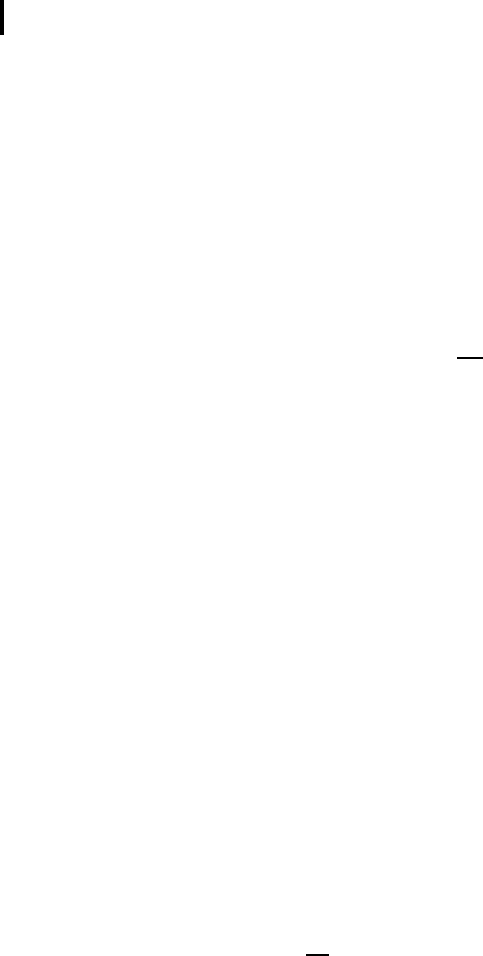
N
α
(k) = f
0
[ω(k)] ; f
0
(ω)=
exp
¯hω
T
−1
−1
, (6.2.7)
where the brackets ... denote averaging in the equilibrium thermodynamic state
and the temperature T here and below is given in units of energy.
A simple form of the Hamiltonian (6.2.5) and the Bose-type distribution (6.2.7)
allow one easily to construct the thermodynamics of a weakly excited crystal. If me-
chanical atomic vibrations exhaust all possible forms of internal motions in a crystal
(6.2.3) determines the total crystal energy whose mean value coincides with the inter-
nal energy. If there are other forms of motion in a crystal (electron motion, change
of spin magnetic moment or similar) (6.2.3) gives only a so-called lattice part of the
crystal energy. In the latter case all results below listed results can be applied only
when the phonon interaction with elementary excitations of the other types is very
weak.
6.3
Quantum-Mechanical Definition of the Green Function
The initial definition of the Green function used in quantum theory differs at first sight
from that accepted in Chapter 4. Nevertheless, it leads to the same properties of the
Green function. We illustrate this by considering an example of the Green retardation
function and restrict ourselves to a scalar model.
The quantum-mechanical expression for the Green retardation function is
G
R
(n − n
)=−
im
¯h
Θ(t)
u(n, t), u(n
, t)
, (6.3.1)
where u(n, t) is the atomic displacement operator at time t; Θ(t) is the discontinuous
unit Heaviside function
Θ(t)=
0, t < 0
1, t > 0.
The presence of the function Θ(t) in (6.3.1) is connected with the singularity of the
Green retarding function shown, e. g., in (4.6.5). It is necessary to recall the proce-
6.3 Quantum-Mechanical Definition of the Green Function
173
dures used to determine the operators u(n, t) in (6.3.1). Since the time dependence of
the operator u( n) is described by
−i¯h
du
dt
=[H, u] , (6.3.2)
where H is the Hamiltonian of crystal vibration s, one can, generally, write
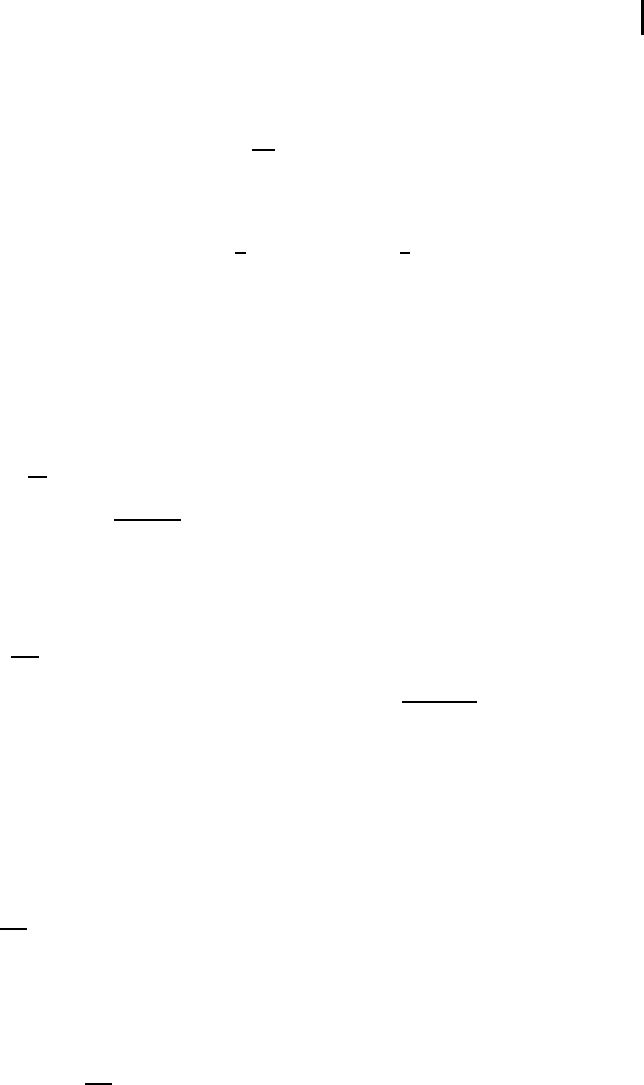
u(t)=exp
i
¯h
Ht
u(0) exp
−
i
¯h
Ht
.
Since the operator u(0) does not commute with H, it follows that for t = 0 it does
not commute with the operator u(t). However, in general
[u(n, t), u(n
, t)] = [u(n,0), u(n
,0)] = 0. (6.3.3)
We take the time derivative of (6.3.1):
i¯h
d
dt
G
R
(n − n
, t)=mδ(t)
u(n, t), u(n
,0)
+Θ(t)
m
du(n, t)
dt
, u(n
,0)
= Θ(t) [p(n , t), u(n
,0)].
(6.3.4)
We have used (6.3.3) when writing (6.3.4) and introduced the momentum operator
p(n)=mdu(n)/dt. L et us differentiate the obtained relation with respect to time
i¯h
d
2
dt
2
G
R
(n − n
, t)
= δ(t) [p(n,0), u(n
,0)] + Θ(t)
m
d
2
u(n, t)
dt
2
, u(n
,0)
.
As the operato rs u(n) and p(n ) taken at the same time are canonically conjugated,
then
[p(n,0), u(n
,0)] = −i¯hδ
nn
. (6.3.5)
On the other hand, the operator d
2
u/dt
2
can be expressed through the operator
u(n, t) by means of (4.5.1). By using this equation and (6.3.5), we obtain
i¯h
d
2
dt
2
G
R
(n − n
, t)
= −i¯hδ(t)δ
nn
−
∑
n
α(n − n
)Θ(t)
u(n
, t), u(n
,0)
.
(6.3.6)
Recalling the definition (6.2.7), we come to the following equation for the function
G
R
(n, t):
m
d
2
dt
2
G
R
(n, t)+
∑
n
α(n − n
)G
R
(n
, t)=−mδ(t)δ
n0
, (6.3.7)
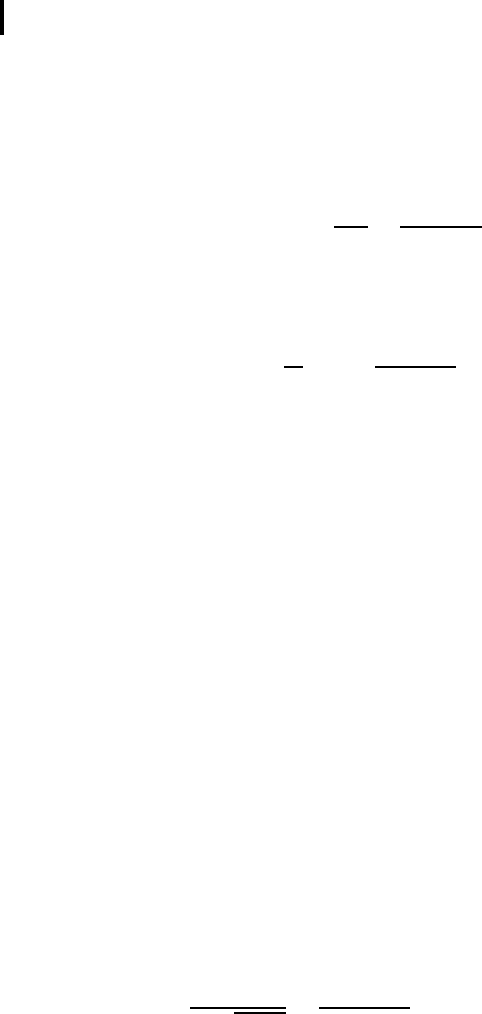
which is exactly the same as (4.5.5).
174
6 Quantization of Crystal Vibrations
Let us verify by means of a direct calculation that the Green function (6.3.1) actu-
ally determines a retarded solution to (6.3.7) with the Fourier components (4.6.5). We
expand the displacements in (6.3.1) in normal vibrations, introducing the phonon cre-
ation and annihilation operators and taking into account their commutation relations
as well as the time dependence (6.1.19). The following formula is then easily obtained
u(n, t), u(n
,0)
= −
i¯h
mN
∑
k
sin ω(k)t
ω(k)
e
ikr (n−n
)
. (6.3.8)
Furthermore, (6.3.8) for t = 0 justifies the rule (6.3.3).
Substituting (6.3 .8) into (6.3.1) we write
G
R
(n, t)=−
1
N
∑
k
Θ(t)
sin ω(k)t
ω(k)
e
ikr (n−n
)
.
The latter has the form of a spatial Fourier expansion of the Green functio n with
Fourier components (4.6.5).
We emphasize the fact that (6.3.8) is valid for any vibrational crystal state. Thus,
the averaging contained in the definition (6.3.1) can be carried out both in the sense of
quantum mechanics and thermodynamics.
6.4
Displacement Correlator and the Mean Square of Atomic Displacement
The quan tum defin ition of the Green function ( 6.3.1) involves averages such as
u(n, t)u(n
,0), determining the correlation of atomic displacements at different
crystal lattice sites. Some physical properties of the crystal are generated by this
correlator. A pair correlation function of displacements (or simply a pair correlator)
will be referred to as the average
Φ
jl
ss
(n − n
, t)=u
j
s
(n, t)u
l
s
(n
,0), (6.4.1)
where both the spatial homogeneity of an unbounded crystal and time uniformity are
taken into account.
Using (6.1.16), we go over from the displacements to the operators a
α
(k) , a
†
α
(k)
and use the properties of their mean values and also of the polarization vectors
Φ
jl
ss
(n, t)=
¯h
2N
√
m
s
m
s
∑
αk
e
j
s
(α)e
j
s
(α)
ω
α
N
α
(k)e
iω
α
t−ikr (n)
+(N
α
(k)+1) e
−iω
α
t+ikr (n)
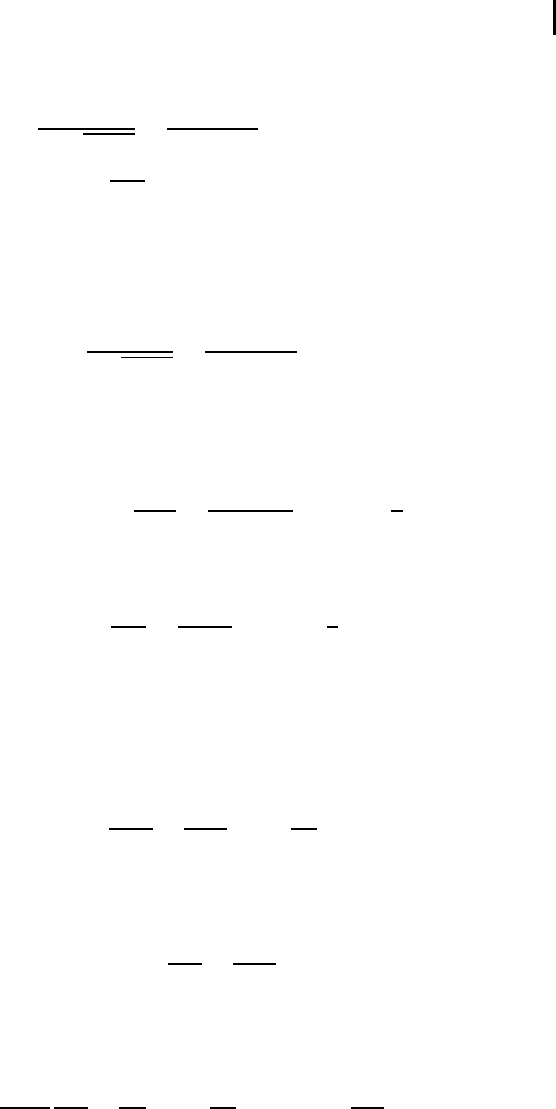
,
(6.4.2)
where ω
α
= ω
α
(k) and e(α)=e(k, α)=e(−k, α).
6.4 Displacement Correlator and the Mean Square of Atomic Displacement
175
After thermodynamic averaging when N(k) is determined by (6.2.7), we obtain
Φ
jl
ss
(n, t) =
¯h
2N
√
m
s
m
s
∑
αk
e
j
s
(α)e
l
s
(α)
ω
α
×
coth
¯hω
α
2T
cos [ω
α
t − kr(n)] − i sin [ω
α
t − kr(n)]
.
(6.4.3)
It is clear that the correlation function is complex. The availability term in (6 .4.3) is
of quantization origin. Indeed, in the classical limit ¯h → 0 when ¯h coth(¯hω/2 T) →
(2T/ω), there remains
Φ
jl
ss
(n, t) =
T
N
√
m
s
m
s
∑
αk
e
j
s
(α)e
l
s
(α)
ω
2
α
cos[ ω
α
t − kr (n)].
It follows from the definitio n ( 6.4.1) and the relation (6.4.2) that the mean square
of atomic displacement at any site (independent, naturally, of the site number) equals
Φ
ll
ss
(0, 0):
u
2
s
(n) = u
2
s
=
¯h
m
s
N
∑
αk
|e
s
(k, α)|
2
ω
α
(k)
N
α
(k)+
1
2
. (6.4.4)
In a monatomic crystal lattice there is no index s, so that o ne can use the relation
(1.3.2) leading to
u
2
=
¯h
mN
∑
αk
1
ω
α
(k)
N
α
(k)+
1
2
. (6.4.5)
To characterize the atomic displacements in the excited crystal states it is reasonable
to consider the mean thermodynamic values of the displacement squares at nonzero
absolute temperature T of the crystal. The averaging (6.4.5) over the phonon equi-
librium distribution and performing an integration over frequencies gives the mean
square of thermal atomic displacements in a monatomic lattice
u
2
=
¯h
2mN
ν(ω)
ω
coth
¯hω
2T
dω. (6.4.6)
The expression (6.4.6) is much simplified at high temperatures when the r atio T/¯h
is much higher than all possible frequencies of crystal vibrations, i. e., T ¯hω.
Indeed, in this case
u
2
=
T
mN
ν(ω)
ω
2
dω. (6.4.7)
A simple (linear) temperature dependence of the mean square of atomic displace-
ment at high temperatures remains in a polyatomic lattice, but the expression for u
2
becomes much more complicated. It follows from (6.4.4) that
u
2
=
V
0
(2π)
3
¯h
2m
s
dω
ω
coth
¯hω
2T
∑
α
ω
α
(k)=ω
dS
α
v
|e
s
(k, α)|
2
,

176
6 Quantization of Crystal Vibrations
where the last integral is calculated over the isofrequency surface of the α-th branch
of vibrations: ω
α
(k)=ω = const.
The dependence of the mean square of atomic displacement on the crystal dimen-
sion is of interest. In a 3D cry stal, for ω → 0 the frequency distribution function
vanishes according to ν(ω) ∼ ω
2
. Thus, the integrals in (6.4.6), (6.4.7) for a 3D
crystal are finite.
In a 2D crystal ν(ω) ∼ ω, and the integral (6.4.7) as well as (6.4.6) for T = 0
diverge logarithmically at the low limit. Consequ ently, the value of the mean thermal
atomic displacement becomes arbitrarily large. It may be said that the thermal fluctu-
ations destroy the long-range order in an unbounded 2D crystal. We stipulate that the
crystal is unbounded for the following reason. If we exclude from our treatment rigid-
body translation of the crystal (k = 0), the minimum value k
min
according to (2.5.3)
can be estimated to be the order of magnitude k
min
∼ π/L where L is the crystal
dimension. Thus, ω
min
∼ Sπ/L ∼ ωma/L and the logarithmic divergence of the
above integrals for a 2D crystal means that u
2
∝ ln(L/a). This is a rather weak
dependence on L , and the general condition that the crystal specimen is macroscopic
(L a) is insufficient to assume large fluctuations. An extremely rapid increase of
the fluctuations takes place only for ln(L/a ) 1, i. e., in fact for an unbounded
crystal.
If T = 0 the integral (6.4.6) remains finite. In other words, zero vibrations do not
break the long-range order in a 2D crystal.
Finally, for a 1D crystal ν(0) = 0. Hence, the integral (6.4.6) diverges at any
temperature – the mean atomic displacement value is infinite. Thus, the long-range
order in a 1D crystal is b roken both by thermal and zero vibrations. The absence of a
Plank constant in (6.4.7) makes it possible to conclude that at high temperatures the
quantization of vibrations is not essential and to describe the averaged atomic motions
in the lattice one can use the classical representations.
6.5
Atomic Localization near the Crystal Lattice Site
At the end of the previous section the mean square of an atomic displacement from
equilibrium was calculated. However, a detailed description of localized atomic mo-
tion in the crystal is given by the distribution f unction of its coordinate, i. e., the prob-
ability density of the random value u
S
(n) .
Let the function P(u)du determine the probability for u to be in the interval (u, u +
du) for du → 0. We consider the Fourier transformation o f the function P(u) that is
sometimes called the characteristic function
σ(g)=
∞
−∞
P(u)e
igu
du, P(u)=
1
2π
∞
−∞
σ(g)e
−igu
dg. (6.5.1)

6.5 Atomic Localization near the Crystal Lattice Site
177
From the definition of P(u),thevalueσ(q) represents the mean value of the
function exp(iqu). If we now assume that P( u) gives the density of a thermody-
namic probability in a system with a given temperature then it is possible to write
σ(q)=exp(iqu).
We begin by analyzing a scalar crystal model and suppose that the random value u
is the atomic displacement relative to the site with number n:
σ(g)=exp[igu(n)]. (6.5.2)
It is clear that the average (6.5.2) is independent of the site number. Therefore, we
may set n = 0, combining the site chosen with the coordinate origin.
Let us calculate the average (6.5.2) in the occupation-number representation. We
go over in (6.5.2) to the phonon creation and annihilation operators, writing
gu(0)=
∑
k
C(k)a
k
+ C
∗
(k)a
†
k
, (6.5.3)
where the number function C(k) is real in the given case
C(k)=g
¯h
2mNω(k)
. (6.5.4)
Since the operators a
k
and a
†
k
with different k commu te, (6.5 .2 ) can be written in
a harmonic approximation as a product of the multipliers that contain the averaging
over states of one of the normal coordinates. Indeed, the Hamiltonian (6.1.9) is the
sum of independent operators with different k and, thus
σ(g)=
∏
k
e
i[C(k)a
k
+C
∗
(k)a
†
k
]
. (6.5.5)
To estimate this value we use a simple method. We take into account that in accor-
dance with (6.5.4), a ll coefficients C(k) are proportional to 1/
√
N, and for a macro-
scopic crystal N is extremely large. Proceeding from this, we expand the exponent in
(6.5.5) as a power series of C(k), up to terms of the third order of smallness. We then
remember that nonzero diagonal elements can be present only in the products of an
even number of operators a
k
and a
†
k
σ(g)=
∏
k
1 −
1
2
|C(k)|
2
a
†
k
a
k
+ a
k
a
†
k
=
∏
k
1 −
1
2
|C(k)|
2
2N
k
+ 1
=
∏
k
1 −
1
2
|C(k)|
2
coth
¯hω(k)
2T
.
(6.5.6)
Using now the equality
lim
N→∞
N
∏
n=1
1 −
1
N
ξ
n
= exp
− lim
n→∞
1
N
N
∑
n=1
ξ
n
,
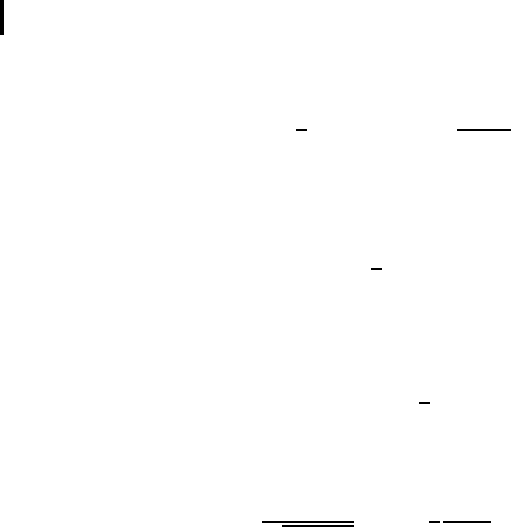
178
6 Quantization of Crystal Vibrations
we transform the product (6.5.6) into the sum
σ(g)=exp
−
1
2
∑
k
|C(k)|
2
coth
¯hω(k)
2T
. (6.5.7)
We substitute into (6.5.7) the explicit expression (6.5.4) and compare the exponent
(6.5.7) with (6.4.5) for a scalar model. It is clear that
σ(g)=exp
−
1
2
g
2
u
2
. (6.5.8)
Although we derived (6.5.8) with respect to a scalar model, after obvious general-
ization it remains valid for any cry stal lattice:
σ(g)=e
igu
s
(n)
= exp
−
1
2
(gu
S
)
2
. (6.5.9)
Thus, the quantity u
j
(n) has the Gaussian probability density
P(u)=
1
2πu
2
j
exp
−
1
2
u
2
u
2
j
. (6.5.10)
In a classical theory of the crystal lattice, this result was obtained by Debye (1914)
and Wailer (1925); the quantum derivation was first made by Ott (1953).
The probability density of an atomic displacement from its crystal lattice site is
strongly temperature dependent, since u
2
is a function of temperature. The most
remarkable fact here is that the atom exhibits an ap preciable probability to be dis-
placed from its equilibrium position even at T = 0 K due to the zero vibrations. Thus,
although the energy of zero vibrations may not be manifest, the zero motion associated
with it is accessible to observation.
6.6
Quantization of Elastic Deformation Field
In studying classical mechanics of a crystal lattice, it has been established that in the
long-wave limit (ak 1) the equations of crystal motion transform into the dynamic
equations of elasticity theory. Such a transition corresponds formally to the limit
a → 0 and establishes a relation between the mech anics of a (crystal) discrete system
and that of a continuous medium (continuum).
On the other hand, the quantum equations for crystal motion transform into the
classical dynamic equations by passing to the limit ¯h → 0 (if α = const). We clarify
whether the limiting transition α → 0 (if ¯h = const) is meaning ful, as the lattice
constant a and the Planck constant ¯h are considered in the crystal quantum theory as
two independent parameters.