
Kosevich A.M. The crystal lattice
Подождите немного. Документ загружается.

6.6 Quantization of Elastic Deformation Field
179
The transition from the q uantum mechanics of a discrete crystal lattice to the quan-
tum field theory of elastic deformations can be carried out using a scalar crystal model.
This allows one to exclude cumbersome expressions and calculations that refer to a
vector quantum field.
A classical field of elastic deformations is the field of the function of coordinates
and time u( r, t). The Lagrange function of this field is given by (2.9.20) and corre-
sponds to the following density of the Lagrange function
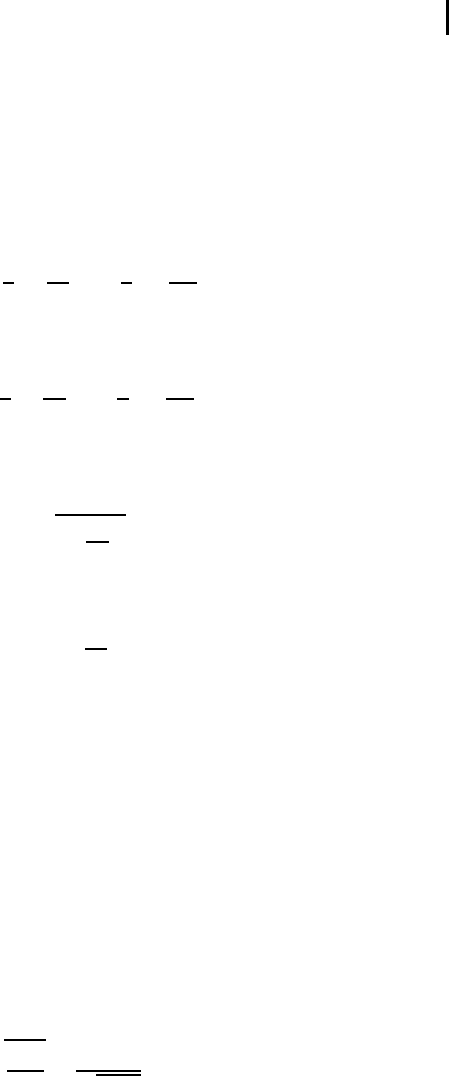
L =
1
2
ρ
∂u
∂t
2
−
1
2
G
∂u
∂x
i
2
. (6.6.1)
It is easy to write the energy of a classical elastic field as
E =
1
2
ρ
∂u
∂t
2
+
1
2
G
∂u
∂x
i
2
dV . (6.6.2)
We also find the momentum of the deformation field. By definition, the field mo-
mentum
P = −
∂L
∂
∂u
∂t
grad udV, (6.6.3)
and this d efinition is independent of a specific form of the Lagrang e function density.
Using (6.6.1) we obtain
P = −
ρ
∂u
∂t
grad udV. (6.6.4)
We note that the field momentum (6.6.4) does not coincide with the momentum of
atoms involved in motion by elastic crystal vibrations. Indeed the momentum (6.6.4),
as well as the energy (6.6.2) and the Lagrange function (2.9.20) in the harmonic ap-
proximation is quadratic in the d erivatives of the function u, and the momentum of the
atoms is proportional to the first degree of atomic velocity and is, thus, linear in the
time derivatives of the atomic displacement vector.
According to the results of quantizing crystal lattice motio n in quantum m echanics,
the function u(r) is replaced by an operator dependent on coordinates as on parame-
ters. The occupation number representation is the simplest way to write this operator,
since we know its expansion (6.1.15) in the lattice.
If we take explicitly into account the finite dimensions of the volume V, then the
formula (6.1.15) may also be used in the case of an elastic deformation field by replac-
ing mN → ρV and assuming the radius vector r = r(n) to be a continuously varying
quantity:
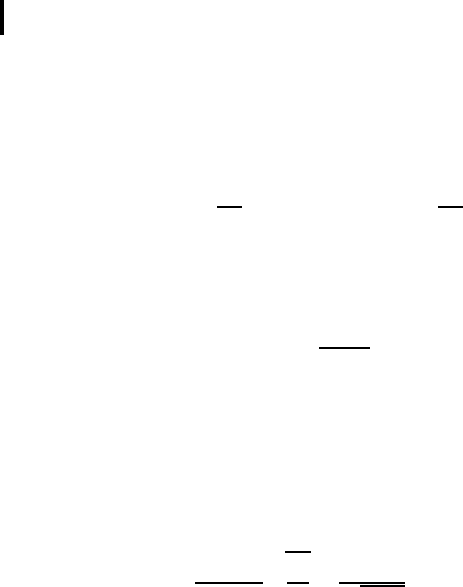
u(r)=
¯h
2ρV
∑
k
1
ω(k)
(a
k
+ a
†
−k
)e
ikr
, (6.6.5)
where the operators a
k
and a
†
k
obey the commutation relations (6.1.8).
180
6 Quantization of Crystal Vibrations
The expansion (6.6.5) is usually performed not in a finite volume, but in all coor-
dinate space, (V → ∞), which results in a continuous k -space. In this case, instead
of the sum over discrete k in (6.6.5), it is necessary to introduce an integral, using the
rule (2.5.4), and to redefine the phonon creation and annihilation operators
a
k
=
2π
L
3/2
b(k), a
†
k
=
2π
L
3/2
b
†
(k) (6.6.6)
(wehavedenotedV = L
3
). Simultaneously it is necessary to replace the Kronecker
symbol in (6.1.8) by the δ-function
δ
kk
→
(2π)
3
V
δ(k − k
).
The operators b(k) and b
†
(k) have commutation relations that directly generalize
(6.1.8)
[b(k), b
†
(k)] = δ(k − k
), [b(k), b(k
)] = [b
†
(k) , b
†
(k
)] = 0. (6.6.7)
On performing the above renormalization, we obtain
u(r)=
1
(2π)
3/2
¯h
2ρ
d
3
r
ω(k)
[b(k)+b
†
(−k)]e
ikr
. (6.6.8)
As a result of the quantization, the field function u(r, t ) describing the elastic dis-
placements of atoms and satisfying the dynamic equation (2.9.21) is represented as an
integral of linear form in the operators b(k) and b
†
(k) . Thus, it becomes an operator.
The time evolution of the operator u(r, t) is d etermined by the time dependence of
the operators b(k) and b
†
(k) , and the latter in a harmonic approximation is based on
the relations
b
k
(t)=b
k
(0)e
−iω(k)t
, b
†
k
(t)=b
†
k
(0)e
iω(k)t
,
where ω(k)=sk.
Using (6.6.8) and the expressions for the energy (6.6.2), it is easy to construct the
Hamiltonian of a vibrating continuum
H = E
0
+
¯hskb
†
(k)b( k) d
3
k, (6.6.9)
where E
0
is the energy of zero vibrations.
The eigenstates of the operator (6.6.9) contain quanta (phonons) with rigorously
fixed quasi-momenta. The wave functions of these states in the coordinate represen-
tation correspond to plane waves.
6.6 Quantization of Elastic Deformation Field
181
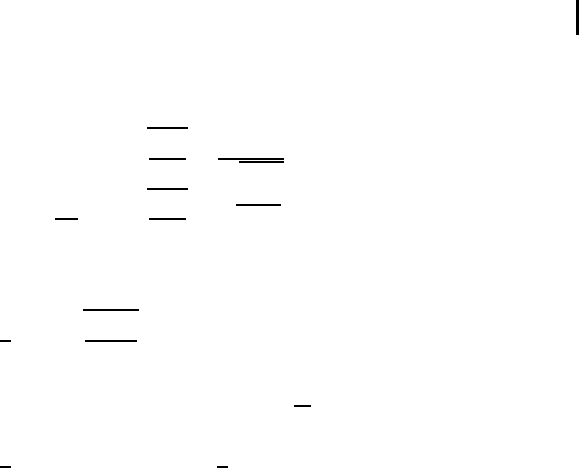
We shall clarify ultimately the q uantum meaning of the field momentum operator
(6.6.3) or ( 6.6.4). We calculate the spatial and time derivatives of (6.6.5)
grad u = i
¯h
2ρV
∑
k
k
ω(k)
a
k
+ a
†
−k
e
ikr
;
∂u
∂t
= i
¯h
2ρV
∑
k
ω(k)
a
†
−k
− a
k
e
ikr
.
(6.6.10)
We substitute (6.6.10) into (6.6.4)
P =
1
2
∑
kk
¯hk
ω(k)
ω(k
)
a
†
−k
− a
k
a
k
+ a
†
−k
×
1
V
∞
−∞
e
i(k+k
)r
dV
=
1
2
∑
k
¯hk
a
k
a
†
k
+ a
†
k
a
k
+
1
2
∑
k
¯hk
a
†
−k
a
†
k
+ a
k
a
−k
.
(6.6.11)
The last sum in (6.6.11) vanishes, as its terms are the odd functions of k,andthe
first sum transforms trivially
P =
∑
k
¯hka
†
k
a
k
=
¯hkb
†
(k)b( k) d
3
k. (6.6.12)
It follows from (6.6.12) that the operator of the field momentum P is the operator
of the total quasi-momentum of a vibrating crystal.
Writing the operators (6.6.8), (6 .6 .9), (6.6.12) and also the commutatio n rules
(6.6.7) accomplishes the quantization of a field of elastic deformations.

7
Interaction of Excitations in a Crystal
7.1
Anharmonicity of Crystal Vibrations and Phonon Interaction
In a harmonic approximation the phonons are noninteracting quasi-particles. How-
ever, the situation is changed if the anharmonicity of crystal vibrations is taken into
account – the phonon gas ceases to be ideal.
To clarify the qualitative role of the anharmonicity, we consider an unbounded crys-
tal with a monatomic spatial lattice. We assume the anharmonicity to be small and in
the expansion of the potential crystal energy in power of the displacement, we restrict
ourselves to cubic terms:
U = U
0
+
1
2
∑
α
ik
(n − n
)u
ik
(n)u
k
(n
)
+
1
3
∑
˜
S
γ
ikl
(n − n
, n −n
)
u
i
(n) − u
i
(n
)
×
u
k
(n) − u
k
(n
)
u
l
(n
) −u
l
(n
)
,
(7.1.1)
where
˜
S is the symm e trization operation in number vectors n, n
, n
. This takes into
account at once the potential energy invariance with respect to crystal motion as a
whole. The coefficients γ
ikl
(n, n
) characterize the intensity of the cry stal vibration
anharmonicity. Generally, they are of the order of magnitude γ ∼ α/a.
After introducing normal coordinates and quantizing the vibrations, the quadratic
term in (7.1.1) will belong to the Hamiltonian of the phonon ideal gas. The cubic
term in (7.1.1) will be quantized by (6.1.16). Denoting the corresponding term in the
The Crystal Lattice: Phonons, Solitons, Dislocations, Superlattices, Second Edition. Arnold M. Kosevich
Copyright
c
2005 WILEY-VCH Verlag GmbH & Co. KGaA, Weinheim
ISBN: 3-527-40508-9
184
7 Interaction of Excitations in a Crystal
Hamiltonian by H
int
, we obtain
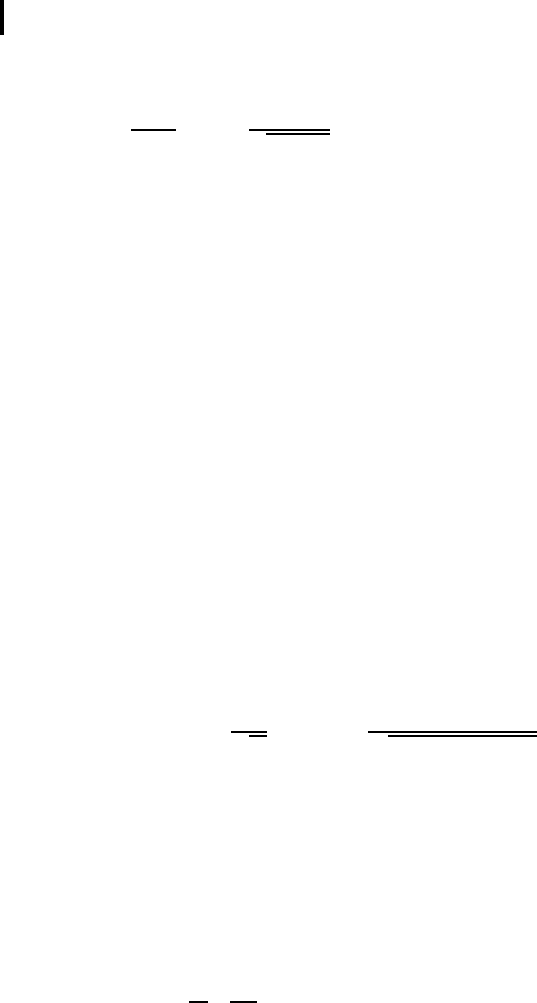
H
int
=
¯h
2mN
3/2
∑
e
i
e
j
e
l
√
ωω
ω
Γ
ijl
(k, k
, k
)
a
α
(k)+a
†
α
(−k)
×
a
α
(k
)+a
†
α
(−k
)
a
α
(k
)+a
†
α
(−k
)
∑
n
e
i(k+k
+k
)r(n)
,
(7.1.2)
where ω = ω
α
(k) , ω
= ω
α
(k
), ω
= ω
α
(k
), e = e
α
(k) , e
= e
α
(k
),
e
= e
α
(k
). The tensor function Γ
ijl
(k, k
, k
) is defined by the double sum over
the sites
Γ
ijl
(k, k
, k
)=
˜
S
∑
n, n
γ
ijl
(n, n
)
1−e
−ikr
1−e
−ik
r
e
−ik
r
−e
−ik
r
,
where r
= r(n
) and the symmetrization is performed in quasi-wave vectors
k, k
, k
.
If one takes the Hamiltonian (7.1.2) into account in deriving the equations of mo-
tion for the operators a
k
and a
†
k
, then instead of a system of separable equations for
individual phonons such as (6.1.18), we get a nonlinear system of “coupled” equa-
tions that will relate the evolution of the phonon in the state ( αk), with the evolution
of the remaining phonons in the other states. As a result, the operator H
int
can be
regarded as the phonon interaction operator. Thus, the phonon interaction displays the
anharmonicity of crystal vibrations.
Let us note that the last multiplier in (7.1.2) is nonzero and equals N only for
k + k
+ k
= G,whereG is any reciprocal lattice vector. Thus, (7.1.2) can be
written as
H
int
=
1
√
N
∑
k+k
+k
=G
V(k, k
, k
)
ω(k)ω( k
)ω(k
)
×(a
k
+ a
†
−k
)(a
k
+ a
†
−k
)(a
k
+ a
†
−k
),
(7.1.3)
where for simplicity, we omit the indices that number the branches of vibrations over
which the summation should also be performed.
In (7.1.3), a new notation is used
V(k, k
, k
) ≡ V
αα
α
(k, k
, k
)
=
1
N
¯h
2m
3/2
e
i
α
(k)e
j
α
(k
)e
l
α
(k
)Γ
ijl
(k, k
, k
).
(7.1.4)
The summation in (7.1.3) is carried out under the condition
k + k
+ k
= G, (7.1.5)

7.1 Anharmonicity of Crystal Vibrations and Phonon Interaction
185
and since each of the vectors k, k
,andk
does not go beyond the unit cell then (7.1.5)
reduces to the two alternative conditions
k + k
+ k
= 0, (7.1.6)
k + k
+ k
= G
0
, (7.1.7)
where G
0
is a vector that can be only composed of the three fundamental vectors of a
reciprocal lattice b
1
, b
2
and b
3
.
If the phonon interaction takes place under the condition (7.1.6), it is called a normal
collision (or N-process). If the condition (7.1.7) is satisfied, the interaction is called
an anomalous collision or an umklapp process (U-process, from the German word
Umklappprozess).
Let us note a remarkable feature of the coefficients V(k, k
, k
) in the interac-
tion Hamiltonian (7.1.3), associated with their behavior at small values of quasi-wave
vectors. It follows from the definition (7.1.5) that a func tion of three independent vari-
ables V(k, k
, k
) vanishes if at least one of these variables tends to zero. For ak 1
this function can be represented in the form
V
αα
α
(k, k
, k
)=e
i
α
(k)e
j
α
(k
)e
l
α
(k
)M
npq
ijl
k
n
k
p
k
q
, (7.1.8)
where M is some tensor coefficient.
In other words, for k, k
, k
→ 0 we have
V(k, k
, k
) ∼ kk
k
∼ ωω
ω
. (7.1.9)
Such a behavior of the corresponding matrix elements in the long-wave limit is
quite natural. Indeed, in view of the limit k → 0, for estimations one can make use
of the results o f elasticity theory. However, in elasticity theory the crystal energy is
expressed through the strain tensor. The cubic anharmonicity corresponds to terms
of third order in d eformations in the elastic energy. T he d eformation tensor for a
plane wave of displacements can be estimated as ε
ij
∼∇
i
u
j
∼ k
i
u
j
. Thus, the cubic
anharmonicity is characterized by an intensity (7.1.9) at small k. This property of
the quantities V(k, k
, k
) is used essentially in evaluating the contribution of the
vibration anharmonicity to the different macroscopic characteristics of the crystal.
We denote temporarily a
−
(k)=a (k) and analyze the characteristic product of the
phonon creation and annihilation operators that enters into the Hamiltonian (7.1.3),
just a product of the type
a
±
α
(k)a
±
α
(k
)a
±
α
(k
). (7.1.10)
It follows from (6.1.21) that the nonzero matrix elements of the operator (7.1.10)
are proportional to the multiplier exp(± iωt ± iω
t ± iω
t), whereas before, ω =
ω(α, k); ω
= ω(α
, k
); ω
= ω(α
, k
).
186
7 Interaction of Excitations in a Crystal
If we now calculate by perturbation theory the probability of a corresponding colli-
sion using the matrix element of the operator (7.1.10), then it will be proportional to
the δ-function
δ(±ω ± ω
± ω
). (7.1.11)
The signs in (7.1.11) correspond to the ± signs in (7.1.10).
Let us consider for instance the term in H
int
proportional to the operator
a
†
(α, k)a
†
(α
1
, k
1
)a(α
2
, −k
2
). This term describes the two-phonon creation pro-
cess in the states (α, k)and(α
1
, k
1
) and phonon vanishing in the state ( α
2
, −k
2
). It
gives nonzero probability under the condition
ω(α, k)+ω(α
1
, k
1
)=ω(α
2
, k
2
),
which is equivalent to the energy conservation under the collision
¯hω(α, k)=¯hω(α
1
, k
1
)+¯hω(α
2
, k
2
). (7.1.12)
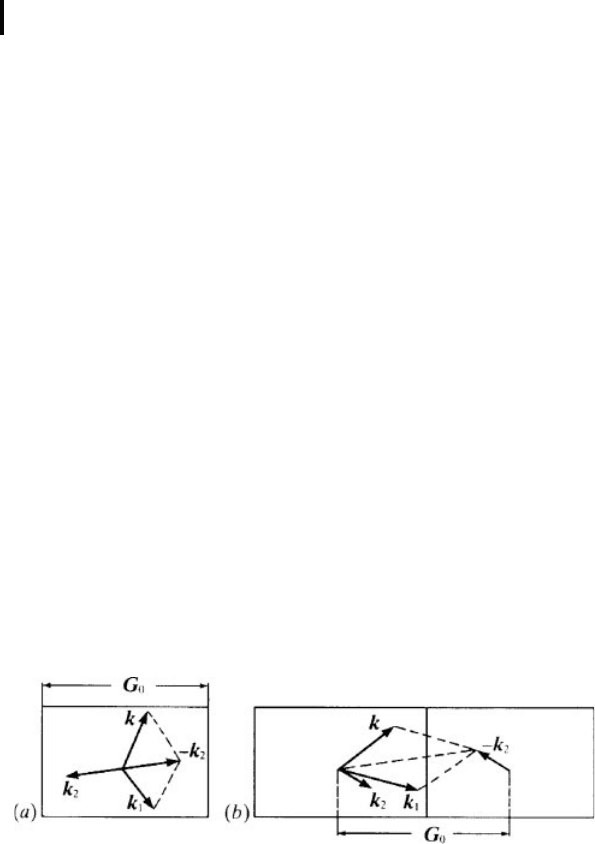
By virtue o f the conditions (7.1.4) and relation (6.2.4) the collision occurs either
with total quasi-momentum conservation (N-process, Fig. 7.1a)
p + p
1
= p
2
, (7.1.13)
or when the quasi-momentum of “the phonon center of gravity” changes by ¯hG
0
(U-
process, Fig. 7.1b)
p + p
1
= p
2
+ ¯hG
0
. (7.1.14)
Fig. 7.1 Three-phonon processes: (
a
) is the normal process, (
b
)isthe
umklapp process.
The term with the ope rator a
†
k
a
−k
a
−k
in the interaction Hamiltonian h a s an anal-
ogous meaning.
7.2
The Effective Hamiltonian for Phonon Interaction and Decay Processes
The term H
(3)
int
(cubic in anharmonicity and describing the phonon interaction) present
in the crystal Hamiltonian affects both the dynamics of separate quasi-particles and the

7.2 The Effective Hamiltonian for Phonon Interaction and Decay Processes
187
equilibrium properties of a phonon gas. In particular, the crystal energy cannot now
be represented as (6.2.3). However, if the anharmonicity is small, it can be taken into
account by perturbation theory in calculating the crystal energy. Small corrections to
the energy are generally expressed through the displacements of the eigenfrequencies
of crystal vibrations. However, when they are calculated consecutively, it is impossible
to confine oneself only to cubic anharmonicity.
Indeed, for the Hamiltonian (7.1.3) we have
H
(3)
int
= 0. (7.2.1)
Thus, when taking cubic anharmonicity into account only, the correction to the first
order of perturbation theory is absent. The frequency shift can be obtained in second-
order perturbation theory only, but the neglected fourth-order terms in the expansion
of th e displacement energy would lead to the interaction Hamiltonian H
(4)
int
involving
the products of four operators a
k
and a
†
k
of the type a
±
1
a
±
2
a
±
3
a
±
4
. Thus,
H
(4)
int
= 0
and the corresponding anharmonicity would result in the frequency renormalization
just in the first order o f pe rturbation theory. It turns out that the corrections to the
energy in first-order perturbation theory coming from H
(4)
int
are generally of the same
second-order corrections coming from H
(3)
int
.
In this situation, it makes no sense to calculate the eigenfrequency shift with the
Hamiltonian (7.1.3). We only note that in calculating a similar shift in the second-
order perturbation theory, all terms of the Hamiltonian (7.1.3) make nearly the same
contribution to the final result. This is so because the virtual transitions in a system
for which the phonon energy conservation law should not necessarily be satisfied are
taken into account in the second-order perturbation theory. When real collisions of
phonons conserving their energy are described the situation appears to be different.
Since we have defined the frequency ω = ω(α, k) as a positive quantity, the δ-
function (7.1.11) may be nonzero only if the terms in its argument have different
signs. Hence it follows that to describe real phonon collisions in a crystal with small
anharmonicity (7.1.3), one can introduce a simpler effective interaction Hamiltonian.
Indeed, if we restrict ourselves to the basic terms of the phonon interaction energy and
use the first-order perturbation theory approximation (when real scattering processes
are considered), we can omit in the Hamiltonian H
int
the terms involving the products
of the operators a
k
a
k
a
k
and a
†
k
a
†
k
a
†
k
. The remaining terms, by a simple replacement
of the summation indeces, can be written in the form
H
ef
int
=
1
√
N
∑
W(k, k
, k
)
√
ωω
ω
(a
†
k
a
†
k
a
−k
+ a
†
k
a
−k
a
k
), (7.2.2)
where the coefficients W(k, k
, k
) differ from the V(k, k
, k
) in numerical multipli-
ers only, the summation is performed over the quasi-wave vectors under the condition
(7.1.4) and the indices that numb er the vibration branche s are omitted.

188
7 Interaction of Excitations in a Crystal
The permutation of the operators a
†
k
and a
k
in deriving (7.2.2) gives no additional
terms in H
ef
int
, since the latter vanish by virtue of the conservation law (7.1.6) a nd the
property (7.1.9) of the function V(k, k
, k
).
We analyze the probability of the elementary process described by the Hamiltonian
(7.2.2) by focusing on the long-wave acoustic phonons (ak 1). We note that if the
long-wave phonons only participate in the collision, the process is normal. Thus, we
shall first be interested in the probability of normal “three-phonon” processes.
Similar processes take p lace when the conservation laws (7.1.6), (7.1.12) are obeyed
k
1
= k
2
+ k
3
; ω(α
1
, k
1
)=ω(α
2
, k
2
)+ω(α
3
, k
3
). (7.2.3)
To clear up whether all conditions (7.2.3) can be satisfied simultaneously, in particu-
lar, whether a quite definite phonon (α, k) always vanishes (decays) with an arbitrar-
ily small cubic anharmonicity, we discuss this problem qualitatively. For long-wave
phonons, it suffices to consider the approximation where the dispersion laws are al-
most the same as for sound
ω
α
(k)=s
α
k, α = 1, 2, 3. (7.2.4)
In such an approximation “longitudinal phonons” (l) exist whose dispersion law is
close to the isotropic one (s
l
=constant) and “transverse” phonons (t) whose velocities
satisfy the relation
s
t
< s
l
. (7.2.5)
Indeed, the true dispersion law differs insignificantly from (7.2.4) even for small k.
For the longitudinal phonons, as a rule, ω
l
(k) < s
1
k. Thus, for the process involving
only the longitudinal phonons, (7.2.3) cannot be satisfied simultaneously. For phonons
of the same type in the isotropic model from (7.2.3), (7.2.4) it follows that |k
1
+ k
2
| =
k
1
+ k
2
. Thus, when the isotropic dispersion law (7.2.4) is obeyed, the process we are
interested in would occur only in the case of parallel vectors k
1
, k
2
, k
3
. We use this
fact to elucidate the possibility of longitudinal phonon decay in a one-dimensional
process.
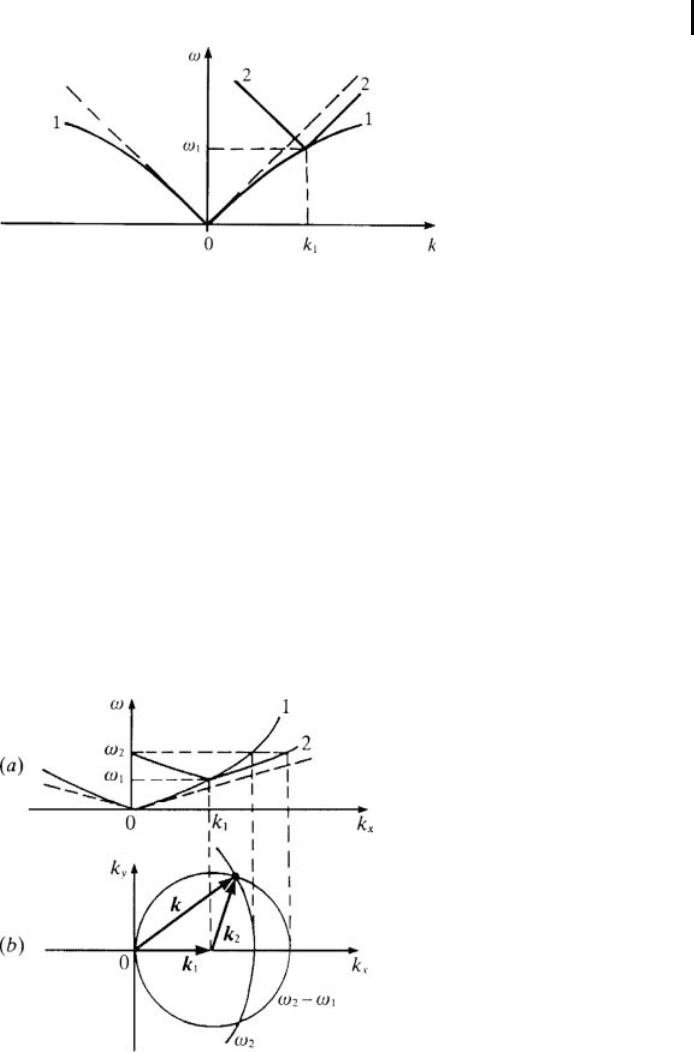
The dispersion law for longitudinal phonons is given by curve 1 in Fig. 7.2. We
show the point (k
1
, ω
1
) corresponding to the state of one of the phonons after the de-
cay. Taking this point as the reference frame origin, starting at this point we construct
the curve 2 for the same dispersion law of the second phonon after the decay. To sat-
isfy (7.2.3), curves 1 and 2 should intersect and the intersection point will determine
the state of a decaying phonon (k
2
, ω
2
). These curves, however, do not intersect at
small k and hence, the process l → l + l is impossible. In a scalar model (for the same
type of phonons) the dispersion law analyzed would be nondecaying.
The conclusion about the nondecaying character of the dispersion law with the
property (∂
2
ω/∂k
2
) < 0 is also valid for an anisotropic crystal, if the isofrequency
surfaces are convex. These include isofrequency surfaces for the branch of phonons
that corresponds mainly to the longitudinal polarization of vibrations. However, the
7.2 The Effective Hamiltonian for Phonon Interaction and Decay Processes
189
Fig. 7.2 The nondecaying dispersion law.
crystal also involves phonons of another type, namely, transverse ones. By examin-
ing the dispersion law of bending vibrations of a layered crystal (Section 1.2.5) it has
been established that in certain directions the dispersion law for transverse vibration s
has the property ω
t
(k) > s
t
k (Fig. 7.3a, curve 1). Let us check that in this case the
t → t + t process is possible.
We choose the required direction in reciprocal space along the k
x
-axis and repeat
the constructions just made above. Curves 1 and 2 may not intersect along the di-
rection Ok
x
. We consider a two-dimension al picture on the plane k
x
Ok
y
and con-
struct isofrequency lines corresponding to the frequency ω
2
for the dispersion law 1
in Fig. 7.3a and to the frequencies ω
2
− ω for the dispersion law 2. These lines in-
tersect (Fig. 7.3b) and the intersection points determine the wave vectors of a phonon
capable of decaying: k = k
1
+ k
2
. Thus, the dispersion law running steeper than that
of sound dispersion (∂
2
ω/∂k
2
> 0)isthedecaying one.
Fig. 7.3 Phonon decay into two phonons of the same branch of vibra-
tions: (
a
) the decaying dispersion law; (
b
) the intersection of isofre-
quency curves.