
Kosevich A.M. The crystal lattice
Подождите немного. Документ загружается.

200
7 Interaction of Excitations in a Crystal
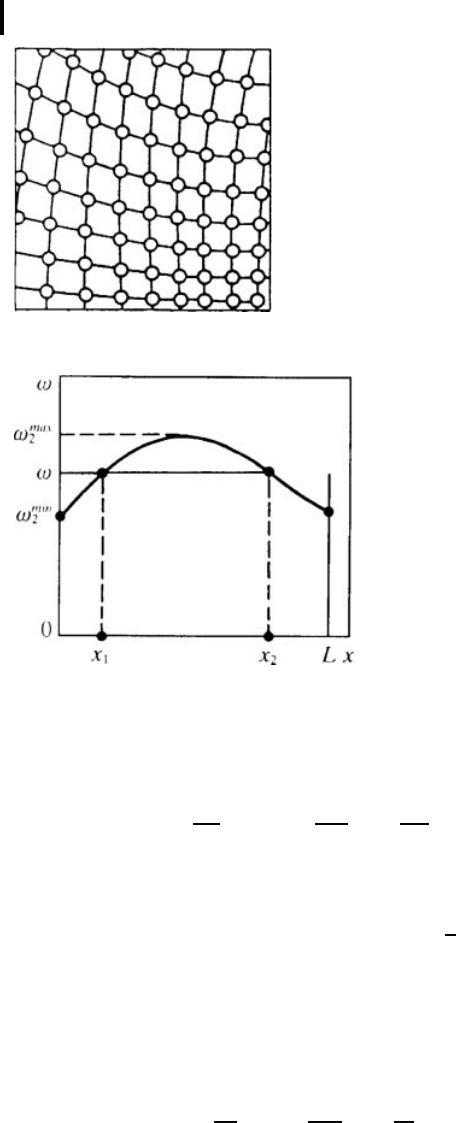
Fig. 7.7 Deformed crystal lattice.
Fig. 7.8 Distortion of an upper edge of the phonon frequency band.
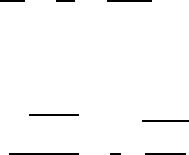
The equations of motion (7.5.4) for this case are
dk
j
dt
= −g
il
(0)
∂u
il
∂x
j
,
dx
j
dt
= −γ
jl
k
l
.
In a cubic crystal (7.5.7) is much simplified
ω(k, r)=ω
m
{1 − βu
ll
(r)}−
1
2
γ
2
k
2
,
γ = const, β = const ∼ 1.
Since the reciprocal-space volume corresponding to the vibrations concerned in-
creases under total compression (u
ll
< 0), it may be concluded that β > 0.Inthe
simplest case
dk
dt
= βω
m
∂u
ll
∂r
,
dr
dt
= −γ
2
k. (7.5.8)

7.5 Equation of Phonon Motion in a Deformed Crystal
201
The phonon motion described by (7.5.8) takes place under the condition
βu
ll
(r)+
1
2
γ
2
k
2
= ω
m
−ω = const.
It is clear that the part of the total crystal compression (at β > 0) is a “potential
well” for a short-wave phonon near the upper spectrum boundary. Thus, getting into
the region of forbidden frequencies of an ideal crystal (ω > ω
m
), the phonon cannot
go beyond the volume bounded by the surface
βu
ll
(r)=ω
m
−ω.
Consider the possible dependence of the upper spectrum boundary ω
2
on the co-
ordinate shown in Fig. 7.8. The short-wave phonon moves in the “potential well”
experiencing total internal reflection at the points x = x
1
and x = x
2
.
The phonon motion under such conditions becomes finite, i. e., localized in some
volume of a crystal with linear dimensions much exceeding the lattice constant. If the
mean free path of the phonon is much larger then its “trajectory”, then we can speak
of bound states of the phonon concerned. When such phonon motion is quantized,
discrete frequencies should appear outside the continuous spectrum band. The number
of possible discrete frequencies is determined by the form of the “potential well”.
8
Quantum Crystals
8.1
Stability Condition of a Crystal State
The anharmonicities of the crystal lattice vibrations are impo rtant in two cases: ei-
ther at high temperatures when relative displacements of neighboring atoms become
significant and the nonlinear character of elastic interatomic forces manifests itself,
and even in the low-temperature region when the phenomena generated by the an-
harmonicity of crystal vibration are examined. The phenomena that are inexplicable
from the viewpoint of a harmonic approximation can be exemplified by any process
stimulated by an interaction in the phonon gas.
Let us analyze the harmonic displacements of atoms more scrupulously and clear
up when they can be considered as small. The necessary condition for the harmonic
approximation to be valid is the requirement that the atomic zero v ibration amplitude
in the crystal be sm all compared to the lattice period. If we denote in (6.2.6)
1
ω
∗
=
1
N
∑
k
1
ω(k)
, (8.1.1)
the ratio of r.m.s. atomic displacement in the ground state of the crystal to the lattice
constant a will be of the order of magnitude
Λ =
u
2
0
a
∼
1
a
¯h
mω
∗
.
Thus, the harmonic approximation provides a sufficient accuracy in describing the
atomic motion in a crystal if Λ 1.
For almost all crystalline substances the parameter Λ is very small. Moreover,
even at high temperatures, when thermal atomic displacements greatly exceed the
zero-vibration amplitude, the ratio of the r.m.s. atomic displacement amplitude to
the lattice period is g enerally small. Only at the m elting temperature does the value
The Crystal Lattice: Phonons, Solitons, Dislocations, Superlattices, Second Edition. Arnold M. Kosevich
Copyright
c
2005 WILEY-VCH Verlag GmbH & Co. KGaA, Weinheim
ISBN: 3-527-40508-9
204
8 Quantum Crystals
of u
2
become comparable with the square of the interatomic distance. The last
point allows one to introduce the physical criterion of melting when the temperature
rises. The m elting temperature can be estimated on the basis of a Lindemann cond ition
according to which at the melting point the thermal atomic displacement square (6.4.7)
is u
2
= γ
2
a
2
,γ ∼ 0.1.
The crystal melting temperature T
melt
for an ordinary crystal is always higher than
the Debye temperature Θ. At temperatures lower then T
melt
, in the majority of crystals
the ratio of thermal atomic displacement to the lattice perio d is very small.
However, there exist crystals for which Λ ∼ 1. These are, in the first instance,
hydrogen and helium crystals
1
. The standard quasi-classical approach to studying
the vibrations of such crystals is already inapplicable. This is not only due to large
anharmonicities. The classification of the crystal states based on the c oncept that
atoms in equilibrium are located at certain lattice sites does not correspond to the
physical situation.
Since the existence of a crystalline state in this situation is problematic, the dimen-
sionless parameter Λ should be determined without involving the lattice period. It was
done by de Bour (1948) in terms of the quantities determining the potential energy of
the interaction between the crystal atoms. The interaction energy of the atomic pair
can be written with a good accuracy in the form of a Lennard–Jones potential
U(r)=4
σ
r
12
−
σ
r
6
, (8.1.2)
where r is the interatomic distance, σ is the spatial interaction distance, the parameter
characterizes the intensity of interaction energy.
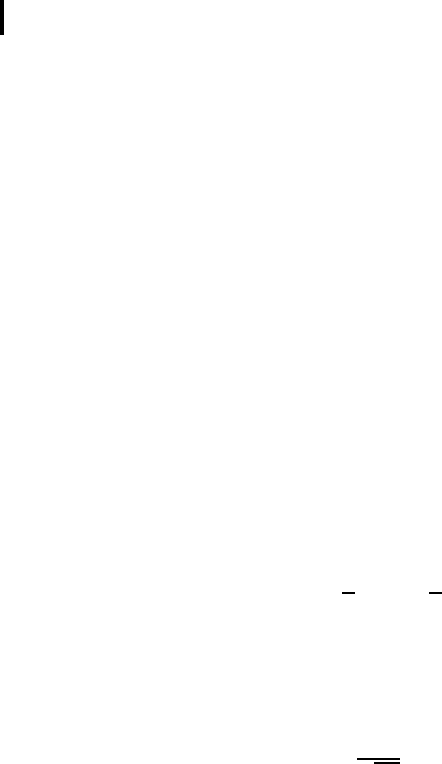
Then the characteristic dimensionless de Bour parameter is
Λ
B
=
¯h
√
m
. (8.1.3)
This parameter Λ
B
for the crystal coincides, in order of magnitude, with the param-
eter Λ considered above, so that small zero atomic vibrations in the crystal correspond
to Λ
B
1. This is just the condition for the ap plicability of the classical appro ach to
the description of the crystal state.
It follows from (8.1.3) that the larger the value of Λ
B
the smaller is the atomic mass
and the intensity of its interaction with its neighbors. For some inert gases the values
of Λ
B
are
3
He
4
He H
2
D
2
Ne Ar Kr Xe
0.48 0.43 0.28 0.20 0.09 0.03 0.02 0.01
1) We remind the reader that at normal atmospheric pressure helium remains
liquid ev en at T = 0 K, and its ordered ground state has no spatial crystal
structure. Helium-4 isotopes form a crystalline state only at pressures higher
than 250 Pa, and helium-3 isotopes – at pressures higher than 300 Pa.

8.1 Stability Condition of a Crystal State
205
Argon, xenon and krypton crystals have comparatively small values of zero-
vibration amplitudes and can be considered as ordinary crystals with the atoms
localized at the lattice sites.
However, the d e Bour parameter for helium and hydrogen crystals is comparable
with 1 and, thus, the classical approach to describe the physical properties o f these
crystals (in p articular, their ground state) is inapplicable. Crystals where the zero-
vibration amplitude is comparable in order of magnitude with th e lattice period are
called quantum crystals.
The most remarkable representative of substances whose ground state is described
in a purely quantum language is helium. The quantum zero vibrations in helium do
not allow th e formation of a stable crystal lattice at normal pressure. Thus, helium
does not crystallize at any temperature (including T = 0 K) if the p ressure does not
exceed a certain limiting value. For pressures lower than this value, at temperatures
near absolute zero helium forms a quantum liquid .
It is interesting to note that in quantum crystals unusual relations between melting
T
melt
and Debye Θ temperatures (T
melt
Θ) are observed. For instance, for H
2
we
have T
melt
≈ 14 KandΘ ≈ 120 K; for
4
He, T
melt
≈ 3 KandΘ ≈ 30 K. Even for
Ne, T
melt
≈ 25 K, Θ ≈ 75 K.
The basic peculiarity of quantum crystal mechanics is that the atoms are not con-
sidered as particles vibrating independently near the lattice sites under only a classical
force interaction. The reason for this is as follows. A quantum crystal is character-
ized by a regular spatial structure and has a definite crystal lattice. Thus, on the one
hand, th e atoms of the quantum crystal make up a spatial lattice and perform vibra-
tional motio ns near its sites, but, on the other hand, the amplitude of the atomic zero
vibration s in the potential field (8 .1.2) is of the order of the distance between the sites.
To combine these two properties of atomic motion in quantum crystals, we assume
the atomic motion is correlated. Thus, if the atomic motion in a quantum crystal is
described microscopically it is necessary to take into account the correlation of the
motion at small distances (short range correlation).
In a quantum crystal the phonons also play the role of weakly excited crystal states.
This conclusion is based on studying the low-temperature properties of the hard he-
lium. The phonons prove to be a good approximation to describe the thermal motion
in a quantum crystal. Hence it follows that large zero atomic vibrations result on ly in
a renormalization of the long-range correlations (phonons) by taking into account the
quantum short-range correlations.
Finally, the condition for zero vibrations to be small may be violated only for sepa-
rate forms of intracrystal motions. For instance, hydrogen dissolved in certain metals
forms a quantum subsystem (sometimes a regular sublattice) in a classical crystal.
The hydrogen atomic displacement should then be described by taking into account
the quantum properties for such a type of motion, whereas the motion in the other
degrees of freedom of a crystal may be regarded as quasi-classical.

206
8 Quantum Crystals
8.2
The Ground State of Quantum Crystal
According to experimental data the “quantum feature” of solid helium (in particular,
the specific role of zero vibrations) is not manifest when considering the dynamic
crystal properties described by the harmonic approximation.
However, there are such physical properties of quantum crystals in which large
zero atomic vibrations are dominant. There is, first of all the possibility of a tunneling
atomic motion in a crystal lattice, which is completely determined by the purely quan-
tum effect of particles tunneling through a potential barrier. The tunneling motion
may cause a rearrangement of the ground state of a quantum crystal.
In describing the ground state of an ordinary crystal it is assumed that there is one
atom at each lattice site. But when the zero-vibration amplitude levels are the same
order of magnitude as the interatomic distance in a crystal, then the atom ceases to be
localized at a definite site. A purely quantum situation can then be realized when in
the ground state (at T = 0 K) the number of lattice sites N
0
is not the same as the
number of atoms N.
For all existing “candidates” for quantum crystals, one should expect N
0
≥ N.
When the value of N
0
exceeds N then the probability to find an atom at a given site
is less than 1, although the crystal does not lose its periodicity. The density that deter-
mines the probability of various positions of a particle in space remains in this case a
periodic function with a lattice period. Andreev and Lifshits (1969) were the first to
predict the existence of such quantum crystals and to describe their basic properties.
To characterize the state of a quantum crystal, it is necessary to take into account
additional degrees of freedom that are not present in a c lassical crystal – the quantum
tunneling. The excess in the number of sites of a spatial lattice over the number
of atoms caused by quantum tunneling is called quantum dilatation. The quantum
dilatation is not associated with an external stretching action or thermal expansion.
Let the function η(r) describe this dilatation and we normalize this function by the
condition
1
V
0
η(r) dV = N
0
− N, (8.2.1)
where th e integral is calculated over the whole crystal volume. T he probability of
detecting an atom positioned in a definite unit cell with the volume V
0
is given by
1
V
0
V
0
(1 − η) dV =
1
V
(1 − η) dV =
N
N
0
< 1, (8.2.2)
where the first integral is taken over the volume of one unit cell.
Thus, the ground state of a quantum crystal is a phonon vacuum that is characterized
by certain quantum dilatation. In the long-range approximation the ground state can
be regarded as homogeneous, i. e., it is admissible to set η(r)=η
0
= const. The
8.3 Equations for Small Vibrations of a Quantum Crystal
207
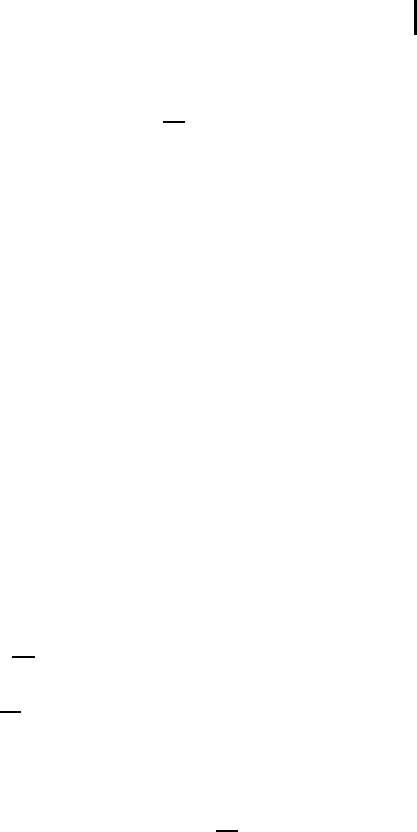
crystal density in the ground state is
ρ = ρ
0
(1 − η
0
) , ρ
0
=
m
V
0
, (8.2.3)
where m is th e mass of an atom (or the mass of atoms in the unit cell o f a polyato mic
lattice).
However, the presence of quantum dilatation in the ground state is not unique or the
necessary property of a quantum crystal. The quantum properties are more transparent
in the crystal dynamics.
8.3
Equations for Small Vibrations of a Quantum Crystal
If tunneling motion of atoms is possible, the ordinary equations of crystal motion are
inapplicable. These equations cannot be derived by means of a classical approach
and the problem requires a rigorous quantum-mechanical consideration. We will not
derive here the equations of quantum crystal vibrations in the whole frequency range,
but will confine ourselves to an analysis of long-wave (low-frequency) vibrations.
For ordinary crystals this approximation results in the dynamic equations of elasticity
theory (Section 2.9), i. e., in the equations of motion of a continuous medium.
The system of linear equations of the continuous medium dynamics includes two
obvious equations
∂j
i
∂t
= ∇
k
σ
ki
, (8.3.1)
∂ρ
∂t
+ div j = 0, (8.3.2)
where j is a vector of the flow density of the substance mass that plays the role of the
momentum of a unit volume. In a classical crystal
σ
ik
= λ
iklm
∇
l
u
m
; j = ρv; v =
∂u
∂t
, (8.3.3)
and (8.3.1), (8.3.2) take the standard form of the elasticity theory dynamic equation
(2.9.18) and the continuum equation (2.9.6).
The physical characteristics for the medium state and the relations between them
in (8.3.1), (8.3.2) must be redefined for the quantum crystal. In particular, these rela-
tions should describe two kinds of motion: a quasi-classical “solid state” and a purely
quantum one. The latter motion is called a superfluid, emphasizing the similarity with
a particular flow behavior of a quantum liquid.
To preserve notations and relations such as (8.3.3), we introduce the vector of
site displacemen ts in the quan tum crystal lattice from their equilibrium positions
u = u(r), and associate it with the tensor of small distortions u
ik
= ∇
i
u
k
and
strain ε
ik
. The vector u describes the normal form of classical crystal lattice motion.

208
8 Quantum Crystals
In a nondeformed (ground) state, u
ik
= 0, and the quantum dilatation is homo-
geneous: η = η
0
= constant. When small vibrations arise, there appears a small
lattice deformation ( |u
ik
|1) and a little deviation of η from equilibrium value:
η = η
0
+ η
, |η
|1. We shall further restrict ourselves to the approximation linear
in small values of η
and ε
ik
.
The internal stresses now characterized by the tensor σ
ik
are generated both by
the deformation of the lattice itself and by the inhomogeneous quantum dilatation
distribution. For small gradients of the function η we may set
σ
ik
= λ
iklm
u
lm
+ p
ik
η
, (8.3.4)
where the moduli λ
iklm
are determined by the elastic properties of a quantum crystal
and, thus, may be η
0
dependent. The second-rank tensor p
ik
determines the crystal
reaction to the inhomogeneity of the function η(r, t). As the quantum dilatation cannot
be associated with the moment of forces that act on the whole crystal, the tensor p
ik
should be regarded as symmetric: p
ik
= p
ki
. With the quantum d ilatation the change
in the crystal mass density ρ cannot be unambiguously determined by the geometric
deformation of the lattice, i. e., by the tensor u
ik
. In this situation a small deviation
of the density ρ(r, t) from a homogeneous equilibrium value ρ
0
in the approximation
linear in η
and u
ik
, may b e written as
δρ ≡ ρ −ρ
0
=
∂ρ
∂u
ik
u
ik
− ρ
0
η
= ρ
0
γ
ik
u
ik
− η
,
where we denote ρ
0
γ
ik
= ∂ρ/∂u
ik
.Sinceu
kk
= div u coincides with a relative in-
crease in the lattice volume under deformation, then γ
ik
= −δ
ik
in an ordinary (clas-
sical) crystal. Assuming the quantum properties of a crystal to be weak we consider
the expansion
δρ = −ρ
div u + η
. (8.3.5)
We now proceed to the second and third relations (8.3.3) that should be revised as
the derivative ∂u∂t does not coincide with the atomic m otion velocity v. The type
of motion described by the vector ∂u∂t is represen ted as spatial lattice vibrations in
a certain medium created by quantum dilatation and capable of superfluid motion. A
superfluid type of motion is characterized by the average velocity v
s
.
In the reference frame for which v
s
= 0 the momentum of the crystal unit volume
coincides with the mass flow density of normal motion:
j
0
i
=(ρδ
ik
+ ρ
ik
)
∂u
k
∂t
,
where ρ
ik
is the tensor of the adjo ined ma ss of a crystal lattice in the above-mentioned
quantum dilatation “medium” (ρ
ik
= ρ
ki
). By assumption, the quantum dilatation
creates a negative mass density compared to a classical crystal, th us, the matrix ρ
ik
should not be positively definite. In a laboratory reference frame, the momentum of a
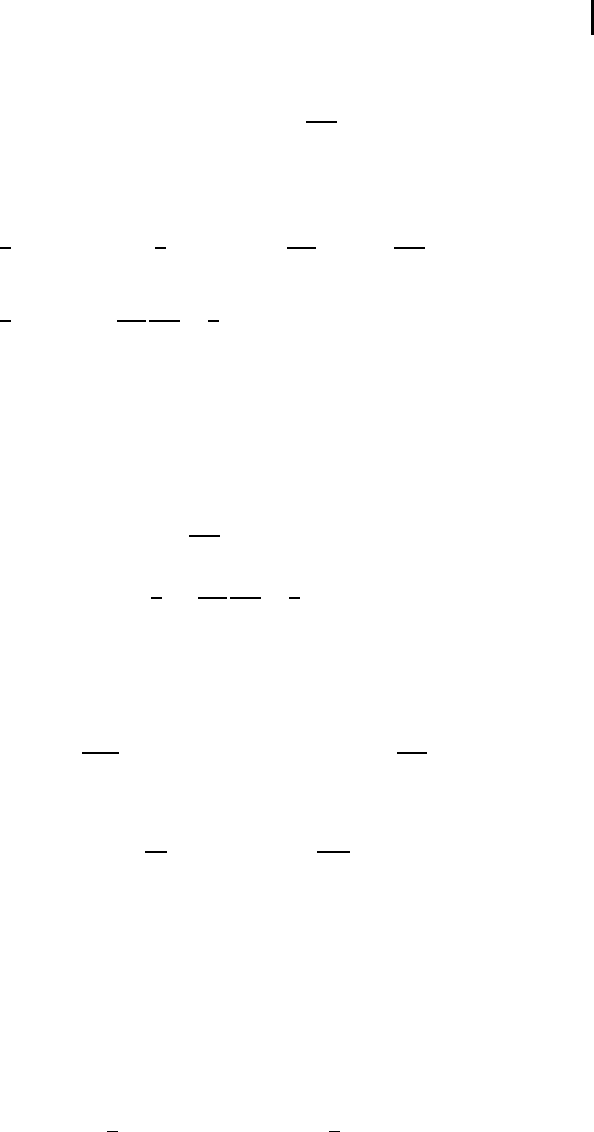
8.3 Equations for Small Vibrations of a Quantum Crystal
209
crystal unit volume is
j
i
= ρv
s
i
+ j
0
i
=(ρδ
ik
+ ρ
ik
)
∂u
k
∂t
−ρ
ik
v
s
k
. (8.3.6)
The formula for the kinetic energy of the crystal unit volume is obtained in a similar
way:
K =
1
2
ρ (v
s
)
2
+ v
s
j
0
+
1
2
(ρδ
ik
+ ρ
ik
)
∂u
i
∂t
−v
s
i
∂u
k
∂t
− v
s
k
=
1
2
(ρδ
ik
+ ρ
ik
)
∂u
i
∂t
∂u
k
∂t
−
1
2
ρ
ik
v
s
i
v
s
k
.
(8.3.7)
Using (8.3.6), (8.3.7) the following effective mass densities can be assigned to su -
perfluid and normal motions
ρ
(s)
ik
= −ρ
ik
, ρ
(n)
ik
= ρδ
ik
+ ρ
ik
= ρδ
ik
− ρ
(s)
ik
. (8.3.8)
Then the crystal unit volume momentum and the kinetic energy density are
j
i
= ρ
(n)
ik
∂u
k
∂t
+ ρ
(s)
ik
v
s
k
; (8.3.9)
K =
1
2
ρ
(n)
ik
∂u
i
∂t
∂u
k
∂t
+
1
2
ρ
(s)
ik
v
s
i
v
s
k
. (8.3.10)
Since the energy is a positive quantity, th e matrices ρ
(s)
ik
and ρ
(n)
ik
should be posi-
tively definite.
We substitute (8.3.9), (8.3.4) into (8.3.1)
ρ
(n)
ik
∂
2
u
i
∂t
2
− λ
iklm
∇
k
∇
l
u
m
= p
ik
∇
k
η + ρ
ik
∂v
s
k
∂t
, (8.3.11)
and (8.3.5), (8.3.9) into (8.3.2)
ρ
0
∂η
∂t
− ρ
(s)
ik
∇
i
v
s
k
= ρ
ik
∂
ik
∂t
. (8.3.12)
It is clear that in the equations of quantum crystal motion there are two new dy-
namic quantities η and v
s
. A relation between the superfluid motion v
s
and the quan-
tum dilatation density η cannot be established from general consideration and needs
the solution of a corresponding quantum problem. However, if we assume a super-
fluid motion to be potential (curl v
s
= 0) and p ostulate that the quantum dilatation
dynamics is described by one additional scalar function of coordinates and time, the
necessary relation can be formulated phenomenologically.
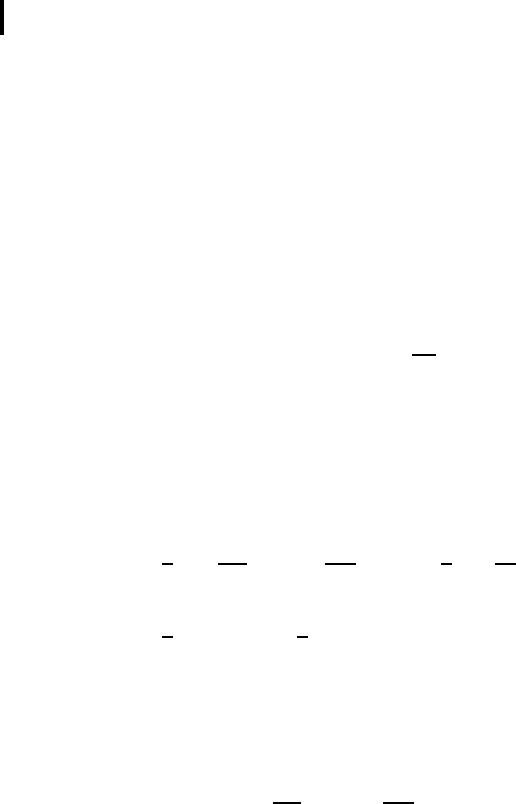
We first write the density of the elastic energy of the system concerned
U =
1
2
λ
iklm
u
ik
u
lm
+ p
ik
ik
η
+
1
2
M
η
2
. (8.3.13)
210
8 Quantum Crystals
The second term in (8.3.13) describes the interaction of the normal deformation with
quantum dilatation, wh ile the th ird arises naturally in a theor y linear in η
and de-
scribes the changes in the nondeformed crystal energy with η deviating from the equi-
librium value η
0
.
The quantum crystal total energy density should have the form of a sum
E = K + U, (8.3.14)
where K and U are given by (8.3.10), (8.3.13).
We require that (8.3.11), (8.3.12) arise from the mechanical action principle. To
formulate this principle, we introduce the potential of a superfluid motion ϕ:
v
s
= A grad ϕ; η
=
∂ϕ
∂t
− β
ik
ik
, (8.3.15)
determining the necessary ratios between the coefficients A, M, p
ik
, β
ik
,etc.
We now write the Lagrange function density assuming the displacement vector u
and the potential ϕ to be generalized coordinates. We cannot use a standard mechan-
ical definitio n of the Lagran ge function as the difference between th e kinetic (8.3.10)
and potential energy (8.3.13)
2
. The Lagrange function density must be chosen in the
form
L =
1
2
ρ
ik
∂u
i
∂t
− v
s
i
∂u
k
∂t
− v
s
k
+
1
2
M
δρ
ρ
2
−
1
2
λ
0
iklm
u
ik
u
lm
−
1
2
ρ (v
s
)
2
,
(8.3.16)
where v
s
and δρ/ρ are related to the derivatives of the generalized coordinates by
(8.3.15), (8.3.5).
A correct expression for the crystal unit volume momentum in the reference frame
moving with velocity v
s
is given by (8.3.16)
p
i
=
∂L
∂
˙
u
i
= ρ
(n)
ik
∂u
k
∂t
− v
s
k
.
In addition, if we take p
ik
= Mβ
ik
and set
λ
iklm
= λ
0
iklm
+ M (δ
ik
β
lm
+ δ
lm
β
ik
− δ
ik
δ
lm
) ,
then the equation for the energy density (8.3.14) follows from (8.3.16).
Equations (8.3.11), (8.3.12) result from the Lagrange function density (8.3.16)
when the coefficients are related by
M = Aρ
0
, p
ik
= Aρ
0
β
ik
.
2) One can see that with the given choice of generalized coordinates (8.3.15),
(8.3.14) will not follow from such a density of the Lagrange function. In field
theory the Lagrange function density is then, generally, a positively definite
form in the time derivatives of the generalized coordinates (in our case in
∂u∂t and ∂ϕ∂t).