
Kosevich A.M. The crystal lattice
Подождите немного. Документ загружается.

190
7 Interaction of Excitations in a Crystal
The dispersion law may be decaying also due to strong anisotropy of isofrequency
surfaces. Even if in each direction of k-space the condition ∂
2
ω/∂k
2
< 0 is satisfied,
but the isofrequency surface is not convex (the cross section of such a surface is shown
in Fig. 4.1) a decay such as t → t + t may be allowed.
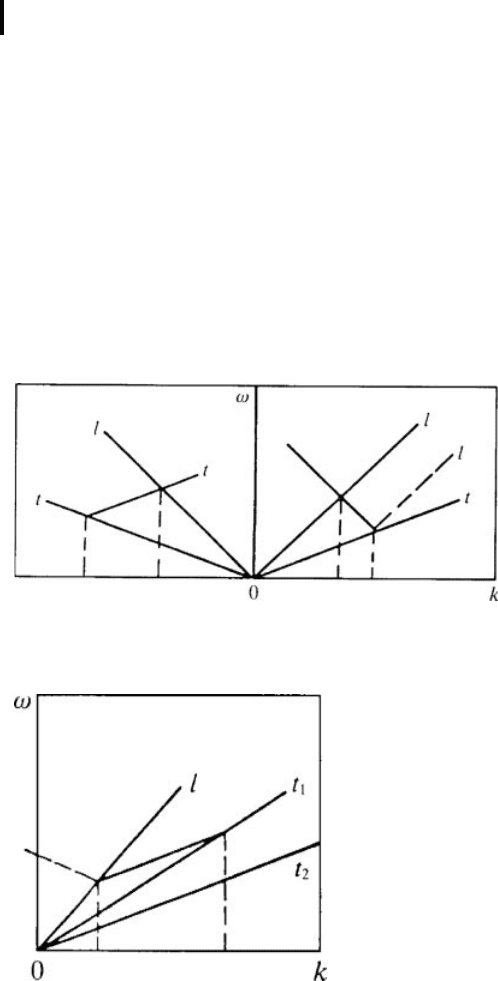
When both longitudinal (l) and the transverse (t) phonons participate simultane-
ously in a three-phonon process, the conditions for its realization, i. e., the conditions
for satisfying (7.2.3) to be met, are much simplified even if the dispersion laws o f
each type of phonons are nondecaying. To analyze these processes, we consider the
dispersion laws (7.2.4) in view of the condition (7.2.5). One can see that for a one-
dimensional model the processes l → t + t
and l → l + t (Fig. 7 .4) are possible,
while processes such as t → l + l
, t → t + l are forbidden, at least in the isotropic
approximation.
Fig. 7.4 Fulfillment of the dispersion laws for the decays l → t + t
(on
the left) and l → l + t for a 1D model.
Fig. 7.5 Three-phonon process t
1
→ l + t
2
.
However, taking into account the existence of two kinds of transverse phonons (t
1
and t
2
) with different sound velocities (s
1
= s
2
) the following process is possible
(Fig. 7.5):
t
1
→ t
2
+ l, s
2
< s
i
< s
l
.

7.3 Inelastic Diffraction on a Crystal and Reproduction of the Vibration Dispersion Law
191
We emphasize that the phonon dispersion law anisotropy assists significantly when
the condition (7.2.3) is satisfied, although it does not remove all prohibitions arising
in the isotropic approximation.
In conclusion we note that for all processes of single-phonon decay into two
phonons there are corresponding inverse processes (fusion of two phonon into a single
one). These are allowed or forbidden to the same extent as direct processes.
7.3
Inelastic Diffraction on a Crystal and Reproduction of the Vibration Dispersion
Law
In elucidating the conditions for Bragg X-ray (rather soft γ-quantum) reflection, we
considered the crystal as an ideal spatial lattice of fixed mathematical points. How-
ever, the scattering by a real crystal whose atoms can perform vibrational motion are
distinguished from the scattering by fixed centers. First, the incident wave may excite
vibrational motion in the crystal, i. e., generate phonons in it. Then, the vibrating lat-
tice atoms are d isplaced from their eq uilibrium positions and the scattering by such a
system is different from that by an ideal periodic structure (the incident wave interacts
with crystal phonons). The second distinction is connected with the root-mean-square
value of the displacement.
Let us discuss the first of th e phenomen a g enerated by the inelastic interaction of
penetrating radiation with a vibrating crystal. In a kinematic theory, the probability
of the incident beam scattering with its wave vector changing to q = q
2
− q
1
,is
proportional to the squared modulus of the following integral over the sample volume
(Section 0.4.5):
U(q
2
, q
1
) ≡ V(q)=
U(r) exp (−iqr ) d
3
r, (7.3.1)
where U(r) is the potential of the crystal in teraction with a field or with a particle. In
a monatomic lattice
U(r)=
∑
n
U
0
[r − r(n) −u(n )] , (7.3.2)
and U
0
(r −ξ) describes the interaction between the penetratin g radiation and a single
atom at the point ξ. We substitute (7.3.2) into (7.3.1)
V(q)=F
0
(q)
∑
n
exp {−i q [r(n)+u(n)]}. (7.3.3)
Here the notation F
0
(q) is introduced for the atomic scattering factor
F
0
(q)=
U
0
(r)e
−iqr
d
3
r.
The sum over the lattice sites that is a multiplier in (7.3.3) will be called the structure
factor and is denoted as S(q). U sually the structure factor is determined as this sum
divided into the number of crystal sites N.
192
7 Interaction of Excitations in a Crystal
We try to calculate the structure factor using the smallness of atomic displacements.
As, by assumption, u a and we take interest in the wave vectors q whose modulus
does not exceed the order of magnitude of π/a, we expand each term of the structure
factor as a power series of u, restricting ourselves to the linear terms
S(q)=
∑
n
e
−iq[r(n)+u(n))]
=
∑
n
e
−iqr (n)
−iq
∑
n
u(n)e
−iqr (n)
. (7.3.4)
The first term on the r.h.s. of (7.3.4) describes the diffraction pattern for an ideal
periodic structure (Section 0.5). It gives the amplitude of scattering by a crystal for
which q = G,whereG is any reciprocal lattice vector.
It is essential that the crystal state under this scattering does not change.
We now study the second (linear in displacement) term on the r.h.s. of (7.3.4), hav-
ing denoted it as M(q). To understand the physical meaning of this term in the struc-
ture factor, we consider M(q) as an operator in occupation-number space and express
the displacement vector u(n) through the phonon creation and annihilation operators
(6.1.16)
M(q)=−iq
∑
n
u(n)e
−iqr (n)
= −i
¯h
2mN
1/2
×
∑
kα
qe(α, k)
ω
α
(k)
∑
n
a
α
(k)e
−i(q−k)r(n )
+ a
†
α
(k)e
−i(q+k)r(n )
.
(7.3.5)
On summing n with (0.4.14) taken into account, it is clear that in (7.3.5) there are
terms of two kinds. Some of them involve the operator a
k
as a multiplier and describe
the scattering process accompanied with the absorption (annihilation) of a phonon
with the qu asi-wave vector k,sothat
q
2
− q
1
= k + G. (7.3.6)
The other terms involve the operator a
†
k
as a multiplier and are responsible for the
phonon radiation (creation) obeying the dispersion law
q
1
− q
2
= k + G. (7.3.7)
The matrix elements of the operator M(q) thus determine the amplitude of inelastic
scattering involving one phonon (the amplitude of a one-phonon process). It follows
from (7.3.6), ( 7.3.7) that one-phonon scattering may take place either as an N-ora
U-process.
We now obtain fairly straightforward energy conservation laws that govern the pro-
cesses (7.3.6), (7.3.7) and also look at the one-phonon scattering from another point of
view. Since we regard V(q) as the energy operator of crystal interaction with an inci-
dent beam, the probability of the beam scattering in the first-order p erturbation theo ry
is expressed through the squared matrix element f |V(q)|i for a transition from the
7.3 Inelastic Diffraction on a Crystal and Reproduction of the Vibration Dispersion Law
193
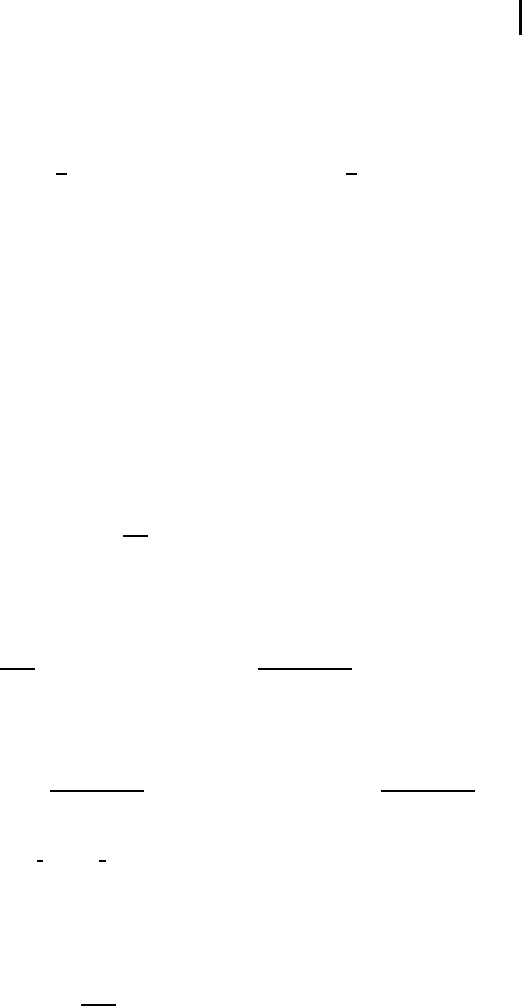
initial crystal state i with a set of occupation numbers for phonons {N
k
} into the final
state f with the occupation numbers
N
k
.LetE
i
and E
f
be the crystal energy in the
harmonic approximation before and after scattering:
E
i
=
∑
kα
N
α
(k)+
1
2
¯hω
α
(k) , E
f
=
∑
kα
N
α
(k)+
1
2
¯hω
α
(k) .
Furthermore we introduce the notation where E
1
= E(¯hq
1
) and E
2
= E(¯hq
2
) for the
energies of an incident particle (γ-quantum, electron or neutron) before and after scat-
tering, and E (p) is the energy of a scattered particle as a function of its momentum.
In the first Born approximation, the prob ability of the separate scattering by a crystal
in the state i is proportional to
w(q, E)=
∑
f
|f |V(q) |i|
2
δ(E + E
f
− E
i
), (7.3.8)
where E = E
2
− E
1
= ¯hω.
Using the integral representation of the δ-function
δ(z)=
1
2π
+∞
−∞
exp(izt) dt,
and transforming (7.3.8) we obtain
w =
1
2π¯h
+∞
−∞
e
iωt
∑
f
|f |V |i|
2
exp
i(E
f
− E
i
)t
¯h
dt. (7.3.9)
We take into account the identity
∑
f
|f |V |i|
2
exp
i(E
f
− E
i
)t
¯h
=
∑
f
f |V|i
∗
f |V|iexp
i(E
f
− E
i
)t
¯h
=
∑
f
f
V
†
if
e
i
¯h
H
t
Ve
−
i
¯h
H
t
i =
∑
f
i
V
†
f f |V(t)|i,
where we move to the Heisenberg representation of the operators and denote V by
V(0). Then,
w(q, E)=
1
2π¯h
+∞
−∞
V
∗
(q,0)V(q, t)e
iωt
dt. (7.3.10)
Here we use the notation ... for the quantum-mechanical average in some crystal
state, {N
k
}. We note that by virtue of time homogeneity
V
∗
(q,0)V(q, t) = V
∗
(q, −t)V(q,0) . (7.3.11)
194
7 Interaction of Excitations in a Crystal
We come back to the definition (7.3.3), taking into account (7.3.11)
w(q, E)=
1
2π¯h
|F
0
(q)|
2
∑
n,n
e
iq[r(n)−r(n
)]
×
+∞
−∞
e
iqu(n,t)
e
−iqu( n
,0)
e
−iωt
dt.
(7.3.12)
Thus, in the general case the scattering probability is determined by the Fourier
components of the correlation functions
e
iqu(n,t)
e
−iqu( n
,0)
. (7.3.13)
For small thermal atomic displacements and insignificant changes in the wave vec-
tor in the scattering, we confine ourselves to the expansion (7.3.4). This expansion
is sufficient to describe the one-phonon processes of inelastic scattering. Using the
definition (7.3.5), we note that
M
†
(q, t) = M(q,0) = 0,
and calculate the part quadr atic in M(q) that contributes to the inelastic scattering
probability
δw(q, E)=
1
2π¯h
|F
0
(q)|
2
+∞
−∞
M
†
(q, t)M(q)e
−iωt
dt
=
q
j
q
l
2π¯h
|F
0
(q)|
2
∑
n, n
+∞
−∞
u
j
(n, t)u
l
(n
, t)e
iq[r(n)−r(n
)]−iωt
dt.
(7.3.14)
The average value coincident with the pair correlator (6.4.1) has arisen in the inte-
grand of (7.3.14). Thus, the probability of one-phonon inelastic processes is propor-
tional to
δω (q, E)=N |F
0
(q)|
2
q
j
q
l
K
jl
(q, ω), (7.3.15)
where
K
jl
(q, ω)=
1
2π¯h
∑
n
+∞
−∞
Φ
jl
(n, t)e
iqr (n)−iωt
dt. (7.3.16)
Thus, the specificity of the scattering of various particles (or waves) is manifest in the
presence of the atomic factor F
0
(q) only.
The participation of the crystal structure of substances in the generatio n of one-
phonon processes is universal and determined by the pair displacement correlator. The
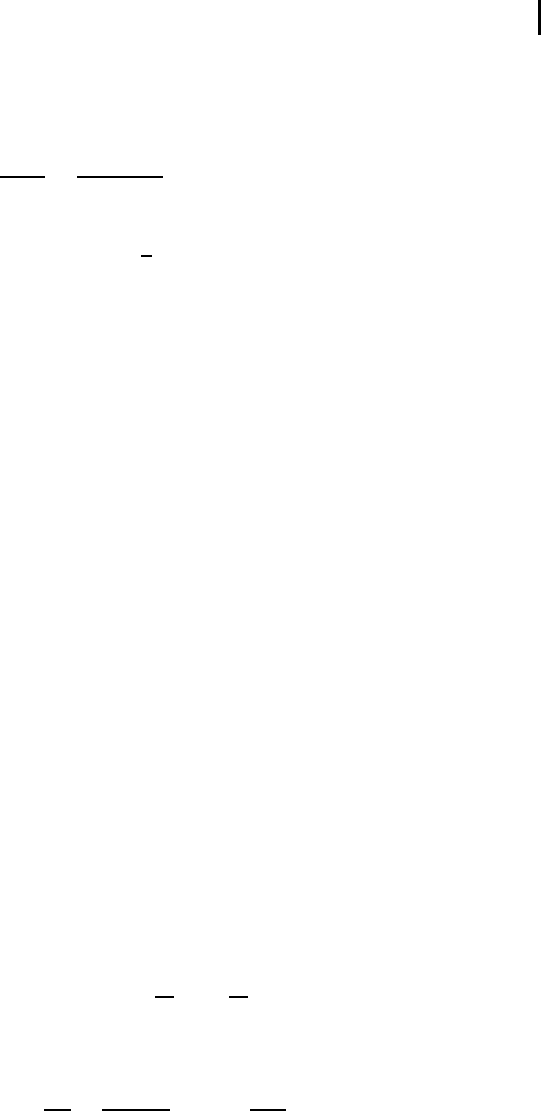
7.3 Inelastic Diffraction on a Crystal and Reproduction of the Vibration Dispersion Law
195
probability of such processes (7.3.15) is proportional to a spatial and a time Fourier
transformation of the displacement correlator (6.4.2).
It follows from (6.4.2) and (7.3.16) that
K
jl
(q, ω)=
1
2mN
∑
kα
e
j
(k)e
l
(k)
ω
α
(k)
{N
α
(k)δ [ω − ω
α
(k)]
×
∑
n
e
i(q−k)r(n)
+
N
α
(k)+
1
2
δ [ω + ω
α
(k)]
∑
n
e
i(q+k)r(n)
},
(7.3.17)
showing that the Fourier components of the displacement correlation are nonzero only
for the frequencies ω = ±ω
α
(k) . This means that one-phonon processes are allowed
if one of the conditions
E
2
− E
1
= ¯hω
α
(k) , (7.3.18)
E
1
− E
1
= ¯hω
α
(k) (7.3.19)
is satisfied (we r emember that in (7.3.15) ¯hω = E
2
− E
1
).
It is easy to understand from (7.3.17) that the process (7.3.18) is allowed under the
condition (7.3.6), and the process (7.3.19) under the condition (7.3.7). The conserva-
tion laws (7.3.6), (7.3.7), (7.3.18), (7.3.19) describe the interaction of strange particles
(capable of propagating a crystal) with phonons, i. e., the quasi-particles of a crystal.
The inelastic diffraction phenomenon accompanied by one-phonon processes de-
scribed provides an effective method for describing lattice dynamics. Let us suppose
that it is possib le to create a narrow beam of particles in cident on the crystal, to fix
the directions of scattered particles and to measure their energy. Thus, in each scatter-
ing process we know q
1
, q
2
, E
1
and E
2
. If we neglect the umklapp processes whose
contribution can be singled out, we determine the values of k and ¯hω for a phonon
participating in the process. Considering various directions and orientations of the
crystal, we can reproduce in principle the function ω = ω(k).
However, this experiment will be a success only if with the wavelength of the order
of a lattice constant (λ ∼ a) one can observe the change in the energy of a beam or a
particle by an amount of the order of phonon energy,
δE ∼ ¯hω
D
∼ ¯hω
m
∼ 0.01 eV.
The energy of X-rays with the required wavelength has the order of magnitude
E = ¯hω = 2π
¯hc
λ
∼ 2π
¯hc
a
∼ 10
4
eV.
Thus, using X-rays the indicated energy change δE is impossible to observe. But for
neutrons,
E =
p
2
2m
=
(2π)
2
¯h
2
2mλ
2
∼ (2π)
2
¯h
2
ma
2
∼ 0.1 eV,
196
7 Interaction of Excitations in a Crystal
which corresponds to the energy of thermal neutrons. Phonon absorption or emission
changes the neutron energy by δE , a value that can be observed.
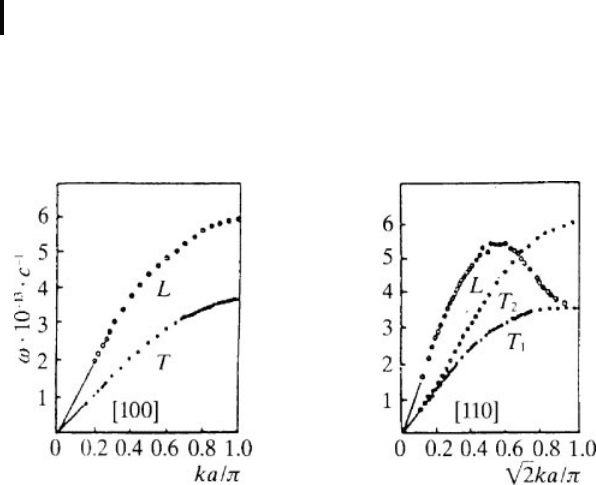
Examples of experimentally reproducing dispersion laws for neutron scattering are
given in Figs 2.4b, 3.2, 7.6.
Fig. 7.6 Dispersion curves for the two directions in Al are reproduced
by the neutron experiments (Yarnell et al. 1965).
7.4
Effect of Thermal Atomic Motion on Elastic γ-Quantum-Scattering
In distinguishing in (7.3.12) the probability of inelastic one-phonon processes,
we have restricted ourselves in (7.3 .12), o nly to the terms con tain ing multipliers
q
i
q
k
u
i
(n, t)u
k
(n
,0). We have not taken into account the terms with multipliers
such as
[qu(n, t)]
2
= [qu(n,0)]
2
, (7.4.1)
that also have second order of smallness in u(n). These terms were omitted since
they contribute to the e lastic scattering o f penetrating radiation only (for definiteness,
we shall speak of γ-quanta). Indeed, the averages (7.4.1) are time independent and,
therefore, after the integration over time they lead to the δ-function δ(ω)=¯hδ(E
1
−
E
2
) appearing in (7.3.12).
Thus, terms such as (7.4.1) determine the difference between the elastic γ -quantum
diffraction intensity from a vibrating crystal fro m that on an immobile spatial lattice
of atoms. It is easily seen that for a quantitative description of the influence the atomic
motion on producing elastic diffraction it is not necessary to restrict ourselves to ap-
proximation, which is quadratic in displacements.
We remind ourselves that (6.5.9) is applicable for a mo natomic lattice
e
iqu(n,t)
= e
iqu(n)
= e
−W
,

7.4 Effect of Thermal Atomic Motion on Elastic
γ
-Quantum-Scattering
197
where
W =
1
2
(qu)
2
, (7.4.2)
and represent the correlation function (7.3.13) in the form o f two terms
e
iqu(n,t)
e
−iqu( n
,0)
= e
−2W
+
e
iqu(t)
e
−iqu(0)
− e
iqu(t)
e
−iqu(0)
.
(7.4.3)
We begin to analyze this formula with the second term. In the approximation qua-
dratic in displacements it is equal to the average M
+
(q, t)M(q,0) that was con-
sidered in calculation of the probability for one-phonon inelastic scattering (7.3.14).
It is clear that the next term following the expansion of th e second term in (7.4.3) in
even powers of the displacement determines the probabilities for multiphonon inelas-
tic scattering processes.
The first term in (7.4.3) is time independent and is thus related to elastic scattering.
When substitu ted in (7.1.3), it contributes to the elastic scattering probability.
The diffraction intensity observed in an experiment is automatically averaged over
all the initial crystal states, which is equivalent to a thermodynamic averaging of the
scattering probability. On performing a thermodynamic averaging in (7.3.12), we find
that the intensity of the elastic γ-quantum diffraction is proportional to the
w
el
(q, E)=Ne
−2W
δ(E) |F
0
(q)|
2
∑
n
e
iqr (n)
= NΩ
0
e
−2W
δ(E) |F
0
(q)|
2
∑
G
δ(q − G),
(7.4.4)
where the su mmation is over the reciprocal lattice vectors; Ω
0
is the unit cell volume
of the reciprocal lattice. The factor e
−2W
describing the weakening of the diffraction
maxima intensity due to thermal atomic motion is called the Debye–Waller factor.
Since the Debye–Waller factor in (7.4.4) is a multiplying factor, the thermal atomic
motion in the crystal does not result in a smearing of th e sharp diffraction maxima in
γ-quantum scattering it only reduces its intensity.
The generalization of (7.4.4) to the case of a polya tomic lattice is straightforward
w
el
(q, E)=NΩ
0
δ(E)
∑
s
e
−W
s
F
s
(q)e
iqx
s
∑
G
δ(q − G), (7.4.5)
where x
s
is the vector of the basis of a polyatomic lattice that gives the s-th atom
position in the unit cell; e
s
is the po larization vector of the s -th sublattice vibrations,
W
s
=
1
2m
s
N
∑
kα
{qe
s
(α, k)}
2
ω
α
(k)
coth
¯hω
α
(k)
T
. (7.4.6)

198
7 Interaction of Excitations in a Crystal
Examining the processes of the interaction of the γ-quantum with the crystal has
shown that an incident γ-quantum may either give the crystal some momentum to
produce a phonon or get from the crystal some momentum generated by the phonon
“absorption”. In this case the γ-quantum energy will change to a finite value and the
scattering will be inelastic.
But another interaction with a crystal is possible when the finite part of the γ-
quantum momentum is transferred to a crystal in the process without the phonon
emission or absorption. As a result of this interaction, the crystal does not change
its state and the γ-quantum conserves its energy. So we have a process without recoil
characterized by extremely narrow diffraction lines. The proportion of such elastic
processes is m easured by the Debye–Waller factor.
7.5
Equation of Phonon Motion in a Deformed Crystal
The equations of crystal lattice motion have static inhomogeneous solutions with
boundary conditions determined by external loads. When such crystal states are de-
scribed in terms of long waves, we can consider the inhomogeneous static deforma-
tions that deform the crystal lattice (Fig. 7.7). If the deformations are small, they are
solutions to the linear equations of elasticity theory. Static deformations do no t in-
fluence small vibrations (phonon after quantization) due to the linearity of the elastic
theory equations, but including the anharmonic interactions transforms a deformed
lattice into an inhomogeneous elastic medium.
It is of interest to discuss the possibility to describe the vibrations of such spatial
inhomogeneous crystals in terms of phonons. Let us suppose that the macroscopic
crystal characteristics vary essentially at distances of the order of δL. How is this in-
homogeneity to be taken into account, while preserving the usual concept of phonons?
The phonons were introduced to quantize vibrations of the homogeneous crystal
that results in the fact that the states of an individual phonon were characterized by
a quasi-wave vector k. If the distance δL is large compared to the average phonon
wavelength δL
¯
λ, the phonon concept may be preserved in an inhomogeneous
crystal, too. Indeed, to describe the crystal vibrations with the above inhomogeneities
instead of normal modes, one should take the wave packets with the interval of wave
vectors δk,where
δL
>
∼
1
δk
¯
λ. (7.5.1)
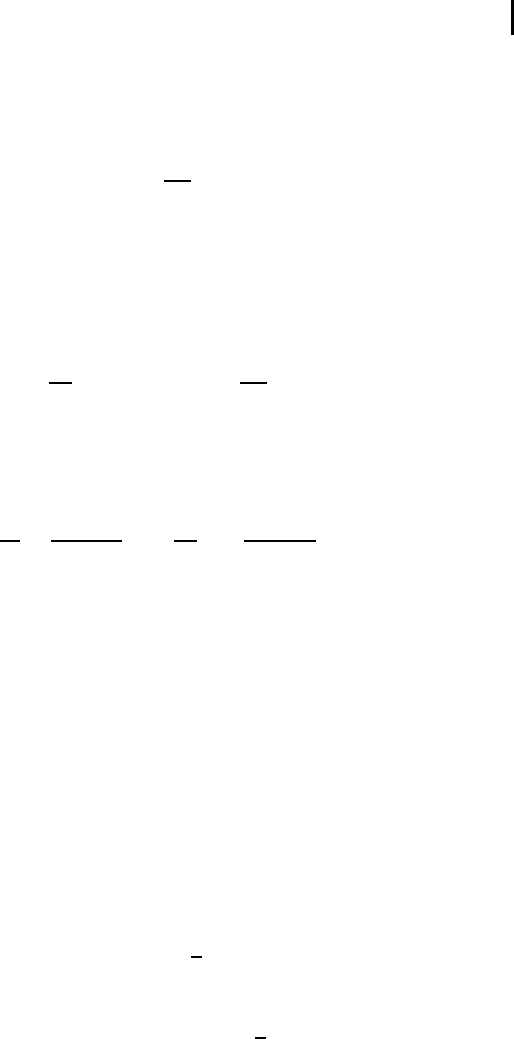
Analyzing (7.5.1) and taking into account the relation between the wavelength and
the value of the wave vector we obtain δk k, implying that the wave packets con-
cerned consist of normal modes whose wave-vector differences much less than their
wave vectors. Some conclusions important for further discussion follow from the last
assertion.
7.5 Equation of Phonon Motion in a Deformed Crystal
199
First the wave packet described may be associated with a vibration with the quasi-
wave vector k, i. e., with an individual phonon in a state with a given k.
Then, the velocity of this new “phonon” is determined by the group velocity of the
packet:
v =
∂ω
∂k
. (7.5.2)
First, if we measure the spatial positions within δx,where
¯
λ δx δL,thena
phonon
1
, having a quasi-wave vector k and located at the point r can be introduced.
Under such conditions the crystal-state inhomogeneity manifest in the inhomogeneity
of a “refraction coefficient” for a phonon, i. e., in the dependence of phonon frequency
on the coordinate r: ω
α
= ω
α
(k, r). The vector k of the corresponding packet will
then vary in time
dk
dt
= −∇ω(k, r) ≡−
∂ω
∂r
. (7.5.3)
The approximation in which the relation (7.5.3) is meaningful corresponds com-
pletely to the Eikonal approximation in g eometry optics. By analogy with the de-
scription of electromagnetic vibrations in inhomogeneous media, we can describe the
equations of motion for a sound beam that follows directly from (7.5.2), (7.5.3)
dr
dt
=
∂ω (k, r)
∂k
,
dk
dt
= −
∂ω (k, r)
∂r
. (7.5.4)
The equations of motion (7.5.4) can be derived not only using the wave properties
of phonons employed to construct the wave packets. According to the de Broglie
principle the phonon is a quasi-particle with energy ¯hω and quasi-momentum p = ¯hk.
Thus, the energy ¯hω(k, r) can be regarded as the Hamiltonian function and (7.5.4) as
the Hamiltonian form of the equations of motion of this quasi-particle.
In the case of small elastic deformation s the dependen c e of ω(k, r) on the strain
tensor u
ik
is lin ear
ω(k, r)=ω
0
(k)+g
il
(k)u
il
(r), (7.5.5)
where ω
0
(k) is the dependence of frequency on a quasi-wave vector in a nondeformed
crystal.
It is interesting to analyze (7.5.5) and the equations of motion (7.5.4) near the edge
of the phonon frequency band. We shall the quasi-wave vector from the value of k
m
corresponding to the maximum or minimum (if we speak of optical phonons) value of
ω
0
(k) . Then, at small k
ω
0
(k)=ω
m
−
1
2
γ
il
k
i
k
l
. (7.5.6)
Confining ourselves to small k, in (7.5.5) we obtain
ω(k, r)=ω
m
+ g
il
(0)u
il
(r) −
1
2
γ
il
k
i
k
l
, (7.5.7)
where ω
m
is the frequency band boundary of the continuous spectrum of a nonde-
formed crystal.
1) The condition δkδx ∼ 1 is allowed by the inequality (7.5.1).