
Kosevich A.M. The crystal lattice
Подождите немного. Документ загружается.

8.4 The Long-Wave Vibration Spectrum
211
We rewrite (8.3.11), (8.3.12) as equations for the functions u(r, t) and ϕ(r, t):
ρ
(n)
ik
∂
2
u
k
∂t
2
− λ
iklm
∇
k
∇
l
u
m
= Aµ
ik
∇
k
∂ϕ
∂t
; (8.3.17)
ρ
0
∂
2
ϕ
∂t
2
− Aρ
(s)
ik
∇
i
∇
k
ϕ = µ
ik
∂
ik
∂t
, (8.3.18)
with µ
ik
= ρ
0
β
ik
−ρ
(s)
ik
, and introduce a new elasticity modulus tensor
˜
λ
iklm
= λ
iklm
− Mβ
ik
β
lm
= λ
0
iklm
− M (δ
ik
− β
ik
)(δ
lm
− β
lm
) .
Equations (8.3.17), (8.3.18) are a complete set of equations for small mechanical
quantum crystal vibrations. They involve, apart from the tensor parameter ρ
(s)
ik
specific
for a quantum crystal, the quantity A having the dimension of the velocity squared.
According to (8.3.15), this qua ntity is included in the linear differential relation
∂v
s
∂t
= A grad (η + β
ik
ik
) , (8.3.19)
derived by assuming the existence of the velocity potential for a superfluid motion
velocity. The constant A is a macroscopic quantum-mechanical characteristic of the
tunneling atomic motion in the crystal.
8.4
The Long-Wave Vibration Spectrum
Let us now discuss the dispersion laws for small vibrations of a quantum crystal.
Assuming all the variables in (8.3.17), (8.3.18) are dependent on the coordinates and
time through the multiplier exp(ikr − iωt),wefind
(ω
2
ρ
(n)
ij
−
˜
λ
iml j
k
l
k
m
)u
j
+ Aµ
il
k
l
ωϕ = 0;
(ω
2
ρ
0
− Aρ
(s)
il
k
i
k
l
)ϕ + µ
il
k
i
ωu
l
= 0.
(8.4.1)
We have obtained a system of four homogeneous algebraic equations that allows us
to find the four unknowns (u, ϕ). The solvability condition for this system determines
the d ependence ω = ω(k ), i. e., the dispersion law. But the solvability condition
for the system (8.4.1) is the zero determinant of a corresponding fourth-rank matrix.
Hence, to each value of the wave vector k there correspond four eigenfrequencies
ω, i. e., there are four branches of the quantum crystal eigenvibrations. Thus, a new
branch of mechanical vibrations generated by additional degrees of freedom appears
in a quantum crystal.
It follows from (8.4.1) that all the branches of the vibrations have the sound-type
dispersion laws: ω = s
α
(κ)k, κ =
k
k
, α = 1, 2, 3, 4. If the quantum properties of the

212
8 Quantum Crystals
crystal are weakly manifest (A s
2
α
for α = 1, 2, 3 and |µ
ik
|,
ρ
(s)
ik
ρ
0
), then in
the main approximation the vibrations are divided into purely lattice ones and those
of quantum dilatatio n. The equation for lattice vibr ations
ω
2
(ρδ
ij
−ρ
(s)
ij
) −
˜
λ
ilm j
k
l
k
m
u
j
= 0, (8.4.2)
formulated in the approximation (8.4.2), is equivalent to a set of equations
ω
2
ρ
0
δ
ij
−
˜
λ
ilm j
+
1
ρ
0
ρ
(s)
in
λ
nl m j
k
l
k
m
u
j
= 0.
Thus, the dynamics of quantum dilatation in the approximation linear in ρ
(s)
/ρ
0
,
can be taken into account in the renormalization of crystal elastic moduli. The ef-
fective elastic moduli λ
∗
iklm
=
˜
λ
iklm
+(1/ρ) ρ
(s)
in
λ
0
nkl m
. The sound velocities are
renormalized to the same extent.
The fourth equation and the corresponding dispersion law can be obtained from the
last equation of (8.4.1): ω
2
=(1/ρ)Aρ
(s)
il
k
i
k
l
.
This dispersion law corresponds to the crystal density vibrations at fixed lattice sites
(u = 0).
Part 4 Crystal Lattice Defects
The Crystal Lattice: Phonons, Solitons, Dislocations, Superlattices, Second Edition. Arnold M. Kosevich
Copyright
c
2005 WILEY-VCH Verlag GmbH & Co. KGaA, Weinheim
ISBN: 3-527-40508-9
9
Point Defects
9.1
Point-Defect Models in the Crystal Lattice
In Chapter 1 it was mentioned that any distortion or violation of regularity in the crys-
tal atomic arrangement can be considered as a cry stal lattice defect. The presence of
defects in a real crystal distinguishes it from an ideal crystal lattice and some proper-
ties of a real crystal are determined by its defect structure. The influence of defects
on the physical properties of the crystal depends essentially on the defect dimension-
ality. This value (dimensionality ) is the number of spatial dimensions along which the
defect has macroscopic dimensions.
A point (or zero-dimensional) defect is a lattice distortion concentrated in a volume
of the order of magnitude of the atomic volume. If a regular atomic arrangement is
broken only in the small vicinity of a certain line, the corresponding defect will be
called linear (or one-dimensional). Finally, when a regular atomic arrangement is
violated along the p art of some surface with a thickness of the order of interatomic
distances a surface (or two-dimensional) defect exists in the crystal.
Any defect can have the following two functions affecting various crystal proper-
ties. First, a r egion of a “distorted” crystal arises near the defect and the defect looks
like a local inhomogenity in the crystal. Then, the p resence of a defect causes some
stationary deformations in the crystal lattice at a d istance from it, resulting in the dis-
placement o f atoms from their equilibrium positions in an ideal lattice. Thus, the
defect is also a displacement field source in a crystal. The field of atomic displace-
ments n ear the defect is dependent naturally on the character of the influence of the
defect on the surrounding lattice (matrix).
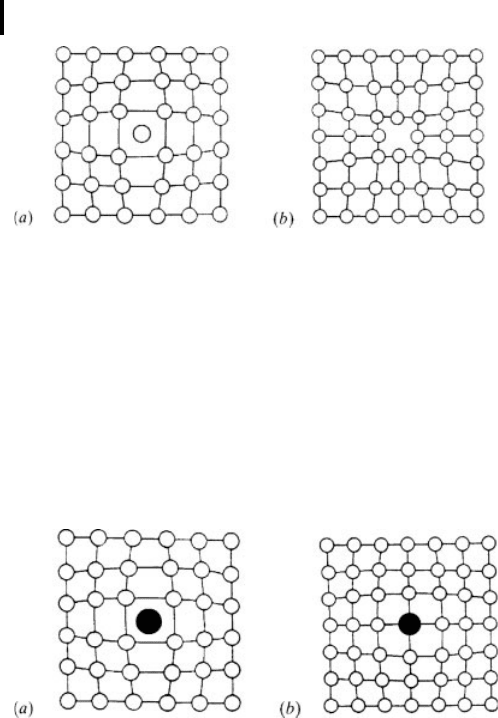
The simplest types of point defects in a crystal are as follows: interstitial atoms are
atoms occupying positions between the equilibrium positions o f id eal lattice atoms
(Fig. 9.1a); vacancies are lattice sites where atoms are absent ( Fig. 9.1b); interstitial
impurities are “strange” atoms incorporated in a crystal, i. e., those that occupy inter-
stitial positions in a lattice (Fig. 9.2a); substitutional impurities are “strange” atoms or
entire molecules that replace the host atoms in lattice sites (Fig. 9.2b).
The Crystal Lattice: Phonons, Solitons, Dislocations, Superlattices, Second Edition. Arnold M. Kosevich
Copyright
c
2005 WILEY-VCH Verlag GmbH & Co. KGaA, Weinheim
ISBN: 3-527-40508-9
216
9 Point Defects
Fig. 9.1 “Proper” defects of a crystal lattice: (
a
) is an interstitial atom;
(
b
) is a vacancy.
We consider the influence of a “proper” point defect on the surrounding matrix in
a simple cubic lattice of a metal or a nonpolar dielectric (dielectric with a covalent
bond). An interstitial atom incorporated in such a lattice locally breaks its ideality.
The sites nearest to this atom are displaced due to the interstitial atom (Fig. 9.1a). In
a simple cubic lattice this deformatio n has a cub ic symmetry.
A vacancy in a simple crystal lattice leads to the displacement of the nearest atoms
in the direction of the vacancy position (Fig. 9.1b).
Fig. 9.2 Atoms of impur ities: (
a
) – interstitial; (
b
) – substitutional.
It is seen from Fig. 9.1a,b that vacancies and interstitial atoms may be considered
as defects of opposite “sign”. In particular, a vacancy in a simple crystal lattice leads
to the displacement of the nearest atoms towards the vacancy position ( Fig. 9.1b). The
annihilation of a vacancy and an interstitial atom may b e effected, that is followed by
the disappearan ce of the vacancy and interstitial atom.
Another pro cess is possible when an interstitial atom leaves its position a nd goes
over to an interstitial site, creating a pair of defects. This scheme is effected if a crystal
is radiated by energetic particles when a particle passing through the crystal displaces
an atom from its site, transferring it to an interstice.
A vacancy and an interstitial atom po sitio ned close together are referred to as a
Frenkel pair of defects (Ya. I. Frenkel was the first to describe these defects).
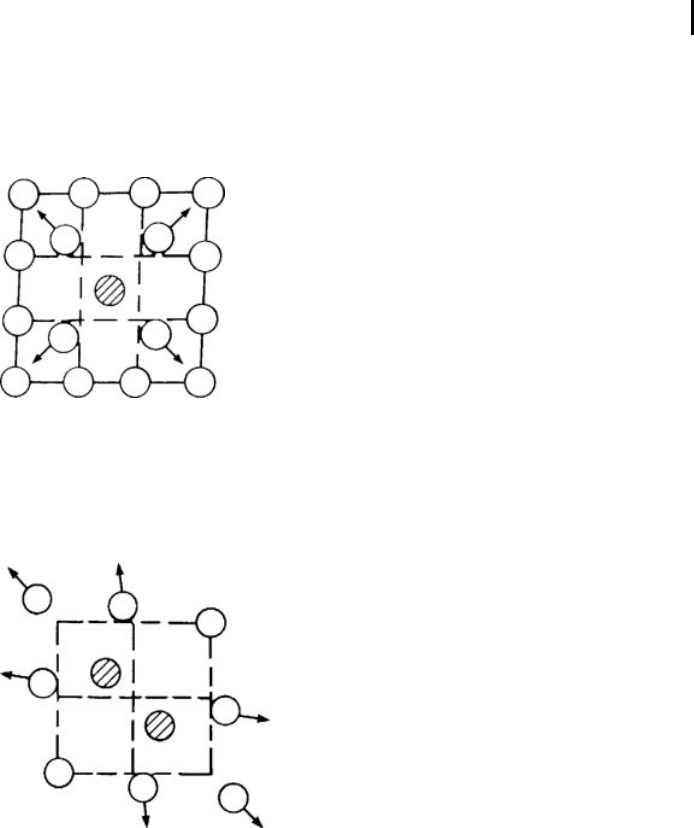
Let us note that the local environment of an interstitial atom (Fig. 9.1a) and the di-
rections of the nearest-atom displacements for crystals with a primitive Bravais lattice
(Fig. 9.3) are different from those observed in a body- or face-centered cubic lattice.
9.1 Point-Defect Models in the Crystal Lattice
217
The displacements near the interstitial atom in such lattices may have no high degrees
of symmetry, as shown in Fig. 9.3. In particular, in the vicinity of an “excess” atom
the lattice configuration with two isolated atoms is possible (Fig. 9.4). Such a position
of an interstitial atom generates a dumb-bell-shaped configuration of the defect.
Fig. 9.3 Atomic displacement near an interstitial in a primitive cubic
lattice.
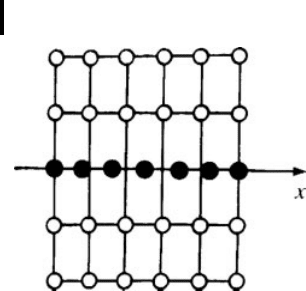
Another possible position of an “extra” proper atom in a lattice is the crowdion con-
figuration that is different in symmetry from the standard interstitial position. A crow-
dion in a 1D crystal is described in Section 5.2.
Fig. 9.4 Dumb-bell-shaped configuration of an interstitial atom.
Now we turn to a line of densely packed atoms in a 3D crystal (Fig. 9.5). Of the
two possible types of defects with an extra atom of the same type (dumb-bell-shaped
and crowdion configurations) the “dumb-bell” is an energetically more advantageous
static point defect, while the crowdion is a dynamic defect capable of moving easily
along a line of densely packed atoms. The comparatively easy motion of a crowdion is
associated with the fact that with a sufficiently extended region of atomic condensation
along a separate line, the displacement of the crowdion center of mass is achieved by
an insignificant displacement of each atom in this line.
It is natural that in a low-symmetry lattice the vacancy may also be characterized
by a local atomic rearrangement of a dipole or “anticrowdion” type.
218
9 Point Defects
Fig. 9.5 Acrowdiononthex-axis.
An anisotropic lattice deformation (indicated by arrows in Fig. 9.4) is also gen-
erated by an impurity molecule that has no spherical symmetry. The corresponding
static point defect is sometimes called an elastic dipole. As a rule, the same dipole-
type defect may be oriented in different ways with respect to the crystal axes and the
processes of elastic dipole reorientation are possible where its dynamic properties are
manifest.
Considering the localization of an interstitial im purity (or an interstitial atom) in a
crystal, we note th a t the unit cell of each crystal lattice has one or several equivalent
positions for interstitials that are determined by the geometrical structure of the lattice.
For instance, in a primitive cubic lattice this position is the cube center, in a FCC
lattice the positions fo r interstitials are localized either at the center of the cube or
at the middle of the cube edges. In a BCC lattice these p ositions are at the centers of
tetrahedrons constructed of two atoms at the cube vertices and two atoms at the centers
of neighboring cubes or in the middle of the cube edges (in octahedron interstices).
If the local surroundings of interstitial vacancies have no cubic symmetry (as, e. g.,
in a BCC lattice) nonisotropic deformations arise around the interstitial atoms. First, a
prerequisite for a dumb-bell or crowdion configuration of an in terstitial atom appears
and, second, the impurity in such a position behaves as an elastic dipole. A classical
example of the latter is the iron crystal distortion around a carbon atom impurity.
Carbon atoms get into octahedron interstices of a BCC iron lattice and behave as
single-axis elastic dipoles oriented along the cube edges.
9.2
Defects in Quantum Crystals
In describing the point defects of a crystal lattice we proceeded from a seemingly
obvious assumption of defect localization in a certain site or interstice. However,
the existence of crystals with specific quantum properties (Chapter 8) makes such an
assumption that is purely substantiated and even unreal in some cases. This refers
9.2 Defects in Quantum Crystals
219
first of all to the defects in quantum crystals and to the behavior of hydrogen atom
impurities in the matrix of rather heavy elements.
Since defect localization is doubtful, it is necessary to make a more rigorous analy-
sis of the physical situation arising in a crystal containing defects.
If we have a crystal with a single point defect, then its Hamiltonian function (or
Hamiltonian) is a periodic function of the coordinate of the defect with the period
of the crystal lattice. We shall study only those crystal degrees of freedom that are
described by the defect coordinates, with the temperature assumed to be zero. We
consider the localization of the defect at one of the equilibrium positions correspond-
ing to the crystal-energy minimum. The dynamical properties of a defect are then
manifest only in small oscillations near the fixed equilibrium position. Thus, the crys-
tal state concept is unambiguously associated with the notion of a fixed coordinate of
the defect.
Defect localization becomes impossible when quantum tunneling occurs. The de-
fect coordinate as a characteristic of the crystal state ceases to be a well-defined quan-
tity and various states of a crystal with a defect should be classified by the values of
a quasi-wave vector k. The crystal energy becomes a periodic function with respect
to k.
If we subtract from this energy the energy of a crystal without a d efect, then we get
the defect energy ε
D
(k) . The different values of k inside the Brillouin zone determine
different energies ε
D
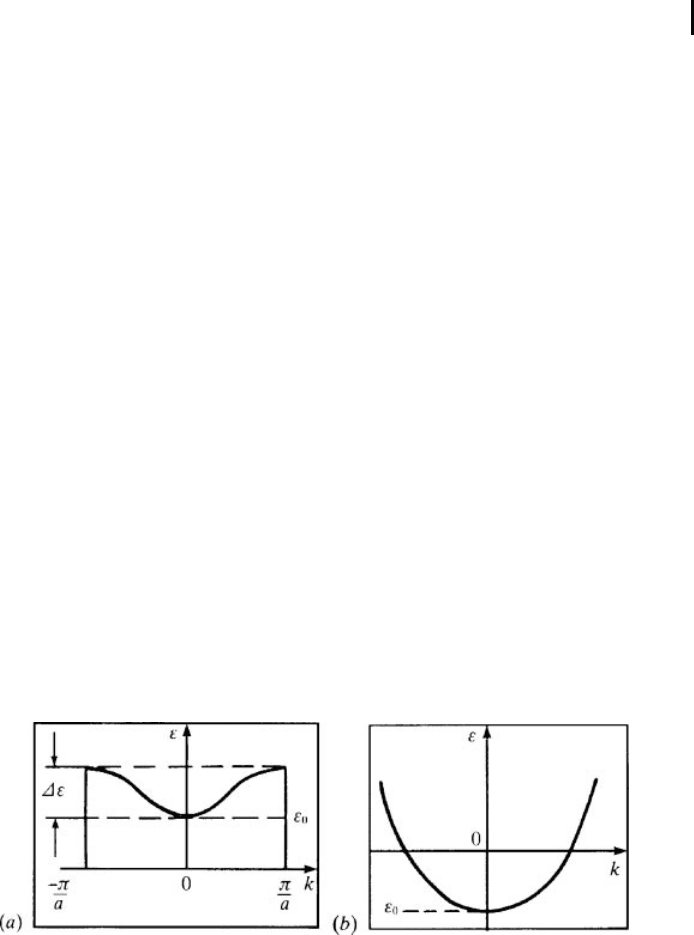
(k) . Thus, an energy band of some width ∆ε proportional to
the probability for quantum tunneling of a defect from one equilibrium position to a
neighboring one arises. This new part of a crystal energy spectrum (Fig. 9.6a) is due
to the appearance of a movable quantum defect. Thus, the defect is associated with an
additional branch of quantum single-particle excitations.
Fig. 9.6 The defecton dispersion law: (
a
) the appearance of a defecton
needs energy expenditure ε
0
;(
b
) the appearance of vacancies induces
the rearrangement of the crystal ground state.
It is clear that a defect in a quantum crystal is delocalized and behaves as a free
particle. It is called a defecton (Andreev and Lifshits, 1969) and the dependence of
the energy ε
D
(k) on k is referred to as the defecton dispersion law. An example o f a
defecton is a
3
He isotope atom in solid
4
He.

220
9 Point Defects
The defectons can collide with one another at finite concen trations, and collisions
with other crystal excitations (e. g., phonons) are also possible at finite temperatures.
An increasing number of collisions fundamentally affects the character of defecton
motion. If the frequency of collisions is small enough, we practically have a freely
moving defecton. With increasing frequency of collisio ns the defecton can approach
equilibrium with the lattice during the time when it stays within a unit cell. We then
speak about a practically localized defect.
In most cases the tunneling probability is relatively small. Therefore, to calculate
the defecton dispersion law, we may use the strong coupling approximation known in
electron theory. The function ε
D
(k) is found in this case explicitly at all values of k.
For instance, for a simple cubic lattice we h ave
ε
D
(k)=ε
1
−ε
2
(cos ka
1
+ cos ka
2
+ cos ka
3
), (9.2.1)
where ε
1
, ε
2
are constant values, |ε
2
| is proportional to the quantum-tunneling proba-
bility; a
α
are the fundamental lattice translation vectors, α = 1, 2, 3. The width of the
defecton energy band is ∆ε = 6 |ε
2
|.
In an isotropic approximation, the expansion (9.2.1) near the minimum value of ε
0
(the energy band bottom) has the form
ε
D
= ε
0
+
¯h
2
k
2
2m
∗
, ε
0
= ε
1
−3ε
2
, (9.2.2)
where m
∗
is the defecton effective mass (of order of magnitude ¯h
2
/m
∗
∼ a
2
∆ε).
The presence of a defecton in a quantum crystal allows one to explain the physical
nature of quantum dilatatio n (Chapter 8). We assume that in a crystal free of impurities
the “defectiveness” arises only due to the excitation of vacancies. The possibility of
tunneling transforms a vacancy into a defecton, or a vacancy wave with the dispersion
relation (9.2.2).
Vacancy wave generation with k = 0 does not break the ideal periodicity of a
crystal. However, the number of crystal lattice sites becomes unequal to the number
of atoms. The defecton energy with k = 0,i.e.,ε
0
, is dependent on the state of
a crystal, in particular on its volume V changing under the influence of an external
pressure. It may turn out that at a certain volume V
k
the parameter ε
0
vanishes. We
assume that near this point
ε
0
= λ
V
k
−V
V
k
. (9.2.3)
We shall set, for definiteness, λ > 0 and consider the defectons obeying Bose
statistics (such as vacancies in solid
4
He).
It then follows from (9.2.3) that for V < V
k
, ε
0
> 0 and the energy spectrum of
defectons is separated from the ground-state energy (without defectons) by a gap. A
finite activation energy is needed to form a vacancy and thus at T = 0 the number of
defectons equals zero.
9.2 Defects in Quantum Crystals
221
For V > V
k
, ε
0
< 0 (Fig. 9.6b) and defecton generation becomes advantageous
even at T = 0. Vacancies tend to assemble into a state with the last energy (k = 0)
that is promoted by Bose statistics. The defects are accumulated (condensed) in this
state until defect repulsion effects start to manifest themselves. It is clear that with any
vacancy repulsion law the energy minimum at T = 0 corresponds to a nonzero equi-
librium co ncentration of defectons with k = 0. Since with a fixed number of atoms
each vacancy increases the number of crystal sites by unity, a finite defect concentra-
tion actually generates a certain crystal dilatation. This is just the quantum dilatation.
A narrow energy band is typical for the defecton dispersion law (9.2.1). According
to experiments, its width ∼ 10
−5
−10
−4
K ∼ 10
−9
−10
−8
eV ∼ 10
−21
−10
−20
erg
for the
3
He atom playing the role of an “impuriton” in solid
4
He. Thus, the energy
band width of the quasi-particle motion of this well-studied defecton is very small
compared to any energies on an atomic scale. This makes the defecton dynamics in
external inhomogeneous fields that arise in a crystal, essentially different from the
dynamics of ordinary free particles.
Let the defecton be in an external field providing the potential energy U(x) but not
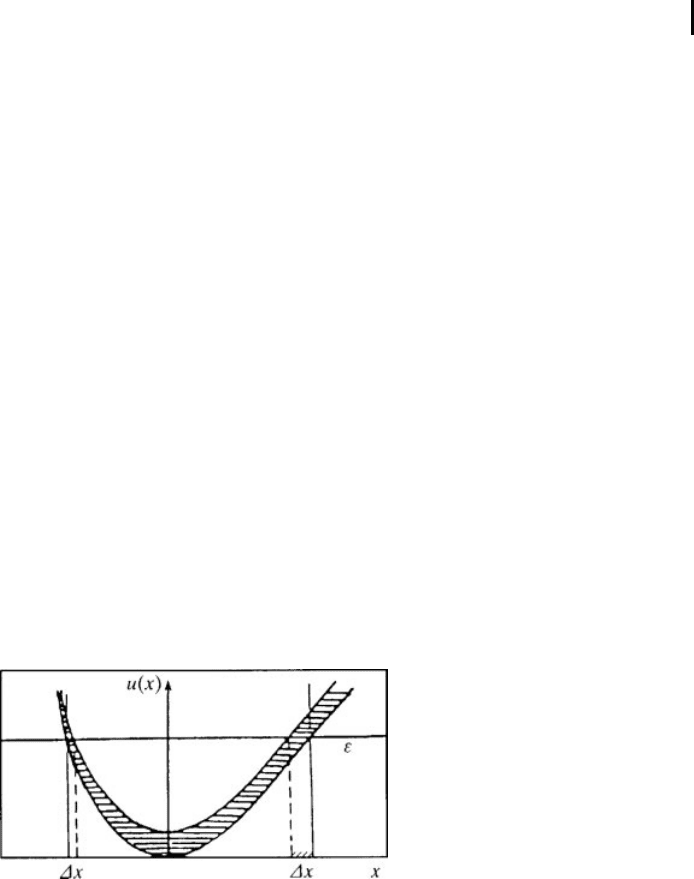
influencing its kinetic energy (9.2.1). The total energy of the defecton E( k, x) can
then be written as E(k, x)=ε
D
(k)+U(x).
If, for the characteristic distances l a, a the potential energy changes by δU
∆ε the defecton energy will fill a narrow strongly distorted band (Fig. 9.7). The fixed
energy of a defecton E(k, x)=E = const corresponds to its motion localized in a
space region with dimensions δx ∼ l∆ε/δU l. Such a localization is independent
of the sign of grad U (Fig. 9.7).
Fig. 9.7 Localization of defecton motion in an external potential field.
Let us assume that the external field is changed at a distance l ∼ 100a ∼ 10
−6
cm
in a certain direction by δU eV. In this case, for ∆ε ∼ 10
−8
the defecton is localized
along the direction of grad U at a distance ∆x ∼ 10
−8
cm and it moves in fact along
the surface of constant potential energy U(x)=const (to be precise, in a thin layer
with a thickness that is comparable with the interatomic distance).
We note that in a strong magnetic field the
3
He impuritons with different orientation
of nuclear spin are in different energy bands. Indeed, the nuclear magnetic moment of