
Kosevich A.M. The crystal lattice
Подождите немного. Документ загружается.


222
9 Point Defects
3
He in a magnetic field H has the energy ( µ
0
is the Bohr magneton)
U
m
= ±µ
nucl
H ∼±10
−3
µ
0
H.
For H ∼ 10
−3
Oe we obtain |U
m
|∼10
−19
erg δε, i. e., the energy bands
of impuritons with magnetic moments d irected along an external magnetic field or
opposite to it do not overlap.
9.3
Mechanisms of Classical Diffusion and Quantum Diffusion of Defectons
Any point defects in a lattice are capable of migrating, i. e., moving in a crystal. For
classical defects the only reason for migrating is a fluctuational thermal motion, and
this arises through chaotic movement of a point defect in a lattice. If under the action
of certain “driving forces” such a migration is effected directionally, then one can
speak of the diffusion of point defects. However, sometimes the diffusion motion
implies any thermal migration o f the defects even if it is not characterized by a specific
direction. In what follows we shall be interested not in the direction of diffusional
migration of the defects but in the mechanisms of their migration.
Thus, the atomic process in which the defect performs more or less random walks
by jumping from a certain position to the neighboring equivalent position underlies
classical diffusion. What d etermines the proba bility of a separate jump?
A strong in teraction between the classical defect and a crystal lattice makes it lo-
calized. As a result, the defect turn s out to be in a deep p otential well and performin g
here small oscillations with frequency ω
0
.
Suppose that we transfer the defect quasi-statically from some point of localization
to neighboring ones, defining the crystal energy E as a function of an instantaneous
coordinate of the defect. If we d enote by x a coordinate measured along this imaginary
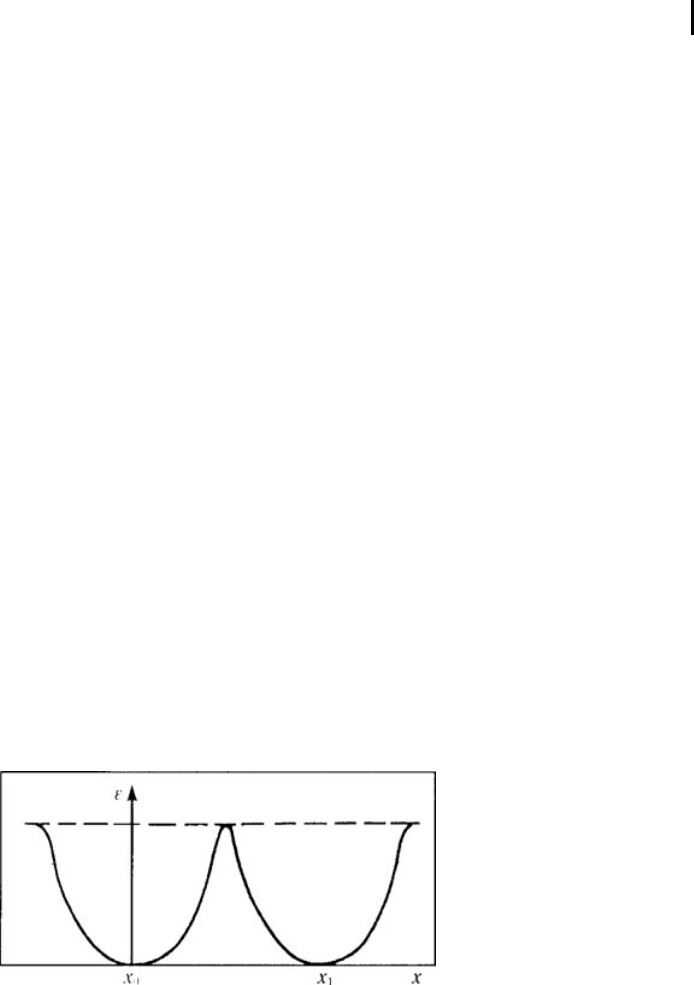
route of the defect migration, the crystal-energy plot in the simplest case will have the
form shown in Fig. 9.8, where x = x
0
and x = x
1
are two neighboring positions of the
defect localization. Varying the “routes” of the transition from x
0
to x
1
, we can find a
way through the “saddle point” characterized by the lowest barrier U
0
that divides the
positions x
0
and x
1
. The probability for a thermally activated fluctuation transition
of the defect into the neighboring equilibrium position will then be proportional to
exp(−U
0
/T) and the diffusion coefficient
D = D
0
e
−U
0
/T
, D
0
∼ a
2
ω
0
, (9.3.1)
where a is the lattice constant determining the order of magnitude o f the distance
between the neighboring equivalent positions of the defect.
Comparing the defect migration activation energy U
0
with the p arameter of the plot
shown in Fig. 9.8, we should remember that this parameter is conventional. The ex-
istence of the function E = E(x) assumes that in the process of defect migration, the
9.3 Mechanisms of Classical Diffusion and Quantum Diffusion of Defectons
223
crystal has time to get into an equilibrium state characterized by the defect coordi-
nate x. Thus, the energy E can be regarded as a function of the coordinate only when
the defect moves slowly in passing between the positions x
0
and x
1
.Ifthe“slow-
ness” condition is not satisfied, the plot for the function of the variable x becomes
meaningless. Equation (9.3.1) remains valid, but the activation energy U
0
becomes an
independent diffusion parameter that determines the “saddle-point” energy in some
multidimensional space of crystal lattice atomic configurations near the defect.
Finally, the migration of a complex poin t defect may be multisteppe d. The crowdion
mechanism of “extra” atom migration is very often observed along a line of densely
packed atoms. However, crowdion displacement under a strong external influence
resembles mechanical motion rather than jump diffusion.
Quite a different mechanism is responsible for quantum defect (defecton) motion.
We consider the behavior of an individual defecton in an almost ideal crystal with a
very small concentration of both classical defects and defectons.
At absolute zero (T = 0) the defecton behaves as a quasi-particle with the disper-
sion law (9.2.1), moving freely in a crystal and a set of defectons has the properties of
an ideal gas. In this case the defecton diffusion coefficient can be determined by a g as-
kinematic expression D ∼ vl
0
where v is the defecton velocity (v ∼ ∆ε/k ∼ ∆ε/¯h);
l
0
is the mean free path (l
0
a) characterizing the collision of defectons with classi-
cal defects (e. g., impurities). The impurity free path (or defecton–defecton free path
with a fixed number of defectons) is temperature independent in the low-temperature
region. Therefore, one can always find an interval of extremely low temperatures in
which the defecton diffusion coefficient is independent of T: D = D(0)=constant.
The defecton energy band width ∆ε that is proportional to the defecton tunneling
probability, is very small (∆ε ¯hω) and thermal crystal oscillations can break it
easily. The main reason for the defecton band breaking can be explained by means of
the following rough scheme.
Fig. 9.8 The potential barrier separating equilibrium positions of the
defect at point x
0
and x
1
.
Let us make use of the concept of a site potential well as shown in Fig. 9.8. Neglect-
ing weak quantum tunneling, we consider the defecton localized in one such well. As
the well is rather deep, there exists a finite number of discrete energy levels of the
224
9 Point Defects
defecton ε
n
(n = 1, 2, 3, . . .), where ε
n+1
− ε
n
∼ ¯hω
0
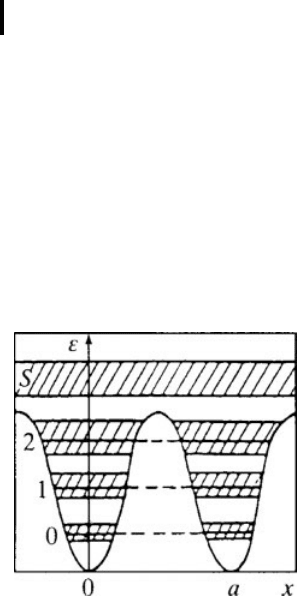
. By virtue of the translational
symmetry of the crystal, such energy levels are also observed in the other site wells
(Fig. 9 .9). The switching on of the tunneling effect generates in all systems of reso-
nance levels, narrow energy bands inside which the energy of the defecton free motion
depends on the quasi-wave vector k and is determined by an equation such as (9.2.1).
The quantum phenomenon of the above-barrier reflection in a periodic structure also
generates some energy bands of the defecton in the region of a classical continuous
energy spectrum (S is one such band (Fig. 9.9). At T = 0, quantum tunneling occurs
at the ground level, and due to the b and character of defecton motion the tunneling
time t is of the order of magnitude t ∼ a/v ∼ ¯h/∆ε.
Fig. 9.9 Energy bands of free defecton motion in a crystal at T = 0.
Thermal crystal motion shifts separate wells relative to each other, and for T ∆ε
the energy levels in the neighboring site wells cease to be resonant. This does not de-
stroy the defecton “pseudoband” motion. Indeed, the time of real tunneling t ∼ ¯h/∆ε
is large compared to both 1/ω
0
and ¯h/T. Thus, tunneling occurs at the ground level
that is averaged over the lattice oscillations (at t ¯hω
0
). Such a coherent motion
of the defect at rather low temperatures (∆ε T Θ) has a rather large free
path l a. The defecton scattering by phonons makes l temperature dependent:
l = l(T). With increasing temperature th e function l(T) decreases and at some tem-
perature T = T
1
it becomes less than l
0
; furthermore, at a certain temperature T = T
2
it is equal to the lattice period: l(T
2
) ∼ a. In the latter case the defecton band is
broken dynamically, and the defect is localized at a site.
The diffusion coefficient of the localized defect is expressed through the probability
of the transition w into the neighboring site by the relation D ∼ a
2
w,takinginto
account random jumps of a distance a with frequency w. Under the condition T
¯hω
0
, the probability w ≈ w
0
,wherew
0
is the transition probability at the ground level
and is temperature independent. The diffusion coefficient is then also temperature
independent and is of the order of magnitude D ∼ a
2
w
0
∼ a
2
∆ε/¯h.
Further increase in the temperature leads to the fact that the defect may, with high
probability, be in an excited state with energy ε
n
in th e potential well. The proba-
9.4 Quantum Crowdion Motion
225
bility of a transition into the neighboring site in this case is: w =
∑
n
w
n
e
−(ε
n
−F)/T
,
F = −T log
∑
n
e
−ε
n
/T
where w
n
is the probability of a transition from the state n.
With rising temperature, w increases from the value w
0
∼ 1/t (corresponding to
quantum tunneling at the ground level) up to a classical value to w ∼ exp(−U
0
/T)
that is attained d ue to the above-barrier transitio ns.
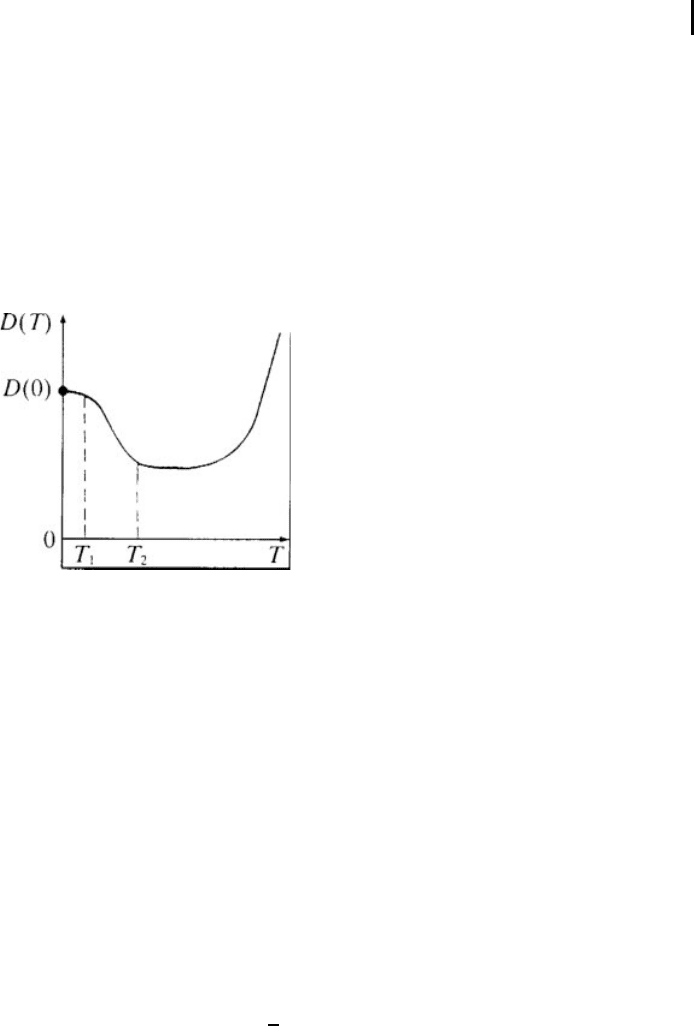
Thus, by lowering the temperature the diffusion coefficient of the defects first falls
exponentially (classical diffusion), then reaches a plateau (the quantum diffusion of
localized defects) and then rises to the value D(0) (Fig. 9.10).
Fig. 9.10 T h e temperature dependence of the defecton diffusion coeffi-
cient; the defecton mobility i s limited by the interaction with phonons in
the interval (T
1
, T
2
).
9.4
Quantum Crowdion Motion
A crowdion moves mechanically, and th e mechanical motion of atomic particles is
quantized. Thus, quantum effects should manifest themselves in crowdion motion.
According to the classical equations of crowdion motion, the crowdion Hamiltonian
function (1.7.6) is independent of the position of its center and this is a result of the
continuum approximation in which this function is d erived.
The simplest way to take into account the discreteness of the system concerned is
the following. We use the so lution (1.7. 8) and calculate the static energy of an atomic
chain with a crowdion at rest by using the formula
E =
∞
∑
n=−∞
1
2
α
0
u
n+1
− u
n
)
2
+ f (u
n
, (9.4.1)
where u
n
= u(x
n
) ≡ u(an).
It is easily seen that the static crowdion energy in the continuum approximation is
equally divided between the interatomic interaction energy and the atomic energy in
226
9 Point Defects
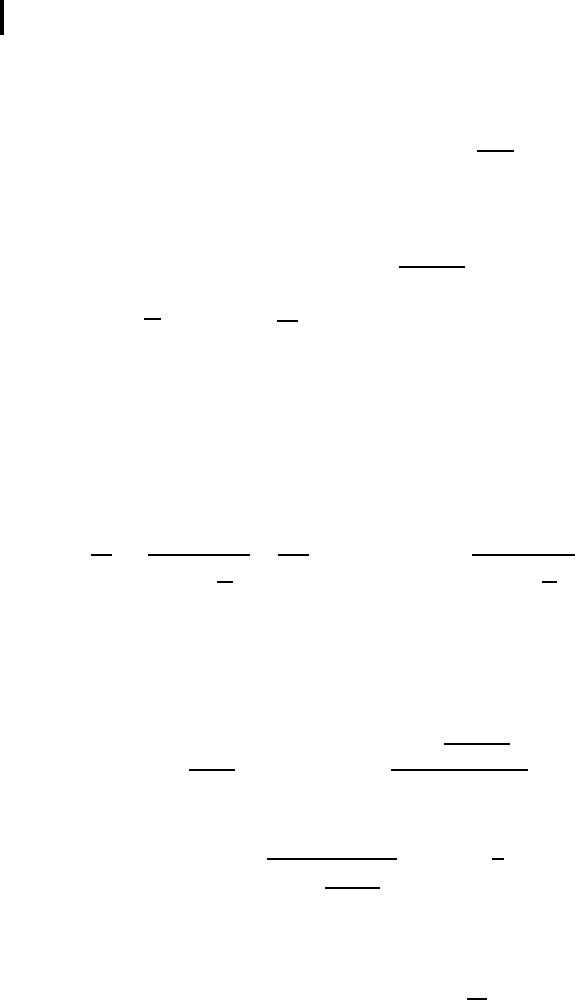
an external field. It can be assumed that the same equal-energy distribution remains in
a discrete chain, and instead of (9.4.1) we then write
E = 2
∞
∑
n=−∞
F(u
n
)=τ
2
∞
∑
n=−∞
sin
2
πu
n
a
.
We substitute here (1.6.12), assuming the point x = x
0
to be a crowdion center:
E = τ
2
∞
∑
n=−∞
sech
2
an − x
0
l
0
, (9.4.2)
where l
0
= as
√
m/(πτ)=a
2
√
α
0
/(πτ).
Using the Poisson summation formula,
∞
∑
n=−∞
f (n)=
∞
∑
m=−∞
+∞
−∞
f (k)e
2πimk
dk , (9.4.3)
we find
E =
τ
2
a
+∞
−∞
dx
cosh
2
x
l
0
+
2τ
2
a
∞
∑
m=1
e
2πim(x
0
/a)
+∞
−∞
e
2πim(x/a)
cosh
2
x
l
0
dx. (9.4.4)
The first term in (9.4.4) coincides with the energy E
0
of a crowdion at rest found
in the continuum approximation (1.7.1), and the second term is a periodic function of
the coordinate x
0
with period a: E = E
0
+ U(x
0
),where
U(x)=
2l
0
τ
2
a
∞
∑
m=1
e
2πim(x/a)
+∞
−∞
cos
2πml
0
ξ
a
cosh
2
ξ
dξ
= 4α
0
a
∞
∑
m=1
m
sinh
π
2
ml
0
a
cos
2πm
x
a
.
(9.4.5)
Sincewehaveassumedthatl
0
a, it then suffices to keep one term with m = 1
U(x
0
)=8α
0
a
2
e
−π
2
l
0
/a
cos
2π
x
0
a
. (9.4.6)
It is clear that the crowdion energy is periodically dependent on the coordinate of
its center x
0
that may be regarded as a quasi-particle coordinate. We set in (1.6.15)
x
0
= Vt using the ordinary relation between the coordinate and the velocity (at V =
const = 0). The part of the energy (9.4.6) that is dependent on the coordinate plays the
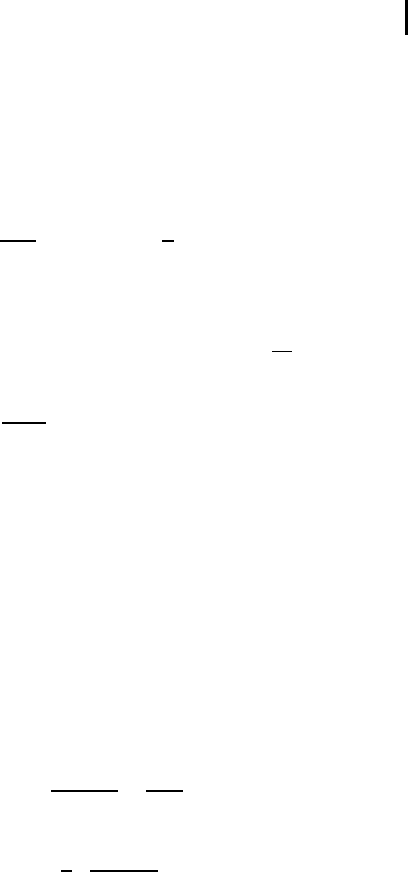
9.5 Point Defect in Elasticity Theory
227
role of the crowdion potential energy. Thus, crowdion migration in a discrete atomic
chain deals with overcoming of the potential relief (9.4.6). However, for l
0
a,
the potential energy curve (9.4.6) creates very weak potential barriers between the
neighboring energy minima, and the crowdion may overcome them through quantum
tunneling.
The Hamiltonian
H = E
0
+
P
2
2m
∗
+ U
1
cos
2π
x
a
, (9.4.7)
is used for the quantum description of crowdion motion, where
U
1
= 8α
0
a
2
e
−π
2
(l
0
/a)
. (9.4.8)
As both m
∗
and U
1
decrease with incr easing parameter l
0
/a ∼ a
√
α
0
/τ the phys-
ical situations, where
¯h
2
m
∗
a
2
U
1
, (9.4.9)
are quite reasonable. The inequality (9.4.9) means that the potential energy contribu-
tion that is dependent on the coordinate is a weak perturbation o f the kinetic energy
of free crowdion motion. In other words, the amplitude of zero crowdion vibrations in
one of the potential minima (9.4.9) greatly exceeds the one-dimensional crystal period
and the crowdion transforms into a crowdion wave (Pushkarov, 1973).
The energy spectrum of a crowdion wave with the Hamiltonian (9.4.7) is rather
complicated and consists of many bands in each of which the energy is a periodic
function of the quasi-wave number k with period 2π/a. However, small crowdion
wave energies for k 2π/a are not practically distinguished from the free particle
energy with the Hamiltonian (1.7.6) under the condition (9.4.9). I ndeed, if we calcu-
late quantum-mechanical corrections to the free particle energy in the second order of
perturbation theory in the potential (9.4.6), then
ε(k)= E
0
−U
1
m
∗
a
2
U
1
(2π¯h)
2
+
¯h
2
k
2
2M
,
M = m
∗
1 +
1
2
m
∗
a
2
U
1
(π¯h )
2
2
.
Thus, in spite of the presence of a potential energy curve (9.4.6), the crowdion wave
moves through a crystal as a free particle with a mass close to the crowdion effective
mass.
9.5
Point Defect in Elasticity Theory
When we consider the problems concerned with macroscopic mechanical properties
of solids, as a rule, it is necessary to take the static lattice distortions caused by the
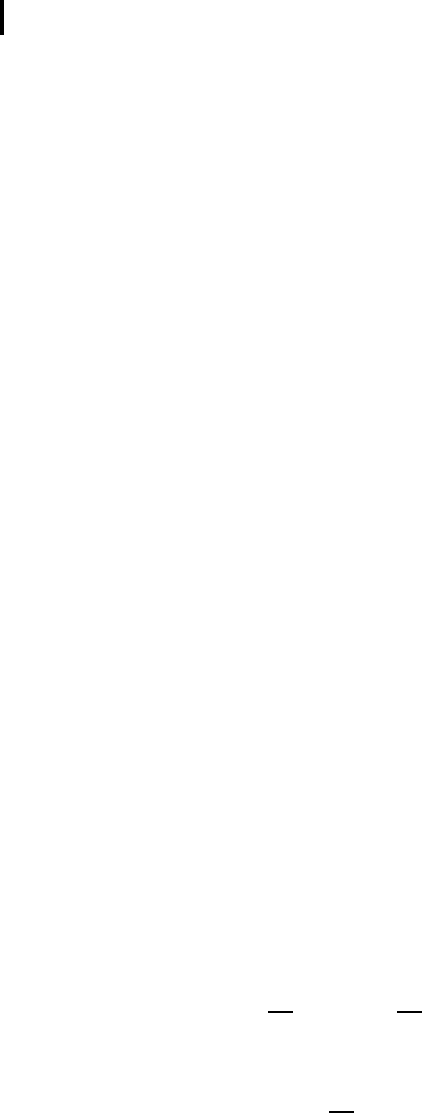
228
9 Point Defects
point defect into account. In calculations of such displacements the point defect is the
source of an elastic field.
In th e atomic model of an interstitial atom (Fig. 9.1a, or 9.3), the ato ms of the
nearest surroundings of an interstitial atom are repelled by the forces distributed very
symmetrically in each coordination sphere. The system of forces has a zero resultant
and a zero total moment. From a macroscopic point of view, their action is equivalent
to the action of three pairs of equal forces, applied to the point where an interstitial
atom is located and directed along the coordinate axes. In elasticity theory such a
system is described by the spatial distribution of forces such as (the defect is at the
coordinate origin)
f ( r)=−KΩ
0
grad δ(r), (9.5.1)
where k is the total compression modulus; Ω
0
is a constant multiplier with the dimen-
sions of volume, whose physical meaning will now be elucidated.
We note that if the distribution of bulk and surface forces in a cubic crystal is known
an elastic change in the crystal volume is calculated directly. We can determine a total
change in the deformed crystal volume without solving the problem of its deformed
state.
The equation of the elastic medium equilibrium that follows from (2.9.17) has the
form ∇
i
σ
ik
+ f
k
= 0.
We multiply this relation by x
i
and integrate over the whole crystal volume
x
i
∇
k
σ
ki
dV = −
rf dV . (9.5.2)
The l.h.s. of (9.5.2) can be transformed simply to give
x
i
∇
k
σ
ki
dV =
∇
k
(x
i
σ
ki
) dV −
σ
ik
∇
k
x
i
dV
=
S
x
i
σ
ki
ds
k
−
σ
ik
δ
ik
dV
= −
σ
kk
dV +
rp dS,
(9.5.3)
where p is the vector of the surface force density acting on the external surface of a
solid body S.
We substitu te (9.5.3) into (9.5.2) and use the relation (2.9.14) in a cubic crystal and
also (1.9.5)
∇V =
1
3K
rf dV +
1
3K
rp dS. (9.5.4)
If the external surface of a solid is free (p = 0), it follows from (9.5.4) that
∆V =
1
3K
rf dV . (9.5.5)
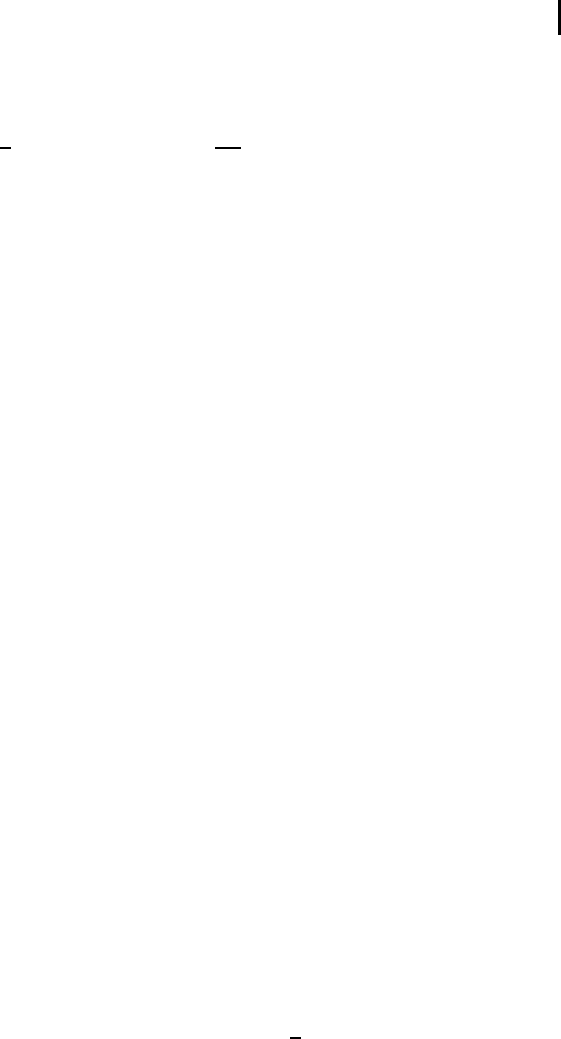
9.5 Point Defect in Elasticity Theory
229
We use (9.5.5) and calculate the change in the crystal volume induced by the density
of forces (9.5.1), and that experiences no external influence
∆V = −
1
3
Ω
0
r grad δ(r) dV =
Ω
0
3
δ(r) div r dV = Ω
0
. (9.5.6)
Thus, in a cubic crystal (or in an isotropic med ium) the qu a ntity Ω
0
has a simple
physical meaning and its value equals the increase in the crystal volume caused by one
interstitial atom. The extra ato m can only enlarge the crystal volume and therefore
Ω
0
> 0 . Usually the volume increase caused by an interstitial atom has the order of
magnitude of the atomic volume, and hence Ω
0
∼ V
0
= a
3
.
According to the classification of the elastic fields in the isotropic medium the defect
described by (9.5.1) is called a dilatation cen ter. We have thus used the dilatation
model for the interstitial atom.
A vacancy is different from an interstitial atom in that the deformation of the crys-
tal lattice is connected with the displacement o f the nearest atoms towards the defect
(Fig. 9.1a). This displacement is induced by forces whose symmetry in a simple cubic
lattice is the same as in the case of an interstitial atom. In other words, the f ormula
(9.5.1) is useful for describing vacancies, but the dilatation intensity should be re-
garded as negative (Ω
0
< 0).
The deformation near a dipole-type point defect is described in a somewhat differ-
ent way. Such a deformation is generated by a system of forces whose macroscopic
equivalent is represented by three pairs of forces applied at the point where the defect
is localized, with zero moment for each pair but with different values of the forces. In
elasticity theory such a system can be described by the density of forces
f
i
(r)=−KΩ
ik
∇
k
δ(r), (9.5.7)
and the absence of a total moment of these forces is contained in the symmetry of the
tensor Ω
ik
(Ω
ik
= Ω
ki
).
It is clear that the latter property is inherent only to a static point defect that is in
equilibrium with the surrounding lattice. If the elastic dipole orientation is a dynamic
characteristic, then the tensor Ω
ik
is not necessarily symmetric.
Performing calculations analogous to (9.5.6), it is easy to verify that the density of
forces (9.5.7) causes changes in the volume ∆V =(1/3) Ω
ll
. Thus, for an interstitial
impurity it is natural to take Ω
ll
> 0, assuming Ω
ll
∼ a
3
, and for the vacancy to take
Ω
ll
< 0.
If the elastic dipole has axial symmetry it is characterized by a tensor Ω
ik
of the
form
Ω
ik
= Ω
0
δ
ik
+ Ω
1
l
i
l
k
−
1
3
δ
ik
,
where l is the unit vector of the dipole axis. In a cubic crystal the first term describes
the pure dilatation properties o f an elastic dipole and the second term contains a new
parameter Ω
1
that determines the deviator part of the tensor Ω
ik
.
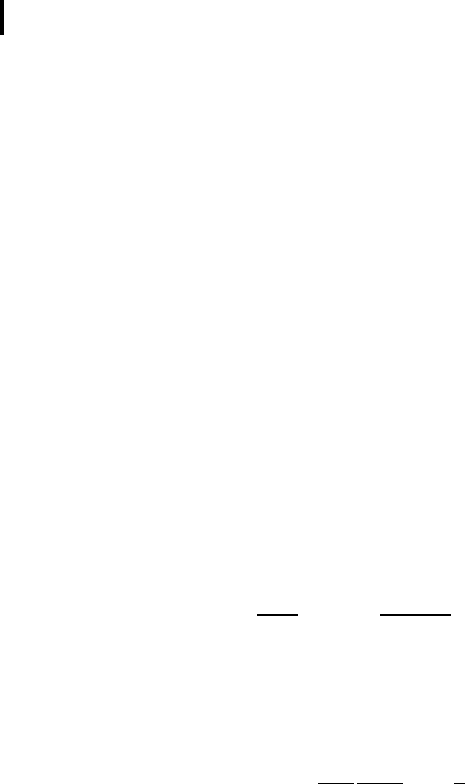
230
9 Point Defects
For the defect described by the density of forces (9.5.7) the convolution Ω
ll
only
has an obvious interpretation in a cubic crystal. If a crystal has no cubic symmetry,
a simple physical meaning even of this quantity is lost and the tensor Ω
ik
should be
regarded as a certain effective characteristic of the point defect.
Let us find the elastic field generated b y a point defect and see th at it really is
extended over macroscopic distances (otherwise, a proposed treatment would make
no sense). We denote by G
ik
the static Green tensor of elasticity theory, i. e., a solution
to the equation vanishing at infinity
λ
∗
iklm
∇
k
∇
l
G
mj
(r)+δ
ij
δ(r)=0.
The displacement vector induced in an unbounded crystal by the density of forces
f (r) is
u
i
(r)=
G
ik
(r − r
) f
k
(r
) dV
. (9.5.8)
We substitute here (9.5.7) and integrate by parts:
u
i
(r)=−KΩ
kl
∇
l
G
ik
(r). (9.5.9)
In the isotropic approximation, the Green tensor for an unbounded space can be
written explicitly
G
ik
(r)=
1
8πG
δ
ik
∆ −
1
2(1 − ν)
∇
i
∇
k
r, (9.5.10)
where ∆ is the Laplace operator (∆ ≡∇
2
k
); ν is the Poisson coefficient (Poisson’s
ratio).
We substitute (9.5.10) into (9.5.9) and restrict ourselves to the case of a dilatation
center (Ω
ik
= δ
ik
Ω
0
):
u(r)=−
Ω
0
12π
1 + ν
1 − ν
grad
1
r
. (9.5.11)
As it follows from (9.5.11) that div u = ε
kk
= 0 at all the points off the region
occupied by an interstitial ato m (off the point r = 0), the dilatation center in an un -
bounded isotropic medium causes a pure shear deformation. It is natural that the latter
conclusion is valid only when the following conditions are satisfied simultaneously:
first, the medium is unbounded, second, the medium is purely isotropic, third, the
point defect is equivalent to the dilatation center. If even one of these conditions is not
satisfied, the elastic point defect field is not strictly a shear field.
We now discuss the first of the above-mentioned conditions. It is connected with
the fact that static elastic field s similar to a Coulomb field decrease very slowly with
distance. That is why it is necessary to take into account the finite dimensions of the
crystal specimen even in considering the field of an isolated defect.
The displacement field that is generated by the dilatation center is described by
(9.5.11) only in an infinite-dimension specimen. In any arbitrarily large, yet finite
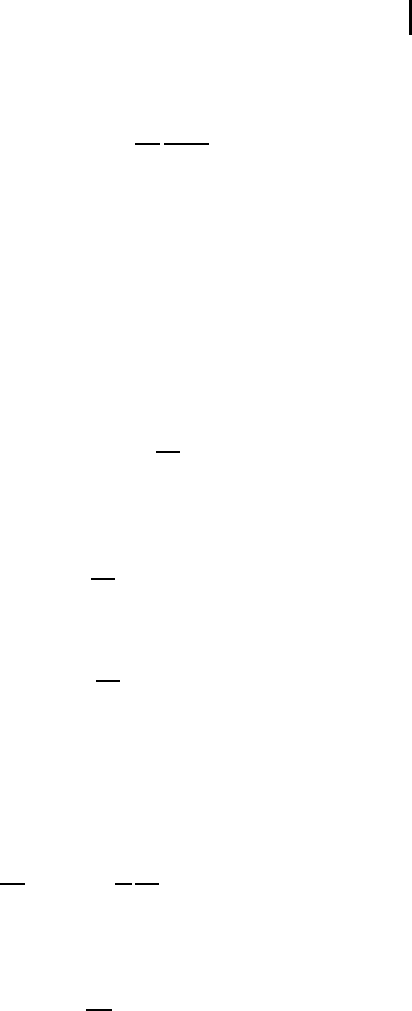
9.5 Point Defect in Elasticity Theory
231
specimen, this formula needs to be improved. Indeed, we note that the dilatation is
concentrated at the defect:
div u = πγΩ
0
δ(r), γ = −
1
3π
1 + ν
1 − ν
.
Therefore, the increase in the volume of the whole specimen calculated from
(9.5.11) is given by
∆V =
div u dV = πγΩ
0
. (9.5.12)
It can be verified that πγ =(1 + 4G/3K)
−1
< 1. Thus, the increase in the crystal
volume obtained b y a direct calculation appears to be less than the initial Ω
0
.This
is due to the fact that the solution (9.5.11) does not actually satisfy the requirement
σ
nn
= 0 on the external surface of a solid. It is clear that if n is the unit vector of the
normal to the spherical surface, then it follows from (9.5.11) (at r = R )that
σ
ik
n
k
= 2G
ik
n
k
= −GΩ
0
γ
n
i
R
3
. (9.5.13)
In order for the external surface of a solid to be free, the quantity (9.5.13) should be
compensated by a surface force density
p = GΩ
0
γ
n
R
3
,
generating in a crystal volume a homogeneous stressed state with the stress tensor
σ
1
ik
= GΩ
0
γ
δ
ik
R
3
. (9.5.14)
Sometimes a field such as (9.5.14) is called an image field or a field of imaginary
sources, by analogy with the electrostatic charge field arising near a conducting sur-
face and equivalent to the field of the charge mirror image.
If we set R = ∞,thenσ
1
ik
will vanish, but at any finite R (9.5.14) results in a
homogeneous expansion of a solid body
ε
1
ll
=
1
3K
σ
1
ll
= Ω
0
γ
G
K
1
R
3
. (9.5.15)
It is natural that (9.5.15) determines such an increase in the volume of the whole
sample ∆V
1
that, being added to (9.5.15), will give Ω
0
:
∆V + ∆V
1
= πγΩ
0
+
4π
3
γR
3
ε
1
ll
= Ω
0
. (9.5.16)
The equality (9 .5.16) proves the consistency of all our calculatio ns. We, however,
point out the other aspect of the problem discussed.
Let us consider a specimen with a un iform distribution of ide ntical dilatation centers
with small concentration and introduce the averaged characteristics of elastic fields