
Kosevich A.M. The crystal lattice
Подождите немного. Документ загружается.


242
10 Linear Crystal Defects
on the surface S, then where b is a fixed vector identical at all points on the surface
S, the distortion tensor u
ik
remains a continuous and differentiable function of the
coordinate everywhere except for a closed line on which the surface S is spanned.
However, the requirement of continuity for the distortion tensor is, to some extent,
excessive as the physical state of the elastic body depends only on stresses and elastic
strains proportional to them. Thus, for studying the elastic fields generated by dis-
continuities δu on surfaces not distinguished by their physical properties in the body
volume we restrict ourselves to the requirement of unambiguity and continuity of the
strain tensor
ik
. It then turns out that (10.2.2) does not present a general form of the
change of the vector u on the surface S at which the strain tensor ε
ik
conserves conti-
nuity and differentiability as a function of the coordinates. The most general form o f
the discontinuity at the surface S is
δu = u
+
−u
−
= b +[Ω r] , (10.4.1)
where b and Ω are constant vectors (b is a translation vector and Ω is a rigid rotation
vector); r is the point radius vector on the surface S. The vector Ω in a crystal should
coincide with one of the elements of crystal rotational symmetry.
Under the condition (10.4.1) an antisymmetric part of the distortion tensor is bro-
ken on the surface. On reminding ourselves of the definition of the rotation vector
under the deformation (1.9.4) we see that the rotation vector ω undergoes a step at the
surface:
δω ≡ ω
+
−ω
−
= Ω. (10.4.2)
The jumps (10.4.1), (10.4.2) generate an elastic field singularity in the crystal con-
centrated along the line D on which the surface S is spanned.
If Ω = 0, then (10.4.1) is transformed into (10.2.2), and the translation vector b
coincides with the Burgers dislocation vector.
If b = 0,butΩ = 0, the singularity arising in a solid is called a disclination.The
disclination vector Ω is sometimes called the disclination power, and sometimes the
Frank vector. We shall use the latter name.
It follows from (10.4.2) that in the presence of a disclination the Frank vector de-
scribes a relative rigid rotation of two parts o f a solid positioned on both sides of the
surface S. It is clear that for an unambiguous definition of δu in (10.2.1), the space
position of the vector Ω, i. e., the position of the disclination axis should be fixed. The
displacement of the disclination rotation axis by the vector R amounts to adding an
ordinary dislocation with Burgers vector b =[ΩR]. Therefore, the definition of a
disclination in (10.4.1) becomes unambiguous if we rewrite it as
δu
i
(r)=e
ilm
Ω
l
(x
m
− x
0
m
), (10.4.3)
where r
0
is the radius vector of the point through which the rotation axis g iven by the
vector Ω runs. It follows from a direct calculation that (10.4.2) is a consequence of
(10.4.3).

10.4 Disclinations
243
As the disclination is a linear singularity of the elastic deformation field, it may
be defined in a form that does not use the notion of an arbitrary surface S,i.e.,in
a form analogous to the definition of a dislocation (10.2.1). Indeed, we introduce a
continuous and differentiable function ω(r) (the medium element rotation at point r
as a result of an elastic deformation o f a solid). The disclination will then be said to
beaspecificlineD with the following property: in passing around any closed contour
L enclosing the line D, the elastic rotation vector ω gets a certain finite increment Ω.
This property is written as
L
dω
i
=
∂ω
i
∂x
k
dx
k
= −Ω
i
. (10.4.4)
The Frank vector Ω unambiguously determines the properties of the disclination D
only when the point through which the disclination rotation axes runs is specified.
Let τ be a unit vector tangent to the line of the disclination. If τ Ω, the discli-
nation is called a wedging or a slope disclination.Ifτ ⊥ Ω we have a twisting
disclination.
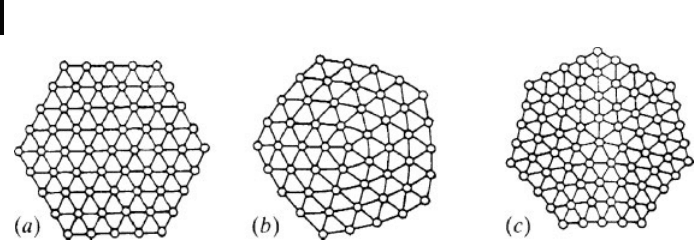
A disclination in a crystal is most vividly exemplified by a 60
◦
wedging disclina-
tion in a hexagonal crystal when this defect is parallel to the six-fold symmetry axis.
Analyzing the atomic arrangement in a plane perpendicular to the axis of this discli-
nation in a nondefective crystal (Fig. 10.7a) and also their distortion in the presence of
a p ositive (Fig. 10.7b) and a negative (Fig. 10.7c) wedging disclination, we note the
following peculiarities. Choosing the sign of a wedging disclination, unlike choosing
it for an edge dislocation, has an absolute character: the atomic displacements in the
vicinity of a positive disclination is inverse to the atomic displacements in the vicinity
of a negative disclination. In the first case, crystal stretching is observed along the
contour that encloses the disclination, and in the second case, we have crystal com-
pression.
Another important peculiarity of the wedge disclination observed is the change in
the crystal lattice symmetry in the vicinity of a disclination. Indeed, for a 60
◦
positive
wedging disclination there arises a five-fold symmetry axis coincident with the vector
Ω (Fig. 10.7b), and a 60
◦
negative disclination generates pseudosymmetry with a
seven-fold symmetry axis (Fig. 10.7c). In a perfect crystal such rotational symmetry
is impossible.
The two types of linear defects considered here (dislocation s an d disclinations) are
in fact two in dependent forms of the same family of peculiarities inherent to the defor-
mation of continuous media that are called Volterra dislocations. The dislocations in a
crystal are translational Volterra dislocations, and disclinations are rotational Volterra
dislocations. Generally, the Volterra dislocation may have a mixed character, i. e.,
simultaneously represent a translational dislocation and a disclination.
We now turn to finding an elastic field around a separate disclination. Note that a
simple tool for calculating this field can be obtained on the basis of (10.4.3). If we
consider the disclination as a line limiting the surface S with g iven rotation vector
244
10 Linear Crystal Defects
Fig. 10.7 A 60
◦
wedge dislocation parallel to the six-fold symmetry
axis: (
a
) ideal structure in a basal plane; (
b
) structure with a positive
disclination; (
c
) structure with a negative disclination.
jump (10.4.2), then it corresponds formally to a dislocation with “Burgers vector”
distributed over the surface S
b
(S)
i
= e
ilm
Ω
l
(x
m
− x
0
m
). (10.4.5)
It is true that in contrast to th e Burgers vector of an ordinary dislocation distribution
(10.4.5) is dependent on the coordinate on the surface S. However, this does not
prevent us from using (10.2.5), without taking the Burgers vector outside the integral
sign. Hence, the problem of finding the displacement vector u( r) around a separate
disclination loop is reduced to calculation of the integral
u
i
(r)=−λ
jklm
e
mpq
Ω
p
S
(x
q
− x
0
q
)∇
k
G
ij
(r − r
) dS
l
. (10.4.6)
The expression (10.4.6) allows us to determine the elastic deformations of a crystal
with an arbitrary disclination loop.
10.5
Disclinations and Dislocations
In so me cases a simple isolated disclination can easily be represented by a planar “pile-
up” of continuously distributed dislocations. Equation (10.4.5) allows us to clarify
how the “Burgers vector” of dislocations is distribu ted along the surface S,whichis
necessary for these dislocations to be equivalent to a disclination with Frank vector Ω.
The above point is illustrated by the relationship between a wedge disclination and
a so-called dislocation wall. By “wall” we mean a large num ber of identical parallel
linear edge dislocations distributed in the same plane perpendicular to their Burgers
vectors (Fig. 10.8a). The dislocations are in parallel slip planes, the distances between
which in the simplest case are the same, i. e., equal to h.
The geometrical meaning of a crystal deformation generated by this system of dis-
locations is easily understood. The presence of a wall leads to a misorientation of
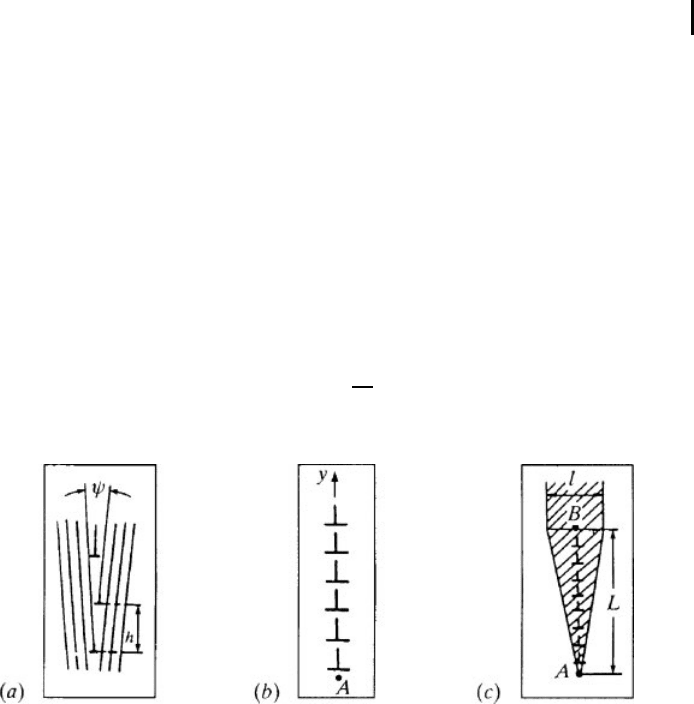
10.5 Disclinations and Dislocations
245
the two parts of a crystal that are divided by the system of dislocations concerned
(Fig. 10.8a). If h is the distance between the dislocations (in a macroscopic theory it
is necessary that h b), the misorientation angle between the two parts of a crystal is
ψ = b/ h. Thus, the dislocation wall is a model of the boundary between two blocks
or subgrains with small misorientation. If the boundary consists of edge dislocations,
then the axis around which the neighboring subgrains are inclined is in the plane di-
viding them. Such a low-angle grain boundary is called an inclination boundary.
Let a half-infinite inclination boundary end at a straight line A (Fig. 10.8b), the
dislocations being distributed in it continuously with the Burgers vector density b/h.
If we now imagine a closed contour enclosing the line A and intersecting the inclina-
tion boundary at the point y, then such a contour encloses dislocations with the total
Burgers vector
B
x
=
by
h
, (10.5.1)
where the coordinate y is measured from the line A.
Fig. 10.8 Dislocation wall and a wedging disclination: (
a
) low-angle
grain boundary, (
b
) dislocation wall ends at the line A,(
c
) representation
of the dislocation wall by a disclination dipole.
Comparing (10.5.1) and (10.4.6), we can conclude that when the dislocation wall
(Fig. 10.8b) is treated macroscopically then it is equivalent to a negative wedge dis-
location with Frank vector Ω
z
= −b/h and rotation axis coincident with the line A.
Naturally, the Frank vector in this case is equal to th e misorientation an gle between
the parts of a crystal.
In this situation the rotation by an angle Ω should not be an element of the group
symmetry of the ideal crystal, but the boundary between two misoriented parts of a
crystal is then taken as a plane stacking fault.
If the inclination boundary ends at a certain line B (Fig. 10.8c), the latter should b e
coincident with the rotation axis of the second disclination. Its Frank vector Ω
then
satisfies the requirement that the rotation through the angle Ω + Ω
be an element of
the group symmetry of the crystal lattice. In pa rticular, the most interesting case is
Ω
= −Ω.

246
10 Linear Crystal Defects
A pair of disclinations of the same type but with opposite sign and parallel rota-
tion axes forms a disclination dipole. In the example concerned (Fig. 10.8c) when
Ω
B
= −Ω
A
, the wedging disclinations positioned along the lines A and B form a
dipole. If the distan ce between the lines A and B is equal to L, the deformation caused
by the dipole described can be thought of as a peculiar wedging-out of a crystal: i. e.,
a semi-infinite planar plate of thickness l = ΩL whose edge has a triangular cross
section with angle Ω at the vertex is set into the c rystal cut.
At distances greatly exceeding L, the dipole of wedging disclinations is regarded as
an edge dislocation with Burgers vector b
x
= l = ΩL and the “core” enclosing the
whole region of an inclination boundary of length L.
10.5.1
Problems
1. Obtain an expression for the displacement vector around the dislocation in an
isotropic medium, isolating explicitly the contour integration over the dislocation loop.
Hint. Use (10.2.5) and (9.5.10) for the Green tensor in an isotropic medium and also
the Stokes theorem.
Solution.
u = b
O
4π
+
[bτ] dl
R
+ grad ψ; ψ =
λ + µ
4π(λ + 2µ)
[bR]τ
dl
R
,
where O is the solid angle subtended at the observer by the dislocation loop.

11
Localization of Vibrations
11.1
Localization of Vibrations near an Isolated Isotope Defect
We begin studying the influence of defects on lattice vibrations by using a scalar
model, treating independently one branch of crystal vibrations only. An equation for
stationary vibrations of frequency ω in this model is
ω
2
u(n) −
1
m
∑
n
α(n − n
)u(n
)=0. (11.1.1)
The dispersion law for an ideal lattice follows from (11.1.1)
ω
2
= ω
2
0
(k) ≡
1
m
∑
α(n) cos kr(n). (11.1.2)
Equation (11.1.1) describes acoustic crystal vibrations for which
ω
2
0
=
1
m
∑
α(n)=0, (11.1.3)
and where the possible v ibration frequencies are in a finite range (0, ω
m
).
If we remove the requirement of (11.1.3), then (11.1.1) can be used to analyze qual-
itatively the optical lattice vibrations (Chapter 3) upon determination of the extremely
long-wave frequency of vibrations by
ω
2
0
(0)=
1
m
∑
α(n) = 0. (11.1.4)
The eigen frequencies of (11.1.1) will then be within a certain interval (ω
1
, ω
2
), where
ω
1
> 0.
The simplest point defect arises in a monatomic species when one of the lattice
sites is o ccupied by an isotope of the atom making up the crystal. Since the isotope
atom differs from the host atom in mass only, it is natural to assume that the crystal
The Crystal Lattice: Phonons, Solitons, Dislocations, Superlattices, Second Edition. Arnold M. Kosevich
Copyright
c
2005 WILEY-VCH Verlag GmbH & Co. KGaA, Weinheim
ISBN: 3-527-40508-9
248
11 Localization of Vibrations
perturbation does not change the elastic bond parameters. Let the isotope be situated
at the origin (n = 0) and have a mass M different from the mass of the host atom m.
With such a defect we get, instead of (11.1.1),
ω
2
Mu(0) −
∑
n
α(n
)u(n
)=0, n = 0;
ω
2
mu(n) −
∑
n
α(n − n
)u(n
)=0, n = 0.
(11.1.5)
Equations (11.1.5) can be written more compactly as
mω
2
u(n) −
∑
n
α(n − n
)u(n
)=(m − M)ω
2
δ
n0
, (11.1.6)
by introducing the 3D Kronecker delta δ
nn
.
We denote
∆m = M −m, U
0
= −
∆m
m
ω
2
, (11.1.7)
and rewrite (11.1.6) in a form typical for such problems
ω
2
u(n) −
1
m
∑
n
α(n − n
)u(n
)=U
0
ω
2
δ
n0
. (11.1.8)
We write a formal solution to (11.1.8) as
u(n)=U
0
G
0
ε
(n)u(0), (11.1.9)
where G
0
ε
is the Green functio n for ideal lattice vibr ations, ε = ω
2
; u(0) is a constant
multiplier still to be defined.
If we reject the scalar model and proceed to the general case of a simple lattice, it is
easy to write a formula analogous to (11.1.9). With an isotope defect at the site n = 0,
the displacement vector of any atom in the crystal is
u
i
(n)=U
0
G
ik
ε
(n)u
k
(0). (11.1.10)
It is also easy to generalize ( 11.1.9), (11.1.10) for the case o f a polyatomic lattice.
However, in order not to complicate the formula, we return to the scalar model.
Setting n = 0 in (11.1.9), we find that (11.1.9) is consistent only when
1 −U
0
G
0
ε
= 0. (11.1.11)
The expression (4.5.12) for the Green function is substituted into (1 1.1.11):
1 −
U
0
N
∑
k
1
ε − ω
2
(k)
= 0. (11.1.12)
11.1 Localization of Vibrations near an Isolated Isotope Defect
249
Finally, after a transition from summ a tion to integration over quasi-wave vectors and
then changing to integration over frequencies:
1 − U
0
g
0
(z) dz
ε − z
= 0. (11.1.13)
Here, g
0
(ε) is the ideal lattice vibration density.
Before we proceed to analyze (11.1.13), we derive a corresponding general equa-
tion, taking into account the different polarizations of vibrations when it is necessary
to use (11.1.10).
We se t n = 0 in (11.1.10) and note that the resulting homogeneous system of three
algebraic equations for three independent u
i
(0) is solvable if
Det
δ
ik
−U
0
G
ik
ε
(0)
= 0. (11.1.14)
An explicit expression for the Green tensor (4.5.14) does not allow us to reduce
(11.1.14) to the relation containing only the ideal lattice vibration density g
0
(ε) and
that is independent of the polarization vectors. In a cubic crystal or in the isotropic
approximation, however, we have
G
ik
ε
(0)=
1
3
δ
ik
G
ll
ε
(0),
and (11.1.14) is reduced to three identical equations of the type (11.1.13).
As (11.1.13) is a condition for solvability of the corresponding equation of motion,
it is an equation to determine the squares of frequencies ε at which the atomic displace-
ment around an isotope has the form of (11.1.9). In a theory of crystal vibrations with
a point defect, equations such as (11.1.11)–(11.1.13) were first obtained by Lifshits
(1947).
We start to analyze (11.1.13) for the case of acoustic vibrations when the unper-
turbed crystal frequencies are in the interval (0, ω
m
). It is clear that in this case
(11.1.13) is meaningful only for ε > ε
m
= ω
2
m
, but the denominator in the integral
(11.1.13) is then always positive and (11.1.13) can only have a solution for U
0
< 0,
i. e., for a light isotope (M < m). In a 3D crystal, however, the availability of the
necessary sign of the p erturbation does not guarantee the existence of a solution to
(11.1.13). This is easily seen when we graphically analyze (11.1.13). Introducing the
notation
F(ε )=ε
g
0
(z) dz
ε − z
,
and taking (11.1.7) into account, we rewrite (11.1.13) as
F(ε )=−
m
∆m
. (11.1.15)
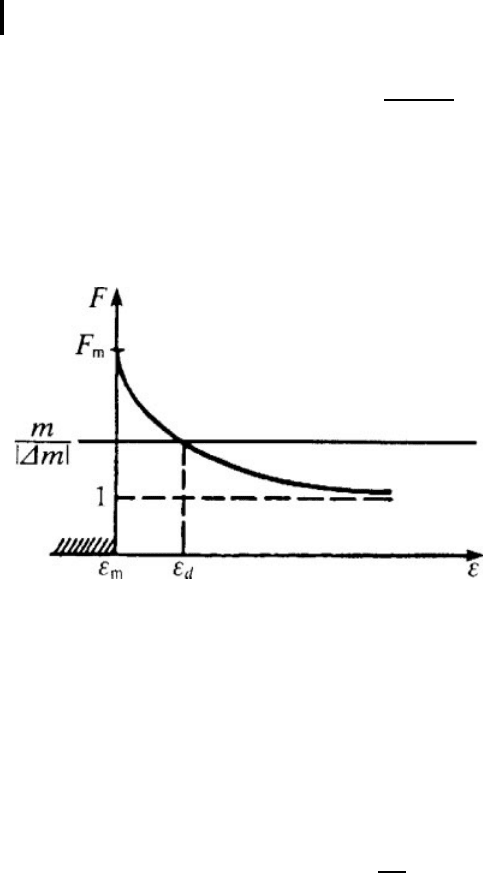
Since g
0
(z) ∼
√
ε
m
− z for z → ε
m
the function F(ε) is finite and positive at the
point ε = ε
m
(F(ε
m
)=F
m
> 0) and, in the small range ε −ε
m
ε
m
, has a negative
250
11 Localization of Vibrations
derivative
F
(ε) −ε
m
g
0
(z) dz
(ε − z)
2
.
For ε ε
m
due to the chosen normalization of the vibration density F(ε) ≈ 1,
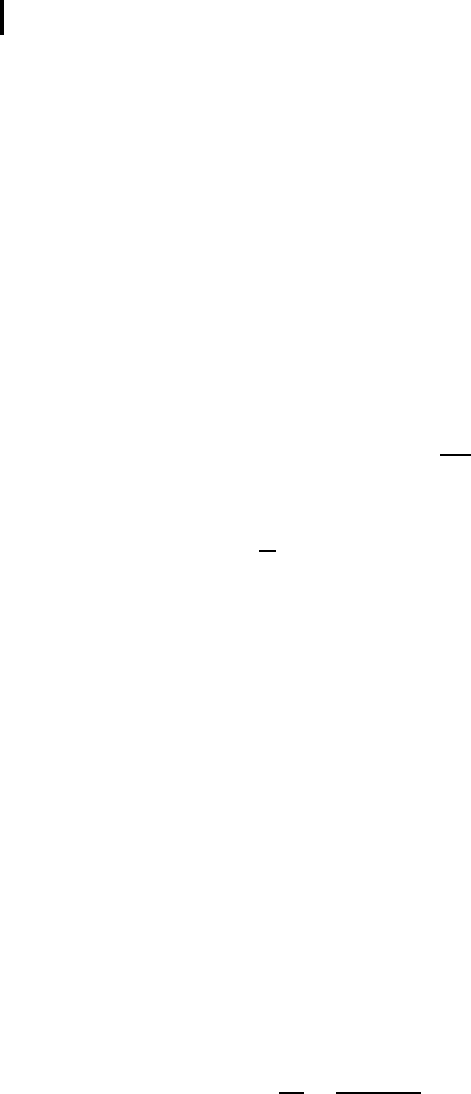
so that a plot of the function F(ε) has the shape of a curve (Fig. 11.1) and a plot
of the r.h.s. of (11.1.15) is a horizontal line. Thus, the solution ε > ε
m
exists if
|δm/m| F
m
> 1. If this condition is satisfied, the solution to (11.1.13) gives a discrete
frequency ω
d
lying outside the continuous spectrum band (Fig. 11.1, ε
d
= ω
2
d
).
Fig. 11.1 A graphical method of finding the frequency of local vibra-
tions.
Thus, in order for a vibration to appear at a discrete frequency lying near the
acoustic band, an isotope should have the mass M satisfying the condition M <
m(1 − 1/F
m
) < m.
Consider the case when the solutions to (11.1.13) determine the d iscrete frequencies
near the optical band of an ideal lattice. Let the continuous spectrum of an ideal crystal
occupy the interval (ε
1
, ε
2
), where ε
1
= ω
2
1
and ε
2
= ω
2
2
and the defect intensity is
characterized by the parameter U = εW
0
. Then, instead of (11.1.15), we write
F(ε )=−
1
W
0
, (11.1.16)
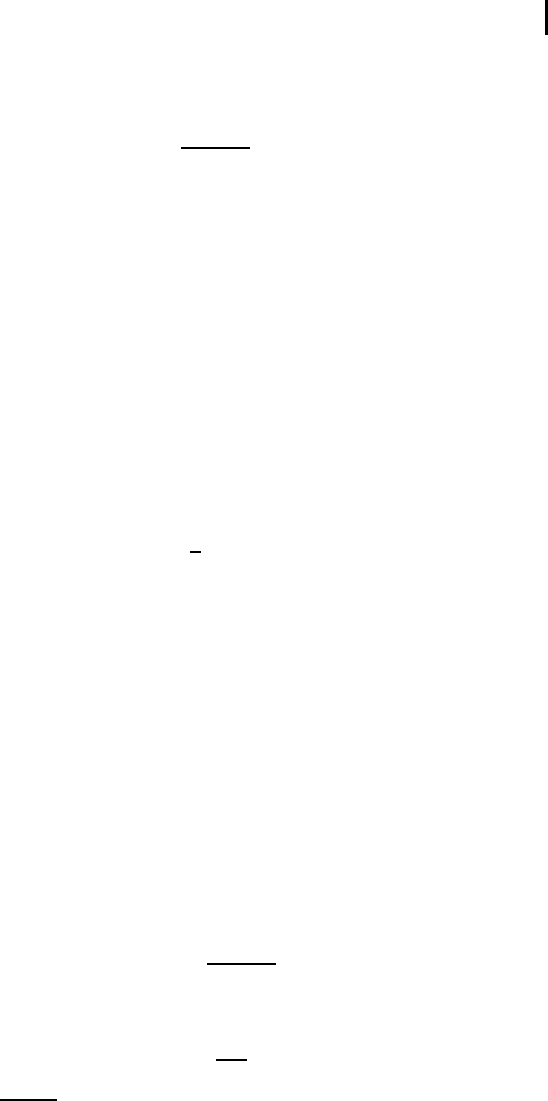
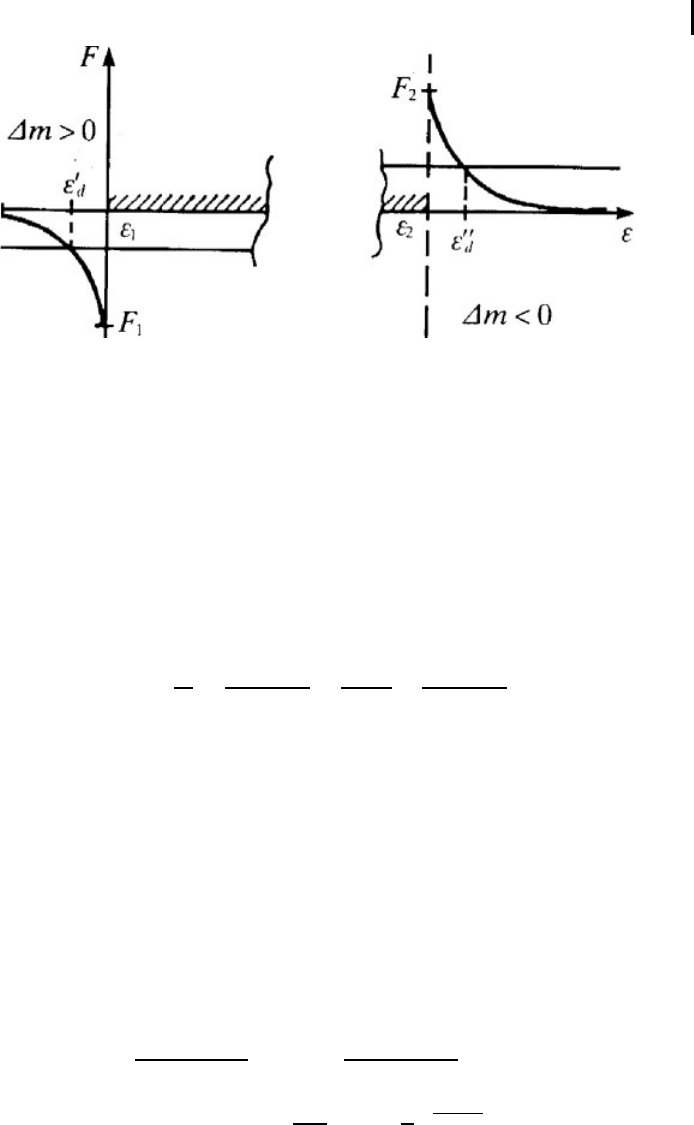
assuming that the function F(ε) is defined for ε < ε
1
and ε > ε
2
(Fig. 11.2,
F
1
= F(ε
1
) < 0; F
2
= F(ε
2
) > 0). Simple analysis leads to the conclusion
that the existence of discrete solutions to (11.1.16) is provided only by the defects
whose parameter W
0
satisfies certain conditions. If W
0
> 0 , it suffices to require
that W
0
> 1/ |F|.IfW
0
< 0, the absolute value of the parameter W
0
is within
1/ F
2
< |W
0
| < 1. In the first case the solution ε
d
is to the left of the point ε
1
(Fig. 11.2), and in the second case to the right of the point ε
2
.
Thus, depending on the sign o f the parameter W
0
, discrete frequencies can arise
either to the left of the continuous spectrum band (ω
d
< ω
1
at W
0
> 0)ortothe
11.1 Localization of Vibrations near an Isolated Isotope Defect
251
Fig. 11.2 Determination of the position of local frequencies for different
signs of ∆m.
right of it ( ω
d
> ω
2
at W
0
< 0). Crystal vibrations with the frequencies described
are called local vibrations, and the frequencies ω
d
– local frequencies.Thisnameis
attributed to the fact that the amplitude of the corresponding vibration is only nonzero
in a certain vicinity near the point defect. Let us analyze the letter of the cases consid-
ered, assuming that W
0
> 0 and the local frequency ω
d
is to the left of the continuous
spectrum band (ω
d
< ω
1
). The local vibration amplitude is given by (11.1.9), imply-
ing its coordinate dependence is completely determined by the behavior of the ideal
crystal Green function. We rewrite the Green function as
G
0
ε
(n)=
1
N
∑
k
e
ikr (n)
ε − ω
2
(k)
=
V
0
(2π)
3
e
ikr (n)
d
3
k
ε − ω
2
(k)
. (11.1.17)
It is known that the behavior o f such integrals at large distances (r a)ismainly
determined by the form of the integrand at small values of k (ak l). In other words,
the major contribution to the integral (11.1.17) at large r comes from the in tegration
in the region of small wave vectors where the dispersion law of an ideal cry stal is qua-
dratic in k. To avo id possible complications we write down the quadratic dispersion
law for the isotropic model in the form
ω
2
(k)=ω
2
1
+ γ
2
k
2
, γ
2
∼ (ω
2
2
− ω
2
1
)a
2
.
We take into account this dispersion law by changing ε
1
= ω
2
1
and performing the
integration required in (11.1.17)
e
ikr (n)
d
3
k
ε
1
− ε + γ
2
k
2
= 2π
∞
0
k
2
d
k
ε
1
− ε + γ
2
k
2
π
0
e
ikrcos θ
dθ
=
2π
2
γ
2
r
exp
−
r
γ
√
ε
1
− ε
.