
Kosevich A.M. The crystal lattice
Подождите немного. Документ загружается.

252
11 Localization of Vibrations
We substitute the r esult obtained in (11.1.17) and denote r = r(n)
G
0
ε
(n) ∼
1
r
exp
−
r
γ
ω
2
1
−ε
. (11.1.18)
Substituting (11.1.18) into (11.1.9) to obtain
u(n)=
U
0
V
0
4πγ
2
u(0)
r
exp
−
r
l
, (11.1.19)
where the characteristic length l determining the localization region of vibrations with
a discrete frequency is introduced:
l =
γ
√
ε
1
−ε
d
=
γ
ω
2
1
− ω
2
d
. (11.1.20)
Thus, the local v ibration amp litude decreases very qu ickly if the distance r increases
and the decay length has the following order of magnitude
l ∼ a
ω
2
2
− ω
2
1
ω
2
1
− ω
2
d
∼ a
ω
2
2
−ω
2
1
δω
,
where ω
2
− ω
1
is the continuous spectrum frequency band width; δω = ω
1
−ω
d
.
Thus, the lo calization of vibrations is de termined by the ratio of the gap size δω
separating a discrete frequency from the edge of the continuous spectrum to the width
of the continuous spectrum band.
Note that local vibrations are concerned with many physical effects observed in
crystals and indicate two aspects of this relation.
On the one hand, a discrete frequency separated by a finite range of frequencies
from the continuous spectrum band results in singularities in the frequency depen-
dencies of different characteristics of the scattering and absorption processes. Corre-
sponding resonance singularities arise in the scattering amplitudes of different parti-
cles (e. g., neutrons) on local defects. Infrared absorption in ionic crystals also shows
peaks corresponding to local vibrations of various centers specific to these crystals.
On the other hand, a local vibration has a finite weight in the expansion of the
displacement vector o f an impurity atom into normal modes of a defect lattice, un -
like each mode of the continuous spectrum vibrations that has an infinitely small
weight (we remind ourselves that the contribution of a separate vibration of the quasi-
continuous spectrum is proportional to 1/
√
N,whereN is the number of atoms in
a crystal). Therefore, the effects connected with the displacement of impurity atoms
and their nearest environment (e. g., optical transitions in impurity atoms, Mössbauer
effect connected with impurity atoms, etc.) are very sensitive to local vibrations.
11.2 Elastic Wave Scattering by Point Defects
253
11.2
Elastic Wave Scattering by Point Defects
In general, the scattering problem can be subdivided into two parts: a calculation o f
the effective cross section for scattering and a study of the shape of the wave surface
after scattering (at large distances from the scattering center). The first part of the
problem requires knowledge of the local inhomogeneity structure (details of the point
defect model). The second part concerns itself with the wave-surface shape at large
distances and can be solved by very general assumptions concerning the character of
the point defects.
A knowledge of the isofrequency surface shape is sufficient for studies of the as-
ymptotic behavior of scattering waves. As we are interested in the scattering wave
asymptotics, we restrict ourselves to the simplest model of a point defect, focusing on
singularities of the isofrequency surface of a vibrating crystal.
The stationary vibrations of an id eal lattice are described by an equation represented
symbolically by (2.2.2). The equation of crystal vibrations with an isolated defect is
given in symbolic form by
εu −
1
m
Au = Uu, ε = ω
2
, (11.2.1)
where A is a linear Hermitian operator corresponding to the dynamic matrix of an
ideal crystal
Au(n)=
∑
n
A(n − n
) u(n
),
U is the perturbation matrix
Uu(n)=
∑
n
U(n, n
)u(n
). (11.2.2)
For an isotope defect positioned at the site n
1
of a monatomic lattice, we have
U
ik
(n, n
)=U
0
δ
nn
1
δ
n
n
1
δ
ik
U
0
= −ε
∆m
m
. (11.2.3)
We consider the scattering of th e vibration mode of an ideal crystal
u(n, t)=u
0
(n)e
−iωt
, u
0
(n)=
e (k
0
)
√
N
e
ik
0
r(n)
, (11.2.4)
by the point defect with a perturbation potential of the type (11.2.3) where we set
n
1
= 0.
Since the defect has no internal degrees of freedom, scattering will occur without
change of frequency, and the coordinate part of the scattering wave is a solution to
(11.2.1). We write the perturbed solution to this equation (in usual vector notations)
as
u(n, t)=u
0
(n)+χ(n), (11.2.5)
254
11 Localization of Vibrations
where χ(n) describes the scattered wave and is a solution to the matrix equation (in
the column notations)
ε −
1
m
A
χ = U(u
0
+ χ). (11.2.6)
A formal solution to this equation is found [similar to (11.1.9)] by using the Green
tensor of an ideal crystal (the index ε is omitted here)
χ = G
0
U(u
0
+ χ). (11.2.7)
Taking the noncommutativity of the operators in (11.2.7) into account we find that
χ =(1 − G
0
U)
−1
G
0
Uu
0
. (11.2.8)
In the isotropic approximation or in a cubic crystal with only one isotope defect
producing the perturbation potential (11.2.3), the matrix G
0
U is diagonal, hence,
1 − G
0
U = 1 − G
0
ε
(0)U.
Changing from the operator form of (11.2.8) to the coordinate form we find for the
scattering wave (in the vector component notations)
χ
i
(n)=
U
0
√
ND(ε)
G
ij
0
(n)e
j
(k
0
), (11.2.9)
where
D(ε)=1 − U
0
G
0
ε
(0)=1 + ε
∆m
m
G
0
ε
(0), (11.2.10)
and for a scalar model the r.h.s. of (11.2.10) should be understood literally, while for
acubiccrystalG
0
(0)=(1/3)G
ll
0
(0).
It follows from (11.2.9) that th e form of a scattering wave at large distance is de-
termined unambiguously by the asymptotic behavior of the Green tensor of an ideal
lattice.
There is an expression (4.5.12) for the Green function in a scalar model. However,
one can really use this formula for calculations on ly when (4.5.12) is rewritten in the
form of an integral (4.5.13), but since the frequency ω is assumed to belong to the
eigenfrequency band of an ideal crystal, (4.5.13) should be regularized
G
0
ε
(n)=
V
0
(2π)
3
e
ikr (n)
d
3
k
ε − ω
2
(k) −iγ
. (11.2.11)
Regularization should result in a diverging wave at infinity, i. e., it should be the
same as that used to determine the retarded Green function (Section 4.6).
Denote
I(r)=
e
ikr (n)
d
3
k
ε − ω
2
(k) −iγ
, (11.2.12)
and transform from an integration with respect to k to an integr ation with respect to
z = ω
2
(k) and over the isofrequency surface z = const
I(r)=
J(r, z) dz
ε − z − iγ
, (11.2.13)
11.2 Elastic Wave Scattering by Point Defects
255
where
J(r, z)=
ω
2
(k)=z
e
ikr (n)
dS
k
∇
k
ω
2
(k)
. (11.2.14)
The main contribu tion to the asymptotic (at r → ∞ ) values of the integral (11.2.14)
comes from the points of the stationary phase of the integrand. To elucidate the ge-
ometrical meaning of these points we write kr = rkn = rh (n is a unit vector in
the direction r,andh = kn) and introduce the orthogonal curvilinear coordinate ξ
i
(i = 1, 2) on the surface ω
2
(k)=z. The stationary phase points are then determined
by the conditions
∂h
∂ξ
i
= 0, i = 1, 2. (11.2.15)
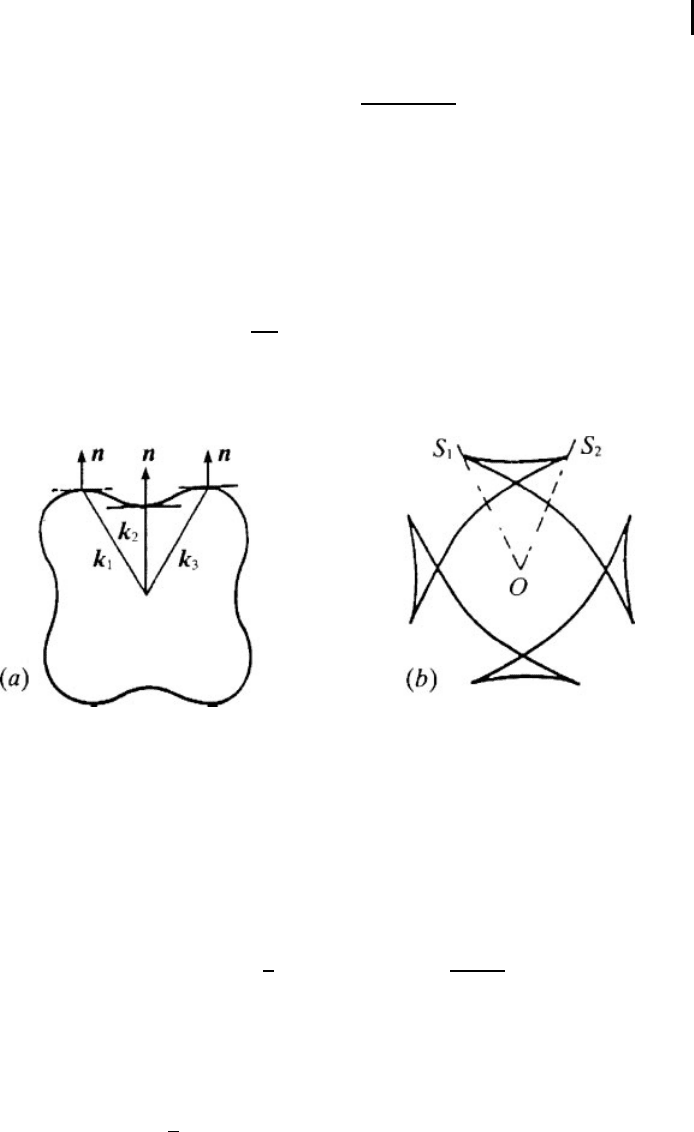
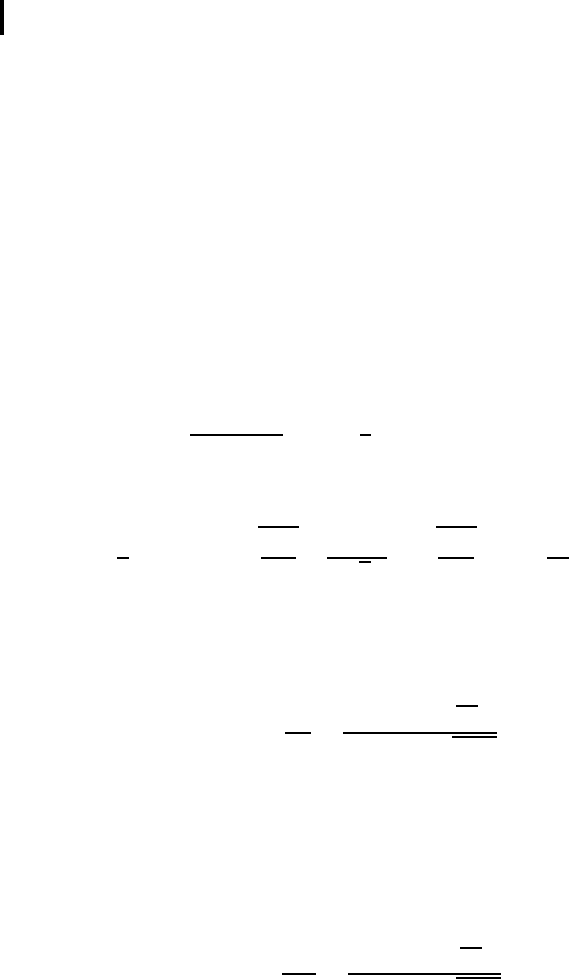
The conditions (11.2.15) are satisfied at the points where the supporting plane
h ≡ kn = constant touches the isofrequency surface (Fig. 11.3a).
Fig. 11.3 Cross sections: (
a
) of an isofrequency surface on which the
support points corresponding to the direction n are indicated; (
b
)ofthe
wavesurfaceonwhichtheraysOS
1
and OS
2
limit the “folds”.
We denote the contact points by k
ν
(sometimes they are called support points).
On an isofrequency surface with an inversion center such points are positioned in
pairs ±k
ν
.
We consider one of the supporting points measuring the coordinates ξ
i
from it. In
the close vicinity of this point the following expansion holds:
h(ξ)=k
ν
n +
1
2
α
ν
ik
ξ
i
ξ
k
, α
ν
ik
=
∂
2
h
∂ξ
i
∂ξ
k
ν
.
We choose a network of curvilinear coordinates, so that the matrix α
ν
ik
is diagonal,
i. e., we choose the local coordinate axes ξ
1
and ξ
2
along the main directions of the
surface curvature ω
2
(k)=z at the point k = k
ν
.Then
h(ξ)=k
ν
n +
1
2
α
1
ξ
2
1
+ α
2
ξ
2
2
, α
1
= α
11
, α
2
= α
22
. (11.2.16)
256
11 Localization of Vibrations
With such a choice of 2D coordinates in k-space, the product α
1
α
2
determines the
total (Gaussian) curvature of the surface at the tangent point; K
ν
= α
1
α
2
.IfK
ν
> 0,
the corresponding point is called elliptical,andifK
ν
< 0 it is called hyperbolic.
All the points of a convex surface are elliptical. If the surface is not convex (such as
shown in Fig. 4.3 or Fig. 11.3), there exist parts of the surface with points of different
types (either elliptical or hyperbolic), but the parts of an isofrequency surface of the
first and second types are divided by the lines along which one of the coefficients (α
1
or α
2
) vanishes. These are the lines of parabolic points. Finally, at the intersection of
the lines of parabolic points are the flat regions where α
1
= α
2
= 0.
We start by analyzing the asymptotic form of the integral (11.2.14) when the sup-
porting points are elliptical or hyperbolic. Reducing the integral (11.2.14) to the sum
of integrals in the vicinities of the tangent points (th e points of the stationary phase),
we get
J(r, z)=
∑
ν
e
ik
ν
r
∇ω
2
(k
ν
)
exp
i
2
r
ξ
2
1
+ ξ
2
2
dξ
1
dξ
2
. (11.2.17)
The integrals in (11.2.17) are calculated simply to be
exp
i
2
rαξ
2
dξ =
2
r |α|
∞
0
e
±ix
dx
√
x
=
2π
r |α|
exp
±
iπ
4
, (11.2.18)
where the sign in the exponent index coincides with the sign of the main curvature α.
Thus we obtain an asymptotic expression proportional to 1/r (Lifshits, 1950)
J(r, z)=
2π
r
∑
ν
exp
ik
ν
r ±
iπ
4
∇ω
2
(k
ν
|K
nu
|
. (11.2.19)
Substituting (11.2.19) into (11.2.13), we note that as r → ∞ the integral with re-
spect to z is reduced to an integral over the close proximity of the point z = ε,where
the integrand has a singularity. The main part of the integral (11.2.13) is obtained by
integrating near the pole z = ε, so that the final asymptotic expression for the Green
function (11.2.11) is
G
0
ε
(n)=
iV
0
4πr
∑
ν
exp
ik
ν
r ±
iπ
4
∇ω
2
(k
ν
|K
nu
|
, (11.2.20)
where the summation is over the support points on the isofrequency surface
ω
2
(k)=0 with nv
ν
≡ n∇ω(k
ν
) > 0.
The asymptote (11.2.20) shows the necessary amount of decrease with distance
(∼ 1/r), providing a finite value of the scattering wave energy flow in any finite
interval of a solid angle dO. Indeed, the flow of the energy density of the elastic

11.2 Elastic Wave Scattering by Point Defects
257
field is quadratic in space and time derivatives of κ(r, t), i. e., at large distances it is
proportional to 1/r
2
. Thus, the flow per area element r
2
dO is finite.
Thus, the scattered wave represents a superposition of several diverging waves
whose number equals the number of possible solutions to (11.2.15) at z = ω
2
. Each
of these waves has its own sha pe and its own propagation velocity. The imaging of
the spatial distribution of a scattered wave can be obtained by studying the so-called
wave surface. The wave surface in coordinate space is, in a certain sense, polar with
respect to the isofrequency surface and is constructed as follows. From the defect po-
sition (point O in Fig. 11.3b) a ray is drawn in the direction n and along it the length
r = 1/(nk
ν
) is plotted, where k
ν
= k
ν
(n) are the support points.
It the isofrequency surface is convex, there is one supporting point with nv
ν
> 0.
If it is not convex there can be several points of this kind. In the last case “folds” and
recursion points arise on the wave surface. A tangent plane in the vicinity of each sup-
port point generates its own region of a wave surface. On the boundary of neighboring
folds there is a transition from the region of elliptic points to that of hyperbolic points
on the isofrequency surface. The boundaries are the parabolic point lines (K
ν
= 0).
There always exists a continuous multitude of directions (a conical surface) corre-
sponding to K
ν
= 0. These directions are shown as straight lines OS
1
and OS
2
in
Fig. 11.3b; at the points S
1
and S
2
a pair of wave surface parts merges and breaks.
Such singularities are classified in a theory of catastrophes and it is shown for elastic
wave scattering in crystals that only catastrophes of the fold and the reversion point
types are possible. The catastrophe implies that the energy flow den sity calculated
formally by (11.2.20) in the d irections considered goes to infinity ( K
ν
= 0). Actu-
ally, at these points (more exactly on corresponding conical surfaces) the asymptotic
behavior of the scattered wave changes, i. e., dependence of the scattered wave ampli-
tude on the inverse distance 1/r becomes another: a power of the distance r decreases
in the denominator of the function I(r, z) or the function I(r).
As an illustration we consider a simple parabolic point k
0
in the vicinity of which
the function h = kn has the expansion
h = k
0
n
0
+
1
2
αξ
2
1
+ βξ
2
2
, (11.2.21)
where n
0
is a unit vector of the direction whose supporting p lanes are tangential to the
isofrequency surface at the parabolic point k
0
(we have chosen the coordinate axes
ξ
1
and ξ
2
along the main directions of the isofrequency surface curvature). Then, in
calculating (11.2.17) apart from the integral (11.2.18) for the direction ξ
1
we have
another integral for the direction ξ
2
, namely
exp
ir βξ
3
dξ =
2
3
3
r |β|
∞
0
cos x
3
√
x
2
dx =
3
3
r |β|
Γ
4
3
, (11.2.22)
where Γ(m) is the gamma-function. Thus, instead of (11.2.19), we g et an asymptotic
258
11 Localization of Vibrations
expansion (Lifshits and Peresada, 1955):
J(r, z)=
√
6πΓ
4
3
r
5
6
exp
ik
0
r ±
iπ
4
ω
2
(k
0
)
|α|
1
2
|β|
1
3
. (11.2.23)
Calculating by means of (11.2.23) the asymptotes of the Green function and then
the energy flow density, we find that the latter is proportional to r
−5/3
.Ifthereare
no additional singularities on the line of parabolic points, then |α|
|β|∼K
∗
where
K
∗
is the Gaussian curve at an arbitrary point of the isofrequency surface. Thus, the
energy flow density along the direction n
0
“catastrophically” exceeds at large r the
energy flow density from the other points in the ratio r
1/3
|β|
1/6
.
However, a solid angle inside which this energy flow density exists decreases with
increasing r. Indeed, consider a scattered wave in the direction n inclined by an angle
δθ
2
(along ξ
2
)ton
0
The supporting point will then be displaced by the value δξ
2
determined by θ
2
= 3β( δξ
2
)
2
. In the new supporting point, the Gaussian curvature
equals K = 6αβδξ
2
. Comparing with (11.2.19), where this Gaussian curvature is used
with (11.2.23) for a parabolic supporting point, we see that they match by the order
of magnitude δξ
2
∼ (|β|r)
−1/3
. Thus, the angle inside which an increased energy
intensity is observed can be evaluated as δθ
2
∼|β|
1/3
r
−2/3
. It is clear that the angle
δθ
2
decreases with increasing r faster than the energy density increases. Thus, the
total energy flow per angle δθ
2
decreases with distance proportional to r
−1/3
.
We ultimately calculate the contribution to the integral (11.2.14) generated by the
flattening point in the vicinity of which an expansion of the function h is
h = k
0
n
0
+ β
1
ξ
3
1
+ β
2
ξ
3
2
.
Without repeating the calculations, we write down the corresponding part of the
integral (11.2.14) as
J(r, z)=
3Γ
2
4
3
r
2
3
e
ik
0
r
∇ω
2
(k
0
)
|β
1
β
2
|
1
3
.
In the given case the energy flow density in the scattered wave exceeds that in the
ordinary conditions in the ratio r
2/3
|β
1
β
2
|
−1/6
Accordingly, the solution of a solid
angle, where the flow of such density is concentrated, decreases with the distance as
|β
1
β
2
|
1/3
r
−4/3
.
Having discussed the singularities of the scattered wave shape and its asymptotic
behavior at infinity, we shall analyze in brief the frequency dependence of the scat-
tered wave amplitude. The frequency dep endence is primarily given by the multiplier
D(ω
2
) in the denominator (11.2.9). The required regularization of this expression can
be performed using the relation (4.7.4)
D(ε)=1 − U
0
G
0
ε−iγ
= 1 − U
0
P.V.
g
0
(z) dz
ε − z
−iπU
0
g
0
(ε), (11.2.24)
11.3 Green Function for a Crystal with Point Defects
259
where P.V. means the principal value of the integral; g
0
(ε) is the vibration density of
a crystal without defects.
We denote
R(ε)=Re{D(ε)} = 1 − U
0
P.V.
g
0
(z) dz
ε − z
,
and represent the complex function D(ε) as
D(ε)=R(ε) − iπU
0
g
0
(ε)=
R
2
(ε)+[πU
0
g
0
(ε)]
2
e
iϕ(ε)
,
tan ϕ(ε)=
πU
0
g
0
(ε)
R(ε)
.
(11.2.25)
Strictly speaking, the function (11.2.25), has no specific properties for real ε,but
it may turn out that at a certain frequency R(ε)=0. If the vibration density g
0
(ε)
at the corresponding frequency is small, |D(ε)|
−1
will be very large. The resonance
amplitude of the scattered wave increases. I t is known that the appearance of reso-
nance denominators in the scattering amplitude at certain frequencies ω
q
is evidence
of the presence of quasi-stationary eigenvibrations in a medium through which the
wave travels. Such a quasi-stationary state is analogous to a resonance state in quan-
tum mechanics and its lifetime increases if g
0
(ε) becomes smaller. Since in a 3D case
g
0
(ε) ∼
√
ε, the resonance will be pronounced at a small quasi-stationary state fre-
quency. Thus, a point defect that provides the equality R(ε)=0 at low frequency may
generate the resonance vibrational states in a crystal (Kagan and Iosilevskii, 1962). A
more consistent theory of resonance states near a point defect is presented in Sec-
tion 11.5, but we shall now try to obtain general conditions for the existence of a
quasi-stationary state.
At small ε (ε ω
2
D
), we set in (11.2.24)
g
0
(z) dz
ε − z
≈−
g
0
(z)
z
dz = −
1
ε
∗
, ε
∗
∼ ω
2
D
,
g
0
(ε)=
V
0
(2π)
3
√
ε
s
3
0
∼
√
ε
ω
3
D
.
(11.2.26)
Therefore, the function R(ε) is represented by
R(ε)=1 +
U
0
ε
∗
= 1 −
∆m
m
ε
ε
∗
=
∆m
mε
∗
mε
∗
∆m
− ε
.
Thus, the resonance frequency ε
k
=(m/∆m)ε
∗
satisfies the condition ε ω
2
D
for a large enough parameter ∆m/m 1. The last inequality provides results in a
resonance state in a crystal with heavy isotopic defects.
11.3
Green Function for a Crystal with Point Defects
The equations of crystal v ibrations with a single defect (11.2.8) involve a perturbation
in the form of (11.1.7). The Green tensor of a crystal with a defect is a resolvent for

260
11 Localization of Vibrations
(11.1.6), i. e., it is found as a solution to the following equation vanishing at infinity
εG
ε
−(A
0
+ U)G
ε
= I. (11.3.1)
We rewrite (11.3.1) in the form (εI − A
0
)G
ε
= I + UG
ε
and represent a formal
solution to this equation by means of the Green tensor of an ideal crystal G = G
0
+
G
0
UG.
Performing calculations analogous to those used in deriving (11.2.8) we get
G = G
0
+ G
0
TG
0
, (11.3.2)
where the matrix T is determined by (11.3.2)
T =
I − UG
0
−1
U. (11.3.3)
In the present case of an isolated defect-isotope, T =[D(ε)]
−1
U, where the definition
(11.2.10) is used. Substituting (11.3.3) into (11.3.2) we obtain
G
ik
(n, n
)=G
ik
0
(n − n
)+
U
0
D(ε)
G
il
0
(n − n
1
)G
lk
0
(n
1
− n
). (11.3.4)
For a scalar model the formula (11.3.4) is not simplified much (only indices i, k, l
are not used). The poles of the Green function as functions of the variable ε determine
the squares of the eigenfrequencies of vibrations of the corresponding system (Sec-
tion 4.5). It follows from (11.3.4) that the Green function for a crystal with a point
defect may have an additional pole at the point where the function D(ε) is zero. Thus,
the additiona l poles of the Green function (with respect to the ideal crystal Green fun c -
tion) determine the frequencies of local vibrations of a crystal with a defect considered
in previous sections.
We shall now point out a specific structure of the Green function in a crystal with
a single defect (11.3.4). By definition, the Green function concerned gives us a dis-
placement of the n-th site in a lattice under the action of a unit force, which is periodic
in time ω
2
= ε and applied to the site n
. In an ideal lattice, th e stationary interaction
is transmitted directly from the site n
to the site n (the first term in (11.3.4)). In the
presence of an isolated defect at the site n
1
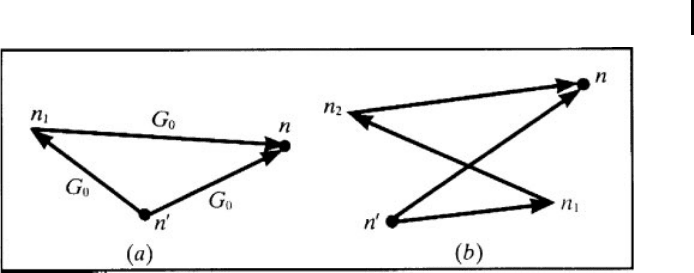
an additional excitation transfer channel
through a defect appears (Fig. 11.4a) (this is the second term in (11.3.4)). In the sec-
ond term the vector going to a defect or from it is associated with a multiplier G
0
,and
the presence of the defect results in an additional multiplier U
0
/D( ε).
A remarkable feature of the excitation transfer through a defect possessing a local
frequency is the resonance character of the transfer. By deriving (11.1.18) we have
shown that the Green function G
0
ε
(n) decays exponentially with distance for the values
of the parameter ε lying outside the band of the squares of the eigenfrequencies of
an ideal crystal. Thus, at frequencies close to a discrete local frequency, the first
term in (11.3.4) at large distances (r(n − n
) l) becomes negligibly small. The
11.3 Green Function for a Crystal with Point Defects
261
Fig. 11.4 Diagram for calculating the Green function in a crystal:
(
a
) with one impurity at the point n
1
;(
b
) with two impurities at the points
n
1
and n
2
.
second term has a resonance denominator D(ε) and for ε can essentially exceed the
first term. Thus, if the crystal h as a defect with a discrete frequency in the forbidden
band of frequencies of an ideal lattice, it promotes a r esonance transfer of excitations
at large distances. However, the second term in (1 1.3.4) also vanishes in the limit
|n − n
|→∞ at any finite D(ε). Th e situation will be different if we go over from a
crystal with one defect to a crystal with small, but finite concentration of defects.
Let us now see whether it is possible to use the method presented to find the Green
function in a crystal with a system of point defects.
Unfortunately, the relation (11.2.22) between the matrix T and the matrix U is non-
linear, and the contributions of separate defects cannot be summarized in an equation
such as (11.3.4). However, a solution generalizing (11.3.4) can also be found in this
case.
We restrict ourselves to a scalar model and choose the perturbation matrix in the
form
U(n, n
)=u
0
∑
α
δ
nn
α
δ
n
n
α
, (11.3.5)
where n
α
are the number vectors of the sites where the defects are positioned.
For the matrix T one should expect a representation such as
T(n, n
)=
∑
αβ
T
αβ
δ
nn
α
δ
n
n
β
. (11.3.6)
Indeed, rewriting (11.3.3) in the fo rm
(I − UG
0
ε
)T = U,
and substituting here (11.3.5), (11.3.6) we obtain a condition unambiguously deter-
mining a set of parameters T
αβ
:
D(ε)T
αβ
−U
0
∑
γ= α
G
0
ε
(n
α
− n
gamma
)T
γβ
= u
0
δα β. (11.3.7)