
Kosevich A.M. The crystal lattice
Подождите немного. Документ загружается.

272
11 Localization of Vibrations
where G
0
(ε, k) is the Green function of an ideal crystal determined in a standard way
in (ε, k)-representation.
The matrix T has the following Fourier transform
T
k
= cU
0
[D(ε) − cU
0
G
0
(ε, k)]
−1
. (11.6.5)
It is easy to see that (11.3.9), (11.3.12) are the first terms of the expansion (11.6.5)
in powers of cU
0
/D( ε).
We make use of the homogeneity of a medium and rewrite (11.3.8) for the averaged
Green function of a defect crystal in k-representation
G(ε, k)=G
0
(ε, k)+G
0
(ε, k)T
k
G
0
(ε, k). (11.6.6)
We substitute here (11.6.5) to obtain
G(ε, k)=
D(ε)G
0
(ε, k)
D(ε) − cU
0
G
0
(ε, k)
. (11.6.7)
It is clear that the add itional poles of the Green function o f a crystal with defects
are found from the equation
D(ε) − cU
0
G
0
(ε, k)=0. (11.6.8)
If we take into account the three branches of the vibrations of a simple lattice, (11.6.8)
will be replaced by
Det
δ
ik
−U
ik
0
(0) −cU
0
G
ik
0
(ε, k)
= 0. (11.6.9)
However, returning to a scalar model, we take into account the explicit expression
for the function G
0
(ε, k) and rewrite (11.6.7) in a canonical form for the Green func-
tion
G
0
(ε, k)=
1
ε − ω
2
0
(k) −cΠ(ε)
, Π(ε)=
U
0
D(ε)
. (11.6.10)
It is clear that (11.6.10) coincides with (11.6.1). Thus, for the range of frequen-
cies distant from singular points of the spectrum, the expression (11.6.10) should be
regarded as a good representation for the averaged Green function (Lifshits), 1964;
Dzyub, 1964).
Note, finally, that the averaging has been performed over impurity configurations
without taking into account the correlations in their mutual positions. Any effects
generated by the fluctuational formation of impurity complexes, the distance between
which is much smaller than the average distance ∼ a/c
1/3
, are not considered when
we use (11.6.10). Sometimes (11.6.10) is regarded as the result o f a selective summa-
tion (rather than a complete one) of a series of successive approximations such as the
expansion (11.3.13).

11.6 Collective Excitations in a Crystal with Heavy Impurities
273
Let us analyze (11.6.1) or (11.6.10) intending, first, to consider eigenvibrations such
as plane waves, i. e., collective excitations of a crystal with point defects. These vi-
brations are characterized by the wave vector k and the frequency ω. The dispersion
law ω = ω(k) connecting the real ω and k is the primary characteristic of ele-
mentary excitations and determined by the Green function poles of a crystal in the
(ε, k)-representation. Therefore, we first discuss the problem of the poles of the func-
tion (11.6.10), i. e., of the roots of the equations
ε − cΠ(ε)=ω
2
0
(k) . (11.6.11)
We come back to the above procedure of regularizing the Green function of stationary
vibration s of an ideal lattice and note that the function Π(ε) is complex.
Hence it follows that for a real wave vector k the solutions to the dispersion equation
(11.6.11) for ω will be complex. The presence of an imaginary part of the vibration
frequency is evidence that the wave with fixed k gets damped in time. Thus, a plane
wave of displacements in a crystal with impu rities has the form
u(r, t)=u
0
exp
−
t
τ
e
i(kr−ωt)
, (11.6.12)
where the d amping time τ is determined by the imaginary part of the function Π(ε).
It is natural that separation of collective excitations of a crystal such as (11.6.12) is
only physically meaningful for ωτ 1.
Let the conditio n ωτ 1 be satisfied, i. e., the damping is weak. Writing the
solution to (11.6.11) in the form
ε =(ω −i/τ)
2
ω
2
−2iω/τ ω
2
−2iω
0
(k)/τ,
it is then easy to calculate ω(k) and τ(k) in the main ap proximation in ωτ.
The dependence ω = ω(k) (see the problem) obtained in this way plays the role of
a dispersion law of crystal vibrations with point impurities, but the corresponding ex-
citations (11.6.12) prove to be damped, i. e., “living” for a finite time. The lifetime of
these excitations τ can be directly associated with a correction δg(ε ) for the vibration
density (11.5.2) near a quasi-local frequency
1
τ
=
π
2
ε
∗
ωδg(ω
2
), ω = ω
0
(k) . (11.6.13)
It is clear that τ has a minimum at ω = ω
q
. A small lifetime of the collective
excitation with ω = ω
q
can be explained easily. The energy of a “homogeneous”
plane wave (11.6.12) is spent to excite the continuous spectrum vibrations whose fre-
quencies are close to a quasi-local one. However, the coordinate dependence of quasi-
local vibrations differs from (11.6.12). Therefore, the collective vibration is damped.
For the maximum of (11.6.13) we have the estimate
1
τ
∼ c
ω
2
D
Γ
q
∼ c
∆m
m
3/2
. (11.6.14)
274
11 Localization of Vibrations
We introduce the concentration c
0
at which the average distance between impuri-
ties has the order of magnitude of a characteristic wavelength of a single quasi-local
vibration λ ∼ 2πs/ω
q
. To an order of magnitude,
c
0
∼
m
∆m
3/2
. (11.6.15)
Under the condition ∆m m,wealwayshavec
0
c
∗
.
Consequently, the estimate (11.6 . 14) can be rewritten as ωτ ∼ c
0
/c; hence it fol-
lows that the condition ωτ 1 is satisfied for c c
0
. Thus at small enough
concentrations of impurity atoms (c c
0
), ordinary vibration al excitations (such as
plane waves) are weakly damped at all frequencies.
11.7
Possible Rearrangement of the Spectrum of Long-Wave Crystal Vibrations
Now consider the dynamic properties of a crystal where the concentration of heavy
impurities is not restricted by the inequality c c
0
(but the condition c 1 remains).
If c
>
∼
c
0
then in the resonance region ωτ
<
∼
1, and the concept of collective excitations
(11.6.12) with frequencies close to ω
q
is physically meaningless. The wave (11.6.12)
is damped practically in one period of vibrations.
In this frequency region, for c
0
<
∼
c 1 the spectrum of crystal eigenvibrations can
be characterized by the quantity Im G(ε, k) as a function of ε and k, because it can be
measured experimentally. We consider Im G(ε, k) as a function of k with a given ε
(this is typical for ord inary optical experiments) and examine how the position of the
maximum of this function changes depending on the value of ω =
√
ε. The maxima
we are interested in are in the space ω, k on hypersurfaces whose points are given by
a straightforward cond ition
ω
2
− ω
2
0
(k) − c Re[Π(ω
2
)] = 0. (11.7.1)
We restrict ourselves to the long-wave isotropic approximation when ω
0
(k)=s
0
k.
As a result of simple calculations, we get the following frequency dependence of the
modulus of a wave vector providing the maximum Im G:
(s
0
k )
2
= ω
2
1 − c
ε
∗
(ω
2
− ω
2
q
)
(ω
2
− ω
2
q
)
2
+ Γ
2
. (11.7.2)
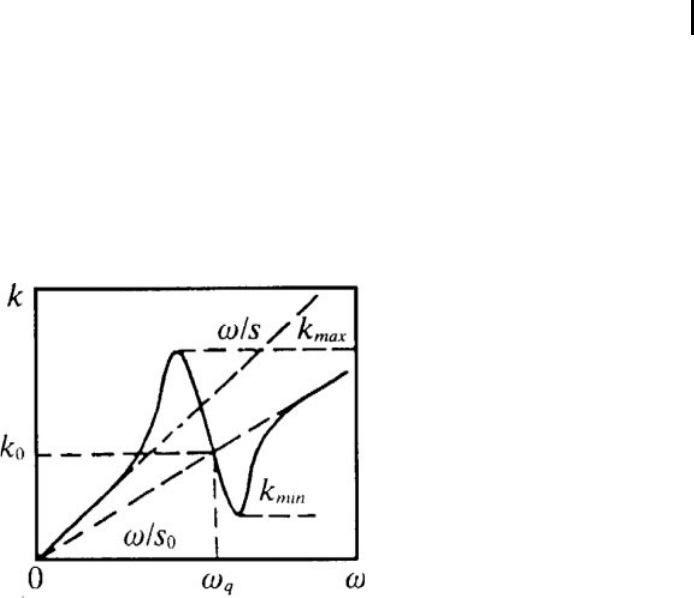
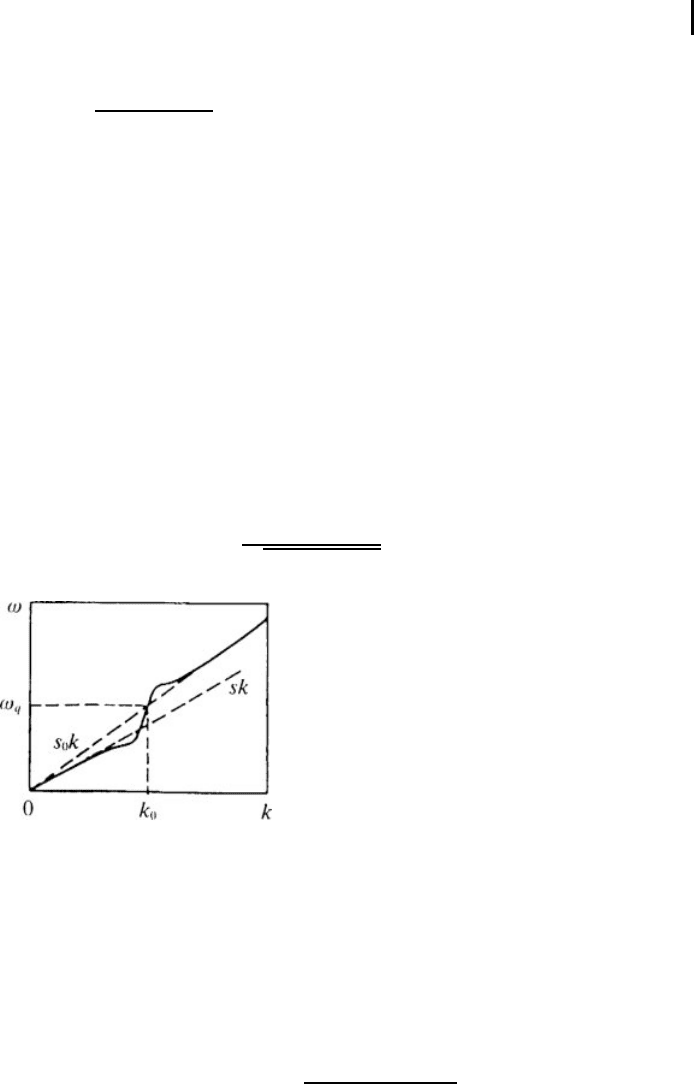
The plot of k = k(ω) (Fig. 11.6) can be considered as the dependence of the wave
vector on the frequency of the crystal eigenvibrations in this case.
The function k = k(ω) has extrema k
max
and k
min
between which the “anoma-
lous dispersion” region is situated. The difference in heights of the maximum and
minimum in Fig. 11.6 is equal, in order of magnitude, to
k
max
−k
min
k
0
=
∆k
k
0
∼ c
ε
∗
Γ
∼ c
∆m
m
3/2
∼
c
c
0
.
11.7 Possible Rearrangement of the Spectrum of Long-Wave Crystal Vibrations
275
With increasing concentration the minimum in Fig. 11.6 decreases and, at concen-
trations c ∼ c
0
, k
min
may reach zero. For long-wave vibrations, one should then
expect phenomena such as total internal reflection in optics. In fact, for c c
0
,in
addition to ω = 0, there appear two more frequency values corresponding to k = 0.
These frequencies lying somewhat higher than ω
q
limit the range of frequencies at
which the crystal has no collective excitations described by the wave vector.
Therefore, in the case of large concen trations of impurities with pronounced quasi-
local frequencies the spectra of long-wave crystal vibrations change significantly.
Fig. 11.6 T h e dependence k = k(ω) that provides the maximum of
Im G(ε, k).
We consider Im G(ε, k) as a function of ε at fixed k (just this dependence is gen-
erally studied in neutron experiments). The maximum value of this function is deter-
mined by the condition (11. 7.1), so that the frequency range where vibrations such as
plane waves are absent is wide enough and satisfies the condition
ω
2
− ω
2
q
Γ ∼ (ω/ω
D
)
3
ε
∗
. (11.7.3)
The inequality (11.7.3) enables us to omit Γ in the real part of the function Π(ω
2
)
and the condition (1 1.7.1) will be replaced by a similar one:
[ω
2
− ω
2
0
(k)][ω
2
− ω
2
q
]=cε
∗
ω
2
. (11.7.4)
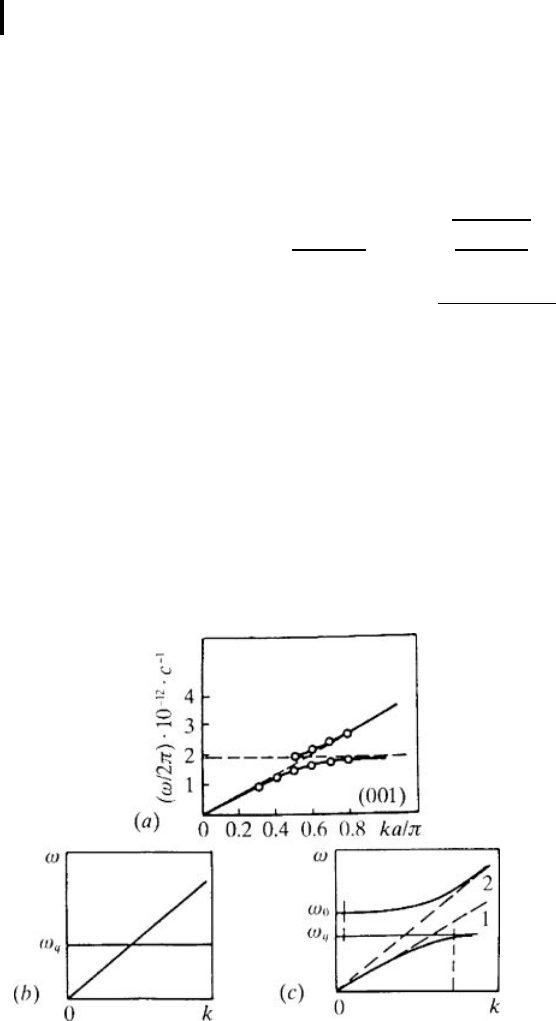
It follows from (11.7.4) that Im G as a function of ε at any fixed k has two maxima
instead of one in an ideal crystal. The dependence of the frequencies on k providing
the maximum Im G (Fig. 11.7a) resembles a typical diagram of frequency splitting
near the resonance point, i. e., in the vicinity of the intersection of the dispersion
curves ω = s
0
k and ω = ω
q
= const (Fig. 11.7b). The choice of the parameters
∆m/m, ω
k
,andc in the p lot is matched to the experiment of Zinken et al. (1977).
A hypothetical degeneration of frequencies arising in Fig. 11.7b is removed and the
276
11 Localization of Vibrations
dependence ω = ω(k) in the isotropic model is obtained by solving an algebraic
equation
ωn(ω)=s
0
k, (11.7.5)
where the function n(ω) is the coefficient of sound wave refraction in a crystal and is
determined by (11.7.2) with Γ = 0:
n(ω)=
1 −
cε
∗
ω
2
− ω
2
q
1/2
=
ω
2
− ω
2
0
ω
2
− ω
2
q
. (11.7.6)
Here ω
2
0
= ω
2
q
+ cε
∗
. We note that n(0)=
1 + c(∆m/ m) and n(∞)=1.
Aplotofω(k) is constructed in an obvious way (Fig. 11.7c).
The vertical dashed lines in Fig. 11.7c cut off the value of the wave vector k at
which (11.7.6) becomes meaningless. Near ω = ω
q
these are the values of k at which
the wavelengths are comparable with the distance between the impurities, and near
ω = ω
0
these are the values of k at which the damping length is comparable with the
wavelength (ωτ ∼ 1).
Figure 11.7c shows the dispersion law asymptotes at small frequencies (straight
line 1) ω = s
0
k /[1 + c(∆m/m)]
1/2
, ω ω
q
and at high frequencies (straight line
2) ω = s
0
k, ω
q
ω ω
D
.
We note that the plot in Fig. 11.7c resembles the plot of the dispersion law of trans-
verse optical vibrations of an ionic crystal in Fig. 3.7.
Fig. 11.7 A scheme of the phonon dispersion law for a crystal with large
impurity concentration: (
a
) experimental observation of two branches;
(
b
) the intersection of the sound dispersion law with the quasi-local fre-
quency of homogeneously distributed impurities; (
c
) two branches of
long-wave vibrations divided by a quasi-gap.
11.7 Possible Rearrangement of the Spectrum of Long-Wave Crystal Vibrations
277
The most remarkable property of the plot is the presence of a forbidden range
of frequencies (ω
q
, ω) or a quasi-gap.Forc c
0
a new limiting frequency
ω
0
= ω
q
1 + c(∆m/ m) is displaced from the frequency ω
q
by a distance greatly
exceeding the broadening due the concentration c of a quasi-local frequency
δω ∼ c
1/3
ω
q
. The frequency ω
0
plays the role of a limiting frequency of optical
vibrations (vibrations of a sy stem of impurities relative to a crystal lattice). Thus,
there are two branches of the spectrum of long-wave vibrations such as plane waves in
a crystal with a large concentration of defects (Kosevich, 1965; Slutskin and Sergeeva,
1966; Ivanov,1970).
11.7.1
Problems
1. Find the frequency of a local vibration connected with an isotope-defect in a 1D
crystal with interaction of nearest neighbors.
Hint. Make use of the dispersion law (2.1.6) and (11.1.12) or the vibration density
(4.4.18) and (11.1.13).
Solution.
ω =
ω
m
1 − (∆ m/m)
2
, ∆m < 0.
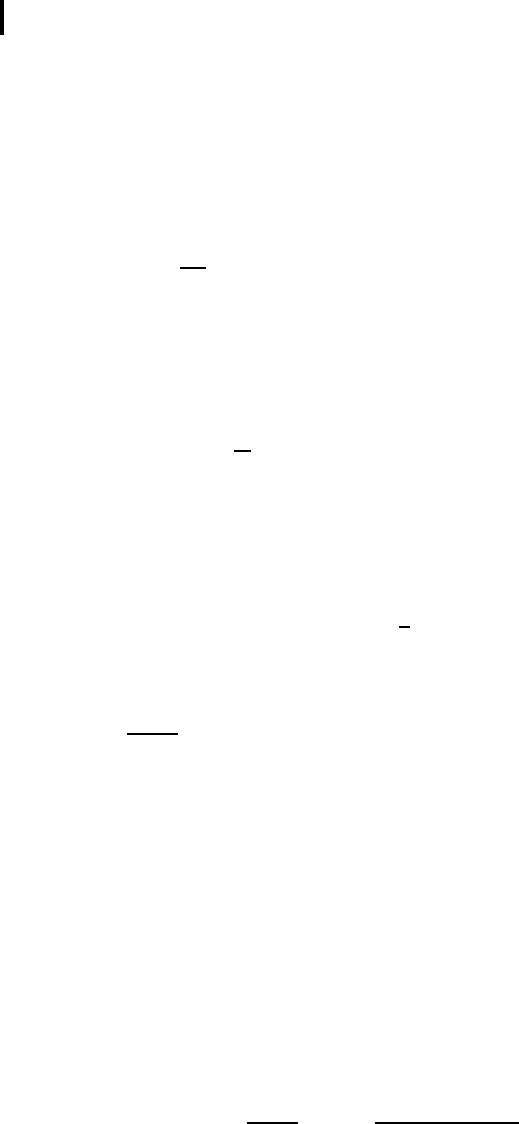
Fig. 11.8 The dispersion law for crystal vibrations with a small concen-
tration of point impurities.
2. Find, in the isotropic approximation, the dispersion law for crystal vibrations with
a small concentration of heavy impurities (c c
∗
=(m/∆m)
2
1).
Hint. Take into account (11.6.13) and the fact that for c c
∗
for all frequencies
|cΠ(ε)|ε and |cΠ
(ε)|1.
Solution.
ω = s
0
k
1 + c
ε
∗
(s
2
0
k
2
−ω
2
q
)
(s
2
0
k
2
− ω
2
q
)
2
+ Γ
2
1/2
.
The plot of this dependence is shown in Fig. 11.8.
12
Localization of Vibrations Near Extended Defects
12.1
Crystal Vibrations with 1D Local Inhomogeneity
In any macroscopic specimen of a real crystal there are dislocations. A dislocation,
being a quasi-one -dimensiona l structure, breaks the lattice regularity only in a small
region near a certain line – its axis. Vibration s lo calized near th e dislocation have the
form of waves running along the d islocation line.
We are interested in small atomic vibrations near new equilibrium positions and
thus in a zero approximation the dislocation axis may be considered to be fixed. We
assume that the dislocation is a straight-line and its axis is perpendicular to the crystal
symmetry plane. We direct the z-axis along the dislocation line and denote by ξ a2D
radius vector in the plane xOy: r =(ξ, z), ξ =(x, y). Assume also that the disloca-
tion does not change the substance density along its axis. The perturbation introduced
by a dislocation is then connected with a local change in the matrix of atomic force
constants. To analyze the long-wave crystal vibrations (λ a), this perturbation is
assumed to be concentrated on the dislocation axis. Using a scalar model we con-
sider the displacement as a continuous function of the coordinates: u = u(ξ, z).The
equation of long-wave lattice vibrations near the linear singularity can be represented
as
ω
2
u(ξ, z) −
1
m
∑
n
α(n − n
)u(ξ
, z
)=a
2
δ(ξ)
∑
z
U(z − z
)u( 0, z
), (12.1.1)
where δ(ξ) is a two-dimensional δ-function (δ(ξ)=δ(x)δ(y)) and the summation
over the lattice sites can be replaced by the integration
∑
z
···=
1
a
dz ···,
∑
ξ
···=
1
a
2
dx dy ···,
∑
n
···=
1
V
0
dV ··· .
(12.1.2)
The Crystal Lattice: Phonons, Solitons, Dislocations, Superlattices, Second Edition. Arnold M. Kosevich
Copyright
c
2005 WILEY-VCH Verlag GmbH & Co. KGaA, Weinheim
ISBN: 3-527-40508-9
280
12 Localization of Vibrations Near Extended Defects
The function U(z) in (12.1.1) describing the force matrix perturbation is indepen-
dent of frequency and can be regarded as an even function of z. It satisfies the obvious
requirement
∑
z
U(z)=0. (12.1.3)
Using the property of homogeneity of the crystal along the Oz direction and apply-
ing a one-dimensional Fourier transformation relative to the z coordinate we obtain
u(ξ, z)=
a
2π
χ
k
(ξ)e
ikz
dk, χ
k
(ξ)=
∑
z
u(ξ, z)e
ikz
. (12.1.4)
The equation for χ
k
(ξ) is derived from (12.1.1)
ω
2
λ
k
(ξ) −
∑
ξ
Λ
k
(ξ − ξ
)χ
k
(ξ
)=a
2
δ(ξ)U
k
χ
k
(0), (12.1.5)
where
Λ
k
(ξ)=
1
m
∑
n
z
α(n)e
ikan
z
, U
k
=
∑
z
U(z)e
−ikz
. (12.1.6)
Equation (12.1.5) is the equation of a 2D crystal vibrations with a point defect at the
origin of the coordinates. The wave-vector component k = k
z
enters this equation as
a parameter and determines the local perturbation intensity U
k
. In the case ak 1,
the function U
k
has an obvious expansion following from (12.1.6), (12.1.3)
U
k
= −k
2
W
0
, W
0
=
1
2
∑
z
U(z)z
2
. (12.1.7)
To find the function χ
k
(ξ), we use a 2D Fourier expansion
χ
k
(ξ)=
a
2
(2π)
2
χ
k
(κ, k)e
ikξ
dk
x
dk
y
, χ
k
(κ, k)=
∑
ξ
χ
k
(ξ)e
ikξ
, (12.1.8)
where κ is a two-dimensional wave vector κ =(k
x
, k
y
).
The Fourier components χ( κ, k) are determined from the relation
ω
2
−ω
2
0
(κ, k)
χ(κ, k)=−k
2
W
0
χ
k
(0), (12.1.9)
where the function ω
2
0
(κ, k) is the d ispersion law of an id eal crystal.
To simplify calculations, we assume the axis Oz is a four-fold or six-fold symmetry
axis. Then in the long-wave limit
ω
2
0
(κ, k)=s
2
0
κ
2
+ s
2
k
2
. (12.1.10)
The dependence of the vibration amplitude on ξ follows directly from (12.1.8)–
(12.1.10)
χ
k
(ξ)=−(ak)
2
W
0
(2π)
2
χ
k
(0)
cos(κξ) dk
x
dk
y
ω
2
− s
2
k
2
− s
2
0
κ
2
. (12.1.11)
12.1 Crystal Vibrations with 1D Local Inhomogeneity
281
If we set ξ = 0 in (12.1.11), we obtain an equation for the vibration frequencies
1 +(ak)
2
W
0
2π
k
0
0
κdκ
ω
2
−s
2
k
2
−s
2
0
κ
2
= 0. (12.1.12)
The upper limit of integration in (12.1.12) can be estimated as κ
0
∼ 1/a.The
fact that the integration limit in (1 2.1.12) is determined by the order of magnitude
only, and has the character of some “cut off” parameter, is connected with a model
assumption of the point-like character of a perturbation in (12.1.5). The assumption
(12.1.1) of a delta-like localization of the perturbation on the dislocation axis as well
as the dispersion law (12.1.10) are valid for the long-wave vibrations only ( aκ 1).
At the same time the integration in (12.1.11), (12.1.12) should be extended to
the whole interval of a continuous spectrum of frequencies. Since the integrand in
(12.1.11) does not exhibit a decrease at infinity necessary for the integral to converge,
we have to take into account the natural limit of integration over the quasi-wave vector
(aκ
0
∼ π).
Simplifying (12.1.12) we obtain
1 − (ak)
2
W
0
4πs
2
0
log
s
2
0
κ
2
0
s
2
k
2
− ω
2
= 0, (12.1.13)
by omitting small terms of the order of magnitude
s
2
k
2
− ω
2
s
2
0
κ
2
0
s
2
k
2
s
2
0
κ
2
0
∼ (ak)
2
1.
As in Chapter 11, (12.1.13) has a solution for eigenfrequency squares ω
2
with a def-
inite sign of W
0
only, namely, for W
0
> 0, so that necessarily ω
2
< s
2
k
2
.Ifthe
condition W
0
> 0 is satisfied, (12.1.13) always has a solution (Lifshits and Kosevich,
1965)
ω
2
= s
2
k
2
− s
2
0
κ
2
0
exp
−
4πs
2
0
(ak)
2
W
0
. (12.1.14)
We recall that in (12.1.14), W
0
> 0 and s
2
0
κ
2
0
∼ ω
D
.
The frequencies (12.1.14) have an exponential dependence on the perturbation in-
tensity, i. e., on U
k
that is characteristic for two-dimensional problems. Their defi-
nition has no critical value of the perturbation intensity at which the local vibration
frequency starts splitting off and that is typical for p oint d e fects. The existence of
the vibrations localized near a dislocation requires a definite sign of the perturbation
(W
0
> 0), and the corresponding frequency is always separated by a certain finite gap
δω the origin of the spectrum of bulk crystal vibrations
δω = sk − ω
d
∼
ω
2
D
sk
exp
4πs
2
0
(ak)
2
W
0
.
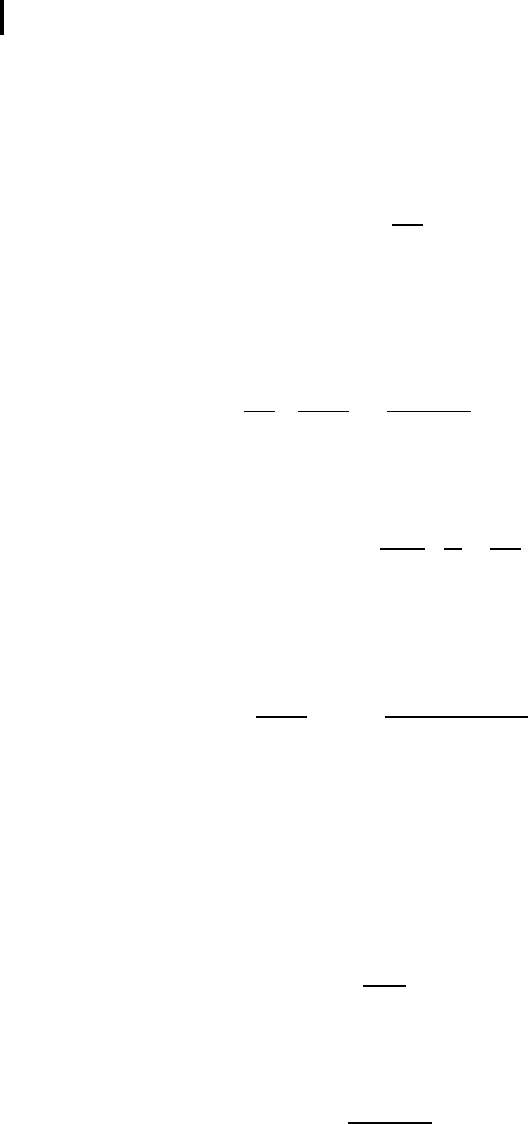
282
12 Localization of Vibrations Near Extended Defects
We have con sid ered elastic waves traveling along the dislocation. Their existence is
due to changes in the elastic moduli in the dislocation core, but the vibrations localized
near the chain of impurity atoms also have frequencies such as (12.1.14). Such a chain
is also a linear defect. The long-wave vibrations near this defect are described by the
same equation (12.1.1), but with a different perturbation matrix
U(z)=U
0
a δ(z)=−
∆m
m
ω
2
a δ(z). (12.1.15)
It is clear th at the prob lem of crystal vibrations with the perturbation (12.1.15) is
reduced to finding a solution to the two-dimensional equation (12.1.5) in which the
replacement U
k
→ U
0
is necessary. Thus, the equation for local frequencies remains
the same, replacing k
2
W
0
→ (∆m/m) ω
2
,
1 −
∆m
m
(aω)
2
4πs
2
0
log
s
2
0
κ
2
0
s
2
k
2
− ω
2
= 0. (12.1.16)
For ∆m > 0, (12.1.16) has the following solution in a frequency region of the
spectrum (ω
2
(m∆m) ω
2
D
),
ω
2
= s
2
k
2
− s
2
0
κ
2
0
exp
−
4π
(ak)
2
s
0
s
2
m
∆m
. (12.1.17)
It is clear that (12.1.17 ) is not qualitatively different from (12.1.14).
Let us note that the frequencies (12.1.14), (12.1.17) do correspond to vibrations
localized near the linear defect. According to (12.1.11), we perform the integration
χ
k
(ξ)= −(ak)
2
W
0
(2π)
2
χ
k
(0)
∞
0
κdκ
ω
2
− s
2
k
2
− s
2
0
κ
2
×
cos(κρ cos φ)dφ,
(12.1.18)
where ρ
2
= x
2
+ y
2
and the upper limit of integration over κ is shifted to infinity since
for ρ = 0 the integral in (12.1.18) converges.
The integrals on the r.h.s. of (12.1.18) can be taken from any reference book; there-
fore, we give only the final expressions for the vibration amplitude
χ
k
(ξ) ≡ χ(ρ)=(ak)
2
W
0
2πs
2
0
K
0
(κ
⊥
ρ)χ
k
(0), (12.1.19)
where K
0
(x) is a cylindrical zero-order Hankel function (of an imaginary argument);
κ
⊥
is the inverse radius of localization of vibrations near the dislocation line
κ
2
⊥
(k)=
s
2
k
2
−ω
2
s
2
0
. (12.1.20)