
Kosevich A.M. The crystal lattice
Подождите немного. Документ загружается.

262
11 Localization of Vibrations
If all T
αβ
are determined from this set of linear algebraic equations, the Green
function will be derived as
G(n, n
)=G
0
(n − n
)+
∑
αβ
G
0
(n − n
α
)T
αβ
G
0
(n
β
−n
). (11.3.8)
Equations (11. 3.7) are simple, but writing th eir solutio n for an arb itrary number of
defects is rather cu mbersome, and their quantitative analysis is complicated. Therefore
we restrict ourselves to a qualitative ch aracterization of the Green function (11.3.8).
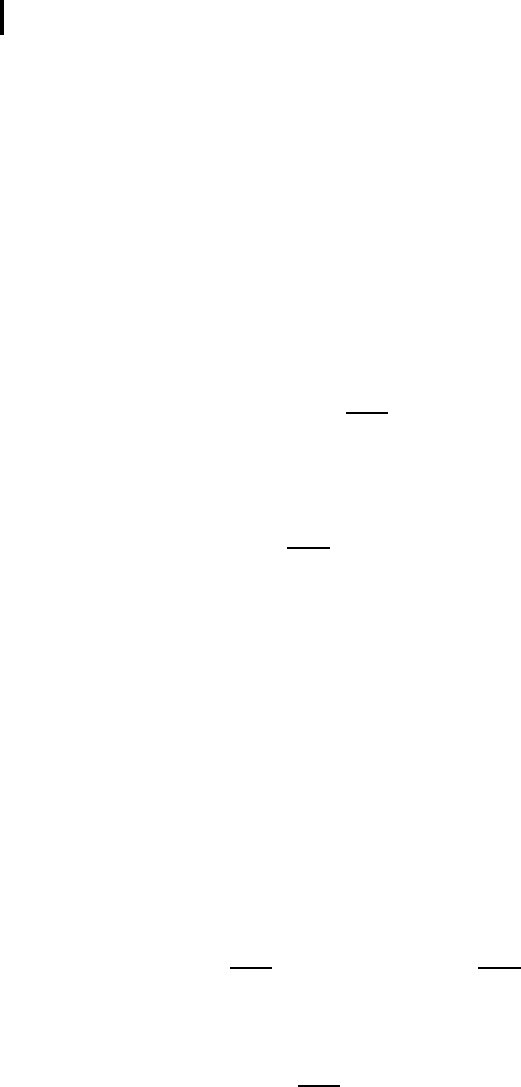
If the distance between all neighboring defects r
αβ
greatly exceeds the dimension l
of the localization region of vibrations near an isolated defect, there are values of the
parameter ε such that
U
0
G
0
ε
(n
α
−n
β
)
D(ε) for α = β. In the relation (11.3.7),
we can then omit th e terms with γ = α. Subsequently, it is simple to solve (11.3.7):
T
αβ
=
U
0
D(ε)
δ
αβ
. (11.3.9)
The solution obtained does not, in fact, differ from (11.3.2) and the Green function
is written analogously (11.3.4)
G(n, n
)=G
0
(n − n
)+
U
0
D(ε)
∑
α
G
0
(n − n
α
)G
0
(n
α
− n
). (11.3.10)
If the defects are distributed randomly but uniformly, (11.3.10) yields an approx-
imate expression for the Green function, which is valid under the assumption that
the average distance between the defects greatly exceed the length l. The expression
(11.3.10) is inapplicable near the boundaries of the continuous spectrum of an ideal
crystal and in the vicin ity of a local frequency.
Coming back to an analysis of Fig. 11.4a we see that (11.3.10) takes into account
the excitation transfer from site n
to site n through a simple use of all the defects. This
situation resembles a kinematic X-ray scattering theory taking into account only sim-
ple X-ray scattering by each of the crystal atoms, but even with two defects available
(at sites n
1
and n
2
) there exists an excitation transfer ch annel (n
→ n
1
→ n
2
→ n)
disregarded in (11.3.10) and shown in Fig. 11.4b.
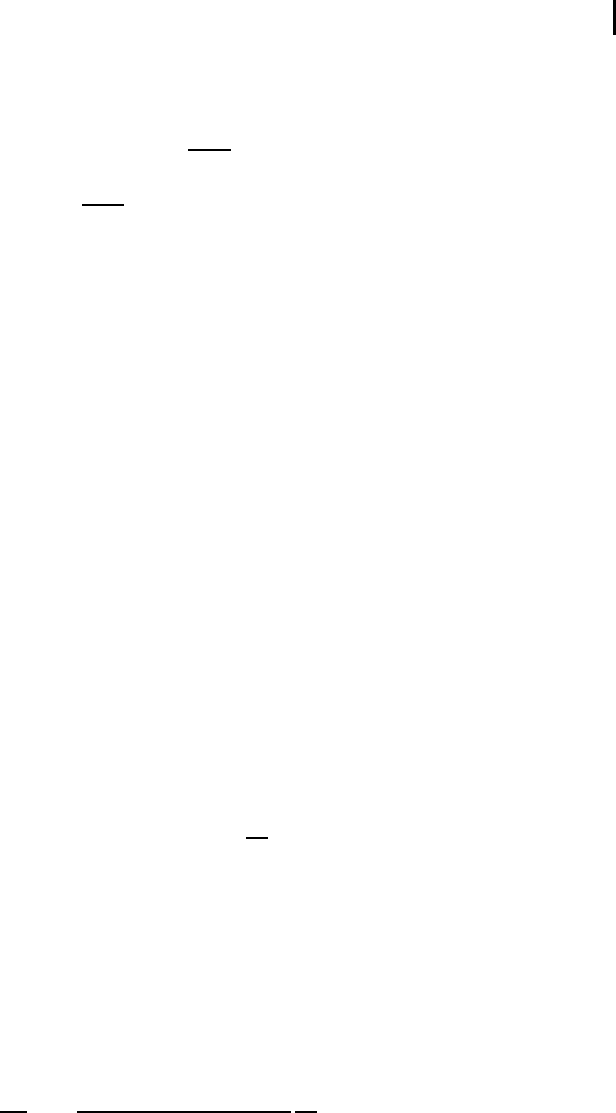
Assuming the contribution of two defect processes to be small, it is easy to describe
this. We find a correction to the solution (11.3.9) by setting
T
αβ
=
U
0
D(ε)
δ
αβ
+ t
αβ
,
t
αβ
U
0
D(ε)
. (11.3.11)
A small correction t
αβ
is easily found by substituting (11.3.11) into (11.3.7)
t
αβ
=
U
0
D(ε)
2
G
0
ε
(n
α
− n
β
). (11.3.12)
11.3 Green Function for a Crystal with Point Defects
263
Thus, a specified expression (11.3.10) that takes into account simple and double “scat-
terings” by the defects takes the form of the following expansion
G(n, n
)= G
0
(n − n
)+
U
0
D(ε)
∑
α
G
0
(n − n
α
)G
0
(n
α
−n
)
+
U
0
D(ε)
2
∑
α=β
G
0
(n − n
α
)G
0
(n
α
− n
β
)G
0
(n
β
−n
).
(11.3.13)
We shall consider (11.3.13) as the beginning of an infinite series of successive ap-
proximations. The structure of terms of different approximations in (11.3.13) is such
that the possibility to construct the Green functions G(n, n
) using a simple diagram
technique is quite obvious. The rule for constructing the whole series is as follows.
The points n and n
are linked b y all possible straight rays broken down by the de-
fects (the simplest o f them are shown in Fig. 11.4). Each ray starting from the point
n
does not return to it and coming to the point n never leaves it again. The ray may
come back to the defect-occupation points many times. The number of breaks of a ray
determines the order of the term in an expansion such as (11.2.13). Each segment of
the ray n
αβ
in the corresponding term is associated with a factor G
0
(n
αβ
) and each
defect with a factor U
0
/D( ε). After the summation over all rays, we get the desired
Green function.
The calculation scheme described above can really only be used for an approximate
calculation of the Green function in a crystal with small concentration of impurities,
since the higher-order terms in (11.3.13) should be p roportional to higher degrees of
concentration of the defects.
We come back to (11.3.10) for the Green function of a crystal with randomly dis-
tributed impurities and consider it in the linear approximation with respect to con-
centration. Being interested first of all in extremely long-wave vibrations of a defect
crystal, we change the summatio n over the numbers of imp urities in (11.3.10) to an in-
tegration over the impurity coordinates, taking into account their homogeneous space
distribution
∑
α
f (r)=
c
V
0
f (r) d
3
r, (11.3.14)
where r
α
= r(n
α
) is the radius vector of an impurity atom; V
0
is the unit cell (atomic)
volume; c is the concentration of d efects, equal to the ratio of the number of the defects
to N (c 1). Note that the procedure (11.3.14) is equivalent to an averaging over the
random positions of impurities.
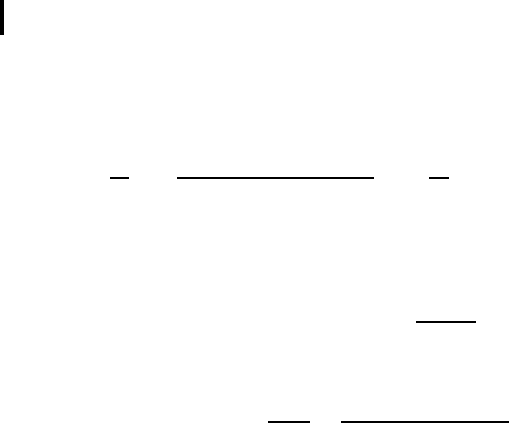
We use (11.3.14) to carry out the summation using the k-representation of the crys-
tal Green function
∑
α
G
0
(n − n
α
)G
0
(n
α
− n
)
=
c
N
2
∑
kk
exp [ikr(n) −ik
r(n
)]
ε − ω
2
(k)
ε − ω
2
(k
)
1
V
0
exp
−i
k − k
x
d
3
x.
264
11 Localization of Vibrations
We then apply the formula
exp(ikr) d
3
r = Vδ
k0
and write
∑
α
G
0
(n − n
α
)G
0
(n
α
− n
)
=
c
N
∑
k
exp {ik [r(n) −r(n
)]}
ε − ω
2
(k)
2
= −c
∂
∂ε
G
0
ε
(n − n
).
(11.3.15)
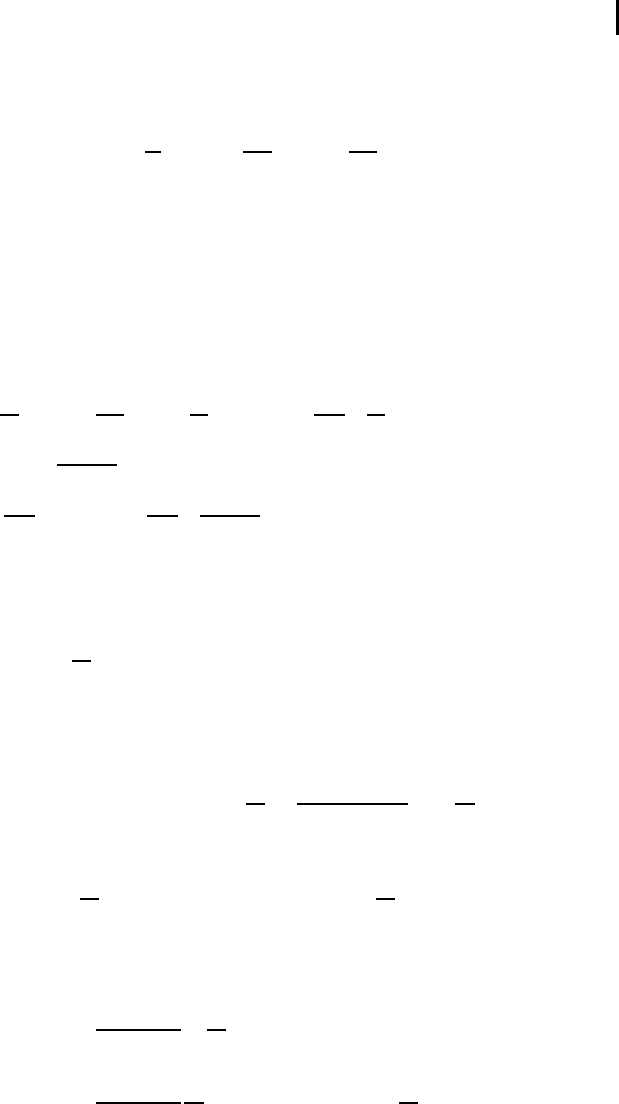
Substituting (11.3.15) in (11.3.10) we obtain an expansion of the Green fu nction
(we are interested only in dependence on the variable ε)
G(ε)=G
0
(ε) −cΠ(ε)
∂G
0
(ε)
ε
, (11.3.16)
where the notation
Π(ε)=
U
0
D(ε)
=
(∆m/m)ε
1 +(∆m/m)εG
0
ε
(0)
(11.3.17)
is introduced.
If we restrict ourselves to a linear approximation with respect to concentration,
(11.3.16) can be represented as
G(ε)=G
0
[ε − cΠ(ε)] . (11.3.18)
We now remind ourselves that the diagram technique described above allows us to
obtain the term of an arbitrary order in Π(ε) in the expansion (11.3.13). The structure
of these terms is such that after changing from the summation to the integration by the
rule (11.3.14), they are expressed through a derivative of a corresponding order with
respect to ε of the ideal crystal Green function and contain the necessary power of
concentration. Thus, the validity of (11.3.1 8) is connected only with the possibility of
replacing the summ a tion over the numbers of impurities by an integration (11.3.15).
It can be derived without assuming an approximation linear in c.
However, there is a requirement that must be satisfied in order to use the Green
function (11.3.18). Using it we can obtain only those crystal characteristics that are
determined by quantities averaged over the defect positions. Sin ce the averaging over
random configurations of a system of impurities results in a considerable loss of in-
formation contained in the initial form o f the Green function, this requirement is ex-
tremely important.
11.4
Influence of Defects on the Density of Vibrational States in a Crystal
Having the Green function (11.3.4), we can use the recipe presented in Chapter 4 to
determine the density of lattice vibrations in the presence o f point defects. Accord ing
11.4 Influence of Defects on the Density of Vibrational States in a Crystal
265
to this me thod it is necessary to u se (4.8.9) in th e given case. For a monatom ic lattice
the density of vibrational states g(ε) nor malized to unity equals (4.8.9),
g(ε)=
1
π
lim
γ→+0
Im
1
3N
Tr
1 −
dU
dε
G
ε−iγ
. (11.4.1)
For a scalar model the factor 3N in the denominator must be replaced by N.
Of much physical interest is generally the density of vibrational states in a crystal
containing a large number of equivalent point defects. Just this quantity can charac-
terize the macroscopic properties of the crystal. In this case, when the average d is-
tance between the defects is large (the concentration is small) the Green function of a
scalar model of crystal vibrations is calculated from (11.3.10 ). Substituting (1 1.3.5),
(11.3.10) into (11.4.1) we first calculate the trace:
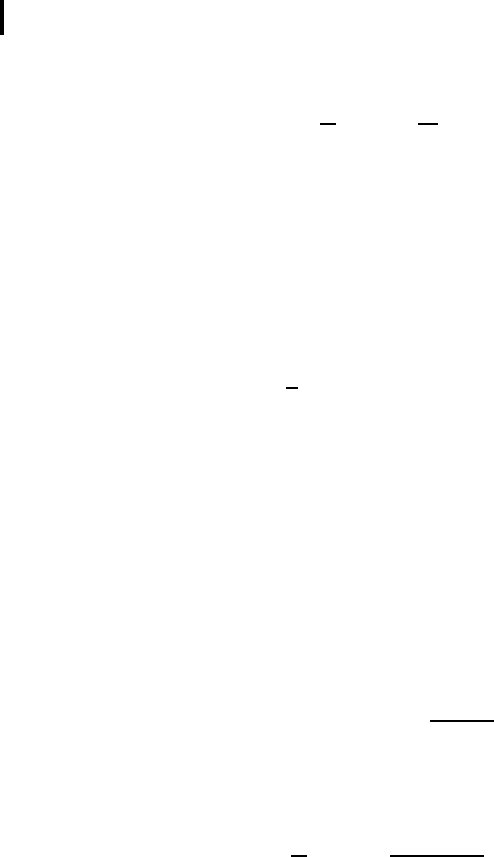
S =
1
N
Tr
1 −
dU
dε
G =
1
N
G(n, n )+
∆m
m
1
N
∑
α
G(n
α
, n
α
)
= G
0
(0)+
U
0
ND(ε)
∑
n α
G
0
(n − n
α
)G
0
(n
α
− n)
+c
∆m
m
G
0
(0)+
∆m
m
U
0
ND(ε)
∑
αβ
G
0
(n
α
−n
β
)G
0
(n
β
− n
α
).
(11.4.2)
Preserving the accuracy with which (11.3.10) for the Green function was derived
we omit the term with α = β in the last sum of (11.4.2)
1
N
∑
αβ
G
0
(n
α
− n
β
)G
0
(n
β
−n
α
)=c
G
0
(0)
2
. (11.4.3)
In addition, it is easy to verify, using the k-representation for the Green function of an
ideal lattice, that
∑
n
G
0
(n − n
α
)G
0
(n
α
− n)=
1
N
∑
k
1
ε − ω
2
0
(k)
2
= −
d
dε
G
0
ε
(0).
Therefore,
1
N
∑
n α
G
0
(n − n
α
)G
0
(n
α
− n)=−c
d
dε
G
0
ε
(0). (11.4.4)
By substituting (11.4.3), (11.4.4) into (11.4.2), and remembering the definition
(11.2.10) for D(ε),wehave
S = G
0
ε
(0)+
c(∆m/m)
ND(ε)
ε
d
dε
G
0
ε
(0)+G
0
ε
(0)
= G
0
ε
(0)+
c(∆m/m)
ND(ε)
d
dε
εG
0
ε
(0)
= G
0
ε
(0)+c
d
dε
log D(ε).
(11.4.5)
266
11 Localization of Vibrations
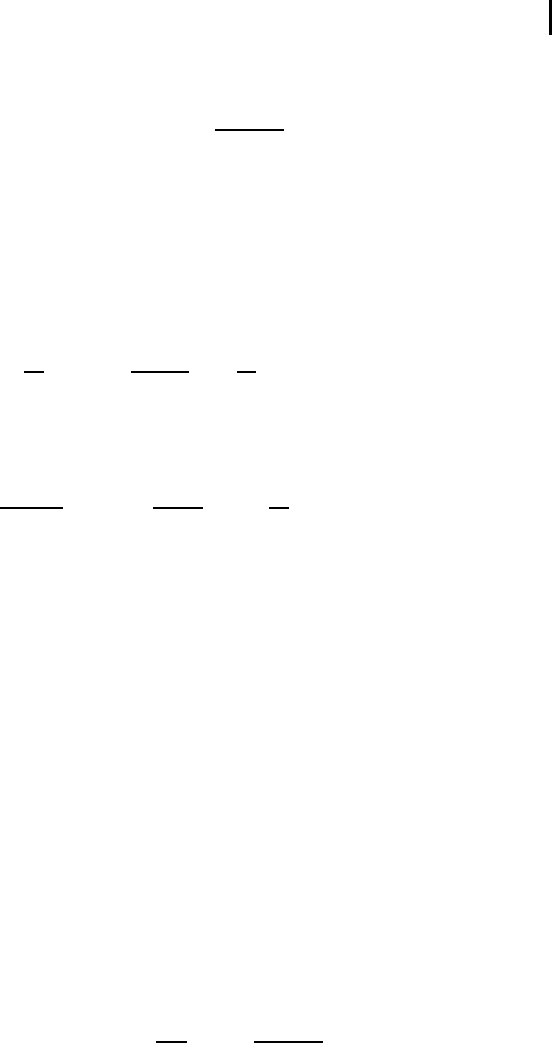
We now return to the initial formula (11.4.1) as applied to a scalar model
g(ε)=g
0
(ε)+
c
π
lim
γ→+0
Im
d
dε
log D(ε). (11.4.6)
In a linear approximatio n with respect to the concentratio n c, the expression (11.4.6)
determines the variation of the density of vibrational states due to point defects. The
applicability of the final formula (11.4.6) is not limited to a scalar model. The pres-
ence of three vibrational polarizations in a cubic crystal does not affect (11.4.6). It is
sufficient to take account of a simple replacement G
0
(0) → (1/3)G
ll
0
(0) in the defi-
nition of D(ε). For a mon a tomic lattice having no cubic symmetry D(ε) is expressed
through the determinant appearing in (11.1.14):
log D(ε)=
1
3
log Det
δ
ik
−U
0
G
ik
0
(0)
.
If the value of ε lies outside the continuous spectral band for an ideal crystal, then
g
0
(ε)=0,andG
0
ε
(0) is a real function of the real variable ε:
lim
γ→0
G
0
ε−iγ
(0)=G
0
ε
(0) ≡ Re{G
0
ε
(0)}.
However, in this case the density of vibrations for a crystal with point defects can
be nonzero outside the continuous spectrum only at the points where the argument of
the logarithm in (11.4.6) vanishes: D(ε)=0, i. e., for the values of ε coincident with
the squares of local frequencies. We represent in close proximity of the point ε = ε
d
,
the function D(ε −iγ) as
D(ε −iγ)=(ε − ε
d
−iγ)
dD(ε
d
)
dε
d
,
remembering that ε
D
is the solution to the equation D(ε)=0.
We then have from (11.4.6)
δg(ε)=
c
π
lim
γ→+0
Im
1
ε − ε
d
−iγ
. (11.4.7)
However, this lim it is equivalent to a δ-function. Therefore, in a corresponding fre-
quency range the density of vibrational states has a δ-like character
δg(ε)=c δ(ε − ε
d
), (11.4.8)
showing that the local frequency is discrete.
The result contained in (11.4.8) has already been discussed, so that we shall now
pass to analyzing the density of “defect” crystal vibrations in the continuous spectrum
range of an ideal lattice (ε
1
< ε < ε
2
).
11.5 Quasi-Local Vibrations
267
In writing (11.2.24), we have taken into account that in the continuous spectrum
region
lim
γ→0
G
0
ε−iγ
(0)=P.V.
g
0
(z) dz
ε − z
+ iπg
0
(ε), (11.4.9)
where P.V. means the principal value of the integral.
In order to separate real and imaginary parts of the derivative (d/dε)G
0
ε
(0) it is
sufficient to differentiate (11.4.9) with respect to ε for all ε except for those getting
into near the edges of the continuous spectrum interval and the van Hove specific
point in which the function g
0
(ε) loses its analyticity. Thus
lim
γ→+0
D(ε −iγ)=R(ε) −iπU
0
g
0
(ε),
lim
γ→+0
d
dε
D(ε −iγ)
d
dR(ε)ε
−iπ
d
dε
[U
0
g
0
(ε)] .
(11.4.10)
The first of these relations is consistent with (11.2.25).
Performing the operations indicated in (11.4.6), it is easy to obtain
δg(ε)=
c
|D(ε)|
2
U
0
g
0
(ε)
dR(ε)
dε
− R(ε)
d
dε
[U
0
g
0
(ε)]
. (11.4.11)
The expression (11.4.11) describes the deformation of the continuous spectrum of fre-
quency squares under the influence of point defects. It has nonphysical singularities
at the points where the function g
0
(ε) loses its analyticity an d has root singularities.
Thus, (11.4.11) is applicable only away from the vicinity of these points. The appear-
ance of singularities in (11.4.11) results from the fact that an approximation that is
linear in concentration is not sufficient for examining the spectral deformation near its
singular points.
11.5
Quasi-Local Vibrations
We have mentioned that (11.4.11) has nonphysical singularities, because the linear
approx imation with respect to the defect concentration is inapplicable when describing
δg(ε) in the v icinity of certain values of ε. However, the function δg(ε) may have
another singularity having a physical meaning. Thus, with a defect-isotope present in
the crystal, the real part D(ε) can vanish for a certain value of ε = ε
q
lying inside the
continuous spectrum:
R(ε
q
) ≡ 1 +
∆m
m
ε
q
g
0
(z) dz
ε
q
− z
= 0. (11.5.1)
Generally, at ε = ε
q
the function δg(ε) has no singularities in a formal mathematical
sense, but if the point ε = ε
q
is near the edges of the continuous spectrum band where
268
11 Localization of Vibrations
the density of states δg
0
(ε) is very small, then the denominator in (11.4.11) becomes
anomalously small in the vicinity of ε
q
and the function δg(ε) increases.
This situation corresponds to the appearance of a quasi-stationary vibration with
ε = ε
q
.
To determine the form of the resonance peak of the function δg(ε) ,weuseanex-
pansion of the type (11.4.7): R(ε)=(ε − ε
q
)dR(ε
q
)/dε
q
) and restricting ourselves
to a small region near the point considered we set ε = ε
q
in the numerator of the r.h.s.
of (11.4.11)
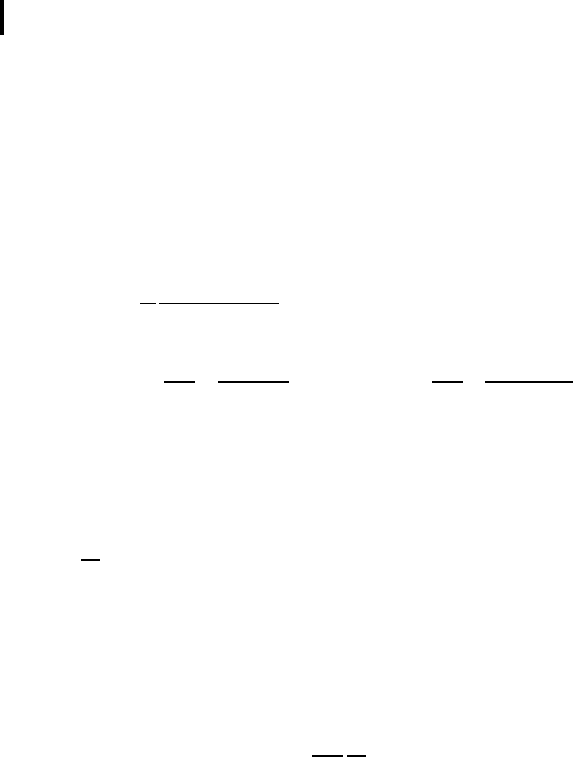
δg(ε)=
c
π
Γ
q
(ε − ε
q
)
2
+ Γ
2
q
,
Γ
q
= −π
∆m
m
ε
q
g
0
(ε
q
)
R
(ε
q
)
δg
0
(ε)=−π
∆m
m
ε
q
g
0
(−ε
q
)
R
(ε
q
)
.
(11.5.2)
The formula (11.5.2) has the characteristic form of an expression describing the
frequency distribution of a quasi-stationary state of the system. The parameter Γ
q
gives the half-width of a corresponding resonance curve and may be associated with
the imaginary part of ε in the conventional notation of (11.2.7). If Γ
q
is small, the
expression (11.5.2) results in a sharp peak in the vibration density. The frequency
ω
q
=
√
ε
q
is then called a quasi-local frequency and the vibration corresponding to it
a quasi-local vibration.
Analysis of (11.5.2) is of most interest in the case when the quasi-local vibration
frequencies are near the long-wave edge of an acoustic spectrum (such vibrations will
be shown to be generated by heavy isotopes with ∆m m). If ε ω
2
D
,whereω
D
is
the Debye frequency, the main part of the expansion of R(ε) in powers of ε is obtained
from (11.2.26)
R(ε)=1 −
∆m
m
ε
ε
∗
, ε
∗
∼ ω
2
D
. (11.5.3)
We note that negativeness of the derivative R
(ε) and positiveness of the parameter
Γ
q
for ∆m > 0 follow from (11.5.3).
Substituting (11.5.3) into (11.5.1), we see that for a large enough value of ∆m/m
there is necessarily a solution to (11.5.1) in the region of small ε
ε
q
=(∆m/m)ε
∗
∼ (∆m/ m)ω
2
D
, ∆m m. (11.5.4)
It follows from (11.5.4) that with increasing ∆m/m, the quasi-local frequency po-
sition approaches the long-wave edge of the vibration of the continuous spectrum
(ε
q
→ 0). Simultaneously, the peak in the spectral density narrows. Indeed, since at
small ε we may use the estimate (11.2.26) for g
0
(ε), the resonance peak half-width is
Γ
q
= πε
∗
ε
q
g
0
(ε
q
) ∼ (m/∆m)
3/2
ω
2
D
. (11.5.5)
11.5 Quasi-Local Vibrations
269
Thus, the relative half-width of the Lorentz curve (11.5.2) for heavy isotopes is
determined by
Γ
q
ε
q
= πε
∗
g
0
(ε
q
) ∼
m
∆m
1,
confirming the resonance peak narrowing with increasing ∆m/ m. Hence, with in-
creasing ∆m/m the resonance peak acquires δ-function character. The possible ap-
pearance of a sharp peak in the function δg(ε) in the region of low crystal vibrational
frequencies with heavy impurity isotopes was first noted by Kogan and Iosilevskii
(1962), and Brout and Visher (1962).
It is natural that the Lorentz-type peak (11.5.2) also arises in a plot of the frequency
spectrum
δν(ω)
N
= c
2ω
q
π
Γ
q
(ω
2
− ω
2
q
)
2
+ Γ
2
q
, (11.5.6)
where ω
2
q
= ε
q
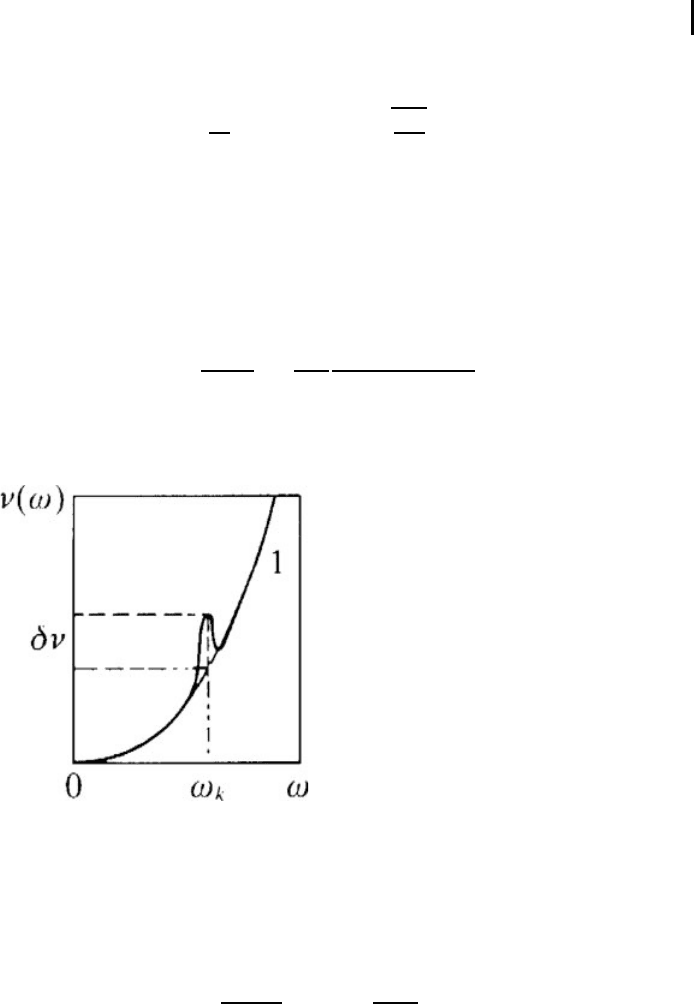
. A typical plot of the function ν(ω)=ν
0
(ω)+δν (ω) for ω ω
D
is shown in Fig. 11.5.
Fig. 11.5 The frequency spectrum near a quasi-local frequency (the
curve 1: ν
0
(ω)=constω
2
).
It is easy to estimate the impurity concentration c
∗
at which the peak height
(Fig. 11.5) calculated by (1 1.5.6) is comparable with the frequency distribution func-
tion ν
0
(ω) of an ideal crystal at a quasi-local frequency ω = ω
q
. From the relation
δν(ω
q
)
ν
0
(ω
q
)
∼ δν(ω
q
)
ω
3
D
ω
q
Γ
q
∼ 1,
we get for the concentration to be estimated:
c
∗
∼ Γ
q
ω
q
/ω
3
D
. (11.5.7)

270
11 Localization of Vibrations
We substitute in (11.5.7) the estimates (11.5.4), (11.5.5) to obtain
c
∗
∼ (m/∆ m)
2
1. (11.5.8)
Since, by assumption, the parameter m/∆m is very small, the quasi-local vibration
density peak may already be equal in order o f magnitud e to the vibration density of
an ideal crystal at small concentrations of heavy impurities (c ∼ c
∗
1). However,
the derivation of (11.5.2), (11.5.6) and the calculation scheme were based on using the
linear approximation (c 1) with respect to concentrations for which additions (pro-
portional to c) to the q uantities studied are assumed to b e small. Since for c ∼ c
∗
1
the last assumption is not justified, it is necessary to analyze more consistently the
influence of heavy isotopic impurities on the spectrum of crystal vibrations even at
their smallest concentrations.
Quasi-local vibrations affect the thermodynamic and kinetic properties of a crystal.
The singularities in the amplitudes of elastic wave scattering near quasi-local fre-
quencies ω
q
lead to resonance anomalies in the ultrasound absorption. Coherent neu-
tron scattering (with emission or absorption of a simple phonon) in the presence of
the corresponding impurity in a crystal has certain specific features at frequencies of
emitted (or absorption) phonons close to ω
q
. The differential cross section of this
neutron scattering has an additional characteristic factor of the type (11.5.6) increas-
ing anomalou sly near a q uasi-local frequency. It is natural that similar peculiarities
should be observed in the infrared absorption spectrum of crystals with impurities that
produce quasi-local vibration.
Finally, much interest has been generated in quasi-local vibrations, related to the
Mössbauer effect for the nuclei of impurity atoms. The Mössbauer phenomenon in im-
purities is connected with the specific relation between the momentum and the energy
are transferred to an impurity nucleus. This relation is determined by those possible
motions in which an impurity atom is capable of participating , i. e., by the expansion
of the impurity displacement vector with respect to normal modes of the defect crys-
tal. Among the vibration modes there is a large group of vibrations with very close
frequencies (quasi-stationary wave packets of these oscillations cause the quasi-local
vibrations). This leads to the fact that in expanding the displacement vector of an im-
purity atom with respect to normal vibrations the relative contribution of a quasi-local
vibration greatly exceeds the relative contribution of ordinary crystal vibration modes
with frequencies of a continuous spectrum. Thus, quasi-local crystal vibrations should
manifest themselves in the spectrum of phonon transitions of the Mössbauer effect.
It should b e noted that in phenomena such as the Mössbauer effect or neutron scat-
tering the contribution of true local vibrations is quite pronounced and larger than the
contribution of the quasi-local vibrations (reduced to the same frequency). However,
in the range of low frequencies (considered, for instance, while studying the influ-
ence of relatively heavy impurities on the crystal properties) there exist quasi-local
vibrations only: local vibrations cannot appear near the low-frequency boundary of an
acoustic spectrum.
11.6 Collective Excitations in a Crystal with Heavy Impurities
271
11.6
Collective Excitations in a Crystal with Heavy Impurities
The Green tensor G
0
of an ideal crystal in the site represen tation is a function of the
difference in the numbers of sites n and n
. It follows from (11.3.18) that the averaged
matrix G for a crystal with randomly distributed point defects is also a function of this
difference. This reflects the macroscopic homogeneity of a crystal with defects that
appear as a result of averaging over random distributions of impurity atoms.
For the Green function of a homogeneous system the long-wave k-representation is
introduced in the usual way. Thus, we just write the averaged Green function (11.3.18)
of a crystal with point defects in (ε , k)-representation.
G(ε, k)=
1
ε − ω
2
0
(k) − c
∏
(ε)
. (11.6.1)
We first show that the validity of (11.6.1) is not really restricted by the linear ap-
prox imation with respect to c. We f ocus on a scalar model and assume that the defect-
isotope introduces a point perturbation (11.3.5). Discussing the Green function o f the
defect crystal, it is necessary to find the matrix (11.3.6) as a solution to (11.3.7). In
studying the long-wave vibrations when the distances
r
α
− r
β
a/c
1/3
give the
main contribution, the quantity
U
0
∑
γ= α
G
0
(n
α
− n
γ
)T
γβ
,
on the l.h.s. of (11.3.7) at fixed α is determined by the total contribution from a large
number of terms. To a first approximation, this contribution can be regarded as being
averaged over a large number of impurities and be calculated usin g (11. 3.14). How-
ever, averaging transforms a crystal into a homogeneous macroscopic medium for
which
T
αβ
= T(r
α
− r
β
), (11.6.2)
where r
α
is the α-th impurity coordinate that can now be considered to be varying
continuously.
Substituting (11.6.2) into (11.3.7) and replacing the Kronecker delta symbol δ
αβ
on
the r.h.s. by a δ -function normalized in the appropriate way we obtain
D(ε)T(r − r
)+
cU
0
V
0
G
0
(r − x)T(x − r
) d
3
x = cU
0
Vδ(r − r
). (11.6.3)
We introduce the Fourier transformation for the function T(x)
T
k
=
1
V
T(x)e
−ikx
d
3
x,
and rewrite (11.6.3) in k-representation
[D(ε) − cU
0
G
0
(ε, k)] T
k
= cU
0
, (11.6.4)