
Kosevich A.M. The crystal lattice
Подождите немного. Документ загружается.

12.2 Quasi-Local Vibrations Near a Dislocation
283
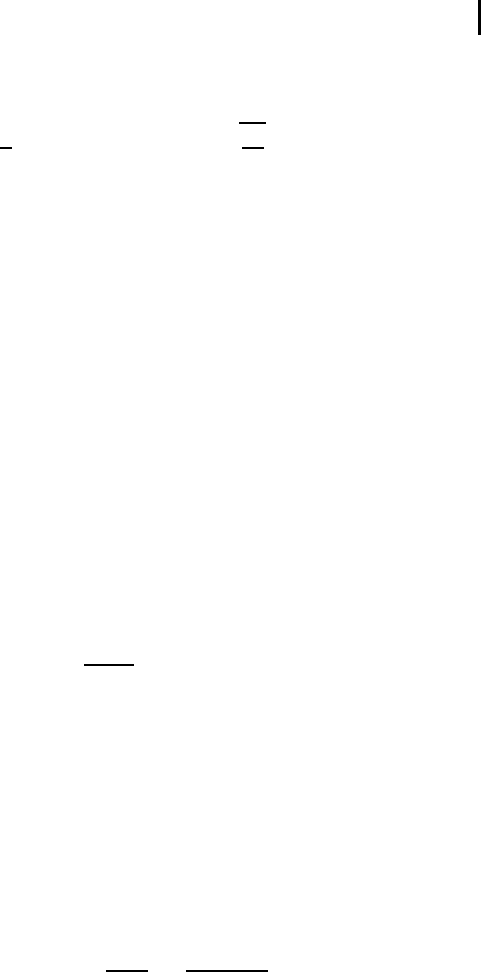
The behavior of the function K
0
(x) at small and large values of its argument is well
known:
K
0
(x)=−log
x
a
, x 1, K
0
(x)=
π
2x
e
−x
, x 1.
Thus, the vibration amplitude distant from the dislocation axis has a characteristic
exponential decrease confirming that the vibrations are localized near the dislocation.
The limiting dependence K
0
(x) for x 1 shows that the vibration amplitude has a
logarithmic singularity as ρ → 0. The equation (12.1.19) derived in the long-wave
approximation is valid only for ρ a; therefore, the extremely small distance ρ for
which (12.1.19) is valid may not be smaller than a.
12.2
Quasi-Local Vibrations Near a Dislocation
The equation for the eigenfrequen c ies (12.1.2) is equivalent to the condition
1 −U
k
G
2
(ε, k)=0, (12.2.1)
where G
2
(ε, k) is the Green function of the equation for 2D crystal vibrations (ε =
ω
2
), with the spectrum of frequency squares (12.1.10) beginning with s
2
k
2
,wherek
is a fixed parameter. Th is function has an obvious definition
G
2
(ε, k)=
a
2
(2π)
2
G
0
(ε, k) d
2
k,
where G
0
(ε, k) is the Green function of an ideal crystal in a scalar model (4.5.10).
The dislocation localized waves have freque ncies for which Im G
2
(ε, k)=0.But
by examining quasi-local vibrations near a heavy impurity, we made it clear that in
the frequency range where Im G
2
= 0, resonance vibrational states may exist. In this
case the frequencies of these vibrations are determined by
1 −U
k
Re G
2
(ε, k)=0. (12.2.2)
Using (12.1.12), it is easy to see that
Re G
2
(ε, k)=
a
2
4πs
2
0
log
s
2
k
2
− ε
s
2
0
k
2
0
. (12.2.3)
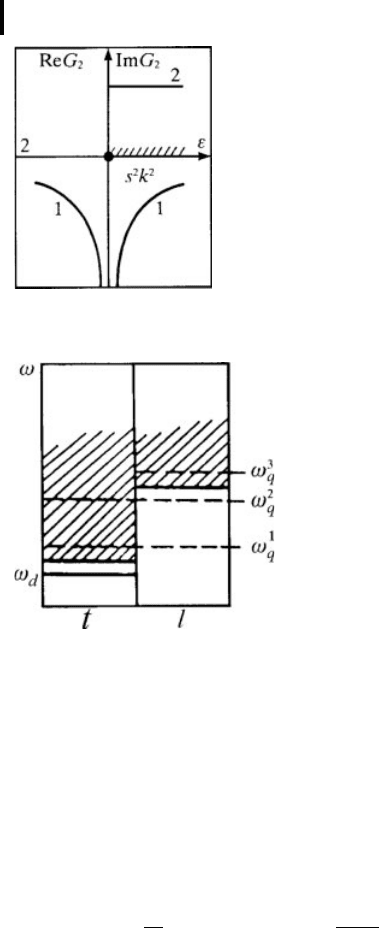
It is clear that the r.h.s. of (12.2.3) tends to −∞ at the point ε = s
2
k
2
and determines
the function symmetrical with respect to this point (Fig. 12.1). Finding from the plot
a solution to (12.2.1), (12.2.2) we conclude that for U
k
< 0 there are simultaneously
solutions both to (12.2.1) for ε < s
2
k
2
(dislocation waves) and to (12.2.2) for ε > s
2
k
2
(quasi-local vibrations near the dislocation). But the latter have the physical meaning
284
12 Localization of Vibrations Near Extended Defects
Fig. 12.1 T he real (1) and imaginary (2) parts of the Green function as
functions of ε at fixed k
z
.
Fig. 12.2 T he position of local ω
d
and quasi-local ω
q
frequencies of
dislocational vibrations with fixed k
z
.
of isolated frequencies only in the case when the damping of a corresponding reso-
nance frequency (i. e., the imaginary part of this frequency) is small. We know that
the damping is determined by Im G
2
(ε, k)=πg
(2)
(ε, k),whereg
(2)
(ε, k) is a two-
dimensional vibration density. In the considered range of frequency squares, πg
(2)
is
practically constant (line 2 in Fig. 12.1) πg
(2)
=(a/s
0
)
2
∼ 1/ω
2
D
. Analyzing the
width o f the quasi-local vibration peak, we have
Γ = πg
(2)
d
dε
Re G
2
−1
= g
(2)
2πs
0
a
2
ε − s
2
k
2
∼ ε −s
2
k
2
, (12.2.4)
i. e., it has the order of magnitude of the square of a resonance frequency measured
from the edge of the spectrum s
2
k
2
. This means that the quasi-local frequency near a
dislocation is very weakly pronounced.
In conclusio n, we consider in brief a short qualitative characteristic of disloca-
tion localized vibrations of a real crystal lattice that has three polarizations of the
displacement vector with three branches of the dispersion law. In the isotropic ap-
proximation, there exist two branches of transverse vibrations with the dispersion law

12.3 Localization of Small Vibrations in the Elastic Field of a Screw Dislocation
285
ω
2
= s
2
t
(κ
2
+ k
2
) and one branch of longitudinal vibrations with the dispersion law
ω
2
= s
2
l
(κ
2
+ k
2
),sothats
l
> s
t
always. If the value of k is fixed, there are two
bands of continuous frequency values of the bulk vibrations (Fig. 12.2) ω > sk.
With the corresponding sign of the perturbation U
k
, the frequency lying near the
boundary of the corresponding band may split off from the lower edge of each of the
bands. One of these frequencies (the lowest one, ω
d
) corresponds to the vibration
localized near the dislocation. It arises near the edge of the transverse vibration band
and the localized vibrations have the form of transverse waves running along the dis-
location. The dislocation axis participates in these vibrations, bending and vibratin g
like a spanned string. As the quantity s
t
k − ω
d
is exponentially small, the bending
waves have a velocity that practically d oes not differ from that of s
t
. The character
of vibrations allows us to formulate the elastic string model oftenusedindifferent
applications of a dynamic theory of dislocations. In this model a dislocation line is
considered as a h eavy string vibrating in a slip plane. The ratio of linear tension to
dislocation mass is such that the dispersion law of string-bending vibrations coincides
practically with the dispersion law of transverse sound waves in a crystal ω = s
t
k.
The frequency “split off” from the boundary of the longitudinal vibrations spectrum
(the frequency ω
d
in Fig. 12.2) could be considered as discrete only if the interaction
between different branches of vibrations is disregarded. But the linear defect violates
the independence of different types of vibrations so that they are “mixed together”.
Since the frequency ω
2
d
is in the region of a continuous spectrum of transverse vibra-
tions, it gets broadened and the corresponding vibration is transformed into a quasi-
local one.
Finally, even in the case of an independent branch of vibrations, the quasi-local
vibrations discussed in detail above are possible. These vibrations in Fig. 12.2 corre-
spond to the frequencies ω
1
q
and ω
3
q
. The quasi-local peak width at the frequency ω
1
q
has been evaluated, and the peak width at ω
2
q
cannot be smaller. Hence, only the fre-
quencies of bending vibrations of a dislocation as a spanned string are actually singled
out.
12.3
Localization of Small Vibrations in the Elastic Field of a Screw Dislocation
The elastic vibrations near the dislocation as a source of static stresses in a crystal
can be included, using a simple anharmonic approximation, into the initial state of a
vibrating crystal and small vibrations on the background of a distorted lattice can be
considered.
We represent the vibrating crystal displacement in the form
u
z
(ξ, z, t)=u
0
(ξ)+u(ξ, z, t) ,
where u
0
(ξ) is a static field of the screw dislocation coinciding with the axis Oz
286
12 Localization of Vibrations Near Extended Defects
((10.2.8) is convenient for this case)
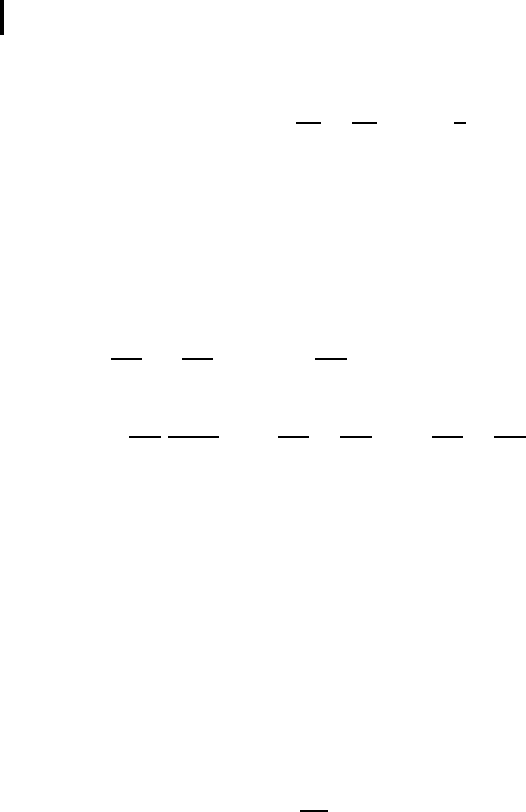
u
0
(ξ)=
bθ
2π
=
b
2π
arctan
y
x
, (12.3.1)
u(ξ, z, t) are small dynamic displacements relative to a stationary crystal with a dislo-
cation.
Apart from a static deformation, the equations of motion of a vibrating crystal with
a dislo cation will include anharmonicities (cubic and fourth-order ones). Then, re-
stricting ourselves to the approximation linear in dynamic displacements, we g et in a
scalar model the following equation for the displacement u:
ρ
0
∂
2
u
∂t
2
− µ
∂
2
u
∂x
2
α
− (λ + 2µ)
∂
2
u
∂z
2
= A
∂u
0
∂x
α
∂
2
u
∂x
α
∂z
+ B
∂u
0
∂x
α
2
∂
2
u
∂x
2
β
+ C
∂u
0
∂x
α
2
∂
2
u
∂z
2
,
(12.3.2)
where λ and µ are the renormalized second-order elastic moduli taking into account
anharmonicities (µ > 0, λ + 2µ > 0); A is the third-order elastic modulus; B and
C are the fourth-order elastic moduli of a nonlinear elasticity theory (from general
considerations, A ∼ B ∼ C ∼ µ).
Equation (12.3.2) should be supplemented with a certain boundary condition on the
surface of a dislocation tube r = r
0
to describe the phonon reflection from the dislo-
cation axis. We use further the fact that no phonons penetrate into the region of the
dislocation core. But we try, using the same approximation in which (12.3.2) is writ-
ten to take correctly into account in the boundary conditions the symmetry of lattice
distortions along the screw dislocation axis. If f (θ, z) is some function characterizing
these distortions on a dislocation tube, it should have screw symmetry
f (θ + θ
0
, z)= f
θ, z −
bθ
0
2π
, f (θ, z + b)=f (θ, z), (12.3.3)
that takes into account static displacements (12.3.1) about the screw dislocation.
In view of (12.3.3), we write the solution (12.3.2) as
u = χ(r)e
ik(z+bθ)+imθ−iωt
, (12.3.4)
where m = 0, ±1, ±2,....
It is typical that the solution (12.3.4) satisfying the screw symmetry (12.3.3) is
nonperiodic with respect to the angle θ, and, therefore, is not a single-valued function
of the coordinate x(ξ, z). We remember that u(x) is the atomic displacement relative
to their equilibrium positions in a crystal with a dislocation, and x(ξ, z) are the atomic
positions (coordinates) in a nondeformed crystal. The atom coordinates in a crystal
with a dislocation, i. e., in a statically deformed med ium, are different from those in

12.3 Localization of Small Vibrations in the Elastic Field of a Screw Dislocation
287
the initially nondeformed medium, n amely, the coordinates ξ(x, y) are unchanged and
the third coordinate (along the dislocation axis) is Z = z + u
0
(θ)=z +(bθ/2π).
If we consider (12.3.4) as a function of atomic coordinates X(ξ, Z) in a deformed
medium, then it is a single-valued function. Ambiguity of the expression (12.3.4) for
the displacement u as a function x(ξ, z) is a direct result of the fact that (12.3. 2) is
written in the coordinate system connected with the initial undeformed medium.
Before writing the equation for χ(r) that follows from (12.3.2) we note that the
spatial derivatives in (12.3.2) have different orders. It follows from (12.1.14) that the
frequency square of a local vibration ω
2
differs insignificantly from (s
0
k )
2
.Butthen
∂
2
u
∂x
2
α
∼ κ
2
⊥
u ∼
s
2
0
k
2
−ω
2
(s
0
k )
2
∂
2
u
∂z
2
∂
2
u
∂z
2
,
where κ
⊥
is the inverse radius of the vibration localization near the dislocation axis.
Thus, it is meaningless to retain on the r.h.s. of (12.3.2) the term with a fourth-order
elastic modulus B. Taking this into account, we get the following ordinary differential
equation
d
2
χ
dr
2
+
1
r
dχ
dr
−
κ
2
⊥
+
ν
r
2
χ = 0, (12.3.5)
where
ν =
m +
bk
2π
2
+ m
bk
2π
A
µ
+
bk
2π
2
A + C
µ
, (12.3.6)
and the parameter κ
⊥
is determined by a relation such as (12.1.20)
κ
2
⊥
(k)=
s
2
l
k
2
−ω
2
s
2
t
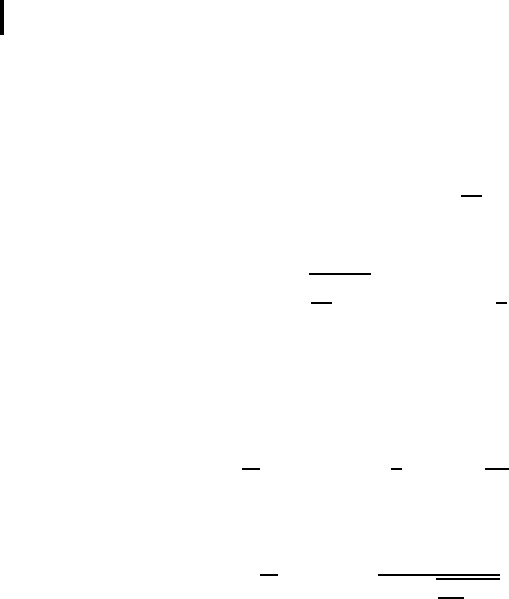
, ρs
2
l
= λ + 2µ , ρs
2
t
= µ . (12.3.7)
Equation (12.3.5) is a Schrödinger equation for the radial part of the wave function
in cylindrical coordinates where the Planck constant should be equal to unity, and the
particle mass to 1/2. It describes a particle located in the potential field U = ν/ r
2
and having the energy E = −κ
2
⊥
.
If m = 0, it follows from (12.3.6) that in the long-wave approximation (bk 1)
ν ≈ m
2
> 0. (12.3.8)
But under the condition (12.3.8) and with a repulsive potential on the dislocation axis
(12.3.5) has no discrete spectrum corresponding to finite (localized) states. Thus, in
the long-wave approximation for m = 0 there are no localized vibrations near the
dislocation.
The situation is quite different in the case m = 0 when
ν =
bk
2π
2
1 +
M
µ
, M = A + C.
For M > −µ, as before, ν > 0 and there are no localized vibrations near the disper-
sion, but if M < −µ,thenν < 0 and the situation changes. The (12.3.5) describes
288
12 Localization of Vibrations Near Extended Defects
the particle motion in a 2D potential well, and there is an infinite number of discrete
levels with the point of condensation at E = 0. These levels can be calculated quasi-
classically.
Equation (12.3.5) corresponds to the Hamiltonian
H = p
2
x
+ p
2
y
+ U(r) ≡ p
2
r
−
τ
2
r
2
,
(here τ
2
= −ν). Thus, the Bohr quasi-classical quantization condition is
r
m
r
0
p
r
dr ≡
r
m
r
0
τ
2
r
2
+ Edr = π
N +
1
2
, (12.3.9)
where N is a natural number (N 1); r
2
m
= τ
2
/ |E| =(τ/κ
⊥
)
2
.
We perform a trivial integration in (12.3.9) and retain logarithmically large terms
only (ln(r
m
/r
0
) 1)
τ ln
λ
r
0
τ
= π
N +
1
2
, λ =
1
κ
⊥
. (12.3.10)
The dispersion law for localized vibrations follows from (12.3.6), (12.3.7), (12.3.9)
ω
2
= s
2
l
k
2
−|ν|
s
t
r
0
2
exp
−
2π
2
(2N + 1)
b |k|
|M|
µ
−1
, (12.3.11)
where the pre-exponential factor is determined to an order of magnitude only.
Let us note two important peculiarities of the dispersion law (12.3.11). First, the
second term on its right-hand side depends less on k than in (12.1.14). Second, the
eigenfrequencies of localized vibrations form an infinite geometric progression that
describes the concentration of local frequencies toward the edge of the continuous
spectrum. The latter should be taken into account in evaluating the statistical weight
of local vibrations that determines their contribution to the low-temperature thermo-
dynamic properties of a crystal.
If the signs of the perturbations on the dislocation axis and the r atio of M to µ
are such that there are vibrations with frequencies (12.1.14), (12.1.11), then these
frequencies are mixing. But these vibrations “do not interfere” with one another under
the condition that the frequency (12.1.14) is lower than the first of the frequencies
determined by (12.3.11) (with a given k).
12.4
Frequency of Local Vibrations in the Presence of a Two-Dimensional (Planar)
Defect
A two-dimensional defect of the crystal breaks the lattice regularity along a certain
surface inside a solid. If the character of the crystal structure distortions is the same
12.4 Frequency of Local Vibrations in the Presence of a Two-Dimensional (Planar) Defect
289
along the indicated surface (more frequently, it is a plane), the break in the rigorous
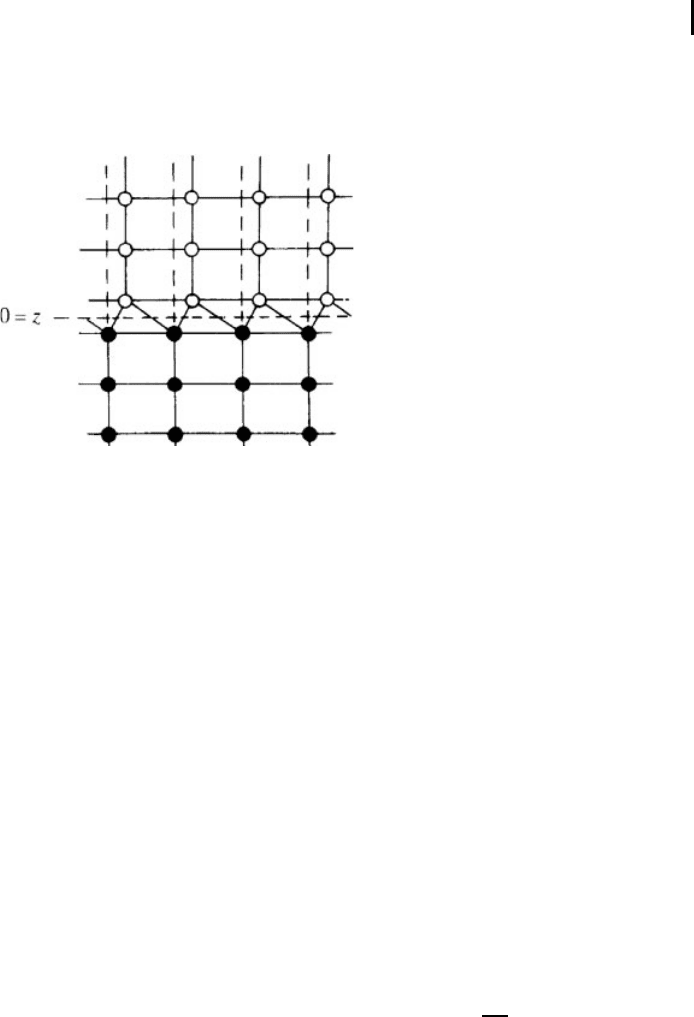
lattice periodicity is called a stacking fault (Fig. 12.3). The possible types of planar
stacking fault are completely determined by the crystallography of a g iven lattice.
Fig. 12.3 Planar stacking fault that is perpendicular to the z-axis.
We consider an unlimited, extended planar defect, assuming it to be coincid ent with
aplanez = 0 p arallel to some crystallographic plane. We restrict ourselves to the case
of a symmetric lattice and assume that the z-axis is a four-fold symmetry axis of an
ideal cry stal. In general, the symmetry group of the plan e defect is smaller than th e
corresponding group of atomic planes for an unbounded crystal lattice. Thus, there is
no four-fold symmetry axis perpendicular to the defect plane in Fig. 12.3.
We show first that the equations of vibrations localized near such a defect coincide
with the equations of vibrations of a certain 1D crystal. The stacking fault does not,
generally, change the atomic mass; thus, it may seem that its influence on lattice vi-
brations is described only by the corresponding force matrix perturbations (just such
perturbations are usually taken into consideration in qualitatively discussing the prob-
lem). However, if the interatomic distances in the stacking fault differ from those in a
nondefect crystal lattice (h = a in Fig. 12.3) a local change in the mass density takes
place. We intend to account for this fact.
The planar defect running through the whole crystal does not break the lattice ho-
mogeneity in a plane perpendicular to the z-axis. Then the p erturbation potential U
∗
due to the change in the mass den sity along the defect layer can be written in the form
analogous to (11.1.7)
U
∗
(n, n
)=U
0
δ
n
z
0
δ
n
z
0
, U
0
= −ω
2
∆ρ
ρ
,
where ∆ρ is the change in the mass density. Assuming such a form of the perturbation
we unite two atomic layers (or crystallographic planes) on both sides of the plane
z = 0 in Fig. 12.3 into one planar defect.

290
12 Localization of Vibrations Near Extended Defects
The perturbation of the force matrix U(n, n
) in this crystal should be dependent
on the differences n
x
− n
x
and n
y
− n
y
and obey the requirement
∑
n
U(n
x
, n
y
; n
z
, n
z
)=
∑
n
U(n
x
, n
y
; n
z
, n
z
)=0. (12.4.1)
Therefore, an equation of crystal vibrations including both types of perturbations is
ω
2
(n) −
1
m
∑
n
α(n − n
)u(n
)
=
∑
n
U(n
x
− n
x
, n
y
− n
y
; n
z
n
z
)u(n
)+U
0
u(n
x
, n
y
,0)δ
n
z
0
.
(12.4.2)
Since the crystal is structurally uniform in the x0 y plane, it is convenient to switch
in the equations of motion from a site representation in this plane to a two-dimensional
k-represen tation, retaining the site rep resentation along the the z-axis. We represent
the amplitude of vibrations in the form
u(n)=χ
κ
(n
z
)e
ia(k
x
n
x
+k
y
n
y
)
, κ =(k
x
, k
y
),
and rewrite (12.3.2) in the κ-representation
ω
2
χ
κ
(n
z
) −
∑
n
z
Λ
κ
(n
z
− n
z
)χ
κ
(n
z
)=
∑
n
z
U
κ
(n
z
, n
z
)χ
κ
(n
z
)+U
0
χ
κ
(0)δ
n
z
0
,
(12.4.3)
where
Λ
κ
(n
z
)=
1
m
∑
n
x
n
y
α(n)e
−ia(k
x
n
x
+k
y
n
y
)
,
U
κ
(n
z
, n
z
)=
∑
n
x
n
y
U(n
x
, n
y
; n
z
, n
z
)e
−ia(k
x
n
x
+k
y
n
y
)
.
It is very important that the quantity κ appears in (12.4.3) as a parameter. If we
assume this parameter to be fixed and are interested only in the dependence of the
vibration amplitude on z, then omitting the index κ in all the quantities in (12.4.3), we
obtain an equation for 1D crystal vibrations
ω
2
χ(n) −
∑
n
Λ(n − n
)χ(n
)=
∑
n
V(n, n
)χ(n
) , (12.4.4)
where n = n
z
and the matrix V(n, n
) is equal
V(n, n
)=U(n, n
)+U
0
δ
n0
δ
n
0
.
The matrix Λ(n) has the following property
∑
Λ(n)=ω
2
0
(κ,0), where the function
ω
0
(κ, k
z
) d etermines the dispersion relation of an ideal crystal.

12.4 Frequency of Local Vibrations in the Presence of a Two-Dimensional (Planar) Defect
291
In order to take into account a band structure of the dispersion relation and have
at the same time a possibility to obtain simple analytical results of calcu lations we
analyze the dynamics of the planar defect in a strongly anisotropic crystal (see Sec-
tion 2.10). Let the crystal has possess a primitive body-centered tetragonal lattice.
Assume that neighboring atomic layers perpendicular to the four-fold symmetry axis
have weak interlayer bonds and the stacking fault is parallel to such layers. The disper-
sion relation for a crystal of this type is given in the nearest-neighbors approximation
by (2.10.2) that determines the vibration band of the strongly anisotropic crystal.
Under the condition ω
1
ω
2
the band width (for any value of k) is determined
by the weak interlayer interaction and is proportional to ω
2
. The maximum frequency
of the vibrations is determined by the strong interlayer interaction and is proportional
to ω
1
. As a result the band is very narrow and strongly elongated. This specific form
of the frequency distribution allows us to propose a simple description of the crystal
dynamics at low enough frequencies ω ω
1
admitting ω ∼ ω
2
.
For the frequencies mentioned above we can use the long-wave approximation in re-
spect to κ-dependence, and the dispersion relation (2.10.2) acquires the form (2.10.4):
ω
2
= ω
2
0
(κ, k
z
) ≡ s
2
1
κ
2
+ ω
2
2
sin
2
bk
z
2
; κ
2
= k
2
x
+ k
2
y
), s
2
1
=
1
4
a
2
ω
2
1
, (12.4.5)
where b is the interatomic distance along the z-axis and s
1
is the sound velocity in the
basal plane.
If the value of κ is fixed then (12.4.5) can be considered as a dispersion relation
for 1D crystal vibrations of the optical type. Remembering the results of Section 11.1
we expect to find discrete frequencies of localized 1D modes outside the continuous
spectrum of an ideal crystal, namely the discrete frequencies squared should lie either
under ω
2
1
(κ) or above ω
2
1
(κ)+ω
2
2
. Assume the perturbation to be small enough
and refer to Section 1.1 where it was shown that in such a case (1) possible discrete
frequencies are located close to the edges of the continuous spectrum; (2) the planar
defect can be assumed to be concentrated in the plane z = 0. The later means that the
Kronecker delta δ
n0
in the r.h.p. of (12.4.3) can be substituted with the Dirac delta-
function and the total perturbation matrix V
0
should be assumed to have the following
form
V(n, n
)=b
2
V
0
δ(z)δ(z
) , V
0
=[U
1
(κ)+U
0
(ω)] . (12.4.6)
Of course, (12.4.6) can be used only for calculations of the localized frequencies close
to boundaries of the continuous spectrum.
Due to the condition (12.4. 1) and the broken symmetry o f the problem, the function
U
1
(κ) has the following general expansion in powers of κ : U
1
(κ)=−W
αβ
k
α
k
β
,
(α, β = 1, 2). We substitute (12.4.6) into (12.4.4)
ω
2
χ(z) −
∑
z
Λ(n − n
)χ(z
)=bV
0
χ(0 )δ(z) , (12.4.7)
292
12 Localization of Vibrations Near Extended Defects
and use the ordinary Fourier expansion
χ(z)=
b
2π
χ
k
e
ikz
dk , χ
k
=
∑
z
χ(z)e
−ikz
. (12.4.8)
The equation for the Fourier component is then reduced to the relation
ω
2
− ω
2
0
(κ, k)
χ
k
= V
0
χ(0 ) . (12.4.9)
In the approximation taken for calculations, the dispersion law of the crystal concerned
is given by (12.4.5).
From (12.4.8), (12.4.9) we just find the dependence of the vibration amplitude on
the coordinate z,
χ(z)=
bV
0
2π
χ(0 )
π
2
−
π
2
cos kz dk
ω
2
−ω
2
0
(κ, k)
. (12.4.10)
Setting z = 0 in (12.4.10), we find an equation for the possible frequencies of such
vibrations
bV
0
2π
π
2
−
π
2
dk
ω
2
−s
2
1
κ
2
−ω
2
2
sin
2
bk
z
2
= 1. (12.4.11)
Before calculations of the integral in (12.4.11) look on the sketch of the vibration
spectrum in Fig. 12.4. In Fig. 12.4. the hatched region corresponds to a band in the
continuous spectrum of vibrations of an ideal crystal at small κ. The bottom ω
low
(κ)
and top ω
up
(κ) boundaries of this band are given by the expressions
ω
low
(κ)=s
1
κ, ω
2
up
(κ)=ω
2
2
+ s
2
1
κ
2
. (12.4.12)
Notations proposed in (12.4.12) allow us to give the simple representation of the cal-
culation in (12.4.11):
V
0
=
ω
2
− ω
2
low
(κ)
ω
2
− ω
2
up
(κ) . (12.4.13)
Analyzing (12.4.12) and (12.4.13) we obtain localized states and their dispersion
relations of the following types.
1. V
0
> 0. In this case a frequency of the localized wave lies above the band of the
continuous spectrum
ω > ω
up
(κ)
:
V
2
0
=[ω
2
− ω
2
low
(κ)][ω
2
−ω
2
up
(κ)] . (12.4.14)
Considering small perturbations we suppose |V
0
|ω
2
2
. Under such a condition
(12.4.14) has the following solution
ω
2
d
= ω
2
up
(κ)+
1
ω
2
2
∆ρ
ρ
ω
2
2
+
∆ρ
ρ
s
2
1
κ
2
+ W
αβ
k
α
k
β
2
. (12.4.15)