
Kosevich A.M. The crystal lattice
Подождите немного. Документ загружается.

12.4 Frequency of Local Vibrations in the Presence of a Two-Dimensional (Planar) Defect
293
If ∆ρ < 0 then there is a gap at κ = 0 between the local frequency ω
2
d
and the band
of the continuous spectrum:
ω
2
d
− ω
2
up
=
∆ρ
ρ
ω
2
2
. (12.4.16)
It is interesting to note that this gap is proportional to the perturbation squared (
∆ρ
ρ
)
2
.
To continue our analysis at κ = 0 we assume W
αβ
= W
0
δ
αβ
forthesakeofsim-
plicity; then
V
0
(κ)=−
∆ρ
ρ
ω
2
2
−
∆ρ
ρ
s
2
1
+ W
0
κ
2
. (12.4.17)
One can see that the behavior of ω
d
as a function of κ depends on the signs of the
perturbation parameters ∆ρ and W
0
.For∆ρ < 0
V
0
=
|∆ρ|
ρ
ω
2
2
+
|∆ρ|
ρ
s
2
1
−W
0
κ
2
. (12.4.18)
If W
0
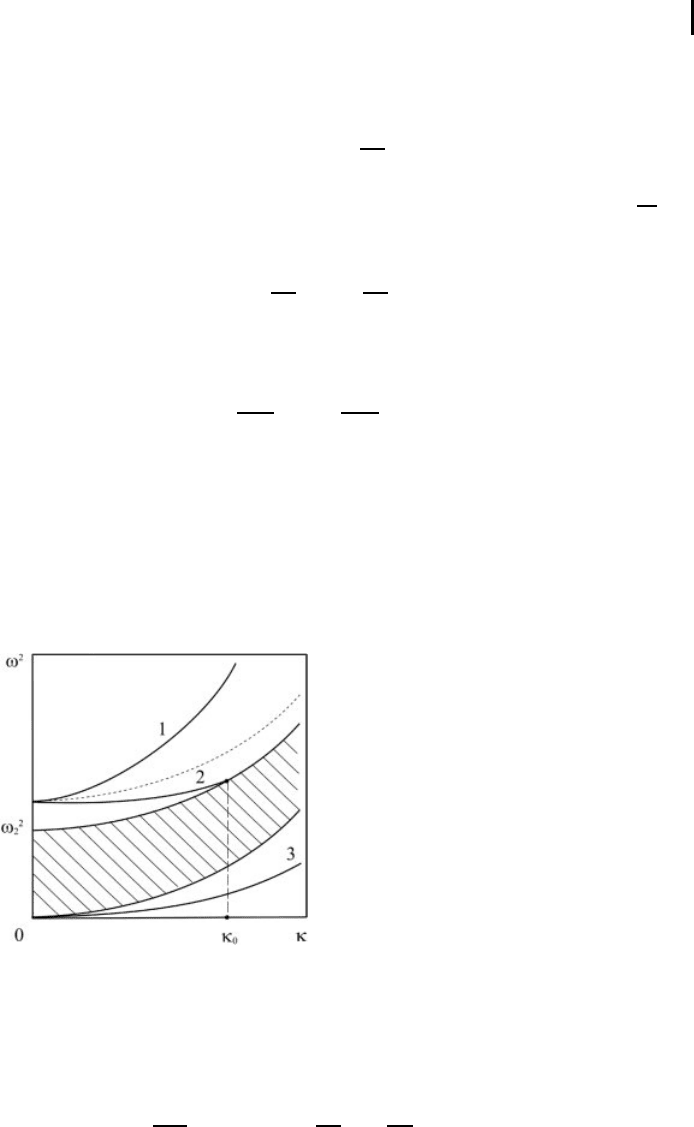
< 0 a dispersion relation f or the localized wave is characterized by curve (1)
in Fig. 12.4 for all κ.AtW
0
> 0, localized states can exist only for wave numbers
0 < κ < κ
0
(curve (2) in Fig. 12.4). The value of κ
0
for which the dispersion curve
corresponding to the localized wave touches the top boundary of the band can be found
from the equation
V
0
(κ
0
)=0.
Fig. 12.4 Dispersion lines of localized waves: (1) vibrations exist at
all wave vectors; (2) the dispersion line ends on the boundary of the
frequency band; (3) the dispersion line for localized vibrations of the
type of a surface wave.
2. V
0
< 0. Now (12.4.10) necessarily has a solution for ω < s
1
κ
ω
2
d
= s
2
1
κ
2
−
aV
0
bω
2
2
= s
2
1
κ
2
−
1
ω
2
2
∆ρ
ρ
s
2
1
κ
2
+ W
αβ
k
α
k
β
2
. (12.4.19)
294
12 Localization of Vibrations Near Extended Defects
The specific feature of this spectrum is that at fixed κ the frequency of the corre-
sponding vibrations is separated from the spectrum of bulk crystal vibrations by a g ap
vanishing as κ → 0 as a power law. It follows from (12.4.11) that as κ → 0 not only
the gap width but also its relative value tends to zero (curve 3 in Fig. 14.4). Using the
simplification (12.4.17) we can obtain
s
1
κ −ω
d
ω
d
∼
κ
ω
2
2
∆ρ
ρ
s
2
1
+ W
0
2
. (12.4.20)
It is easily seen that these v ibrations are localized near the planar defect. Since small
wave vectors k play the main role in the integral in (12.4.10) we can take into account
the approximation bk 1 and sim plify the integral:
χ(z)=
aV
0
2π
χ(0 )
∞
−∞
cos kz dk
ω
2
− s
2
1
κ
2
− s
2
k
2
, (12.4.21)
where s is the sound velocity along the z-axis (2s = bω
2
).
Perform the integration in (12.4.21) and use (12.4.19):
χ
κ
(z)=χ
κ
(0) exp
−
s
2
1
κ
2
− ω
2
d
|z|
s
= χ
κ
(0) exp
−
1
2
V
0
(κ)
bz
s
2
= χ
κ
(0) exp
1
2
V
0
(κ)
a |z|
s
2
.
(12.4.22)
One should remember that the case V
0
(κ) < 0 is considered. As we see, th e amp litude
χ(z) exhibits an exponential decay typical for surface waves. The rate of decay of the
amplitude depends on the d irection of the vector κ.IfV
0
(κ) is not negative at all κ,the
localized wave with the d ispersion relation (12.4.19) and the coordinate dependence
(12.4.22) exist only for the directions κ for which V
0
(κ) < 0.
The scheme presented allows one in principle to describe the vibrations of the free
surface of a crystal. Generally, the atomic interaction in a crystal decreases with in-
creasing distance between the atoms. Thus, in analyzing the equ a tions for the lattice
vibrations, only the elements of the matrix α(n) with comparatively small n are taken
into account. In a model where a small number of elements α(n) is nonzero, the free
crystal surface is equivalent to a certain planar defect. Indeed, a crystal with a free
surface can be obtained from an unbounded ideal crystal by cutting along a certain
plane between two atomic layers and replacing the force matrix of an ideal crystal
by another matrix of atomic force constants that results in the interaction between the
atomic planes vanishing.
A scalar model is convenient for describing the bulk vibrations, but is unsatisfactory
for analyzing the surface vibrations. To construct a consistent theory of long-wave

12.4 Frequency of Local Vibrations in the Presence of a Two-Dimensional (Planar) Defect
295
surface vibrations it is natural to turn to elasticity theory making some assumptions on
the properties of a planar defect that models the free crystal surface.
The vibrations localized near the planar defect are described as follows. The equa-
tions of elasticity theory for the bulk vibrations that occur with frequency ω have the
form
ρω
2
u
k
+ ∇
l
λ
kl mn
∇
m
u
n
= 0, (12.4.23)
and the elasticity modulus tensor of a crystal λ
iklm
in an isotropic approximation is
reduced to the two Lamé coefficients λ and G
λ
iklm
= λδ
ik
δ
lm
+ G(δ
il
δ
km
+ δ
im
δ
kl
).
If a solid has a defect coin cident with the plane z = 0, the “perturbed” Lamé
coefficients and the mass density are given by
λ
= λ + Lhδ(z), G
= G + Mhδ(z) ,
ρ
= ρ + ∆ρhδ(z)=ρ [1 −(h − a)δ(z)] ,
(12.4.24)
where h is the “thickness” of the planar defect; L and M are characteristics of its
elastic properties; a is the interatomic distance along the z-axis in an ideal crystal.
Substituting (12.4.24) into (12.4.23), we get a system of equations generalizing the
scalar equation (12.4.7). It is clear that such a description of the planar defect has
a literal meaning only fo r hk 1. Therefore, the singular functions describing the
space perturbation localization in (12.4.24) must be treated with caution. Analyzing
the vibrations near the linear defect, we have seen that using the δ-like perturbation in
the long-wave approximation leads to introducing a finite upper limit of the integration
over the wave vectors. Similarly, in the case of a perturbation of the type (12.4.24)
caused by the planar defect, when we use the method of Fourier transformations along
the z-axis, it is necessary to restrict the possible values of k
z
by the limiting value
k
0
∼ 1/h. In the case we are interested in it is determined by
hk
0
= π . (12.4.25)
The solution o f a similar elasticity theory problem has shown that the frequency of
waves localized near the defect splits off from the edge of the lowest-frequency band
of vibrations (in the isotropic approximation, from the boundary of the transverse
vibration frequency). This frequency is at a distance of δω ∼ κ
3
from the band
boundary, in agreement with (12.4.20).
This approach may also be used to study surface waves in an elastic half-space
(Rayleigh waves), assuming that they are localized vibrations near the planar defect.
If this planar defect is a free crystal surface, than as a result of the perturbation of
elastic moduli the connection between elastic half-spaces z > 0 and z < 0 vanishes.
The latter can be provid ed in a straigh tfo rward way by setting
L = −λ, M = −G , h = a . (12.4.26)

296
12 Localization of Vibrations Near Extended Defects
Substituting (12.4.26) into (12.4.24), taking (12.4.25) into account, and using the
described method of finding the possible frequencies of surface vibrations, one can
show that these waves h ave the dispersion relation ω = s
s
κ,wheres
s
coincides with
the known velocity of Rayleigh waves (Kosevich and Khokhlov, 1970). We do not
prove this statement here because the calculations are cumbersome.
13
Elastic Field of Dislocations in a Crystal
13.1
Equilibrium Equation for an Elastic Medium Containing Dislocations
Our initial definition of a dislocation
L
dx
i
∇
i
u
k
= −b
k
(13.1.1)
may be rewritten in a somewhat different form using the notation of a distortion tensor
u
ik
= ∇
i
u
k
L
u
ik
dx
i
= −b
k
. (13.1.2)
In dislocation theory the elastic distortion tensor may be r egarded as an independent
quantity describin g the crystal deformation. Similarly to the strain tensor ε
ik
and the
stress tensor σ
ik
it is a single-valued function of the coordinates even in the presence
of a dislocation.
Let us write down the condition (13.1 .2) in a differential form. For this purpose
we transform the integral around the contour L into an integral over any surface S
spanning this contour:
L
dx
i
u
ik
=
dS
i
e
ilm
∇
l
u
mk
.
The constant vector b is represented in the form of an integral over the same surface
by means of the 2D δ-function introduced in (10.3.4)
b
k
=
S
τ
i
b
k
δ(ξ) dS
i
. (13.1.3)
The Crystal Lattice: Phonons, Solitons, Dislocations, Superlattices, Second Edition. Arnold M. Kosevich
Copyright
c
2005 WILEY-VCH Verlag GmbH & Co. KGaA, Weinheim
ISBN: 3-527-40508-9

298
13 Elastic Field of Dislocations in a Crystal
As the contour L is arbitrary, the equality of th ese in tegrals means the equality of the
integrand expressions:
e
ilm
∇
l
u
mk
= −τ
i
b
k
δ(ξ). (13.1.4)
This is just the desired differential form of (13.1.1). It is clear that on the disloca-
tion line (ξ = 0), which is a line of singular points, a representation in the form of
derivatives is meaningless.
If there are simultaneously many dislocations in a crystal with relatively small sep-
arations (but large compared to the lattice constant), their averaged consideration be-
comes important. This consideration is useful in problems where an exact field distri-
bution between separate dislocations is of no interest and in which a theory operates
with physical quantities averaged over small volume elements. It is clear that many
dislocation lines should run through such “physically infinitesimal” volume elements.
The equation that expresses the main property of dislocation deformations is for-
mulated by generalizing (13.1.4). We introduce the dislocation density tensor α
ik
by
requiring its integral on the surface spanned on any contour L to be equal to the sum
of Burgers vectors b of all dislocation lines enveloped by this contour:
S
dS
i
α
ik
= b
k
. (13.1.5)
The tensor α
ik
replaces the expression on the r.h.s. of (13.1.4)
e
ilm
∇
l
u
mk
= −α
ik
, (13.1.6)
and describes a continuous dislocation distribution in a crystal.
It follows from (13.1.4), (13.1.6) that in the case o f a discrete dislocation
α
ik
= τ
i
b
k
δ(ξ). (13.1.7)
As is seen from (13.1.6), the tensor α
ik
should satisfy the condition
∇
i
α
ik
= 0, (13.1.8)
which in the case of a single dislocation shows that the Burgers vector is constant
along the dislocation line.
With such an interpretation of dislocations, the tensor u
ik
becomes the primary
quantity that describes the crystal deformation. The displacement vector u cannot
then be introduced. Indeed, at u
ik
= ∇
i
u
k
the l.h.s. of (13.1.4) would identically
become zero over the whole crystal volume.
Equations (13.1.6) or (13.1.4), together with
∇
i
σ
ik
+ f
k
= 0, (13.1.9)
and Hooke’s law co nstitute a complete system of equilibrium equations of an elastic
medium with dislocations.

13.2 Stress Field Action on Dislocation
299
In a scalar elastic field the role of a distortion tensor is played by the vector h that
in a medium without vortices is determined by
h = grad u. (13.1.10)
If vortex dislocatio ns are present in the medium, the vector h obeys the equation
curl h = −α, (13.1.11)
where α is the density of vortices. For a separate vortex, α = τbδ(ξ).
An analog of the stress tensor is the vector σ = Gh that is determined by the elastic
scalar field equilib rium equation:
div σ = −f , (13.1.12)
where f is the analog of the force density.
13.2
Stress Field Action on Dislocation
Let us consider a dislocation loop D in a field of external (with respect to a dislocation)
elastic stresses σ
ik
and find a force acting on the dislocation. We calculate the work
done by external forces δR for an infinitely small movement of the loop. If this work
is given as
δR =
D
FδX dl , (13.2.1)
where δX is the displacement element of a d islocation line, F will determine the force
with which an elastic stress acts on a unit length of the dislocation.
Let the dislocation displacement generate a certain change in the displacement vec-
tor δu. The work of external stresses performed in a volume V with a dislocation loop
is
δR =
σ
ik
δu
k
dS
∞
i
, (13.2.2)
where S
∞
is the surface enveloping the volume V.
In the given case it is convenient to use transformations of the integral (13.2.2)
based on Gauss’s theorem. Therefore the displacement u near a dislocation should
be considered as a single-valued function of the coordinates. Then, the vector u will
have a d iscontinuity along the surface S
D
spanned on the dislocation loop. To exclude
discontinuity points of the vector u, we surround the loop D with a certain closed
surface S
D
outside which (in the volume V
) the function u = u(r) is continuous.
300
13 Elastic Field of Dislocations in a Crystal
Then,
δR =
∇
i
(σ
ik
δu
k
) dV
−
σ
ik
δu
k
dS
0
i
=
∇
i
σ
ik
δu
k
dV
+
σ
ik
δε
ik
dV
+
σ
ik
δu
k
n
0
i
dS
0
,
(13.2.3)
where the unit normal vector n
0
is directed outwards with respect to the surface S
0
.
Since the dislocation is not associated with additional volume force in a crystal,
then ∇
i
σ
ik
= 0 and the first integral on the r.h.s. of (13.2.3) vanishes. To calculate
the last two integrals, we choose S
0
as the surface going along the upper and lower
banks of the cut S
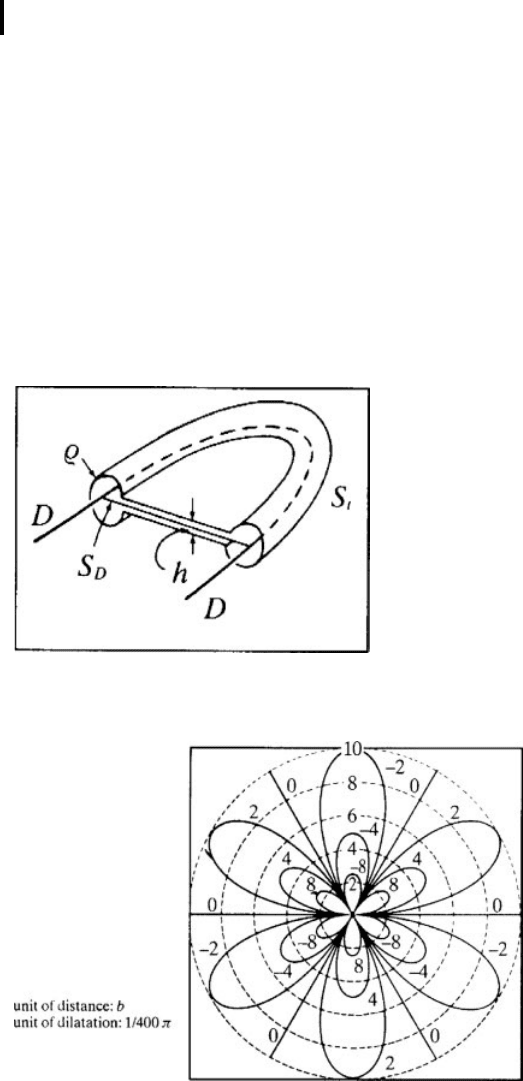
D
(with a “clearance” h) and connected by an infinitely thin tube S
t
of radius ρ that envelopes the line D (Fig. 13.1).
Fig. 13.1 Scheme of closed surface surrounding the cut S
D
.
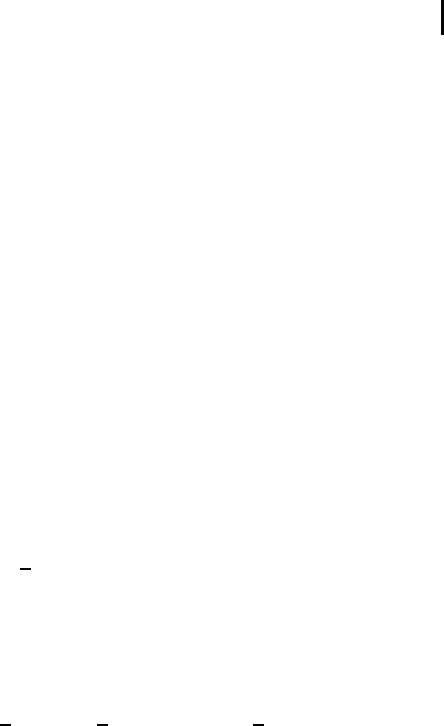
Fig. 13.2 Dilatation field of a screw dislocation with an axis along [111]
in a α-Fe crystal calculated by Chou (1965).
13.2 Stress Field Action on Dislocation
301
If we disregard the inhomogeneity of material generated by a dislocation and that is
unimpor tant in evaluating the interactio n between the dislocation and an elastic field ,
the volume integral remaining on the r.h.s. of (13.2.3) is simplified. Indeed, when the
cut banks come closer (h → 0) and the tube radius decreases (ρ → 0), the integral
over the volume V
, because of continuity of σ
ik
and ε
ik
, transforms into an integral
over the whole volume
V
σ
ik
δε
ik
dV →
V
σ
ik
δε
ik
dV . (13.2.4)
The surface integral in (13.2.3) can also be simplified by a corresponding limiting
transition. We note that the integral over the surface of the tube S
t
vanishes as ρ → 0,
since the dislocation field has the following obvious property:
lim
ρ→0
ρu(r)=0.
On the cut banks still present in the integrals, the values of the continuous functions
σ
ik
in the limit are the same and the limiting values of u are different in a constant
value b. Thus, instead of (13.2.3), we g et
δR =
σ
ik
δε
ik
dV +
1
3
σ
ll
δε
kk
dV + b
i
δ
S
D
σ
ik
dS
k
, (13.2.5)
where σ
ik
is the stress deviator and ε
ik
is the strain deviator [(ε
ik
= ε
ik
−(1/3)δ
ik
ε
ll
)].
The first two terms of the integral (13.2.3) due to th e obvious identity in (13.2.5) follow
from
σ
ik
ε
ik
=
σ
ik
−
1
3
δ
ik
σ
ll
+
1
3
σ
ll
ε
kk
= σ
ik
ε
ik
+
1
3
σ
ll
ε
kk
.
In the last term on the r.h.s. in (13.2.5) the symbol of an infinitely small variation
δ is taken outside the integral sign since the stress distribution σ
ik
is assumed to be
given.
If the element of the dislocation line dl is displaced by δX theareaofthesurface
element S
D
changes by
δS
i
= e
imn
δX
m
τ
n
dl. (13.2.6)
The relation (13.2.6) should be used in transforming the last integral in (13.2.5).
If the displacement δX is in the dislocation slip plane, (13.2.6) characterizes the
changes in the crystal completely. If the displacement is perpendicular to the slip
plane, additional conditions have to be taken into account that follow from the medium
continuity. When the dislocation moves without breaking the medium continuity the
local relative variation of the volume given by (10.3.4) exists. Using this formula, a
formal replacement can be made to transform the second integral in (13.2.5)
δε
kk
dV → e
imn
b
m
τ
n
δX
i
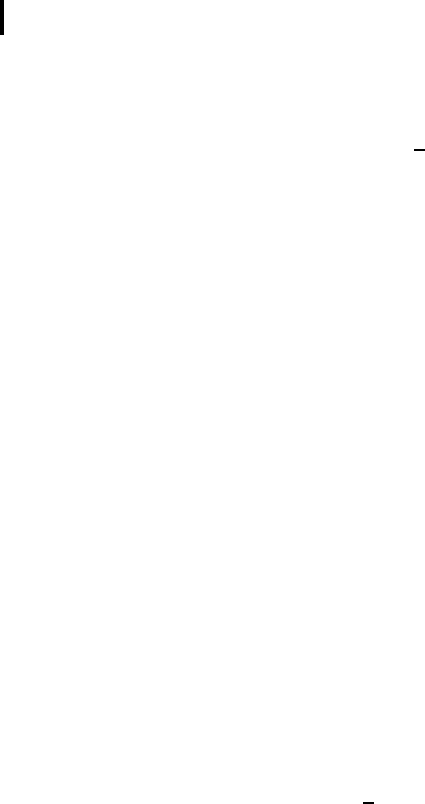
dl. (13.2.7)
302
13 Elastic Field of Dislocations in a Crystal
Taking into account (13.2.6), (13.2.7), we single out in the work δR the part con-
nected with inelastic medium deformation that accompanies the dislocation migration:
δR =
σ
ik
δε
ik
dV +
e
imn
τ
m
σ
nk
−
1
3
δ
nk
σ
jj
b
k
δX
i
dl. (13.2.8)
The first integral in (13.2.8) equals the increase in elastic energy of a medium in a
solid volume. The linear integral over the dislocation loop
δR
D
=
e
ilm
τ
l
σ
mk
δX
i
dl (13.2.9)
will determine the work done for a dislocation displacement. Comparing (13.2.1),
(13.2.9) it is clear that the force acting per unit length is
F
i
= e
ilm
τ
i
σ
mk
b
k
. (13.2.10)
A formula such as (13.2.10) where the stress deviator σ
ik
is replaced by the stress
tensor σ
ik
was first obtained by Peach and Koehler (1950). The necessity of taking
into account an inelastic change in the medium volume in climbing of a dislocation,
i. e., the necessity to replace σ
ik
by σ
ik
− (1/3)δ
ik
σ
ll
, was indicated by Weertman
(1965).
As simple examples of using (13.2.10), we consider the forces acting on screw and
edge dislocations. Let the Oz-axis be parallel to the dislocation line (τ
z
= −1). In the
case of a screw dislocation, b
z
= b and
F
scr
x
= bσ
yz
, F
scr
y
= −bσ
xz
. (13.2.11)
In the case of an edge dislocation, we direct the Oz-axis along its Burgers vector
(b
x
= b). Then,
F
edg
x
= bσ
xy
, F
edg
y
= −bσ
xx
=
1
3
b(2σ
xx
−σ
yy
−σ
zz
). (13.2.12)
It is interestin g to determine the projection of the force (13.2.10) on the slip plane
of the corresponding dislocation element. Let κ be a vector that is perpendicular to
the dislocation line in the slip plane. Th en, this projection (we denote it as f ) is equal
f = κF = e
ikl
k
i
τ
k
σ
lm
b
m
or
f = n
l
σ
lm
b
m
, (13.2.13)
where n =[kτ] is the vector normal to the slip plane.
Since the vectors n and b are mutually perpendicular, by choosing two of the co-
ordinate axes along these vectors, we see that the force f is determined by one of the
components σ
ik
only. If the dislocation is a plane curve lying in its slip plane and is in
a homogeneous elastic stress field then the force f is the same for all dislocation line
elements, independent of their position on the slip plane.