
Kosevich A.M. The crystal lattice
Подождите немного. Документ загружается.

13.3 Fields and the Interaction of Straight Dislocations
303
13.3
Fields and the Interaction of Straight Dislocations
If the dislocation is linear, the dependence on the distance of elastic stresses around
it can easily be elucidated in a general case. In cylindrical coordinates r , ϕ, z (with
the z-axis along the dislocation line) the deformation will be d ependent only on r
and ϕ. The integral (13.1.2) should not change, in particular, with an arbitrary sim-
ilarity transformation of the integration contour in the plane xO y. It is obvious that
this is possible only if all the elements of the tensor u
ik
are inversely proportional to
the distance u
ik
∼ 1/r. The strain tensor ε
ik
and also the stress tensor σ
ik
will be
proportional to 1/r.
As an example of calculations of the elastic deformation generated by dislocations,
we consider the d islocation around straight screw and edge dislocations in an isotropic
medium. The physical meaning of these and other problems referring to an isotropic
medium is conventional, since real dislocations are basically inherent only to crystals,
i. e., to an anisotropic medium. These prob lems, however, are of interest as illustra-
tions.
We start with a screw dislocation along which τ b (it is clear that only a straight
dislocation may have pure screw character). We choose the axis z along the dislocation
line, the Burgers vector then has the components b
x
= b
y
= 0, b
z
= b. It follows
from symmetry considerations that the displacement u is parallel to the z-axis and
is independent of the coordinate z. Since in an isotropic medium σ
ik
= 2Gε
ik
for
i = k, the equilibrium equation (13.1.9) without bulk forces ( f = 0) is reduced to a
2D harmonic equation for u
z
:
∆u
z
= 0, ∆ ≡
∂
2
∂x
2
+
∂
2
∂y
2
. (13.3.1)
The solution (13.2.2) satisfying (13.1.1) has the form
1
u
z
=
b
2π
ϕ ≡
b
2π
arctan
y
x
. (13.3.2)
The solution (13.3.2) is equivalent to (10.2.8).
The tensors ε
ik
and σ
ik
have the following nonzero components in cylindrical coor-
dinates:
ε
zϕ
=
b
4πr
, σ
xϕ
=
Gb
2πr
, (13.3.3)
where G is the shear modulus. Thus, the deformation around a screw dislocation in
an isotropic medium is pure shear.
We recall that the field of a screw dislocation in an isotropic elastic medium coin-
cides with the vortex field in a scalar model. In cylindrical coordinates it looks like:
h
ϕ
=
b
2πr
, σ
ϕ
=
Gb
2πr
. (13.3.4)
1) In all problems with straight dislocations we take the vector τ in the negative
direction of the z-axis (τ
z
= −1).
304
13 Elastic Field of Dislocations in a Crystal
A screw dislocation g enerates around itself a pure shear strain field due to the
isotropic medium. To show the role of anisotropy in the elastic field variation we show
the distribution of dilatation deformation (the distribution of ε
kk
= div u) around the
screw dislocation parallel to [111 ] in a cubic crystal. In Fig. 13.2, the levels of con-
stant div u value forming a rosette that exh ibits the anisotropy of a α-Fe monocrystal
are given.
Calculation of elastic fields around a straight edge dislocation is much more com-
plicated (in contrast to a screw dislocation, a purely edge dislocation can be curvi-
linear if th e dislocation line is in a plane perpendicu lar to the vector b). Let the z-
axis be directed along the dislocation axis and the x-axis along the Burgers vector:
b
x
= b, b
y
= b
z
= 0. It follows from the symmetry of the problem when ε
zz
= 0 that
the deformatio n vector lies in the plan e xO
y
and is independent of z.
Since the solution to this seemingly simple elasticity theory problem is cumber-
some, we do not repeat it here in detail.
We write down the final results for the displacement field
2
u
x
=
b
2π
arctan
y
x
+
1
2(1 − ν)
xy
x
2
+ y
2
,
u
y
= −
b
4π(1 − ν)
(1 − 2ν) log
x
2
+ y
2
+
x
2
x
2
+ y
2
,
(13.3.5)
where ν is Poisson’s ratio.
The first term in the expression for u
x
is written in a form analogous to (13.3.2).
Thus, the condition (13. 1.1) is satisfied.
The stress tensor calculated on the basis of (13.3.5) has the Cartesian components
σ
xx
= −bM
y(3x
2
+ y
2
)
(x
2
+ y
2
)
2
, σ
yy
= −bM
y(x
2
−y
2
)
(x
2
+ y
2
)
2
,
σ
xy
= bM
x(x
2
− y
2
)
(x
2
+ y
2
)
2
,
(13.3.6)
or in polar coordinates (the corresponding coordinates r, ϕ in the plane xO y):
σ
rr
= σ
ϕϕ
= −bM
sin ϕ
r
, σ
rϕ
= bM
cos ϕ
r
, (13.3.7)
with M = G/2 π(1 −ν).
It follows from the condition ε
zz
= 0 that σ
zz
= ν(σ
xx
+ σ
yy
)=ν(σ
rr
+ σ
ϕϕ
).
Therefore, the mean hydrostatic pressure generated by the edge dislocation in an
isotropic medium is
p
0
= −
1
3
σ
kk
= −
1
3
(1 + ν)(σ
rr
+ σ
ϕϕ
)=
2(1 + ν)
3
bM
sin ϕ
r
. (13.3.8)
2) The solution to this problem can be found in the literature on dislocation
theory.
13.3 Fields and the Interaction of Straight Dislocations
305
In an isotropic medium the levels of constant pressure p
0
are at the same time the
levels of constant dilatation ε
0
≡ ε
kk
= −p
0
/K (K is the compression modulus).
Therefore, the distribution of an elastic dilatation of the deformation field of an edge
dislocation is characterized by the levels
sin ϕ
r
≡
y
x
2
+ y
2
= constant. (13.3.9)
The curves (13.3.9) represent a family of circles where centers are on the Oy-axis and
pass through the coordinate origin (the dislocation axis).
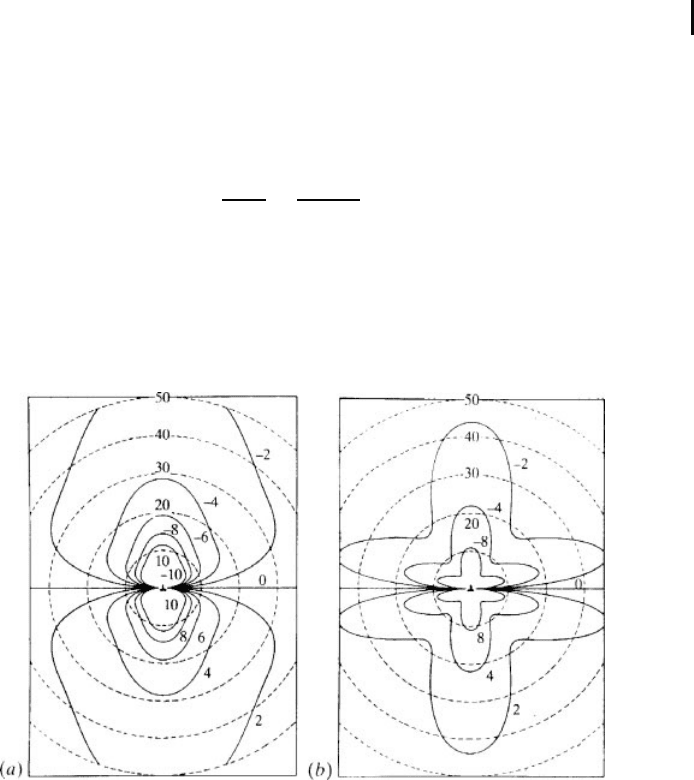
In a crystal the dilatation distribution around the edge dislocation has levels that
are different from circles (13.3.9), but preserving the same character on the whole
(Fig. 13.3).
Fig. 13.3 The dilatation field of an edge dislocation in plane (110):
(
a
) the crystal α-Fe; (
b
) the crystal Li calculated by Chou (1965).
The expressions for the elastic fields of straight dislocations allow us to describe
the interaction of parallel dislocations easily.
To determine the force acting from one dislocation on another and parallel to it,
we use (13.2.11), (13.2.12) and the expression for the stress tensor of an elastic field
around the second dislocation. As seen from Fig. 13.2, the elastic field around a screw
dislocation in a crystal differs considerably from that in an isotropic med ium. Th ere-
fore, a detailed descrip tion of the interaction of screw dislocations in the isotropic
model is meaningless, although it is justified for edge dislocations, and therefore we
shall now describe the interaction of edge dislocations in an isotropic medium.
If a dislocation coincides with the z-axis, it acts on a second dislocation running
through the point (x, y) in the (xO y) plane with a force whose projection on the slip
306
13 Elastic Field of Dislocations in a Crystal
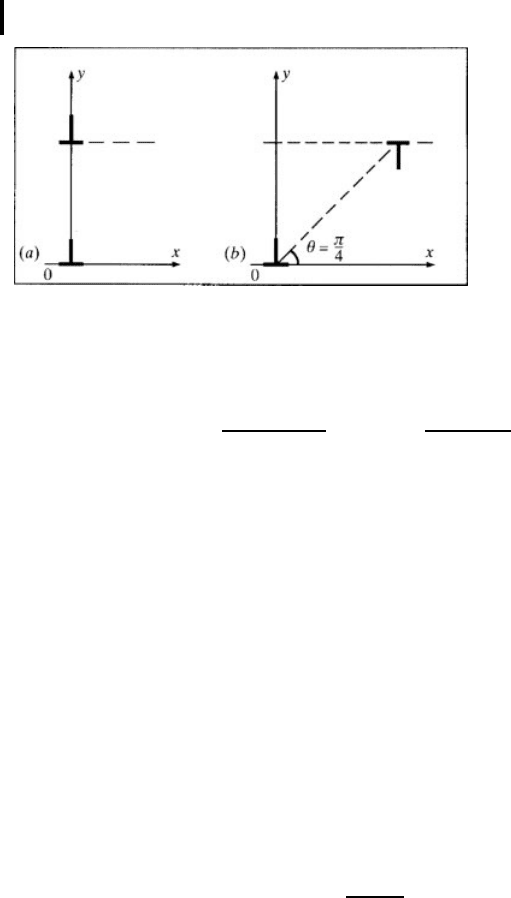
Fig. 13.4 Stable equilibrium configurations of a system of two parallel
edge dislocations: (
a
) of a single sign, (
b
) of opposite signs.
plane is
F
x
= Mb
1
b
2
cos ϕ cos 2ϕ
r
, M =
G
2π(1 −ν)
. (13.3.10)
Just this projection is of great interest, since in the slip plane only migration of
the dislocation may have the character of a mechanical motion. The vanishing of
this force projection corresponds to the equilibrium configuration of two dislocations
relative to gliding. It follows from (13.3.1 0) that F
x
vanishes at ϕ = π/2 and ϕ =
π/4. It is easy to verify that the first of these positions (Fig. 13.4a) corresponds to
the stable equilibrium condition of two dislocations of the same sign (b
1
b
2
> 0),
and the second one (Fig. 13.4b) to that of two dislocations of different sign (b
1
b
2
<
0). Obviously, the first configuration (Fig. 1 3.4a) remains in stable equilibrium if the
number of dislocations is greater than two. This is the reason for the dislocation wall
(Section 10.5, Figs 10.8) to be an equilibrium and stable structure.
If a dislocation pair is formed by two dislocations of opposite sign (Fig. 13.4b)
separated by a small distance (e. g., dislocations are positioned in the neighboring slip
planes) such a pair is called a dislocation dipole. This system is stable enough to occur
as a single dislocation entity.
Edge dislocations that are in the same glide plane (whose trace is the O
x
-axis)
interact in a very simple way
F
x
=
Mb
1
b
2
x
. (13.3.11)
The formula (13.3.11) is also valid in an anisotropic medium when the constant M
is connected in a different way with the elastic moduli, but remains positive.
We consider a set of a large number of identical edge dislocations placed parallel to
one another in the same slip plane. The interaction of each pair of them will then be
determined by the force (13.3.11).
We choose the x-axis along the Burgers vector and assume that the dislocations
are distributed on the part (a
1
, a
2
) of the x-axis. For definiteness, we can assume
that at the point x = a
2
there is an obstacle holding the dislocations and the whole
13.3 Fields and the Interaction of Straight Dislocations
307
set of them undergoes the action of a certain external stress σ
e
xy
, that “presses” the
dislocations to the obstacle (σ
e
xy
< 0). Under these conditions we have a planar array
of parallel dislocations on the same glide p lane th at is called a dislocation pile-up.
The conditions of mechanical equilibriu m of the pile-up are determined as follows.
We assume that there is such a large number of dislocations per unit length of the
x-axis that their distribution can be described by the linear density ρ(x),whichis
a continuous function of the coordinate x. Then, ρ(x) dx is the Burgers vector of
dislocations going through the points of the interval dx.
We single out a dislocation at the point x and write the condition of its mechanical
equilibrium . The remaining dislocations of the pile-up act on a sep arated dislocation
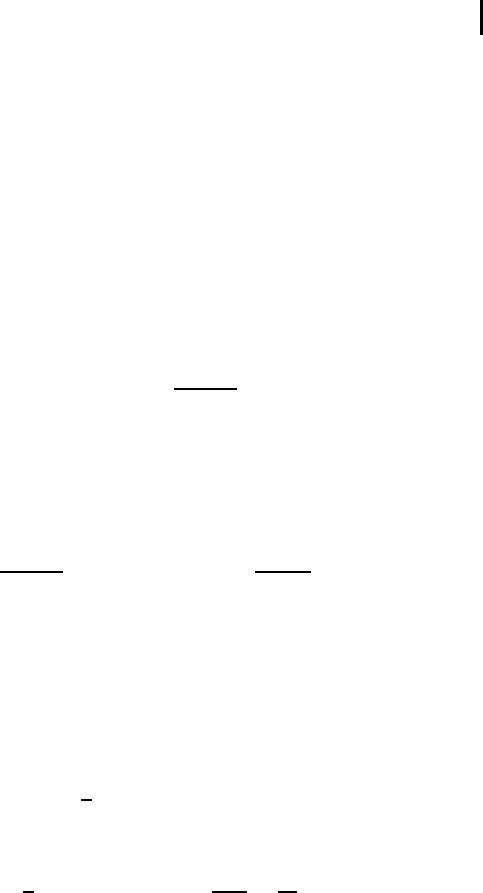
with a force that is found by taking account of (l4.3.11)
F(x)=bM P. V.
a
2
a
1
ρ(ξ) dξ
x − ξ
, (13.3.12)
P.V. means the principal value of the integral. The action of a dislocation on itself
should be excluded.
Externally, the dislocation is acted upon by the force bσ
e
xy
so that in equilibrium
P.V.
a
2
a
1
ρ(ξ) dξ
ξ − x
= ω(x), ω(x)=
σ
e
xy
(x)
M
. (13.3.13)
If the function ω(x) is given, the relation is an integral equation for the equilibrium
distribution ρ(x). It belongs to the type of singular integral equation with a Cauchy
kernel.
In conclusion, we calculate the energy of the elastic field generated by the straight
dislocation in a crystal. The free energy of a dislocation of unit length is given by the
integral
U +
1
2
ε
ik
σ
ik
dx dy. (13.3.14)
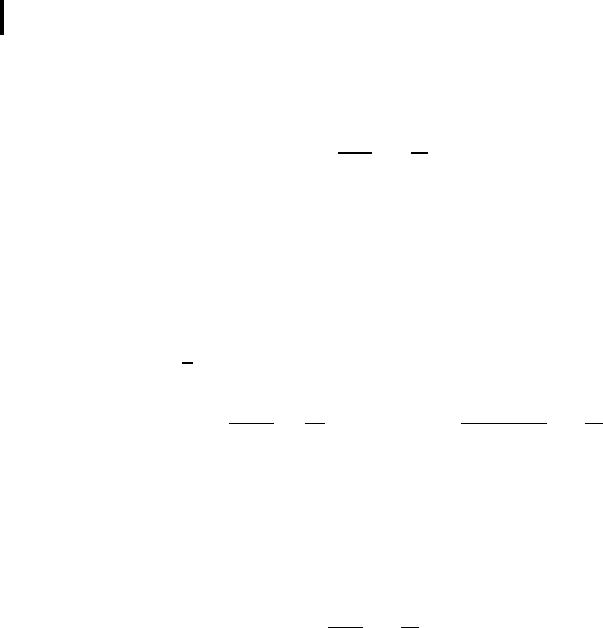
For a screw dislocation the integral (13.3.14) equals
U
scr
=
1
2
2ε
zϕ
σ
zϕ
2πrdr=
Gb
2
4π
dr
r
(13.3.15)
where the integration over r should b e performed within (0, ∞). However, the integral
(13.3.15) diverges logarithmically at both limits. The divergence at r = 0 is connected
with the inapplicability of elasticity theo ry formulae at atomic distances. Therefore, as
the low integration limit we must take the value of r
0
of the order of atomic distances
(r
0
∼ a ∼ b ). Also, we have to omit the energy of the dislocation core U
0
whose
maximum value is easy to estimate. In fact, in a dislocation core with cross sectional
area ∼ b
2
the relative atomic displacement is of the order of unity. Thus,
U
0
∼ Gb
2
. (13.3.16)
308
13 Elastic Field of Dislocations in a Crystal
The upper integration limit (13.3.15) is determined by the quantity R that is of the
order of the dislocation length or crystal dimension. Then,
U
scr
=
Gb
2
4π
log
R
r
0
. (13.3.17)
Comparing (13.3.16), (13.3.7), we see that (13.3.17) determines the main part of the
dislocation energy under the condition log R/r
0
1. The formula (13.3.17) deter-
mines the dislocation energy with logarithmic accuracy.
We note that the scalar field vortex energy is exactly equal to (13.3.17).
For an edge dislocation the integral (13.3.14) equals
U
edg
=
1
2
(ε
rr
σ
rr
+ ε
ϕϕ
σ
ϕϕ
+ 2ε
rϕ
σ
rϕ
)rdrdϕ
= b
2
M
2
1 − ν
G
R
r
0
dr
r
2π
0
sin
2
ϕ dϕ =
Gb
2
4π(1 − ν)
log
R
r
0
.
It is natural that the energy of unit length of an edge dislocation has the same order
of magnitude as the screw dislocation. Moreover, it can be shown (although it is
quite obvious) that for any weakly distorted dislocation line (with radius of curvature
R b) its energy per unit length will have the order of magnitude
U ∼
Gb
2
4π
log
R
r
0
. (13.3.18)
However, it should b e noted that the theoretical “large parameter” log(R/r
0
) is,
in fact, small. Indeed, taking the relatio n R/r
0
∼ 10
5
− 10
6
(and it is often less),
we obtain that ln(R/r
0
) is not different from 4 π. Therefore, for rough estimates the
energy per unit length of an isolated dislocation can be taken approximately equal to
U ≡ Gb
2
. Such an estimate also remains valid for an anisotropic medium .
Analyzing straight dislocation fields, we considered a screw and an edge disloca-
tion separately. This is so because i n an isotropic medium any straight dislocation
with tangent vector τ can be represented as consisting of two independent disloca-
tions: a purely screw dislocation, the displacements around which are parallel to τ,
and a purely edge dislocation, the displacements around which are perpendicular to τ.
It is interesting to know whether the displacement field of a straight dislocation in an
anisotropic medium can be divided into a screw part where all displacements are par-
allel to the dislocation line and an edge part where all displacements are perpendicular
to this line. It turns out that this division is possible if the dislocation line is a two-fold
symmetry axis or if the dislocation line is perpendicular to the crystal symmetry plane.

13.4 The Peierls Model
309
13.4
The Peierls Model
For a quantitative study of the role of c rystal lattice discreteness in a d islocation de-
formation, Peierls (1940) suggested a semi-microscopic model that on the one hand,
takes into account the crystal translation symmetry, and on the other hand allows one
to obtain a direct limiting transition to the elasticity theory results.
We return to (13.3.12) and recall the geometrical meaning of the quantity ρ(x).We
assume that the sh ift generated by dislocations along the slip plane is absent at x = ∞.
By the definition of an edge dislocation the integral
u(x)=
∞
x
ρ(ξ) dξ (13.4.1)
equals the atomic layer displacement at the point x above the slip plane relative to that
under this plane. It follows from (13.4.1) that
ρ(x)=−
du
dx
. (13.4.2)
Thus, knowing the relative crystal displacements on both sides of the slip plane we
can, using (13.4.2), find a corresponding dislocation density.
We now formulate a semi-microscopic model of an edge dislocation. Let nonde-
formed crystal atoms form a simple tetragonal lattice with the constant b along the
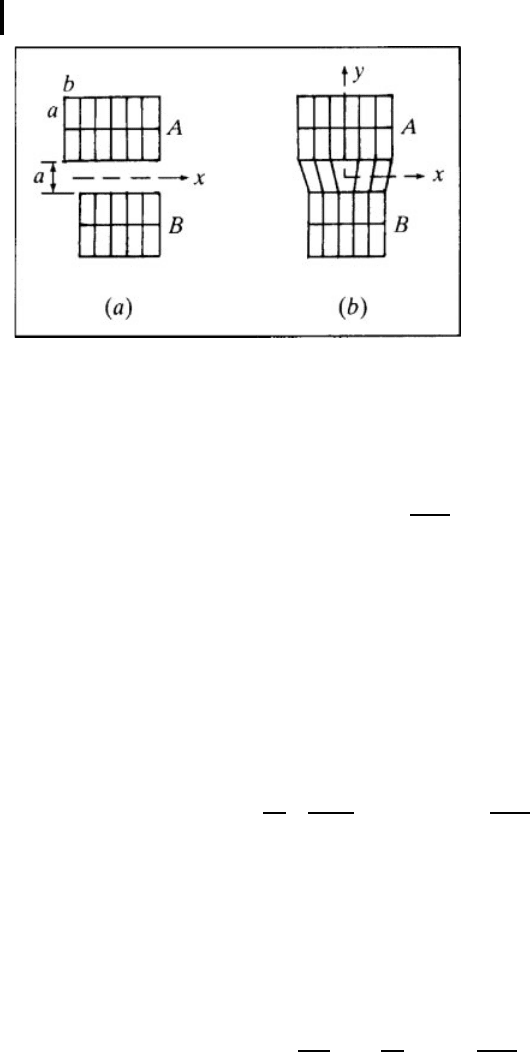
x-axis and the constant a along the y-axis (Fig. 13.5a). We consider two p arts of this
crystal, one of which (A) contains an extra atomic plane compared to the other part
(B). We form a single crystal of these two parts, making the upper and lower parts
come closer at an interatomic distance a and matching the left and right edges of these
parts. To make the latter, with fixed righ t edges of parts A and B, it is necessary to
perform a r elative shift along the x-axis by the value b of their left edges. After join-
ing the two parts of a crystal, the atoms form a single lattice with an edge dislocation
(Fig. 13.5b).
We denote by u(x) the relative displacement of the atoms on two sides of the slip
plane in the direction of the x-axis. At an infinitely large distance from the dislocation,
the lattice should be ideal. This means that
u(∞)=0, u(−∞)=b. (13.4.3)
The function u(x) should have a form qualitatively similar to the plot in Fig. 5.1.
We set u(x
0
)=b/2, i. e., assume the dislocation center to be at the point x = x
0
=
X. For an exact definition of the function u(x) the upper and lower parts of a crystal
can be regarded as two continuous elastic solids. However, the tangential stress in the
slip plane (in a plane where elastic half-spaces link) that prevents the deformation is
treated as a periodic function of the local relative displacement u(x) with period b.
310
13 Elastic Field of Dislocations in a Crystal
Fig. 13.5 A scheme of the formation of a monocrystal with an edge
dislocation: (
a
) crystal part A contains an extra atomic plane. (
b
)Parts
A and B are combined in a monocrystal with a dislocation.
Peierls chooses a simple periodic dependence, namely
σ
P
xy
(x)=µ
1
sin
2π
u(x)
b
, (13.4.4)
where the coefficient µ
1
has the order of magnitude of crystal elastic moduli. The
procedure determining it will be indicated below.
The local stresses (13.4.4) should be coincident with the macroscopic stresses gen-
erated by an inhomogeneous distribution of the displacement u(x) along the slip
plane. We have already seen that an inhomogeneous relative displacement u (x) is
equivalent to a set of edge dislocations with the density (13.4.2) and, hence, it causes
the shear stresses (13.3.12). Substituting (13.4.4) into (13.3.12 ) and equating the result
to σ
P
xy
, we get a singular integral equation for u(x):
M P. V.
∞
−∞
du
dξ
dξ
x −ξ
= −µ
1
sin
2π
u(x)
b
. (13.4.5)
The solutions to (13.4.5) should have the property (13.4.3).
First, we shall find the relation between the coefficient µ
1
and the crystal elastic
moduli. It is clear that far from the dislocation core (x b), where the displacements
u(x) are small, the solution to (13.4.5) should coincide with the known solution of
elasticity theory if we take u
yx
= u/a. It follows from (13.4.5) that for x → ∞ when
u b,
2πµ
1
u(x)=
Mb
x
∞
−∞
du
dξ
dξ ≡
Mb
2
x
. (13.4.6)
We now calculate the derivative ∂u
x
/∂y using (13.3.5) for x → ∞ and compare
it with (13.4.6). We get µ
1
= bG /πa(3 − 2ν) . Thus, the Peierls equation takes the
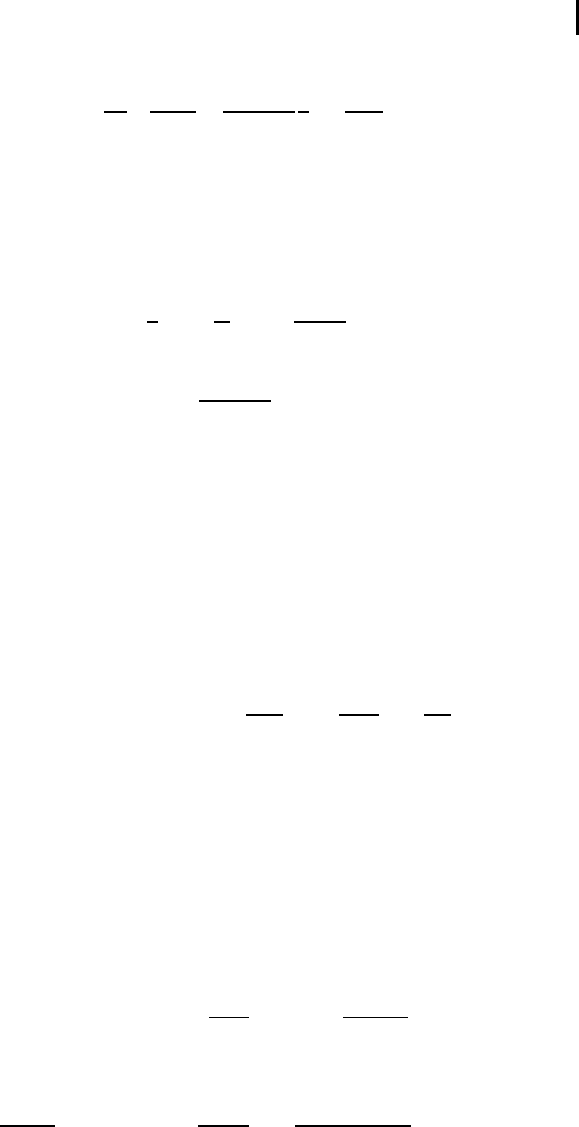
13.4 The Peierls Model
311
form
P.V.
∞
−∞
du
dξ
dξ
x −ξ
+
2(1 − ν)
3 −2ν
b
a
sin
2πu
b
= 0. (13.4.7)
A very important property of (13.4.7) that distinguishes it from the Frenkel–Kontorova
equation f or dislocations in a 1D crystal is the very slow variation o f the quantity u(x)
with distance x. While in a 1D crystal the decay of u(x) as x → ∞ is exponential, the
solution to (13.4.7) decreases as a hyperbolic law (13.4.6). The solution corresponding
to the conditions (13.4.3) is
u(x)=
b
2
1 −
2
π
arctan
x − X
l
, (13.4.8)
where
l =
3 −2ν
4(1 − ν)
a. (13.4.9)
The quantity l may conventionally be called a dislocation half-width. This notation
is tentative, because the displacement u(x) varies more slowly in space, which leads
to the dislocation width being dependent on a specific form of the periodic function
in (13.4.7). In the isotropic approximation the dislocation half-width depending on
Poisson’s ratio can range from l =(3/4a) (for ν = 0 )tol = a (for ν = 1/2).
The Peierls model allows one to estimate the critical stress necessary to displace
the dislocation in the slip plane. This was made by Nabarro (1947) using the follow-
ing considerations. The stress σ
P
xy
corresponds to the following potential energy per
interval b of the x-axis
U(x)=−b
u(x)
0
σ
P
xy
du = −bµ
1
u(x)
0
sin
2πu
b
du =
µ
1
b
2
π
sin
2
πu
b
. (13.4.10)
We now take into account the discrete structure of a slip plane and associate each
atomic layer with the coordinate
x = x
n
≡ nb, n = 0, ±1, ±2,..., (13.4.11)
choosing the layer numeration origin in the vicinity of the d islocation center. If we
now substitute a discrete coordinate (13.4.11) into (13.4.10), then we obtain the n-th
atomic layer energy in a lattice distorted b y the presence of a dislocation . Hence, th e
dislocation energy related to local stresses along the slip plane is equal to
E =
∞
∑
n=−∞
U(x
n
)=
µ
1
b
2
π
∞
∑
n=−∞
sin
2
πu(x
n
)
b
. (13.4.12)
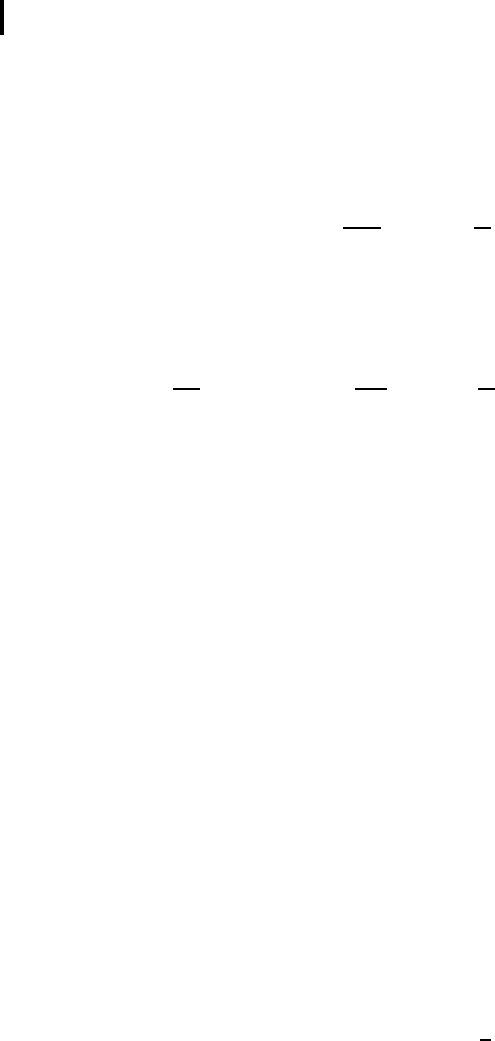
Using the explicit form of (13.4.8) for the function u(x), it is easy to obtain
sin
2
πu(x)
b
= cos
2
arctan
x − X
l
=
l
2
(x − X)
2
+ l
2
. (13.4.13)
312
13 Elastic Field of Dislocations in a Crystal
We recall that X is the dislocation center coordina te that is an indep e ndent character-
istic of the dislocation and noncoincident in general with the coordinate of any atomic
layer.
Finally, we substitute (13.4.13) into (13.4.12) using the Poisson summation formula
and obtain as a main approximation with regard to the small parameter b/(2πl) 1:
E = µ
1
b
2
+ 2µ
1
b
2
exp
−
2πλ
b
cos
2π
X
b
. (13.4.14)
It is clear that the dislocation energy is a periodic function of the coordinate of its
center. Differentiating (13.4.14) with respect to the co ordinate X,wefindtheforce
acting on a dislocation in the crystal:
F = −
∂E
∂X
= 4πµ
1
b exp
−
2πl
b
sin
2π
X
b
. (13.4.15)
The formula (13.4.15) determines a Peierls force. The maximum value of this force
F
m
determines th e shear stresses σ
s
= F
m
/b to be applied to a crystal for the dislo-
cation to begin moving in the slip plane. To evaluate σ
s
,wesetl = a and a = b.It
appears then that σ
s
∼ 2πµ
1
10
−2
∼ 10
−2
G.Ifa =(3/2)b,thenσ
s
∼ 10
−4
G.Just
these limiting values are generally given in analyzing dislocation glide.
13.5
Dislocation Field in a Sample of Finite Dimensions
Point-defect fields decrease slowly with distance. Thus, analyzing the fields of elastic
point defects (Section 9) it is necessary to consider the effects associated with the
presence of free external crystal surfaces. But dislocation fields decrease with distance
even slower. Therefore, the finite dimensions of a crystal can result in effects that,
when disregarded, could distort the result of solving dislocation problems.
As an example we consider a screw dislocation positioned along the axis of a spec-
imen of finite dimensions having the form of a cylinder of radius R. Let the cylinder
length L be much larger then the radius (L R), then it is possible to exclude from
our discussion a stress distribution near the cylinder ends. The stresses (13.3.3) result-
ing from (13.3.1) satisfy the boundary conditions σ
rr
= σ
rz
= σ
rϕ
= 0 on a free side
surface of a specimen r = R. But these stresses generate a nonzero twisting moment
on cylinder ends
M
0
z
=
rσ
zϕ
dS = 2π
R
0
σ
zϕ
r
2
dr =
1
2
GbR
2
. (13.5.1)
Thus, if the cylinder ends are free the solution (13.3.3) does not satisfy the boundary
conditions on the faces (even if the latter are infinitely distant). Thus, the true solution